27 May 2014

Preaching Proverbs 6 — getting in shape to preach (#4)

by Dan Phillips

Structure. Scary. Though I've read and loved Proverbs since before many of you were born, the shape of chapters 1—9 remained a thing of mystery and terror to me. That may be an exaggeration, but it isn't much of a one.

Obviously, I could tell (and wrote about the fact!) that those chapters stood off from the rest of the book. They were longer, they were discourses of multiple verses, whereas "Proverbs of Solomon" at 10:1a signals the beginning of largely one-verse proverbs of two lines each. That much was plain.

Ah, but how many discourses? Where did they actually start and stop? Could you tell? Was there any progression from one to the other, or was it just a series of random sections? I mean, just look at 1:8ff. That's pretty clearly its own section... and then v. 20 signals a change. And then most of the chapters have discourses of at least some length to them.

But then you get to chapter 6. Just look at it.


Proverbs 6: Rollicking randomness? Starts off talking to "My son" (v. 1), so that's promising. And it's about going surety, whatever that is. It goes along and then... whoops! Now we're suddenly talking to the sluggard (v. 6). No transition, just five short verses then bam! And along we go ragging on the sluggard, and then whoops! again, we're musing aloud about a worthless person (v. 12), which we do for awhile until whoops! now we're listing off six seven things Yahweh really hates. And then another more standard discourse begins in v. 20 and seems to sweep on to the chapter's end.

So what's that all about? Is it just five unconnected sections? Fewer, more? See, you have to decide this before you teach or preach it, or you just can't, you don't know how — because you haven't seen what Solomon was doing. If you don't see what Solomon was doing, you don't see what God was doing, and you're not ready to preach or teach it.

As an aside, I'd wager this is a reason why more don't preach Proverbs. These aren't easy questions to answer with confidence, and the literature is only sometimes helpful. That is, the academics don't write for preachers, and the preachers (tend to) lack the necessary chops to answer these questions competently.

Getting under the hood. So I dove in hammer and tongs, making my own observations and ransacking others'. As I've taken to doing, I created files just on this issue — the shape of Proverbs 6. My file on that is 19 single-spaced pages in Word, and contains a number of tables and illustrations. It wasn't a cakewalk.

For starters, it was pretty clear that vv. 20-35 hung together as a self-contained, complete discourse. Whew. But what of vv. 1-19? Here were my first impressions.
Chapter 6, at least initially, looks like five little pericopes:
1.      Verses 1-5 — Surety [addressed to "my son," vv. 1, 3]
2.      Verses 6-11 — Sloth [addressed to the sluggard, vv. 6, 9]
3.      Verses 12-15 — Scamming [addressed to no one]
4.      Verses 16-19 — Seven abominations [addressed to no one]
5.      Verses 20-35 — Shun adultery [addressed to "my son," v. 20]

OK, I liked that I'd come up with five "S" summaries. That was... well... sweet. Any preacher would love that. But were they really completely separate? The commentators — those who even wrestle with shape — were all over the map. How to decide?

Is it getting hotter in here? Well, when you start looking at it more closely, you do start to notice a progression and cohesion in the first 19 verses. How? Well, as I note above, the first section is addressed to "My son," which is close, it is intimate. The second section is also addressed, but this time it is to the "sluggard." That's not so intimate! It isn't as bad as a fool or a scoffer, for whom there is little or no hope respectively. But it's still an address.

And then the third section is addressed to no one. It is a deeper level of condemnation, of contempt. In the first two, Solomon is speaking-to; in this, he is speaking-about. There's a progressive distancing. Now, this is classically Proverbial. Very often Line B is an escalation of Line A. So it doesn't surprise to see an escalation as the sections progress.
Indeed, on further reflection you see the sense in this. In the first section (vv. 1-5), the son has made a bad decision in one area of his life which will come back to bite him. It may have been good-hearted, meant to help someone else, but still it is risky and foolish. So Solomon urges him to do what he needs to do to get out of it honorably, right away. If it goes wrong, it means financial ruin. Then in the second section (vv. 6-11), it is the sluggard, and he's making bad decisions in many areas of his life. He is thinking of no one else; he's not even thinking of his own future. He's dumber than a bug! One day, he'll find his ability to choose all-gone, as the armed man puts a sword to his chin and takes away all his freedom.

So the first is bad, and the second is worse. Will this continue to the third (vv. 12-15)? Indeed it does. Solomon signals this by not even deigning to speak to this man; he speaks only of him. And what a wreck he is: he's wicked and he's worthless. He sins against God in six different ways, involving his mouth, his eyes, his feet, his finger, his heart. Whereas the son who's gone surety may face financial ruin, and the sluggard utter destitution, this man will be irreparably broken and ruined.

So now you're seeing that indeed the sections are related, they do hang together, and in a classically Solomonic way. The first paints a bad portrait, the second worse, and the third is worst of all.

Four? or three? Or is it? Must we confine it to vv. 12-15? Then what of vv. 16-19? That would be awkward: the first fifteen verses hang together, the last sixteen verses hang together, but between them are just four random verses?

So we look closer, and ponder further. We notice that the first section (vv. 1-5) is five verses long, and the second (vv. 6-11) is six verses long. This is a progression. But then, if it stands alone, the third steps back and is only four verses long (vv. 12-15). Moses doesn't have a law against it, but it does seem anticlimactic. So what if we join vv, 16-19 to vv. 12-15? Then the third section becomes eight verses long, which is a fitting climax to the progression.

Yet at first blush, the two sections don't seem to cohere. There's a musing-aloud about the worthless man (vv. 12-15), and then there's a list of six seven things Yahweh hates? Sure looks like two lists.

But look again. How many horrid crimes are charged to the worthless man? From my translation:
  1. Walks with a twisted mouth,
  2. Winks with his eyes
  3. Signals with his foot
  4. Points with his fingers
  5. With perversities in his heart/Devises evil at all times
  6. He spreads conflicts.
Why, that's six things. And in the next section, how many things does Yahweh hate?

Seven.

Okay then, that is progression. And there's more. There's a conceptual hinge, right in the middle. The last verse of the first section (v. 15) promises judgment on this man, but does not explicitly say that it is Yahweh who will bring that judgment. Then in a mirror image, the first verse of the next section (v. 16) reveals that Yahweh condemns certain traits — but does not explicitly say that He will bring judgment on these people. That hinge connects the two sections, pairs them.

One other thing. In the first section the "son" is addressed twice. In the second, the "sluggard" is addressed twice. Doesn't it make sense for Solomon to take two passes at describing what Yahweh really finds unbearably noxious, in the climactic section?

Catchy. There are also indicators in Hebrew that show the sections as relating, the use of catchwords (forms of the same word, or synonyms). Steinmann lists them out, as does Waltke. Hoping it's of some use to you, here's a color-coding I did based on my translation, trying to illustrate the catch-words which, you'll notice, run throughout the sections:

6:1  My son, if you guaranteed debt for your neighbor,
If you struck your 
palm for a stranger,
6:2  You have been snared by the sayings of your mouth,
You have been trapped by the sayings of your 
mouth.
6:3  So do this, my son, and deliver yourself —
For you have 
come into the palm of your neighbor:Go, grovel, and pester your neighbors!
6:4  Do not give sleep to your eyes,
Or 
slumber to your eyelids;
6:5  Deliver yourself as a gazelle from the hand,
As a bird from the 
hand of the fowler.
6:6  Go to the ant, sluggard;
See her ways, and become wise.
6:7  Who, though she is without leader,
Administrator, or ruler,
6:8  Readies, in the summer, her bread,
Gathers, in the harvest, her food.
6:9  Until when, sluggard, will you lie there?
When will you rise from your 
sleep?
6:10  “A little sleep, a little slumber,
A little folding of the 
hands to lie down….”
6:11  Then comes, like a vagabond, your poverty,
And your lack like an armed man!
6:12  A worthless person, an abusive man,
Is he who 
walks with a twisted mouth,
6:13  Winks with his eyes, signals with his foot,
Points with his fingers,
6:14  With perversities in his heart
Devises evil at all times.
He 
spreads conflicts.
6:15  Therefore suddenly comes his calamity,
Instantly he is broken,
      And with no healing.
6:16  Six things they are, Yahweh hates —
 in fact, seven are abominations to His soul.
6:17  Haughty eyes,
deceptive tongue,
And 
hands shedding innocent blood;
6:18  A heart devising abusive plans,Feet hastening to run to evil,
6:19  A deceptive witness who breathes out lies,
And one 
spreading conflicts between brothers. [DJP]

Now let's preach! So I ended up seeing that I should preach this as a progressive series of portraits of folly, each worse than the other. I titled the sermons thus:

Dumb: Financial Folly
Dumber: Squandered Treasures (My dear wife really liked this one. Just sayin')
Dumbest: Antagonizing God

So, what of the final section (vv. 20-35)? Does it relate? Should we do as Ortlund does, lump it with chapter 7 as being about immorality?

Next time, DV.

This way to the fifth and final post

Previously:
First post: Introduction and Overview:
Second post: Getting Started
Third post: Commentaries

Dan Phillips's signature


25 May 2014

The Golden Rule

Your weekly dose of Spurgeon
The PyroManiacs devote some space each weekend to highlights from the lifetime of works from the Prince of Preachers, Charles Haddon Spurgeon.  The following excerpt is from The Gospel of the Kingdom, page 43, Pilgrim Publications.
Therefore all things whatsoever ye would that men should do to you, do ye even so to them: for this is the law and the prophets. Matthew 7:12

In this place our King gives us HIS GOLDEN RULE. Put yourself in another’s place, and then act to him as you would wish him to act towards you under the same circumstances. This is a right royal rule, a precept always at hand, always applicable, always right.

Here you may be a judge, and yet not be judging others, but judging for others. This is the sum of the Decalogue, the Pentateuch, and the whole sacred Word.

Oh, that all men acted on it, and then there would be no slavery, no war, no sweating, no striking, no lying, no robbing; but all would be justice and love! What a kingdom is this which has such a law!

This is The Code Christian. This is the condensation of all that is right and generous. We adore the King out of whose mouth and heart such a law could flow. This one rule is a proof of the divinity of our holy religion.

The universal practice of it by all who call themselves Christians would carry conviction to Jew, Turk, and infidel, with greater speed and certainty than all the apologies and arguments which the wit or piety of men could produce.

Lord, teach it to me! Write it on the fleshy tablets of my renewed heart! Write it out in full in my life!


23 May 2014

Preaching Proverbs 6 — commentaries (#3)

by Dan Phillips

As I am working through preaching Proverbs, here are some of my friends, with their level of trust and value:

BFF
(Best Friends Forever — Lifesavers)
Derek Kidner. For what it is, this is a remarkably valuable volume. Kidner is a wonderful writer, very insightful. Fight your first impression, which would be to dismiss the book as too brief to be of any use. Kidner has Solomon's own knack for saying a great deal in a very few words. He supplements the verse-by-verse comments with his very fine subject-studies ("God and man," "Wisdom," "The Fool," etc.), and often refers to the latter from the former.

Even Kidner's titles for the sections and verses, apart from any commentary, can help head a reader in the right direction. He titles chapter 7 "Simpleton and seductress," breaking it down to prologue (vv. 1-5), drama (vv. 6-23), and epilogue (vv. 24-27). "The obedient and the opinionated" is 10:8; "Nothing to hide, nothing to fear" is 10:9; "Mischief sooner made than mended" is 10:10 — and on it goes. My biggest gripe: I wish the volume were five times as long, allowing Kidner to go into greater depth.

Bruce Waltke. Need I explain? This 2-volume NICOT set (vol 1vol 2) from the dean of evangelical OT theologians is a monument to decades of fruitful writing and thought on this subject. When I wrote my Master's thesis on Proverbs in 1983, Waltke's Bibliotheca Sacra articles were cutting-edge for believing scholarly thought, in putting Proverbs back into its canonical setting where it belongs. Now Waltke has developed the mature fruit of his thought and research into this massive 2-volume work.

This is not to say I agree with every word or conclusion. Anyone who knows Waltke much knows that he's a puzzle, a conundrum. Very conservative this minute, what-the-heck-were-you-thinking?! the next. For instance, Waltke acknowledges that no version or manuscript omits Proverbs 8:11 — yet he rejects it because it doesn't fit his view of the structure. So confident is Waltke of his view, in the face of all textual evidence, that he does not even bother to translate it!

Perhaps this explains why I write of Waltke with both the deepest of respect and even affection, and the deepest of bafflement.

Despite that and other peculiarities (Waltke's rationalization for using "LORD" instead of Yahweh will make your brain itch), the overall value of the work is immense. Waltke is particularly helpful in analyzing the borders and shape of a section — the very issues I broached in the previous post. Waltke is very attentive to catchwords and phrases, inclusios, and other devices by which Solomon reveals his mental topography. He'll comment on word-meaning, syntax, variant readings, and even Hebrew accents, as well as relating it to the revelation of the Bible as a whole. He's an in-depth preacher's best friend, and he'll be in use for years and years.

Andrew SteinmannI bet even the better-read of you are saying "Who?" It's a pity, but Steinmann is not as well-known in our circles as he deserves. I "met" Steinmann while researching and writing my book, as the Bibliography reflects, for his thoroughly-scholarly and thoroughly-believing work on the authorship of Proverbs.

This is a terrific book, written from a thoroughly Bible-affirming perspective. Steinmann provides his own translation, with detailed notes on etymology, syntax, and textual issues. After that comes his commentary, which is actually illustrated with interpretive graphics in the margin. Steinmann puts the whole book under the law/grace template, which sometimes gives the impressions that they are the Proverbs of Paul, not of Solomon. He defends at length the reading of Proverbs 8 as being about Jesus Christ, period, end of story. On the theological spectrum of Bible-reading, from over-segmentation to over-flattening, Steinmann definitely is in the latter field.

That said, I highly recommend his commentary, and refer to it without fail, constantly and closely.

BFWF
(Best Friends With a Flag)
Michael V. Fox. This two-volume Anchor Bible set is another absolute must-have for in-depth preachers, though clearly his view of Scripture is not ours. That said, Fox is a respectful, exhaustive, close and invaluable reader of the details of the text. He has a great sensitivity to the shape of Proverbs, as well as the terms and grammar. His mature and deep knowledge of Biblical Hebrew helps a lot both in translation and in interpretation. Invaluable. So glad Logos finally got the rights to it, after I'd used my hard-copy for for some time.

Richard J. Clifford. This book surprised me, given the publisher and series. Apart from difference in theological perspective, I would compare this favorably with Kidner. Clifford jams an immense amount of helpful material into a relatively very small volume. He does provides his own translation, with notes on issues of translation or text. Clifford often detects and helps with the shape and flow of the text. I make constant use of him. As a Jesuit, Clifford doesn't affirm inerrancy, and that does sometimes affect his handling of the text...but not nearly as much as one would anticipate.

Raymond VanLeeuwen. It's a drag to have to buy a whole volume of which I'll probably only ever use this part — but I got it used (still relatively pricey), and it's worth it. Also not from the view of Scripture I hold, but of the newer school that is more respectful of and attentive to the text as it stands, and its theology. Many useful insights.

Franz Delitzsch. What a brilliant scholar, Delitzsch was: faithful, deep, very attentive to the text in all its details. Usefulness is only decreased due to its age, but still worth consulting.

GF
(Good Friends)
John KitchenSee my review here. My complaint about the editor's disinterest in larger outlines particularly affects my use of the commentary on chapters 1—9, in which I don't find the help I look for in planning or shaping my preaching. Having said that, what Clifford and Fox lack in terms of reverence for the text as God's inerrant Word, Kitchen has in abundance. Kitchen clearly loves the text as the word of God, and gives attention to each word as inspired. Kitchen's a preacher, and I wish the editors would contract a second edition incorporating these suggestions.

Peter A. Steveson. Here's another useful resource that I would wager that few of you have heard of. This is from Bob Jones University Press, and it's quite good. Though Steveson's own baseline is the KJV, he constantly and competently deals with the Hebrew text. Where others reach quickly for textual emendations (even Waltke!), Steveson rarely does, which is helpful. Solid material, quite useful. Steveson's strength as a rule is his commentary on individual verses, rather than in discerning shapes and outlines; there, Waltke, Fox, Clifford and others shine. In fact, Steveson seldom does outlines. However, when I prepared to preach Proverbs 8, Steveson's outline seemed to flow with the text better than the those of the more scholarly volumes I consult, and I ended up adapting it to use as my own.


Raymond C. Ortlund, Jr. I have only used this in the first seven chapters thus far, and have been helped a number of times. As the series-title suggests ("Preaching the Word"), Ortlund's focus is on proclaiming the text. He's very readable, there's the sense of attentive reading of the Hebrew text underneath what he writes, but he processes it into a very positive, Gospel-oriented form for preaching. Ortlund has often pointed out perspectives I hadn't thought of, and that's always valuable. For instance, his passage on usury (Prov. 6:1-5) was among the most helpful I read.

However (as I'll develop in this series of posts), like all of us Ortlund can miss the ten-ring. For instance, I think he does so when he lumps together Proverbs 6:20—7:27 as if it were simply about sexuality. Then, once he finishes his thoughts on chapter 9, Ortlund falls to seven chapters of subject study, rather than any attempt at consecutive preaching or exposition. Thus, the written for men preaching through all of Proverbs has yet to be written. Also, chapter 17 is titled Family and keyed to 22:6, but there is no real exposition of that verse. Readers of my book will know that this skates over some fairly serious issues.

I do recommend Ortlund heartily for preachers and teachers going through chapters 1 through 9, it is immensely helpful. Regrettably, Crossway insults and disserves the reader by removing all of Ortlund's footnotes to endnotes.

Charles BridgesYou'll get no help here with Hebrew or any scholarly developments within the last couple of centuries. However, you will get a Puritanical (— used as a compliment) blossom of some fragrance. Bridges cares nothing for Hebrew or inclusios or chiasms or parallelism, but he is constantly mining Scripture itself for examples and illustrations of what Solomon is commending or warning against. Personally edifying, and helpful for preaching.

Otto Zöckler. From Lange's. Dated, but useful, with preaching tips.

CA
(Cordial Acquaintances)
Duane Garrett. When he's useful, Garrett can be very useful...but that's the case far less often than one would wish. I just have to say candidly (particularly after chapter 9) that I am far more often disappointed when I go to Garrett for help, than not. He has a good conservative introduction to the book, and believes it to be God's Word; but his comments are far too brief and notional as a rule, and he's a bit fonder of emendations than I'm comfortable with.

Paul Koptak. The NIV Application commentary format makes for a bit more wordiness than is most useful to me, but Koptak does occasionally offer helpful comments on translation and shape — though not enough yet (in my use) to put him in the reach-for-first list.

Tremper Longmann III. Reviewed here.

TAE
(These Also Exist)
Roland MurphyMost Disappointing Commentary Ever? Ronald Youngblood (who actually believes in the Bible) had been contracted to write this volume in the Word series, and was going to incorporate my thesis... but for some reason that fell through, and the assignment went to Roman Catholic priest and OT writer Murphy. I've wondered ever since: Why? Murphy has some Hebrew chops, but shows very little interest in Proverbs. His work seems dutiful and shallow, phoned-in, showing a tin-ear to Solomon's theology and thought. I look at it to broaden my scope, but it's very seldom of any real use to me.

Crawford H. Toy. Old ICC volume. I love the series layout and thoroughness, and really wish they'd assigned Proverbs to some scholar who actually believed the self-witness of Scripture in general, and of Proverbs in particular. Toy is liberal, ridiculously so sometimes, and disrespectful of the text. Can give helpful syntactical and even sometimes etymological help, and on very rare occasion even interpretive help. But if you're simply a preacher or on a short budget, this is not a must-have.

Allen P. Ross. Very disappointing. This is in the Expositor's Bible series, and simply does not get into the text with any depth or insight. I look at it frequently, yet virtually never am helped by it.


This way to the next (fourth) post.

Previously:
First post
Second post

Dan Phillips's signature


22 May 2014

Sufficient Fire and Church Membership

by Frank Turk


From 2006 to 2012, PyroManiacs turned out almost-daily updates from the Post-Evangelical wasteland -- usually to the fear and loathing of more-polite and more-irenic bloggers and readers. The results lurk in the archives of this blog in spite of the hope of many that Google will "accidentally" swallow these words and pictures whole.

This feature enters the murky depths of the archives to fish out the classic hits from the golden age of internet drubbings.


The following excerpt was written by Frank back in June 2007. Frank reiterated and reinforced several points from multiple posts on the topics "How to read your Bible" and "Should I quit my church?"


As usual, the comments are closed.
We may not have Apostles among us, but we have Scripture. We have their witness. We have their testimony. And this testimony is all things which we need to grasp Jesus Christ and be what He has called us to be.

We are not smarter than Paul. We are beggars before the wisdom which Paul was given – we do not grasp what he wrote and taught, so we do not do the things Paul (or Peter, or the Evangels, or James, or the others) was exhorting the believers to do.

If we think Paul didn’t know all the errors we face, maybe we ought to go back and look at who and what Paul was talking about as he wrote his letters to the various churches.

In Romans, Paul decries legalism, libertinism, pride, racism, and anarchy – and he was writing to people whom he longed to see, and thought highly of in terms of the faith.

In 1 & 2 Corinthians, Paul decries exalting teachers, intellectual and spiritual pride, lax church discipline, sexual immorality, material squabbling, seeking recourse in secular venues outside of the church, false views of marriage, both idolatry and being a slave to the fear of idolatry, false views about Christian liberty, abuse of the Lord's Table, abuse of common worship in the demonstration of spiritual gifts, false views of the Gospel, church discipline which does not aim to redeem but seeks only to punish, the fear of death, stingy giving, and interestingly those who think they know more than the Apostles do about the Gospel, Christ and the church. His view of what to do about false teachers is especially useful if you care to review it in 2 Cor 10 & 11. And these were people whom he himself established in the faith – people who literally got it from the bondservant's mouth.

In Galatians, Paul decries adding works to the Gospel, and showing partiality based on observances, and rejects circumcision as necessary, and underscores the necessity of unity under truth in the church – in spite of the fact that he had to defy Peter to his face to do it! He didn’t say, "and I never set foot in any house with Peter ever again." You know: Peter who got the vision from God, "take and eat"? Nobody abandoning the Galatian church in spite of that.

In Ephesians, Paul expresses the fully-orbed Gospel and uses it to say, "I therefore, a prisoner for the Lord, urge you to walk in a manner worthy of the calling to which you have been called, with all humility and gentleness, with patience, bearing with one another in love, eager to maintain the unity of the Spirit in the bond of peace." And leaps off from there to exhort to personal holiness, submission to each other, the true nature of marriage and the roles of husband and wife, the roles in family and society, and the method by which we are girded up against the temptations of the world.

See: the foundational premise of Scripture is not that we should read it. The foundational premise of Scripture is that it is sufficient for our equipping; reading is a consequence of sufficiency. And the equipment in Scripture says that the church is necessary and that this is the place where we first and foremost stand for the truth of the Gospel, and in standing for truth we stand together.

If you are holed up in your study in your robe reading and writing blogs, but you can't find a church that suits you, you are not standing on the sufficiency of Scripture: you are sitting in your robe. If Scripture is sufficient to tell you that Your Best Life Now is a fraud and that no pastor should emulate it to his congregation, it is also sufficient to tell you – and let me make it clear that I mean you personallyyou the one who is unable to find one believer over whom you do not have parental authority over with which to fellowship -- that you belong joined together with other believers in a visible and social way which demonstrates the glory of God to the world.

21 May 2014

God in our Real Life

by Frank Turk

Well.  Hello.

This is not the end of my hiatus.  It's sort of an update.

This last weekend, I was tasked to teach in Adult Equipping Hour from Jeremiah 25.  In doing that, I was tasked to talk about the Wrath of God.  You can hear the results in the link above.  Apologies to DJP for switching in that lesson between "Jehovah" and "Yahweh" when the text said "LORD;" you know that I know your preference there, and since I agree with it I reverted to form as the lesson unfolded.  I also apologize for butchering the names in 2 Cr 34.

However, it occurred to me in writing that lesson and thinking about it after teaching it, that if God is who He is, we have to deal with the wrath of God in our real life as Christians in a way more than affirming it as a theological category.

Is there still something called "the Wrath of God" evident in the world?

What does it have to do with people in general, but especially for those of us who are believers in YHVH and therefore in Jesus?

Do we diminish Grace at all by admitting that there is a wrath of God which ought to be respected and feared?

Can we make any sense at all out of Grace if the wrath of God is not in our vocabulary?

Why ask these questions today?

Discuss as you see fit.


20 May 2014

Preaching Proverbs 6 — getting started (#2)

by Dan Phillips

As I continue walking you through a lab in preaching Proverbs, using chapter 6 as an example, I'm assuming you've worked through the basics as to the specific challenge and resource that is the book of Proverbs. Otherwise, to take you through all that, I'd have to write a whole book. Oh, hang on just a minute...

So we've got in place who wrote Proverbs, what difference it makes, how the book is shaped, what the book is about, and how to approach proverbs.  All that is absolutely essential, for starters.

The next step is translating Proverbs. If you're a pastor and you don't read Hebrew, I'd urge you to get started in learning it. For this, I'll assume that you've learned it and, since your job is to teach the Bible and 2/3 of it is in Hebrew, you use it all the time.

So here BibleWorks is (as always) my best friend. As I've shown you in the past, its Notes editor is simply a Godsend to me, and it's in constant use as I prepare sermons.  I can't imagine doing what I do, without BibleWorks.

So what I literally do in Proverbs is transfer every word to Notes, and break it up so I can make notes on the words. I begin with each word getting its own slot, though that will occasionally be supplemented by phrases deserving a note. Here's a screen shot from Proverbs 7:7, which was then in the planning-stages for a coming sermon:


You'll notice that my working translation is at the top, then some initial observations, then the lexical entries start. I do a search on each word's use in Proverbs; if it's already been worked on, I refer to those places. I'll also keep an eye for Solomon's abundant artistic flourishes, like the sound-play noted in red ink (aBINah BABBANIm). Of course, such observations often don't end up in the sermon, but they feed me, and if I ever write a commentary or lecture at seminary, they'll likely show up there.

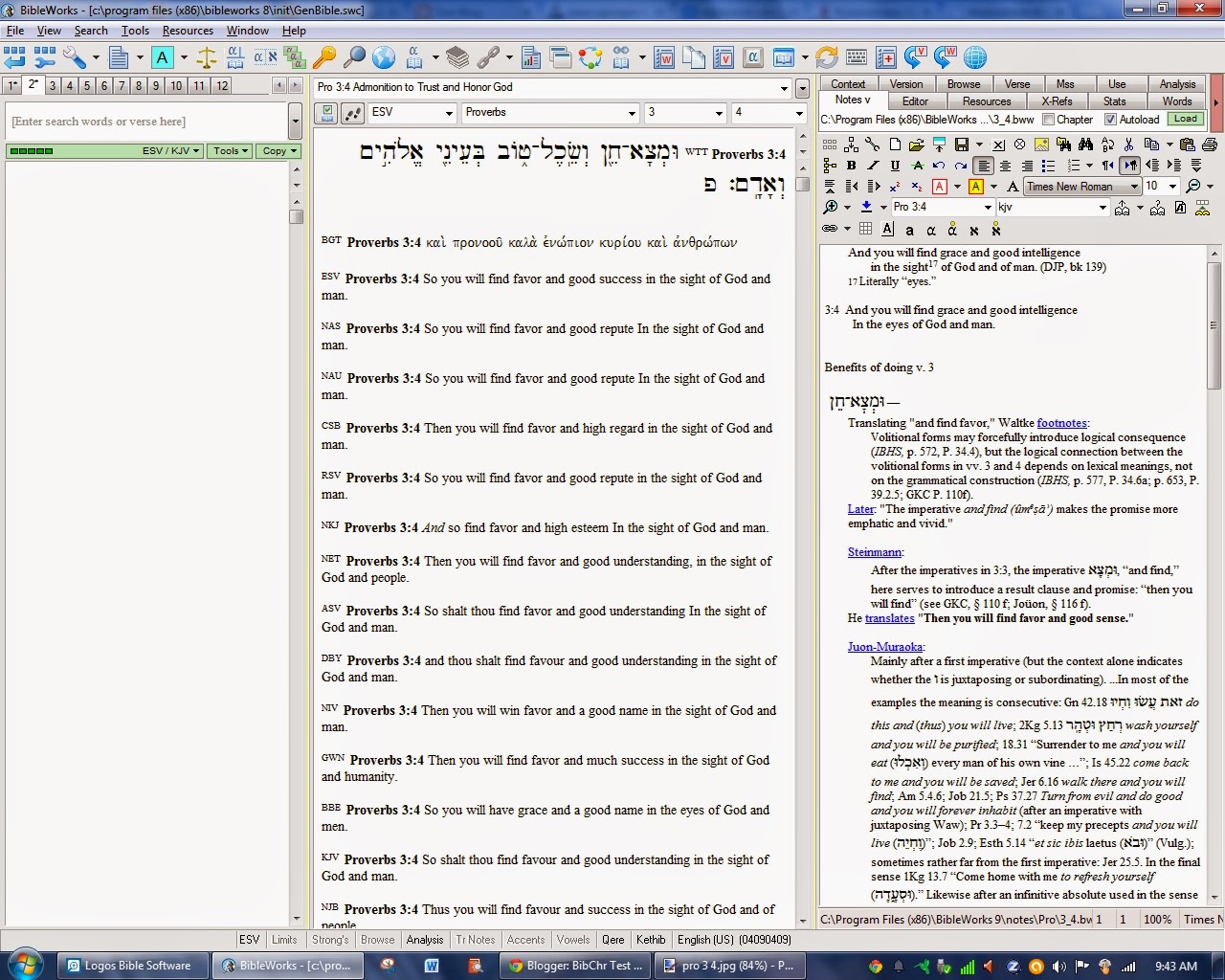
Again, here's a "finished" one from Proverbs 3:4, showing what it ends up looking like:


At the top is the verse as rendered in my Proverbs book; the next is the version I ended up using in preaching, with a minor change. Then I note the opening phrase and-find-grace, with material from commenters Waltke and Steinmann, and grammar. The hyperlinks are to the resources in Logos.

So I do lexical searches within Proverbs, and usually in the larger Canon as well. Then I refer to the lexical authorities such as BDBHALOTTLOTTWOT, and NIDOTTE, as well as any of a dozen or so grammars, including Waltke-O'ConnorJoüonGKCDavidson (latter two = old, but still useful) and others, and copy info with links lavishly. My design is to end up with a little study-center in the Notes of BibleWorks.

All through this process, I'm noting words that are repeated within the section or chapter. Often, these are excellent clues as to how the chapter lays out or what it's about. This is just one of those places where Hebrew is essential, since English versions sometimes obscure connections (and, regularly, chiasms) by using different words and billowy syntax. The ESV is really frustrating about that; it's a main reason why I always provide my own more literal translation in my sermon outlines for the church.

Next step is usually to decide (A) what are the borders of the section, and (B) what is the shape within the section. This was really rough, in preaching chapter 3. Good arguments could be (and are) made for it being three sections, two sections, or one large section. This is the point at which I usually begin engaging the commentaries, focusing at this point with how they see the section laid out. Often I'll use the Editor tab in BibleWorks and do a study on this issue alone — as indeed I did with chapters 3, 6, and others.

I mention commentaries. Which are being most helpful, and which are pretty much worthless?

That will be a worthy focus in the next post.

Programming note: as of this week, I begin posting Tuesdays and Fridays (DV), instead of Tuesdays and Thursdays. Thursday is now the Greatest Hits day.

This way to the next (third) post.

Previously:
First post

Dan Phillips's signature


18 May 2014

The three wonders of Heaven

Your weekly dose of Spurgeon
The PyroManiacs devote some space each weekend to highlights from the lifetime of works from the Prince of Preachers, Charles Haddon Spurgeon.  The following excerpt is from The Metropolitan Tabernacle Pulpit, volume 48, sermon number 2,763, "The glory of grace."
"The grace of God is as free as the air we breathe."

You remember the story of the three wonders in heaven. The first wonder was, that we should see so many there we did not expect to see there; the second was, that we should miss so many we did expect to see there; but the third wonder would be the greatest wonder of all,—to see ourselves there.

Oh! when I hear people censuring and condemning their fellow-Christians because they are not perfect,—because they see some little fault in them,—I think, do these people know that they are saved by grace, and that they have nothing which they have not received?

I think, surely, if they knew how they received what they have, they would not be quite so hard with those who have not got the blessing. When we feel right, my brethren, we always feel ourselves to be veritable beggars. Nay, the more right we come to be, the less we feel ourselves to be.

That big letter I is so large with us all, pride is so interwoven into our nature, that I am afraid we shall never get it pulled out until we are wrapped in our winding-sheets. But if there be anything that can cure it, methinks it is the fact that it is all of grace.

Heaven shall show us how gracious God has been to us; but on earth we shall never know the full value of the grace we have received.


16 May 2014

Propitiation: What It Is, What It Isn't

by Phil Johnson


From 2006 to 2012, PyroManiacs turned out almost-daily updates from the Post-Evangelical wasteland -- usually to the fear and loathing of more-polite and more-irenic bloggers and readers. The results lurk in the archives of this blog in spite of the hope of many that Google will "accidentally" swallow these words and pictures whole.

This feature enters the murky depths of the archives to fish out the classic hits from the golden age of internet drubbings.


The following excerpt was written by Phil back in April 2007. Phil addressed a common—and seriously erroneous—view of propitiation.


As usual, the comments are closed.
Too many Christians think of divine forgiveness as something that utterly overturns justice and sets it aside—as if God's mercy nullified His justice—as if God's love defeated and revoked His hatred of sin. That's not how forgiveness works.

Is forgiveness from sin grounded only in the love and mercy and goodness of God—apart from his justice? Does love alone prompt the Almighty to forego the due penalty of sin, wipe out the record of our wrongdoing, and nullify the claims of justice against us, unconditionally?

Or must God Himself be propitiated? In other words, do His righteousness and His holy wrath against sin need to be satisfied before He can forgive?

It truly seems as if most people today—including multitudes who identify themselves as Christians—think God forgives merely because His love overwhelms His holy hatred of sin. Some go even further, rejecting the notion of propitiation altogether, claiming it makes God seem too harsh. The problem with every such view of the atonement is that mercy without propitiation turns forgiveness into an act of injustice.

That is a seriously erroneous view. As a matter of fact, that very idea was one of the main errors of Socinianism.

The original Socinians were 16th-century heretics who denied that God demands any payment for sin as a prerequisite to forgiveness. They insisted instead that He forgives our sin out of the sheer bounty of His kindness alone. They argued that if God demanded an atonement—an expiation, a payment, a reprisal, or a propitiation—for sin, then we shouldn't really call it "forgiveness" when He absolves us. They claimed that sin could either be paid for or forgiven, but not both.

In other words, they defined forgiveness in a way that contradicts and contravenes justice. They were essentially teaching that God could not maintain the demands of His justice and forgive sins at the same time. They thought of forgiveness and justice as two incompatible ideas.

Scripture expressly refutes that idea. One of the most glorious truths of the gospel is that God saved us in a way that upheld His justice. Justice was neither compromised nor set aside; it was completely satisfied. God Himself was thus fully propitiated. And our salvation is therefore grounded in the justice of God as well as His mercy.

Our thoughts about such things are almost always too shallow. We take God's mercy for granted and ignore His holy justice. But a right view of God will always exalt His righteous hatred for sin as much as it magnifies His love and mercy. God's mercy is not some maudlin sentiment that causes Him to forget about His holiness and set aside His righteous anger against sin. The demands of righteousness must be fully and completely satisfied if God is ever going to forgive sin. He cannot and will not simply overlook sin as if it didn't really matter.

In other words, the gospel is not only a message about the love of God. It is that; but it is not only that. The true gospel magnifies His justice as much as it magnifies His love.

When was the last time you thought of the gospel as a message about divine justice?

"Without shedding of blood there is no remission" (Hebrews 9:22).

15 May 2014

And... we're live: TeamPyro's Sufficient Fire conference — January 23-24, 2015


...we're putting the band back together!
And we want you to be there!

13 May 2014

Preaching Proverbs 6 — introduction and overview (#1)

by Dan Phillips

Though I've loved Proverbs for decades, the thought of actually preaching Proverbs — moving through it consecutively — was daunting to me. I'd preached from Proverbs here and there, and even included suggestions and an appendix on preaching the whole in my book on Proverbs — but I'd not yet actually done it.

Once I determined to preach through at least chapters 1—9, one looming issue I knew I'd have to confront is dealing with the size and shape of the discourses. I knew that there were extended sections, some of which were pretty easy to trace as to start and stop (i.e. 1:8-19, then 20-33). But I also knew that others were not so obvious at all — such as chapters 2, 3, 4... All these were matters of debate among Top Men, and if preached, I'd have to make my own decisions.

So let's see: I'd have to...
  1. Translate Hebrew poetry (always a challenge);
  2. Discern where the discourse started and stopped (no agreement among Top Men);
  3. Find the shape within and point(s) of each discourse;
  4. Interpret each discourse; and...
  5. Process how to preach each section — meaning: In how many sermons? In what way, specifically for the glory of Christ in a Christian church? How to take in-depth exegesis, light it on fire, and translate it into passionate Christ-exalting preaching?
Piece of cake!

Of course, it hasn't been a piece of cake. It has, however, been "the breakfast of champions," somewhat like a literary Bowflex. Given the amount and depth of research and thought I invest every week, it's been literally (and I only use "literally" literally) like writing a term-paper every week. Now, believe me, I'm not complaining in any way; I've loved it. But it's a real workout.

Now I'm sharing with you a series of posts just on Proverbs 6 as an example. It's fresh in my mind, and it makes for a good test-case.

So here's what you do: read through Proverbs 6, and see how you think it lays out. Is it one discourse? Two? Four, or five? What of themes — how many themes does the chapter feature?  Five? One? And further, how would you preach it? Would you preach one sermon? Or two? How would you divide your sermons? Would you do like Ray Ortlund does in his book on preaching Proverbs, and lump together 6:20—7:27 into one treatment, as if it were all the same?

If you'll tussle with that chapter a bit and "prime the pump," you'll get more out of our subsequent studies.

Or you could go through the sermons I preached on chapter six.

But that'd be cheating.

NEXT: where even to start?

Dan Phillips's signature


11 May 2014

A Wasted Sunday

by Frank Turk

Yesterday, John Stark made the following comment on Twitter:
I read it, thought about it, challenged him on it, and told him he was wrong. However, John provided a link for me to discover that this is a Protestant doctrine.

Because he was right and I was wrong, I apologize to John for wasting his time and making little of his keen insight.  I was wrong.  I apologize, John.  Please forgive me.

Encouraging mendicancy

Your weekly dose of Spurgeon
The PyroManiacs devote some space each weekend to highlights from the lifetime of works from the Prince of Preachers, Charles Haddon Spurgeon.  The following excerpt is from Words of Wisdom, pages 108-109, Pilgrim Publications.
"The world generally confines its good wishes and blessings to its class, and kith, and kin. It cannot think of giving blessings to its enemies."

The world always gives with a sparing motive. The most of us are compelled to economy. If we give anything away to a poor man, we generally hope that he will not come again. If we give him half-a-crown, it is very often, as we say, to get rid of him.

If we bestow a little charity, it is in the hope that we shall not see his face just by-and-by; for really we do not like the same men continually begging at our door when the world is so full of beggars.

Did you ever hear of a man who gave a beggar something to encourage him to keep on begging of you? I must confess I never did such a thing, and am not likely to begin. But that is just what Christ does. When he gives us a little grace, his motive is to make us ask for more; and when he gives us more grace, it is given with the very motive to make us come and ask again.

He gives us silver blessings to induce us to ask for golden mercies; and when we have golden favours, those same mercies are given on purpose to lead us to pray more earnestly, and open our mouth
wider, that we may receive more. What a strange giver Christ is! What a strange friend, that he gives on purpose to make us beg more!

The more you ask of Christ, the more you can ask; the more you have got, the more you will want; the more you know him, the more you will desire to know him; the more grace you receive, the more grace you will pant after; and when you are full of grace, you will never be content till you get full of glory.

Christ’s way of giving is, “Of his fullness have we received, and grace for grace”—grace to make us pant for more grace; grace to make us long after something higher, something fuller and richer still. “Not as the world giveth, give I unto you.”


09 May 2014

"All You Need is Love"?

by Dan Phillips


From 2006 to 2012, PyroManiacs turned out almost-daily updates from the Post-Evangelical wasteland -- usually to the fear and loathing of more-polite and more-irenic bloggers and readers. The results lurk in the archives of this blog in spite of the hope of many that Google will "accidentally" swallow these words and pictures whole.

This feature enters the murky depths of the archives to fish out the classic hits from the golden age of internet drubbings.


The following excerpt was written by Dan back in February 2011. Dan addressed the popular but false ideas behind the slogan "Love, not doctrine."


As usual, the comments are closed.
Breaking news: Jesus talked about love!

Well honestly, the way I see it mentioned hither and yon, you'd think there was a segment of the church which denied that statement. If so, I've yet to meet it. Certainly there are parts which aren't very good at it, but denial? Denigration? I don't think I've ever heard anyone deny or denigrate genuine, Biblical love — not the way folks have repeatedly denigrated doctrine.

Love is the mark of a disciple (John 13:34-35). In this passage, our Lord does not say that doctrine is the mark of a disciple, or that correctness is the mark of a disciple, or even that truth is the mark of a disciple. So love, some would say, clearly supplants concerns about correct doctrine.

Not so fast. Why stop there? Jesus also does not say that monotheism is the mark of a disciple. He does not say that abstaining from murderrape, or theft is the mark of a disciple. He does not say that wearing clothes or eating are marks of a disciple. He does not even say that believing in Him, in any sense, is the mark of a disciple.

So what have we established? Only that Jesus didn't say what He didn't say in this passage. Which, hopefully, all are agreed upon. We had better hope He said other things, somewhere. Because if all we had were this passage, we would not even know what this passage meant! I mean, what is love? Warm feelings? Cheesy sentimentalism? Coddling? Indulging? Unconditional approval and enabling? Indifference towards damaging (or even damning) error? Treacly benevolence?

So rather than camping on this passage as if it were the only thing Jesus ever said, without any context, what if we — oh, I don't know — considered everything Jesus said? Shall we?

So we ask: is this the only thing Jesus ever said about love, or about what should distinguish His followers? Hardly. Let's start with the latter:  "Why do you call me 'Lord, Lord,' and not do what I tell you?" Jesus asks (Luke 6:46). So right away, we know that Jesus expects obedience to His words to characterize His real followers.  Nor do we see a hierarchy, as if one may obey some but disregard others. Jesus seems to think that He is our Lord, or He is not; and if He is, what He says should produce obedience in us.

Whatever He means by "love" in John 13, then, it must be characterized and framed by obedience to His words — which, as we just saw, leads us to the rest of the New Testament, and back to the whole of the Old Testament as well.

In fact, Jesus Himself ties those ideas together, repeatedly (John 14:15, 21, 23-24, 15:10). So would He ever have tolerated a notion of love divorced from a specific, set doctrinal framework? Fantasy-Jesus, yes. Fantasy-Jesus thinks all sorts of things, largely things that will keep the world's good graces. The actual Jesus, however, the one who really lived and lives — He would never have conceived of such a view.

Love for God comes first (Matthew 22:37-40). Then, and only then, is it followed by love of neighbor. And what, pray, is love for God? The concept is explained and given full color in the Old Testament, whence Jesus mined this gold. Let's just lift a snippet:
"You shall therefore love the LORD your God and keep his charge, his statutes, his rules, and his commandments always." (Deuteronomy 11:1)
Do you see it yet again? Love for God walks hand in hand with wholehearted acceptance of the full authority of all of God's words. But what is more, plugging in Deuteronomy, it means doctrinal loyalty, it means clinging wholly to the true God — which is to say as well, to the doctrinal truth about God — in the face of all opposing doctrines. It is loyal devotion to God, as His doctrine is revealed in Scripture alone.

08 May 2014

The sufficiency of Scripture and preaching

by Dan Phillips

Last week I launched a few Tweets on a theme I've hit in the past and mean to develop more in the near future. You may have heard of it: the sufficiency of Scripture.

The specific point I was making was that, if we really believed it, we'd start there, rather than making stuff up and then testing it by Scripture. Here was one of my tweets:
Someone who doesn't follow my account (and thus understandably may not "get" where the shorthand of my tweet was coming from) responded, "So then why do we hear sermons in church instead of just Scripture readings?"

I take it that the idea is, if Scripture is enough, why say anything else? Why not just stand up and read it, and be good with that?

The question itself makes my brain itch. But the calmer DJP says "Teaching opportunity!" so, here we go.

The truth of the sufficiency of Scripture means that Scripture contains everything for which we need a word from God. That's what it does mean. It doesn't mean that, whenever we have a need, we whip out a Bible and read a passage at random without a moment's thought (before or after), and call it good.

The life of faith and obedience that the Bible (the Bible, the words in the Bible, the contents of what Scripture teaches) calls us to means that we read it, study it, understand it, think about it, and apply it.

So here's this "church"-thingie. What's it for? What am I supposed to look for in it? Who leads it? If I'm one of those leader-people, what am I supposed to do?

From what Scripture teaches me, I should start with the assumption that I don't have one clue, no idea whatever — unless I get that idea from Scripture itself. (If you're not clear on why that is, I can recommend something that goes to the literal heart of the matter in great Biblical detail.) So I consciously set aside my assumptions and biases and preferences, and go to the Bible, God's Word, believing that it contains everything for which I need a word from God.


So, let's fast-forward through decades of study and all, and get to the bottom-line: if Scripture is sufficient, then why do we preach sermons, in church?

Because that sufficient Scripture tells us to. See, for instance, 1 Timothy 3:2; 4:13; 5:17; and 2 Timothy 4:1-2; Titus 1:9.

See? That's how it works. It won't teach anyone who is unteachable — nothing does that. But it does give us everything for which we need a word from God.

Like to hear that opened up even further, live and in person? I know this conference that's coming up. We'd love it if you came!

Dan Phillips's signature