
by Frank Turk
Dear Bob --
My friend Ed Stetzer says the open letters are all alike, but I think this one will stand apart.
Welcome to the internet.
Yes, I know: you've been in business since you were 6, you're a tech guy with that visionary business, um, thing, and you are certainly familiar with the internet.
Well, I'm sure you have a feed reader, and I'm sure you grasp the uses of viral marketing, and I'm sure you have read a few blogs in your day. But this weekend you made a completely-rookie mistake at the Logos community forums, and I thought you -- being a pragmatic man who is willing to do what's right for the sake of your own actual objectives rather than some flighty ideal -- might hear me out about that mistake and take some advice worth at least what it costs you.
For those who missed it, here's what you said:
Now, here's what you didn't do wrong: upholding community standards in an internet forum is not wrong. It's actually fundamentally right. And as I see it, your post was meant to do exactly that -- as headlined by the subject line of your post: "Forum Guidelines: No Theology Debates."
You and I both know: the purpose of the Logos forum is not apologetics. It's not even evangelism. It's something far more secular and rudimentary: creating a community of users who are unified by a product or a brand for the purpose of marketing the product. This kind of forum has dozens of others consequential uses for the participants: it can create support for innovation and product development; it can provide relatively cost-free (for the product marketer) 24/7/365 support; it can provide a venue for understanding upgrades and plug-ins (which in turn produces more sales for the marketer and more satisfaction for the user); it can create a culture for users who then use the product in unexpected or inventive ways, causing more buzz for the product.
In short: there are a lot of reasons for Logos to literally foot the bill for a user forum, but none of those reasons have one iota to do with whether or not righteousness is imputed or infused. They all have to do with gaining users for the product.
And let me say this without any reservation, sarcasm, or qualification: I admire that. I admire the kind of commitment it takes to want the product to rule its market, and the commitment it takes to see that it really does take standards to make that happen.
I mean: it is actually a rule for the forums -- at least since 19 Jan 2010, according to the above screencap. It's a long-standing rule, and the objective there is simple: anyone who wants to learn to use Logos software can come here; anyone who wants to make a theological point while using Logos software can use the whole rest of the internet to do so. I credit you for being serious about your product.
Having a policy is not a rookie mistake. Indeed: not having a policy, or failing to enforce it consistently, is the rookie mistake.
So what's the big stink about? Where's the rookie error?
Well, the problem is feeding the trolls, Bob. Let me suggest something to you: by trotting out the most-offensive polemic of internet "Catholics" against Protestants, and then trotting out what can only be called talking out of the side of one's ecumenical mouth to Protestants about the Catholics who are allegedly using Logos (the Bible-readers, people: not the Mariolators and Indulgence-collectors), you have taken sides in the debate you are trying to squash.
I realize I'm not the life-long entrepreneur you are, Bob, but I am a bit of an intermediate blow-hard here in the bandwidth. Here's one way you could have approached this:
Instead, something else happened here -- and I want to give you my take on it since I have your attention. As a former CBA member (almost 10 years as an independent retailer), one thing always stunned me about CBA: the idea that somehow being averse to any apologetic or theological distinction was not actually, in and of itself, a kind of apologetics. The eye-rolling that ICRS/ECPA/CBA people do when someone makes a theological point toward a liberal who is torturing orthodoxy or when someone trots out Mormons as Christians is its own sort of apologetic - the kind which wants to flatten all differences out to matters of taste rather than important places where the Christian faith actually makes itself different than other ideas and religions.
And let's face it, Bob: the Catholic/Protestant split really has never been deeper than it is today -- it just has the problem of actual Protestants being almost completely not in evidence. This is not my opinion, but David Wells' opinion, which he has documented over the last 2 decades for us all so well. Instead we have uncolored, flavorless Evanjellos jiggling in the public square, pressing themselves into all manner of relevant moulds in the hope that someone will at least squirt some canned whipped cream on them for some kind of savor.
What you did was the classic ECPA play of alleged objectivity girding itself up against sectarianism -- by ignoring and minimizing real differences and issues for the sake of what we have to admit is only one thing: selling our stuff to the largest demographic we can statistically size up.
See: there's nothing wrong with selling any morally-credible product to anyone who will buy it. Bill Mays was not a bad guy for being a huckster. You're not a bad guy for selling Logos and finding books and documents to digitize to grow your market.
But there is something wrong with intentionally minimizing issues of truth to appeal to an audience. There is something wrong, when you say you have a reformed statement of faith, in essentially tossing it off when it comes between you and your product for the sake of silencing debate. You don't need anyone to sign off on your convictions in order to sell them a product -- but running down your own confession, and the confessions of like-minded people, in order to quell the concerns of potential customers, is wrong. That's what your statement did, and it is this broad and common error which makes your approach a bad one.
You're a clever guy, and you could have done better -- you can still do better. You can overcome the rookie mistake of dipping into the internet as a combatant rather than as a marketer.
Thanks for decades of innovations which have benefitted thousands globally is their use of the Bible and all manner of theological resources. Remember your business mission and your confession as you tread out into the internet where someone, invariably, is wrong.
To that end, I am praying for you.

Dear Bob --
My friend Ed Stetzer says the open letters are all alike, but I think this one will stand apart.
Welcome to the internet.
Yes, I know: you've been in business since you were 6, you're a tech guy with that visionary business, um, thing, and you are certainly familiar with the internet.
Well, I'm sure you have a feed reader, and I'm sure you grasp the uses of viral marketing, and I'm sure you have read a few blogs in your day. But this weekend you made a completely-rookie mistake at the Logos community forums, and I thought you -- being a pragmatic man who is willing to do what's right for the sake of your own actual objectives rather than some flighty ideal -- might hear me out about that mistake and take some advice worth at least what it costs you.
For those who missed it, here's what you said:
 |
| CLICK TO ENLARGE |
You and I both know: the purpose of the Logos forum is not apologetics. It's not even evangelism. It's something far more secular and rudimentary: creating a community of users who are unified by a product or a brand for the purpose of marketing the product. This kind of forum has dozens of others consequential uses for the participants: it can create support for innovation and product development; it can provide relatively cost-free (for the product marketer) 24/7/365 support; it can provide a venue for understanding upgrades and plug-ins (which in turn produces more sales for the marketer and more satisfaction for the user); it can create a culture for users who then use the product in unexpected or inventive ways, causing more buzz for the product.
In short: there are a lot of reasons for Logos to literally foot the bill for a user forum, but none of those reasons have one iota to do with whether or not righteousness is imputed or infused. They all have to do with gaining users for the product.
And let me say this without any reservation, sarcasm, or qualification: I admire that. I admire the kind of commitment it takes to want the product to rule its market, and the commitment it takes to see that it really does take standards to make that happen.
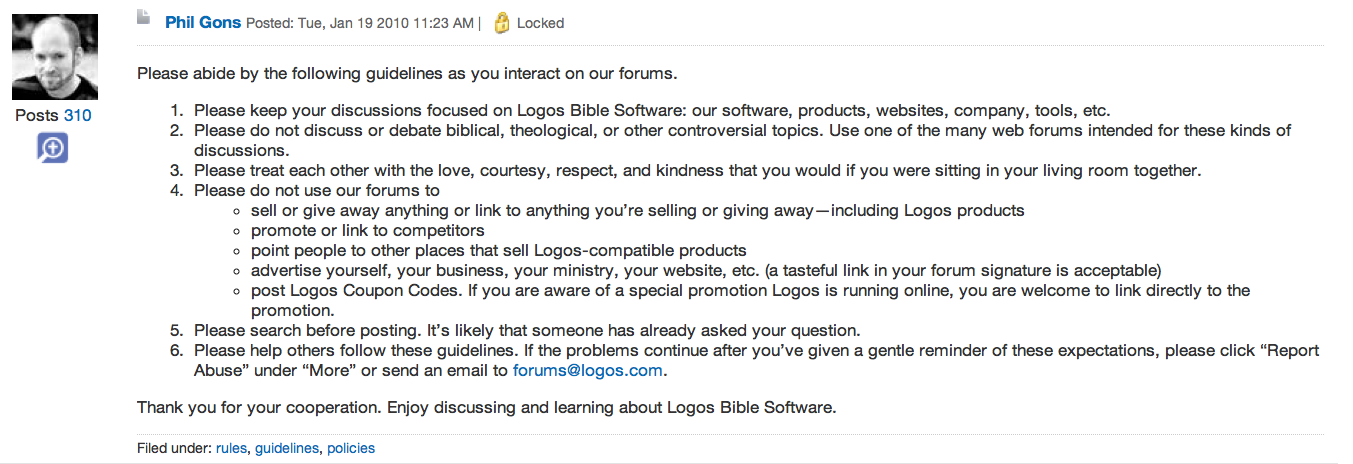 |
| CLICK TO ENLARGE |
Having a policy is not a rookie mistake. Indeed: not having a policy, or failing to enforce it consistently, is the rookie mistake.
So what's the big stink about? Where's the rookie error?
Well, the problem is feeding the trolls, Bob. Let me suggest something to you: by trotting out the most-offensive polemic of internet "Catholics" against Protestants, and then trotting out what can only be called talking out of the side of one's ecumenical mouth to Protestants about the Catholics who are allegedly using Logos (the Bible-readers, people: not the Mariolators and Indulgence-collectors), you have taken sides in the debate you are trying to squash.
I realize I'm not the life-long entrepreneur you are, Bob, but I am a bit of an intermediate blow-hard here in the bandwidth. Here's one way you could have approached this:
Right? You could have said it that way -- mostly-objective, somewhat-pointed, and strictly about the subject you really wanted to promote here: Logos products.Dear Logos Users and Forum Community:It is a long-standing policy of Logos not to let the forum expand its scope from a vehicle to generate support and community relationships regarding the use of our product families. For that reason, we do not allow theological debate to blossom on the various forums.Logos is the leading publisher of multilingual Bible software on Mac, Windows and mobile platforms -- and we don't foster debates as to whether one computing platform is superior to another. Logos partners with more than 130 publishers to make more than 12,000 electronic books available to customers in more than 180 countries -- and we don't foster debate over which is the most influential or most important among them. The company serves church, academic and lay markets, bringing the best in software innovation to Christians worldwide -- and that marketplace has many needs.Logos now produces high-end tools for studying biblical texts in their original languages along with the largest electronic libraries for study of the Bible. The combination of tools and texts within the software now make it possible, for the first time ever, to perform in-depth biblical language research from the same software application that holds the largest and most advanced electronic Bible reference library available. The unified, integrated research platform reduces the cost and learning curve associated with having to own and maintain a separate software package for each style of study.Projects underway include the development of exclusive new databases with the help of scholars from around the world. Data creation is a new area for Logos, but we're confident that the databases and morphologies being built will pave the way for the next revolution in electronic Bible study.To that end, please keep these forums about these subjects and not others -- which are right-minded subjects for the church to consider, but which will also never be resolved in a forum which is not intended to solve them.Thanks for your help, but be aware that our forum administrators will continue to block and delete posts which violate our rules for forum use.
Instead, something else happened here -- and I want to give you my take on it since I have your attention. As a former CBA member (almost 10 years as an independent retailer), one thing always stunned me about CBA: the idea that somehow being averse to any apologetic or theological distinction was not actually, in and of itself, a kind of apologetics. The eye-rolling that ICRS/ECPA/CBA people do when someone makes a theological point toward a liberal who is torturing orthodoxy or when someone trots out Mormons as Christians is its own sort of apologetic - the kind which wants to flatten all differences out to matters of taste rather than important places where the Christian faith actually makes itself different than other ideas and religions.
And let's face it, Bob: the Catholic/Protestant split really has never been deeper than it is today -- it just has the problem of actual Protestants being almost completely not in evidence. This is not my opinion, but David Wells' opinion, which he has documented over the last 2 decades for us all so well. Instead we have uncolored, flavorless Evanjellos jiggling in the public square, pressing themselves into all manner of relevant moulds in the hope that someone will at least squirt some canned whipped cream on them for some kind of savor.
What you did was the classic ECPA play of alleged objectivity girding itself up against sectarianism -- by ignoring and minimizing real differences and issues for the sake of what we have to admit is only one thing: selling our stuff to the largest demographic we can statistically size up.
See: there's nothing wrong with selling any morally-credible product to anyone who will buy it. Bill Mays was not a bad guy for being a huckster. You're not a bad guy for selling Logos and finding books and documents to digitize to grow your market.
But there is something wrong with intentionally minimizing issues of truth to appeal to an audience. There is something wrong, when you say you have a reformed statement of faith, in essentially tossing it off when it comes between you and your product for the sake of silencing debate. You don't need anyone to sign off on your convictions in order to sell them a product -- but running down your own confession, and the confessions of like-minded people, in order to quell the concerns of potential customers, is wrong. That's what your statement did, and it is this broad and common error which makes your approach a bad one.
You're a clever guy, and you could have done better -- you can still do better. You can overcome the rookie mistake of dipping into the internet as a combatant rather than as a marketer.
Thanks for decades of innovations which have benefitted thousands globally is their use of the Bible and all manner of theological resources. Remember your business mission and your confession as you tread out into the internet where someone, invariably, is wrong.
To that end, I am praying for you.


 “Ecumenical”, as I am using it, does not mean “blindly taking everyone’s word for it that they are Christians”. For example, wherever you come down on the AA/FV issue, it doesn’t really have anything to do with the baptism of the author of a given book. Since she comes up later in
 But that is so rare, so obscure today that it’s like finding a Hershey’s Kiss made of gold in a urinal in Grand Central Station in NYC. At a glance, you’re sure it’s prank meant to get you to put your hand into something vile; if you stare at it long enough and you realize that it’s real, you can’t figure out how to touch it without looking giddy or disturbed; and if you don’t grab it, somebody else with less sanctification than you is bound to grab it and waste it on sterno and summer sausage. This thing we are talking about is one of the great lay ministerial opportunities in the history of the church, but so many people have no idea how to get the kiss without touching the porceline that we just wind up with a lot of people trying to wash their hands quickly and forget that they ever saw the confounded thing to begin with.




