16 May 2006

Unbiblical

by Frank Turk


ather than force Phil to spend time and money to find me, I'll post this here and let the dogs sniff it in their own back yard. The first place I want to start is the dictionary.
Bib-li-cal also Bib-li-cal adj.
1. Of, relating to, or contained in the Bible.
2. Being in keeping with the nature of the Bible, especially:
a. Suggestive of the personages or times depicted in the Bible.
b. Suggestive of the prose or narrative style of the King James Bible.
3. Very great in extent; enormous: a natural disaster of near biblical proportions.
The word compares in scope and meaning to words like "constitutional" or "confessional": is means the object being described agrees with some other source document. Does it mean it is identical? No: it means it does not violate that source document.

In that, I have in the past had a discussion with a fellow who said this to me:
If I say that the Blessed Virgin Mary is the immaculate conception [sic] (or any other RCC distinctive), wouldn't you argue that such a belief is "unbiblical?"
The answer is, "Yes, I would. I have in fact, as you know." The issue is whether the doctrine resembles what the Bible says or not -- and whether the matter is taken with the kind of weight the Bible places on such a thing.

Before I go on, this has some pretty significant implications on the link-trolling British blogger's discussion of the T4G affirmations and denials. In my view, when we spend time discussing things in an apologetical context, or in a "bunch of guys who are Christians chewing the fat" context, like Dr. Mohler's choice of words to describe the authority of Scripture rather than why we should desire God when he has spilled the righteous blood of Christ for us, that's like spending a $100 bill on sawdust. Pheh.

Let me give you a Protestant example of this biblical/unbiblical thing first, then we can turn to the matter of the Immaculate Conception (as one example, which this Roman Catholic person presented to me), and then sum up. There is a small KJVO Baptist sect (I would call them a cult, if that matters to you) that doesn't just demand baptism by immersion, but by "straightway" immersion, which is to say straight down and straight up -- because Mt 3:16 saith in KJV, "And Jesus, when he was baptized, went up straightway out of the water".

You and I might laugh at these folks (I laughed when I met a fellow who told me this is what he believed), but they think that everyone else is going to hell because they have faulty baptisms. Now let me ask you: wouldn't you agree that's it's fine for them to perform the baptismal right "straightway", but that to demand that this is the only way baptism can rightly be performed is unbiblical? That is to say, the demand goes beyond the bounds of what the Bible teaches us and demands something that the Bible does not demand.

"Cent, how can you say such a thing?" you might say, astounded. "You are yourself a Baptist and would deny the infant baptisms of all Lutherans and Presbyterians -- not to mention Catholics! You're completely inconsistent and self-incriminating here!"

Well, if I thought all Lutherans and Presbyterians were going to hell based on the kind of baptism they are taking or giving, you might be right. The problem is that I don't think that at all: what I think is that baptism is for the believer, and it is an outward sign of an inward reality -- a symbol of identification with Christ done in obedience. So those who baptize infants might, in my view, put the cart before the horse, but they're not going to hell for it. They are allowed their mistake in that belief. The difference between me and the straightway advocate is that I allow for the fact that the method of baptism is secondary, and that there is no violation of the Gospel if one is sprinkled or dipped or comes up straight-way.

In that, let's consider the immaculate conception. You know something? Up until 1854 when Pius IX declared that anyone who disagreed with this was "condemned by his own judgment; that he has suffered shipwreck in the faith; that he has separated from the unity of the Church", I'd say that he is welcome to believe it as long as it doesn't lead one to lift Mary above the status of faithful human being. The 4 Bible texts Pius used to make his declaration are thin at best, but that's his faith: I leave it to him to work it out. However, when he makes the demand that those who reject this idea are "condemned, shipwrecked and separated", what he is saying is that the belief that Mary had no original sin is of equal importance and equal weight to the belief that Christ was both God and man, or that Christ rose from the grave.

What forces this belief into "unbiblical" rather than extra-biblical is the demand that it is an integral part of the faith. Just like the straight-ways who think that anyone dipped sideways, or who goes down forward and comes up, have fallen into Satan's snare of lies, the demand that everyone accept the immaculate conception as a core belief on-par with the Resurrection over-reaches the bounds of what the Bible teaches about saving faith.

One last pass at this for clarity's sake. The Bible certainly does not teach which operating system to use on your computer, or whether Linux, Mac or Windows is Christ's choice for computing output. However, I prefer Mac OS, and most people prefer Windows. Now which choice is "biblical"? None of them are. However, that does not mean that any of the are unbiblical -- unless someone demands that Mac OS is God's OS and all other PC users are heretics based on a very thin interpretation of Deu 32:10, Ps 17:8 and Prov 7:2.

At the place where we make demands that Scripture does not make, and burden people with rules that Scripture does not endorse, we have become unbiblical. Let's keep that in mind as we say we are people who are preaching and teaching the Gospel.


British link troll

Some odds 'n' ends
by Phil Johnson

  1. Adrian Warnock is giving away books. In the interests of full disclosure, we note that he asked for this link. (He could've had ten links without the Gollum picture if he had simply given me one of the books as a bribe.) But he links to PyroManiacs a lot, and I like Adrian, so we're happy to do it. His goal is to stir up discussion about the "Together for the Gospel" statement.
  2. I'm strongly in favor of the T4G statement. Do I need to say more to qualify for a free book?
  3. What Frank Turk said.
  4. Speaking of Centuri0n, if he doesn't post here soon, we're going to file a missing-persons report.
  5. Jaroslav Pelikan, Yale's famous Sterling Professor of History Emeritus, died at age 82 on Saturday. His magnum opus, a five-volume set titled The Christian Tradition: A History of the Development of Doctrine, is indisputably the most important and most comprehensive work on historical theology published in the past century. Though Pelikan began his study of church history because of his interest in Luther (his father was a Lutheran pastor), he converted to Eastern Orthodoxy. But the range of his expertise was incredibly expansive, and anyone interested in the full sweep of church history and doctrine will benefit from his scholarship. (One of his books on my "to-read" list is Bach Among the Theologians.) Pelikan's works are as readable as they are comprehensive. His 2003 book Credo—a wonderful theological survey of Christianity's creeds and confessions of faith—is a real treasure.
  6. Here's a poignant post that I somehow missed several weeks ago, but Darlene pointed out to me this week. David "Gunner" Gundersen and his wife Cindy and both of their families are longtime friends of ours. (Gunner was my son's roommate in college, and he's also one of the regulars at foolishblog.com.) Gunner and Cindy are in the adoption process, and that opened up an opportunity for him to minister in Uganda. Back in February, it seems, he posted a beautifully written testimony about his first experience in Africa.
  7. My long dialogue and debate with militant fundamentalist separatists continues in the forum at SharperIron.org.
  8. For a slightly different approach to "dialogue and debate," James White posts his "Caner Correspondence File." James has shown ten times the patience and stamina I would have in dealing with the yapping style of Ergun Caner.
         Meanwhile, Michael Spencer makes an observation that may be worth pondering: "The Caners are playing this purported Calvinism debate for one purpose: to put SBC Calvinism right in the middle of the road and run over it for years to come." (Spencer knows something about how that tactic works against Calvinism. So I think he has a point here.)
         Still, in the chronicle of correspondence James White has posted, Caner has already managed to overthrow the old canard which suggests that Calvinists have some kind of monopoly on mean-spiritedness. Caner seems to think the word debate means "a cage match with steel chairs."
         Seriously, he sounds like a cheap wrestler taunting the competition. If he shows up for the debate in tights and a Mexican wrestling mask, I hope White and Ascol will politely duck out the back door.

Phil's signature

15 May 2006

Truth is old, but the reverse may not hold

by Dan Phillips

There is a danger in saying that truth is always old.

In itself, the statement is certainly true. Truth is always old. Our perception of it, however, is not. Our statements of it, are not necessarily always old. I would add that anything "new" should be viewed with suspicion, and put to the most rigorous test. It should never be accepted simply because it is new, or popular.

Let me give an example: Dispensationalism. (Please read carefully what follows.) A constant criticism is that it is new. Some reject it for that reason alone.

This has always struck me as ironic, coming from Calvinists. Our forefathers met with exactly the same criticism from Romanists, in their day. They responded by citing church fathers who stated or accorded with the same truths, but mostly they responded that Scripture isn't new, so their (Scriptural) view also is not new.

Reject Dispensationalism if you believe it does not accord with the Bible. Put forth your better, more Biblical view. But don't reject it solely because you think it is new.

Take a more specific example of a traditional thought that right-minded folks have held for centuries, if not millennia: seeing Canaan as a type of Heaven, and crossing the Jordan as death. If there is a direct Biblical basis for this identification, I've never seen it.

On the contrary, I find it a distressing equation. Canaan was filled with giants and fortified cities (Numbers 14:38-39). After they entered it, Israel faced many bloody battles, some of which they lost. While living in it, they were tempted to and committed apostasy, and they were severely judged by God.

Eventually, they were thrown out of it.

That's Heaven? I hope not! More importantly, not by anything I read in Scripture!

I love Spurgeon dearly. (Surprise!) He's probably my favorite preacher to read, ever, by a vast margin. But in his March 15 evening devotion, he wrote: "When I cross the Jordan, the work of sanctification will be finished...." Where did this imagery of Jordan/death start? If it's in the Bible, I've missed it. Crossing the Jordan certainly presented no crisis in Israel's sanctification.

Or again, in Spurgeon's March 13 morning devotion, the great preacher encourages the downtrodden by quoting a couple of lines:
"A few more rolling suns, at most,
Will land thee on fair Canaan’s coast."
If that's true, I'm not encouraged! Is that what going to Heaven is? I'm going to go from a land where I constantly face my own miserable pronenesses to sins within, and disheartening battles without -- to a land where I'm constantly going to face my own miserable pronenesses to sins within, and disheartening battles without? There will be giants and pagans and well-fortified villages in Heaven? There's a chance I might be thrown out?

As Jonathan Edwards once was heard to remark, "Yikes!"

Okay, Edwards probably never said that, but I do. Of course I know what Spurgeon meant, and what he meant was true. But what he said was simply, in my view, a mistake. But it is old! It's very old! Old, yet mistaken. It happens.

I want old truth, only old truth. As old as the Bible. Let us just make sure that our "old truth" really is that old, and not just an old misconception that should have been reconsidered and retooled ages ago.

Dan Phillips's signature


13 May 2006

A few ethics short of a Happy Meal®

by Phil Johnson

A PyroManiacs special Mother's Day news bulletin for Homeschool Moms


Apparently Ronald McDonald isn't wearing white makeup, orange hair, and striped stockings for nothing. McDonald's sponsors a website that wants your daughters to embrace the Goth lifestyle.
Christian parents who think the large portal websites designed for little kids must be perfectly safe ought to take a second look at the KidzWorld site, whose biggest corporate sponsor is none other than McDonald's. (In fact, McDonald's name and logo are so ubiquitous at KidzWorld that it looks like a McDonald's-owned site.)

"Get the Goods on Goth Style"

According to KidzWorld, death as a "lifestyle" is really cool. "If you identify more with Marilyn Manson than Britney Spears, or if you'd rather date your mom than be caught wearing anything floral or J. Lo inspired, you should check out the ins and outs of gothic style," the page tells little girls. The graphic to the left, replete with skull and crossbones on the bottle, is from the KidzWorld site.

Overall, KidzWorld's pages are brightly colored, and that may not seem to fit well with the Gothic mood, but no worries. The article carefully gives your daughter all the helpful tips she needs on Goth basics like black nail polish, black boots, hair dye, studs, and black eyeliner ("Great for lining lips, eyes or drawing stuff on your face").

Those are the "Five Goth Essentials," according to KidzWorld. Links on the page will take the kids to an informative biography on Marilyn Manson. Warning: follow the "Goth clothing" links too far and you will be on the bad side of the Internet pretty quickly.

There's even a place for feedback from the kids. One fourteen-year-old ominously calling herself "Slipknot_4ever" writes, "Thank you so much for the article the goods for goths! I really wanted to go goth and this will really help me! I really needed this article and thank you again! I just have one question, do you know where to find a lot of kool black clothes in Canada? Thanks again!"

At least one 15-year-old critic with obvious expertise in things Gothic (nickname: Acidalayde) thinks KidzWorld's advice is a tad lame. She offers this helpful addendum for the younger girls: "[They] forgot to mention Tape. Duct-Tape, and electrician's tape, can be your best friend. And GAH. Remember kiddies, being the mime is bad, go past the chin-line and to the neck. And neon colours work too. If you want help with style look up Switchblade Symphony, Rasputina, Sisters of Mercy, Cradle of Filth on search engines such as Google"

Hmmm. I certainly wouldn't try those searches. Googling "Cradle of Filth" sounds like a pretty bad bit of advice for adolescent girls. I guarantee it's not what most parents think their kids are being exposed to when they this large, colorful website for kids that promises to keep your children "safe" from the dark side of the Web.

As if that weren't enough...

KidzWorld furnishes links to teen horoscopes, another page on our old friends Hoobastank, a special feature on The Pioneers of Punk, and a surprising array of pages peddling more disgusting aspects of culture's dark side than you can imagine.

KidzWorld is promoting this stuff aggressively and directly to little kids. It's a pretty safe bet that most parents aren't even watching. After all, a website supported so heavily by McDonald's wouldn't deliberately corrupt our kids by promoting Marilyn Manson behind their parents' back—would they?

Well, check out this a sampling of what the KidzWorld search engine serves up for your kids if you put in the word punk. If your kids try the word gay, they'll be offered, among other things, an article that tells what Rosie O'Donnell is doing to help gay parents adopt children.

You may wonder why a website for kids which bills itself as "a safe and secure portal to the best the web has to offer" feels it is their prerogative to instruct your kids on values, lifestyle, and moral issues. Actually, the article on gay adoption is carefully written in totally amoral tones. KidzWorld will surely insist that they are not advocating anything one way or the other. They just want to know what your kids think about such things. Feedback from the kids, as always, is solicited.

Anyway, don't be fooled by the bright colors and fuzzy animals at the top of every page on the site. Someone at KidzWorld is working pretty hard to corrupt your kids.

Shame on McDonald's for underwriting this. Their food is not that good anyway. I'm sticking with In 'n' Out.


Update: Wiccan work it out

An alert Canadian commenter, Rileysowner, points out that KidzWorld also includes a page celebrating "The Wonderful World of Wicca," which aims to instruct your little girls and boys on the finer nuances of witchcraft.

Try these two searches at the KidzWorld search engine, and note the stark difference in the results displayed:

  1. Wicca
  2. Christian
In the response section of this page, a 12-year-old reader asks: "I read your article on Wicca and it really interested me. I have one question though: Can be you be another religion and still be a Wiccan or do you have to be strictly a Wiccan?"

I deliberately haven't dug further into the KidzWorld website, and I'm not going to. It's one of those websites I know my mom wouldn't approve of, and I try to stay away from them.


Phil's signature

For the moms

by Phil Johnson
Your weekly dose of Spurgeon

The PyroManiacs devote space at the beginning of each week to highlights from The Spurgeon Archive.

A mother's influence

"Fathers are all very well—God bless them!—and a father's godly influence and earnest prayers are of untold value to his children; but the mothers are worth two of them, mostly, as to the moral training and religious bent of their sons and daughters."

C. H. Spurgeon


With love from all the PyroManiacs to all the mothers in our lives.

Phil's signature

12 May 2006

On proper attire for church

My turn to post on top of James Spurgeon.
by Phil Johnson

Dan's post yesterday made an important point to which I add a hearty and solemn amen. The comment-thread that ensued prompted a secondary discussion about whether our attire for church ought to be formal or informal. I want to bring that issue up out of the meta.

Here's how it came about:

Somewhere under Dan's post, Sharon added a comment bewailing the epidemic of informality that has changed the look and feel of church services everywhere since the days of "Leave it to Beaver." Hers is not a popular point of view these days, except among schoolmarm types. After all, everyone knows that legalism is a greater threat than irreverence, right?

Well, maybe not.

First of all, thanks to Jerry Wragg for saving me some time (once again). I haven't time to say everything I would like about the issue. So see Jerry's lengthy comment in this thread for a good summary of my view.

But I wanted to add this:

Regarding formality

There's important truth on both sides of this question. Scripture gives no dress code for when the congregation assembles—except that we're expressly forbidden to favor people with fine attire (James 2:2-4). Selah.

It's also possible to be both formal and immodest.

Moreover, I've been in very formal environments where the formality seemed designed mainly as an opportunity to parade one's finery. To whatever degree that's someone's motive for dressing up, it's a sinful motive.

So I wouldn't argue that church must be formal. I've ministered too often in undeveloped countries and non-western cultures to suggest that neckties are a biblical necessity. (Ask Jay Adams if you don't believe me about that.)

Oddly enough, however, it seems to me that in less affluent cultures, people are usually more inclined to see the church service as an occasion to wear one's best clothing. For what it's worth.

Regarding informality

On the other hand, even those who claim to eschew every kind of dress code would surely deem some things too informal or otherwise inappropriate for church attire. And "modesty" is not the only issue here. If Sharon showed up at Chris Freeland's church in her band uniform, if Frank Turk arrived in a zoot suit, if I came in my lederhosen, or if James White showed up in his kilt (even with his bicycle tights underneath for modesty), I bet Chris would raise an eyebrow (or at least swallow hard).

Except for certain Anglicans, I'm betting most of us would agree that clown suits are generally inappropriate attire for church.

So even if we don't have a legalistic dress code, practically all of us would recognize that some kinds of attire are more appropriate than others for church.

But:

If there's an imbalance today on one side or the other, it seems to me that it's largely in the direction of cheapening, informalizing, and trivializing everything that's sacred.

Which is to say that while wouldn't necessarily suggest that it's a sin to dress like this, I'd wonder about a Christian who dressed that way for church.

In other words...

There's an important and valid principle in what Sharon is saying, and those inclined to blow it off ought to pause and listen first:

To a certain extent, our attire in church reflects our attitude toward the significance of corporate worship and the holiness of the One whom we worship, and we ought to give some thought to that fact when we decide what to wear. The tendency toward making Hawaiian shirts, Bermuda shorts, sandals, bare midriffs, and gold chains the standard attire for corporate worship is related to the very same mentality that is cheapening and trivializing every other aspect of our worship.

Phil's signature

11 May 2006

Sister... show mercy!

Preface: "What are you -- nuts?!" Just thought I'd lead with the question you'll be wondering in a few minutes. I am about to stick my finger in the fan, about up to my elbow, and I know it. But I really think someone needs to say this -- and why not me? I have less to lose than many who've thought the same thing, but daren't say it.

This is likely to get the water hotter than the first or second Wright posting did. If I was accused of "ignorance" in daring to Touch The Academy's Anointed... well, just wait. And it won't matter that I will dance more precisely than ever before. (See? "Dance." Already have some Baptists mad at me.)

So here we go.

What will change, and what won't. Spring's springing, and summer looms. Mercury rises, fashions change. But one thing that won't change, unless I'm badly and happily mistaken: some good and regular churchgoers will not dress as helpfully as they could.

I chose that word with care: "helpfully." I am not talking about sin, shame, indecency, wantonness, or the like. Perhaps I could, with some justification, in some cases. But that's for another time -- and probably another writer. At this point, I just want to talk about being helpful.

Sister, if there's one thing you and I can certainly agree on, it's this: I don't know what it's like to be a woman, and you don't know what it's like to be a man. We're both probably wrong where we're sure we're right, try as we might. So let me try to dart a telegram from my camp over to the distaff side.

"Sheol and Abaddon are never satisfied, and never satisfied are the eyes of man" (Proverbs 27:20). Solomon doesn't use the Hebrew words that would indicate males exclusively, so this and Ecclesiastes 1:8 may apply across the gender-board. Libbie pointed out very ably that we men wrongly assume that we alone battle with temptations entering through the eye-gate.

But. But if men aren't alone in the battle, they may have a particular weakness for this aspect of it. Consider passionately-godly King David, whose psalms express aspirations after God beside which our own are pale, bloodless things. One day King David is in the wrong place, at the wrong time; sees a naked woman bathing next door, and boom! -- he's gone (2 Samuel 11). Family, kingdom, God -- all forgotten, consumed in the flash-flame of a lust that was only visual in its inception.

And what of that Israelite Philistine Samson and his own "eye trouble?" He sees a fetching young pagan, and bellows at his dad, "Get her for me, for she looks good to me" (Judges 14:3 NAS). Where did Samson's passions take him? How did his course end?

Unless all the men I've known personally or at a distance are completely unrepresentative, it's a lifelong struggle, a lifelong weakness. As I recall from a Proverbs lecture on mp3, Bruce Waltke says that his dad, at around age 100, told him, "Bruce, I still have the same struggles I did when I was 50." It was sobering for Dr. Waltke to hear; sobering for any man! (In fact, put me down for "disheartening.")

Where am I going with this? Oh, don't try to look so innocent. You know exactly where I'm going.

So here comes this brother into the assembly of the saints, hoping for a rest from the battles of the week, a moment to regroup, sing, pray, get the Word, fellowship. He looks up to the choir, or to his left or his right -- and in a tick of the clock, he's facing the same struggle he faced every time he turned on his TV, opened a magazine, or went down a city street. He's seeing things that make it far too easy for him not to keep his mind focused where it needs to be focused.

And he's not in a nightclub, he's not at a singles' bar, he's not at the beach. He's in church.

Now, some very direct disclaimers:
  • Every man's sin is his own, and every man's struggle is his own (Proverbs 14:10)
  • No one makes a man think or feel anything (Proverbs 4:23)
  • It is each individual's responsibility to guard his own heart (Proverbs 4:23)
  • Beauty is a wonderful gift of God (cf. Exodus 28:2; Song of Solomon 1:8, 15, etc.)
Having said all that: while it may be true that I'm holding the matches, you won't help me if you pile twigs all around my feet and douse them with lighter fluid. To be more specific: if you know I've had trouble with drunkenness, you won't offer me a glass of wine. If you know I battle covetousness, you won't take me window-shopping in high-end stores I've no business frequenting.

So I put this question: what are some sisters thinking, in how they dress?

As the ladies pick clothes, they'll consider what's pretty, what's flattering, what's attractive. Who could blame them? But, "attractive" to whom? In what way? To what end? With what focus?

Consider the questions again. "Is it pretty?" Good question, no evil in it. "Is it comfortable, is it complimentary, is it fun?" No problem. I'd just suggest you add one more question: "Is it helpful, or is it hurtful, to my brothers in Christ? Will this unintentionally contribute to their having a focus that is harmful to their walk?"

Now, lookie here:
In that day the Lord will take away the finery of the anklets, the headbands, and the crescents; 19 the pendants, the bracelets, and the scarves; 20 the headdresses, the armlets, the sashes, the perfume boxes, and the amulets; 21 the signet rings and nose rings; 22 the festal robes, the mantles, the cloaks, and the handbags; 23 the mirrors, the linen garments, the turbans, and the veils. (Isaiah 3:18-23)

...likewise also that women should adorn themselves in respectable apparel, with modesty and self-control, not with braided hair and gold or pearls or costly attire, 10 but with what is proper for women who profess godliness--with good works. (1 Timothy 2:9-10)

Do not let your adorning be external--the braiding of hair, the wearing of gold, or the putting on of clothing-- 4 but let your adorning be the hidden person of the heart with the imperishable beauty of a gentle and quiet spirit, which in God's sight is very precious. (1 Peter 3:3-4)
Immediately we'll swing in, as we always do, and say, "Now, the writer's not saying that women can't dress nicely, or wear jewelry, or blah blah blah." And we'll all disown our Fundie forebears who focused on nylons and lipstick, and came up with precise hemline measurements. We'll want to make sure that we're not advocating a new line of Burqaware for evangelical women. All that will be true and valid enough.

But I'm concerned that, in our anxiety to be sure to prevent the wrong interpretation, we effectively cut off all interpretation. We have swung from making the passages say silly things, to not letting them say anything. These passages have to mean something! They must have some application! What is it?

Surely the emphasis of the passages is warning against vanity, externality, sensuality; and on highlighting and promoting focus on a godly character as true beauty. Who you are; not just what you look like. Remember: "As a ring of gold in a swine's snout, So is a beautiful woman who lacks discretion" (Proverbs 11:22 NAS).

Oh boy, I'm going to make it worse now. Deep breath....

What are you clothes saying about you, sister? What are they supposed to say to your brothers? "Hey, look at this?" Well, they actually are trying to look at the Lord; it's not good for them to be looking at that. No, it's not your fault that they have a problem. We established that. And it's really great that God has made you beautiful. I hope your husband (present or future) shows you how grateful he is for that about you.

But you can help the brothers who aren't your husband, or you can not-help them. Which are you doing? If you're not married, and a man looks at you, is he thinking, "What a great character"? Or are you giving him reason to think about something else?

I know many of the responses. "You don't know what it's like to buy women's clothes, you ignorant man!" Mostly true. My first just-for-fun purchase for my wife was, well, it was appalling. What a good sport my wife was. I took it back to the store immediately, and made a much better subsequent choice.

But this: "You can't find anything modest! It's all too revealing! It's impossible to get something that looks nice, yet isn't too tight, or too short, or too-something / not-something-enough!"

Sorry, but baloney.

I put "modest women's clothing Christian" in Google, and 453,000 pages come up. Yes, some are funny and quaint at best. But are they all Amishwear? "Can't find?"

More fundamentally: I do not accept that anyone has to wear clothes that are too tight or too sheer or too short -- unless you are the largest and tallest woman living in the hottest part of the planet. Because I see larger, taller women walking around in hot weather, and they're all wearing clothes, every last one. They got those clothes somewhere, I reason. You could too.

"But -- but they won't look good on me! The shoulders will be wrong!"

I'm not sure that's necessarily true, but let's accept it and pose a counter-question. You tell me. Which is worse: your shoulders hanging a half-inch too low? Or a blouse/shirt that simply (shifting into turbo-delicate) provides need-to-know information to those with a need-to-not-know?

I'm sure we all agree that there are clothes that show what others have no helpful business seeing. Here's what to show, in clothes-selection: show a Godward focus, discretion, a godly character.

And show mercy.

Parting thought. Darlene pointed me to a statement by Arthur Pink, which makes everything I've just said look awfully mild. But there's no denying that he has a point. I'll close with it:
Again, if lustful looking be so grievous a sin, then those who dress and expose themselves with desires to be looked at and lusted after-as Jezebel, who painted her face, tired her head, and looked out of the window (2 Kings 9:30)-are not less, but even more guilty. In this matter it is only too often the case that men sin, but women tempt them so to do. How great, then, must be the guilt of the great majority of the modern misses who deliberately seek to arouse the sexual passions of our young men? And how much greater still is the guilt of most of their mothers for allowing them to become lascivious temptresses?
Now, note, Pink and I speak to different ends. I speak to those who I assume are inadvertently dressing in an unhelpful manner. Pink speaks to those whose intent is to allure. Between the two of us, I can pray we've provided food for thought, prayer, reconsideration, and needed change.

Dan Phillips's signature


10 May 2006

The way to win

by Frank Turk

PROGRAMMING NOTE: Yes, this is almost 100% a gratuitous cross-post. I say "almost" because this version of this post -- originally seen on my personal blog -- did not have all the links in this version. So if you are not a person who normally reads my blog, all the details are duly linked here and you can now be part of the inner circle.

As many of you know, Brian Flemming declared himself the winner at the DebateBlog, and that’s fine – everyone needs to pad their resume, and if that helps him he’s welcome to it. I didn’t know that there was supposed to be a “winner” – I would have listed a point system in the rules if that was how I was looking at it.

Anyway, as the winner, Brian has recently posted a new set of rules for anyone who wants to debate him, and I thought it would be interesting to read them and see what they say. His blog entry looks like this:

So you would like to challenge me about the claims I make in The God Who Wasn't There?

No problem. But please understand that I get a lot of these requests, and I can't waste my time arguing with people who are not open to changing their minds or who haven't developed enough familiarity with the material.

So just download and sign this "Statement of Belief" PDF, have it notarized, then mail it to Beyond Belief Media. Then we can talk.

If you are unable to sign the Statement, we cannot talk any further, for one or both of the following reasons:

1) You are not familiar enough with the facts to be ready for a meaningful discussion at this time.

2) Your capacity to understand the facts is so compromised by your religious ideology that a conversation with you would be pointless.
Honestly, who wants to debate somebody who is not in the game, so to speak? It seems superficially reasonable that Brian is simply eliminating people who don’t have enough information to make a case for their own side.

I think that’s a great idea – and given that I have a Master of Arts in Literature in English, I think that Brian is making a fair demand that people who want to talk about the Bible as literature ought to know something about literature. For example: we should exclude people who do not have advanced degrees in literature, or any complete formal academic training.


Yes, Certainly. James White and William Lane Craig have the same kinds of rules. I agree. Well, that is until I read the PDF:
STATEMENT OF BELIEF

I believe it is possible that Jesus did not exist.

I believe there is no evidence for the existence of Jesus Christ that dates to the time of his alleged life.

I believe there are no written eyewitness accounts of the existence of Jesus Christ.

I believe the names of the Gospels were added well after their composition, and there is no good reason to believe that these names correspond to the original writers.

I believe there is no good reason to believe that any of the Gospels were written by disciples of Jesus Christ, or that any eyewitnesses to Jesus were involved in their composition.

I believe the Bible is not infallible. I believe it is common for religious cults to make things up.

I believe it is common for religions to influence each other, and for young religions to be derived from older religions.

I believe that any claim can be part of Christian tradition and also be false.

I believe that no figures such as "God" or "The Holy Spirit" or "Satan" performed any supernatural actions that had any significant effect upon the formation of early Christianity.

I swear, under penalty of perjury, that the foregoing is true and correct.
Now, re-read the bits I highlighted there. Go on.

Do they sound familiar in some way? Ah yes! They do! They are actually all the premises of Brian’s argument! So it turns out that Brian doesn’t want to debate anybody that actually disagrees with him about his argument.

Dude: maybe we should check the definition of a "debate" before we provide this document to the world. This is more like a mutual admiration society. It is exactly like me saying, “In order to play at DebateBlog, you have to first sign off (with witnesses) the T4G affirmations and denials. After that, we can argue all day long.”

It’s an easy way to stay undefeated, I am sure. You can say without any question, “after every debate I have ever had, the person I debated agreed with me.”

Well, except for that self-deluded fundie centuri0n – but he’s a liar who’s not familiar with the facts.

ON A SIMILAR NOTE: I'm looking for a community of like-minded people to synthesize a Wikipedia entry for me -- for me personally. If Brian Flemming can have a Wikipedia entry and not feel any pangs of self-indulgence, so can I.

Let me also say something about the entry: I would love it if guys like Armstrong and Johnson and even Tim Enloe created their own sections of this entry to express their concerns about me. It would be fantastic to get both the loyal fans and the loyal opposition to all make a wikipedia stew for my wiki-bio.

If it works out good, we can get Phil and the rest of TeamPyro wikipedia entries. Any all the sidekicks, too.


09 May 2006

Three short personal items

by Phil Johnson

Update on Jeff Williams

I've posted a few times about my friend Jeff Williams, who is currently doing a six-month stint in the International Space Station (ISS). He phoned me from space just before I left for Italy. Darlene and I have gotten pretty good at spotting the ISS at night. We watched it several times in Italy and expect to see it twice tonight. If you want precise details about when the Space Station will be visible over your own house, you can get the calculations at the Heavens Above website.

Updates on Jeff's mission are also featured daily on NASA-TV (channel 376 on DirectTV). This morning Jeff gave a complete video tour of the Space Station and gave himself a haircut. How do they do that in space without getting little bits of hair all over the place? I wondered that, too. Turns out there's a vacuum hose attached to the electric shears.

While we were in Italy, an unpiloted Progress cargo carrier docked with the ISS. It brought fresh supplies, including some fresh fruit (Jeff peeled and ate an orange on this morning's NASA update). While the Progress craft was docked with the Space Station, its engines were fired for about six and a half minutes—long enough to adjust the Space Station's orbit, moving the ISS an additional 1.7 miles further from earth.

The November A&O Conference and Cruise

I've had to withdraw from the Alpha & Omega national conference and cruise in November. An unexpected conflict arose that makes it impossible for me to go. Of course, my duties at Grace to You and Grace Community Church must take priority over everything else I do. So although I regret having to cancel, I couldn't anticipate or avoid the conflict, and I can't change it. It especially pains me to disappoint James White, but he is a good friend and has been very gracious about it. Likewise, Mike O'Fallon, who is arranging the cruise, was extremely kind and understanding, even though my withdrawal is a huge inconvenience to him. My profound apologies to all who are inconvenienced or disappointed by it.

Debrief on Italy

I meant to post more pictures and a full report on my recent visit to Italy and the Republic of San Marino, but there's no time this week, and after that it will be out of date.

But I wanted to say a public thanks to David Standridge, who translated for me while I taught forty hours of intensive bibliology and theology proper in five days. Teaching eight hours a day is grueling enough. Just imagine if you had to listen, translate, and repeat all that in a different language.

David is a Roman native and showed us things in Rome we'd never seen. (His dad has been a faithful missionary pastor there for many years). Since my great-grandmother's maiden name was Standridge, we're probably distant cousins. Those who know us both say that's a frightening thought.

Our hosts for the week were Joe and Georgia Aleppo, dear friends of ours and close partners in ministry with Grace to You for several years. So despite the grueling teaching schedule, the week was a wonderful and refreshing break from my routine. I'm already looking forward to next year's installment.

At the moment, however, I have to get back to my regular work. I still have a book to edit, and less than three weeks to get it finished.

Phil's signature

08 May 2006

A quickie

Picking the N. T. Wright scab one more time
by Phil Johnson

If I had any kind of clout, I would use every means available to try to induce Carl Trueman to write for PyroManiacs. I've never met Carl, but aside from his musical tastes (which seem as eclectic as mine, but in a totally different direction), he seems like the kind of guy I would never tire of listening to.

Carl writes for the reformation21 blog. You ought to read that blog, even though the experience is sometimes more like eavesdropping on a private conversation—mainly because of all the inside jokes and pseudonyms. Following threads is hard, because these guys don't ever use links, comments, or clear references to previous posts. (It's sort of like the Boar's Head without any booze or bad theology.) So it takes a little effort to follow the conversation. I don't always get it. But it's worth the effort to try.

Anyway, here are two comments in a thread begun by Trueman that perfectly and succinctly express one of the main complaints many of us have with the reflex response we get whenever we dare to express any kind of disagreement with Bishop N. T. Wright:

Read this and this.

Be sure also to read the thread started by Trueman's post on satire and humour over at reformation21.

All they need over there now is some comic-book art.

Phil's signature

06 May 2006

The agonies of travel, and the joys of coming home

posted by Phil Johnson

A postcard from Rome

Better late than never:


Darlene and I returned home from Italy late Friday night. The journey home was a 24-hour ordeal, including a four-hour layover in New York. The in-flight movies were deplorable, so I spent the entire 8-hour flight from Rome to New York listening to my iPod, and by the time we arrived on this side of the Atlantic, the iPod battery was nearly gone.

On top of that, I had stupidly left my computer in standby mode, so its battery was depleted, too. And compounding the stupidity, I had packed my power cords in the checked luggage. So the layover was not only long; it was profoundly dull, too.

New York was hot, and the air-conditioning (if such a thing exists at JFK) was not working in any of the three buildings we had to traverse to make our connection. By the time we got on the plane to Los Angeles, I was suffering from Restless Leg Syndrome, and the cramped 6.5-hour flight from New York to LAX was miserable.

People in my great-grandparents' generation would be amazed to hear me complain of such "inconveniences." The thought of traveling from Rome to Los Angeles so easily in a single day would never have occurred to them. They would be shocked and appalled to hear me complain about such petty annoyances, which are by no means real hardships.

Which brings us to. . .

Your weekly dose of Spurgeon

The PyroManiacs devote space at the beginning of each week to highlights from The Spurgeon Archive.

Complaining about traveling reminded me of this letter Spurgeon once wrote during a hard journey home from Italy. In the later years of his ministry, at his doctors' insistence, he traveled annually to warmer climates. Unfortunately, Mrs. Spurgeon was a semi-invalid and was usually unable to travel with him. Spurgeon kept her in his mind and heart by sending letters about places he visited and things he saw.

His travel journals were by no means upbeat and cheery. Travel for him was no pleasure, and you get a sense of that from his description of this journey home:

One last letter from Paris

In the hope that one more letter may reach you before I come personally, I give myself the delight of writing it. The telegram will have told you that, at the very prudent advice of the doctor, I left Cannes at 3.15 on Tuesday in a coupé-lit to travel direct to Paris. It has proved a very wise step.

A lady lent her Bath-chair to take me to the station, and porters lifted me into the carriage. There I had a nice sofa-bed and every convenience. I lay there with great comfort till we reached Marseilles; then came the night, and I had hoped to sleep, but the extreme oscillation of the train quite prevented that. Once only I dozed for a few minutes, yet I was kept restful till six o'clock, when my dear friends got me some warm soup, and I had a refreshing wash. Then, all day long, I was at peace till 6 p.m.

From Lyons, the country is flooded all along the road; we seemed to ride through a vast river. I naturally felt the chill of this, and my knees complained. Near Paris it rained hard, and at Paris heavily.

After much stress and difficulty, I was put into a cab, and we drove to this hotel. I went to bed immediately, and slept on, on, on, till eight o'clock the next morning, awaking then refreshed, and, happily, none the worse for the long journey.

I meant to stay in bed all day, and sent my friends out, so that I might not always be a drag upon them; but, at about noon, I rose and dressed, and when they came in, I had flown,—to a sitting-room and a sofa by a cozy fire! I can walk now a little, and hope to be all right for Sunday. Bless the Lord, O my soul; and may He bless thee, too, my dear heart of love! I hope to have a coupe, and to-morrow lie down again while travelling, and so home to my tender wifely.

Who could hope to escape rheumatic pains when all the world is wet through to the center? It must not grieve you that I suffer, but you must rejoice that I escaped so long. Why, even rocks might feel this marvelous, long-continued wetting! I am indeed grateful to God for His goodness; still, "there's no place like home." This brings great loads of love all flaming. God bless thee ever!

Carriage at Victoria at 5.45, Friday!

C. H. Spurgeon

Notice that Spurgeon was unable to walk and needed to be carried. The cold and damp of the season enflamed his gout and left him almost completely incapacitated. The pain was so intense that every motion of the train was sheer agony, and he was unable to sleep. Yet he valiantly fought for rest, because he intended to preach that very weekend.

Kind of puts the discomfort of "Restless Leg Syndrome" and the inconveniences of depleted batteries and substandard air-conditioning in perspective, doesn't it?

But I can still fully relate to Spurgeon's eagerness to get home. It's good to be back.

If you sent me an e-mail while I was gone, it might be awhile before I get to it. Send it again if it's urgent. But I'll continue to be scarce at the blog until I get my book project finished.

Phil's signature

05 May 2006

"The Semi-Pelagian Narrower Catechism"

by Dan Phillips

It's Friday. You need a chuckle.

This is not brand-new, but it's awfully and ouchily good. You'll laugh, you'll wince, you'll pass it along. I'm not sure the writer and I are on the exact same side on every particular... but yikes, it's good (H-T Paleoevangelical.)

Here are a few excerpts (but you should read the whole):

1. Q: What is the chief end of each individual Christian?
A: Each individual Christian's chief end is to get saved. This is the first and great commandment.

2. Q: And what is the second great commandment?
A: The second, which is like unto it, is to get as many others saved as he can.

3. Q: What one work is required of thee for thy salvation?
A: It is required of me for my salvation that I make a Decision for Christ, which meaneth to accept Him into my heart to be my personal lord'n'saviour

...6. Q: By what means is a Decision for Christ made?
A: A Decision for Christ is made, not according to His own purpose and grace which was given to me in Christ Jesus before the world began, but according to the exercise of my own Free Will in saying the Sinner's Prayer in my own words.

7. Q: If it be true then that man is responsible for this Decision, how then can God be sovereign?
A: He cannot be. God sovereignly chose not to be sovereign, and is therefore dependent upon me to come to Him for salvation. He standeth outside the door of my heart, forlornly knocking, until such time as I Decide to let Him in.

8. Q: How then can we make such a Decision, seeing that the Scripture saith, we are dead in our trespasses and sins?
A: By this the Scripture meaneth, not that we are dead, but only that we are sick or injured in them.

9. Q: What is the assurance of thy salvation?
A: The assurance of thy salvation is, that I know the date on which I prayed the Sinner's Prayer, and have duly written this date on an official Decision card.

...10. Q: What is thy story? What is thy song?
A: Praising my Savior all the day long.

11. Q: You ask me how I know he lives?
A: He lives within my heart.

12. Q: And what else hast thou got in thine heart?
A: I've got the joy, joy, joy, joy down in my heart.

13. Q: Where??
A: Down in my heart!

14. Q: Where???
A: Down in my heart!!

He shot, he scored.

Dan Phillips's signature


03 May 2006

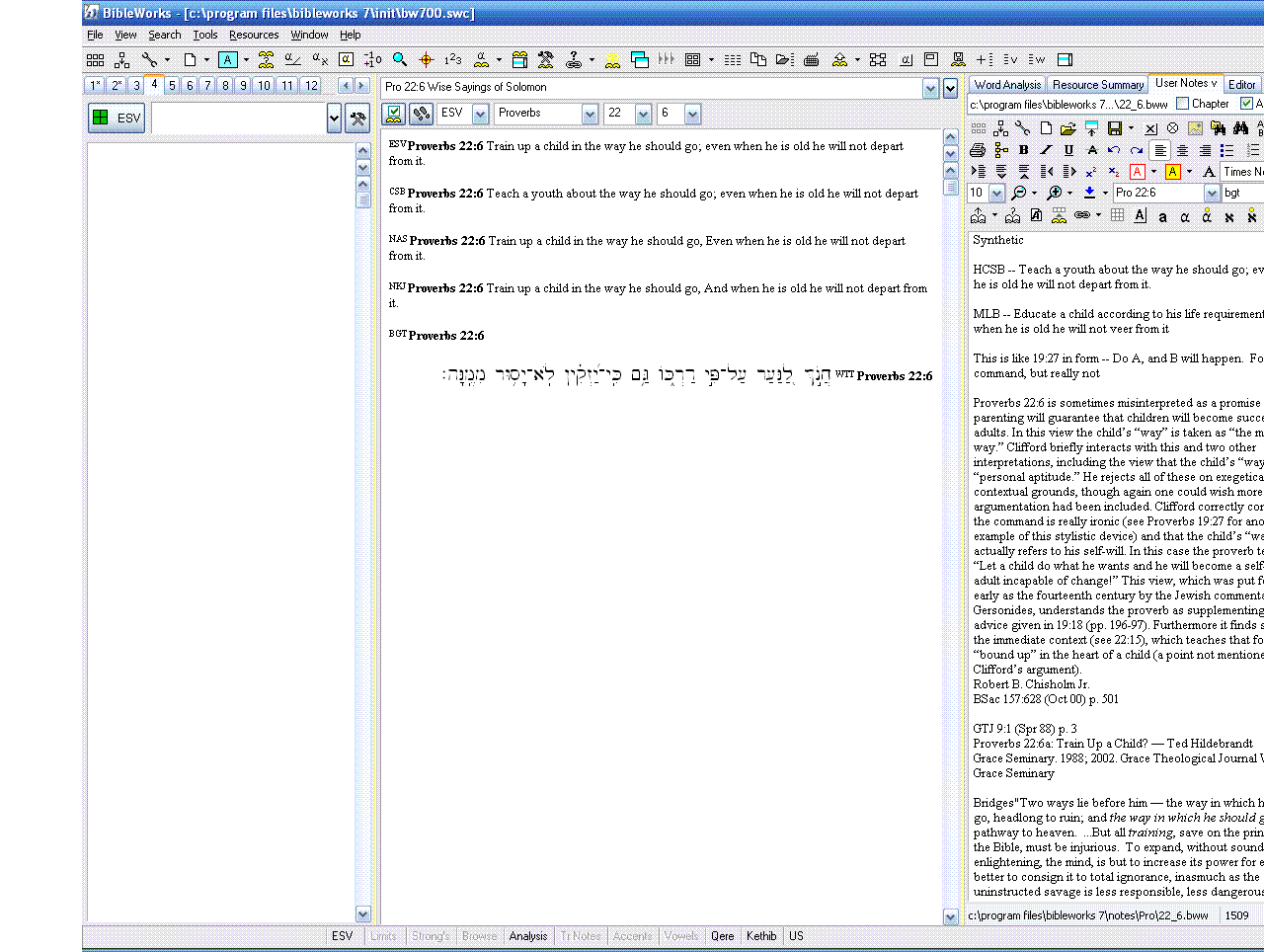
BibleWorks 7: a brief review

by Dan Phillips

Preface: in keeping with (what I think are) the distinctions between this blog and mine, I'll do a relatively brief review of this product here, supplemented with some more details over at my Biblical Christianity blog. If you want more details, nuts and bolts, go there.

Summary: with this version, BibleWorks really comes into its own. BibleWorks 7 (BW7) really is an astonishing product and an astonishing value. Preachers, scholars, students: save up the pennies, unsubscribe to Christianity Today, sell your old Watchman Nee collection, wash Dad's car and mow the lawn -- get BW7.

Review
What can BW7 do for you? It can help you learn, study, preach and teach the Bible, no matter what your level of education. If you're not a pastor, and thus may never learn Greek or Hebrew, it may be more than you need; but if you have studied or will study the God-breathed text, it is just an astonishing resource.

Bundled with the program, you get thirty-two English versions, plus various forms of the Hebrew and Greek texts. You can easily display in one version, or verse by verse in as many versions as you like. Point your mouse at a Hebrew or Greek term, and a parsing and simple definition pops up right in your display window. At the same time, whatever lexicon you've chosen instantly displays the full entry on that word in the right pane. There is another tab in that pane, which displays all the resources you have installed, whether on that word (in the lexica), or on the syntax or even textual condition of that verse (in the grammars and Metzger).

When you buy the basic package, you get an astonishing array of original-language resources. For the Greek NT, you get Thayer, Gingrich's Shorter Lexicon, and others; for the Hebrew, there's good ol' Brown-Driver-Briggs, but there's also Holladay's lexicon and the TWOT. Then, for a reasonable additional price, you can add the latest editions of BAGD and HALOT, as I did. (I figure that if you don't know the acronyms, you don't care; if I'm wrong, ask.)

But wait, there's more! You get the whole Greek NT diagramed; Conybeare's grammar of Septuagint Greek; MacDonald's Greek Enchiridion, the Archer/Chirichigno work laying out and discussing all the NT quotations of the OT, and the Septuagint lexicon by Lust (long "u"), and Metzger's textual commentary on the Greek NT, Burton's Moods and Tenses, Davis' grammar -- and a whole lot more.

Did I say "more"? Like the old ISBE, Robertson's Word Pictures, the Treasury of Scripture Knowledge, satellite Bible maps, Bible outlines... okay, I'll stop. But those and more are all part of the package.

There are many additional resources you can get for an extra price. In addition to HALOT and BAGD, I have four additional modules. One is Waltke and O'Connor's Hebrew grammar, which is a massive and useful advanced work; remember, it's keyed in with the whole text of BW7. So if Waltke-O'Connor has a discussion of the syntax of the verse I'm reading or studying, it pops up instantly in the right pane. Also, I have Daniel Wallace's Greek Grammar beyond the Basics, another terrific reference work, full of useful studies and all keyed in to the text; Futato's Basic Hebrew for Bible Study, and N. Clayton Croy's Primer of Biblical Greek. Croy is a recent work, new to me. He focuses on being brief and to the point, uses examples from the Septuagint as well as made-up sentences to be sure the student doesn't just apply his memorized English version to his exercises. (But he's very proud of his inclusive language. Ugh.) Futato has good pedagogical focus, and works to get the reader actually into the Old Testament.

What really excites me about BW7. I've used BW for years. I thought BW6 was a pretty-good tool. BW7 is simply stellar.
  1. Tabs! Used to be that, if you had a study going, and a Bible-reading plan, you'd have to create two setups, and open BW twice. Now there are a dozen tabs, and you can have that many separate readings going at the same time, saved every time you close and re-open BW7. You can keep track of your daily reading on Tab 1, then have your sermon text study on Tab 2, your Bible study on Tab 3, your research paper outline on Tab 4.... Then, mid-stream, you can step aside from any of them to do searches or other bypaths on Tab 5. Tight, convenient, cool.
  2. Editors! This, in my mind, may be the single coolest thing about this upgrade. BW6 had a text editor, but it was very buggy, limited, unreliable. No longer. BW7 has two editors: one you can keep linked either to verses or chapters, and one that is whatever you want it to be. So, for instance, say you're reading Proverbs. I prefer my User Notes keyed to verses. So on that screen, I could be making notes on each verse that strikes me. The editor automatically saves and reloads as I move from verse to verse. But meanwhile on the Editor tab, I could be building a study on the different words for "fool" in Proverbs, not tied to any particular verse.
  3. Plus, the new editors are very stable. I don't believe the editor has crashed once since I installed BW7 on March 2 of this year -- and believe me, that's a big improvement.

    Beyond that, the new, completely-rewritten Editor is a fully-featured word processor, so that it has keyboard shortcuts and a full array of editing features, all completely integrated into the program. The last edition's editor was a good idea, but a bit of a nightmare in practice. This one is a dream.

    And it's instantaneous. That is, as I mouse-over verses, my comments instantly display in the user notes. Plus, when I make a note and move on to the next verse, my note is instantly saved without further interaction.

  4. Resources! It is amazing how the BW geniuses have integrated the wide array of resources provided. Let me try to illustrate briefly. Say I'm on Genesis 4:24. Instantly the resource tab displays lexicon articles on the Hebrew words in that verse, plus the notes in Futato, Waltke, Gesenius etc. on the general grammar (noun, conjunctions, noun patters) -- plus specific notes on this verse in Gesenius (6 of them) and Waltke (2). Or similarly, on Ephesians 5:18, it immediately displays notes in Wallace and MacDonald on Imperative, Present, Passive -- plus eighteen citations of this verse in Wallace! This is truly a goldmine.
There are facets I think are improvable, changes I hope they'll make eventually. The interface, though learnable, isn't as intuitive as I think it should be in a few respects. The update system is great, but could be automated. If I write any more, however, "brief" won't pass the Truth in Blogging Post Titles standard. Check out the BibleWorks website, and their full presentation of BW7 (including a video). Plus BW runs a forum, where generally very helpful brainiac users compare notes, and prospective buyers are free to ask questions.

BibleWorks 7, in my opinion, is a true investment in one's ministry.

Dan Phillips's signature


01 May 2006

Karate exegesis

by Dan Phillips

Yes, it's true: I "do" karate, using the verb in its very broadest sense. My three sons were in first, and then it became possible for me to join in and start making with the kiyai!

One of the (to me) counter-intuitive things one learns about sparring is to present a profile, not a flat-on wide target. That way, there's less to hit -- and you're positioned to move outside. So if your opponent lunges at you, you just let him follow his momentum, you step to the side, and you work a little mayhem as he passes. Remember that: let him lunge, then do some mayhem from the side.

This same principle -- allowed lunging, then angular mayhem -- applies well in exegetical debates. Too often, we allow ourselves to be put unnecessarily on the defensive. Somebody cites a problem verse, and we start with the 47-page frontal-assault exegetical answer defending our position... and when we finish, they just go on to the next attack unfazed, untaught, unchallenged. We stay on the defensive.

I probably shouldn't tip my hand so publicly, but here's the sort of thing I try to do. Say we're making the Biblical case for Purposeful Redemption -- that is, the view that our sovereign Lord died so as actually to save particular people (Matthew 20:28; 1 Timothy 1:15), not everyone in general but nobody in particular. (Or "Effective Redemption," in that we affirm that Christ Jesus came into the world to save sinners [1 Timothy 1:15], not make it possible for them to add the necessary ingredient to save themselves.)

Our friend pulls out 1 John 2:2 -- "He is the propitiation for our sins, and not for ours only but also for the sins of the whole world" -- with the air of a gambler laying down the winning card.

"'The whole world,'" our friend emphasizes meaningfully, perhaps tapping the verse in his Bible. "'Not for ours only.'"

How do we answer?

Well, we could do a lo-o-o-o-o-ong riff on every occurrence "world" in and out of John's writings. We could go to John 11:51-52, and 12:19, and discuss them at length. We could do lots of frontal, defensive things, and take a long while and expend a lot of energy doing them.

Or we could step aside, let our friend plow on through... then work a little mayhem from the side.

That is, we could nod sympathetically and say, "Yes, I can see how that is a real problem for your position."

Our friend (if he's not read this post) will likely do a double-take, say "Yes, I... wait -- my position? Huh? It isn't! It's a problem for your position!"

You see, he has lunged. Now we make with the mayhem.

That is, with a puzzled look, we could say, "How so? Your idea is that 'world' means every human being who ever was, or ever will be born, right?" (Nod.) "So, do you believe that every human being ever born will go to Heaven?"

Our friend will assure us that he believes no such thing.

"I didn't think you did. But that means you have a real problem with this verse, don't you?" we could continue. "John writes that Jesus Christ is -- not 'would really like to be,' or 'wishes He could be,' or even 'stands ready to be,' but is the propitiation for the sins of the whole world. What is a propitiation?"

Our friend, an astute soul, replies, "A 'propitiation' is a sacrifice that turns away the wrath of God."

We agree. Then with knitted brow, we ask, "So, if you're right about 'the whole world,' then John is saying that Christ has turned away the wrath of God for the sins of every human being ever born -- you, me, Judas, the Beast, the False Prophet -- everyone.

"On that understanding, how can anyone be in Hell? Why are they there? For what are they being judged and punished?"

"For their unbelief," our friend may offer.

"Oh, I see. Is unbelief a sin?" we ask innocently.

Our friend may nor may not allow as much. If he does not, we could add, "From what I read, unbelief certainly is a sin. Or is it not a moral issue to call God a liar (1 John 5:9-10)? See," we can conclude sympathetically, "you have a real problem. On your view, either unbelief isn't a sin, in which case God is a liar; or everyone's going to Heaven, in which case, again, God is a liar; or Christ really isn't a propitiation for everyone's sins -- in which case, one more time, God is a liar. Do you think God is a liar?"

Maybe now our friend might be willing to consider that the text is capable of a better construction.

We might help him open up to the possibilities with another question: "I think it's your idea of what John means by 'world' that is giving you such trouble. Can you think of any verses where 'world' unambiguously means 'everyone who ever was born or ever would be born'? I can certainly think of many that do not. Maybe that isn't the best way to read that verse?"

At the very least, he'll now know that, if the verse is a problem for Calvinists, it isn't a problem for us alone. If he's honest, that is. (And why would we have dishonest friends?)

In your mind, try the same exercise with 1 Timothy 2:6 or 4:10, or other similar "problem" passages. I think you'll find it pretty effective.

Dan Phillips's signature