Showing posts with label wisdom. Show all posts

18 June 2013

Proverbs inspired by the author of Proverbs

by Dan Phillips


Having done an introduction to the introduction to Proverbs, last Sunday I began an actual introduction to Proverbs.

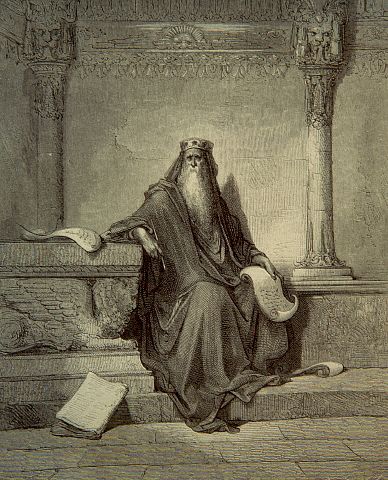
I skipped over the first Hebrew word of the book ("Proverbs-of"), to focus on "Solomon son of David king of Israel." Titled The Pithy Penmen of Proverbs, my focus was the central author and overall editor, King Solomon.

As I'm sure I've remarked somewhere before, I find Solomon one of the most frightening, sobering men in all of history, in the company of men like King Saul, fallen pastors, and the head of the pack, Judas Iscariot.

In Solomon's case, was there ever a man who was more advantaged and fell further — apart from Judas? In the sermon, I traced his lineage, his beginnings, his encounters with God, his accomplishments... and his disgraceful fall.

The sermon concluded with a series of (artless) proverbs based on the instruction one should receive from the life of Solomon. In the sermon, they're offered pretty quickly, so I reproduce them here for your reflection:

A.       Three Do’s
1.        Do love God with everything you’ve got todaynow.
2.        Do cling to God as if all the demons of hell are trying to pull you away.
3.        Do learn God’s word like there’s going to be a test. Because there will be.
B.       Four  Don’ts:
1.        Don’t live on yesterday’s devotion
a.         Yesterday’s spirituality and devotional is a wonderful thing – if you’re building on it today!
b.         But if not, all it is is a towering, damning monument to our declension, a sad comment on how far we’ve fallen, like the religious buildings of Europe.
2.        Don’t relax your guard until the General says the war’s over.
3.        Don’t think you’re home until you’re actually at Jesus’ feet.
4.    Don’t stop studying, learning and doing until the Master says to put your pencil down...which will probably never happen.

To coin a phrase: you (and I) think about that. Amen

Dan Phillips's signature

15 August 2012

Not a Literary Theme

by Frank Turk


SHAMELESS PLUG: GUT CHECK PRESS has published a juvenile and sophomoric piece of fiction which takes a massive pot-shot at the genre of end-times dispensationalist thrillers, aptly named Beauty and the Mark of the Beast.  I mention it for two or three reasons.  First, I wrote the foreword, which is probably the last time you'll see a piece of fiction with a foreword.  Second, it's available on Kindle and will only put you out $ 2.99, so at the very least you will get $2.99 worth of laughs out of it.  Third, I promised the guys to review it three weeks ago and rather than putting the 3 hours in it takes to write a decent book review I have been serializing my Sunday School Lesson on the Goodness of God because, well, why waste a really decent prep?

So that said, go buy you a copy before you don't have any more lazy summer days to do fun reading in.  


I think it’s important here to see that David is not saying, “wow: at least it’s not as bad as it could have been.”  David is in fact saying that God has delivered him from an evil end.  On the one hand, he has been delivered from the hands of Achish who is his true enemy.  David was not put to shame to be either killed or put in debt to the enemy of God’s people.  But on the other hand, David is also delivered from Saul – who ought to be his ally and friend, but is instead jealous of him to the point of madness.


David sees God as delivering from his enemies.  But how does David justify this statement?
11 Come, O children, listen to me;
     I will teach you the fear of the LORD.
12 What man is there who desires life
    and loves many days, that he may see good?
13 Keep your tongue from evil
    and your lips from speaking deceit.
14 Turn away from evil and do good;
    seek peace and pursue it.
In David’s view, God is the provider of Moral refuge and Moral guidance.  Think about this: David is stuck between two kings – both rejected by God because, frankly, they are evil.  Achish is the king of the Philistines, a godless people who have been at war with Israel for generations.  Saul was chosen to lead Israel, but this is what God says of Saul: “I regret that I have made Saul king, for he has turned back from following me and has not performed my commandments.” Both Saul and Achish are, simply put, foolish men.  They both are enemies of God, and they reject the idea that God has a right way for a man – even a King – to follow.

This is why, by the way, David’s view of this is different than mine.  In my view, if God promised me something, he should deliver it right now – or else he’s the one at fault.  In my view of it, God should stop making me wait for things he promised me.  In Achish’s view of it, we ought to be able to trust in a Giant, and a wooden Idol.  In Saul’s view of it, the king should be able to trust in himself, and maybe his son.  But these are the tasteless views of God, the views not prepared to receive what God is really doing in the world.

David doesn’t see it that way at all.   David sees that Achish is in fact surrounded by madmen – in his own words.  And Saul is himself a madman – a murderous man who can’t decide whether he wants his son to be king or to be cursed – as long as David is no longer in the way.   For both, when trouble comes, there is no place to turn to.  There is no hope for a long life, good days, or peace.  In David’s view, the first provision of God to people in trouble is wisdom.  This is a huge theme in the Old Testament – a theme which gives us, among other things, the book of Proverbs.  But David isn’t talking about a literary theme here: he is talking about what God’s provision is in a world where we are literally surrounded by crazy people: God give us moral, ethical counsel so that we may live in a way which is actually good for us.

When trouble comes, what God has given us is instruction in righteousness.  That is: we don’t do these things because we are especially good.  We don’t even do them because we think it makes us better people – because our instinct in hard times is to be afraid of the future, and afraid of the consequence of not looking out for ourselves.  David tells us that we behave in a wise way because we believe God.  We have received good counsel from Him about the right way to live – and how to know that men like Achish and Saul are, frankly, wrong.

Maybe you’re nothing like me, and this seems really obvious to you.  But here’s the thing: Unless I am mindful of this view of God as Good, I will neglect his counsel to me.  In hard times, I am prone to look inside myself for what I ought to do to fix my own problems – rather than simply keeping my tongue from deceit and turning away from evil and toward the good.  I am prone to look for what looks right in my own eyes to fix what ails me.

But more tellingly: when things are good, I am no less willing to simply do whatever it is that occurs to me rather than taking the full counsel of God which is worth more than mere comfort.

David here cuts under both of these tasteless views and says it plainly: the fear of the Lord is found in obeying Him, and trusting His good counsel.


09 August 2012

Phillips' axioms

by Dan Phillips

When you get old, experienced and opinionated, you build up a stock of axioms. Here are some of mine, for whatever use, ponderance, reflection, passing whimsy, and/or outright theft, you might make of them. They range from the theological to the practical to the political. What use will you make of them? None, maybe. But I've used various of them variously in sermons, conversation, evangelism, counseling, teaching, and writing.

Unlike Biblical Proverbs, they're uninspired. Like Biblical proverbs, the aim is memorable, thought-provoking, stick-in-your-mind brevity.

Strictly, some of these are proverbs or apothegms... but that would make too long a title!

If this list has no interest to you, I'd just ask you graciously to remember what you paid for it.
  1. If you ever weren't God, you never will be.
  2. When you sin, or say or do something really foolish, you have two choices: repent, forsake, and rectify; or start an endless cycle of doubling-down degradation. Most people do the latter.
  3. Don't be the last to know you're wrong.
  4. Trolls are thoughtful people. Nail them for what they are, and they immediately prove you right.
  5. Pastors who don't pastor aren't pastors, they're lecturers.
  6. Anyone who claims to be an apostle today is 'way, 'way too young.
  7. Any woman who seeks to lead men in church is eo ipso disqualified—if open rebellion against the Lordship of Christ is still a disqualifier.
  8. Folks who are full of themselves don't leave much room for anyone else.
  9. Every vote is a vote for the lesser of two evils.
  10. Men shouldn't let our eyes rest anywhere our hands shouldn't.
  11. Looking may just be looking, but doing starts with a look.
  12. Only way to be certain not to forget something is to do it now.
  13. Preach like God's watching, like you'll never get another chance, and like every second of your hearers' time is precious.
  14. Don't let truth lose by default through your laziness, indifference, cowardice or ignorance.
  15. If nobody else has ever seen what you're seeing in the Bible, that's probably because it isn't there.
  16. The world is far better at being the world than the church ever could be, so don't even try.
  17. Don't be shocked when unbelievers act like unbelievers.
  18. Do be shocked when believers act like unbelievers. Especially when it's you.
  19. Counsel the person who's there. 
  20. Better to have it and not need it, than need it and not have it.
  21. Excelling at anything is a matter of wisely investing odd moments.
  22. Better to know a little truth, and believe it deeply, Than to know a lot, and not.
  23. Anyone can be taught — except the dead and the proud.
  24. Everyone does what he does because he thinks it will make him happy. (Added 12/5/12)
  25. Unhappy complainers are always louder and more insistent than happy people with praises. This works both horizontally and vertically, and is equally a reproach to both categories of people. (Added 1/3/2013)
  26. When a man opposing God's truth is destroying his own argument with every word, sometimes it's best to stay out of the way and let him get on with it. (Added 1/18/2013)
  27. Kid, life's not a game. Hasty decisions cast long shadows. (Added 4/8/2013)
  28. When someone wants to misunderstand, no power on Earth and no amount of explanation can make him understand. (Added 9/26/2013)
  29. Everyone in the embrace of a sin dismisses Biblical rebuke by claiming to be misunderstood. (Added 9/27/2013)
  30. The problem with the person who thinks he's too strong to be able to join himself in fellowship with imperfect Christians in a local church is that he is actually too weak to sustain it. (Added 9/27/2013)
  31. Being married is like being a Christian, only more so. (Added 9/27/2013)
  32. Sin is always the problem, never the solution. (Added 9/27/2013)
  33. Every time someone tries to be a "'progressive' Christian," (s)he ends up being a whole lot of the one, and not much of the other. (Added 2/24/2014)
  34. With stubborn, unrepentant sin, lack of information is rarely the real problem; so pouring in information is rarely the solution. (Added 2/24/2014)
  35. God didn't give kids sense. Instead, He gave them parents, told the parents to teach the kids His Word, and told the kids to honor their parents. (Added 4/26/14)
  36. If anyone makes you feel better about thumbing your nose at God, that person does not love you. (Added 5/6/14)
  37. Arguing X does not necessarily mean that there is a real argument worth making for X. (Added 7/8/14)
  38. The hands do what the hands do because the heart is what the heart is. (Added 8/22/14)
  39. "Love" should not be defined as the compulsion to force others to subsidize the idle, the immoral, and the illegal. (Added 2/20/15)
  40. When one loves God, no reason is a large enough obstacle to prevent us from serving Him. When one does not love God, no excuse is too puny, paltry, or pathetic to keep us from serving Him. (Added 5/11/15)
  41. The moral obligation of leading by example is absolute; its efficacy, however, is often grossly, grossly overstated (2 Chron. 27:2). (Added 8/26/15)
  42. Racism is not the cure for racism. Only the Cross of Christ is. (Added 2/12/16)
  43. Atheists tend to blurt bombastic clichés rather than read, reflect, and respond. (Added 11-7-2017)
  44. Big names are often small people. (Added 1-9-2018)
  45. Youth, dirt-ignorance and hubris are a deadly combination. (Added 1-9-2018)
  46. The mark of a truly big person is how he treats "little people." (Added 1-9-2018)
  47. No human authority has the right to command what God forbids, or forbid what God commands. (Added 4-11-18)
  48. Obedience isn't a technique. You don't "try" it, to see if it "works." (Added 5-14-2018)
  49. {Instant acclaim + massive soapbox} minus {coherent, thought-out, well-grounded, long-demonstrated convictional, Biblical worldview} = disaster. Generally not a matter of if, but when, and how bad. (Cf. 1 Timothy 5:22). (Added 5-14-2018)
  50. Sin snowballs. That's its propensity. No sin likes to remain alone. (Added 7-23-2018)
  51. You can't make someone see what he doesn't want to see. (Added 5-12-2020)
  52. The existential distance between "humiliated" and "humbled" is so much vaster than the lexical distance. Many who are the former, are not the latter — to their destruction. (Added 4-5-2021)
  53. Once Pride makes an investment, it will defend it to the death...of everything. (Added 8-2-2021)
  54. You can lead a "continuationist" to Scripture, but you can't make him think. (Added 12-15-2022)
  55. God is good, but He plays the long game. (Added 2-22-2024)
  56. Anyone who will cheat with you will cheat on you. (Added 4-10-2026)
There y'go.

[By the way, there is a companion-post: 25 Things I've Learned. You're welcome!]

Dan Phillips's signature

15 April 2012

Lamentable Ignorance

Your weekly dose of Spurgeon
posted by Phil Johnson


The PyroManiacs devote some space each weekend to highlights from The Spurgeon Archive. The following excerpt is from "Compassion on the Ignorant," a sermon preached on Thursday evening, 3 April 1884, at London's Metropolitan Tabernacle.


he talk of the theological hall is not understood in the cottage; and common phrases, which reading people understand at once, are not understood by multitudes of people.

But the pity is that there are also thousands of reading people who are totally ignorant of the things of God,—some of the wealthiest, some of the best educated, aye, some even of those who have been to the university, and some who put the "D.D." after their names.

"No," say you, "that cannot be."

I say that it is; and if you yourself know the way of salvation, you have but to talk with some of these people to find that what I say is true.

This is a truth that is learnt by the teaching of the Holy Ghost, and not by the teaching of theological professors. A man might spend a century under the best ministry, or in the best school that ever existed on earth, and yet, at the end of one hundred years, he might not know the things of God; for these truths must come as a revelation to each man, and God the Holy Ghost must teach them to each one, or they will never be learned. This is the standing miracle in the Church of God; and unless we see it continually wrought, we have not the clearest evidence that our religion is supernatural and divine.

Every man who really receives it, receives it not because it suits his taste or his palate, but because the Spirit of God sends it home to his heart. Every man who truly knows Christ, knows him not because with his own faculties he found him out, but because it pleased God to reveal his Son in him. And, apart from this, there is and must be to the end of human life an absence of all real knowledge of the Lord Jesus Christ.

First, "Ye must be born again;" and then, being born again, ye must be taught of the Spirit of God; and, if we are not, as the strongest light cannot make a blind man see, and the greatest heat cannot make a dead man warm, so, neither can anything that we do, as long as the soul is unrenewed, ever cause it to know God and his grace aright. It is a common ignorance, then, in all ranks of society.

It is also an ignorance concerning the most important matters; for the men of whom I am now speaking are, first, ignorant of themselves. They are ignorant of their own ignorance; and perhaps there is no ignorance that is so hard to deal with as the utter ignorance of men as to their own ignorance.

"What! you call me ignorant?" a man asks. "I know everything; I have read from Genesis to Revelation, and I understand it all; I could preach as well as anybody."

Yes, but that kind of talk shows that you do not know, for he that knows that he does not know; and there is no man less inclined to boast of his knowledge than the man who has a good deal of it.

Whenever I find the men of the modern school of thought, as they are continually doing, sneering at the orthodox because we are all uncultured, and so forth, I think to myself, "And if you only had a little culture, you would not sneer so often." It is a mark which will never mislead you, that he who thinks that he knows is a fool; and he who says that he knows more than anybody else, and can afford to deal out his sneers liberally to others, is a gentleman who, if justice were dealt out to him, would be himself sneered at.

Those who are strangers to themselves do not know their own ignorance, and that is lamentable ignorance indeed.

C. H. Spurgeon

25 March 2012

True Wisdom Is Not Academic

Your weekly dose of Spurgeon
posted by Phil Johnson


The PyroManiacs devote some space each weekend to highlights from The Spurgeon Archive. The following excerpt is from "The Sluggard's Farm," one of the sermons in the book Farm Sermons.


ertain persons call themselves "cultured," and yet they cultivate nothing. Modern thought, as far as I have seen anything of its actual working, is a bottle of smoke, out of which comes nothing solid; yet we know men who can distinguish and divide, debate and discuss, refine and refute, and all the while the hemlock is growing in the furrow, and the plough is rusting.

Friend, if your knowledge, if your culture, if your education does not lead you practically to serve God in your day and generation, you have not learned what Solomon calls wisdom, and you are not like the Blessed One, who was incarnate wisdom, of whom we read that "he went about doing good." A lazy man is not like our Saviour, who said, "My Father worketh hitherto, and I work." True wisdom is practical: boastful culture vapours and theorizes. Wisdom ploughs its field, wisdom hoes its vineyard, wisdom looks to its crops, wisdom tries to make the best of everything; and he who does not do so, whatever may be his knowledge of this, of that, or of the other, is a man void of understanding.

Why is he void of understanding? Is it not because he has opportunities which he does not use? His day has come, his day is going, and he lets the hours glide by to no purpose. Let me not press too hardly upon anyone, but let me ask you all to press as hardly as you can upon yourselves while you enquire each one of himself—Am I employing the minutes as they fly? This man had a vineyard, but he did not cultivate it; he had a field, but he did not till it. Do you, brethren, use all your opportunities? I know we each one have some power to serve God; do we use it? If we are his children he has not put one of us where we are of necessity useless. Somewhere we may shine by the light which he has given us, though that light be only a farthing candle. Are we thus shining? Do we sow beside all waters? Do we in the morning sow our seed, and in the evening still stretch out our hand; for if not, we are rebuked by the sweeping censure of Solomon, who saith that the slothful is a "man void of understanding."

Having opportunities he did not use them, and next, being bound to the performance of certain duties he did not fulfil them. When God appointed that every Israelite should have a piece of land, under that admirable system which made every Israelite a landowner, he meant that each man should possess his plot, not to let it lie waste, but to cultivate it. When God put Adam in the garden of Eden it was not that he should walk through the glades and watch the spontaneous luxuriance of the unfallen earth, but that he might dress it and keep it, and he had the same end in view when he allotted each Jew his piece of land; he meant that the holy soil should reach the utmost point of fertility through the labour of those who owned it. Thus the possession of a field and a vineyard involved responsibilities upon the sluggard which he never fulfilled, and therefore he was void of understanding. What is your position, dear friend? A father? A master? A servant? A minister? A teacher? Well, you have your farms and your vineyards in those particular spheres; but if you do not use those positions aright you will be void of understanding, because you neglect the end of your existence. You miss the high calling which your Maker has set before you.

The slothful farmer was unwise in these two respects, and in another also; for he had capacities which he did not employ. He could have tilled the field and cultivated the vineyard if he had chosen to do so. He was not a sickly man, who was forced to keep his bed, but he was a lazybones who was there of choice.

You are not asked to do in the service of God that which is utterly beyond you, for it is expected of us according to what we have and not according to what we have not. The man of two talents is not required to bring in the interest of five, but he is expected to bring in the interest of two. Solomon's slothful was too idle to attempt tasks which were quite within his power. Many have a number of dormant faculties of which they are scarcely aware, and many more have abilities which they are using for themselves, and not for him who created them. Dear friends, if God has given us any power to do good, pray let us do it, for this is a wicked, weary world. We should not even cover a glow-worm's light in such a darkness as this. We should not keep back a syllable of divine truth in a world that is so full of falsehood and error. However feeble our voices, let us lift them up for the cause of truth and righteousness. Do not let us be void of understanding, because we have opportunities that we do not use, obligations that we do not fulfil, and capacities which we do not exercise.

As for a sluggard in soul matters, he is indeed void of understanding, for he trifles with matters which demand his most earnest heed. Man, hast thou never cultivated thy heart? Has the ploughshare never broken up the clods of thy soul? Has the seed of the Word never been sown in thee? or has it taken no root? Hast thou never watered the young plants of desire? Hast thou never sought to pull up the weeds of sin that grow in thy heart? Art thou still a piece of the bare common or wild heath? Poor soul! Thou canst trim thy body, and spend many a minute at the glass; dost thou not care for thy soul? How long thou takest to decorate thy poor flesh, which is but worm's meat, or would be in a minute if God took away thy breath! And yet all the while thy soul is uncombed, unwashed, unclad, a poor neglected thing! Oh it should not be so. You take care of the worse part and leave the better to perish through neglect. This is the height of folly! He that is a sluggard as to the vineyard of his heart is a man void of understanding. If I must be idle, let it be seen in my field and my garden, but not in my soul.

Or are you a Christian? Are you really saved, and are you negligent in the Lord's work? Then, indeed, whatever you may be, I cannot help saying you have too little understanding; for surely, when a man is saved himself, and understands the danger of other men's souls, he must be in earnest in trying to pluck the firebrands from the flame. A Christian sluggard! Is there such a being? A Christian man on half time? A Christian man working not at all for his Lord; how shall I speak of him? Time does not tarry, DEATH does not tarry, HELL does not tarry; Satan is not lazy, all the powers of darkness are busy: how is it that you and I can be sluggish, if the Master has put us into his vineyard? Surely we must be void of understanding if, after being saved by the infinite love of God, we do not spend and be spent in his service. The eternal fitness of things demands that a saved man should be an earnest man.

C. H. Spurgeon