 learned about the accusations against Tom Buck when they first surfaced months ago. Tom himself informed me on March 27 and sent me a copy of the packet someone had mailed anonymously to First Baptist Church of Lindale, Texas, where Tom Buck serves as Pastor. Copies were mailed to each of his elders' and deacons' homes (about 30 households). Tom wanted my opinion and counsel. On that same day, elders from Tom's church asked if they could discuss the matter with me in a conference call. So I read and digested the material thoroughly.
There was no evidence that Pastor Buck was preaching sermons written by others. On the contrary, the evidence proved definitively that he was doing his own thorough study of the biblical text in the preparation of his sermons. But there were also examples of wording taken directly from commentaries without attribution. That's a practice I do not endorse—and when I've expressed opinions about it, I have candidly referred to it as "plagiarism," because it technically is.
Nevertheless, it's small-time, non-criminal, traffic-ticket-level plagiarism, usually motivated by haste, carelessness, negligence, perhaps even laziness—not by a desire to steal others' work. The preacher who uses words he read in a commentary without attribution is not the moral equivalent of a horse thief. I don't condone or approve the practice, but unless it is being done on a large scale by someone who is using it to avoid his own study of the biblical text, it is ordinarily not a serious enough infraction to disqualify a teaching pastor or ruin his reputation and career.
The packet of evidence against Pastor Buck was pretty weak, in my judgment, and the fact that it had been assembled and sent anonymously also made the motives and character of the incognito accusers suspect. I would be loath to join an obviously dishonest, underhanded campaign like that. Nevertheless, I tried to examine the evidence objectively.
And to be clear: I hate plagiarism. I've been involved in Christian publishing for 50 years, and purposeful theft of another author's work is a transgression I do not view lightly. In publishing and in academia, deliberate plagiarism rises to the level of a capital crime. Students or people who publish works where they intentionally try to pass someone else's writing off as their own deserve whatever harsh consequences they receive.
But, to reiterate, a pastor using words he got from a commentary is categorically different, because every careful expositor will glean ideas and insights from the best commentaries, and you don't want to front load a sermon with verbal footnotes.
Still, pastors: Use your own words. Read commentaries while you're studying a biblical text. Read any and all commentaries that will help you think through the passage you are preaching from. But when you reach the process of preparing your preaching notes, set the commentaries aside. Using just your own brain and a sheet of paper for taking notes, organize all the good ideas you gleaned from your study into a logical flow reflecting your own thinking, and then write your sermon notes in your own words without leaning on the way someone else phrased the idea. The principle is simple: Do your own work. Say it in your own words. Don't just parrot the exact words you read in a commentary.

And if you think a commentator has stated an idea in words so clear and brilliant that you could not possibly improve on the phrasing or say it differently, then go ahead and quote the commentary, but say whom you are quoting.
I shared my concerns about the proper use of commentaries with Tom Buck, and I candidly told him he needed to adopt more careful methods in his preparation. He agreed and assured me he had already changed his study habits and was eliminating the use of any verbatim quotations without attribution. When I met with the Lindale elders and deacons, I was likewise completely candid about my concerns and convictions, and I offered to answer their questions regarding how they should handle their pastor's case, and how (if at all) they should respond to these anonymous mailings. The elders were receptive to my counsel and as far as I know implemented all the corrective measures I recommended.
Tom asked if I thought he needed to make a public statement of confession and repentance to his congregation. I thought it would be good for him to do that, but it should come from his own heart and his own conscience, not from anyone's mandate.
Tom did make such a statement. It was clear; it was candid; it was thorough; it was penitent. He described to his congregation what he had done, acknowledged the wrong in it, and outlined what he and the elders had done and would do to address the issue. In all of this, Tom Buck never pushed back, never made excuses, and never tried to argue that he wasn't doing anything he shouldn't. He embraced the criticism completely, admitted where he was wrong, and adjusted his approach immediately.
The matter was thus settled as it should have been, in the context of the local church.
Rather, it should have been settled, until someone started mailing out the accusatory packets some four months later, falsely claiming the Lindale elders had utterly failed "to deal with this public sin biblically." (The cover letter was full of plural first-person pronouns, making it clear that a group, not an individual, were the instigators in this campaign.)
These letters were sent, it appears, to almost everyone who had ever been on the G3 speakers' list. I received one. It came to my old address and was forwarded by the postal service. The senders remained anonymous, but they fraudulently put return addresses on the packages to make it appear they were coming from someone affiliated with FBC Lindale. The envelope even bore a Texas postmark, but I knew immediately it didn't really come from FBC Lindale, because everyone there knew that I was already aware of the allegations and didn't need another copy of the packet.
The fake return address also made it immediately obvious that whoever sent these packets was not motivated by a love for the truth or any other wholesome rationale. The entire charade was purely and simply an ugly, dishonest attempt by some anonymous group of miscreants to discredit Pastor Buck.
The case had already been dealt with by FBC Lindale, so it didn't need to be broadcast to the wider public. But there is credible testimony that the scheme to make it as public as possible was hatched by someone in leadership at the board level both in Pray's Mill Baptist Church (Douglasville, GA) and in G3. Witnesses with firsthand knowledge say the packets were taken to Texas and mailed from there in an attempt to further conceal their origin.
 Now the whole affair is as public as they wanted it. And it won't go well for those who were building a gallows for Tom Buck.
I don't know precisely who or how many men in leadership in those two organizations were involved in the plot to destroy Tom Buck. I'm not interested in trying to untangle a web of allegations and denials involving people who are willing to scandalize and discredit a fellow minister clandestinely. The rank dishonesty involved in such a strategy speaks for itself. It is sufficiently clear that men in leadership at both Pray's Mill and G3 were behind it. Indeed, members of both boards were privately informed of the charges and the evidence last week. They did not respond to the Lindale elders' request for a meeting.
|
The similarities between this episode and the issues that forced Josh Buice to step out of public ministry last year are too stark to ignore. One wonders how this itch to discredit or destroy their adversaries by anonymous dirty tricks crept into G3's DNA. This will be another scandal G3 did not need, and it is one they probably cannot survive. The organization frankly should not survive if anyone on the inside who knew about or participated in this plot remains in leadership. These are men who have refused to accept Josh Buice's expressions of repentance and want to dictate for him what his repentance should look and sound like. This case shows they are not qualified to make judgments like that.
No one loved and promoted G3 with more enthusiasm than I did when the organization's focus was clear and singular. So it pains me to say this, but frankly, it is time for G3 to dissolve and go away.




 ric Satie is one of Darlene's favorite composers. He called some of his work "furniture music"—music not to be listened to, but to be played as background. That's what most music has become these days, but it was a radical idea in Satie's day.
 Now, don't tell Darlene this, but Satie was a supremely aberrant individual. Look up the French word for "eccentric." Instead of a definition, they could simply put Satie's picture there.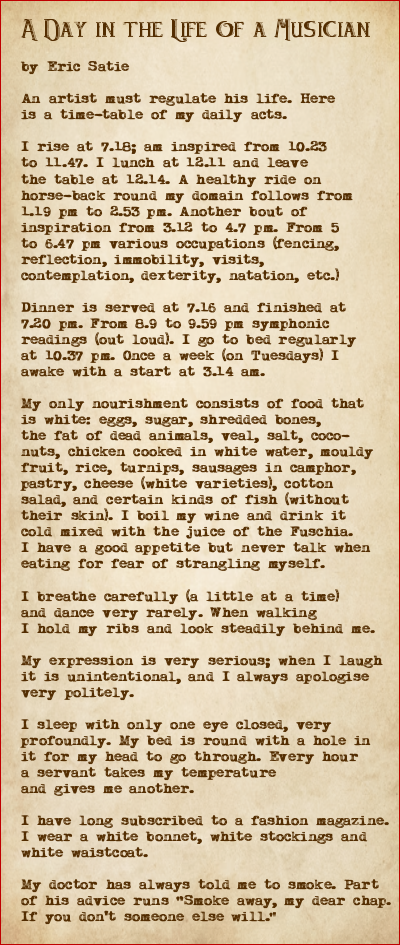
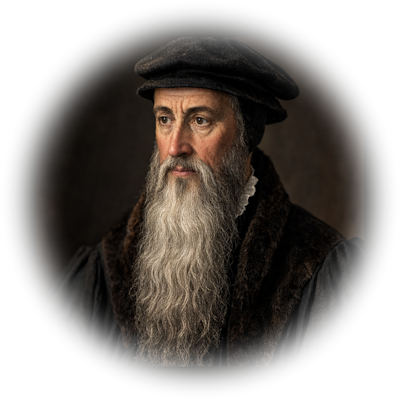
 hat was the sort of preaching you had from the Protestant Reformers. What kind of preaching? Prophetic preaching, not priestly preaching. What we have today, you know, is what I would call "priestly preaching"—very nice, very quiet, very beautiful, very ornate. Sentences turned beautifully; prepared carefully.
 I'm often surprised and not a little shocked by the tone and flavor of some of the discourse on social media among people who self-identify as gospel-believing Christians. I'm not talking only about the annoying busybodies, false accusers, trash-talkers, and all-purpose haters. I'm thinking also of the people who routinely sprinkle their comments with obscene or profane language ("cuss words," as the idiom used to be known). They tend to be fiercely resistant to any criticism or correction of the practice. They think the casual use of salty language shows how "genuine," and "relatable" they are, and this somehow enhances the believability of their testimony.
 he followers of the early Reformers were distinguished by the sanctity of their lives. When they were about to hunt out the Waldenses, the French king, who had some of them in his dominions, sent a priest to see what they were like, and he, honest man as he was, came back to the king, and said, "As far as I could find, they seem to be much better Christians than we are. I am afraid they are heretics, but really they are so chaste, so honest, so upright, and so truly pious, that, though I hate heresy—I hope your majesty does not suspect me on that account—yet I would that all Catholics were as good as they are."
 hen an enterprise begins in martyrdom, it is none the less likely to succeed; but when conquerors begin to preach the gospel to those they have conquered, it will not succeed; God will teach us that it is not by might.
 obody wonders that Mahometanism spread. After the Arab prophet had for a little while himself personally borne the brunt of persecution, he gathered to his side certain brave spirits who were ready to fight for him at all odds. You marvel not that the sharp arguments of scimitars made many converts.
 Now, if our Lord had arranged a religion of fine shows, and pompous ceremonies, and gorgeous architecture, and enchanting music, and bewitching incense, and the like, we could have comprehended its growth; but he is "a root out of a dry ground," for he owes nothing to any of these. Christianity has been infinitely hindered by the musical, the æsthetic, and the ceremonial devices of men, but it has never been advantaged by them, no, not a jot. The sensuous delights of sound and sight have always been enlisted on the side of error, but Christ has employed nobler and more spiritual agencies.
 ouTube and social media are full of AI-produced videos using John MacArthur's voice and image, making him say things that perhaps sound like something you might think he believed, but expressing opinions he never held and making statements he never made. There are dozens of these fake videos floating around, and I am asked about them almost daily.
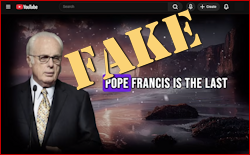 My standard reply: "No, those are fake. If you want to be certain you are hearing something John MacArthur actually said; or if you are looking for a video or audio recording of John's that you can trust to be genuine, you'll find it at
  John was never a fan of Siri or Alexa, and he certainly did not want to lend his face, voice, or personality to an AI-generated cyber-pastor or digital rabbi. The idea of an artificial John MacArthur saying fake prayers for people with real needs absolutely appalled him—perhaps even more than it appalled the rest of us.