by Phil Johnson
ith this post, I'm bringing to a close the long series on 2 Corinthians 5:21 that we began in May. Here's a complete list of all the previous posts in the series:


appreciated John Piper's recent remarks about 2 Corinthians 5:21:
"I spent days on that verse, reading articles that are tearing it to shreds—and abandoning what 1500 years have said it meant—in order to warrant putting our God-wrought obedience where Christ's righteousness belongs."
John Piper
I've read some of those same articles, too, and I share Dr. Piper's dismay about the drift that's so popular these days.
But rather than dissecting all the ways this text has been nuanced, especially by people who claim it has nothing to do with Christ's atonement or the actual content of the gospel message anyway, I am trying (throughout this series) to give a positive explanation of what I believe the passage clearly teaches (which happens to be what the vast majority of Protestant Bible teachers have always believed).

I will just say that the exegetical gymnastics necessary to impose any
other sense on 2 Corinthians 5:21 are really quite remarkable. Most of the ideas that have been set forth in numerous attempts to reconcile this simple verse with the various New Perspectives on Paul are rather far-fetched. They often involve tangled interpretations that are hard to make sense of at all. Surely the meaning of Scripture cannot be
that obscure.
We're taking note of three perspectives of Christ presented in 2 Corinthians 5:21. In the previous two post of this series, we considered
"Christ as sinless," and
"Christ made sin." Now consider—
Christ in Union with SinnersNotice the last clause of the verse, and especially the last two words: "He hath made him to be sin for us, who knew no sin; that we might be made the righteousness of God
in him."Now, what is this saying? In what sense are we "made the righteousness of God"?
You might be tempted to think this means simply that God
makes us righteous. After all, according to Romans 8:29, He
did "predestinate [us] to be conformed to the image of his Son." And according to 2 Corinthians 3:18, we are being changed into the image of Christ.
But
this verse isn't talking about that at all. Look at the parallelism: God made Christ to be
sin; He makes us to be
righteousness. Similar expressions, saying similar things.
God made Christ to be sin. How did He do it? By making Him sinful? We already discussed why that
cannot be the meaning. God made Christ to be sin by
imputing our sin to Him.
Conversely, we are made righteousness. How is that done? By making us righteous? No. By imputing the righteousness of Christ to us.
The context makes this clear. Notice: it's not our own righteousness; it's "the righteousness of God." It's an imputed righteousness. This verse is describing a straightforward exchange: Just as sin was reckoned to the account of Christ, and He was punished for it, so righteousness is reckoned to our account, and we are rewarded for it. We stand before God clothed in a perfect righteousness, so that in the estimation of the heavenly Judge, it is as if we were the embodiment of righteousness itself.
Now, where does this righteousness come from? Is it just an ethereal righteousness floating around in the universe that is imputed to us?
No; it is the righteousness of Christ. "That we might be made the righteousness of God
in him.""In Him." In
union with Him.
Again, this
verse is describing an exchange of our sin for Christ's righteousness. That exchange—a double imputation (our sin reckoned to Christ; His righteousness reckoned to us)—
is the starting point and the whole basis of our spiritual union with Christ.In other words, union with Christ is not an
alternative to forensic imputation (as some recently have claimed). It's a corresponding truth. The two ideas are distinguishable but inseparable. They go hand in hand, like faith and repentance, or justification and sanctification. We are "in Christ" in the sense that
through imputation, we become participants in His life, death, and resurrection. Union with Christ means much more than that, of course. But the starting point of our union with Christ is no
less than that. This is the reason Paul employs the language of imputation so frequently when he deals with the subject of justification.
By the way, Paul speaks of our union with Christ more than once here 2 Corinthians 5. Verse 17 uses the expression "in Christ"—"if any man be in Christ, he is a new creature: old things are passed away; behold, all things are become new."
The apostle Paul often employs the language of spiritual union with Christ as a kind of shorthand to describe the believer's perfect standing with God. We are seen by God
in Christ. "For you died, and your life is hidden with Christ in God" (Colossians 3:3). Christ's righteousness covers us like a garment; His life counts for our life; and the merit of His obedience accrues to us.
Imputation is the common thread that ties all those truths together.To put it in simple terms: just as my sin was imputed to Christ so that He could pay the full price of it for me;
in exactly that same way, His perfect life counts as mine by imputation.
No other interpretation does full justice to the text and context of 2 Corinthians 5:21.That great exchange (my sin for Christ's righteousness) is the very essence of the doctrine of justification.
Note: it's more than just the forgiveness of my sins. That would merely leave us with a blank slate. But the positive merit of Christ's righteousness is also credited to our account, so we get full credit for the perfection of His divine righteousness and His holy life.
Active ObedienceThat brings us back to an issue we discussed briefly in
an earlier post. Here's why it is so important to understand that the
life of Christ, and not
His death only is an essential part of His atoning work. He lived a full, perfect life of obedience on our behalf, and therefore His perfect righteousness as a man counts for us in the reckoning of God.
Did you ever wonder why, at His baptism, Jesus told John the Baptist it was absolutely necessary that He, the sinless Saviour, receive a symbol of repentance? Matthew 3:13-15: "Then cometh Jesus from Galilee to Jordan unto John, to be baptized of him. But John forbad him, saying, I have need to be baptized of thee, and comest thou to me? And Jesus answering said unto him, Suffer it to be so now:
for thus it becometh us to fulfil all righteousness."Now think about that. John's Baptism signified repentance (Acts 19:4). John the Baptist understood the situation. Jesus was sinless. John was not. If one of them should have been baptizing the other, it would appear that Jesus should have been baptizing John.
But Jesus expressly said He was doing it
"to fulfil all righteousness." For whose sake? For His own? Certainly not. He had no need of repentance or baptism. But He did it for
our sake, to fulfill the righteousness that would be ours by imputation. It was a complete and perfect righteousness, encompassing even the symbol of our repentance.
To sum up:That is the simple meaning of this text. I can't say it any more clearly than John MacArthur often states it:
"God treated Christ as if He had committed all the sins of all the people who would ever believe, so that He could treat them as if they lived Christ's perfect righteousness."Therefore, Paul says, "We pray you in Christ's stead, be ye reconciled to God."
How can you do that? Forsake your love of sin, embrace Christ by faith, and receive the water of life He promises to those who are spiritually parched.
By the way, this great exchange of our sin for Christ's righteousness was a common theme in Paul's writings. He spoke of it in Romans 3. After spending two and a half chapters showing that everyone, Jews, pagans, and religious Gentiles are hopeless sinners, unable to save themselves, he says in verses 21-22, "But now the righteousness of God without the law is manifested, being witnessed by the law and the prophets; Even
the righteousness of God which is by faith of Jesus Christ unto all and upon all them that believe."In other words, we lay hold of Christ's righteousness by faith. A few verses later, he says in Romans 4:5, "To him who does not work but believes on Him who justifies the ungodly, his faith is accounted for righteousness." And verse 6: "God imputes righteousness apart from works."
Paul said that his own singular hope for salvation lay not in himself, but (Philippians 3:9), "[To] be found in [Christ], not having mine own righteousness, which is of the law, but that which is through the faith of Christ, the righteousness which is of God by faith."
That's the message Christ's true ambassadors are called to proclaim to the world. We need to make it clear, and we need to preach with force and biblical conviction.
History reveals that when Christians have backed away from this doctrine, the church has gone into decline and worldliness. But when preachers have featured this truth—as the Reformers did, and as George Whitefield and Jonathan Edwards did in the First Great Awakening, as the Welsh preachers did just before the outbreak of revival in Wales—this truth has awakened the church and enlivened the people of God.


 ince snippets from Dan Wallace's writings have come under fire in the meta here, it's only fair to note that he has replied to some of the comments and questions that have been raised.



 also, but pointed out that I'd reviewed the book, not the man. Paul responded that he'd done the reverse, and that seemed like the end of that.
 developed as Paul’s is" -- maybe; he's not sure, he's just asking. Out loud, in the hearing of potentially hundreds of thousands.


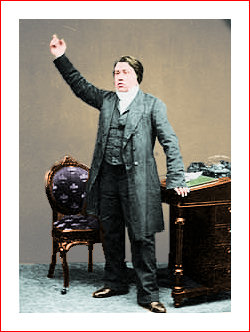
 lick on the picture to the right to download a 3-megabyte high-resolution colorized digital scan of a photo of Charles Spurgeon. Put this on removable media, take it to Costco or some other photo processing place, and print it in any size up to 12x18. If you can find a Victorian oval frame to fit, you will love the way this looks on the wall of your study.

 I’m taking some flack from readers because I’m only posting at my personal blog rather than here at TeamPyro, so on the one hand I’m thinking, “Who knew people read teamPyro for my posts? I thought I was filler of the sake of stringing people along until Phil can paste a post together.” On the other hand I’m thinking, “Geez, I don’t want to end up like Pecadillo as a sort of token blog member.”
 Let me give you two examples. The first would be me personally – especially my penchant for sarcasm. Like yesterday when I chided Phil into making graphics for the blog to prop up a rating system for when we review books or whatever. That was sarcasm for the sake of berating Phil into doing something I would have done if I had the time, but if you were looking for a fight you could have taken what I said as insults.
 In saying what I did about Dr. Wallace, I was making a distinction (and I made it poorly – I admit it) between being a theology guy and being a language guy. To make a poor comparison, Kurt Aland is a wildly-talented language guy – most of us bank on his scholarship to use a translation of the NT in English. However, I wouldn’t give you the change in my pocket for his theology -- unless you'd let me throw it away for you. He can be someone in whom we trust on an academic question like which variant most likely captures the earliest source, but then he can also be someone whom we ignore when he starts running down the idea of inerrancy – because that’s not his field.
 In that, he’s advocating for a robust text in the NT – one which is not some kind of flat, linguistic calculus that yields only one byte of information per annotated verse. And when he says something like, “Luke changes the meaning of Christ’s words” in a paper on some portion of the NT, he is not advocating for some quackery that demands that Luke was a scoundrel who was trying to make a Jesus relevant to his own time through ammendation and distortion: he is making the right-minded decision to believe that some human being with a writing instrument wrote down that passage we are reading, and he had some motivation for writing which the text reveals by what it says.

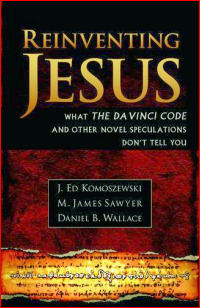 not because I am vying for J. I. Packer / F. F. Bruce "Pan-Endorser" status, but because Reinventing Jesus informed, educated, and encouraged me, and reinforced my confidence in Scripture. Being me, I'll pick at this and that little bone, but wish to make clear at the outset that I heartily recommend the fish.

 Summary: Reinventing Jesus is solid, readable, informative, useful, fresh, up-to-date, clever, and sometimes even funny.
 is hard to beat. I'm not even certain Bridges knew Hebrew (a big minus), but he'll remark on the English text, and then give brilliant illustrations of the principle straight from the Bible. Plus he's often eminently quotable.
 henever I look abroad on the aggregate assemblies of religious people, I am obliged to hold a large number of my hearers in supreme contempt. Are you not one day crowding to hear me preach what I think the truth, and another day cramming a place where a man is preaching the very opposite to what I hold to be true?


 imply put, the so-called "Emerging Church" has no way to fend off heresy. The movement itself grew out of postmodern presuppositions about truth and assurance that make any kind of vigorous, biblical defense of the faith impossible.
 I'm not proposing that we literally bust out
 oger Overton at the A-Team blog finds "a number of problems" with the above post.
 n May, I started a series of posts on 2 Corinthians 5:21. The rigors of my real-life schedule have made it difficult to keep a sense of momentum in that series, but I am determined to finish it.
 We're taking note of three perspectives of Christ presented in 2 Corinthians 5:21. In the previous post of this series, we examined the first of the three, "Christ as sinless."
 We'll flesh those ideas out a little more in the final posts in this series.

 or most of the day, our friend and favorite rocketman Jeff Williams will be hanging around the outside of the International Space Station, doing maintenance work and whatnot. You can watch it live on