Showing posts with label depravity. Show all posts

28 March 2013

Extreme measures, dire situation

by Dan Phillips

(Excerpted from The World-Tilting Gospel, 77-79)

Our eyes open on an operating room.

We've never seen such a scene. Impossibly complicated machines are busily engaged. We see blinking, flashing, pulsing; we hear beeping, buzzing, throbbing. A dozen measurements display on a dozen monitors. Tubes, wires, even arcing electricity fill the room.

One full complement of antiseptically garbed professionals rushes about, working intently on a patient in the center of the surgical theater. Instruments flash, experts lean in, all attention is riveted on this figure and the controlling machinery surrounding him. Off to their right stands another complete team, uniformed and equipped, waiting for their cue to dive in and begin their specialized assignment. On the other side, to the left, another squad reclines on cots, resting.

A clock on the wall reads Time elapsed, and gives a figure of eighteen hours, forty-seven minutes, nineteen seconds . . . twenty . . . twenty-one . . .

And we gasp, Good heavens, what a desperate ruin this poor soul must be, that such a massive-scale operation was necessary!

Blink. Our eyes open again on a garden.

It is nighttime. Before us, we immediately recognize the figure of Jesus Christ—but we are seeing Him as no one has ever seen Him. This man who has stared down thousands of hell’s foulest demons without blinking, who has shut up storms with a curt word of command, who has reduced the human powers to babbling, loose-bowelled nonsense—is falling down in horror, and He is pleading with His Father.

Listen. What does He ask?

“Abba, Father, all things are possible for you. Remove this cup from me. Yet not what I will, but what you will” (Mark 14:36).

The Father has never through all eternity denied a request of the Son. Surely He will grant this! Yet Christ pleads it once . . . twice . . . three times. There is no answer. The Father says nothing.

Another first—and an alarming one.

An angel appears. We hear no words. But the Son rises. He squares His shoulders. He goes forth, meets a jittery and heavily armed crowd. He allows Himself to be arrested.

Too horrified to look away, we watch from afar as He is led off, as He is subjected to atrocious and repellent mockeries of justice; as He is beaten, whipped to a ragged walking corpse; as He is mocked,
condemned, and sent off carrying a cross.

To that cross He is nailed. On that cross He bleeds. He groans under glowering, angry, darkened skies. Our gut clenches and we gasp to hear Him cry out in prayer once again, this time to the silent heavens, “My God, My God, why have You forsaken Me?” He lets out a loud cry . . .

And He—the resurrection and the life; the way, the truth, the life; the bread of life—dies.

Nauseated with horror, through numb lips we murmur, “Dear God, why? What a desperate ruin must we be, that such a massive-scale operation was necessary!”

For, you see, the Bible is clear that the miserable, lonely death of the Son of God was absolutely necessary for the recovery and redemption of men and women. If such extreme measures were an absolute necessity—and they were—then the ruin from which we needed to be rescued must have been far worse, and far more comprehensive, than many imagine. As we are about to see, the cross of Christ underscores the truth of what we just learned about man, and our need for what we are about to learn...

Dan Phillips's signature


04 June 2012

Inability and Responsibility

by Phil Johnson


ere's a bit of e-mail correspondence from someone who is adamantly opposed to the biblical (and Calvinistic) doctrine of total depravity. He insists that if sinners are spiritually unable to summon faith from their own hearts by their own free will, then they cannot be held responsible for their unbelief. Since we know they are responsible if they remain unrepentant, he says, we cannot say their depravity renders them unable to come to Christ in faith. Would God hold them responsible for something they are totally unable to do?

I cited the argument Jonathan Edwards makes in Freedom of the Will: that the sinner's problem is a "moral inability," not a "natural inability" (Edwards' words).

In other words, the problem with fallen humanity is not a physical incapacity or a lack of some intellectual, emotional, or rational faculty; it is that our wills are in bondage to sin. Fallen people sin willfully, not under compulsion or duress. They know full well what God's righteousness demands of them, and they refuse that duty, not because of factors beyond their control, but because they love sin and hate God. And it is that hatred of God that renders them unable to repent and trust Him.

Therefore the sinner's inability does not nullify (or even mitigate) his responsibility. He is without excuse (Romans 1:20).

My correspondent flatly rejected Edwards's distinction, appealing only to "common sense." "Inability is inability," he wrote.

The following exchange ensued between us. I've framed his messages in blue boxes:

Simply put: I reject the false dichotomy between "moral inability" and "natural inability." Inability is inability. You are simply failing to come to grips with the ramifications of your own doctrinal system.


But I've already given multiple examples to show that inability is not always morally exculpatory. Yet you are simply reasserting your original presupposition (that "inability is inability" and inability always rules out responsibility)—and your only defense of that claim is that it's "self-evident."

Well, it's not self-evident to me. If that's your best defense of Arminianism, your theology is in trouble.

Nevertheless, let me give one more example: Here's a man at a party who is so drunk he is unable to keep from wetting his pants. On the other hand, here's an infant who is unable to keep from wetting his diapers because he is only 10 days old.

Do you think the infant's inability is morally equivalent to the inability of the drunk?

Yes, because in either case, unless (according to Calvinism) God has regenerated the individual, he will simply be unable to believe, no matter his age or experience. So age and experience make absolutely no difference. What makes the difference, in Calvinism, is regeneration. But if you want to hold to a doctrine that views babies as hopelessly evil, created solely for the purpose of eternal torment, hey, knock yourself out.


You missed the whole point, or else you deliberately ignored it. I know you don't really think the drunk's inability exculpates him. Even your vaunted "common sense" tells you the drunk's inability is different from the inability of the infant—because the drunk's inability is the fruit of his own wrongdoing. Claiming his inability renders him blameless is like the gang-banger who kills his own parents to get drug money and then pleads with the court to show him mercy on the ground that he is an orphan.

See: "Common sense" actually forces us to acknowledge that there are different kinds of "inability," and inability per se does not necessarily absolve us from responsibility and guilt.

But Scripture commands sinners to believe. You simply cannot say they are unable to do what the Lord commands.


That argument is as biblically unsound as your original appeal to "common sense" was rationally deficient. God frequently commands us to do what we have no ability to do (cf. Matthew 5:48). And Scripture clearly teaches that sinners are unable to please God (Romans 8:7-8). They are nonetheless damned for their sin.

You need to rely more on the Bible and less on what seems reasonable to your rationalistic notion of "common sense."

Your "drunkard vs. baby" analogy simply does not hold water.


Nice accidental pun, but that wasn't an analogy. I was simply making the point that there is more than one kind of inability. The inability of the drunk is not morally equivalent to the inability of the infant. Trying to dodge that rather obvious point doesn't help the Arminian case, here.

But the man in your tale was not born drunk. It is not relevant as an analogy to human depravity.


Again: I was not making an analogy. I was merely trying to disabuse you of the notion that "inability is inability" and no legitimate distinction can ever be made between moral inability (as in the case of the drunkard) and natural inability (the reason we don't look askance when the baby soaks diaper after diaper).

Nonetheless, the comparison between that drunkard's incontinence and our fallenness is not as irrelevant as you suggest, because our sinful behavior shows that we are complicit with Adam in his rebellion. We cannot claim to be "innocent" victims of original sin, as you are trying to portray. Our sinful inability is more like that of the drunk than the infant. That is the very point Jonathan Edwards was making when he distinguished between moral and natural inability. Our inability is a moral defect, not a natural one. And therefore we are guilty because of it.

It works this way even in everyday life, too. You don't excuse a sluggard just because he was born with lazy tendencies, do you? Do you buy the claim that even homosexual behavior is OK because some people seem to be born with a constitutional attraction to people of the same gender?

I still say it is self-evident that the distinction you are trying to make is bogus.


Of course you do. It always comes down to that in Arminian theology, doesn't it? You just know inability nullifies responsibility, even though the Bible never says that, and even though plenty of verses could be cited to prove otherwise.

Thanks for the feedback, but I'd rather trust Scripture than your notion of what is "self-evident."

The bottom line is that unredeemed sinners are sinfully unable to do anything God demands of them (Romans 8:7-8). Yet God does hold them responsible for their disobedience. Your whole argument thus falls apart with your presuppositions.


Phil's signature


20 March 2012

"Total depravity," a Biblical doctrine

by Dan Phillips

One old canard is the notion that "total depravity" is (at worst) a uniquely Calvinistic doctrine, or (at best) a uniquely Pauline doctrine, unknown to OT writers, all of whom are supposed to have had an optimistic view of human nature.

One doesn't get very far in Genesis before running into contrary evidence. Of course, there is simply chapter three, which details the death of the first parents, a narrative continued in Adam's fathering of a son in his own (now fallen and depraved) image and likeness in 5:3, with its subsequent, somber refrain of "and he died...and he died... and he died."

But a very clear statement comes in Gen. 6:5 — "The LORD saw that the wickedness of man was great in the earth, and that every intention of the thoughts of his heart was only evil continually." Neither Paul, Calvin nor Owen said anything more comprehensive, extensive or damning.

However, one might attempt the plea, "This is an especially bad generation, not a universal statement. It was why the flood was brought. You can't extend that to everyone."

So what happens next? Noah finds grace in God's eyes (Gen. 6:8), and he and his family alone are preserved alive, while the rest of mankind is destroyed. They, then, are the exceptions. Right?

Wrong. Look at Gen. 8:21 —
And the LORD smelled the soothing aroma; and the LORD said to Himself, "I will never again curse the ground on account of man, for the intent of man's heart is evil from his youth; and I will never again destroy every living thing, as I have done."
This is just as universal and unconditional a condemnation as 6:5. But note that it comes (A) after the eradication of the entire evil generation of 6:5, (B) after an act of worship on Noah's part, (C) while the chosen remnant is just beginning its new life in the new world, and (D) before any of them had committed any sin, as far as the narrative is concerned.

Surely it is simpler to let the whole Bible say what it says, and understand that this is why Solomon could, without further qualification, assert that "there is no man who does not sin" (1 Ki. 8:46), and why Paul could say what he said. Even if it forces a revision (one could almost say reformation) of our theological system.

(This is developed Biblically at greater length in chaps. 2 and 3 of TWTG.)

Dan Phillips's signature

07 September 2011

Open Letter to College Football

by Frank Turk

Dear College Football,

It is not going to do any good to tell you this because you're not a person.  You're not even an event per se: you're a season in the sociological calendar.  So this is like writing an open letter to Spring Break, and I grasp its futility even as I type.

You know: between January and August inclusively, more or less, I can count on Twitter being veritably alive with the tweets of good men and pastors who are prep'ing for Bible Study and Sermons on Friday, Saturday and Sunday.  It can actually get unnerving to get Tweet-preached by roughly 100 guys who take their duties as pastors and fathers and husbands seriously -- in a good way.

And then on that first Saturday of College Football ...

... I mean: it's like the Egyptians brought Leeks and Garlic to the Red Sea rather than the chariots.

What I am not saying is that ever watching sports is a sin -- or that enjoying sports is a sin.  Hating Futball (that's Soccer to you ign'ant Americans) is a kind of sin, but that's not my point.  My point is that there's something strange that happens when College Football season starts, and it shows up on even the best of men with the most formidable spiritual lives.

Because I trust their faith and not yours, I hold you responsible.  Do something about that -- after you make sure the Razorbacks get a good bowl slot this year, you stingy, jaded, biased and possibly conspiratorial malcontent.

Woo Pig Sooey.


17 August 2010

Do I know you? No... and yes

by Dan Phillips

[Notes: (1) pretend this is in small font. Every time I small-font something, New Blogger undoes it; (2) though this is a standalone post, I plan to refer back to it in a future review of a book that... that I just... that is so, so utterly... well, I'll tell you later, Lord willing. Now to the post.]

Let's say I've never met you in my life. For most of you, that will be true. There is a whole lot I don't know about you, things important for a real genuine relationship. I probably don't know your temperament, your tastes in books or movies or food, how you handle pressure, what you think is funny, what you think about politics and culture. Your favorite food, your most painful memory, your proudest achievement, your greatest shame and regret. There's a lot I don't know.

So if I want to know you, I'll have to meet you, hang with you, watch you, ask some questions, listen to you, and I'll have to try to keep an open mind through it all.

This is just Human Relations 101, and it's also "Golden Rule" 101.

However, does that mean that you and I are complete blank slates to each other? Hardly. Even though I've never met you, there's a lot I already know about you.

Let's focus on what I already know about a non-Christian, the moment I meet him, before he opens his mouth. (This list, if exhaustive, could fill several long posts, and I know commenters will add items I should have thought of; but here we go.)

If you are not a Christian, I know a number of things. I know them both before you utter one syllable, and in spite of anything you may say:
  1. I know that you were created in the image of God (Genesis 1:26), and still bear that image (Genesis 9:6), though sin has warped that likeness (Genesis 5:1, 3; cf. Ephesians 4:24), and though you try hard to efface it (Romans 1:18-32).
  2. I know that everything you will tell me will come from a heart that is (A) self-deceived, and (B) definitionally unaware of that self-deception (Jeremiah 17:9).
  3. I know that you are at war with God, and hate Him (Romans 8:7).
  4. I know that you are under the wrath of God (John 3:36; Romans 1:18; Ephesians 2:3).
  5. I know that you are dead to God (Ephesians 2:1).
  6. I know that it is natural to you to resist the truth of God, and to warp truths about God into forms that do not threaten your war against God (Romans 1:18).
  7. I know that your very ability to see and understand the truths of God is so mangled by sin that you could effectively be said to be blind to them (Psalm 14:1-3; 1 Corinthians 2:14; Ephesians 4:17-19).
  8. I know that you are blinded to the beauty and truth of the Gospel (2 Corinthians 4:3-4).
  9. I know that what you most need from me is to be loved (Luke 6:26-27).
  10. I know that the specific expression of love you most need from me is not for me to affirm nor enable your self-destructive errors, nor for me to tell you about myself (2 Corinthians 4:5a).
  11. I know that the specific expression of love you most need from me is that I tell you the good news about Jesus Christ (2 Corinthians 4:5b), and that if you do not hear that good news, you have no hope of being saved from God's wrath (Romans 10:8-17).
  12. I know that Jesus Christ came to save people exactly like you (Luke 19:10; 1 Timothy 1:15).
  13. I know that if you believe the Gospel and come to Jesus Christ the saving Lord, in repentant faith — and only then — you surely will be saved (Matthew 11:28-30; John 6:35, 37, 40; Acts 16:31; 17:30).
  14. I know that if you do not come to this saving faith, you have no hope whatever (John 3:36).
  15. I know that you must do this, and that you can only do this if God does a gracious, miraculouslife-giving work within you (Matthew 11:25; John 3:3; 5:25-26; 6:37, 44-45, 65; 2 Corinthians 4:5-6; Ephesians 2:1-10).
As a Christian, and insofar as I am being a Christian, I know those things for a certainty. God has told me those things.

If I enter a relationship with an unbeliever and do not keep those things in mind, two disastrous consequences absolutely and certainly will follow:
  1. I will be led off into the wrong path; and
  2. I will be, at best, absolutely useless to you and, at worst, positively harmful to you.
Everything I hear from an unbeliever will have to be run through that grid. It is as if I am a doctor with an MRI in my hand, showing me what he may not see for himself. So you may report a pain here, but I know that the pain is actually being caused by a tumor there. If I pretend that I do not know what I do in fact know, I will do you a grave disservice. To do so would be being faithless both to the Lord and to my unbelieving friend.

A thousand objections could be arrayed against this list. Such as:
  • "But that won't help dialogue!"
  • "But that just pre-judges people!"
  • "But times have changed, we can't relate to people like that!"
  • "But people will view us as arrogant and narrow!"
  • "But that won't make outsiders feel valued and respected and welcomed and liked!"
To the disciple and slave of Christ, every one of those objections is irrelevant. Of course he must not be truly arrogant or hateful or spiteful. But that isn't where these objections really come from. They come from a mindset according to which God's viewpoint is offensive, the Cross is offensive, confidence based on God's word is offensive. The only way a Christian can find approval from this mindset is to cease being a Christian in all but name — or, better still, lose the name altogether. Find a trendier name, something that sneers "I'm not with them!"

The reality is that there is no greater arrogance than rejecting the word of God (Psalm 119:21).

The slave of Christ is, to say the least, not concerned with being liked by the world (James 4:4). In fact, if he is liked and embraced and applauded by the world, he will worry (Luke 6:26).

Yet in a strange twist, by thus seeking not to be a friend of the world, the faithful disciple who approaches the world with God's wisdom is the best friend who worldlings will ever have.

Because he, and he alone, can tell them how to get saved from the doom towards which the world is hurtling (Acts 2:40; Galatians 1:4).

Dan Phillips's signature

21 July 2010

Filthy Calvinists, and the people who love to hate them

by Frank Turk

Before the real antics begin today, our friends at Triablogue have digitally-published a book called The Infidel Delusion to respond to John Loftus' cadre of sad-faced clowns' most recent book, the Christian Delusion -- because it's the Christians, you see, who slavishly follow the thoughts and edicts of their mentors and heroes.

Anyway, Peter Pike's announcement for the book is worth the read as well, and there you can download the PDF for your reading pleasure. Bring a Lunch.


The best way to ensure, by the providence of God, that I will have a full week at work is to promise to post something controversial which will require significant moderation and a lot of time disambiguating people regarding their own bum preconceptions.


So on Monday, I promised to write a blog post where hating on Calvinism would be on-topic. And here we are.

Back in February 2009, Challies made a post called A Portrayal of Calvinism in which he was reviewing two different books entitled Finding God in The Shack (ugh -- and he survived) where the authors of these books were taking pot-shots at Calvinism.


Before we get to the meat there, I just want to point something out: the real barking dogs of horrible theologically who want to still call themselves Christians always always always find it necessary to beat down on Calvinism in order to say, "see how much better my system of thinking about the Bible and Jesus and God and people is?" Why is that I wonder? Why is Calvinism the whipping boy for people who want to find God in the Shack, and the people who want to say God doesn't know the future, and the people who want to say all roads lead to the same God Almighty, and the ecumenicists, and the social gospelists, and so on?

Why is it that all these people hate Calvinism -- if it's such an obvious falsehood?

That's a thought to ponder if you want to fire up your vitriol in the comments -- in fact I insist: why do all the nut-jobs hate Calvinism most of all rather than, for example, the idea that God is the Eucharist, or that your soul will suffer in purgatory for your sin before you get to spend eternity with God and the Virgin Mary? Why is Calvinism the one they know they have to overcome?

OK -- back to Challies. In what may be the most strongly-worded statement Tim has ever made publicly, he had this to say about the way these books treated Calvinism:
My reaction when reading all of this was, if not anger, real frustration. I hate to think that thousands of people will read such an inaccurate, uninformed, fictitious view of Calvinism (and this by an author who has some credibility by virtue of his position as a Professor of Theology). Even where Rauser is correct, his words often lack the charitable nuance we might well hope for. But in so many ways he is really, really wrong. Not surprisingly, he does not quote any sources; I know of none that would support his statements.
You know: Challies was almost angry. That's saying a lot.


But people hate calvinists, right? I mean, let's do some benchmarking here. I dropped this into Google, and look at the results I got:


About 557,000 sites which are decidedly not Arminian, yes? But when we put the competition into Google, check it out:


Wow! Like DOUBLE the number of sites! Seriously -- if the problem is that there's quite a lot of venom going around, check the internet, because clearly someone out there is wrong.

So what's your beef? You hate Calvinism? Really? Let's hear your beef - in comments which are neither vulgar nor insulting, si vous plait - with only one limiting factor: one comment of complaint per customer, limited by Blogger's new-found character limit of about 4,000 characters.

Have at it. You loyal Calvinists need to buck up for this because it's going to be instructive one way or the other. Stay away from brawling and responding to taunts. You have heard this all before, and all I'm asking is that you spend you time today thinking about why people will be glad to dump on Calvinists in the first place.

I'll moderate at will. Enjoy.


11 July 2010

Why the unregenerate (no matter how smart or how benevolent) just don't get it

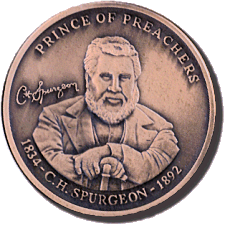
Your weekly dose of Spurgeon
posted by Phil Johnson

The PyroManiacs devote some space each weekend to highlights from The Spurgeon Archive. The following excerpt is from "Natural or Spiritual?"—a sermon preached on Sunday morning 1 September 1861, at the Met Tab in London.


t is a well-known fact, and one which can be proved by the observation of every day, that the natural man receiveth not the things of the Spirit of God. Mark, we lay this down as a rule.

We do not say that the drunken or debauched natural man receives not the things of God. That is true; but we also insist upon it that the delicate and the refined natural man receives not the things of the Spirit of God. I do not pick out some one case, and say the uneducated, illiterate, coarse, low-minded natural man cannot comprehend spiritual things; but all alike, the most intelligent, enlightened, and trained natural men, equally, do not, and cannot, and will not comprehend the things of the Spirit of God. Like our apostle, we take a wide range, and do not leave out one.

However amiable in natural temperament, however well trained by the best parental associations, however kept in check by the most excellent position in providence, however patriotic, however self-denying, however benevolent, however estimable in any other respects, the natural man does not and cannot receive the things of the Spirit of God.

Now—look around and search for the facts which prove the truth of this. How many natural men there are, and such as you would call good men too in some ways, who oppose violently the things of the Spirit of God? They do not believe them; nay, they say they are a lie. They cannot understand how men should be simpletons enough to believe such ridiculous things. Honestly do they imagine that they shall be snapping the chains of priestcraft and unrivetting the fetters of superstition, if they should come forward and attempt to prove that these spiritual things are a mere delusion.

There, gentlemen, we have lived to see you, under a profession of religion, actually oppose those spiritual things which this religion teaches. We have lived to see what we scarcely ever dreamed to be possible—clergymen of the Church of England themselves denying the truths which they swore they would defend, and in their "Essays and Reviews" seeking to cast down those spiritual things which once they professed to have understood when they claimed to have received the Holy Spirit by the laying on of the hands of their bishop.

We have not only in these times opened and avowed infidel lecturers who, like honest men deny everything openly, but we have the hypocritical Christian infidel who, like a dishonest thief and wolf in sheep's clothing, willing always to take the gain of godliness, denies godliness itself. Perhaps it was left for this age to permit wickedness to culminate to the highest, and to see the growth of the vilest hypocrisy that ever appeared among the sons of men.

We have had abundant proof that men of the most scientific minds, persons who have been exceedingly inquiring, men who have trod the realms of knowledge, and gone even to the seventh heaven of wisdom, that these have nevertheless proved that they could not receive the things of the kingdom of God, by their determined opposition and enmity against anything like the truth as it is in Jesus. When you hear them blaspheming the holy name of Christ, when you hear them bringing what they call "scientific facts" against the truth of revelation, be not amazed as though it were some new thing, but write this down in your memorandum book—the Holy Ghost said of old, "The natural man receiveth not the things of the Spirit of God," and these men live to prove that what the Spirit of God said was very truth.

A greater proportion of persons there are who do not so much oppose violently as more secretly despise and condemn. Well, they tell us, they dare say that the Christian religion is a very good thing for some people, and especially for old women and for persons that are on the borders of the grave, but still no rational being would endorse full all the doctrines of the gospel, and especially that particular form of them which John Calvin taught; for if there be any doctrines that excite more the spleen of the wise men than any other, it is the doctrines of grace, the doctrine of discriminating, distinguishing love, the doctrine of divine sovereignty, the doctrine of God, being really God, and not man.

Against these they have no words too bitter. "Oh," they say, "it is an exploded theory; it has had its day, and it has become effete," and so, without actually persecuting those who hold the truth, or without even setting themselves up by active efforts to put it down they do secretly with a sneer and with a jest, pass it by as a thing utterly unworthy of a rational person, a thing that is not for a moment to be thought of as being one half so important as the wing of a beetle, or as the particular flight of a sparrow, or the period of the migration of a swallow.

All the facts of natural history they think valuable and important, but these grander truths which have to do with the kingdom of God they despise utterly, and think they are but the dream of simpletons.

Again, I say, my brethren, marvel not at this. Let this be to you another argument that the Spirit of God knew what was in man, and rightly judged of the human heart when he said, "The natural man receiveth not the things of the Spirit of God."

C. H. Spurgeon


23 July 2009

Unbelief is depressing [requested classic re-post]

by Dan Phillips
[Well, friends, I've finished the complete first draft. Now some select folks are reading and giving feedback, and I'm editing it in preparation for submission to the publisher. It's coming down to it! Also, I've a Bible conference in October to be thinking about. So... in this thread, commenter Deborah bids us reach back to November of 2006 for this re-post, slightly edited. It provides perhaps a balancing consideration to some thoughts I just offered on depression over at my blog, with attendant discussion, as well. Oh, and before you ask, I'm just fine, thanks!]
Sad to say, I have the personal resumé to write an extended series of articles about depression.

In reading through Numbers, I was reminded of one potent cause of depression. (No, I don't mean that reading through Numbers causes depression.)

The nation of Israel was dallying in the desert. They were there as a penalty for their unbelief. In these wanderings, they came to Kadesh, and ran short on water (Numbers 20).

This was their reaction to the situation:
And the people quarreled with Moses and said, "Would that we had perished when our brothers perished before the LORD! 4 Why have you brought the assembly of the LORD into this wilderness, that we should die here, both we and our cattle? 5 And why have you made us come up out of Egypt to bring us to this evil place? It is no place for grain or figs or vines or pomegranates, and there is no water to drink" (Numbers 20:3-5)
First, I'd observe that their concern had a basis in reality. I've lived in the desert. Water is nothing to spit at. (Pause for laughter to die down.) (It's a very short pause.) You just don't go anywhere without spare stores of water on-hand. And so here were many hundreds of thousands of people, in the desert, and they'd come short on water. This isn't an "Oh, well, what's on TV?" situation. It is a legitimate crisis. Without water, they would die.

Depression, however, doesn't need an objective cause. M'man Spurgeon spoke of causeless depression, and I may add my own thoughts someday. Dealing with free-floating depression is like boxing a deadly fog bank. But this situation was not of that nature. This depression was able to fix on objective realities.

Second, their viewpoint was incomplete, and that in two specifics. Glaringly, the Israelites had forgotten why they were still in the wilderness. They were stuck in the desert because of their own unbelief. Surely you remember the story, from Numbers 13-14. In sum:
God said "Go"
They said "No"
So God said "No go"
They said "Woe!"
(Some tried...
...they died)
So in their response here, they blame everyone — everyone, that is, except themselves. It's Moses' fault. It's Yahweh's fault (cf. 21:5). But of course the truth is that it was their fault, it was the fault of their unbelief. And so, having failed to learn from the previous lesson, they simply repeat their sin.

Let me underscore that point.

"For whatever was written in former days was written for our instruction," (Romans 15:4), and we mustn't miss the lesson here. Refuse to learn from discipline for sin, and we will repeat both sin AND discipline. This is why Proverbs is so full of thunderous warnings and reproofs for the man (or woman) who bull-headedly refuses to accept discipline, rebuke, correction (cf. 1:24-31; 10:17; 12:1; 15:10; 29:1, etc.).

You and I may stop our ears, stiffen our necks, harden our hearts, and turn our backs. We may even eventually forget. But God doesn't. We can be sure that it will come up again, and again, until we either address the issue or fall under it.

I think of my kids in our home school. On occasion, some kid may give me a bunch of sloppy, slapdash, thoughtless homework. I take my red pen and (as my dear wife puts it) proceed to bleed all over it. Then, if nothing comes of that, I lecture. If there is no change in direction, I may add some stiff penalties in terms of lost privileges and/or extra work. It escalates.

And if that child then clearly seethes with anger at me, I say, "If you blame me for what just happened to you, I guarantee it will just keep happening to you, again and again. Today is a result of the decision you made when you were supposed to be doing your homework yesterday. Think and do the same today, and the same (or worse) will happen tomorrow, and for the exact same reason."

So why were these Israelite knotheads still in the desert, in the first place? Unbelief. So how do they respond to the crisis they face, here, in-the-desert-because-of-unbelief?

With more unbelief.

And in their unbelief, they had left God out of the equation. On the one hand, nobody could argue with part of their assessment of the situation. They were indeed short on water. Without water, an unpleasant death was certain. That's "dire" according to any dictionary.

But what of God? Their thinking did not include Him fully. That miscalculation, from the matrix of unbelief, was the cause and sustenance of their despair.

The essence of depression, and the unbelief that is so often at its root, is not that it is completely baseless. It may have a fragile and tenuous basis, or it may have a large and overwhelming basis. Either way, its vantage point is incomplete. It is incomplete in a way that makes it end up completely wrong.

Suppose I meet this little shrimpy old guy in an alley, and he tries to rob me. I say, "Dude, you're old, and I've got a hundred pounds on you, plus a green belt in karate. You're completely outmatched."

He shrugs and says, "True. Except for this gun."

"Yeah, well, except for that," I reply, noting sagely that one factor can alter the entire equation.

And so Israel, never having dealt with their sin head-on, never having confronted the abhorrent and appalling nature of their unbelief head-on, and never having estimated God correctly, once again miscalculates. They leave out one crucial factor. They leave out God. And they're depressed.

And so I suggest to you that, at the root of much (— not all!) of our depression is a similar miscalculation.

But while we're shaking our heads at what nincompoops those dumb Israelites were, we should reflect pointedly on our own unbelief. We have one thing they didn't have. We have their instructive story. Plus a truckload of additional revelation, including the whole New Testament.

So when our own unbelief casts us down into our own depression, let us learn from their example, that we not repeat it. Let us reach into our own coats, and pull out the precious key called Promise that let Christian and Hopeful out of Doubting Castle. Let us make it ours by faith, use it, escape from Giant Despair, and head for the joy that is our portion.

Dan Phillips's signature

15 December 2008

How "Total" Is Our Depravity?

Your weekly dose of Spurgeon
posted by Phil Johnson

The PyroManiacs devote some space each weekend to highlights from The Spurgeon Archive. This week's dose comes a bit late, but here it is. It's an excerpt from "Startling!"—a sermon originally delivered at the Metropolitan Tabernacle, London, on a Sunday evening in the summer of 1861.


od only knows the vileness of the human heart. There is a depth beneath, a hidden spring, into which we cannot pry. In that lower depth, there is a still deeper abyss of positive corruption which we need not wish to fathom.

God grant that we may know enough of this to humble us, and keep us ever low before him! Yet hold, Lord, lest we should yield to despair, and absolutely lie down to die under the black thought of our alienation from righteousness, our naturalization in sin, and the deplorable tendency of our heart to rebel more and more against thee, the faithful and true God! Show us not all our wretchedness. . .

I have often been startled when I have found in my heart the possibilities of iniquity of which I thought I never could have been the subject, in reveries by day or in dreams of the night. All at once, a blasphemy foul as hell has started up in the very middle of offering a prayer so earnest that my heart never knew more fervor. I have been staggered at myself.

When God has called us into the pulpit,—we thought, at one time, we never could be proud if God so honored us,—this has seemed to quicken our step in the black march of our depraved heart. Or, when a little cast down and troubled in spirit, we have wished to leave the world altogether, and have been like Jonah, trying to flee to Tarshish that we might not go to this great Nineveh at our Lord's bidding. Little did we reckon that there was such cowardice in our soul. We have thus found out another phase in our own nature.

Does any man imagine that his heart is not vile? If he be a professing Christian, I much suspect whether he ought not to renounce his profession; for, methinks, any enlightened man, who sincerely looks to himself, and whose experience leads him somewhat to lock within, will surely find, not mere foibles, but foulness that literally staggers him. I question the Christianity of that man who doubts whether there are, in his soul, the remains of such corruption as drown the ungodly in perdition; or whether, though a quickened child of God, he hath another law in his members, warring against the law of his mind.

What! hath he no such battle within that the things he would do he often doeth not, while the things that he would not do he often doeth? Hath he no need to be in constant prayer to God to deliver him from the evil in his heart that he may be more than a conqueror over it at last? I do assert, once more, and I think the experience of God's children beareth me out, that, when we shall be most advanced, and when we come, at last, to sit down in God's kingdom above, we shall find that we have not learnt all that there is to be learnt of the foulness of our nature, and the desperateness of our soul's disease.

"The whole head is sick, and the whole heart faint. From the sole of the foot even unto the head there is no soundness in it; but wounds and bruises, and putrefying sores." "The heart is deceitful above all things, and desperately wicked; who can know it?" "Cleanse thou me from secret faults." "Search me, O God, and know my heart; try me, and know my thoughts; and see if there be any wicked way in me, and lead me in the way everlasting."

Perhaps, if we knew more of this terrible evil, it might imperil our reason. Hardly could it be possible for us to bear the full discovery and live. Among the wise concealments of God, is that which hides from open view the depravity of our heart, and the corruption of our nature.

C. H. Spurgeon


27 February 2008

Is There an Antidote for Human Depravity?

The fact of our fallenness makes sovereign grace essential
by Phil Johnson

(This is the continuation of a series begun here.)


et's go back to the passage we began this series with: Ephesians 2:1-3. This time I'll add (in bold italics) two words from verse 4. Those two words mark the pivotal statement of the chapter:
You were dead in your trespasses and sins, in which you formerly walked according to the course of this world, according to the prince of the power of the air, of the spirit that is now working in the sons of disobedience. Among them we too all formerly lived in the lusts of our flesh, indulging the desires of the flesh and of the mind, and were by nature children of wrath, even as the rest. But God . . .

D. Martyn Lloyd-Jones preached one of his most famous sermons on those two words—"But God." That simple conjunction marks the apostle Paul's transition from the problem of human depravity to its solution. The only possible solution, Paul says, is the sovereign application of saving grace to the sinner. Are you looking for an explicit statement of Calvinistic doctrine in the Pauline epistles? Here is one of many, and it's a classic. Notice: Paul's whole argument in bringing up the doctrine of human depravity in this context was to make the point that our fallenness leaves us utterly at the mercy of God for salvation. Our utter inability—which Paul has just described as a state of spiritual death—underscores the absolute necessity of God's sovereignty in salvation. Because we are so thoroughly fallen and spiritually incapacitated, our salvation must be God's work, and God's work alone.


This truth does not come out of nowhere. Paul already established the truth of divine sovereignty in chapter 1, where he reminded the Ephesians that God chose them (4), predestined them (5), guaranteed their adoption (5), bestowed on them His grace (6), redeemed them (7), forgave them (7), lavished riches of grace on them (8), made known to them His will (9), obtained an inheritance for them (11), guaranteed that they would glorify Him (11-12), saved them (13), and sealed them with the Spirit (13-14). All those same truths are true of every believer. In short, God "has blessed us with every spiritual blessing in the heavenly places in Christ" (3). All of this is the work of His sovereign grace, performed not because of any good in us, but simply "according to the kind intention of His will" (5, 9) and "according to His purpose who works all things after the counsel of His will" (11).

There's not a hint of Arminianism in that. There's not a whisper of stress on human free will. Paul is expressly teaching that all of salvation is God's work and He is absolutely sovereign in the process. In fact, Ephesians 2 begins with the passage quoted in red type in the block paragraph above, stressing the utter inability of spiritually-dead sinners, and then it culminates with Paul's statement in verse 10 that even the good works done by believers were prepared by God beforehand! How could Paul have been any more clear or emphatic about the truth of God's sovereignty in our salvation?

In fact, this is the central message of Ephesians 2: salvation is entirely God's work. We're not to think redemption hinges on any work, motion, activity, or free-will choice on the part of the sinner. Verses 8-9 therefore constitute a succinct thesis statement for the whole chapter: "By grace you have been saved through faith; and that not of yourselves, it is the gift of God; not as a result of works, [so] that no one [can] boast" (8-9).

"But God!"—and here we see the only possible cure for human depravity, the grace of a loving God:
But God, being rich in mercy, because of His great love with which He loved us, even when we were dead in our transgressions, made us alive together with Christ (by grace you have been saved), and raised us up with Him, and seated us with Him in the heavenly places, in Christ Jesus, in order that in the ages to come He might show the surpassing riches of His grace in kindness toward us in Christ Jesus. For by grace you have been saved through faith; and that not of yourselves, it is the gift of God; not as a result of works, that no one should boast.


Phil's signature

24 February 2008

How Blind must be Thy Heart

Your weekly dose of Spurgeon
posted by Frank Turk, pinch-hitting for our beloved leader Phil Johnson

The PyroManiacs devote some space each weekend to highlights from The Spurgeon Archive. The following excerpt is from "The Honored Guest," a sermon Published on Thursday, November 25th, 1915, delivered at the Metropolitan Tabernacle. It's date of actual sermonizing is not known.

Why Is It That All Men Do Not Receive Christ Joyfully?
This is our first question. They need him, all of them. There is no difference in this respect. Whether Jews or Gentiles, they are all sold under sin. God has concluded the whole race of man in unbelief. He has shut them all up in condemnation. There is no escape from the universal doom except by the way of the cross. Jesus Christ comes to save; comes with pardon in his hands, with messages of love, with tokens of favour; yet most men bar the doors of their hearts against him. There is no cry heard in their souls, "Lift up your heads, O ye gates! and be ye lifted up, ye everlasting doors, that the King of Glory may come in!" Instead thereof, there is a sullen cry, "Come prejudice; come unbelief; come hardness of heart; come love of sin; bar ye the doors and barricade the gates lest, perhaps, the King of Glory should force an entrance!" Men treat the Saviour as they would treat an invader who attacked their country. They seek to drive him away; they would fain be rid of him. They cannot endure his presence. Nay, they can scarce endure, some of them, to hear about him in the street. Why is this? The chief reason lies in the depravity of man's nature. You never know how bad man is till he comes in contact with the Cross.

Although the crimes of savage, uncivilized men may appear to you far more heinous than any that are committed in our favoured country, where just laws are for the most part enacted, and opportunities of education generally enjoyed, yet the propensity to do that which is evil in the teeth of a knowledge of that which is good, the subtlety of perverting truth in the clear light of divine revelation, the perfidiousness of that foul ingratitude which can betray the tenderest friendship, are never so painfully illustrated as in view of the Crucified. To despise the grace of Jesus, to reject the love of God, to conspire against the Ambassador of peace, to take the inhuman, devilish counsel—"This is the heir; let us kill him!"—this was the last offence of the wicked husbandmen in the parable. Nor does the parable exaggerate the treachery. For this is the greatest offence of human nature, when it says, in effect, "This is the Incarnate God, let us reject him; this is the Word made flesh, let us traduce him; this is the Father's beloved Son—let us betray him!" Oh! Human Nature, how blind must be thy heart, how seared thy conscience, not to see the beauties of Christ! How base must thou be to despise the love and tenderness of such a Saviour!
C. H. Spurgeon


17 February 2008

How Did We Inherit Adam's Sinfulness?

by Phil Johnson

Note: I would normally make this post on Monday morning, but this afternoon I'm making an unplanned trip to London. I won't be back home till Friday, so everyone please behave for Frank and Dan. See you at the end of the week.

Meanwhile, let's take up where we left off in our discussion of human depravity:


ow did we get in this state? Scripture lays the blame at Adam's feet. Roman's 5:12 says, "Through one man [Adam] sin entered into the world, and death through sin, and so death spread to all men, because all sinned." Sin entered the world through Adam, then passed to all men. Adam's sin brought spiritual death—total depravity—upon the entire race. First Corinthians 15:22 says, "In Adam all die."

Remember, we are sinners before we ever commit one overt act of sin. We are born with the taint of sin. In fact, it is appropriate to say, as David did, that we are sinful from the moment of our conception (Ps. 51:5). Theologians refer to this as "original sin."

So how did Adam's guilt get passed on to you and me? That question gets complex, and there are several different theological opinions that have been proposed to explain it. If you want to delve into the question deeply, I recommend John Murray's book, The Imputation of Adam's Sin or Martyn Lloyd-Jones's sermons or commentary on Romans 5. One of these days, we'll take up the subject of original sin here on the blog.

In this series, however, it's not really necessary to go into great detail on the question of how sin was transmitted to us from Adam. It's enough to affirm the fact that Adam's sin condemned us. Without delving deeply into all the mysteries that surround this question, let's simply declare what God's Word has to say on the matter: "By the transgression of the one the many died" (Rom. 5:15). "The judgment arose from one transgression resulting in condemnation" (v. 16). "By the transgression of the one, death reigned" (v. 17). "Through one transgression there resulted condemnation to all men" (v. 18). "Through the one man's disobedience the many were made sinners" (v. 19).

Five verses in a row all state in different ways that Adam's sin corrupted the entire race. Adam, as the representative head of the human race, plunged us all into sin. Yet we cannot stand aside and point the finger of blame at him in an attempt to excuse ourselves. We inherit his guilt as well as his sinfulness. We are as blameworthy as Adam. The question of how his guilt was passed on to us is not as important as the reality that it happened. No fact in all of philosophy or religion is attested to with so much empirical evidence. All Adam's offspring—with one significant, divine Exception—all Adam's offspring have been sinners. We are born morally corrupt.

I do want to call your attention to a couple of corollaries to this doctrine. First, it suggests Adam was a historical person. Those who want to treat the early chapters of Genesis as symbolism or myth destroy the doctrine of original sin. If Adam was not a historical individual, none of this makes sense. There's no reasonable explanation for how our race became sinful, unless the account of the fall in Genesis 3 is literally true. So the sinfulness of all humanity bears witness to the truth of Scripture's account of the fall.

Second, those who deny that human nature is sinful are guilty of willful ignorance. The universality of human sinfulness is irrefutable. It is self-evident. Everyone we know is sinful. There's no evidence whatsoever for the myth that people are basically and fundamentally good.
Original sin is not a minor blemish on the human soul. It corrupts every aspect of our character. Listen to these words from Romans 3, where Paul summarized the doctrine of universal depravity. These verses come after two chapters of argument showing that pagans, moral Gentiles, and even religious Jews are all hopeless sinners. In Romans 3:9-18, Paul sums up and makes the point so that no one can miss it:
We have already charged that both Jews and Greeks are all under sin [he had been proving that charge for two chapters]; as it is written, [and here he quotes a series of Old Testament verses] "There is none righteous, not even one; there is none who understands, There is none who seeks for God; all have turned aside, together they have become useless; There is none who does good, There is not even one." "Their throat is an open grave, With their tongues they keep deceiving," "The poison of asps is under their lips"; "Whose mouth is full of cursing and bitterness"; "Their feet are swift to shed blood, destruction and misery are in their paths, and the path of peace have they not known." "There is no fear of God before their eyes."
That's exactly where we began this series, isn't it? Unbelievers are incapable of loving, fearing, trusting, or obeying God. They may fool themselves into thinking otherwise, but that only proves the wicked deceitfulness of a sin-sick heart.

That leaves us with one more question on his topic, which we'll consider next time.

Phil's signature

13 February 2008

The Talking Stain

by Frank Turk

Here's what I think a lot of people are thinking about Phil's latest series on theology – and by "a lot of people", I don’t mean "our faithful and brilliant normal readers". I mean the passers-by and the people who, frankly, don’t think about theology all the time.

I think they see the topic "total depravity" and they think, "yeah, but what's that got to do with me?" And before we get all "thank God I'm not like that American evangelical" on those people, I think it is actually a very good question.

Here's one person I know who asks that question a lot, for example. There's a family who I know who, frankly, doesn’t want to hear about grace – and their oldest son is a really bright kid who wants to be informed about his faith. And in his Sunday school class, his teacher started a semester on the history of the Christian faith (!) in which they, obviously, encountered the Reformation.

Anyway, without making a massive parenthetical sidetrack here (HT: DJP), this young man was of a mind that lost people do good works, too – that the doctrine of total depravity falls right apart when we look at the fact that even Christopher Hitchens does charity work; even Hitler loved his mother. And in one sense, he's right: anyone can (and almost anyone does) give $5 to a hobo or donate books to the library or pretend to end poverty in Africa or whatever. Anyone can do those things; most people, if you watch them long enough, will do something like that once in a while.

But here's the question: in what sense is any of that "good"? I know Phil covered this on Monday, but he gave the high-brow Westminsterian sketch. What's that mean to this kid who thinks, or at least thinks he thinks, that everyone has some basic, native goodness?

My response is this: "good enough to prove you're a lot worse off than you thought".

Think about this --
whenever the Gentiles, who do not have the law, do by nature the things required by the law, these who do not have the law are a law to themselves. They show that the work of the law is written in their hearts, as their conscience bears witness and their conflicting thoughts accuse or else defend them, on the day when God will judge the secrets of human hearts, according to my gospel through Christ Jesus. [NET Bible]
Here Paul is saying that people have the problem of not merely being occasional breakers of the decrees of God: he's saying that people show that they know better and therefore really don’t have any excuses when it comes time to judge whether they were willing law-breakers or merely ignorant foils trapped by a system they never understood.

See: any native goodness we demonstrate only highlights how broken our nature really is.

I was watching my son's basketball game a couple of weeks ago, and it's the "recreational" league where the kids really haven’t ever played on a court before with rules or a ref. And on the other team was this really aggressive kid who simply wanted to put the ball in the net. It was clear to me he had played football before because every time he got the ball, he tucked the ball under, ducked his head, and rolled into the crowd of boys in the key like a fullback.

And in this kid's case, it was actually kinda funny – he obviously didn’t know any better. He was playing by the wrong rules, and he had no clue what the right rules where. But if that same thing happened in a High School game, or even in the next age bracket up, it wouldn’t hardly be that funny – because those kids know better, and they prove it in all kinds of ways.

And this is the case with us: we show that we know enough about God's law to obey it when we want to, so when we are unwilling to obey God's law it's that much worse for us.

Here's what that has to do with you: you should be more worried about whether you have a savior than whether you are doing any good. See: you can admit that you really just aren't any good. Even the good you seem to do is really just the white space around the big black blobs of sin nature that come out of you, guiding the eye to the violations rather than somehow making you seem mostly clean – like that crazy talking stain commercial from the Superbowl.

And what that stain says is, "I need a savior, not a self-help book."

Jesus is a savior, not a life coach. The high-brow doctrine of "total depravity" is really another way of saying, "you need a savior." You do. The kid who thinks that everybody does something good once in a while, and only wants Jesus to be a good example rather than a bloody sacrifice which God accepts for the sake of those who believe.