Showing posts with label catholicity (sic). Show all posts

01 August 2010

Cold-Blooded Liberal "Charity"

Your weekly dose of Spurgeon
posted by Phil Johnson


The PyroManiacs devote some space each weekend to highlights from The Spurgeon Archive. The following excerpt is from "Needless fears," a sermon preached on Thursday evening, 11 June 1874, at the Met Tab in London.


he very persons who talk most about being liberal in their views are generally the greatest persecutors. If I must have a religious enemy, let me have a professed and avowed bigot, but not one of your "free thinkers" or "broad churchmen" as they are called, for there is nobody who can hate as they do; and the lovers of liberal-mindedness who have no creed at all think it to be their special duty to be peculiarly contemptuous to those who have some degree of principle, and cannot twist and turn exactly as they can.

C. H. Spurgeon


09 December 2009

Idealism vs. Normally-Wise Pragmatism

by Frank Turk

I'm almost hesitant to blog today because the last time I blogged here I posted a link to a somewhat-helpful article about Twilight and its apparent analogical apologetic for Mormonism, and it turned into, well, something else. I enjoy blogging, especially when I think I have something useful, helpful or otherwise edifying to share, and sometimes people just take the fun out of it.

{sigh}

Anyway, again leap-frogging from a post by a co-blogger at Evangel, the Manhattan Declaration rears its ugly head as some over there are again taking up its torch. James Grant has pointed to a blog post by Father Patrick Reardon. What we should think about today is the center of Fr. Reardon's assessment of the position of (for example) Dr. John MacArthur (and for those who missed it, RC Sproul):
The critics I have in mind, rather, are those Christians who confessed agreement with the substance of the Declaration while declining to associate with the other signers. Their objections, I believe, are significant in the sense of deserving comment. Considerations of available space impose brevity here.

We may take the example of the Evangelical spokesman, John MacArthur, Jr. His complaint was very simple: The Manhattan Declaration scans only the symptoms of these social evils but neglects to address their root cause. That is to say, this document fails to proclaim the Gospel of salvation, which is the sole remedy for every social ill.

Substantially identical was the objection of the Orthodox Christian priest, Father Jonathan Tobias, who faulted the Declaration for not preaching repentance. This writer went even further, nonetheless, lampooning at length the document's form and rhetorical style. (Ironically, the somewhat softened Father Tobias has of late chastised James Carroll, for a similar mockery of it.)
That underlined part (emphasis added) is the part that interests me -- because here's what Dr. MacArthur actually wrote:
In short, support for The Manhattan Declaration would not only contradict the stance I have taken since long before the original “Evangelicals and Catholics Together” document was issued; it would also tacitly relegate the very essence of gospel truth to the level of a secondary issue. That is the wrong way—perhaps the very worst way—for evangelicals to address the moral and political crises of our time. Anything that silences, sidelines, or relegates the gospel to secondary status is antithetical to the principles we affirm when we call ourselves evangelicals.
Now, you know what? I'll be glad to concede for the sake of this post and whatever argument you think you want to start at this point that it is possible for someone with a clean conscience to have signed this document. You know: Al Mohler deserves the benefit of the doubt. Ligon Duncan deserves the benefit of the doubt just in case he's reading here. I think it's possible that some people have made an error not because they have some aim to deceive even the elect (as if that was possible) but because they think public proclamations of morality are prophetic in nature.

To that I say: I respect your motives, but your are letting your idealism obscure your normally-wise pragmatism.

What I'm posting about here is about Fr. Reardon's approach to justifying the MD's signers. The idea that John MacArthur has merely decided that if we just preach the Gospel we don't need to do anything else is, frankly, unfounded for two reasons:

[1] Plainly, Dr. MacArthur's objection is grounded on the idea that the three major groups named in this declaration all define the Gospel of Jesus Christ differently! That is: all his other objections are in orbit around the point that you cannot possibly say that confessional Evangelicals and Roman Catholics can say, "preach the Gospel" and mean the same thing. This fact obscures the Gospel.

[2] Only someone who has never read Dr. MacArthur and his thorough stand on holiness and godly living could possibly say he advocates for just preaching the Gospel "as the sole remedy for every social ill". The Gospel has real-world, real-life consequences, and Dr. MacArthur is one of the loudest and clearest preachers to this point in the English-speaking church.

So in that, let's please not think that if one has repudiated the MD he has repudiated living among people, doing good works, actually protecting the down-trodden and the orphan the the widow, and suffering for the sake of others. What he has repudiated is doing that in the context of an undefined "gospel" for an inexplicable Jesus. Someone has already said this, but it bears repeating:
[the Manhattan Declaration] assumes a big tent for the definition of what it means to be a “believer”, assumes that law is greater than grace in reforming the hearts of men, and provides moral reasoning that those who are unbelievers have no reason to accept — because they are unbelievers. And in making these three items “especially troubling” in the “whole scope of Christian moral concern”, it overlooks that the key solution to these moral concerns is the renovation of the human heart by supernatural means established by the death and resurrection of Christ.
I also have a beef with the red herring of "declining to associate" which Fr. Reardon mentions. Many of the signers of this document are either hopeful or fearful (I just can't tell which) that the disagreement over this document is going to lead to some manner of quasi-fundamentalist "separation" over the matter.

We'll have to take that up another time. It's enough to say for now that this document doesn't hardly cause a person to be a rank heretic or disqualify himself from ministry. It's just a mistake which, one hopes, many of the signers will reconsider and therefore remove their names from the list.


19 April 2008

On the Broad-Minded Spirit of Sadduceeism, and How to Answer It

Your weekly dose of Spurgeon
posted by Phil Johnson

The PyroManiacs devote some space each weekend to highlights from The Spurgeon Archive. The following excerpt is from "The Charge of the Angel," A sermon delivered 8 July 1888 in the morning service at the Met Tab..


HE second persecution of the church, in which all the apostles were put into the common prison, was mainly brought about by the sect of the Sadducees. These, as you know, were the Broad School, the liberals, the advanced thinkers, the modern-thought people of the day.

If you want a bitter sneer, a biting sarcasm, or a cruel action, I commend you to these large-minded gentlemen. They are liberal to everybody, except to those who hold the truth; and for those they have a reserve of concentrated bitterness which far excels wormwood and gall.

They are so liberal to their brother errorists, that they have no tolerance to spare for evangelicals.

We are expressly told that "the high priest, and all they that were with him (which is the sect of the Sadducees,) were filled with indignation." That which had been done deserved their admiration, but received their indignation. Such gentlemen as these can be warm at a very short notice, when the doctrine of the cross is spreading, and God the Holy Spirit is bearing witness with signs following. Let them display their indignation, it is according to their nature.

To them the only answer which God gave was spoken by his angel: "Go, stand and speak in the temple to the people all the words of this life." Argument will be lost upon them; go on with your preaching. They have lost the faculty of believing: go and speak to the people. They are so given over to their doubts, that it is like rolling the stone of Sisyphus to persuade them to faith. They are so eaten up with objections, that to attempt to answer all the questions they raise would be as vain as the labor of filling a bottomless tub.

Go on with your preaching, you apostles; but address yourselves mainly to the people. Extend as widely as possible the range of the truth, and thus answer the opposition of its adversaries. It is better to evangelize than to controvert. The preaching of the word of life is the best antidote to the doctrine of death.

Clearly enough, if they had known it, and had been capable of seeing it, these blind Sadducees were answered at every point when the apostles were brought out of prison and bore witness to their Lord. Here was the creed of the Sadducees: they said that "there was no resurrection, neither angel, nor spirit"; but these apostles stood up and witnessed to the resurrection of Jesus Christ from the dead. What did they make of that?

An angel had come from heaven and had brought these apostles out of prison. Then there were angels.

As these apostles were set free while the sentries remained standing before the doors, and those doors were afterwards found fastened, if there were no spirit, assuredly materialism had acted in a singular fashion.

Every item of their negative creed had been made to fall like Dagon before the ark. The Lord always arranges Red Seas for Pharaohs. All that the apostles had to do was to go on with their preaching, and this they did; for "daily in the temple, and in every house, they ceased not to teach and preach Jesus Christ."
C. H. Spurgeon


06 February 2008

Wednesday filler-upper

by Trinketman, aka Frank Turk

Dan had a brilliant post yesterday, as usual, and of course Phil's tubing video is hillarious, so to give your brains a rest today I thought I'd do a Wednesday post which doesn't start WWIV -- about what I'm reading this week.

Before we get to that, for those of you who don't have an electron microscope, this is what the note on the "out of office" post says:


Which, of course, doesn't help one bit, does it?

The telegram says, "Having fun in New Jersey. Glad to be out of snow. You guys go ahead and open the blog on 4Feb08. I'm going to stay away for another week. Phil J."

And I find is a little weird, having grown up in NY, that NJ doesn't have any snow on 5 Feb 08 as I am certain it has snowed in the Jersey area as late as April. However, Punxsutawney Phil did, in fact, see his shadow, so it's all in play now. Yet another contributor to global warming.

OK – so to keep you people at bey until the boss comes home, I wanted to inform you of a very interesting book that has sort of flown under the radar of the blogosphere since its publication in 2006 through IVP: Exploring Protestant Traditions: An Invitation to Theological Hospitality by W. David Buschart. It's sort of a fat book, and because it's IVP some people may think it's actually an academic book. It certainly has enough footnotes to be some kind of textbook.

I bring it up because this book would be a good thing to add to your library. You don’t have to buy it from me, and when you read it I am sure you'll find something to sort of snort at for one reason or another – because everyone, of course, comes to a subject like this from one bias or another.

W. David Buschart (Ph.D., Drew University) is associate dean and professor of theology and historical studies at Denver Seminary. Denver has a decent doctrinal affirmation, and for those of you who don’t know, it is historically a conservative Baptist institution. This isn't a volume produced by some kind of ecumenical hooligan who wants to ask the proverbial question, "can't we all just get along?"

Dr. Buschart's treatment of the 8 Protestant traditions he covers (Lutheran, Anabaptist, Reformed, Anglican, Baptist, Wesleyan, Dispensational, and Pentecostal) is very fair – including his treatment of the Pentecostal family of traditions, in which he tends to define the tradition by its more moderate advocates rather than by, um, what appear to be the majority of its practitioners.
So what's in it for you, right? I mean, that's why you read this blog: feed me. I have my birdie-mouth open Frank: stick the worm in there and let me have a fat, happy tummy.

Here's what's in it for you: a little peek outside your theological silo. Listen: because the evangelical landscape is so washed out and watered down, and because you can't really tell the Joely-O's from the Dan Kimball's without a scorecard and list of hair stylists anymore, this book sort of salvages each tradition examined from its own sloppy housekeeping to spell out why they think and do the things they (theologically) think and do. And think about this: if you're one of those people who can't find a church to attend, this book could help you figure out how to find a church to attend which, maybe, isn't in the tradition you grew up in, but still resides someplace inside 3-Sigma of your doctrinal tolerances.

Personally, I think it's one part of the antidote to a lot of the stuff "emergent" types want to tell themselves about what they're doing. "Reclaiming traditions"? Shouldn’t you know something about those before you try to trot some of that stuff out again?

That's all I got. Nice to see you, too.


14 September 2007

Sectarianism? If You Mean "True Honesty," Let There Be More of It

Your weekly dose of Spurgeon
posted by Phil Johnson

The PyroManiacs devote some space each weekend to highlights from The Spurgeon Archive. The following is an exerpt from "The Gospel's Power in a Christian's Life," a sermon published in 1865.


he gospel of Jesus Christ is a very fearless gospel. It is the very reverse of that pretty thing called "modern charity."

The last created devil is "modern charity." "Modern charity" goes cap in hand round to us all, amid it says "You are all right, every one of you. Do not quarrel any longer; Sectarianism is a horrid thing, down with it! down with it!" and so it tries to induce all sorts of persons to withhold a part of what they believe, to silence the testimony of all Christians upon points wherein they differ.

I believe that that thing called Sectarianism now-a-days is none other than true honesty. Be a Sectarian, my brother, be profoundly a Sectarian. I mean by that, hold everything which you see to be in God's Word with a tighter grasp, and do not give up even the little pieces of truth.

At the same time, let that Sectarianism which makes you hate another man because he does not see with you—let that be far from you! but never consent to that unholy league and covenant which seems to be rife throughout our country, which would put a padlock on the mouth of every man and send us all about as if we were dumb: which says to me, "You must not speak against the errors of such a Church," and to another, "You must not reply."

We cannot but speak! If we did not, the stones in the street might cry out against us. That kind of charity is unknown to the gospel. Now hear the Word of God! "He that believeth and is baptized shall be saved; he that believeth not"—What? "shall get to heaven some other way?"—"shall be damned;" that is the gospel. You perceive how boldly it launches out its censure. It does not pretend, "you may reject me and go by another road, and at last get safely to your journey's end!" No, no, no; you "shall be damned" it says.

Do you not perceive how Christ puts it? Some teachers come into the world and say to all others, "Yes, gentlemen, by your leave, you are all right, I have a point or two that you have not taught, just make room for me; I will not turn you out; I can stand in the same temple as yourself." But hear what Christ says:—"All that ever came before me were thieves and robbers, but the sheep did not hear them."

Hear what his servant Paul says, "Though we or an angel from heaven preach any other gospel unto you than that which we have preached unto you,"—what then? "Let him be excused for his mistake?" No; but, "Let him he accursed." Now, this is strong language, but mark you, this is just how the Christian ought to live. As the gospel is very fearless in what it has to say, so let the Christian always be.

It strikes me that a "living" which becomes the gospel of Christ, is always a bold and fearless kind of living. Some people go crawling through the world as if they asked some great man's leave to live. They do not know their own minds; they take their words out of their mouths and look at them, and ask a friend or two's opinion. "What do you think of these words?" and when these friends censure them they put them in again and will not say them. Like jelly-fish, they have no backbone.

Now God has made men upright, and it is a noble thing for a man to stand erect on his own feet; and it is a nobler thing still for a man to say that in Christ Jesus he has received that freedom which is freedom indeed, and therefore he will not be the slave of any man.

"O God," says David, "I am thy servant, for thou hast loosed my bonds." Happy is he whose bonds are loosed! Let your eye be like that of an eagle, yea, let it he brighter still; let it never be dimmed by the eye of any other man. Let your heart be like that of the lion, fearless, save of yourself:—

"Careless, myself a dying man,
Of dying men's esteem,"

—I must live as in the sight of God, as I believe I should live, and then let man say his best or say his worst, and it shall he no more than the chirping of the grasshopper, when the sun goeth down. "Who art thou that thou shouldst be afraid of a man that shall die, or the son of man that is but a worm?" Quit yourselves like men! Be strong! Fear not! for only so will your conversation be such as becometh the gospel of Christ.
C. H. Spurgeon


23 May 2007

On Controversy in the Church

by J. Gresham Machen
posted by Phil Johnson

The following article is excerpted from an address originally delivered in London on June 17, 1932. The whole article is well worth reading. I quoted part of it in a message in Atlanta last week, and Caleb Kolstad wrote to ask me for the source. I sent him the snippet he requested, but it occurred to me that this would make an excellent post here at PyroManiacs:
f we are to have Christian apologetics, if we are to have a defense of the faith, what kind of defense of the faith should it be?

In the first place, it should be directed not only against the opponents outside the Church but also against the opponents within. The opponents of Holy Scripture do not become less dangerous, but they become far more dangerous, when they are within ecclesiastical walls.

At that point, I am well aware that widespread objection arises at the present time. Let us above all, men say, have no controversy in the Church; let us forget our small theological differences and all repeat together Paul's hymn to Christian love. As I listen to such pleas, my Christian friends, I think I can detect in them rather plainly the voice of Satan. That voice is heard, sometimes, on the lips of good and truly Christian men, as at Caesarea Philippi it was heard on the lips of the greatest of the Twelve. But Satan's voice it is, all the same.

Sometimes it comes to us in rather deceptive ways. I remember, for example, what was said in my hearing on one occasion, by a man who is generally regarded as one of the leaders of the evangelical Christian Church. It was said at the climax of a day of devotional services. "If you go heresy-hunting for the sin in your own wicked hearts," said the speaker, as nearly as I can remember his words, "you will have no time for heresy-hunting for the heretics outside."

Thus did temptation come through the mouth of a well-meaning man. The "heretics," to use the term that was used by that speaker, are, with their helpers, the indifferentists, in control of the church within the bounds of which that utterance was made, the Presbyterian Church in the United States of America, as they are in control of nearly all the larger Protestant churches in the world. A man hardly needs to "hunt" them very long if he is to oppose them. All that he needs to do is to be faithful to the Lord Jesus Christ, and his opposition to those men will follow soon enough.

But is it true, as this speaker seemed to imply, that there is a conflict between faithfulness to Christ in the ecclesiastical world and the cultivation of holiness in one's own inner life? My friends, it is not true, but false. A man cannot successfully go heresy-hunting against the sin in his own life if he is willing to deny His Lord in the presence of the enemies outside. The two battles are intimately connected. A man cannot fight successfully in one unless he fights also in the other.

Again, we are told that our theological differences will disappear if we will just get down on our knees together in prayer. Well, I can only say about that kind of prayer, which is indifferent to the question whether the gospel is true or false, that it is not Christian prayer; it is bowing down in the house of Rimmon. God save us from it! Instead, may God lead us to the kind of prayer in which, recognizing the dreadful condition of the visible Church, recognizing the unbelief and the sin which dominate it today, we who are opposed to the current of the age both in the world and in the Church, facing the facts as they are, lay those facts before God, as Hezekiah laid before Him the threatening letter of the Assyrian enemy, and humbly ask Him to give the answer.

Again, men say that instead of engaging in controversy in the Church, we ought to pray to God for a revival; instead of polemics, we ought to have evangelism. Well, what kind of revival do you think that will be? What sort of evangelism is it that is indifferent to the question of what evangel it is that is to be preached? Not a revival in the New Testament sense, not the evangelism that Paul meant when he said, "Woe is unto me, if I preach not the gospel." No, my friends, there can be no true evangelism which makes common cause with the enemies of the Cross of Christ. Souls will hardly be saved unless the evangelists can say with Paul: "If we or an angel from heaven preach any other gospel than that which we preached unto you, let him be accursed!" Every true revival is born in controversy, and leads to more controversy. That has been true ever since our Lord said that He came not to bring peace upon the earth but a sword. And do you know what I think will happen when God sends a new Reformation upon the Church? We cannot tell when that blessed day will come. But when the blessed day does come, I think we can say at least one result that it will bring. We shall hear nothing on that day about the evils of controversy in the Church. All that will be swept away as with a mighty flood. A man who is on fire with a message never talks in that wretched, feeble way, but proclaims the truth joyously and fearlessly, in the presence of every high thing that is lifted up against the gospel of Christ.

But men tell us that instead of engaging in controversy about doctrine we ought to seek the power of the living Holy Spirit. A few years ago we had a celebration of the anniversary of Pentecost. At that time, our Presbyterian Church was engaged in a conflict, the gist of which concerned the question of the truth of the Bible. Was the Church going to insist, or was it not going to insist, that its ministers should believe that the Bible is true? At that time of decision, and almost, it seemed, as though to evade the issue, many sermons were preached on the subject of the Holy Spirit. Do you think that those sermons, if they really were preached in that way, were approved by Him with whom they dealt. I fear not, my friends. A man can hardly receive the power of the Holy Spirit if he seeks to evade the question whether the blessed Book that the Spirit has given us is true or false.

Again, men tell us that our preaching should be positive and not negative, that we can preach the truth without attacking error. But if we follow that advice we shall have to close our Bible and desert its teachings. The New Testament is a polemic book almost from beginning to end. Some years ago I was in a company of teachers of the Bible in the colleges and other educational institutions of America. One of the most eminent theological professors in the country made an address. In it he admitted that there are unfortunate controversies about doctrine in the Epistles of Paul; but, said he in effect, the real essence of Paul's teaching is found in the hymn to Christian love in the thirteenth chapter of I Corinthians; and we can avoid controversy today, if we will only devote the chief attention to that inspiring hymn. In reply, I am bound to say that the example was singularly ill-chosen. That hymn to Christian love is in the midst of a great polemic passage; it would never have been written if Paul had been opposed to controversy with error in the Church. It was because his soul was stirred within him by a wrong use of the spiritual gifts that he was able to write that glorious hymn. So it is always in the Church. Every really great Christian utterance, it may almost be said, is born in controversy. It is when men have felt compelled to take a stand against error that they have risen to the really great heights in the celebration of truth.

J. Gresham Machen


16 April 2007

Ah, yes. Large-hearted catholicity.


20 January 2007

End of a bad week

by Phil Johnson

t's been a tougher-than-usual week here on the blog. We seem to have irritated a few people who aren't usually numbered among our critics. We really didn't need any more detractors, either.

Note: The following quotes illustrate why we didn't need any more detractors; not why this has been such a tough week. See further remarks on this below.

Faint praise for the PyroManiacs

Here's a sampling of some things various readers here and there have been saying about us—from our first foray into the blogosphere until now:
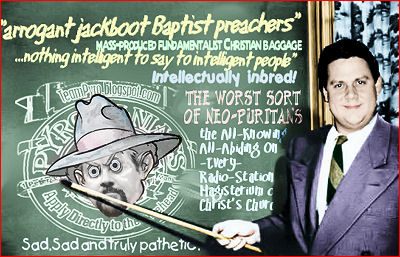
  • "These men have nothing intelligent to say to intelligent people. They are merely reactionary Fundamentalists who found a couple of things they liked in old records and haphazardly pasted them together regardless of internal coherence or external fit to reality. And you can't just TALK to them, have a decent brother-to-brother conversation. Their whole identity is at stake on every minute little position they hold, so any form of nuance is anathema to them."—Tim Enloe
  • "I was profoundly disappointed in the post that opened the week over at TeamPyro. I can think of few things that have disappointed me more in the past year than that post. It was as if a part of me died. . . .I'm dead serious when I say that what has happened over there is what Spurgeon would have called "downgrade." Reformed blogdom is a little less than it was before."—Chad Bresson
  • "This man has made a cult of C.H. Spurgeon. Spurgeon, a cigar-smoking, overweight pedant, is the darling of arrogant jackboot Baptist preachers and many other slow bellies. Preachers who love to use one text and jabber on and on showing their gifts of elocution read Spurgeon instead of their Bibles for inspiration . . . Watch this creep attack a classic bible-church fundamentalist."—Steve Van Nattan
  • "What you have [here] is independent Baptist fundamentalism, right down the line, with only a few changes. . . . Go and check up on names like Jerry Falwell, Jerry Vines, John R. Rice and Jack Hyles. You'll understand a lot more about what you're hearing."—Michael Spencer, "The Internet Monk"
nyway, let's see if we can do the usual weekend BlogSpotting without picking at any of those scabs: BlogSpotting Anyway, that's all I really have time for this weekend. See you at church tomorrow.
Update: For whatever reason, the iMonk is very keen for me to inform my readers that the quote from him (see above) is not anything new. Indeed; it's typical of the kind of thing he was posting about me at his blogs even before I entered the blogosphere.

The quotes above were deliberately juxtaposed to illustrate that our most determined critics cannot even agree amongst themselves about what is wrong with us. The iMonk and his drinking buddies constantly deride us for being too TR ("Truly Reformed"). Others evidently think we're a black hole through which everything that is actually Reformed is being drained out of the blogosphere. And according to iMonk, the only way to understand us is to study the evil legacy of Jack Hyles. But those who are more "Truly Fundamentalist" regard us as the mortal enemies of "classic bible-church fundamentalists." Those on a Romish trajectory apparently think we're so far off base that we must be answered with insults rather than arguments.

I defy anyone to plot all those criticisms on a graph and find a spot on the map where everything that is being said about us could possibly be true all at once.

Of course, that by no means proves we have achieved the perfect equilibrium. But it may well be evidence that some of our critics are pretty seriously imbalanced.

That was my point in citing the above four criticisms together. Sorry if that was too cryptic for some.
Phil's signature

06 December 2006

The Tinker of Bedford


n Tuesday, Darlene and I went with Tom and Kathy McConnell and sons to Bedford to visit the Bunyan Meeting Free Church, whose name (of course) comes from their best-known pastor, John Bunyan (1628-1688).

In keeping with this week's theme, Bunyan was another uneducated preacher who had a few things in common with the Lollards. Like them, Bunyan was a severe irritant to the pompous hierarchy of the established church. Also like them, he was especially annoying to high-sacramentalist types who loved ceremonies and vestments more than powerful preaching, and who valued erudition more than plain speaking.

Between you and me, I think Bunyan also would have greatly appreciated this week's Dose-o'-Spurgeon.

So we're on a bit of a roll here, and I want to say another word or two about John Bunyan's career.

But first . . .

It appears I need to clarify something regarding Monday's dispatch about Wycliffe and the Lollards.

It has been brought to my attention that Kevin Johnson has managed to unearth from somewhere in the white spaces of that post several outlandish but unstated assertions that even I didn't know I had made. Kevin evidently feels I have somehow indicated that the Lollards were Reformed Baptists, or something like that. He is (to put it as mildly as possible) rather cross with me.

Now, Kevin rarely misses any opportunity to demonstrate how much he hates Baptists (and all evangelicals, for that matter). So we're not really surprised that reading PyroManiacs occasionally tends to elevate his sense of ecclesiastical outrage. This time, though, Kevin was left so thoroughly gobsmacked—so profoundly smitten with "stunned amazement" (his words)—that pretty much all he could do was sputter and fulminate.

Sadly, poor Kevin wasn't even able to recover his rational senses in time to point out or refute any of my actual statements that he disagreed with. But at least it was clear that he disagreed.

Moreover, he was by no means alone in his staggered sense of bewilderment. Most of the commenters over at "Reformed Catholicism" were nearly as stupefied as Kevin was.

Did I really suggest that the Lollards believed exactly as I do about all the distinctive points of my doctrinal stance? I would of course immediately retract and correct such a statement if I could find it in Monday's post. But since I didn't actually say that (or anything like it), and since I don't even hold a view that remotely approximates any form of "Baptist successionism" or any of the other grotesquely naïve caricatures Kevin loves so much to lampoon, I don't really have anything I can honestly retract.

And if my post contained any subliminal messages visible only to those wearing their cardboard episcopalian secret-decoder glasses, I was totally unaware of it.

I'll leave the post completely unedited and let more objective readers compare it with the comments made by Kevin Johnson and company. You can judge for yourself whether truth and accuracy really appear to be the driving concerns in Kevin's post. Compare his professed concern for honesty and objectivity in the handling of historical figures with the rhetorical way he distorts the views and statements of his own contemporary theological opponents. Then draw your own conclusions.

Anyway, I think it odd that men who profess to have so much esteem for "generosity" and "catholicity" instantly swarm so angrily whenever they think they see an opportunity to vituperate against evangelicals or Baptists.

That's OK. Kevin and friends were not one-tenth as outraged to see a picture of me in an Anglican pulpit as I am by the way Anglicans themselves have abused their own pulpits—and allowed them to be regularly misemployed by men (and women!) who possess all the right academic credentials and lots of initials after their names, but who have none of the spiritual qualifications for church leadership.

But that's a story for another post.

Back to Bunyan

John Bunyan was both poor and uneducated. He was born into a traveling tinker's family November 28, 1628 and lived a typically shallow and worldly life as a youth, caught up in the entertainments of the time. He followed his father's trade, becoming an itinerate tinker at an age when most youth of today are still in high school.

Tortured by fears and nightmares, and fearful that he might have already committed the unpardonable sin, he finally found peace and assurance in Christ through the gospel. He was baptized by immersion in 1653 and received into a Baptist church.

Within a few years he began preaching, and the response to his preaching was dramatic almost immediately. His sermons were imbued with pathos and delivered with amazing power.

Bunyan was concerned about the rising influence of early Quakerism, and that prompted him to take part in written debates with Quakers. This both prompted him to undertake an earnest study of doctrine and demonstrated his natural flair for writing.

Bunyan was put in jail in 1660 for preaching without a license. He could have been released at almost any time if he had merely promised to stop his unlicensed preaching. He refused, and was kept in prison for the better part of twelve years. He redeemed the time and worked to support his family by writing while in prison. Released in 1672, he became the pastor of the Bedford church.

In 1675, he was arrested and jailed for unlicensed preaching again, but the public outcry against his imprisonment was so fierce that this time he obtained release after just six months.

It's ironic that this uneducated workman became one of the best-known preachers of the Puritan age (an era rich with well-schooled pastors, theologians, and doctors of divinity). Perhaps it is even more ironic that such a man made so important a contribution to English literature—writing one of the greatest allegories of all time, Pilgrim's Progress.

That work was most likely begun during Bunyan's first imprisonment and completed during his final stint in jail. The work is in two parts, the first of which was originally released in 1678, three years after Bunyan's final release from the Bedford Jail. It may be the most popular book ever written in English. It was a favorite of Charles Spurgeon's, who read it at least once a year and said before he died that he had probably read it more than a hundred times.

Spurgeon wasn't the only important admirer of Bunyan. John Owen, probably the most prominent and respected academic leader of Bunyan's own era, once went to hear Bunyan preach. Charles II, hearing of it, asked the learned doctor of divinity why someone as thoroughly educated as he would want hear a mere tinker preach. Owen replied: "May it please your Majesty, if I could possess the tinker's abilities to grip men's hearts, I would gladly give in exchange all my learning."

Owen, of course, never joined any movement that was drifting in a Romish direction.


Anyway,

Today we're taking the train to London, where we'll be for the rest of the week. I'll be attending a board meeting of the Martyn Lloyd-Jones Recordings Trust this morning; calling in at the Metropolitan Tabernacle Book Shop and seeing Dr. Masters on Thursday; visiting the V&A (our first time there) on Friday; teaching a men's group, and then spending the day with Doug McMasters and family (who have recently relocated from California to pastor a church in the London area) on Saturday; and preaching in Doug's pulpit at Trinity Road Chapel in Upper Tooting on the Lord's Day morning.

I'll be back in California Monday evening, Lord willing. See you then.

Phil's signature

19 May 2006

The Key to the Gospel

With an Unexpected Addendum about My Criticism of NT Wright
by Phil Johnson

I've been reading the comments for the past two days, and it occurs to me that someone desperately needs to post something of substance here. So I'm going to do something I've wanted to do since I started blogging last year: This is the start of a series on the doctrine of justification by faith and the principle of imputation.
Second Corinthians 5:21 is one of my favorite verses of Scripture: "For he hath made him to be sin for us, who knew no sin; that we might be made the righteousness of God in him."

The whole gospel message is contained in embryo in those words. That short statement is crucial to our understanding of the nature of the atonement, the doctrine of justification by faith alone, and the twin principles of imputation and substitution. It teaches great truths about the character of God, the sinlessness of Christ, and the simplicity of salvation. It summarizes the core truth of biblical soteriology. It has important implications for Christology. And it even says something about theology proper, because it plainly assumes the sovereignty of God, the love of God, the justice of God, and the grace of God.
This is one of those crystal-clear verses that helps us make sense of all the rest of Scripture. It helps explain the significance of the priestly and sacrificial laws of the Old Testament. It thoroughly illuminates the meaning of the cross of Christ. It reminds us why Christ is the only way of salvation from sin. It shows why no good works performed by sinners could ever contribute an iota to their salvation. And it demonstrates how salvation was accomplished for us without any of our own works—and yet in a way that completely fulfilled God's law, upheld His justice, and vindicated His own righteousness.

In other words to borrow an expression from Romans 3:26, here is how God can "be just, and the justifier of [those who believe] in Jesus." This text explains how God can pardon sinners and treat them as righteous without compromising His own impeccable righteousness or lowering His perfect standards in any way.

I love John MacArthur's summary of the meaning of this text, and it bears repeating. It's also a pretty good paraphrase of the text itself: "On the cross, God treated Christ as if He had committed all the sins of every sinner who would ever believe, so that He could treat believers as if they had lived Christ's perfect life."

In a series of posts that will probably stretch across the next two weeks or longer, I want to explore further the far-reaching ramifications of this simple verse. I think it's a good corrective for much that is lacking in contemporary evangelicalism's truncated gospel message.

Phil's signature

PS: The Pulpit Live blog now has open comments and an RSS feed. We've put a graphic link in the form of a small ad in our right sidebar to highlight the best of whatever is current over there. But here's something a lot of people missed anyway: Some interesting details about the size and shape of the pulpit at Grace Community Church.

The Wright Stuff

PPS: Somewhat germane to the topic of sola fide and justification by faith, over at Reformed Catholicism, Jamey Bennett posts this critical review of my comments on NT Wright and the New Perspective on Paul. (He's reviewing a chapter of mine from the book Fool's Gold, which chapter was a slightly edited version of a seminar I did at the Shepherds' Conference a couple of years ago.)

I'll say this for Jamey: his comments are measured and reasonable, absent the tone of smug and ill-humored snideness often favored by a few of the regulars over at Reformed Catholicism. He rightly zings me for referring to Wright as an "Archbishop." (But then he commits a similar gaffe by referring to John MacArthur as my editor. Well, OK. On second thought, JM does sometimes edit me.)

Jamey at least did me the favor of reading the chapter before criticizing it, and he interacts with what I actually said (something some better-known critics have egregiously failed to do), as opposed to merely questioning my right to criticize the Bishop at all.

As a matter of fact, Jamey turns the normal defense of Wright completely on its head. Instead of complaining that no one has a right to critique Wright's popular-level books without first doing dissertation-level work on all his scholarly tomes, Jamey acknowledges that he himself has read only Wright's "... for everyone" commentaries. He confesses that he hasn't even read the book I was critiquing.

Nonetheless, Jamey objects to my criticism of Wright's view of justification as an incomplete process which culminates in a "declaration [that] will be made on the last day on the basis of an entire life." My complaint was that Wright seems to smuggle the believer's own works into the justification formula with that definition. But Jamey says he sees no difference between that and John MacArthur's view that salvation (note: MacArthur does not say "justification") is a process that won't be complete until we are glorified.

Jamey's comments reflect a point of confusion—the equating of justification with all of salvation—that I would regard as the source of many evils in the world of contemporary Protestant soteriology. It's the very same error made by the advocates of antinomian no-lordship theology (though they push it to the extreme opposite conclusion from the "Reformed Catholicism" gang).

Anyway, the timing of this is propitious. My current series of blogposts on 2 Corinthians 5:21 will enable me to elaborate on some of the issues Jamey's review deals with.

01 March 2006

Evangelicalism in disarray

by Phil Johnson
Note: Today at the Shepherds' Conference I'll be teaching a seminar analyzing the current evangelical infatuation with building ecumenical bridges to Rome. Here's part of what I'll be saying:

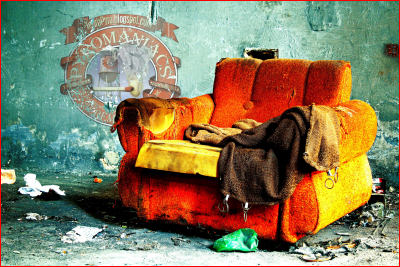
The comfy chair?
Have you noticed that no one defines evangelicalism in theological terms anymore? When a person says he is an "evangelical" nowadays, more often than not he is describing an experience, or a particular style of ministry, or an interest in the pragmatics of evangelism, or something like that. The word evangelical has been stripped of virtually all doctrinal content.

In fact, over the past decade, mainstream evangelicals have been assaulted with a number of trends and movements whose aim seems to be to make evangelicals let go of all their doctrinal distinctives.

  • There is the pragmatism of the church growth movement, which encourages pastors to downplay doctrine (because doctrine is "too academic") and focus only on the practical aspects of the Christian faith. In the worst cases, some preachers deliver material on relationships and success that is devoid of any authentically Christian message.
  • There is the anti-intellectualism that dominates large segments of the charismatic movement, which also downplays doctrine and suggests that experience is more important.
  • There is the neo-ecumenism of groups like Promise Keepers, encouraging men to seek unity by ignoring doctrine and doctrinal differences.
  • There is the intense pressure to lay aside our doctrinal distinctives in order to forge a political coalition with all who share our views on the great moral issues of the day.
  • There are various campaigns to redefine the doctrine of justification in Protestant circles. This is a common theme among many who are enthralled with "The New Perspective on Paul," the sacramental presbyterianism represented by the Auburn Avenue Theology, so-called "reformed Catholicism," and other crypto-Romanist movements.
  • And now there is an infatuation with postmodern ways of thinking, which is flourishing in the Emerging Church movement, denying that propositions really matter and thus (in effect) rendering all doctrine moot in one violent act of epistemological suicide.
All of those things have worked to the detriment of sound doctrine among evangelicals. Now we have reached the point where evangelicalism, a movement historically defined in doctrinal terms, has ironically become a movement where doctrine is now often portrayed as something evil, divisive, and unbrotherly.

Mention the importance of sound doctrine in the typical gathering of mainstream evangelicals these days, and you are certain to be labeled contentious, quarrelsome, divisive—or worse.

The obvious casualty in all of this is the gospel.

Both Roman Catholics and Protestants have insisted for five centuries that their disagreement is a dispute about the gospel. If that is an accurate assessment of the debate (I think it is; and I certainly see no good reason to question 500 years of Catholic-evangelical agreement on that point) then we cannot possibly set aside our differences and enter into communion and fellowship with one another without also setting aside the gospel.

Phil's signature