"Elijah was a man subject to like passions as we are."
 et's take a minute and dissect that expression from James 5:17. In a series of posts on Elijah a couple of years ago, I cited that verse and noted that James was stressing Elijah's ordinariness. He wasn't anything superhuman. He was unexceptional. The modern versions mostly say: "He was a man with a nature like ours." That's the main idea.
But it's more than that. The Greek term is homoiopathes—literally, "like passions." And indeed, Elijah's human passions are prominent throughout his life story. If anything, Elijah wore his passions on his sleeve. His affections and his zeal are more pronounced and more clearly visible than most of us. Even his famous ups and downs were driven to the highest of heights and the lowest of lows by his passions. He was not only a man of passions—he was a man of strong passions.
But James's central point is simply that Elijah was "a man"—and he was every bit a man. The ruggedness of his masculinity is one of the most prominent and endearing features of his character. He was a man of strong passions—but don't get the idea he was always emoting. His passions weren't the sniveling or effeminate kind. He wasn't a wimp. His manliness is always as evident as his emotions, even at the emotional low point in his life. That came at the end of a long fast, during which he had run nearly the full length of the nation of Israel from north to south. That one episode of discouragement was also the exception to a life and ministry distinguished by remarkable courage and stamina.
Elijah was a guy's guy. He seems to have been a bit crude. For months he ate food that was brought to him by ravens—scavenger birds. I don't know many people who wouldn't cringe at such a diet. It suited Elijah just fine.
 And listen to the Bible's physical description of Elijah from 2 Kings 1:8: "He was an hairy man, and girt with a girdle of leather about his loins." So his physical appearance was dominated by hair and leather. I wonder how people would look at him if he walked into the typical evangelical church today.
And in that episode where he lapsed into discouragement, Scripture says he slept under a juniper tree. The Hebrew word signifies a kind of broom plant that flourishes in desert climates. They are scratchy. They grow low to the ground. And they don't make enough shade to shield a grown man. Underneath one of them would make a spectacularly uncomfortable sleeping place.
But Elijah was that sort of crude, earthy character whom the Lord delights to use. I find this refreshing. Time and time again, both in Scripture and in church history, God employs men who smash the stereotypical notions of piety. John the Baptist was exactly like Elijah, living in the desert and eating bugs and honey for his meals. Christ's closest disciples were fishermen instead of sanctimonious Pharisees. Christ himself grew up in a carpenter's home rather than the more sheltered environment of a scribe or cultured clergyman. Again and again, God uses that which is uncultured, unsophisticated, and contemptible in the eyes of refined society. I don't know about you, but I find that wonderfully liberating and encouraging.
Think about it, and you'll realize that the Bible's standard of true holiness is about as far as you can get from the cloistered existence most people imagine when they think of a life of devotion to God. But what good is the kind of righteousness that can only be lived out in behind the walls of a monastery or convent? What good is any kind of piety that cannot survive in the real world?
I'll take the robust, manly faith of Elijah any day over the weak and effeminate attitude of the typical professional clergyman (or woman) who thinks he (or she) is being devout because (s)he pretends (s)he has attained a higher level of social refinement than (s)he really has.

Elijah was the kind of person who tends to offend the sensibilities of cultured clergypeople. He was a passionate, plain-spoken man of decisive action. He could be harsh and even viciously sarcastic, especially when he was defending the truth against its enemies. He wasn't known for diplomacy. He was no friend of the enemies of God. He had a clear-cut sense of right and wrong, truth and error, and he had little patience with anyone who might want to blur or obscure the line between them.
He was not a man who would fit in well among modern evangelicals. The biggest fear of most evangelical pastors today is that they might offend people. They are convinced they will never win the world unless they are as subtle and indirect as possible with the truth—especially those truths that go against the spirit of our age. They think the only way to attract people to the truth is by accommodating worldly appetites as much as possible—especially in matters of style and form. Political correctness is their standard of truth.
Elijah was at the opposite end of the spectrum. He was abut as non-subtle and non-compromising and politically incorrect as it is possible to be. His style would not be warmly welcomed in the typical 20th-Century clergyperson's convention.
But he had a faith that was well-suited for the real world. His passion for truth was stronger than his love of comfort. His convictions were so unshakable that he never wavered, even when he thought he was literally the last man alive who believed the truth. Most people are tempted to decide truth by majority vote. Most of us would probably be tempted to adjust our world-view if we thought the entire world had abandoned the faith and we were the last Christians left. But not Elijah. It's true that he begged to be allowed to die, but he never once entertained the thought of abandoning the faith or softening the truth just to make his life easier.
Elijah's culture was remarkably like ours. The parallels between his time and ours are striking. Elijah's life is a textbook example of what real faith looks like when it's unleashed in a hostile world. If your prototype for Christian piety has always been the quiet ascetic who sits with his hands folded, reading devotional material, it's time to adjust your thinking—especially since we live in a culture where passion and plainspokenness are commonly deemed inappropriate modes of communication when we're proclaiming the truth of Scripture to a hostile culture.
I think if you seriously contemplate the example of Elijah, you'll come away with a different perspective on what real passion for the truth looks like. And I hope you'll be persuaded to pray for a double portion of Elijah's spirit.



 ast year I did
  When Elijah arrived, that woman and her little boy were on the verge of starvation. She was
 While we're on the topic of doing things with our churches besides complain, we have a bevy of readers in Atlanta who are about to run out of water, and we have a significant contingent in SoCal who are getting smoked out like bees.
 y fascination with Elijah goes back to my college years. My freshman year at Moody Bible Institute, Moody Press released a very thin but potent book by Howard Hendricks on Elijah, drawn from Hendricks's messages at Founders Week the year before. I loved Hendricks and loved his book.
 So I've decided to add several more posts to
  Elijah was both an ordinary and an extraordinary man. The apostle James stresses his ordinariness in James 5:17: "Elijah was a man subject to like passions as we are." He was a first of all a fallen man, with the same sinful passions you and I struggle with daily. He was also a common man, without any unusual credentials or special status. And he was a zealous man, living in a decadent culture (with many similarities to our so-called postmodern culture), and hating the spiritual apathy, false religion, and outright contempt for the truth that so dominated that society.

 by Frank Turk


 Providence is characterized by many unexpected twists and turns. This reminds us that God's ways are mysterious and beyond human scrutiny—so that all we can know for sure about God's sovereign dealings with us is that His purposes are always righteous.
 It's always interesting (isn't it?) to look back on an episode like this and marvel at the wisdom and goodness of God, who can bring so much eternal good out of a moment of tragedy. But real faith is to be able to trust Him in the midst of the tragedy—before we see the final outcome—and rest in the assurance that He does all things well.
 arlier in the week,
 Elijah's response is also surprising. Verse 19: "And he said unto her, Give me thy son. And he took him out of her bosom, and carried him up into a loft, where he abode, and laid him upon his own bed."
 So by clasping this little boy's body to his heart, Elijah was breaking Jewish convention. But he was in effect accepting this widow and her son as his own family—even though the woman was a Gentile from a pagan background. He was bearing her burden. He was sharing in her grief. And the threat of ceremonial defilement would not deter him from this gesture of identification with that woman and her son.
 couple of weeks ago,
  Remember that when she met Elijah, she had essentially given up her son for dead. She was resigned to the fact that she and the boy were going to die from starvation. She was already emotionally spent and yet still grieving over what she knew lay ahead.
 This affliction seems to have called to mind a specific sin that this woman had buried in her past. We're given no clue about the nature of that sin, but it loomed large in her heart as she tried to come to grips with why she was being made to suffer so painfully.
 od was sovereign in His choice of the widow of Zarephath to host Elijah. Jesus made that point emphatically at the beginning of His public ministry, in His own home synagogue in Nazareth. Luke 4:24-26:
 Think about this: God could have sent Elijah to any number of widows in Jerusalem, but he bypassed them all and chose this foreign widow instead.
 So the point is not that this woman had hidden virtues that somehow merited God's favor more than any of the widows in Israel. The point is that God's grace cannot be taken for granted. He bestows His grace on whomever He chooses, and when it pleases Him, he may bypass all the widows in Israel in order to show mercy on a pagan widow.
 y God's providence, just as Elijah arrived at Zarephath, this poor woman was going out to perform the sad task of collecting sticks for fuel to make what she was convinced would be her last meal. The same providence that led Elijah to Zarephath moved the widow to be out gathering sticks for her last meal. So she was the first person he saw. God's sovereignty is written all over this passage.
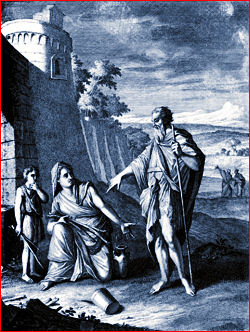 Notice also that even though this woman was in a hopeless situation, her despair had not yet caused her to lie down and give up. She remained occupied and busy, gathering fuel even for one last meal. A lot of people would have given up to depression and dejection and simply lay down to die. But this woman would continue to cook for her son until she had nothing left to cook. And it was her devotion to that duty that brought her across Elijah's path, and into the pathway of God's blessing.
 Elijah didn't ask for all of her final measure of flour—only enough to make a very small cake—a token that would demonstrate a spark of faith in her. And God graciously moved her heart to obey. "She went and did according to the saying of Elijah: and she, and he, and her house, did eat many days. And the barrel of meal wasted not, neither did the cruse of oil fail, according to the word of the LORD, which he spake by Elijah" (vv. 15-16).
 hy did God send Elijah to the home of a Gentile widow?
 When Elijah met her, she was preparing a meal with the expectation that this would be the last morsel of food she would ever taste before she and her little boy starved to death.
 lijah's experience illustrates how God can give abundant grace without necessarily bestowing abundant wealth. Sometimes He chooses to show grace through the most extreme kind of poverty. And that is why when Elijah's brook dried up, God moved Elijah to a widow's home in Zarephath, where by most standards, things were even worse for him. He was living in a hostile, pagan land; he was utterly dependent on the hospitality of one poverty-stricken widow; and there were never enough provisions on hand for more than one meal. At Cherith he at least had regular delivery of food by the ravens—here it was just the paltry remnants of a poor widow's dwindling supply of oil and flour.
 The very name of the town, Zarephath, gives a hint about what kind of experience this was for Elijah. "Zarephath" means "smelting furnace" or "cauldron"—the place where precious metal is heated to a white-hot temperature in order to remove impurities. This was part of the painful sanctifying process that would make Elijah fit for his future days of ministry.
 Pecadillo tells me he thinks the cat theme isn't working. He wants all cats banned permanently from the blog. (He's been telling me this for days. It's a mantra I've heard so often, I've given it a name: "The Prayer of Jpeg.") Pecadillo's already got Wrigley on his side. I'm ambivalent. We've got a LOT more cat images already in the pipeline. But I'll get rid of them all without compunction if a majority of Pyro Regulars share Pecadillo's strong distaste for the feline imagery.
  n Monday
  Most of us would have begun to make alternative plans of our own about the time the stream showed signs of drying up. Obedience to the Lord might be our "Plan A," but the minute "Plan A" starts to get difficult, we start thinking about "Plan B." Not Elijah. I mentioned on Monday that Elijah obeyed the Lord one step at a time, even when all he could see was danger ahead, and he did not know what God would call him to do next. He was walking completely by faith, and he did not take one presumptuous step on his own.