by Dan PhillipsBoB. One of the questions posed to the
Band of Bloggers panel (at which our blog was ably represented by Phil Johnson) was on the issue of "accountability."
I think "accountability" has taken on the status of a
buzzword. You say it's important, everyone nods knowingly and murmurs "Mmm,
accountability," and you're
in. They know you're okay.
But what does "accountability" mean?
In some contexts, it means "
infinite-buck-pass." Folks who rankle at submitting to any human authority simply assure that everyone (else) can be trumped by someone. This usually ends in a majority vote. Folks like this feel a lot better about majority-vote.
This solution has long puzzled me. In the Bible, the majority is almost invariably wrong.

Q: Can 10 out of 12 spies be wrong?
A: You betcha!
Q: Can virtually an entire nation be wrong?
A: You betcha! More than once!
Etc.
Further, to whom is the majority "accountable"? With mob-rule, who rules the mob?
The question of accountability strikes me as particularly odd in the context of blogging. Nonetheless, let's take it seriously, and work towards a serious answer.
To whom is a Christian blogger "accountable"? First, we have to define "accountability." Is that an easy task? Let's try to make it easy by suggesting
answerable as a synonym. But does that really make it easy? What would you mean by either word? Are you asking who has the authority to
censor a blogger, or to
reprove him, to
correct him? To
force him to change his mind, or to change one of his posts?
How about his
pastor? I actually think that's a good suggestion for some sort of accountability, since it is indeed the role of a pastor to keep watch over (and answer for) the souls of those under his charge (Hebrews 13:17). We are to respect our pastors and follow their lead (1 Corinthians 16:16; 1 Thessalonians 5:12-13; Hebrews 13:7, 17; etc.).
So I think it would be perfectly appropriate for a pastor to read his sheep's blogs
insofar as he is able to do so, or at least to check on occasion to make sure that the blogger is representing Christ faithfully. After all, as I mean to develop in another post, blogging is indeed a stewardship with some attendant formidable responsibilities.

Frank Turk has shared that his pastor keeps tabs on him, and I think that's great. I had the pleasure of meeting Pastor Tad at T4G and offered my sympathies and prayers. It would certainly be faithful pastoring to offer correction and encouragement and direction to those under one's charge (cf. 2 Timothy 4:2).
Additionally, we three keep tabs on each other. More than once, each of us has put up a post in "Draft" status and invited the others for feedback. Or if a discussion heats up, we'll invite assessment or criticism or perspective, confident that we'll be candid and honest with each other.But beyond that, what would one suggest? An advisory panel of
Christian Blogger Overlord Watchdogs? What a
great idea. We could call it
"CBLOW."But, seriously. What further "accountability" is called for?
I honestly think that to pose the question thoughtfully is to answer it. To whom is a Christian blogger answerable? Good heavens — what is
more public than blogging?

Think about it: you talk to a fellow church member, and
one person hears you. You teach a Sunday School class, and maybe a few
dozen hear you. Preach, and (unless it's recorded)
dozens or
hundreds hear you.
But when you blog?
Blog, and
everybody hears you — or at any rate everyone
can. It is right out there in public, all of it, for God and everyone to see, analyze, fact-check, pick over, misrepresent, treasure, slander, repeat, steal, discuss, debate, and any other appropriate verb you might choose.
In the past, and very frequently, I've taken great
comfort in this fact. When someone glances at a post-title and then blurts out his immediate emotional reaction, or skims to my last paragraph and rips apart what he imagines I said, or runs off to his own blog or another's to cry and complain about something... the public nature of this entire "conversation" is very comforting to me. I know that any fair-minded reader can examine what I said, and decide for himself — up, down, or sideways.
And if they're
not fair-minded? Oh well; wasn't going to win them anyway.
I remember a fellow who angrily demanded that I source a quotation. But I had! I'm obsessive about sourcing. It was right there in the post. I even re-read it myself again and again — but he insisted it wasn't sourced, and got madder and madder at me for being so irresponsible. But everything I had written was on display for everyone to see. Very
comforting to me, in that case.
But on the other hand, the knowledge that everything I write will be read by all sorts of people is very
sobering as well. Think about it: everything I write will be read by people smarter than I, better-educated than I (the two are not necessarily interchangeable); by people who know things I don't know, and who see things from angles I haven't considered. Some of them will be supportive of what I want to say, some will be very angered by it, some will be bitterly opposed to it. And
they all have access to a public forum. Genius or... er, non-genius, they have equal access to the same public forum that I access.
If I did in fact say something foolish and/or irresponsible and/or stupid, they can tell everyone.
Everyone. On this blog, on their blog, on anyone's blog. Forever, until I die or am hounded off the scene in shame, known only as "Oh-yes-Dan-Phillips,-that-pinhead-who-____."
How's
that for accountability?

And it works, too. In fact, it's a big reason why I tend to crankiness when someone quick-draws (and sloppy-shoots) some challenge to a question I already anticipated in the post. Before I hit
PUBLISH POST, I try to read the post from several angles to anticipate challenges and questions it might provoke. I doubt anyone likes to be made a fool in public, and I try to avoid it whenever possible.
But what is the final court of appeal? When I (say) vigorously affirm the sufficiency of Scripture, a lot of folks are delighted, but equally a lot of folks are madder than wet cats. To which group am I responsible, to which am I "accountable"?
In the final analysis, to
none of them.
Where the buck actually stops. On the great Day, my ministry as a blogger won't be passed before a majority vote, but before a vote of one (2 Corinthians 5:10; Hebrews 4:13).
I know that's got to seem suspiciously
convenient to some. Consider these Scriptures, then:
You shall not curse the deaf or put a stumbling block before the blind, but you shall fear your God: I am the LORD (Leviticus 19:14)
You shall not wrong one another, but you shall fear your God, for I am the LORD your God (Leviticus 25:17)
For they are my servants, whom I brought out of the land of Egypt; they shall not be sold as slaves. 43 You shall not rule over him ruthlessly but shall fear your God (Leviticus 25:42-43)
All these ethical demands, and each has the same motivator:
fear your God.
The disabled person cannot avenge himself — but you had better fear God! The neighbor you bilk may not know enough to call your dishonesty — but you had better fear God! Your helpless fellow-Israelite may not have the power to deal with your injustice — but you had better fear God!
One might counter, "But there were courts and judges to which people could appeal. Israelites were accountable to them." Perhaps so.
So who was at the top of the human authority-ladder? Where did the buck stop? Who had
no humans to whom he was "accountable," in that sense? That would be
the king. As Solomon wrote:
I say: Keep the king's command, because of God's oath to him. 3 Be not hasty to go from his presence. Do not take your stand in an evil cause, for he does whatever he pleases. 4 For the word of the king is supreme, and who may say to him, "What are you doing?" (Ecclesiastes 8:2-4)
And where was the king's accountability?

"And when he sits on the throne of his kingdom, he shall write for himself in a book a copy of this law, approved by the Levitical priests. 19 And it shall be with him, and he shall read in it all the days of his life, that he may learn to fear the LORD his God by keeping all the words of this law and these statutes, and doing them.... (Deuteronomy 17:18-19)
The king was to learn from the Law the fear of Yahweh. The priests made sure he copied it accurately, but there's no indication of further responsibility on their part. The king was directed to the Word, and the Word taught him to fear Yahweh.
That was to motivate him, keep him in line. Hold him accountable.
And besides, ultimately, if the fear of God is insufficient motivation, then we have a problem not soluble by committee.
This dimension should both humble and embolden the Christian blogger (Proverbs 28:1). He will welcome wise criticism without being its slave (Proverbs 9:8b-9; 11:2; 26:12).
He's wise enough to mistake neither his critics' judgment, nor his own, for God's.


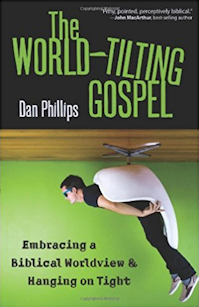
 But also if you have read and profited from The World-Tilting Gospel, published by Kregel, you have Ed to thank. Ed is the man who sold Kregel on taking a chance on unpublished me and my baby, and helped nurse it and me through the process. Valerie and I have had the pleasure of meeting and dining with him, as well as a continued occasional correspondence.



 get this kind of question all the time, so I figured if I blogged an answer, I could just post a link instead of writing a whole new answer every time this comes up:
 'm a passionate person. People who know me will affirm that. I think Christians ought to be passionate about truth, passionate in our love for God and for one another, and (above all) passionate about the glory of God.
 But raw passion is not the point. Passion is valid and edifies only when it's the right kind of passion, based on legitimate affections for the right things. I'm concerned about the unbridled passions frequently turned loose by people whose only religious affections were cultivated in evangelical youth groups. (And if I can speak freely: that includes a lot of of our so-called young, restless, and Reformed frends.) Everything seems to unleash stadium-style passions. I've even seen people scream, whistle, stomp, and cheer at baptisms, as if they were celebrating a touchdown. Many Christians glorify passion for passion's sake—as if raw passion per se were something praiseworthy and deeply spiritual. It's not. And this has become a serious problem in today's post-pentecostal, post-evangelical, anything-goes era.
 nthony Trollope was a Victorian novelist whose output and popularity rivaled Dickens. His books aren't as well known today as the Dickens classics, but they are still easily available and Trollope still has a passionate following.
 Trollope grew up in a poor but aristocratic family. His father, though related to the landed gentry, failed at practically everything he ever attempted. In later years Anthony's mother, Frances Trollope, scored some remarkable successes as a writer (achieving fame but not much critical acclaim with Domestic Manners of the Americans [1832] and several novels). But her earnings were not enough to overcome her husband's failures, and the family ultimately fled to Belgium so that Anthony's father could avoid debtors' prison.

 couple of our readers lately have questioned whether we are really on the same page regarding political activism and the proper place of partisan punditry in Christian ministry. Since Dan has extensively written on elections and political/societal matters at his own blog, and Frank Turk writes a fair amount of social and cultural commentary at his blog, one or two of our commenters wondered if all the members of TeamPyro really do see eye to eye on these matters. Obviously, we each have different emphases and interests we like to write about. Phil likes Bach Cantatas and Dan likes Chicago. Dan collects commentaries and Frank collects comic books. Frank is an expert in marketing and Phil is an expert in editorial matters. Granted, we're an unlikely menagerie of co-authors. But on the issues that really count, we're


 by Frank Turk
 So:
So: [4] When we are doing our job in the church, as the church, our methods of political engagement will change. It’s ironic, I think, that the church has been able to historically manage the highest rate of change and the highest value of social change when it is most willing to die for the Gospel rather than fight for political ends with political means.
 by Frank Turk
 These are the two conflicting opinions, dear readers. If you have read both of these books, you are welcome to comment here regarding which one offers the more compelling vision of the church and its mission.