Showing posts with label doubt. Show all posts

15 April 2015

Trivializing a Real Problem

by F.X. Turk

There was once a guy who loved his wife and served faithfully in his local church.  His wife really loved this guy, and they had a lot of kids.  This guys was the kind of guy you read about in Titus 1 who really set things in order most of the time by loving people and being informed by God's word, and everyone who knew him and his family thought that this is what God's will looked like in a Christian home.

And this guy was killed by a natural disaster, while he was spending his last moments making sure his family was safe from harm.  He spent his whole life, from a tender age, loving his wife the way Christ loved the church, and God decided to take this guy out and leave his wife husbandless and his children fatherless.


I bring it up for one reason only: I don't really want you to talk to me about whether or not you struggle with faith and doubt unless you have spent your whole life following God, and then suddenly everything you think following God looks like is blown to bits by God.  If you are the wife of the guy I described up above (or someone like her, with her experience of loss and grief in the face of faithful devotion both to God and to your fellow human beings), your reflections on faith and doubt ought to turn some heads.  If you are not, I'm wondering what you think you have to say about the subject.

Look: the book of Job is not about some guy who, after growing up in a famous pastor's house, has some uneasiness about how Christians live and whether or not God is real if Christians are not yet perfect people.  Job is about a man who spent his life serving God and loving God, and raising a family to the place where his adult children all loved God -- and then God says, effectively, "I know you love Me and not merely My gifts, so I am taking away the gifts to show Satan and the world that Faith is in Me, not in My generosity only."  It's not some version of adolescent poetry which got published by Crossway - it's about actually losing everything to God and still remembering that God is God and you are Not.

If you are writing a book about your struggle with faith and doubt, and the best you can do is tell me that sometimes you wonder if God is safe enough to protect your middle-class notions of being warm and well fed, please find something else to write about.  Please put your pen away.  Most of us resolve your issues when we are unemployed for the first time and we don't know if we are going to feed our babies next week, or when we are afraid that God will not let us have babies in our family.  Your middle-class angst about this subject does a huge disservice to actual doubt and (if I can really put my foot in it) real faith.

You should be a grown up for more than the span of the run of your favorite TV show before you try your hand at explaining adult faith to the rest of us.

There was quite a dust-up on the internet a little while ago about what I think Phil called "Heaven Tourism books."  That is: there's a real problem in Christian Media which presents itself as books ginned up by agents and marketing people about alleged visits to heaven which somehow look nothing like the place where Jesus is sitting on a throne at the right hand of God.  That sort of hucksterism is easily discovered and decried.  It's easy to call it out and say that publishers ought to be ashamed to make a buck off that sort of thing.  But let me be clear about something: this is no better. Books about the niggling little sophist quips of people who have never really suffered which come to the conclusion that they love Jesus anyway trivializes the real dry gulf between doubt and faith.  People writing those books are trivializing a real problem which grow-ups face, and are in the same category as Rachel Held Evans - diarists of their own failure to launch, authors of memoirs where there is nothing yet to remember.





27 June 2013

Unfathomable unbelief (re-post)

by Dan Phillips

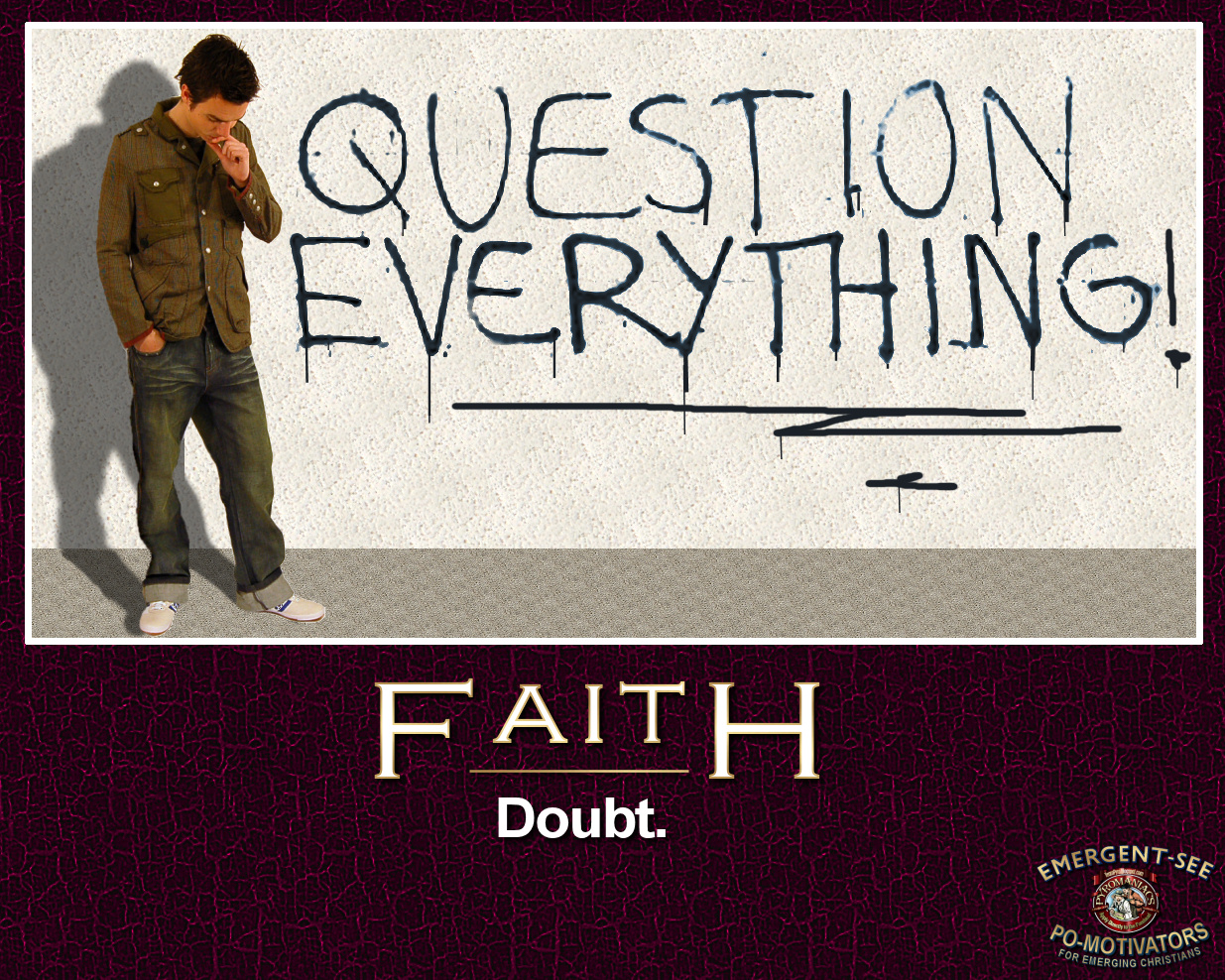
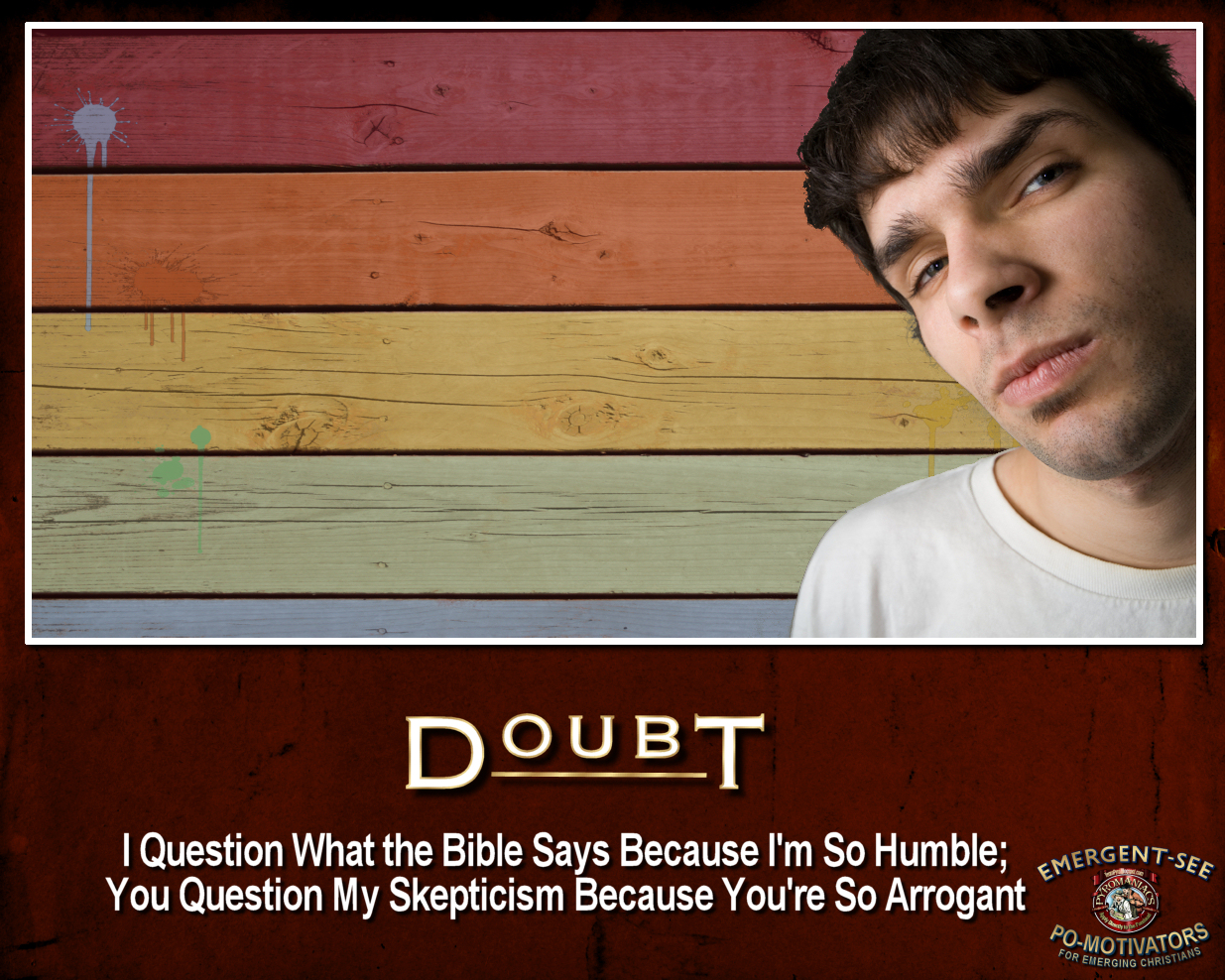
Of course, Phil's Po-Motivator makes this post from December of 2007 a "win" all by itself. But I thought it timely as well.


And he said to them, "Why are you troubled, and why do doubts arise in your hearts?" (Luke 24:38)
Is this really a rhetorical question?

Our unbelief has to be unfathomable to God, as was the disciples' to Christ. It is as if He were saying,
"What basis have I ever given you for doubting Me? I told you that I would be rejected, handed over to the chief priests and scribes, beaten, condemned, crucified, killed (Luke 9:22, 44; 18:31-33). You didn't believe that would happen, but it did. I also said I'd rise again from the dead (Luke 18:33). Did you disbelieve? Again? Why?"
To say that God knows and understands all things is not to say that God finds everything understandable, if you take my meaning.

It is clear that the Lord does not see doubt as a virtue. But beyond even that, He seems to find unbelief unbelievable.

Dan Phillips's signature

03 June 2012

About those "Honest Doubts . . ."

Your weekly dose of Spurgeon
posted by Phil Johnson

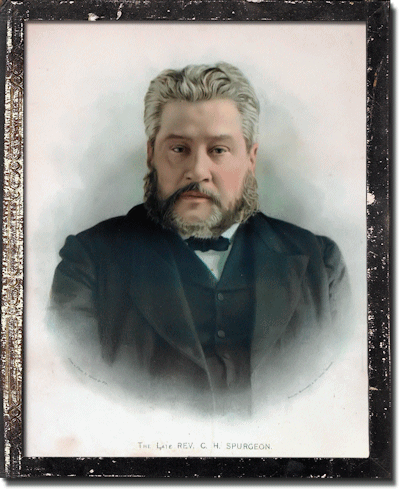
The PyroManiacs devote some space each weekend to highlights from The Spurgeon Archive.The following excerpt was a short item in the July 1884 issue of The Sword and The Trowel.


WO pilots are alongside our vessel; each one is eager to seize the helm. Let us take stock of the rivals and their several works.
Faith in God has evidently steered many into a haven of personal rest, and their voyages have been grandly serviceable to that Humanity which we are nowadays so blandly invited to adore.

As for Doubt, that popular guide of man's youth, it has assuredly left the barques which it has boarded to drift to and fro like derelicts, without owner or harbour. When it has come on board our own vessel we have been all in a flutter till it has swaggered off again. Usefulness to humanity has come scantily enough from the skeptical principle. It has attempted nothing, and accomplished less.

"Weak to perform, though mighty to pretend."

Assuredly there will not be much lost if this popular gentleman called Doubt, who finds it needful ostentatiously to dub himself Honest, should be dropped overboard. He will not drown, and the yielding element will suit him.

Investigation, judgment, conscientious care, must ever be exercised; but the harpy of unbelief, perpetually defiling the sacred and tearing to pieces the useful, we cannot and will not endure. To live to jangle is no ambition of ours.

Plain common sense leads us to prefer virtue to vice, and, as a way to virtue, that same sense selects faith in God rather than incredulity. Surely it needs no surplus of wit to make this election. How can a man who has a right to be outside of Bedlam long debate which of the two to choose—the faith which sees the invisible God, or the blind unbelief whose highest glory is to know nothing?

C. H. Spurgeon

17 June 2011

Unbelief: Parent of Every Gross Evil

Your weekly dose of Spurgeon
posted by Phil Johnson


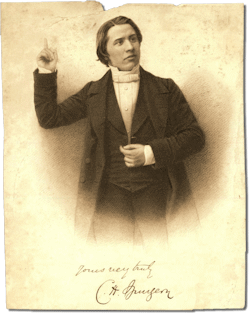
The PyroManiacs devote some space each weekend to highlights from The Spurgeon Archive. The following excerpt is from "The Sin of Unbelief," Sermon #3 in the vast New Park Street/ Metropolitan Tabernacle collection. It was preached on Sunday Morning, 14 January 1855, at the New Park Street Chapel in Southwark, during Spurgeon's first year as pastor of that congregation.


he sin of unbelief will appear to be extremely heinous when we remember that it is the parent of every other iniquity. There is no crime which unbelief will not beget.

I think that the fall of man is very much owing to it. It was in this point that the devil tempted Eve. He said to her, "Yea, hath God said, ye shall not eat of every tree of the garden?" He whispered and insinuated a doubt, "Yea, hath God said so?" as much as to say, "Are you quite sure he said so?"

It was by means of unbelief—that this part of the wedge—that the other sin entered; curiosity and the rest followed; she touched the fruit, and destruction came into this world. Since that time, unbelief has been the prolific parent of all guilt.

An unbeliever is capable of the vilest crime that ever was committed. Unbelief, sirs! why it hardened the heart of Pharoh—it gave license to the tongue of blaspheming Rabshakeh—yea, it became a deicide, and murdered Jesus. Unbelief!—it has sharpened the knife of the suicide! it has mixed many a cup of poison; thousands it has brought to the halter; and many to a shameful grave who have murdered themselves and rushed with bloody hands before their Creator's tribunal, because of unbelief!

Give me an unbeliever—let me know that he doubts God's word—let me know that he distrusts his promise and his threatening; and with that for a premise, I will conclude that the man shall, by-and-bye unless there is amazing restraining power exerted upon him, be guilty of the foulest and blackest crimes.

Ah! this is a Beelzebub sin; like Beelzebub, it is the leader of all evil spirits. It is said of Jeroboam that he sinned and made Israel to sin; and it may be said of unbelief that it not only sins itself; but makes others sin, it is the egg of all crime, the seed of every offense; in fact everything that is evil and vile lies couched in that one word—unbelief.

And let me say here, that unbelief in the Christian is of the self-same nature as unbelief in the sinner. It is not the same in its final issue, for it will be pardoned in the Christian; yea it is pardoned: it was laid upon the scape-goat's head of old: it was blotted out and atoned for; but it is of the same sinful nature.

In fact, if there can be one sin more heinous than the unbelief of a sinner, it is the unbelief of a saint. For a saint to doubt God's word—for a saint to distrust God after innumerable instances of his love, after ten thousand proofs of his mercy—exceeds everything.

In a saint, moreover, unbelief is the root of other sins. When I am perfect in faith I shall be perfect in everything else: I should always fulfill the precept if I always believed the promise. But it is because my faith is weak, that I sin. Put me in trouble, and if I can fold my arms and say, "Jehovah-Jireh the Lord will provide," you will not find me using wrong means to escape from it. But let me be in temporal distress and difficulty, if I distrust God, what then? Perhaps I shall steal, or do a dishonest act to get out of the hands of my creditors; or if kept from such a transgression, I may plunge into excess to drown my anxieties.

Once take away faith, the reins are broken; and who can ride an unbroken steed without rein or bridle? Like the chariot of the sun with Phaeton for its driver, such should we be without faith. Unbelief is the mother of vice; it is the parent of sin; and, therefore, I say it is a pestilent evil—a master sin.

C. H. Spurgeon


13 June 2011

The Indignity of Doubt

Your weekly dose of Spurgeon
posted by Phil Johnson


The PyroManiacs devote some space each weekend to highlights from The Spurgeon Archive. The following excerpt is from "Fear Not!"—a sermon preached Sunday Morning 4 October 1857 at the Music Hall, Royal Surrey Gardens.


oubt not the Lord, O Christian; for in so doing thou dost lower thyself. The more thou believest, the greater thou art; but the more thou doubtest, the less thou becomest.

It was said of the world's conqueror, that when he was sick, he puled [whined weakly] like a child. "Give me some drink," cried one, like a sick girl, it was said to his dishonor. And is it not to the dishonor of a Christian, who lives in secret on his God, and professes to trust alone in him, that he cannot trust him; that a little child will overcome his faith?

Oh, poor cockle-shell boat, that is upset by a rain-drop! O poor puny Christian that is overcome by every straw, that stumbles at every stone!

Then, Christian men, behave like men! It is childish to doubt; it is manhood's glory to trust. Plant your foot upon the immoveable Rock of Ages; lift your eye to heaven; scorn the world; never play craven; bend your fist in the world's face, and bid defiance to it and hell, and you are a man, and noble. But crouch and cringe, and dread, and doubt, and you have lost your Christian dignity, and are no longer what you should be. You do not honor God.

"Fear not, thou worm Jacob; I will help thee, saith the LORD." Then why shouldst thou fear?

C. H. Spurgeon


09 January 2011

Don't Fear the Militant Skeptics

Your weekly dose of Spurgeon
posted by Phil Johnson


The PyroManiacs devote some space each weekend to highlights from The Spurgeon Archive. The following excerpt is from "The Dream of the Bakery Cake," a sermon preached Sunday morning, 22 November 1885 at the Met Tab in London.


ehold the host of doubters, and heretics, and revilers, who, at the present time, have come up into the inheritance of Israel, hungry from their deserts of rationalism and atheism! They are eating up all the corn of the land. They cast a doubt upon all the verities of our faith.
But we need not fear them; for if we heard their secret counsels, we should perceive that they are afraid of us. Their loud blusterings and their constant sneers are the index of real fear. Those who preach the cross of our Lord Jesus are the terror of modern thinkers. In their heart of hearts they dread the preaching of the old-fashioned gospel, and they hate what they dread. On their beds they dream of the coming of some evangelist into their neighborhood. What the name of Richard was to the Saracens, that is the name of Moody to these boastful intellects. They wish they could stop those Calvinistic fellows and those evangelical old fogies.

Brethren, so long as the plain gospel is preached in England there will always be hope that these brigands will yet be scattered, and the church be rid of their intrusion. Rationalism, Socinianism, Ritualism, and Universalism will soon take to their legs, if the clear, decided cry of "the Sword of the Lord and of Gideon" be once more heard.

C. H. Spurgeon


17 October 2010

Another Word About Doubt

Your weekly dose of Spurgeon
posted by Phil Johnson


The PyroManiacs devote some space each weekend to highlights from The Spurgeon Archive. The following excerpt is from "The Three Witnesses," a sermon originally preached at the Metropolitan Tabernacle on Sunday morning, 9 August 1874.

   feel sick to death of the common talk about the healthiness of doubting and the beauty of "modern thought." This talk is only the self-praise of a set of concealed infidels treacherously lurking in God’s church.
C. H. Spurgeon


03 October 2010

"Advanced Thinkers"

Your weekly dose of Spurgeon
posted by Phil Johnson

The PyroManiacs devote some space each weekend to highlights from The Spurgeon Archive. The following excerpt is from "Advanced Thinkers," an article Spurgeon wrote for the November 1871 issue of The Sword and the Trowel.


here has by degrees risen up in this country a coterie, more than ordinarily pretentious, whose favorite cant is made up of such terms as these: "liberal views," "men of high culture," "persons of enlarged minds and cultivated intellects," "bonds of dogmatism and the slavery of creeds," "modern thought," and so on.

That these gentlemen are not so thoroughly educated as they fancy themselves to be, is clear from their incessant boasts of their culture; that they are not free, is shrewdly guessed from their loud brags of liberty; and that they are not liberal, but intolerant to the last degree, is evident, from their superciliousness towards those poor simpletons who abide by the old faith.

Jews in old times called Gentiles dogs, and Mahometans cursed unbelievers roundly; but we question whether any men, in any age, have manifested such contempt of others as is constantly evidenced towards the orthodox by the modern school of "cultured intellects." Let half a word of protest be uttered by a man who believes firmly in something, and holds by a defined doctrine, and the thunders of liberality bellow forth against the bigot.

Steeped up to their very throats in that bigotry for liberality, which, of all others, is the most ferocious form of intolerance, they sneer with the contempt of affected learning at the idiots who contend for "a narrow Puritanism," and express a patronizing hope that the benighted adherents of "a half-enlightened creed" may learn more of "that charity which thinketh no evil."

To contend earnestly for the faith once delivered to the saints is to them an offense against the enlightenment of the nineteenth century; but, to vamp old, worn-out heresies, and pass them off for deep thinking, is to secure a high position among minds "emancipated from the fetters of traditional beliefs."
. . . . . . . . . .

These gentlemen of culture have certainly adopted peculiar tactics. The misbelievers and unbelievers of former ages withdrew themselves from churches as soon as they found out they could not honestly endorse their fundamental articles; but these abide by the stuff, and great is their indignation at the creeds which render their position morally dubious. Churches have no right to believe anything; comprehensiveness is the only virtue of a denomination; precise definitions are a sin, and fundamental doctrines are a myth: this is the notion of "our foremost men." For earnest people to band themselves together to propagate what they hold to be the very truth of God, is in their eyes the miserable endeavor of bigots to stem the torrent of modern thought; for zealous Christians to contribute of their substance for the erection of a house, in which only the truths most surely believed among them shall be inculcated, is a treason against liberality; while the attempt to secure our pulpits against downright error, is a mischievous piece of persecution to be resented by all "intellectual" men.

The proper course, according to their "broad views," would be to leave doctrines for the dunces who care for them. Truths there are none, but only opinions; and, therefore, cultivated ministers should be left free to trample on the most cherished beliefs, to insult convictions, no matter how long experience may have matured them, and to teach anything, everything, or nothing, as their own culture, or the current of enlightened thought may direct them. If certain old fogies object to this, let them turn out of the buildings they have erected, or subside into silence under a due sense of their inferiority.

It appears to be, now-a-days, a doubtful question whether Christian men have a right to be quite sure of anything. . . . The right to doubt is claimed clamorously, but the right to believe is not conceded. The modern gospel runs thus: "He that believes nothing and doubts everything shall be saved." Room must be provided for every form of skepticism; but, for old-fashioned faith, a manger in a stable is too commodious.

Magnified greatly is the so-called "honest doubter," but the man who holds tenaciously by ancient forms of faith is among "men of culture" voted by acclamation a fool. Hence, it becomes a sacred duty of the advanced thinker to sneer at the man of the creed, a duty which is in most cases fully discharged; and, moreover, it is equally imperative upon him to enter the synagogue of bigots, as though he were of their way of thinking, and in their very midst inveigh against their superstition, their ignorant contentedness with worm-eaten dogmas, and generally to disturb and overturn their order of things. What if they have confessions of faith? They have no right to accept them, and, therefore, let them be held up to ridicule.
. . . . . . . . . .

While we are upon the point, it may be well to inquire into the character of the liberality which is, now-a-days, so much vaunted. What is it that these men would have us handle so liberally? Is it something which is our own, and left at our disposal? If so, let generosity be the rule. But no, it is God's truth which we are thus to deal with, the gospel which he has put us in trust with, and for which we shall have to render account.

The steward who defrauded his lord was liberal; so was the thief who shared the plunder with his accomplice; and so were those in the Proverbs, who said, "let us all have one purse." If truth were ours, absolutely; if we created it, and had no responsibilities in reference to it, we might consider broad-church proposals; but, the gospel is the Lord's own, and we are only stewards of the manifold grace of God, and of stewards it is not so much required that they be liberal, but that they be found faithful.

Moreover, this form of charity is both useless and dangerous. Useless, evidently, because all the agreements and unions and compromises beneath the moon can never make an error a truth, nor shift the boundary-line of God's gospel a single inch. If we basely merge one part of Scriptural teaching for the sake of charity, it is not, therefore, really merged, it will bide its time, and demand its due with terrible reprisals for our injustice towards it; for half the sorrows of the church arise from smothered truths.

False doctrine is not rendered innocuous by its being winked at. God hates it whatever glosses we may put upon it; no lie is of the truth, and no charity can make it so. Either a dogma is right or wrong, it cannot be indifferent. . . . The rule of Christians is not the flickering glimmer of opinion, but the fixed law of the statute book; it is rebellion, black as the sin of witchcraft, for a man to know the law, and talk of conceding the point. In the name of the Eternal King, who is this liberal conceder, or, rather, this profane defrauder of the Lord, that he should even imagine such a thing in his heart?

Nor is it less important to remember that trifling with truth is to the last degree dangerous. No error can be imbibed without injury, nor propagated without sin. The utmost charity cannot convert another gospel into the gospel of Jesus Christ, nor deprive it of its deluding and destroying influence.

There is no ground for imagining that an untruth, honestly believed, is in the least changed in its character by the sincerity of the receiver; nor may we dream that the highest culture renders a departure from revealed truth less evil in the sight of God. If you give the sick man a deadly poison instead of a healing medicine, neither your broad views of chemistry, nor his enlightened judgment upon anatomy, will prevent the drug from acting after its own nature.

It may be said that the parallel does not hold, and that error is not deadly, but here we yield not, no, not for an hour. Paul pronounced a curse upon any man or angel who should preach another gospel, and he would not have done so, if other gospels were harmless. It is not so long ago that men need forget it, that the blight of Unitarian and other lax opinions withered the very soul of the Dissenting Churches; and that spirit has only to be again rampant, to repeat its mischief. Instances, grievous to our inmost heart, rise up before our memory at the moment of men seduced from their first love, and drawn aside from their fathers' gospel, who only meant to gather one tempting flower upon the brink of the precipice of error, but fell, never to be restored.

No fiction do we write, as we bear record of those we have known, who first forsook the good old paths of doctrine, then the ways of evangelic usefulness, and then the enclosures of morality. In all cases, the poison has not so openly developed itself, but we fear the inner ruin has been quite as complete. In the case of public teachers, cases are not hard to find where little by little men have advanced beyond their "honest doubt," into utter blasphemy.
. . . . . . . . . .

We are not believers in stereotyped phraseology, nor do we desire to see the reign of a stagnant uniformity; but, at this present, the perils of the church lie in another direction. The stringency of little Bethel, whatever may have been its faults, has no power to work the mischief which is now engendered by the confusion of the latitudinarian Babel. To us, at any rate, the signs of the times portend no danger greater than that which can arise from landmarks removed, ramparts thrown down, foundations shaken, and doctrinal chaos paramount.

C. H. Spurgeon


12 September 2010

The Times Are Out of Joint

Your weekly dose of Spurgeon
posted by Phil Johnson (from US Airways flight 1206, while over Columbus, OH)


The PyroManiacs devote some space each weekend to highlights from The Spurgeon Archive. The following excerpt is from chapter 10, "The Evils of the Present Time, and Our Object, Necessities, and Encouragements," in An All-Round Ministry.


e are getting into the condition into which Germany fell not long ago. To this day, when talking with a German who is about joining our church, I usually find that he has lived in a country town. The devout German villager still attends public worship, but in the large towns a practical atheism is supreme.

Why is this? The ministers have done it. They preached the people out of their faith in the Scriptures; they taught them to be doubters.

The most mischievous servant of Satan that I know of is the minister of the gospel, who not only doubts the truth in his own soul, but propagates doubt in the minds of others by his criticisms, innuendoes, and triflings with words.

Some ministers believe nothing except that nothing can be believed. Such a man's conscience is withered. In some modern ministers, the faculty wherewith to believe is extinct; they have played with words till they cannot be true if they try.

Against this evil I have protested with my whole soul. People say, "Why did you not speak against these things twenty-five years ago?" I answer, "These evils were scarcely apparent then." Things are not now as in our early ministry. There has been a sudden growth of the toadstools of error. I never heard of Universalism then, nor of post-mortem salvation, nor of probation in the next state. Until very lately, I have not heard of ministers holding up the blood of Jesus to scorn. I will not, however, repeat the sad facts which have of late come to my knowledge, and pierced my heart.

The times are out of joint. The world may well be careless, for the Church in many places is full of unbelief. I trust the present hurricane of evil may soon pass over; but anyone who has his wits about him will sorrowfully admit that the good ship of the Church is now tossed about with contrary winds, and needs that her Lord should come, and say to the winds and the waves, "Peace, be still." So far, I have borne before you "the burden of the Lord."

C. H. Spurgeon


04 July 2010

Worth Dying For

Your weekly dose of Spurgeon
posted by Phil Johnson


The PyroManiacs devote some space each weekend to highlights from The Spurgeon Archive. The following excerpt is from "A Gospel Worth Dying For," a sermon preached on Sunday Morning, 12 August 1883 at Exeter Hall in London.


e have gospels nowadays which I would not die for, nor recommend anyone of you to live for, inasmuch as they are gospels that will be snuffed out within a few years. It is never worthwhile to die for a doctrine which will itself die out.


I have lived long enough to see half-a-dozen new gospels rise, flourish, and decay. They told me long ago that my old Calvinistic doctrine was far behind the age, and was an exploded thing; and next I heard that evangelical teaching in any form was a thing of the past, to be supplanted by "advanced thought."

I have heard of one improvement upon the old faith and then of another; and the philosophical divines are still improving their theology. They have gone on advancing and advancing, till heaven knows and perhaps hell knows what next they will advance to; but I am sure I do not.

I would not die for any one of all the modern systems. I should like to ask broad church divines whether there is any positive doctrine in the Bible at all; and whether any form of teaching could for a moment be judged worth dying for; and whether the martyrs were not great fools to die for truths which might be valuable to them, but which the advance of thought has cast into disuse. Those men and women who went to Smithfield and were burnt quick to the death for Christ, were they not fools every one of them to die for a set of ideas which "modern thought" has quite exploded?

I do verily think that to our modern divines there is no such thing as fixed truth, or that, if there be, they are not sure of having yet reached it. They have digged, and digged, and digged: look at the dark pits of unbelief, which they have opened; but they have not come to the rock yet. Wait a little longer; they may one of these days find out something solid; but as yet they have only bored through layers of sand.

Yet there used to be a gospel in the world which consisted of facts which Christians never questioned. There was once in the church a gospel which believers hugged to their hearts as if it were their soul's life. There used to be a gospel in the world, which provoked enthusiasm and commanded sacrifice. Tens of thousands have met together to hear this gospel at peril of their lives. Men, to the teeth of tyrants, have proclaimed it, and have suffered the loss of all things, and gone to prison and to death for it, singing psalms all the while.

Is there not such a gospel remaining? Or are we arrived at cloudland, where souls starve on suppositions, and become incapable of confidence or ardor? Are the disciples of Jesus now to be fed upon the froth of "thought" and the wind of imagination, whereon men become heady and high-minded? Nay, rather, will we not return to the substantial meat of infallible revelation, and cry to the Holy Ghost to feed us upon his own inspired word?

C. H. Spurgeon


16 May 2010

Confident Believers vs. the Chameleons

Your weekly dose of Spurgeon
posted by Phil Johnson


The PyroManiacs devote some space each weekend to highlights from The Spurgeon Archive. The following excerpt is from "Hold Fast Your Shield," a sermon published in 1875.


ome persons appear to think that a state of doubt is the very best which we can possibly reach. They are very wise and highly cultured individuals, and they imagine that by their advanced judgments nothing in the world can be regarded as assuredly true.

Some of the broad church school would seem to believe that no doctrine in the Bible is worth dying for, or worth anybody's losing over and above a halfpenny for. They do not feel sure of any doctrine: it may be true, and there is a good deal to be said for it, but then a good deal may be said on the other side, and you must hold your mind "receptive," and be ready to accept "new truth."

Some Robinson or other said something about new truth, as if there ever could be such a thing, and, under cover of his probably misinterpreted speech, like chameleons, they are always taking their clue from the particular light that falls upon them. They have no light in themselves and no truth which they hold to be vital.

Such people cannot understand this confidence, but the veriest babes in the family of faith know what it means. Here are certain things which God has taught me; I believe them and am sure about them.

"Dogmatical," says one.

Exactly so; call it what you like, but we are bold to confess that there remains no doubt to us after God has spoken. The question is solved by God's word; the doubt is laid to sleep for ever by the witness of the Holy Spirit.

Oh, to know the grand truths of the gospel, and to know them infallibly. For instance, the grand doctrine of the substitutionary sacrifice of the Son of God—to know it and hold it and say, "Let others question and quibble, but I must believe it; it is my only hope, it is all my salvation. I stake my soul upon it: if that be not true then am I lost." And so with regard to all the other grand truths of revelation, the thing is to know them and grasp them firmly. There must be leverage if we would move men, and to have a leverage you must have a fixed point.

There must be certain undoubted truths about which you can sing, "O God, my heart is fixed; my heart is fixed: I will sing and give praise "—things which you perceive to be plainly taught in the Scriptures—things brought home by the power of the Holy Spirit.

C. H. Spurgeon


28 November 2009

The Evil of Uncertain Preaching

Your weekly dose of Spurgeon
posted by Phil Johnson


The PyroManiacs devote some space each weekend to highlights from The Spurgeon Archive. The following excerpt is from "A Sermon for the Time Present," preached at the height of the Down-Grade Controvery, on 30 October 1887.


he brilliance of the gospel light is dimmed by error. The clearness of the testimony is spoiled when doubtful voices are scattered among the people, and those who ought to preach the truth, the whole truth, and nothing but the truth, are telling out for doctrines the imaginations of men, and the inventions of the age.
Instead of revelation, we have philosophy, falsely so-called; instead of divine infallibility, we have surmises and larger hopes. The gospel of Jesus Christ, which is the same yesterday, to-day, and for ever, is taught as the production of progress, a growth, a thing to be amended and corrected year by year. It is an ill day, both for the church and the world, when the trumpet does not give a certain sound; for who shall prepare himself for the battle?

C. H. Spurgeon


23 September 2009

A few pithy thoughts on doubt

by Dan Phillips and homeboys

[Note: I am using "doubt" as a kind word. There are others that would fit.]

The meta of the post I discuss here led me to a few thoughts about doubt. I shared those thoughts with my betters here, and Phil and Frank added some of their own. It's collaborative, it's an ensemble! Like Seinfeld... only with a point.

Have you ever noticed...
  1. ...everyone who tries to back away from an unpopular Biblical doctrine paints himself as heroic?
  2. ...everyone who tries to back away from an unpopular Biblical doctrine paints himself as tragic?
  3. ...everyone who tries to back away from an unpopular Biblical doctrine paints his doubt as different doubt from every other doubter who has ever doubted and come to a bad end from it?
  4. ...everyone who tries to back away from an unpopular Biblical doctrine insists that his path won't end up where every other doubter's path ended? Which is to say...
  5. ...everyone who tries to back away from an unpopular Biblical doctrine hates it when the historical and logical progression of doubt is pointed out?
  6. ...everyone who tries to back away from an unpopular Biblical doctrine paints himself as smarter, deeper, less lazy, and more honest than people who don't share his doubt?
  7. ...everyone who tries to back away from an unpopular Biblical doctrine paints himself as humble, while those who point him back to the Word are arrogant?
  8. ...everyone who tries to back away from an unpopular Biblical doctrine paints himself as nice, while those who point him back to the Word are mean?
  9. ...everyone who tries to back away from an unpopular Biblical doctrine paints himself as academically sophisticated, carefully nuanced, and wonderfully insightful, while those who point him back to the Word are unenlightened hacks and drooling theological troglodytes?
  10. ...everyone who tries to back away from an unpopular Biblical doctrine paints himself as courageous, while those who point him back to the Word are bullies and ruffians?


Dan Phillips's signature

20 September 2009

Doubt Is a Deadly Poison

Your weekly dose of Spurgeon
posted by Phil Johnson

The PyroManiacs devote some space each weekend to highlights from The Spurgeon Archive. The following excerpt is from "The First Appearance of the Risen Lord to the Eleven," a sermon preached Sunday morning, 10 april 1887.


ind if you can, beloved, one occasion in which Jesus inculcated doubt, or bade men dwell in uncertainty.



The apostles of unbelief are everywhere to day, and they imagine that they are doing God service by spreading what they call "honest doubt." This is death to all joy! Poison to all peace! The Savior did not so. He would have them take extraordinary measures to get rid of their doubt. . . .

O beloved, you that are troubled and vexed with thoughts, and therefore get no comfort out of your religion because of your mistrust, your Lord would have you come very near to him, and put his gospel to any test which will satisfy you. He cannot bear you to doubt. He appeals tenderly, saying, "O thou of little faith, wherefore didst thou doubt?" He would at this moment still encourage you to taste and see that the Lord is good. He would have you believe in the substantial reality of his religion, and handle him and see: trust him largely and simply, as a child trusts its mother and knows no fear.

C. H. Spurgeon


18 September 2009

Transparency

by Phil Johnson

f you have been reading the blog very long, this shouldn't come as any surprise:

I'm not impressed with the postmodern notion of transparency as a substitute for the old-fashioned (and biblical) virtue of humility.

Dan Phillips shares my point of view. Last year he posted a three-part series on the subject.


The type of transparency I'm speaking of is that faux-honesty so often used as an excuse for voicing various kinds of complaints, doubts, accusations, fleshly desires, and other kinds of evil thoughts. This exhibitionistic "virtue" is often paired with a smug self-congratulatory sneer or a condescending dismissal of anyone who dares to suggest that propriety and spiritual maturity may sometimes require us not to give voice to every carnal thought or emotion—i.e., that sometimes discretion is better than transparency.

Here's a biblical case-study that goes against conventional postmodern "wisdom": In Psalm 73, Asaph is rehearsing the confusion he felt over the reality that wicked people sometimes prosper while righteous people suffer. He says:
I was envious of the arrogant when I saw the prosperity of the wicked. For they have no pangs until death; their bodies are fat and sleek. They are not in trouble as others are; they are not stricken like the rest of mankind. Therefore pride is their necklace; violence covers them as a garment. Their eyes swell out through fatness; their hearts overflow with follies. They scoff and speak with malice; loftily they threaten oppression. They set their mouths against the heavens, and their tongue struts through the earth. Therefore his people turn back to them, and find no fault in them. And they say, "How can God know? Is there knowledge in the Most High?" Behold, these are the wicked; always at ease, they increase in riches. (Psalm 73:3-12)

A note of resentment against God? A model of the very kind of transparency I decry? Sure sounds like it, huh? He continues:

All in vain have I kept my heart clean and washed my hands in innocence. For all the day long I have been stricken and rebuked every morning.

Self-pity, too. Wow! Is that not a classic example of brilliant, transparent, postmodern confessional writing? The psalmist is venting his spleen, giving voice to his doubts, teaching us that it's OK to broadcast whatever doubts and resentments we maybe harboring against God. Right?

Well, not exactly. In fact, the point Asaph is making is precisely the opposite: "If I had said, 'I will speak thus,' I would have betrayed the generation of your children" (v. 15).


In other words, Asaph confesses that if he had broadcast his doubts before resolving them, it would have been a sinful act of betrayal against God and against the children of God.

Asaph is actually testifying about how he resolved those doubts and resentments: "But when I thought how to understand this, it seemed to me a wearisome task, until I went into the sanctuary of God; then I discerned their end" (vv. 16-17).

He has acquired a decidedly un-postmodern kind of confident faith. He reaches a settled certainty about the very things he was tempted to doubt. Then he goes on to explain to his readers that the state of the wicked is not as comfortable as it appears to carnal eyes. He's spreading his new-found faith; not soliciting companions who share his doubts.

So this psalm is not an apologia for the sort of "transparency" whose only aim is to vent in a way that aims to legitimize skepticism; it's a condemnation of precisely that sort of intemperance.

There's nothing vague or confusing about the point Asaph is really making. As a matter of fact, the whole psalm starts with an explicit statement of his main thesis: "Truly God is good to Israel, to those who are pure in heart."

Selah.

Phil's signature

PS: Some random notes in passing: Longtime Pyro reader David Kjos thinks my Tweets are boring, and another blogger lists PyroManiacs in some rarefied company. Meanwhile, we came up tenth in a category we didn't even know we belonged to—"Church blogs." And did anyone notice our hit counter went over 3 million this week? Keep your feedback coming. It motivates us to do better.


12 July 2009

On Philosophical Apologetics

Your weekly dose of Spurgeon
posted by Phil Johnson

The PyroManiacs devote some space each weekend to highlights from The Spurgeon Archive. The following excerpt is from "The Weaned Child," an undated sermon delivered at the Met Tab and published in 1875.


"Oh, but really one ought to be acquainted with all the phases of modern doubt."

es, and how many hours in a day ought a man to give to that kind of thing? Twenty-five out of the twenty-four would hardly be sufficient, for the phases of modern thought are innumerable, and every fool who sets up for a philosopher sets up a new scheme; and I am to spend my time in going about to knock his cardhouses over?

Not I! I have something else to do; and so has every Christian minister. He has real doubts to deal with, which vex true hearts; he has anxieties to relieve in converted souls, and in minds that are pining after the truth and the right; he has these to meet, without everlastingly tilting at windmills, and running all over the country to put down every scarecrow which learned simpletons may set up.

We shall soon defile ourselves if we work day after day in the common sewers of scepticism. Brethren, there is a certain highway of truth in which you and I, like wayfaring men, feel ourselves safe, let us travel thereon.

C. H. Spurgeon


22 March 2009

Doubt is not a virtue

Your weekly dose of Spurgeon
posted by Phil Johnson

The PyroManiacs devote some space each weekend to highlights from The Spurgeon Archive. The Following excerpt is from "Faith's Dawn and Its Clouds," a sermon preached January 28th, 1872, at the Metropolitan Tabernacle.


oo many in the church of God regard unbelief as if it were a calamity commanding sympathy, rather than a fault demanding censure as well. . . . Doubts are among the worst enemies of your souls. Do not entertain them. Do not treat them as though they were poor forlorn travelers to be hospitably entertained, but as rogues and vagabonds to be chased from thy door. Fight them, slay them, and pray God to help thee to kill them, and bury them, and not even to leave a bone or a piece of a bone of a doubt above ground. Doubting and unbelief are to be abhorred, and to be confessed with tears as sins before God. We need pardon for doubting as much as for blasphemy. We ought no more to excuse doubting than lying, for doubting slanders God and makes him a liar."



C. H. Spurgeon