05 March 2010

Redneck Atheism, Part 3: Prayer

by Phil Johnson

his week is Shepherds' Conference so I don't have a lot of time to write detailed blogposts. Incidentally, you can watch the livestream of this morning's session at 9:00 PST here. I'll be preaching from 1 Corinthians 16:13 ("Act like men!").


we're in the process of replying to our Atheist friends' Ten Most (currently) Popular Sneers against Christians. Given my jammed schedule, I've decided to take up just one of their arguments today, and on top of that, I'm picking the easiest one:

  1. You define 0.01% as a "high success rate" when it comes to answered prayers. You consider that to be evidence that prayer works. And you think that the remaining 99.99% failure was simply the will of God.

I can't speak for people who deliberately pray for things that are manifestly opposed to the will of God, but my prayers are all answered. While I don't tabulate the answers statistically, I'm confident that the majority of my prayers are answered with some kind of yes—often far more abundantly than anything I could ask or imagine (cf. Ephesians 3:20).

In any case, your exaggerated (and obviously undocumentable) statistic is pathetic evidence of how desperate you are to discredit the One whom you are clearly obsessed with yet adamantly insist doesn't even exist. I doubt even the most wild-eyed, biblically-illiterate, superstitious, name-it-claim-it charismatic could honestly say only .01% of what they pray for goes unanswered. If they follow Christ even nominally—enough to pray once a day or so for "our daily bread"—I'll guarantee the "success rate" (as you so elegantly put it) is much higher than one hundredth of a percent—one in ten thousand.

Anyway, if a person takes time to learn to pray by studying the Lord's Prayer (and the other prayers in Scripture); and then prays diligently, importunately, and sober-mindedly—not "ask[ing] wrongly, to spend it on your passions" (James 4:3)—that person will certainly have no reason to take such a cynical attitude toward prayer.

Phil's signature


Whence 'Redneck' Atheism?

by Frank Turk


Vigilant reader ‘Aimee’ who is a High School student asked this relevant question regarding this series of posts:
After all of these highly intellectual people have commented, I feel sort of silly, but I have a question. Why are you calling this series "*Redneck* Atheism"? I am not technically a redneck myself, but I think that you might be misusing the term "redneck". Having been raised in the South, using "atheism" and "redneck" together sounds like an oxymoron to me. All of the rednecks I've ever met were kind, smart, hard-working people, and many were sincere believers. I get that you're not trying to paint all rednecks as atheists or vice versa, but I am honestly confused and would love to hear an explanation. I hope I haven't been disrespectful.
Which, of course, is a reasonable question.

Since I coined the term, I’ll unpack it for y’all.

First, let me say that I would agree with Aimee’s assessment that the people I know who are actually rednecks tend to be salt-o’-the-earth sort of people who work hard, play hard, and love the people they love hard. You shake hands with an actual redneck, and his (no offense, ladies) hand feels like the hand of a man who works – and not at a keyboard all day blogging or some such nonsense. So the usage I’m thinking about here is not regarding people who self-select into this group.

Wikipedia is a good help to start the disambiguation of the matter:
Southern comedian Jeff Foxworthy defines "redneck" as "a glorious absence of sophistication," stating "that we are all guilty of [it] at one time or another."

Redneck has two general uses: first, as a pejorative used by outsiders, and, second, as a term used by members within that group. To outsiders, it is generally a term for white people of Southern or Appalachian rural poor backgrounds. In the West Coast, there are regionally specialized versions of the term, namely Okie and Arkie, for poor rural white migrants from Oklahoma and Arkansas, displaced from the Great Plains by the Dust Bowl years of the 1930s.
I’m thinking of the way an outsider to the group would use the term, and the reference to Foxworthy is especially useful – since he is the popularizer of the infamous series of books and jokes which begin “You might be a Redneck if ...”

You know -- you might be a Redneck if:
  • You ever cut your grass and found a car
  • You think the Stock Market has a fence around it
  • Your wife has said, “Come move this transmission so I can take a bath.”
  • Your mother-in-law has “ammo” on her Christmas list
  • There are more than 5 McDonald’s bags in your car
  • You’ve ever financed a tattoo
You see what I’m sayin’? I an sure this will make for a frothy meta to this post.

That said, the point of calling the problems referenced in the top-10 list from the atheists in question “Redneck Atheism” is two-fold:

1. Unabashedly, they are trying to cash in on the popularity of the “you might be a Redneck if ...” meme. In spite of the fact that it’s played out. So pointing out their less-than-timely attempt to ride th coat-tails of a fad is somewhat satisfying on its own terms.

2. But more importantly, the complaints themselves are specifically unsophisticated. They are in their own way, laughably ignorant of the subjects they are speaking of – and the real irony there is that the actual atheists riding this John Deere into their own intellectually-overgrown front yard where they may yet find all manner of items due for the philosophical junkyard are proud to be the purveyors of this sort of ignorance regarding what they allegedly disdain.

Not all atheists are “redneck atheists”. But the ones rolling out this jalopy with the red-tape tail lights, a giant crack in the windshield, and a “Chiggers On Board” window decal certainly are.

So enjoy the spectacle. I admit that I am.

Thanks for asking.


04 March 2010

Colossians studies 5: the false teacher's teaching (2)

by Dan Phillips

Last time we laid the base for understanding the Colossian error as syncretistic in nature. Now, the specifics as I glean them from Paul's hints in Colossians. I note five (all translations are my own), which I present briefly in overview:
    FIRST: a reduction of Christ. This was doubtless the subtlest. It could not have been an outright rejection of Christ, or the false teacher himself would have been rejected out-of-hand by Christians. Satan is seldom so frontal. At least, not with professed believers.

    Though I put this first (because of its importance), it might better be placed last, because it is the upshot of all the rest. One might obscure a large object in a room by walking up to it and trying to pick it up and carry it away. Or one might accomplish the same end simply by crowding the room with so many other things, that the main thing is sidelined and obscured.

    Thus it is with virtually all heresy. This teacher may have said something like, “You trusted in Christ? Great! Now do you want to have fullness of life? Do you desire special revelation, special knowledge and understanding? Do you yearn for a deeper life, greater reality, and a deeper level of spirituality? Do you long for greater holiness and intimacy with God. I have discovered the secret! I can show you how!”

    SECOND: an imposition of Jewish rules and rituals. See 2:16 — "Therefore, stop letting someone judge you in eating and in drinking, and in respect to a festival or new moon or sabbath day."

    As disciples of Paul and his Lord, Epaphras and the church would have revered the OT revelation. If their teaching hadn’t gone very deep, hadn't been very comprehensive — and particularly if this man were a Jew — they might very well have been made to feel like second-class citizens in light of Israel’s great position in the plan of God, and the great promises that Israel had and has.

    The false teacher may very plausibly have said, “If you want in on the whole package, you need to keep the law of God too!”

    My suggestion may find additional confirmation in 4:11, because Paul specifically names the authorized, on-target Jewish believers. That is, in saying "only these who are of the circumcision are fellow-workers for the kingdom of God," Paul may well be implying "—as opposed to that guy, who is not."

    THIRD: asceticism (i.e. extra rules for holiness, applying to diet and all). See 2:18a, 20b-22 — "Stop letting anyone rule you out, delighting in humiliation...why, as though living in the world, do you permit yourselves to be regulated — `Handle not, neither taste, nor even touch’ (all of which things are destined for destruction by consumption) — in accord with the commands and teachings of men?" The false teaching tried to lessen the evil impact of the flesh. But in so doing, it concentrated on the flesh, tailored itself to the flesh, and actually preened and promoted the flesh.

    FOURTH: angel-worship. See 2:18 — "and worship of the angels." One might reasonably doubt that any Jew or Jew-oid would have taught such a thing. However, the Dead Sea Scrolls show that the Qumran community was one Jewish sect that was very interested in angelology.

    Remember, too, that the Jews of Colosse originally came from Mesopotamia, not Israel. Many religions put forth many mediators, objects of worship. His was, it appears, another one. Therefore this appears to be a mixture of a sort of Judaism and paganism, as Christian Science is a mixture of Christianity and Eastern mysticism.

    FIFTH: a dependence on this man’s own special revelation and teachings. First, note 2:8 — "Keep looking out lest there shall be someone who takes you hostage through  empty, deceptive philosophy,  in accord with the tradition of men, in accord with the rudiments of the world,  and not in accord with Christ." Then, 2:18 — "Stop letting anyone rule you out, ...going into detail about things he has experienced, being inflated without cause by the mind of his flesh." I take it that this teacher stressed their getting information that they could get nowhere else, apart from him. This arcane information does seem to be a prominent feature, since Colossians features different terms for knowledge in 14 verses, and “wisdom” in 7 verses.

    The Greek is interesting and challenging here. Perhaps we'll dig in deeper, when and if we get to chapter two. The upshot: the false teacher is his own proof-text! Whatever else God may have made available to all Christians, he had something special. The only way they could access it was by dependence upon him. The whole tenor of his teaching would turn them from what God had done and provided for all His people in Christ, to this man's special goods.
      One real guy? I do think (for reasons I argued two posts ago) that it was one teacher, and that he was both a real presence and a real danger.

      In verse 4 Paul's warning could be hypothetical, since Paul phrases his fear in the subjunctive mood ("that no one should delude you"). Then in verse 8 he moves to the indicative mood, but now the tense is future ("Keep looking out lest there shall be someone who takes you hostage through empty, deceptive philosophy").

      Yet in neither case does the grammar mean that the attempt is not in progress, only that it is has been (and must remain) unsuccessful. They are not being deluded, they are not being taken hostage — but someone is sure trying.

      However, in v. 16 it is possible that Paul should be translated "stop letting someone judge you," indicating that it was going on; and in v. 18 "Stop letting anyone rule you out," as well as v. 20's incredulous question "why, as though living in the world, do you permit yourselves to be regulated...?" Both are in the present tense, more than hinting that the action was in progress.

      Pause. At present, we're just introducing the book and doing an overview. If I (A) live, and (B) continue to be allowed to blog here, and (C) continue in this series, then perhaps we will examine each of those more closely when we get to chapter 2.

      For now: what modern equivalents do you think you see?

      Next time, Lord willing, we'll start looking at how Paul responded.

      Dan Phillips's signature

      03 March 2010

      Redneck Atheism: is Christianity really polytheism?

      by Frank Turk

      There are so many things about the list Phil provided already that I enjoyed that it’s hard to start in the middle like this and not want to go back. But a lot of the principles carry over from one thing to the next, so I’ll just enjoy talking about this nifty little aphorism and be content with my 3 pages of joy. They say you might be an unquestioning Christian if you laugh at polytheists, but you have no problem believing in a Trinity God.

      Now, a basic defense of the Trinity seems to be the straightforward approach to this reproach, but let me be honest: I’ve never met any Atheists converted to robust Christian faith by a sudden dawning of the truth of the Nicean Creed. If you have, please line it out in the meta as it will undoubtedly be instructive.

      Instead, I want to talk about Physics for a minute. Physics is a brilliant thing – because it deals with things as the actually exist in nature. People who are really good at physics tend to be good at other stuff, too – like chemistry and engineering. They make things work, and who can’t actually admire that?

      Physics is something that, frankly, is sort of the king of sciences (in my humble and ignorant opinion). It’s because of physics that we can take a gallon of a smelly liquid, set it on fire one drop at a time, and convert the force that comes out of the tiny explosion over and over again into enough kinetic energy to drive to work in the morning. It’s one of those things where you know for a fact that the amount of force that comes from setting two drops of gasoline isn’t anything at all, and the force of dropping a match on a gallon of gas is enough to probably kill you if you’re standing close enough, but if you manage the drop-sized explosions closely enough, you can drive 20 or 30 or 50 miles with the air conditioner on. And while there are a lot of things in play there, one which is necessary is the law of the conservation of energy.

      Anyway, the people who figure that kind of stuff out will enjoy without any end of the glee this article from Scientific American from 09 Oct 2006. The most of the rest of you would rather read about supralapsarian reprobation and God’s hidden will, and the flabby-bottom rest of you can follow me to the comic book shop to discuss the recent apparent death of the Red Skull.

      Ahem.

      My point in linking to the SA article is this gem:
      Quantum mechanics allows, and indeed requires, temporary violations of conservation of energy, so one particle can become a pair of heavier particles (the so-called virtual particles), which quickly rejoin into the original particle as if they had never been there. If that were all that occurred we would still be confident that it was a real effect because it is an intrinsic part of quantum mechanics, which is extremely well tested, and is a complete and tightly woven theory--if any part of it were wrong the whole structure would collapse.

      But while the virtual particles are briefly part of our world they can interact with other particles, and that leads to a number of tests of the quantum-mechanical predictions about virtual particles. The first test was understood in the late 1940s. In a hydrogen atom an electron and a proton are bound together by photons (the quanta of the electromagnetic field). Every photon will spend some time as a virtual electron plus its antiparticle, the virtual positron, since this is allowed by quantum mechanics as described above.
      Now, before anyone starts blustering about the way this is phrased, these are the words of Gordon Kane, director of the Michigan Center for Theoretical Physics at the University of Michigan at Ann Arbor who probably knows something about this. Probably more than you. So if this doesn’t meet your critical assessment of the issues, please do yourself a favor and take it up with him.

      BTW, what I’m about to say here next is not attributable to Dr. Kane, and I have no idea if he’s a Christian or not.

      What I’m about to say is this: I think we should believe our friends the philosophical naturalists when they put it to us that quantum mechanics allows, and indeed requires, temporary violations of conservation of energy. We should trust them. This is what they do.

      But is it reasonable to trust them? Do we actually know for a fact – a fact almost as old as physics itself – that the energy is a closed system cannot increase or decrease – only change state? Should we have a massive “AHA!” when we find ourselves listening to otherwise-reasonable men who say, “well, yeah, usually, but in this case we know it for a fact because we saw it ourselves. I probably can’t show you, but I can show you the guys who wrote all this down. And some of it might not make any sense because they’re had to invent new words to really describe what’s happening. Maybe you would just take my word for it and enjoy your radio and your snake-egg magnets and your computer and leave the rest to me.”

      I mean: I can be honest and say that I really don’t know anything about solid-state electronics and magnetic fields, so the idea that an electron is sometimes not an electron makes me a little woozy. It doesn’t actually make any sense to me – but you know what? Making fun of it will not make the Physicist change his mind.

      Which brings us back to the statement of our atheist friends: aren’t you an unquestioning Christ if you laugh at polytheists, but you have no problem believing in a Trinity God?

      Well, I think the answer is “NO.”


      Because let’s face it: first of all, Trinitarianism isn’t polytheism any more than virtual particles are some sort of pixie dust. Polytheism is always a system which describes the world as a place where chaos reigns due to the capricious nature of the urges of beings who are generally much greater than men, but under some sort of inexplicable hierarchical rule which requires them to quibble without actually overthrowing the order of things. And in these systems, the “gods” are either completely apathetic toward mankind, or somehow aligned with mankind in order to divide mankind – and often the gods did not even create mankind.

      But the Bible speaks to something different. The essence of Trinitarianism is the unity of God. That is to say, in the act of creation, all of the Godhead were in agreement. In the act of judging man’s sins, all agreed. In promising to redeem or correct man’s error, all agreed. And in counting the cost and setting forth the price in grace and love, all agreed.

      Yet in this unity, there is diversity. What the Son has done, the Father agreed with – but the person of the Son accomplished it. What the Spirit did and does the Son agrees with and requires – but the Spirit accomplishes it. And in this, we say rightly, God is unique.

      Secondly, the unique attribute of the Triune God is his call of all men to himself. All men are qualified and indeed obligated to be his unique possession.

      But there is a final fact which must be true: whatever it is that God is, He cannot be anything else. It seems a little less than candid to listen to Dr. Kane say with certainty and authority, “Quantum mechanics allows, and indeed requires, temporary violations of conservation of energy,” without abandoning all hope for reasonability or comprehensibility – let alone the hope that your car will go when you press the gas pedal – but to demand of God – whom even the atheist must agree is in some way greater than us -- that there be no moments when we have to admit: it is what it is, even if it looks like a logical contradiction or an absurdity. Those of us who know God must confess that He is what He is, and nothing less, and nothing else. It doesn’t matter if it seems to be some kind of contradiction.

      So for a laymen to point and laugh at Dr. Kane’s description of virtual particles and what happens to them even though that description has a seeming contradiction is unwarranted – and to frame it as something it is not (insert your own punchline here) is simply dishonest. In the same way, to frame Trinitarian descriptions of God as somehow another kind of polytheism is itself simply a crass and reductionistic approach to something someone simply doesn’t want to understand, and doesn’t want to have confidence in. (there's an interesting hypothesis for why this is true, and a book recently published which explicates this. Remind me to tell you about it some time.)


      God is what he is. We have an obligation to say he is what he is. And to hear someone rebuff that by saying, “well, you’re a little foolish to reject what he is not since I say all these other things look suspiciously like him,” sounds ill-considered to me. You wouldn’t do that to Dr. Kane, so have a little consideration for the maker of Dr. Kane.


      02 March 2010

      Colossians studies 4: the false teacher's teaching (1)

      by Dan Phillips

      In the last post, I introduced and defended my idea that the Colossians were being troubled by one particular charismatic false teacher. By the way, I did not mean to say that no one else has ever had that idea, which is unlikely. I may even have read it, in 35+ years of loving and reading on Colossians. But I honestly don't recall anyone advancing the position, and I do continue to see and hear the plural + Gnosticism as the standard, default position.

      Now let's approach a closer look at the shape of the false teaching. After that, I plan to shift to focusing on how Paul responded to it.

      As TruthStands observed in the last post's meta, Colosse was ideally situated for syncretism. In case that's not a regular word for you, syncretism is basically playing religious mix-n-match. You take a bit from various religions and mix it together, so that what you have is a little of several religions, but not any particular religion — until it itself becomes a religion. I'd say that Christian Science, Religious Science, and Roman Catholicism are three syncretistic religions, for example. You could name others.

      Why was it ideal for syncretism? Here is where introductory matters matter, in interpretation. As I observed in the first post, Colosse hosted travellers going to and from Rome and the Euphrates Valley, and was home to native Phrygians, Greek settlers, and Jews — specifically Jews who had been imported not from Israel but from Babylonia and Mesopotamia.

      What that means is that the populace featured folks presumably influenced by paganism, Greek thought, and Judaism that had been uprooted from the holy land and put through a wringer for a few centuries. It was not singly rooted anywhere, nor in anything. It was eclectic, and not in the best sense of the word. The framework would have been not to have a framework.

      Kind of like us.

      One can over-generalize and say that false teachers can come at Christianity in one of two ways.
      1. Confrontation. They can initiate a frontal, head-on collision, trying their mightiest simply to undo Christian truth-claims. "Not that, but this" would describe this stance. Atheists, Orthodox Jews, Islam today are often of this stripe.
      2. Assimilation. This approach tries more at collusion than collision. Assimilators labor to give the impression of shared common-ground, so as to make room for their bringing in what really matters to them. Mormons are attempting this today, as are many Roman Catholics. This apparently was the approach of the Judaizers in Galatia. They were not kin to apostate Jews today who would try to discredit Jesus' Messianic claims. They would affirm faith in Jesus as a terrific starting-point... and then say "here is what you really need to be fully saved."
      If you think it through, you see that the Serpent utilized both approaches, in Genesis 3, starting more with the second, and ending up with the first.

      The Colossian teacher was of the second variety. Piecing together what clues we have in Colossians, it does not appear that he flatly denied Jesus. I gather that from the fact that Paul did not deal with him by asserting the truthfulness, or the reality, or the qualifications of Christ.

      Rather, I think his approach was to "Yes, yes of course" the whole Jesus-thing... but then, by emphasis and omission, to substitute the distinctives he brought as the real heart of the matter (according to him). Like the Colossians, he was ready to admit Jesus as important, and to affirm him as a tremendous starting-place.

      Christ just wasn't enough. Having Jesus alone didn't get you all the way there. Christ wasn't everything one needs.

      To get all that, you needed what the false teacher was bringing, which he would be delighted to share.

      This is why Paul's pro-active response is not to stress the truthfulness of Christ, but the absolute sufficiency of the person and work of Jesus Christ.


      Next time, Lord willing, we'll get into the specifics of the false teacher's doctrines. After that, we'll begin looking at Paul's response, in overview.

      Dan Phillips's signature

      01 March 2010

      Redneck Atheism

      by Phil Johnson

      n the busyness of all my preparation for this week's Shepherds' Conference, I almost forgot Monday is my day to post. Sorry this is 6 hours late. I got up early this morning to write it, after staying up late to watch the tail end of the Olympic closing ceremonies.


      And let's not forget to say congratulations to Challies and all the other hosers up north who read our blog, eh?


      Last week I proposed a series of posts answering the points in this popular atheist meme, which is currently plastered all over the internet. (Incidentally, I don't want to hog this project; Dan and Frank are welcome to jump in if they like. Or not. I never tell them what to post. My original intention was to deal with the atheists' "Ten Signs" myself on the days I post, but I would also be happy if Frank wants to apply his golden wit or Dan his trademark thoroughness to the project.)

      Anyway, as I said last week, some of our atheist neighbors have treated this Top Ten List as if it contains all the best ironclad arguments against Christianity. Atheists generally cultivate a totally unwarranted air of intellectual superiority. I'm pretty sure it's part of the job description (Psalm 14). But if these are the best reasons someone can come up with to reject Christianity, I'd say whoever compiled the list is desperate to justify a bad worldview. (Which we know is in fact the case—Romans 1:28-32).

      This morning I'll give my thoughts about the first two of the atheists' allegations, with this caveat: I want to come back to #1 at the end of this series, because I think it's foundational to the not-so-subtle argument our atheist friends are making. This morning I'll reply to it in abbreviated fashion, then when it's time to wrap the series up, we'll revisit it.

      And by the way—one of my goals here is to keep all my answers as brief as possible. There's no need for me to write a long essay in response to a trifling point:

      You vigorously deny the existence of thousands of gods claimed by other religions, but feel outraged when someone denies the existence of your God.

      Well, yes (except for the histrionic assertion that I "feel outraged" when I see people trying to do what Romans 1:21-32 says we all try to do).

      This is, after all, one of the fundamental truth-claims of Scripture: "For thus says the LORD, who created the heavens (he is God!), who formed the earth and made it (he established it; he did not create it empty, he formed it to be inhabited!): 'I am the LORD, and there is no other'" (Isaiah 45:18; cf. vv. 5, 22; 46:9; Joel 2:27).

      Belief in the God who made that decree has been the foundation of both Judaism and Christianity for millennia. It's not as if some acne-faced postmodern twenty-first-century apologist invented the God of Scripture out of thin air as a rhetorical device—like the Flying Spaghetti Monster. But the allegation seems to want to dismiss the God of Scripture as if He were no more important to human history, human belief, and human understanding than Tinkerbell. You'd have to be hopelessly jejune or intellectually dishonest to think an argument like that carries any weight.

      And surely you need to come up with a better first argument than "You always think you're right and everyone else is wrong." When I was 7 and my sister used that argument, I knew she had run out of real, substantial arguments.

      Indeed, the atheists' List o' Ten instantly gets even weaker:

      You feel insulted and "dehumanized" when scientists say that people evolved from other life forms, but you have no problem with the Biblical claim that we were created from dirt.


      The accusation utterly miscontrues creationist concerns. (Furthermore, it implicitly seems to want to deny basic scientific facts that are not even in dispute.)

      What's most troubling about the evolutionary hypothesis is not the claim that humans descended from other primates but the assertion that homo sapiens is even now nothing but an advanced ape—morally and spiritually equivalent to an animal.

      The scientifically demonstrable (!) biblical truth that we "are dust, and to dust [we] shall return" (Genesis 3:19) has nothing to do with the dignity of man. On the contrary, it illustrates how ignoble we truly are. Our fallenness (and the fact that we all are prone to do evil) further underscores how vile we have become as a species. Biblical Christians don't chafe at or ignore that truth; we emphatically affirm it.

      The "dignity" of the human race, however, is bound up in the fact that we bear God's image. And that is just what materialistic evolution denies. Contrary to atheistic claims (but supported by a century and a half of the political fruits of Darwinism) the materialists' denial that humanity bears God's image removes society's moral foundation and breeds all kinds of evil. That's more "dehumanizing" than all the other stupid atheist ideas combined.

      Phil's signature


      28 February 2010

      How Firm Was Spurgeon's View of the Atonement?

      Your weekly dose of Spurgeon
      posted by Phil Johnson

      No punishment required?
      Spurgeon and penal substitution revisited

      (First posted 26 October 2005)

      PyroManiac
      The PyroManiacs devote some space each weekend to highlights from The Spurgeon Archive. This week, I'm rerunning an old post I encountered while researching my seminar for next week's Shepherds' Conference. (I'll be doing a seminar on the life and controversies of Spurgeon during the conference.) This post explored the question of whether Spurgeon would truly fight for penal substitution against the likes of Steve Chalke, Brian McLaren, and Rob Bell, or was he just a quaint old fogey whose understanding of atonement was naive, and hung somewhere between Anselm and Calvin? Read the sermon referred to and linked below if you want Spurgeon's own answer to that question.


         couple of Brit-bloggers, Steve and Sven, both noticed Monday's Spurgeon quote and voiced doubts about whether Spurgeon really believed in the penal-substitution view of the atonement.

      Steve writes,

      "Pyromaniac digs up this quote by spurgeon, which he belives [sic] is talking about Penal Substitution. Aside from some amusement at the Victor Meldrewness of it, it's an excellent, and typical spurgeon quote, talking about Jesus atoning (at-one-ment—reconciliation) death on the cross."

      (For Yank readers who wonder what Steve means, Victor Meldrew was an elderly character in the Britcom One Foot in the Grave, known for his ill-tempered grousing.)

      Steve then opines:

      "Interestingly while he talks about a recompence [sic] and substititution [sic], he makes no mention of punishment or anything penal. In fact he seems to be fairly clearly talking about the satisfaction model of Atonement (Substitutionary Atonement) which Anselm devloped [sic], before it was developed further by Luther and Calvin into the currently popular penal model."

      Actually, in such a context, the recompense Spurgeon spoke of (the payment of which he "fairly clearly" says was "render[ed] to God's justice") is nothing if not punitive. I suppose if you don't understand Spurgeon and aren't familiar with Victorianisms, you might not catch that idea on your initial reading of this particular quote, but for the record, Steve has badly misread what Spurgeon is saying.

      Anyway, in a note added after posting, Steve refers his readers to The World of Sven, promising, "Sven says this better."

      Sven actually says it much worse: "Spurgeon himself seems to have gotten stuck halfway between Anselm and the classic Reformed position." Sven quotes a sentence from Spurgeon, ("My conscience tells me that I must render to God's justice a recompense for the dishonor that I have done to His law, and I cannot find anything which bears the semblance of such a recompense till I look to Christ Jesus.") and asks:

      Doesn't this sound rather more like satisfaction theory rather than the popular version of penal substitution? This is of course slightly problematic, because Anselm (satisfaction theory) and the magisterial Reformers view Christ's death in two very different ways, because of course if Christ makes recompense to God's honour, no punishment is required.(Emphasis added.)
      I admit to some amusement at the Arnold Rimmeresque hubris contained in such pronouncements; but Steve and Sven really ought to investigate what Spurgeon actually believed about the atonement before lecturing their readers on the nuances of his view. Spurgeon's view on the atonement was no secret. His outspoken defense of penal substitution was a consistent theme—and not a subtle one—from the beginning of his ministry to his dying gasps at the height of the Downgrade Controversy (in which this very issue of penal substitution was one of the main doctrines in dispute).

      Nor would Spurgeon ever have approved of paring back the definition of "at-one-ment" to reconciliation only.

      It's extremely irritating that after more than two years of controversy, Steve Chalke and his aficionados still seem blithely ignorant about the historical debate among British Baptists over the doctrine of penal substitution. It's always annoyed me that Chalke, who ministered at Haddon Hall—a chapel founded by Spurgeon's own congregation and named for him—decided to champion this issue, and then has handled the ensuing controversy in such a clumsy and perfunctory way.

      Here's a message where Spurgeon explains himself with absolute clarity and without the Victorian euphemisms. Whenever Spurgeon spoke of "substitutionary atonement," here, in his own words, is what he had in mind:

      "The doctrine of Holy Scripture is this, that inasmuch as man could not keep God's law, having fallen in Adam, Christ came and fulfilled the law on the behalf of his people; and that inasmuch as man had already broken the divine law and incurred the penalty of the wrath of God, Christ came and suffered in the room, place, and stead of his elect ones, that so by his enduring the full vials of wrath, they might be emptied out and not a drop might ever fall upon the heads of his blood-bought people."

      "Christ—Our Substitute" is one of my all-time favorite Spurgeon sermons, because Spurgeon's passion is conveyed in the words. You don't have to know what he actually sounded like to sense the fervor with which he defended the atonement against the Steve Chalkes of his day:

      SpurgeonThese are the new men whom God has sent down from heaven, to tell us that the apostle Paul was all wrong, that our faith is vain, that we have been quite mistaken, that there was no need for propitiating blood to wash away our sins; that the fact was, our sins needed discipline, but penal vengeance and righteous wrath are quite out of the question. When I thus speak, I am free to confess that such ideas are not boldly taught by a certain individual whose volume excites these remarks, but as he puffs the books of gross perverters of the truth, I am compelled to believe that he endorses such theology.


      Well, brethren, I am happy to say that sort of stuff has not gained entrance into this pulpit. I dare say the worms will eat the wood before there will be anything of that sort sounded in his place; and may these bones be picked by vultures, and this flesh be rent in sunder by lions, and may every nerve in this body suffer pangs and tortures, ere these lips shall give utterance to any such doctrines or sentiments.

      There's lots of picturesque and painfully blunt language in this sermon, but if I get started quoting it, I won't know where to stop. It reads like it was aimed at Steve Chalke himself. Read the sermon for yourself. It's a good one.

      And, by the way, there are many more where this one came from. Fans of Steve Chalke need to face up to the reality that Spurgeon is no friend of anything Chalke stands for.

      Phil's signature

      27 February 2010

      Weekend Bonus Material

      by Frank Turk

      I was catching up on podcasts last night and I heard the Southern Seminary video podcast of Al Mohler's round-table discussion about the movie Avatar, which I found a little confusing but pretty thought-provoking. Because it's Dr. Mohler I'm completely willing to concede that the things about the discussion which confused me were because Al Mohler has a brain the size of Jupiter and I have, well, salted peanuts.

      Anyway, somehow I received a link to the "Big" Blog at SeattlePI.com which was also about a discussion of Avatar -- by Mark Driscoll.

      Quoth the patriarch of Mars Hill:
      The world tempts you to sin, to use people, to disobey God, to live for your own glory instead of his own, to be a consumer instead of generous, that's the world system.

      And if you don't believe me, go see Avatar, the most demonic, satanic film I've ever seen. That any Christian could watch that without seeing the overt demonism is beyond me. I logged on to christianitytoday.com and the review was reflective of Christianity today, very disappointing. See, in that movie, it is a completely false ideology, it's a sermon preached. It's the most popular movie ever made, and it tells you that the creation mandate, the cultural mandate is bad, that we shouldn't, we shouldn't develop culture, that's a bad thing.
      I mention it only because it's the weekend and it's not likely, therefore, to turn into a big thing.

      You can watch/listen to the Southern Seminary discussion here. I think that Avatar presents a false worldview is an unquestionable truth. The rest is open for discussion, and that's why we leave the comments open.

      UPDATED: I forgot to mention that DJP has an extremely-intersting review of Avatar which you ought to consider as well.


      26 February 2010

      "Unquestioning Christians" and Atheistic Bluster

      by Phil Johnson


         don't encourage anyone to hang around the infidel sectors of the Internet or interact on a large scale with the many missionaries of skepticism who inhabit those districts. They love to vent their hatred of God along with copious amounts of profanity, smutty language, lewd innuendo, blind rage, and pathologically pugnacious attitudes wherever they can find an unmoderated forum. Face it: a sewage-flow like that is not a healthy thing to expose oneself to.
      That's not to suggest I think Christians should be unaware of or unprepared to meet atheists' pet arguments against Christianity. In fact, it is every believer's duty not only to sanctify the Lord Jesus (i.e., honor Him as holy) in your heart; but also to be "prepared to make a defense to anyone who asks you for a reason for the hope that is in you" (1 Peter 3:15). (The how is crucial, too: "do it with gentleness and respect, having a good conscience, so that, when you are slandered, those who revile your good behavior in Christ may be put to shame"—vv. 15-16).

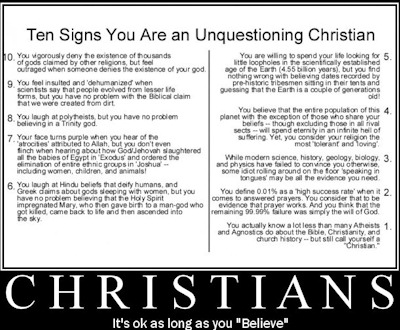
      Well, the atheists of cyberspace have had this little meme going for months called "Signs That You Are An Unquestioning Christian." Actually, the 10-list has been around for at least five years, but someone made it into a really badly-formatted motivational-style poster and the jpeg has recently been cropping up all over the place. Here's the bad graphic, followed by the list in a more readable format:


      Ten Signs You Are an Unquestioning Christian
      1. You vigorously deny the existence of thousands of gods claimed by other religions, but feel outraged when someone denies the existence of your God.
      2. You feel insulted and "dehumanized" when scientists say that people evolved from other life forms, but you have no problem with the Biblical claim that we were created from dirt.
      3. You laugh at polytheists, but you have no problem believing in a Trinity God.
      4. Your face turns purple when you hear of the "atrocities" attributed to Allah, but you don't even flinch when hearing about how God/Jehovah slaughtered all the babies of Egypt in "Exodus" and ordered the elimination of entire ethnic groups in "Joshua" including women, children, and animals.
      5. You laugh at Hindu beliefs that deify humans, and Greek claims about gods sleeping with women, but you have no problem believing that the Holy Spirit impregnated Mary, who then gave birth to a man-god who got killed, came back to life and then ascended into the sky.
      6. You are willing to spend your life looking for little loopholes in the scientifically established age of Earth (4.55 billion years), but you find nothing wrong with believing dates recorded by prehistoric tribesmen sitting in their tents and guessing that Earth is a few generations old.
      7. You believe that the entire population of this planet with the exception of those who share your beliefs - though excluding those in all rival sects - will spend eternity in an infinite hell of suffering. Yet, you consider your religion the most "tolerant" and "loving."
      8. While modern science, history, geology, biology, and physics have failed to convince you otherwise, some idiot rolling around on the floor speaking in "tongues" may be all the evidence you need to "prove" Christianity.
      9. You define 0.01% as a "high success rate" when it comes to answered prayers. You consider that to be evidence that prayer works. And you think that the remaining 99.99% failure was simply the will of God.
      10. You actually know a lot less than many atheists and agnostics do about the Bible, Christianity, and church history - but still call yourself a Christian.

      Now, let's be clear: no sound Christian suggests that blind, "unquestioning" credulity is a good thing. A puerile kind of fideism—faith in faith itself—often masquerades as Christianity, but it's not. There are a lot of false Christians out there, and some shallow self-styled "evangelicals" who absolutely fit the descriptions of nos. 8 and 10. Shame on them. But for the record, those aren't characteristics of true, historic Christianity.

      Apparently, this list is also supposed to represent some of atheism's most iron-clad nuclear arguments against Christianity per se. (At least that's the way the atheistic consensus on the Web seems to regard the meme.) I find it totally unimpressive as an apologetic for atheism, but I do occasionally hear from Christians who have been confronted with one or more of these arguments (or others like them) who want help giving an answer.

      So that's what I propose to do here at TeamPyro over the next couple of weeks. We'll take these ten arguments two or three at a time and examine them. What are the claims and presuppositions these ten arguments make? Are they really accurate? Is there a biblical answer to each of these challenges, and is it a reasonable answer?

      If you are stumped by any of these ten arguments, you certainly don't need to be. Let's talk about them together. We'll start today with a preliminary question: Which of the ten arguments (if any) troubles you the most?

      Bonus: Be sure to see this comment from the February 2005 post linked above, where the agnostic woman who made the post emphatically proclaims her own superior open-mindedness, then immediately declares the conversation over with this curt dictum: "I don't want to talk about this anymore. We will never agree, and I have better things to do."

      Phil's signature


      25 February 2010

      Colossians studies 3: the false teachers (?)

      by Dan Phillips

      As I mentioned last time, the little church in Colosse was being threatened by false teaching.  In time, I hope to show you that understanding as much as we can about the false teaching — and, particularly, observing how Paul responded to it — is extremely helpful and instructive to us in our current situation.

      I also mentioned that it is common to identify the opposition in Colosse as (A) a group of (B) Gnostic false teachers. I have seen studies debating just how Gnostic they were (and more studies and sermons simply and flatly asserting that they were Gnostics), but I've never seen the number of false teachers debated, nor even discussed.

      For instance, the recent, excellent NT introduction by D. A. Carson and Douglas Moo (Zondervan: 20052) discusses whether the false teaching can be called Gnostic in any sense, what its elements seem to be, and even whether there was any specific identifiable heresy in Colosse (526-529). But in describing the opposition, they simply write, "The apostle had heard that some false teachers had come to Colosse, so he wrote to refute their errors..." (523, emphases added).

      Similarly, in N. T. Wright's earlier TNTC commentary on Colossians (IVP: 1986) he spoke only of "false teachers," plural. Even on 2:18, where Paul uses the singular, Wright wrote that "Paul describes these people as ‘entering into—their own visions!’ All they have discovered in their vaunted mystical experiences is a set of imaginary fantasies" (128).

      In spite of this unargued consensus, I noticed something consistently in the text of Colossians sent my thinking in a fresh direction. As I said, given that far better men that I evidently have seen no such thing, I may well be wrong. However, given that greater understanding and greater attention to details is always helpful, I think it's at least worth a thought.

      Let's start by isolating every verse that directly mentions the opposition in Colosse. Here you go (all are my ad hoc translations, bolding added):
      • 2:4 — "I say this that no one should delude you with persuasive arguments."
      • 2:8 — "Keep looking out lest there shall be someone who takes you hostage through empty, deceptive philosophy, in accord with the tradition of men, in accord with the rudiments of the world, and not in accord with Christ:"
      • 2:16 — "Therefore, stop letting someone judge you in eating and in drinking, and in respect to a festival or new moon or sabbath day,...."
      • 2:18-19a — "Stop letting anyone rule you out, delighting in humiliation and worship of the angels, going into detail about things he has experienced, being inflated without cause by the mind of his flesh, and not holding fast to the Head...."
      With those in mind, note these mentions of opponents in other epistles:
      • "Indeed, I consider that I am not in the least inferior to these super-apostles. ... 12 And what I do I will continue to do, in order to undermine the claim of those who would like to claim that in their boasted mission they work on the same terms as we do.  13 For such men are false apostles, deceitful workmen, disguising themselves as apostles of Christ.  14 And no wonder, for even Satan disguises himself as an angel of light. 15 So it is no surprise if his servants, also, disguise themselves as servants of righteousness. Their end will correspond to their deeds. (2 Corinthians 11:5, 12-15)
      • "...there are some who trouble you and want to distort the gospel of Christ." (Galatians 1:7)
      • "They make much of you, but for no good purpose. They want to shut you out, that you may make much of them." (Galatians 4:17)
      • "I wish those who unsettle you would emasculate themselves!" (Galatians 5:12)
      • "For even those who are circumcised do not themselves keep the law, but they desire to have you circumcised that they may boast in your flesh." (Galatians 6:13)
      • "Look out for the dogs, look out for the evildoers, look out for those who mutilate the flesh." (Philippians 3:2)
      • "As I urged you when I was going to Macedonia, remain at Ephesus so that you may charge certain persons not to teach any different doctrine,  4 nor to devote themselves to myths and endless genealogies, which promote speculations rather than the stewardship from God that is by faith. ...6 Certain persons, by swerving from these, have wandered away into vain discussion, 7 desiring to be teachers of the law, without understanding either what they are saying or the things about which they make confident assertions" (1 Timothy 1:3-4, 6-7)
      • "For there are many who are insubordinate, empty talkers and deceivers, especially those of the circumcision party.  11 They must be silenced, since they are upsetting whole families by teaching for shameful gain what they ought not to teach" (Titus 1:10-11)
      What do you notice? Every one of the mentions in Colossians is in the singular, both pronouns and verbs. The other epistles regularly speak of the opposition in the plural.

      Now, this isn't an exhaustive study of every mention of false teachers in every other letter. But I do note that even when Paul uses a singular (i.e. 2 Corinthians 11:4), he'll shift right back into plural (11:5, 12ff.).

      So I surmise that there was one charismatic and potentially influential false teacher in Colosse, who was threatening to exert a dangerous influence among believers. I don't think we should speak of the false teachers in Colosse, but the false teacher. At any rate, that's all we have direct authority to identify.

      Some might quite appositely point to Colossians 2:8 and 22, where Paul mentions the traditions, commandments and teachings "of men." But 2:8 says to beware of someone, some individual, who teaches these things. Besides, in every other occurrence of τῶν ἀνθρώπων ("of men"), Paul is speaking of mankind, not of specific men (Romans 2:16; 1 Corinthians 1:25; 13:1; Ephesians 3:5; 4:14). Indeed, the ESV translates both occurrences in Colossians as "human."

      If I'm reading it right, then, while the other epistles help us see how Paul responded to movements and teachings, Colossians will specifically show how the apostle goes up against one big name, one heretical proto-televangelist, who perhaps could fill the auditoriums of his day and rivet crowds with his personal teachings and experiences and revelations.

      What will Paul do? Find dirt on the man's private life? Focus on the way he dresses or lives, or how much money he gets or spends, or what rumors are told of him? How will the apostle respond to this one charismatic false teacher who is threatening to unravel this young church?

      First, Lord willing, let us identify what we can of the man's doctrines.  (Was he a Gnostic, like everyone says?  What did he teach?) Next time. Then we can see how Paul responded.

      Dan Phillips's signature

      24 February 2010

      Ordinary Means

      by Frank Turk

      God, in his ordinary providence, maketh use of means, yet is free to work without, above, and against them, at his pleasure. (WCF, V.3)


      I dropped the ball last week on Wednesday, forgetting to post something even though I had a couple of decent things in the hopper.

      The one I want to post today is about the singular problem with Calvinism – which is, Calvinists.

      Imagine you were talking with two friends: one’s a fellow reformed “Ø” and the other is a marginal believer or an unbeliever. As the conversation turns to something that happens in the real world – something like success at work, or your marriage (which can be good or bad), or how your church runs, or any number of things we live with all the time.

      Your unbelieving friend is eventually going to say something like this:

      “I really don’t know how to cope with this. I have no idea what I can do to make it right.”

      Now, listen: if your Calvinists friend says, “well, it’s all up to a sovereign God anyway, so what ‘you do’ isn’t really all it’s cracked up to be – in fact it may not matter at all. It’s all in God’s hands,” immediately do something to shut his mouth.

      Now: why shut his mouth? I mean – God is sovereign, right? God is in charge of the things going on in the universe. God is the creator and sustainer of all things. So when this fellow says, “well, SDG, whatever – it rains on the just and the unjust,” in response to some person’s plea for help, this person’s plea that he cannot control the universe and feels helpless because things are going poorly, it’s sort of “right” to say, “well, God is in control.”

      Yes, BUT –

      Part of the way God is in control of things is by His revelation of decrees (like the Law) and "good advice" (like the Proverbs). That is: part of the way God is in control of the Cosmos is that there are ordinary means for achieving ordinary parts of His sovereign will for all things.

      For example: your marriage. There’s no question that it’s really impossible for two people to have a wholly-holy marriage apart from the sanctifying grace of God. Cannot happen.

      BUT many people who are not even believers have a marriage that works insofar as it actually follows the purpose and guidance God has given for such a thing. That is, even if it is not spiritually profitable, it turns out to be materially profitable and emotionally profitable and relationally profitable.

      This is because after the primary purpose of Scripture (that is: being about Christ; revealing him to us), there is another purpose of Scripture, that being as our tutor. It teaches us how people who believe this stuff live as if it is true. There are ordinary means, ordained by God – that is, the normal way things work. So, for example, if you train up a child in the way he should go, ordinarily when he grows old, he will not depart from them. Ordinarily, when you teach your children diligently what the law of the LORD is, it will go well for you. Ordinarily, If anyone aspires to the office of overseer, he desires a noble task.

      And in all of this, we take refuge in a few things:

      [1] That we obey not for the sake of what it ordinarily accomplishes, but because we believe that God is wiser than we are. We shouldn’t have to invent what it means to believe him over and over when he has already spelled it out. His sovereignty actually starts in the means and doesn’t just reside in the ends. He’s not God just because what he wanted to happen was finally accomplished: he’s God and sets forth for us all the works, too.

      [2] That we obey knowing this is actually how God ordinarily accomplished his plan, trusting and actually placing our hope in him and not in the work. Sometimes the work looks completely foolish. Since we are fools anyway, we should be glad that God can use even that for His ends – and they are His means after all.

      [3] The sovereignty of God gives us hope and does not put us in a place where we are humiliated or over-awed into inaction or despair. In fact: we need to see all the means God uses to instruct as the way He reveals that there is hope for those who believe Him.

      It is utterly true that God may do as he pleases: God is free to work without, above, and against normal means, at his pleasure. But He is also not a capricious being. He is a savior to the weak, and a God who loves those who have hated him and even still today do hate him.

      This is why He is great and we are not. And this is why it’s critical to believe in his sovereignty – not to believe that we are somehow merely pawns, but to know that in doing what the maker and sustainer of all things has prescribed, we demonstrate our love and trust in him.


      23 February 2010

      Colossians studies 2: the church's founding, and its foundering

      by Dan Phillips

      From the opening words of the epistle, we learn that the church in Colosse had its inception in sound doctrine.


      This is a necessity for any Christian church. The church at large is built on good doctrine. When Peter confessed that Jesus was the Christ, the Son of the living God, Jesus said He would build His (yet-future) church on that foundation: on the confessed truth of His deity (Matthew 16:13-18). As He predicted, so it happened. The inaugural sermon of the Christian church was the preaching of Christ, leading to a mass confession of Christ as Lord (Acts 2).

      As it is with the universal church, so it is with any local church. A church of Christ must be build on the foundation of the preached truth of Jesus Christ (1 Corinthians 3:10-11). Paul says categorically that no other foundation can be laid than Jesus Christ.

      What does it mean to lay a foundation of Jesus Christ? Clearly Paul does not mean that he is pulling Jesus down from the Father's right hand, and constructing an edifice on Him. Obviously what Paul must mean in-context is Jesus Christ as preached and believed. It is the true doctrine of Jesus Christ that is laid as a foundation by preaching; it is the confession of Christ as preached by the apostles that is the foundation of the church, of any Christian church. Without that, there can be no church of Christ.

      The church of Christ, then, is founded on doctrine, on theology, specifically on Christology.

      This was the start that the Colossians got. See 1:4-7, where Paul speaks of
      having heard of your faith in Christ Jesus, and the love which you have for all the holy ones, 5on account of the hope which is laid away for you in the heavens, of which you heard before in the word of the truth, the good news, 6which has come to you, just as also in all the world it is bearing fruit of itself and growing just as also among you, from the day in which you heard it and came to know fully the grace of God in truth; 7just as you learned it from Epaphras, our beloved fellow-slave, who is a faithful servant of Christ for your sake... (DPUV)
      So far, so good.

      However, the little church had run into a problem. As it had begun by sound doctrine, so now it was being threatened by sick doctrine.

      Who or what was behind it? It is difficult to say, impossible to be absolutely certain. Paul doesn't name some aberrant cult or sect. He doesn't talk about Jehovah's Witnesses, Mormons, Roman Catholics, Christian Scientists, Gnostics, or any other identifiable false sect. We are left to piece things together from the indications within the letter, both the subtle and the obvious.

      Commentators tend to assume that a group of false teachers were exerting a baleful influence. It is common to read of “the false teachers” in Colosse, and of "the Colossean heresy." Even more, it is very common for writers and preachers to identify them positively as Gnostics, a movement visible in the second century and beyond.

      Here's where I strike out on my own, with a position I haven't seen anyone else take. This probably means I'm wrong. But I'll tell you what I think, and why I think it, leaving you to make your own judgment.

      Next time, Lord willing.

      Dan Phillips's signature

      21 February 2010

      A Plea for Courage in the Defense of the Truth

      Your weekly dose of Spurgeon
      posted by Phil Johnson

      The PyroManiacs devote some space each weekend to highlights from The Spurgeon Archive. The Following excerpt is from "The Church of God and the Truth of God," a sermon preached at the New Park Street Chapel on Sunday morning 14 September 1856, when Spurgeon was barely 23 years old.

      emember how your fathers, in times gone by, defended God's truth, and blush, ye cowards, who are afraid to maintain it!


      Remember that our Bible is a blood-stained book; the blood of martyrs is on the Bible, the blood of translators and confessors. The pool of holy baptism, in which many of you have been baptized, is a blood-stained pool: full many have had to die for the vindication of that baptism which is "the answer of a good conscience toward God."

      The doctrines which we preach to you are doctrines that have been baptized in blood,—swords have been drawn to slay the confessors of them; and there is not a truth which has not been sealed by them at the stake, or the block, or far away on the lofty mountains, where they have been slain by hundreds. It is but a little duty we have to discharge compared with theirs. They were called to maintain the truth when they had to die for it; you only have to maintain the truth when taunt and jeer, ignominious names and contemptuous epithets are all you have to endure for it.

      What! do you expect easy lives? While some have led through seas of blood, and have fought to win the prize, are you wearied with a slight skirmish on dry land? What would you do if God should suffer persecuting days to overtake you? O craven spirits, ye would flee away, and disown your profession!

      Be ye the pillar and ground of the truth. Let the blood of martyrs, let the voices of confessors, speak to you. Remember how they held fast the truth, how they preserved it, and handed it down to us from generation to generation; and by their noble example, I beseech you, be steadfast and faithful, tread valiantly and firmly in their steps, acquit yourselves like men,—like men of God, I implore you!

      Shall we not have some champions, in these times, who will deal sternly with heresies for the love of the truth,—men who will stand like rocks in the center of the sea, so that, when all others shake, they stand invulnerable and invincible? Thou who art tossed about by every wind of doctrine, farewell; I own thee not till God shall give thee grace to stand firm for his truth, and not to be ashamed of him nor of his words in this evil generation.

      C. H. Spurgeon