31 January 2019

A Creationist and Evolutionist Rapprochement?

Response to "Ten Theses on Creation and Evolution That (Most) Evangelicals Can Support": Part 1
by Dr. Colin Eakin


ere we go again. With a tiresome repetition like that of tax bills, springtime allergies, and NCAA football champions from the deep South, a quasi-Christian media outlet has published another appeal to "evangelicals" to lay down arms and come to some general agreement as to what the Bible says about origins.

These appeals, mind you, always seem to arise from those proposing an alternative to the straightforward reading of the text, one which will update our biblical understanding based upon "new revelations" from the worlds of both "science" and "biblical scholarship." We are now being told by "experts" how "ancient Near East cultural understanding" can broaden our grasp of how the Bible reconciles with the world we see around us. The articles always seem to be written as if truly enlightened evangelicals have no problem with the latest learning and have advanced well beyond these core proposals, but here are some basics that even evangelical Neanderthals (pardon the pun) should be able to get behind.

The latest salvo is from Todd Wilson, president and co-founder of the Center for Pastor Theologians, which was published January 4, 2019 in Christianity Today. Wilson begins by disclosing how, some time ago, his conservative-on-many-issues congregation had some "heartburn" when its closely held, literal six-day creation scheme was assaulted by its new pastor's belief in evolutionary creationism. This understandably led to a "tension-filled season," during which the church "grappled" with its "doctrinal boundaries." The upshot of this grappling was the codification of "ten theses on creation and evolution that we believe (most) evangelicals can (mostly) affirm," what they termed (in an apparent nod to C.S. Lewis) "Mere Creation."

How did they do with their theses? Herewith is a commentary on their evolutionary "Wittenberg door":

  1. The doctrine of creation is central to the Christian faith.

    They got this one right. In fact, this is a dead-on, stand-alone truth. Wilson proposes that the doctrine of creation belongs in the same strata as the doctrines of the Father, Christ, the Spirit, and soteriology at the core of the Christian faith, and he is absolutely correct. Make no mistake: Genesis 1-2 is so vital to proper biblical understanding that if one does not comprehend it rightly, one will err repeatedly in attempting to assimilate the remainder of the Word of God. Want to know a simple way to confirm one has found a biblical church that likely gets the gospel right and upholds sound doctrine in other areas? Ask its pastor if he reads and teaches Genesis 1-2 in a literal, historical manner. The correlation is remarkable.

  2. The Bible, both Old and New Testaments, is the Word of God, inspired, authoritative, and without error. Therefore whatever Scripture teaches is to be believed as God's instruction, without denying that the human authors of Scripture communicated using the cultural conventions of their time.

    Here, again, they got it right—mostly. We might add to the inspiration, authority and inerrancy of the Word of God its completeness, sufficiency, perspicuity, necessity, efficacy, certainty, immutability, universality, vitality, and theocentricity, as these qualities are no less applicable to the Word of God. But we concede the point. Further, it is axiomatic that whatever Scripture teaches is to be believed as God's instruction. In other words, when the Bible speaks, God speaks.

    The dog whistle in Thesis #2 comes in the last clause. Wilson writes, "No amount of stress on a 'high view of the Bible' should cause us to inadvertently downplay the human side of the equation."

    Okay, fair enough on its face. The Bible did have human authors who wrote according to "cultural conventions" of their time. If that is all that is intended, fine. And if he is also implying that readers of the Bible must be attuned to the grammatical and contextual aspects of the writing, more power to him. But if the implication is that the humanity of the Bible's authors somehow obscures God's actual message and thereby diminishes our confidence in understanding it, he is wrong. The humanity of the authors of Scripture does not in any way confound the communication of God in His Word. Just because the Bible had human authors beginning 3500 years ago does not mean that their "cultural conventions" somehow limit our modern comprehension of what they were saying and how it applies today. God inspired His human authors and their "cultural conventions" to say exactly what He meant to say and how He meant to say it, with a message that transcends time, as comprehendible today as it was to those to whom it was first written.

  3. Genesis 1-2 is historical in nature, rich in literary artistry, and theological in purpose. These chapters should be read with the intent of discerning what God says through what the human author has said.

    Wilson begins to reveal his true colors in his commentary on Thesis #3 when he writes, "Of course, there is much to debate about how to interpret Genesis 1-2" (those colors come into even greater relief later in the article when he favorably references theologian Karl Barth and historian Mark Noll, as well as his use of the NRSV). He goes on to suggest the need for "a balanced approach to the question of the literary genre of Genesis 1-2." Wilson subdivides Genesis 1-2 into a proposed composite of historical, theological and literary types, and insinuates that if this portion of Scripture can be designated as literary and theological as well as history, it would somehow diminish its reliability as a source of historical information.

    Says who? Only those trying to retain some claim to orthodoxy as they simultaneously seek to undermine the information of the text by reclassifying it as something other than history. So let us be clear here: Genesis 1-2 is history. A sixth-grade student can identify it as such. Yes, the text does yield tremendous theological implications, as any biblical historical text might, and it has a certain literary style. But neither of those designations alters in any way the factual, historical information we are reading about the world and its occupants. Genesis 1-2 is God's clear-cut revelation of how things began, designed to inform the highest order of His creation about something they would have no other way of knowing. Only those who wish to impose faulty paradigms on Scripture have any inclination to consider Genesis 1-2 as some form of literature other than history (e.g. legend or poetry), as if that literary designation might somehow disable its plainly evident interpretation.



  4. God created and sustains everything. This means that he is as much involved in natural processes as he is in supernatural events. Creation itself provides unmistakable evidence of God's handiwork.

    Again, pretty good, up to a point. God certainly has created everything and sustains it moment by moment (Job 12:10; Acts 17:28; Heb. 1:3). His direct handiwork is no less a part of natural processes as it is with supernatural ones. Wilson makes a good point about the tendency even of evangelical Christians toward deistic thinking, often slipping "into patterns of thinking that exclude God from the routine workings of nature, like the rotation of the stars, the formation of clouds, or the grass as it grows." He rightly references Psalm 104 as evidence of God's continuous, direct ordering of the natural world.

    But the Bible nowhere states nor implies that study of the natural world can divulge any knowledge about its origins. Yes, as Wilson offers, "the heavens declare the glory of God" (Ps. 19:1), but not in any way that brings to light the process that led to their formation. In fact, it is no coincidence that after David extols the natural, or general, revelation of the cosmos in the first portion of this Psalm (Ps. 19:1-6), he follows it with an exquisite overview of the special revelation encompassed in the Word of God (Ps. 19:7-11). Why this juxtaposition of the general and special revelation of God? David knows that general revelation only goes so far in revealing who God is and what He has done, and that ultimate knowledge of God and His work must come from His self-revelation, as can only be found in His Word.

  5. Adam and Eve were real persons in a real past, and the fall was a real event with real and devastating consequences for the entire human race.

    Wilson gets this thesis exactly right as stated, which is commendable. But his substantiating commentary is so problematic that it leads him to unbiblical conclusions. Yes, Adam and Eve were real persons in the real past, who really fell with real and devastating consequences for each and every one of their descendants. Wilson then (correctly) reports that this reality is under considerable challenge within modern evangelical Christianity. Why is that? Because, according to Wilson, "the genetic evidence, at least as we now understand it, makes belief in an original human pair doubtful if not impossible." He then predicts, " . . . in 20 years' time, support for Adam and Eve as real persons in a real past will be a minority view even within evangelicalism." And what if that happens? Wilson continues: "Should this come to pass, I remain confident that the Christian faith will survive, even though this will require some reconfiguration of our deepest convictions."

    Just how "Christian faith will survive" despite the "reconfiguration" of its "deepest convictions" is not at all clear from Wilson. In reality, this would be an utter impossibility, because when one reconfigures the deepest convictions of a particular faith, then that faith is no longer said to exist. Give up a real Adam and Eve with a real fall bringing real consequences to the entire human race, and you might as well describe a new religion, for you have just severed orthodox Christianity from its doctrinal moorings. To deny a real Adam and Eve is to call the Bible erroneous and God a liar, because He says all humans derive from this original pair (Gen. 3:20; Acts 17:26). To deny a real Adam and Eve is to contradict the Lord and Savior, Jesus Christ, who references them as the basis for understanding God's concept of marriage (Mt. 19:4; Mark 10:6). And to deny a real Adam is to nullify the manner by which God says humans might be reconciled to Him, because the only ones He justifies are those born into sin through Adam and then reborn into righteousness through Christ (John 3:3-7; Rom. 5:15-19; 1 Cor. 15:45-49).

Wilson says Paul's argument in Romans 5 along with Adam's presence in genealogies (Gen. 5; Luke 1) keeps him tethered—for now—to the traditional view of a real Adam and Eve, but he leaves open the possibility that future scientific developments might cause him to reconsider. Which begs the question: what might those future "scientific developments" be? Science relies upon the certain operation of uniform constants. Given that, on what basis can we be certain that the scientific constants we can measure today, such as the speed of light, were operating in the same manner at the moment of creation? We cannot. So if we are only speculating that the constants of today were present in unchanged form at creation, how then are conclusions based upon such speculation "scientific?" This is an unsolved quandary for Wilson and all his evolutionary ilk. The same goes for the "genetic evidence" to which Wilson alludes. Wilson is basing his conclusions upon genetic similarities found between humans and certain other species. But genetic similarity does not confirm shared ancestry. Moreover, genetic inheritance would depend upon genetic makeup at the moment of creation, which, again, cannot be known for certain.

On a textual level, whatever happened to the "full-throated" endorsement of inerrancy Wilson proclaims at the beginning of his article? As an inerrantist leader of "pastor theologians," one presumes Wilson would always subject his doctrinal beliefs to the exact text of Scripture. Specifically, we expect him to know that when God uses the term bara for "created" in the first statement in His Word, He is specifying that such a work is ineligible for scientific inquiry. As opposed to the other Hebrew terms for "create" in the Old Testament (e.g. yatsar and asah), the term bara is used only with God as its subject, and only in the creation of marvels never before known. The use of the term denotes a development of something completely outside the boundary of the established order, and not subject to the constraints of uniformity that govern science. As such, God's use of the verb bara in the first verse of His first book should notify all to pay attention, because the information that follows cannot be discerned through observation of natural phenomena (i.e. scientific inquiry).

Untroubled by this, Wilson then proceeds to a very troubling deduction: "It may be the case that faithful Christians will develop biblically legitimate and theologically sensible ways of explaining the gospel apart from a real Adam and Eve." For someone claiming to uphold the inerrancy of Scripture, this is certainly an incongruous detour. How in the world could Christians ever be "faithful" by refuting what God has explicitly said about this pair of original humans? And how would a revised "gospel" look if the "last Adam" did not become a "life-giving spirit" because the "first Adam" never became a "living being?" (1 Cor. 15:45)? Apart from a real Adam and Eve, the entire structure of Christianity as presented in God's Word becomes a house of cards.

Finally, instead of a clarion call to defend God's Word against any and all specious theories masquerading as knowledge, Wilson concludes, " . . . the better part of wisdom is maintaining a spirit of engaged conversation on this issue" (italics his). Really? What happened to the New Testament's repeated calls for the vigorous censure of falsehood (2 Tim. 4:2; Titus 1:9; Eph. 5:11; 2 Cor. 10:5; 2 John 8-11; Jude 3-4)? It is the harbinger of apostasy for believers to have their doctrinal convictions always subject to supposed discoveries of worldly knowledge, be they scientific or sociologic. Paul warned the Ephesians that they should "no longer be children, tossed to and fro by the waves and carried about by every wind of doctrine, by human cunning, by craftiness in deceitful schemes" (Eph. 4:14)—the precise muddle in which Wilson, by his own words, appears to find himself.

We will continue with evaluation of Wilson's final five theses in the next post.

Dr. Colin L. Eakin Pyromaniac

Dr. Eakin is a sports medicine orthopædic surgeon in the Bay Area and part time teacher at Grace Bible Fellowship Church's Stanford campus ministry. He is the author of God's Glorious Story.

Virtue Signaling and the Signing of Religious Manifestos

by Phil Johnson


A friend—actually a very good friend of mine—noticed that I had spoken on "virtue signaling" at the G3 pre-conference, and he put a comment on my FaceBook page asking if signing a manifesto like the Dallas Statement on Social Justice and the Gospel might not be legitimately seen as "the conservative equivalent of liberal virtue signaling." Here's my reply:

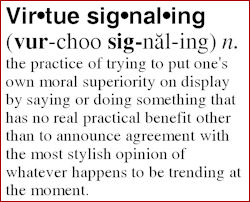
f you listen carefully to the definition I gave, virtue signaling is when you affirm a trendy, politically correct, or socially popular position in order to claim the moral high ground or garner praise—especially when you have little intention of doing anything else about the issue you are publicly wringing your hands over.

So my conscience is clear.

Still, it's certainly possible that someone wishing only to trumpet his own notion of "stylish orthodoxy" might think signing a conservative group's manifesto could accomplish that self-aggrandizing purpose.

But one could say that about anyone in any context who makes his or her opinions known publicly. Blogging, FaceBook comments, even sermons delivered from a sound church's pulpit all carry the same risk.

So unless a person is willing to keep all his opinions to himself, he ought to examine his own motives on a regular basis. Because Scripture does say, "Let every person be quick to hear, slow to speak."

This is therefore a good reminder. "Let a person examine himself."

But Scripture also says, "Always be prepared to make a defense to anyone who asks you for a reason for the hope that is in you; yet do it with gentleness and respect, having a good conscience." So silence isn't always a virtue.

Anyway, I take your feedback as a good reminder, and not a rebuke. Anyone who knows you should understand (as I do) that you were not just trying to pick a fight for the sake of being contentious.

ut:


When one sees a massive bandwagon rolling by, filled with people who have all suddenly become concerned with a specific issue that is being hard-peddled to them by celebrities and trend-setters, and all these people are both trumpeting their own wokeness and shaming everyone who isn't woke yet (including aiming their newfound scorn at respectable Christian leaders who may not share the now-trendy opinion)—one can hardly help concluding that this is another wave of just what we saw when Emergents were saying similar things and shaming the rest of us for not being sufficiently postmodern.

"Woke," it turns out, is the new postmodern.

The current wave of political correctness has simply put a veneer of evangelical moral outrage on the idea of "social justice," without carefully delineating how the term "social justice" as it has been employed in modern and postmodern secular academic circles (and in liberal religion) for more than a century now. And if you look at the landscape carefully, you'll see that leading the parade of those who are clamoring for a "woke church" is a pack of socialists and liberation theology buffs.

Pointing out that fact is hardly an example of "virtue signaling."

Here's that message from the G3 preconference:


Phil's signature


20 January 2019

Soaked

Your weekly Dose of Spurgeon


The PyroManiacs devote some space each weekend to highlights from the lifetime of works from the Prince of Preachers, Charles Haddon Spurgeon.  The following excerpt is from the Metropolitan Tabernacle Pulpit, volume 27, sermon number 1,578, "Taught the we may teach."


Image result for charles spurgeon
"We are to be impartial in our study of the word, and to be universal in its reception." 


Set your whole heart on the word. Some people like to read so many chapters every day. I would not dissuade them from the practice, but I would rather lay my soul asoak in half a dozen verses all day than I would, as it were, rinse my hand in several chapters. 

Oh, to bathe in a text of Scripture, and to let it be sucked up into your very soul, till it saturates your heart! The man who has read many books is not always a learned man; but he is a strong man who has read three or four books over and over till he has mastered them. He knows something. He has a grasp of thoughts and expressions, and these will build up his life. 

Set your heart upon God’s word! It is the only way to know it thoroughly: let your whole nature be plunged into it as cloth into a dye.


13 January 2019

Call upon, stir up, take hold


Image result for charles spurgeon


Your weekly Dose of Spurgeon

The PyroManiacs devote some space each weekend to highlights from the lifetime of works from the Prince of Preachers, Charles Haddon Spurgeon.  The following excerpt is from the Metropolitan Tabernacle Pulpit, volume 23, sermon number 1,377, "Taking hold upon God."


"There is none that calleth upon thy name, that stirreth up himself to take hold of thee." 
Isaiah 64:7

"We have in these days a race of time servers and word spinners to succeed the real men."

I do not know that the condition of the church of God at the present time is quite so bad as that which is here described. It would be wrong to boast of our condition, but it would be worse to despair of it. It would not be honest to apply the words of our text to the church of the present day.

Blessed be God, we could not say, “There is none that calleth upon thy name, that stirreth up himself to take hold of thee,” for there are many who plead day and night for the prosperity of Zion. Yet in a measure we are somewhat in the same plight as that which is described by the prophet, and there is much to mourn over. 

Prayer languishes in many churches, power in intercession is by no means a common attainment, and meetings for prayer are, as a rule, thinly attended, and not much thought of. Sin abounds, empty profession is common, hypocrisy is plentiful, and the life of God in the soul is but little esteemed.

Notice carefully that according to our text the prophet traces much of the evil which he deplored to the lack of prayer. After he has compared their righteousnesses to filthy rags he adds, “there is none that calleth upon thy name, that stirreth up himself to take hold of thee.” 

When there is a degeneracy of public manners, you may be sure that there has also occurred a serious decline of secret devotion. When the outward service of the church begins to flag and her holiness declines, you may be sure that her communion with God has been sadly suspended. Devotion to God will be found to be the basis of holiness and the buttress of integrity. 

If you backslide in secret before God, you will soon err in public before men. You may judge yourselves, my dear hearers, as to your spiritual state by the condition of your hearts in the matter of prayer. How are you at the mercy seat? for that is what you really are. 

Are the consolations of God small with you? That is a minor matter; look deeper,Is there not a restraining of prayer before the living God? Do you find yourself weak in the presence of
temptation? That is important; but search below the surface, and you will find that you have grown lax in supplication, and have failed to keep up continual communion with God.

06 January 2019

Held

Your weekly Dose of Spurgeon


The PyroManiacs devote some space each weekend to highlights from the lifetime of works from the Prince of Preachers, Charles Haddon Spurgeon.  The following excerpt is from the Metropolitan Tabernacle Pulpit, volume 34, sermon number 2,031, "David dancing before the Ark because of his election."
Image result for chaRLES SPURGEON


"Dear brethren, there is great power in the truth of election
when a man can grasp it."

Personally, I have overflowing joy in the doctrines of eternal, unchanging love. It is bliss to know that the Lord has chosen me. When I am down very low in spirit, I crave for those old books which, like the Lord Jesus, are full of grace and truth. 

You who are at ease in Zion can do with the chaffy modern theology; but when your heart is heavy, and especially when your conscience is under a sense of sin, you will want these two dishes on the tablefree grace and dying love, and you cannot do without them. 

We must have an atoning sacrifice, and free grace to make us partakers thereof. I cannot give up the doctrines of grace, for they are my life. I do not so much hold them as they hold me. The five fingers of the great doctrines of grace have enclosed my heart. 

I can die; but I cannot deny the imperishable truth. The doctrine of the eternal choice gives forth joy as myrrh and cassia give forth perfume. May you all know it! 

01 January 2019

Onward!

Your weekly Dose of Spurgeon

The PyroManiacs devote some space each weekend to highlights from the lifetime of works from the Prince of Preachers, Charles Haddon Spurgeon.  The following excerpt is from the metropolitan Tabernacle Pulpit, volume 19, sermon number 1,114, "Onward!"
Image result for charles spurgeon
"Never mind though you have run so far, you must let the space which lies between you and the goal engross all your thoughts and command all your powers."

Some people seem to have very good memories as to what they have performed. They used to serve God wonderfully when they were young! They began early and were full of zeal! They can tell you all about it with much pleasure.

In middle life they wrought marvels, and achieved great wonders; but now they rest on their oars, they are giving other people an opportunity to distinguish themselves—their own heroic age is over. Dear brother, as long as ever you are in this world forget what you have already done, and go forward to other service!

Living on the past is one of the faults of old churches. We, for instance, as a church, may begin to congratulate ourselves upon the great things God has done by us, for we shall be sure to put it in that pretty shape, although we shall probably mean the great things we have done ourselves. After praising ourselves thus we shall gain no further blessing, but shall decline by little and little.

The same is true of denominations. What acclamations are heard when allusion is made to what our fathers did! Oh, the name of Carey, and Knibb, and Fuller! We Baptists think we have nothing to do now but to go upstairs and go to bed, for we have achieved eternal glory through the names of these good men; and as for our Wesleyan friends, how apt they are to harp upon Wesley, Fletcher, Nelson, and other great men!

Thank God for them: they were grand men; but the right thing is to forget the past, and pray for another set of men to carry on the work. We should never be content, but “On, on, on,” should be our cry!

When they asked Napoleon why he continually made wars, he said, “I am the child of war; conquest has made me what I am, and conquest must maintain me.” The Christian church is the child of spiritual war; she only lives as she fights, and rides forth conquering and to conquer.

God deliver us from the self-congratulatory spirit, however it may come, and make us long and pine after something better!

31 December 2018

Let the Church Seek God's Honor, Not this World's Acclaim

An addendum to last Friday's theme
by Phil Johnson

Do you not know that friendship with the world is enmity with God? Therefore whoever wishes to be a friend of the world makes himself an enemy of God.—James 4:4


cripture forbids believers to imbibe the world's values (cf. 1 John 2:6; Romans 8:5-6; Matthew 6:19-21) or set their affections on things of the earth rather than on heavenly things (cf. Colossians 3:2; 1 John 2:15; Matthew 16:23). Christians do not belong to this world. We are not beholden to the world. We cannot legitimately court the world's admiration or approval. And it is wrong to think otherwise. Jesus told His disciples, "If you were of the world, the world would love you as its own; but because you are not of the world, but I chose you out of the world, therefore the world hates you" (John 15:9).

That truth is ignored or rejected by multitudes of 21st-century evangelical Christians who wrongly believe that if the church does not first win the world's friendship and admiration, we have no hope of reaching anyone for Christ. Some of today's largest and most influential churches even take surveys to find out the desires and ambitions of unbelievers in their communities. Then they plan their Sunday services accordingly, putting on a performance that caters to what people say they desire.

Popular televangelists follow a cruder version of the same strategy, promising people health, prosperity, and riches in return for money. They are today's equivalent of the medieval indulgence-sellers. These religious charlatans make their appeal blatantly and directly to "the lust of the flesh, the lust of the eyes, and the pride of life"—the same carnal cravings that 1 John 2:16 says are "not of the Father but . . . of the world."

Churches are full of people who are sinfully obsessed with the whims and entertainments of this world. They are desperate to keep up with various worldly fads and secular celebrities. They wrongly believe that if they embrace the icons of pop culture, the world will also embrace them and therefore be more open to Christ. So they wear the badges of worldly fashions; they echo the key elements of worldly wisdom; and they immerse themselves in worldly amusements. They cultivate an unhealthy appetite for attention, popularity, and worldly approval, convincing themselves that this is a valid evangelistic strategy.

Even in the highest echelons of evangelical academia certain scholars seem driven by an unhealthy yearning for academic renown. They become so desperate to win the admiration of their counterparts in the secular academy that they willingly compromise the truth and sometimes even apostatize completely.

The wish to be noticed and admired by other people is itself a carnal, illegitimate lust. Jesus condemned the Pharisees because, "They [did] all their deeds to be seen by others" (Matthew 23:5). They made a show of public piety to give the impression they were holier than anyone else.

Like the Pharisees, today's stylish evangelicals fancy the praise and recognition of other people. But unlike the Pharisees, most of them want to be noticed for being hip, not holy.

It dishonors Christ when Christians try to fit into the fraternity of those who hate Him. Scripture is very clear about this: "Friendship with the world is enmity with God."

According to Jesus, the only business the Holy Spirit has with the world outside the church is to "convict [unbelievers] concerning sin and righteousness and judgment" (John 16:8). Those are precisely the themes that are typically omitted when churches become too interested in winning the world's approval.

The church must get back to preaching the gospel, remembering that the message of the cross, when faithfully preached, is by God's own design "a stumbling block to Jews and folly to Gentiles, but to those who are called, both Jews and Greeks, Christ the power of God and the wisdom of God" (1 Corinthians 1:23-24). The gospel alone is "is the power of God for salvation to everyone who believes" (Romans 1:16). Christians should not be ashamed to proclaim it.

It's true that if we are faithful, many in the world will view us with contempt as enemies—and we must be prepared for that. "Do not be surprised, brothers, that the world hates you" (1 John 3:13). The world put Christ to death, and He said, "A servant is not greater than his master.' If they persecuted me, they will also persecute you" (John 15:20).

Furthermore, our Lord Himself didn't shy away in shame or retaliate in anger. Indeed, "to this you have been called, because Christ also suffered for you, leaving you an example, so that you might follow in his steps. . . . When he was reviled, he did not revile in return; when he suffered, he did not threaten, but continued entrusting himself to him who judges justly" (1 Peter 2:21-23).

Phil's signature


From 95 Theses for a New Reformation: For the Church on the 500th Anniversary of the Reformation, edited by Aaron B. Hebbard (Eugene, OR: Wipf & Stock, 2017), 144-45.

28 December 2018

An "Irresistible" Faith and Its "Likeable" Devotees?

The Bible Confronts a Major Modern Misconception

by Colin Eakin


"How do I know if I am a true Christian?"

Have you ever asked yourself that question? God says you should. Paul writes to the Corinthian church, "Examine yourselves, to see whether you are in the faith. Test yourselves. Or do you not realize this about yourselves, that Jesus Christ is in you?—unless indeed you fail to meet the test!" (2 Cor. 13:5). So those who desire to be true followers of Jesus Christ are expected to assess whether Jesus truly lives within. How is this done?

This question was anticipated and answered by the Lord Jesus Himself. He told a group of recent Jewish believers, "If you abide in my Word, you are truly My disciples, and you will know the truth, and the truth will set you free" (John 8:31b-32). So according to Jesus, the criterion for knowing who truly belongs to Him is fidelity to His Word, which brings knowledge of truth, which brings everlasting freedom from the sin—its penalty, its power and (one day) its presence altogether.

Well, how hard could that be—staying true to Jesus' Word? One look at the modern evangelical church would indicate harder than you might think. In fact, one of the most astounding and appalling realities of our present day is how many would-be faithful followers of Christ regularly imbibe teaching that is not only not what Christ taught, but is in fact the exact opposite! And of all the topics where what the Bible teaches and what is commonly taught as true are most at odds, at or near the top is the anticipated response of the world to the Christ-led life.

Take, for example, the latest book from the pastor of one of America's largest churches. In it, he claims that if Christ-followers were to live out the faith as was originally taught and exampled by Christ, the appeal of that faith would be irresistible to a watching world. Similarly, another American megachurch pastor and popular author this past year exposited Matthew 5:20 for his congregation as follows:
To understand Jesus, we might actually translate Matthew 5, verse 20—a really core statement in the Sermon on the Mount—"Unless your 'likeability' surpasses that of the Pharisees and the teachers of the law, you cannot enter the kingdom of heaven." We think of righteousness as this kind of cliché, pious thing, but really it's very much . . . to be a likable, caring, loving person.
Is that true? Is the authentically lived, Christ-led life "irresistible" to a watching world? And is "likeability" an anticipated assessment we should expect those outside the Church to attach to the genuine Christ follower? What is the biblical testimony in this regard?

Answer: it would be hard to parody what the Bible has to say more outrageously. The modern evangelical notion that authentic Christianity and its eminently "likeable" Christ-followers should be "irresistible" to the surrounding world could not be further from what the Bible actually says. This would even qualify as outrageous lampoon—such as from the Babylon Bee—were it not for the fact that these teachers are 100% serious. As it is, the only way such evangelical charlatans can get away with this scandalous deception is that their listeners must never bother to open and read the Bible.


Here is how "irresistible" Christianity was at its outset. Nearly two years into Christ's ministry, the question on the mind of one witness was: "Lord, will those who are saved be few?" (Luke 13:23). And Jesus does not contradict this assessment, but informs His followers that the path to salvation is agonizing! (Agonizing paths, it should be obvious, are not irresistible.) Then, by the end of Christ's earthly tenure, after thousands upon thousands had heard His message while eating divinely-prepared food and being miraculously healed of every condition imaginable, the sum total of believers was not many more than 120 in an upper room in Jerusalem (Acts 1:15), with 500 more in Galilee (1 Cor. 15:6). Even given generous approximations, the "conversion rate" of Christianity while the Son of God walked the earth seems to have been in the neighborhood of 0.1%—hardly an "irresistible" number.

As for the "likeability" of true believers, Jesus says to those He sent out during His ministry, "You will be hated by all for my name's sake" (Mt. 10:22). (Likeability, it should be obvious, does not induce hatred). He says of the future destiny of His followers in His Olivet Discourse, "Then they will deliver you up to tribulation and put you to death, and you will be hated by all nations for My name's sake" (Mt. 24:9). And in John 15:19, He declares to His Apostles, "If you were of the world, the world would love you as its own; but because you are not of the world, therefore the world hates you." So, according to Jesus, the faithful life of believers engenders hatred from the world, a far cry from "likeability."

Well, maybe these were ominous predictions of Christ simply because He knew that His fallible followers would fall so far short of His example. But Christ was "likeable" while here in earthly form, wasn't He? After all, if we as Christians are to be His "likeable" followers, our Mentor must have epitomized this quality, right? The answer is found in John 7:7, where Jesus says to His brothers (who, at this point, were not yet believers in Him), "The world cannot hate you, but it hates Me because I testify about it that its works are evil." And in John 15:18 and 20, Jesus provides clarification to His above warning (John 15:19) to His Apostles: "If the world hates you, know that it hated Me before it hated you . . . Remember the word that I said to you: 'A servant is not greater than his Master.' If they persecuted Me, they will persecute you."

Wow. Jesus says He wasn't likeable because of His message, and His Apostles were given the same unpopular message, guaranteed to make them pariahs. So Jesus was hated, as were His Apostles. But maybe that all changes by the time the Church gets off the ground. Doesn't God want His church to be popular? Isn't that how it grows, through pragmatic, "seeker-friendly" methods designed to optimize the appeal of Jesus? What is the expectation of the NT writers on this topic?

To this, we find that Peter's expectation of odium and mistreatment for faithfulness to Christ is no different from Jesus' day. He informs his readers:

"Beloved, do not be surprised at the fiery trial when it comes upon you to test you, as though something strange were happening to you. But rejoice insofar as you share Christ's sufferings, that you may also rejoice and be glad when His glory is revealed. If you are insulted for the name of Christ, you are blessed, because the Spirit of glory and of God rests upon you" (1 Pet. 4:12-14).
Paul, too, anticipates the unpopular nature of Christianity and its converts when he preaches in Lystra that entrance to the kingdom of God is fraught with many tribulations (Acts 14:22). In 2 Cor. 11:23-28, Paul itemizes exactly how "resistible" his message was as he details the litany of imprisonments, beatings, and near-death experiences that it brought. And toward the end of his ministry, he writes to Timothy, "Indeed, all who desire to live a godly life in Christ Jesus will be persecuted" (2 Tim. 3:12).

So, the anticipation of Jesus and His Apostles is animosity and persecution for the faithful, just as Christ Himself received. They anticipate that most will reject the far-from-irresistible message of repentance for the forgiveness of sins (Luke 24:47), and will turn on those who devotedly proclaim this gospel. In fact, the atrocious interpretation of "righteousness" as "likeability" in Mt. 5:20 is especially egregious, because not only did Jesus teach the exact opposite, but He did so only moments earlier in the same talk! He declares in Matt. 5:10-12:

"Blessed are those who are persecuted for righteousness sake, for theirs is the kingdom of heaven. Blessed are you when others revile you and persecute you and utter all kinds of evil against you falsely on My account. Rejoice and be glad, for your reward is great in heaven, for so they persecuted the prophets who were before you."
Clearly, Jesus is not on board with the idea that His message is supposed to be "irresistible" to the world and that his followers would be known for their "likeability." These specious musings are so opposite from what Jesus actually had to say that, again, the natural impulse is to assume it is all meant as satire, except for the dead-serious nature of its exponents.

So if, in reality, the biblically-expected response to gospel presentation is mostly rejection of its message and revilement of its adherents, how then are those adherents to stay faithful? After all, no one in right mind would choose a life of rejection and persecution without some compelling incentive. Without a gripping motivation to remain true, the tendency to defect would be overwhelming. In fact, even during the earthly ministry of Jesus, many of His followers deserted Him as the cost of discipleship began to hit home (cf. John 6:60, 66). As Paul writes to the Corinthians, "If in Christ we have hope in this life only, we are of all people most to be pitied" (1 Cor. 15:19).

But it is not in this life that the believer has hope. Rather, faithful followers of Christ are those who have relinquished all earthly attachments, including their own lives, in hope of the eternal blessing to come (Luke 14:26). They are those who have denied themselves and daily take up the cross of shame and reproach originally intended for Jesus (Luke 9:23). As Paul explains to the Galatians, "But far be it from me to boast, except in the cross of our Lord Jesus Christ, by which the world has been crucified to me, and I to the world." True followers of Christ are those who have already been crucified with Christ (Gal. 2:20) and now consider it a small thing to forsake everything for His cause.

Referring back to Matt. 5:12, Jesus actually exhorts the maligned believer to "rejoice and be glad" for such mistreatment. Why? Jesus goes on to link suffering on account of Him with one's eternal reward. His undeniable implication is that one's experience of persecution is a barometer for how faithfully one is proclaiming the gospel, which in turn brings greater blessing in heaven. In fact, if one is not experiencing any persecution from the world, one must wonder if he or she is really living a life faithful to the Savior.

Finally, Jesus connects the suffering of His present faithful with the treatment received by His former Old Testament prophets. These "spirits of just men made perfect" (Heb. 12:24) now enjoy the incomparable bliss of holy communion and perfect fellowship with God as they await their promised resurrection (Dan. 12:2; 1 Thess. 4:14-16). Today's faithful are to look to these heroes of the past, those " . . . who died in faith, not having received the things promised, but having seen them and greeted them from afar, and having acknowledged that they were strangers and exiles on the earth" (Heb. 11:13). These prophets of old—"of whom the world was not worthy" (Heb. 11:38)—desired something beyond this world, "a better country, that is, a heavenly one" (Heb. 11:16), the same heavenly dwelling Christ has prepared for all who repent and believe in Him (John 14:3).

So, to review:
  1. Christ's true followers abide in His Word, a considerable challenge given the abundance of anti-biblical notions in today's modern evangelical morass;
  2. Christ's Word promises widespread rejection—not "irresistibility"—of the Christian faith, and widespread persecution—not "likeability"—for Christ's faithful followers;
  3. One's experience of persecution is a barometer for how faithfully one is sharing the gospel message of "repentance and the forgiveness of sins" (Luke 24:47);
  4. In like manner, one's eternal reward will directly depend upon one's faithfulness in the face of persecution;
  5. Christ's faithful followers are to endure persecution like the prophets of old by anticipating the glorious reward that awaits them in the coming age.
Dr. Colin L. Eakin Pyromaniac

Dr. Eakin is a sports medicine orthopædic surgeon in the Bay Area and part time teacher at Grace Bible Fellowship Church's Stanford campus ministry. He is the author of God's Glorious Story.

23 December 2018

The name of Jesus


Image result for charles spurgeon christmas


Your weekly Dose of Spurgeon

The PyroManiacs devote some space each weekend to highlights from the lifetime of works from the Prince of Preachers, Charles Haddon Spurgeon.  The following excerpt is from Christ's Incarnation, pages 19-20, Pilgrim Publications.

"Thou shalt call His Name JESUS: for He shall save His 
people from their sins."

He is not called Jesus because He is our Exemplar, though indeed He is perfection itself, and we long to tread in His footsteps; but He is called Jesus because He has come to seek and to save that which was lost.

He is Christ, too, or the Anointed, but then He is Christ Jesus; that is to say, it is as a Saviour that He is anointed. He is nothing at all if He is not a Saviour. He is anointed to this very end. His very Name is a sham if He does not save His people from their sins.

It is a gracious but very startling fact that our Lord’s connection with His people lies in the direction of their sins. This is amazing condescension. He is called Saviour in connection with His people, but it is in reference to their sins, because it is from their sins that they need to be saved. If they had never sinned, they would never have required a Saviour, and there would have been no Name of Jesus known upon earth.

That is a wonderful text in Galatians i:4,—did you ever meditate upon it? “Who gave Himself for our sins, that He might deliver us from this present evil world, according to the will of God and our Father.” It is true, as Martin Luther says, He never gave Himself for our righteousness, but He did give Himself for our sins.

Sin is a horrible evil, a deadly poison, yet it is this which gives Jesus His title when He overcomes it. What a wonder this is! The first link between my soul and Christ is, not my goodness, but my badness; not my merit, but my misery; not my standing, but my falling; not my riches, but my need.

He comes to visit His people, yet not to admire their beauties, but to remove their deformities; not to reward their virtues, but to forgive their sins.

O ye sinners,—I mean you real sinners,—not you who call yourselves by that name simply because you are told that is what you are, but you who really feel yourselves to be guilty before God, here is good news for you!

O you self-condemned sinners, who feel that, if you are ever to get salvation, Jesus must bring it to you, and be the beginning and the end of it, I pray you to rejoice in this dear, this precious, this blessed Name, for Jesus has come to save you, even you!

Go to Him as sinners, call Him “Jesus,” and say to Him, “O Lord Jesus, be Jesus to me, save me, for I need Thy salvation!” Doubt not that He will fulfill His own Name, and exhibit His saving power in you. Only confess to Him your sin, and He will save you from it. Only believe in Him, and He will be your salvation.

16 December 2018

Turning down the volume

Your weekly Dose of Spurgeon


The PyroManiacs devote some space each weekend to highlights from the lifetime of works from the Prince of Preachers, Charles Haddon Spurgeon.  The following excerpt is from Only a Prayer Meeting, pages 146-47, Pilgrim Publications.


Image result for charles spurgeon


"The much despised truth of election stands us in good stead in troublous times."

We sigh, and cry, because so many worship the deity of the hour; but the Lord answereth, "Yet have I reserved unto Myself seven thousand men who have not bowed the knee to Baal. Even so then at this present time also there is a remnant according to the election of grace."

The words of the apostle are true at this moment, "The election hath obtained it, and the rest were blinded, according as it is written, God hath given them the spirit of slumber, eyes that they should not see, and ears that they should not hear, unto this day."

I bow before the awful sovereignty of God, and the clamour of the people comes not into my ears.

Jehovah's purpose shall stand, and He will do all His pleasure. No drop of the redeeming blood shall be spent in vain, no line of the everlasting covenant shall be erased, no decree of the Eternal shall be disannulled.

This angers the adversary, but in its divine truth we find our consolation while the heathen rage, and the people imagine a vain thing.   

09 December 2018

“It is time"

Your weekly Dose of Spurgeon

The PyroManiacs devote some space each weekend to highlights from the lifetime of works from the Prince of Preachers, Charles Haddon Spurgeon.  The following excerpt is from Only a Prayer Meeting, pages 157-58, Pilgrim Publications.
Image result for charles spurgeon


"It is time for Thee, Lord, to work: for they have made void thy law." Psalm 119:126

We might urge, as reasons for the Lord's working, the sorrows of mankind, the terrors of the world to come, the glory of God, and the merits of the Saviour. 

We might plead the promises, the covenant, the prophecies, and the long weary time of waiting before they are fulfilled; but it is a bright use of a gloomy fact when we can turn even the infidelity, the superstition, and the rebellion of man into an argument for the Lord's interference. 

"It is time for Thee, Lord, to work: for they have made void Thy law." Thus we set our sail so as to use an adverse wind. We extract a reason for grace out of the reeking of iniquity. 

We observe that many men now deny the inspiration of the Scriptures, and that is making void the law of the Lord. Of what use is the Bible to us if it be not infallibly inspired of the Holy Spirit? An erring guide is as bad as none at all when a step may lead to ruin. 

If we have not the very mind of God in these pages, their essence, their authority, their life, and their power are gone. Yet certain ministers, ay, ministers of Nonconformist churches, speak of the Bible as though it were in considerable portions of it blurred with mistakes, and by no means to be relied upon. 

They talk of "essential parts of the Old Testament," as if other parts might be laid aside; and some of them set up the Gospels above the Epistles, as if the one Spirit had not dictated all the Word. It is grievous to hear divines undermining the foundations of the faith which they are supposed to preach. 

"O Lord, we turn from these Thine unfaithful servants to Thyself, and cry, 'Do Thou prove the truth of the Scriptures, fulfill the promises, and put power into the teaching of the cross, so that men may be compelled to own that Thy law is not void, but that the Scripture cannot be broken.'" 


02 December 2018

Have you?

Your weekly Dose of Spurgeon


The PyroManiacs devote some space each weekend to highlights from the lifetime of works from the Prince of Preachers, Charles Haddon Spurgeon.  The following excerpt is from The Metropolitan Tabernacle Pulpit, volume 49, sermon number 2,814, "Abraham's great reward."


Image result for charles spurgeon


"You may have losses and afflictions; these are a part of your lot, but they shall not overwhelm you. You shall be no real losers in the end, but you shall be kept by the power of God, and shall be delivered out of every trial and affliction. He shall be to you also your shield, and your exceeding great reward."

Have you, dear friend, made any sacrifices for Christ? Have you lately been called to imperil your own interests by pursuing right course? Have you been steadfast even though you lost friendships? Have you been so firm in your adherence to principle that you have been judged to be obstinate?

Well, if so, you shall be no loser through your faithfulness. As certainly as God is in heaven, you shall prove, in some way or other, that in keeping his commandments there is great reward.

It is always a pity when any of the children of God begin to think that they can be enriched by the king of Sodom, or try to find their portion, in any measure, amongst they ungodly sons of men.

God’s command to his people is, “Come out from among them, and be ye separate, saith the Lord, and touch not the unclean thing;” and his promise to those who do so is, “I will receive you, and will be a Father unto you, and ye shall be my sons and daughters, saith the Lord Almighty.”