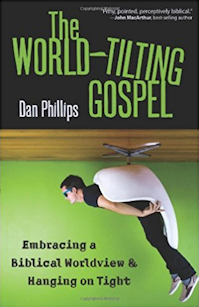
Well, Tim, it seems at least one of us has come a long way from being a mere channel rat in DrO's #prosapologian. In spite of my jealousy, after reading the book you've obviously done good here.
Since a lot of people have "blogged" you so far about your book, I'm going to try to ask you some unconventional questions. Bear with me as I work them out.
I started reading your book, got through 2 chapters, and turned back to the index with my highlighter to do an experiment. I highlighted all the names of theological “conservatives” in green, and theological “moderates” (or those farther left) in orange. My pages were mostly green and not hardly orange. What would you say to people who would call this kind of foundation for your book one-sided? Why not include some insights into “other kinds” of discernment, such as Rob Bell’s approach to Scripture or an Assemblies of God approach to spiritual gifts?
 The easy answer here would be to simply state that some teachers both emphasize and model discernment while others do not. The reason some authors are “orange” or “red” (or whatever you’d use to indicate the category that comes after the moderates) is precisely because they lack discernment! In the resources section of the book I even mention John MacArthur as a teacher who always emphasizes discernment, mentioning that his books and commentaries never miss the opportunity to make note of the call of the Christian to spiritual discernment. I tended to rely on authors who have emphasized discernment in their ministries.
 I can’t speak specifically to Rob Bell’s approach to Scripture or the Assemblies of God approach to spiritual gifts as they did not factor into the book. But I can say that I relied first and foremost on Scripture and, beyond that, on teachers who love Scripture and who seek to accurately convey what God teaches through it. I think you’d find that the “green” authors in the book are the ones who love Scripture and who skillfully teach it through the books and through their teaching ministries.
I think that’s an interesting answer, Tim, because it seems to me that “discernment” as you are defining it sort of presupposes a specific approach to Scripture. That is, the “greens” all seem to share a common hermeneutic, a common approach to the text. You’re not a theologian (neither am I), but would you consider other approaches to Scripture as viable approaches to developing spiritual discernment?We’re probably walking a little outside my area of expertise here. While I’d acknowledge that these men (and women) do share a common hermeneutic, I guess I would see it as a better hermeneutic (or a biblical hermeneutic). Not all hermeneutics were created equal. Whether I’d consider other approaches to Scripture as viable would really depend on the approach a person took. It’s rather too broad a question to just assign a yes or a no, I think.As I was reading your book, I was also reading a book by Larry Osborn called The Contrarian's Guide to Knowing God. I bring it up because it's a little more light-hearted than your book is, and it overlaps some of the same topics. How does seriousness of tone relate to your view of how discernment works?To be honest, this is a question I’ve been thinking about for several weeks now. I do not remember putting a lot of effort into determining whether I would write in a serious or a more light-hearted tone (though, to be honest, it was almost two years ago that I began to write and I’ve got a poor memory. Putting those two factors together means I may have spent all kinds of time thinking about it but such thoughts have long since slipped my mind). But I do know that I did not expressly set out to create a book that was serious in tone. Rather, I set out to write a book that would share what the Bible says about spiritual discernment. At my blog I write from a personal perspective, often basing theological lessons on my own experiences and simply sharing things God has taught me. But when it came to discernment, I did not want to share my perspective on discernment, as if that would be of any value. Instead I wanted to share the biblical perspective.I recently discussed this topic with my editor (as I begin to think about future writing projects) and her words rang true when she said that perhaps some of the feedback about stylistic issues came from people who were expecting “Tim in print rather than the need for and instruction on how to be discerning.” I did not want to interfere and did not want to inject too much of myself into the book. At the same time I did want to maintain a personal rather than a scholarly tone. How well I’ve succeeded in that will probably become more clear as I gain more feedback on the book.
Yeah, my problem, Tim, is that I like you. You’re always a little dry, but you’re relatable. How would you respond to the person who says that while your book may be useful, because it’s not relatable it doesn’t deliver what the average seeker, sitter or disciple really needs?I would be surprised to hear that my book is not relatable. I was deliberate about writing in a way that was accessible and I often relied on what I think are helpful illustrations to try to give something memorable that they can hold onto. In fact, the whole Preface is nothing but a story for that very reason. If a person felt that I was not relatable, what could I say, really? I guess I’d suggest they read another book about discernment. Oh, wait…Now, that said, here's the real controversy starter: here we are at the TeamPyro blog talking about your book, and we're sort of renown for being somewhat other than sober in tone – me personally for sure, but certainly Phil and Dan, and certainly the inimitable Pecadillo. We have taken some hits for it in some corners of the blogosphere. What's your take on the use of something other than a somber, pious tone in talking about spiritual matters?I may have more to say about this when I post a review of the new book by Mark Driscoll. It is something I’ve thought about quite a bit, and especially so as I read his book.I believe there is a time and a place for humor. I believe humor can be effective in teaching and in communicating even something as serious as theology and spiritual matters. Of course there are times when humor is inappropriate (as comedian Brian Regan has aptly pointed out, greeting card stores have no “humorous sympathy” section). I’m sure Jesus had a terrific sense of humor and I don’t know that He would have been truly human if He hadn’t shared some good belly laughs with His disciples on those long, hot and dusty walks. Yet our society, I think, has been prone to elevating humor and levity. After a while, it seems, we are no longer capable of taking seriously much of anything. So while there is a time for humor, and while laughter is a gift from God, there is also a time for soberness and a time to be serious. There ought to be a kind of gravity surrounding Christians, I think, that proves that they take life seriously and that they are aware of their own sin and aware of the state of the world around them.
Even while we do laugh and have fun, our humor must be sanctified. We can use humor to point to what is ridiculous and can use it just for the sheer enjoyment of laughing, but we must be careful that we do not make light of sin. This is, I think, where many Christians abuse humor. When we laugh at what God has forbidden, we make light of sin. So let’s laugh and let’s have fun and let’s be something other than somber and pious when necessary, but let’s be careful all the while that we take seriously what is important to God.
I said something similar this week at my blog about Pastor Mark’s Q&A relating to the theology of sex & procreation – that some things just require us to take them seriously rather than crack jokes that allegedly make a point. A laugh is a serious thing in the larger sense, I guess.You have a blog? Anyways, it just so happens that I listened to Mark’s sermon and Q&A this afternoon, before you sent me this comment. I think you’re right—some things are very easy to laugh about but could probably be treated with a bit more seriousness. Issues regarding sexuality definitely fall in this camp. It is easy (very easy, even) to get laughs when it comes to sex. But I think we might do better to treat the subject with a bit more soberness at times.Quick lightning round – top-of-mind answers only:
* Favorite TeamPyro Post/Series, – I guess I’d probably vote for all those Emergent Demotivation posters as my favorites. They weren’t the most edifying things you guys have ever produced, but they were good for some laughs.* Favorite TeamPyro Contributor (Doh!) – Darlene (by far!)
* Most puzzling criticism of your book – Even I was taken aback by the level of some of the criticism lodged against me because of my lack of credentials. The early comments were fairly innocuous, but as people got warmed up, the comments got pretty dark. It bothered me far less than it surprised me.
* Best reason to live in Canada – There is almost no such thing as evangelical politics up here—at least not compared to what goes on in the U.S.
* Favorite place to eat in Toronto – I don’t actually live in Toronto proper and rarely eat out. But if I do venture downtown and get a bit hungry, I generally grab some of Toronto’s finest street meat from a hotdog/sausage vendor outside Rogers Centre (where the Blue Jays play).
Challies is on a blog tour for his new book.



 t seems the doctrines that pertain to human sin are generally some of the hardest doctrines for people to understand and embrace—particularly the doctrines of original sin and universal depravity. Of all the
  doctrines taught in Scripture about the nature of humanity, the one doctrine that comes under attack more than any other is the Bible's teaching that all have sinned and fall short of the glory of God, that we inherited a sinful nature from Adam, and that it means we are completely helpless to redeem ourselves from the condemnation of God.
 One significant fact that strikes me in Scripture is that the most godly men on the pages of Scripture all had a deep sense of their own sinfulness. David was a man after God's own heart, yet in Psalm 52:5 he confessed that he was sinful from the moment of his conception. Isaiah was perhaps the greatest prophet in all the Old Testament, and yet in Isaiah 6:5, he wrote, "I am a man of unclean lips, and I dwell in the midst of a people of unclean lips." The apostle Paul, the figure who towers over the early church, representing perhaps the ultimate example of godly scholarship, wrote in Romans 7:18: "In me (that is, in my flesh,) dwelleth no good thing." In verse 24 he wrote, "O wretched man that I am! who shall deliver me from the body of this death?" Again and again in Scripture, we see that the people who are the prime examples of godliness had the keenest perception of their own sinfulness.

 he church is a separate and distinct thing from the world. I suppose there is such a thing as "the Christian world"; but I do not know what it is, or where it can be found. It must be a singular mixture. I know what is meant by a worldly Christian; and I suppose the Christian world must be an aggregate of worldly Christians. But the church of Christ is not of the world. "Ye are not of the world," says Christ, "even as I am not of the world."

 n the topic of church activities, Christian testimony, and our collective influence on the world, I wanted to point out that the message we send with our lifestyle is to a very large degree subject to the interpretation of the observer anyway.
 o I grew up in a modernist church where we had dances all the time. It was the default activity for our youth group. And if you think church dances are a novel idea, you've been wading in the shallow-evangelical end of the pool for too long. In fact, the most famous incident regarding a church dance I can think of occurred in 1949.
 Also, I'm not suggesting (as some of our more zealous fundamentalist brethren might want to) that the club atmosphere in that one Colorado church is directly to blame for the fall of the World Trade Center towers.
 watched the following video last April or thereabouts, and I intended to link to it on our blog. But I can't find any reference to it in our archives, so I rather suspect it hasn't yet got the sort of attention it deserves from Pyro-readers.
 There are lots of sound bites here worth singling out. I'll let you discover them all for yourselves. My favorite is the remark made by the woman at about 4:20.
 But that said, one of the great strengths of this book is that it's not written at the grad-school level. It's written at the popular level in spite of its high-brow attributes of subject and scripture indices. Its vocabulary is accessible and frankly simple. Tim's examples from history and current events are intriguing and his use of one in particular to sort of weave the themes of the book together was really good and useful – it makes your brain engage the subject matter in a "apply to me" way and not just a "apply to them" way. You know: you can read this book, no matter who you are. The question is whether you will read this book.

 others in different "binds."
 who luxuriate in any uncertainty they can magnify and exaggerate, who work so hard to blunt edges and blur lines, yet strike grand and dramatic poses as great and brave Pioneers of the Void. They invest a lot of energy into convincing us how agonized they are by their doubts and uncertainties — though not with quite the energy with which they scald and upbraid anyone who dares to try to help them find truth, certainty, and assurance.
 f you think you know who said the following, leave a comment. I'm traveling today, with no time to write or answer comments. But unless weather (or worse) delays me, I'll be home by this evening. So if nobody's got it yet, I'll post the correct answer then.
 Fosdick, one of the most militant modernists of the twentieth century, would feel right at home with both the views and the rhetoric of Emergent Village. The similarity of his ideas and the standard talking points at Emergent Village belies the utterly groundless claim that post-modernized "evangelicalism" somehow constitutes the abandonment of modernity rather than the further advancement of it. (One intrepid commenter at one of the post-evangelical trash-talk blogs recently accused me of misconstruing Spurgeon's position with regard to Emerging trends. Spurgeon hated modernism, this fellow reasoned. Therefore he surely would have embraced post-modernism, right?)
 Although Fosdick insisted that those who believe in the truth of Scripture were evil aggressors destroying the unity of the church, and he decried the efforts of fundamentalists and evangelicals to drive liberals out of their denominations, in the end it was the fundamentalists and evangelicals who were driven out. Most liberals thought they had gained the upper hand. But virtually all the mainstream denominations declined drastically under liberal leadership, and some ceased having any kind of spiritual influence whatsoever. Moreover, the independent churches and institutions founded by fundamentalists and evangelicals grew pretty steadily in size, strength, and influence for most of the twentieth century.

 have often admired Martin Luther, and wondered at his composure. When all men spoke so ill of him, what did he say? Turn to that Psalm—"God is our refuge and strength, a very present help in time of trouble; therefore we will not fear, though the earth be removed, and though the mountains be carried into the midst of the sea." In a far inferior manner, I have been called to stand up in the position of Martin Luther, and have been made the butt of slander, a mark for laughter and scorn; but it has not broken my spirit yet, nor will it, while I am enabled to enjoy that quiescent state of—"So he giveth his beloved sleep." But thus far I beg to inform all those who choose to slander or speak ill of me, that they are very welcome to do so till they are tired of it. My motto is cedo nulli—I yield to none. I have not courted any man's love; I asked no man to attend my ministry; I preach what I like, and when I like, and as I like. Oh! happy state—to be bold, though downcast and distressed—to go and bend my knee and tell my Father all, and then to come down from my chamber, and say—
 he main substance of today's entry is something I originally wrote in 2006 in the comments section of another blog. A writer on that blog had complained that my criticism of the "Emerging Conversation" was insufficiently nuanced and unnecessarily nitpicky. He seemed to be suggesting that there are more good influences than harmful ones in the broad world of Emerging religion.
  is (unless we're doing parody at their expense). Nothing in my two-and-a-half -year experience in the blogosphere has given me any reason to think any of those who talk the most about "conversation" are really interested in having a serious one with anyone who is more certain about eternal truths than they are.