
 obody wonders that Mahometanism spread. After the Arab prophet had for a little while himself personally borne the brunt of persecution, he gathered to his side certain brave spirits who were ready to fight for him at all odds. You marvel not that the sharp arguments of scimitars made many converts.
Any religion will win assent when the alternative is conversion or instant death. Give a man a strong right hand and a sharp sabre, and he is a fit missionary of Mahomet's doctrine.
Our Saviour gave to his soldiers neither spears nor swords, but said, "Put up again thy sword into his place: for all they that take the sword shall perish with the sword." He asked no aid from governments, he disowned the temporal arm altogether as his ally. Had our Saviour been a State-churchman, and not, as he was, the grandest of nonconformists, it would have been said that under the wings of the State his church was fostered into power. If Cæsar had said, "I will gather thy children together as a hen gathereth her chickens under her wings," it would not have been surprising if the brood of Christians had multiplied indefinitely.
But our Saviour sought no succour from potentates, and rested not upon an arm of flesh. The people would have made him a king, but he hid himself, for his kingdom was not of this world, therefore did not his servants fight.
Our Saviour as he used no force, so neither did he use any means which might enlist man's lower nature on his side. When I have heard of large congregations gathered together by the music of a fine choir, I have remembered that the same thing is done at the opera-house and the music-hall, and I have felt no joy. When we have heard of crowds enchanted by the sublime music of the pealing organ, I have seen in the fact rather a glorification of St. Cecilia than of Jesus Christ.
Our Lord trusted in no measure or degree to the charms of music for the establishing his throne. He has not given to his disciples the slightest intimation that they are to employ the attractions of the concert room to promote the kingdom of heaven. I find no rubric in Scripture commanding Paul to clothe himself in robes of blue, scarlet, or violet; neither do I find Peter commanded to wear a surplice, an alb, or a chasuble. The Holy Spirit has not cared even to hint at a surpliced choir, or at banners, processions, and processional hymns.
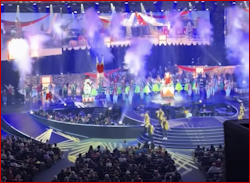 Now, if our Lord had arranged a religion of fine shows, and pompous ceremonies, and gorgeous architecture, and enchanting music, and bewitching incense, and the like, we could have comprehended its growth; but he is "a root out of a dry ground," for he owes nothing to any of these. Christianity has been infinitely hindered by the musical, the æsthetic, and the ceremonial devices of men, but it has never been advantaged by them, no, not a jot. The sensuous delights of sound and sight have always been enlisted on the side of error, but Christ has employed nobler and more spiritual agencies.
Things which fascinate the senses are left to be the chosen instruments of Antichrist, but the gospel, disdaining Saul's armour, goes forth in the natural simplicity of its own might, like David, with sling and stone. Our holy religion owes nothing whatever to any carnal means; so far as they are concerned, it is "a root out of a dry ground."

Charles Haddon Spurgeon, "A Root out of a Dry Ground," in The Metropolitan Tabernacle Pulpit (London: Passmore & Alabaster, 1872), 18: 569-70.









No comments:
Post a Comment