

|
 ric Satie is one of Darlene's favorite composers. He called some of his work "furniture music"—music not to be listened to, but to be played as background. That's what most music has become these days, but it was a radical idea in Satie's day.
 Now, don't tell Darlene this, but Satie was a supremely aberrant individual. Look up the French word for "eccentric." Instead of a definition, they could simply put Satie's picture there.
Satie was born in the French harbor town of Honfleur in 1866 and died in Paris in 1925 (just nine days before my dad was born). So we're coming up on the 100th anniversary of his death.
How weird was he?
You get a little glimpse from the titles he gave to some of his own compositions: "Chilled Pieces," "Vexations," "Drivelling Preludes (for a Dog)," "Dried up Embryos."
Satie was Frank Zappa at least 75 years before anyone ever heard of Frank Zappa.
He wrote humorous notations, drawings, and puns in the margins of many of his compositions, intended as private jokes between him and the performer. When he learned of instances where the jokes had been shared with the audience, he wrote, "To whom it may concern: I forbid anyone to read the text aloud during the performance. Ignorance of my instructions will bring my righteous indignation against the audacious culprit. No exceptions will be allowed."
Satie lived alone in a room in Arcueil, France for 27 years. No one but he ever entered that room. At his death, friends discovered an unbelievable hoard of personal memorabilia, including a large collection of umbrellas, drawings he had made, letters he had collected, and dozens of previously unpublished works. The manuscripts of his compositions were all stuffed in odd places—such as the pockets of his trademark grey velvet suits and behind the piano (which, as it turned out, was covered with junk and cobwebs, revealing that he never used it in composing).
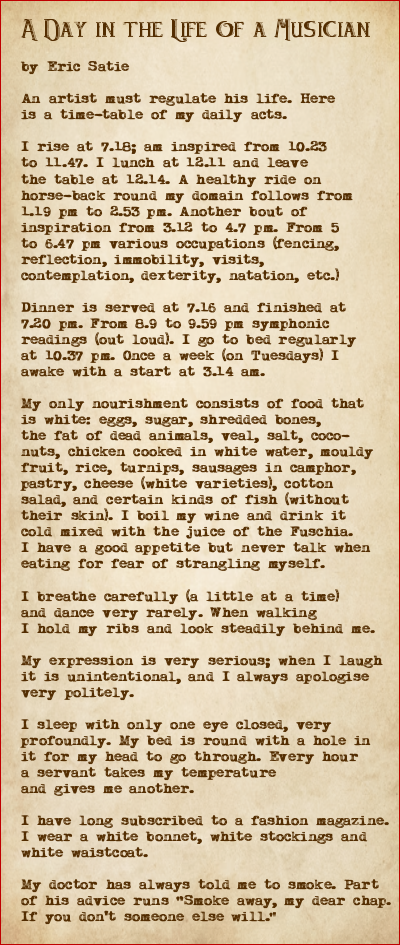
My favorite Satie item is his description of a typical day:
See if you can make any sense of this fragment from Satie's pen, found in an article titled "Ce Que Je Suis" ("What I am"), in the French Journal, Revue musicale S.I.M., (15 April 1912), p. 69. He coins the word pyrophony, which could be very useful. But I'm not sure what he is saying:
|
Erik Satie was a living example of the fact that even though sin has badly marred the image of God in man, the image is still there. We can see it clearly in the way fallen creatures, no matter how outré, are still capable of amazing creativity. I think our love for the beauty, humor, and artistry of creaturely creativity is also an expression of the imago Dei.
You'll be familiar with Satie's best-known work, "Gymnopédie No. 1." Enjoy:













3 comments:
Blood, sweat and Tears did a nice version on an early album. Gymnopedie#1!
I did not know that. But you're right. It's nice: https://www.youtube.com/watch?v=WFxIaaPzO3c
I had to go put on the album and listen to it. I never knew the guy but now I'll give a listen.
Post a Comment