Showing posts with label A-H-A. Show all posts

14 July 2013

Random Update on the AHA/D'OH! posts from last week

by Frank Turk

First, I think it's a shame to bump the Dose of Spurgeon for updates, but the friends of AHA/DOH! (note: after 2 weeks of looking at these acrostics, I am still amused by them.  I can't believe nobody looked at those and said, "um, guys? maybe we need something that will cause other people to take us a little more seriously?")(says the guy whose blog is named "TeamPyro" where they call themselves PyroManiacs, so there's that) have linked me via Facebook to the start of the rejoinders:


When it went live, I was entering a cave in the Ozarks in a place where my phone had no signal; I responded on FB as soon as the signal returned (briefly).  I am now seated at my PC with a stable internet connection, and you can see that I am putting this ahead of lunch and ahead of a much-need nap after canoeing 9 miles down the Buffalo River.

My response to the AHA counterposts is as follows (slightly amended):
I ask every person who reads the series of responses at AHA's blog to do 3 things:
[1] read the AHA website (particularly, read the 5 tenents, no compromise, the difference, funding philosophy, and then the following links from ChurchRepent.com: one two three (for "three," browse until you feel like you've had plenty)
[2] read the 3 blog posts I wrote
[3] then read AHA's response (I'll link to part 1, and then I'll imagine that you are able to navigate the internet with more finesse than  someone from the 1950's if/when the balance of these posts are made)
I am utterly satisfied that any English-speaking reader can decide for himself what to think.
Also, Steve Hays has posted a note about one aspect of this exchange.  I thank him for it as it may be useful to anyone following along.

I consider this topic closed.  The comments will also remain closed.


11 July 2013

Running Around without a Church

by Frank Turk

WAIT!

BEFORE you dive down to the comments, they are on moderation, and I'm not going to check them until about 7 AM Central Time.  You might as well read this post before you comment and are disappointed that your comment didn't magically and instantaneously appear ...

As of 2 PM on 14 July 2013, the comments are closed

Welcome back -- some of you are already diving for the comments as this will be the first day in 3 when they will be open -- but sadly for you, they are also set to moderation (as is our New Normal), so your comments won't crash onto the internet with the speed and ferocity of rabbit darting out onto the highway to avoid a fox, but sadly ignoring the oncoming 18-wheel truck full of machine parts.

That said, over the last two days I have been, due to some odd interactions I have had over the last week or so, examining the organization which calls itself "Abolish Human Abortion," or "AHA."  We have covered their version of absolutism, and also their view of being "biblical" about their endeavor, and I find myself left with one other complaint that seems glaringly-obvious to me but maybe not so much to them.

However, before proceeding, and to make sure nobody missed it, I'm going to say this one last time.

Let me make sure I say this as clearly as possible:

All murder is wrong

That's the moral premise which under-girds any work to limit or abolish abortion.  Anyone commenting or responding after this series of posts goes live who ignores this essential fact of Christian ethics in my position is selling something unsavory.  And, since the comments are open today, let me be especially clear: anyone ignoring this statement when they comment will not make it out of moderation.  Those of you who are dying to say that I have already, or would, endorse abortions?  I am talking to you.

OK: so maybe they aren't actually as biblical as they claim to be, and maybe they aren't as absolutist as they claim to be -- but so what?  Shouldn't we just embrace them as an ally in a war against one aspect of our culture which, let's face it, needs to be abolished?  Should we just sort of class them as the Marines and the rest of us can be maybe the volunteer militia or the tax payers who fund the efforts of those who see themselves as called to the front line of the battle?

I have a lot of sympathy for that idea -- because I believe that there is one body but many members.  While there may be a priesthood of believers, some are called to be pastors, some teachers, some evangelists, some janitors, some bloggers, some just as members in good standing who are fathers and mothers and sons and daughters.  In short, God did not save us into a family of uniform Lego minifigs.  For some people, it is right to be more of one thing and less of another because this is what they are gifted for -- and to ignore this is to simply ignore the places where Scripture actually says this.

These are not the Saints you were looking for ...
And there are two ends of the spectrum in that error -- one being the obvious: demanding from everyone that they demonstrate your spiritual gift to the scope and extent that you are personally going to do it.  Demanding everyone be a blogger, for example, would be very bad.  But: demanding that everyone in every church dedicate all time and resources to one aspect of pleading the Gospel to the culture is equally bad. In fact, demanding that every church be a militant abolitionist church is also bad -- because let's face it: since 34% of women live in counties with no abortion provider, it's a likely statement that about a third of churches are in counties where there is no abortion provider.  In those counties, shouldn't those churches minister to the sinners they have rather than the sinners they don't have?

But the other end of the gifting spectrum, it seems to me, is less-obvious, but more important.  It's the view that I don't need the other gifts of the church.  This, it seems to me, is rampant in all manner of good-doing under the tablecloth tent with the letters "G O S P E L" plastered on it with a sloppy paint brush.  People get outside the church in order to do something that seems good -- for example, stopping babies from being killed -- and then they take the moral authority of obeying what is plain in God's created order as the authority to forget the rest of God's plan for the world.  Specifically: they forget that the church is the place where the authority of the Gospel is located.

Don't think so?  Review Mat 16:16-19.  Here's what Calvin says about this passage:
Here Christ begins now to speak of the public office, that is, of the Apostleship, which he dignifies with a twofold title. First, he says that the ministers of the Gospel are porters, so to speak, of the kingdom of heaven, because they carry its keys; and, secondly, he adds, that they are invested with a power of binding and loosing, which is ratified in heaven. ... We know that there is no other way in which the gate of life is opened to us than by the word of God; and hence it follows that the key is placed, as it were, in the hands of the ministers of the word. [Emph Added]
The Gospel is not running around without a church.  The rest of the New Testament testifies to this -- for example in Titus 1-2, 2 Tim 2, 2 Peter 3 and so on -- and demands that the Gospel come from the church under the good order of the body as protected by faithful men.  The fact is that all the people saved into Christ in the NT were saved into the church -- a local church, a physical body of people -- and worked together from the church into the world.

In that: so-called "Gospel" ministries in which the workers and especially the leaders are outside of the protection of the church, and are not accountable to the church for their actions, are problematic.  It's not enough to say that they are members in good standing at their local church: if they are doing the work which is prescribed for the local church but they are not under the authority of the local church, they are either robbing the local church or scoffing at it, or both.

The problem, at its heart, is a failure to see that there is a need for all the parts of the body for the right function of the body -- in this case, the function of leadership over the function of social action.  This problem is present in spades in the AHA organization.

First: there is no visible, accountable leadership structure.  After inquiring with someone who knows, I was able to get a short list of fellows who are sort of running AHA, but that list is not readily visible to the public.  In the best case, that's AHA simply asking for grace that they aren't willing to give anyone else.  They are hell-bent to make sure the names of the people they find lacking are well-known and well-dunked in the shortcomings they have charged them with.  Imagine what AHA would do with a church that wouldn't list its leadership, or an outfit which funded abortions but shielded its leaders behind an anonymous "inquiries@prochoicepayouts.com" e-mail address.  At best it puts them at risk of wandering around without any real purpose; at worst, it gives them a license, as they said in the '70's, to do until others, then split.

Second: they have removed themselves from Gospel accountability.  That is to say, it seems obvious that there is no one with a mature view of Scripture out in front.  Yesterday we saw at least two significant errors in theology and in the meaning of the Gospel; there are more to be found on their website.  Those errors are replicated as this organization goes about its business.  It stems from failing to have a local church accountable for and accounting for their actions, and overseeing their work to make sure both that it is wholesome and godly and also that it is not a scandal.

Think about this for a second: if they were a seminary that cropped up out of the wild blue yonder, or a publishing house, or a prison ministry with no means of maintaining confidence in the theology they were teaching and preaching, who would take them seriously?  But in this case, there is no visible means of doing that at all, and (not surprisingly) they have given themselves a free pass.

Third and finally: they have inverted God's economy of the church.  Yesterday I linked to the "Church Repent" site to show how they are shaming churches they say are not living up to the standards these unaccountable fellows have established.  In the best possible case where these fellows are 100% correct and the churches they are shaming are 100% wrong, this activity is simply never found in the NT -- it's not even implied.

The flimsy excuse they use is from Eph 5:11 (it's telling they don't use James 5, although in private conversations they will use Galatians 2), to "expose evil."  It's fair enough -- but that exhortation is actually regarding shameful personal acts which one is actually doing, not sins of omission.  Moreover, it's a call to personal accountability and not a call to form a non-church mob to heckle a functioning church.

Worst of all, because they have no church accountability themselves, there's no way to correct these fellows.  Talking to them about their opinions is about as productive as talking to the college kid who just discovered Schrodinger's Cat -- it seems to him that everything he knew before is now wrong, and there's no two ways about it.  I'll offer up the anticipated content of the comments section as supporting documents to this point.

Conclusion

Now: so what?  If I'm right, AHA has a significant list of issues to resolve before they can be seen as credible, let alone useful or (to be fair to their point of view and not reason only from pragmatism) faithful.  Should we simply toss them off as another ill-conceived parachurch ministry and consign them to the ash-heap of church history?

Let's go back to my original premise: all murder is wrong, and in this country, abortion is the most-common form of murder.  Whatever we think about AHA's methods and mode of operation, and whatever we think about their theology, abortion is still a vile crime.  To that end, I think it's wise to call these fellows not to fold up the tents and go find another hobby to spoil, but instead to repent of their obvious and critical errors in order to rightly approach the problem:
  • They should repent of their absurdly-bad view and use for the local church.  They behave shamefully toward the local church because they are not accountable to a local church, and have an unbiblical view of discipleship and evangelism.  If they found themselves accountable to elders in a church for their actions, they would find most of their other problems would head toward correction.
  • They should repent of their unwise, misguided use of the Bible.  What they do not need is to replace their random statements with someone else's systematic theology; what they do need to do is to read the Bible as it comes, as it was intended to be read, and ask themselves, for example, how did those people change their culture when they hand little or no political influence, and definitely no active theology of civil unrest?  What does the Bible teach us regarding the role of the local church in changing the culture?  And what is the Christian's role in society when the Christian faith is a minority view?
  • They should repent of their own self-righteousness.  Disguising pride with phony expressions of camaraderie when what is being said is, effectually, "You are an idiot and probably a criminal, brother," is not impressive except as a hallmark of one's own assessment of one's worth.  Hiding behind God's sovereignty as an endorsement of your "ministry" when one's own method of reading God's word is, at best, idiosyncratic, is underwhelming.  Claiming to be the wounded party when one is falsely calling local churches aiders and abettors of murderers is ugly.  They should repent of the idea that they are the ones on the high moral ground.
  • They should repent of their current methods and modes until they have adopted the fruit of repentance from the previous 3 items, and then re-assess their manner of establishing engagement in the communities they operate in -- both toward churches and toward abortion clinics.


JUST TO BE CLEAR BEFORE YOU START YOUR COMMENTS

What I did NOT say this week:
  • I did NOT say abortion is morally justified
  • I did NOT say Christians should do nothing about abortion
  • I did NOT say that Churches should do nothing about abortion
  • I did NOT say that protesting abortion clinics was wrong
  • I did NOT say that Christians have no duties as citizens
What I DID say this week:
  • the AHA version of absolutism on this issue is inconsistent at best, and morally and biblically untenable at worst
  • AHA's condemnation of anyone who doesn't agree with their philosophy or methodology is not morally or biblically tenable
  • There are biblical problems with all 5 of their major tenets for conducting operations as they are stated on the AHA web site
  • The two most important problems are a lack of a clear approach to hermeneutics/interpreting the truth of God's word, and a complete lack of clarity regarding whether or not the methods/means of accomplishing their goals matter.
  • AHA lacks a clear and workable theology of the church, and therefore they don't get right the responsibilities of the local church, and the responsibilities of believers, and the responsibilities of believers to the church and vice versa
If you disagree with what I actually DID say this week, I welcome your comments -- I welcome your critiques in detail.  If you simply cannot stand that I have criticized them, that's another matter.  Ranting about your disbelief that I would criticize these people doesn't interest me.  I don't have an obligation to give anyone who is angry because they are wrong a platform for their ravings, nor do I  have to answer such ravings.

The comments are open, and under moderation.  Mind the gap.


10 July 2013

A Lot More Bible to Cover

by Frank Turk

Yesterday I posted part 1 of 3 regarding the organization "Abolish Human Abortion," a group of fellows who are very proud of what they have set out to do -- which is the right-minded objective of abolishing human abortion.  Yesterday I made one statement that ought not to be ignored, so I'll repeat it here.

Let me make sure I say this as clearly as possible:

All murder is wrong

That's the moral premise which under-girds any work to limit or abolish abortion.  Anyone commenting or responding after this series of posts goes live who ignores this essential fact of Christian ethics in my position is selling something unsavory.


Yesterday we covered the interesting idea that these fellows are the only ones doing anything not-evil in the fight against abortion.  Today we are going to cover some of their theological reasoning.

The five major tenets of this organization are as follows:

1. Biblical

Usually, when an organization says it is "Biblical," it means that it reasons biblically to its objectives and to its means.  The tenet of "biblicism" is therefore usually a foundational objective -- not a list of Bible verses.  It usually outlines the method or approach the group takes toward the Bible -- it establishes a hermeneutical standard, or a tradition in which it stands.  The list of Bible verses usually comes later.

In this case, they present the Bible verses right here, and the list is simple:
Micah 6:8
Isaiah 1:16-17
Eph 5:11
James 1:27
Luke 4:18-19
That is: the tenet here is not that they will use the Bible as a sufficient and infallible authority.  If they did, maybe they would have a local church which was overseeing them to make sure they weren't doing things they ought not to be doing, for example.  The tenet, rather, is a list of Bible truths which they demand to be taken at face value without further comment:
  • do justice, love mercy, and walk humbly with our God
  • make the church holy, reprove the ruthless, and defend widows and orphans
  • expose all evil
  • be holy and "visit" widows and orphans in need
  • Keep the two great commandments
  • Human beings are in the image of God
  • Jesus became a man to save men from "sin, self-destruction, death, and eternal separation from God."

This is interesting because at first glance, the list is actually a random list of true statements from Scripture.  All of the statements are true.  The question we have to ask is why these in particular have any priority over any other statements of truth -- for example, the commission of the church to make disciples of all men (Mat 28); the demand of Christ to love one another (John 13); requirement of Husbands to love their Wives (Eph 5); the demand that there be no divisions in the local church (1 Cor 1-3).  And just to keep things testimentally balanced, how about the idea that God hates divorce (Malachi 2); or that God hates all evildoers (Ps 5:5); or that God hates the double-minded and liars (Ps 119); or that God hates Robbery (Is 61)?

Superficially, there is no question: they have seven true statements from Scripture.  Whether these statements are necessarily the most important statements of Scripture regarding the existence of the church or the purpose of men (with or without faith) is simply undemonstrated.  What's the cause from the text or from good reasoning which causes these verses to be so true that they cause us to create a new #1 priority for the church?

In that: I think the idea that these fellows are "Biblical" remains to be seen.  They have Bibles; they can extract true statements from the Bible.  Whether they use the Bible for its necessary purpose, to say what it means to say, remains to be seen.

2. Providential

The next part is worth transcripting fully:

We rely on the Providence of God, not the pragmatism of man. Abolitionists do not trust in warhorses or chariots. We trust in the spiritual means and methods God has given to us in His Word. Abolitionists have always cried, “duty is ours, the results are God’s!” We look to the Spirit of God to lead us, believing He is our ever present guide and that He is not silent.

We depend upon the Providence and Sovereignty of God. “… He giveth to all life, and breath, and all things.” (Acts 17:25) It is the power of God working through His Holy Spirit that changes hearts. Yet we acknowledge that God has deemed men active participants in this drama. He gives us choices, and these choices have consequences. (Matt. 9:38, Acts 27:22,31) We are called to be faithful – to walk in righteousness – to speak the truth in love. We leave the results in His hands.

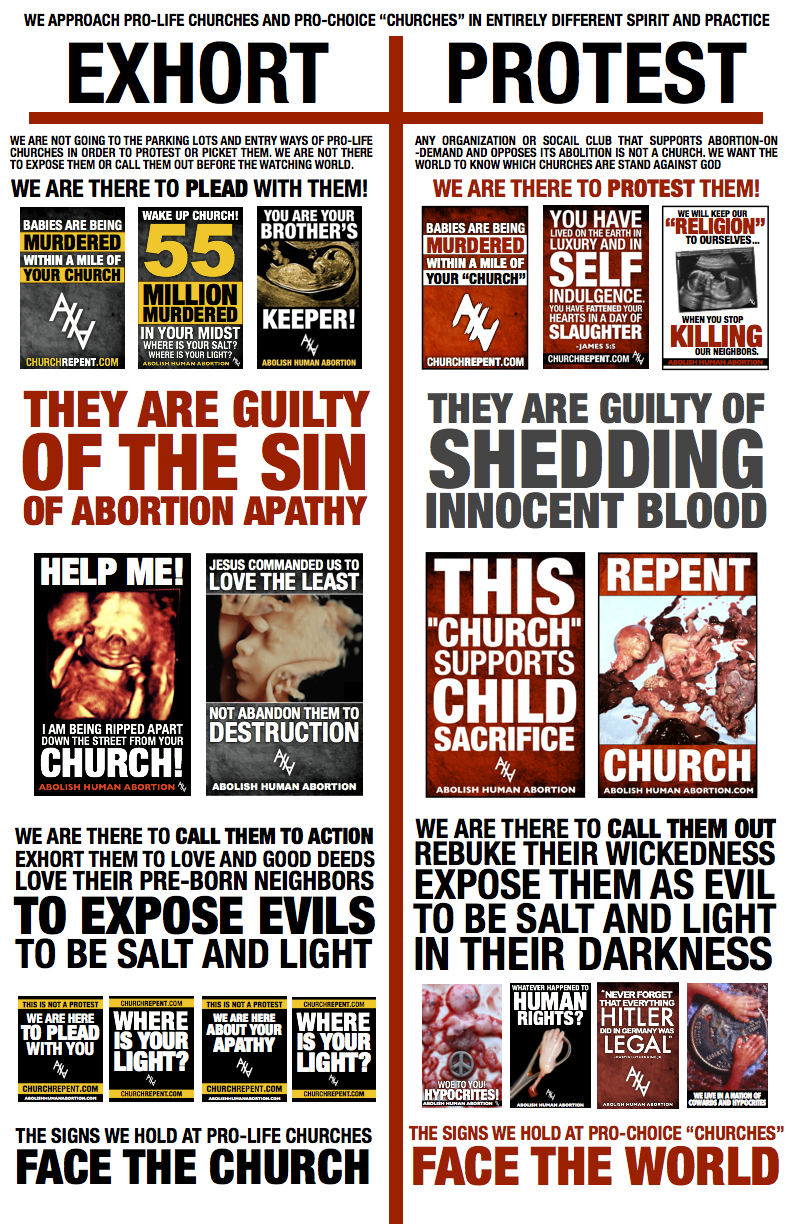
These fellows escape being true hypercalvinists or fatalists by admitting they are, at least, called to do something -- and good on them for that.  They say they have a moral obligation to participate in the drama -- which is a fascinating turn of phrase.  But it's funny that they demand that they do not trust in chariots and warhorses -- because they do rely on graphic posters and sandwich boards. (see some examples here, but click at your own risk as they are explicit regarding the cost of abortion in human terms)  That is: they do rely on shock and awe to deliver a message.  And at the end of it, they do want the laws to change -- they want the horses and chariots of the Government to protect unborn lives, yes?

Moreover, they also are not merely content protesting abortion at local clinics: they have an explicit mission to "exhort" local churches (again:explicit warning) who do not meet AHA's definition of being sufficiently-militant towards abortion.  It seems, at least, odd that they are worried about relying on means when, frankly, they have such explicit means and militant means -- and demand the same from others.

Let's be clear about the reasoning here: they can't accept an incremental change in the law of a local state or a nation because that's complicity with evil, but they can protest exhort one church at a time to change that church's ministry objectives (changing one church, not all churches) to suit the objectives of AHA.  And they don't trust in horses and chariots, but they do demand these churches change their behavior right now.

We'll have to wait for tomorrow for the comments to be open to see what sort of response AHA can muster toward the charge that while they are not politically incremental, they are unquestionably spiritually incremental -- even if it is because they have limited resources.

3. Gospel-Centered

You know: someplace in this neighborhood of the internet, the phrase was coined, "The Gospel is the Solution to Culture." I have made the T-Shirts.  It's my attempt to doff my hat the best-in-class in post-millennial theology to see the Gospel not as some weak tea which causes us to lose a lot of battles so that Christ can just win in the end, but rather as our vision of what's the right priority in this world.  It's the way Paul saw the world -- that all suffering is worth enduring if we can only tell people the truth about themselves and about God.  We would to God that all who hear us at any time might become such as we am—except for the chains, as the Apostle so blythely said. (Act 26)

And to their credit: the AHA team says this:

We are committed to an uncompromising adherence to the good news that God stepped down into human history as Jesus Christ.  He was conceived in the womb of a young unmarried woman who did not choose to be with child. He lived a sinless life, and by His death redeemed a lost, wandering and wicked people from sin, punishment and eternal separation from God.  

But then they spoil it by saying this:

The fullness of the Gospel of God is supreme above all philosophies and ideologies and without the Gospel there would be no call or means of Abolition.

Well, no.  First off, the Gospel is not an "ideology."  It's a declaration of fact.  It's not a system of political thought, or a religious scheme.  It's a declaration that God has done something which spares sinful man from judgment.  The Gospel is a message, a word of Good News.  You'd think biblical fellows would know this, but like all people overwhelmed by an agenda of social justice, they have simply forgotten it.

But second, the reason that we abhor murder is not that Christ was murdered: the reason we abhor murder is that the Law teaches us that Murder is wrong.  In fact, the idea that murder is wrong is so obvious, Paul tells the Romans that such a thing is written into the very fabric of the universe and the very conscience of man (purists: Rom 1-2).  The call to "abolition" comes from the fact that murder is wrong -- not from that fact that sovereign God has made a way to forgive men for sin.

And this, frankly, also goes back to whether or not these fellows are actually "Biblical."  They are unable to distinguish the Glory of God in Creation from the Glory of God in Christ -- they cannot, in fact, distinguish between revelation in creation and the special revelation in Scripture which Christ fulfills.

That's troubling.  And it's not the only place these guys could do with a second or third reading of the whole Bible for the sake of actually being a little more Biblical.

4. Body Driven
and 
5. Immediate and Uncompromising

We should let them, again, speak for themselves:

We believe that Abolition is an Obligation of the Church. We seek to awaken the Church to fulfill her ordained purpose to be salt and light in this sin spoiled and darkened world. The primary means God has ordained to display his manifold wisdom to the world is through his people, his body and bride. The church must take the gospel to the ends of the earth and bring it into conflict with every dark deed of man.

Read that again, especially the emphasized part (I added the emphasis).  Abolition is not the spread of the Gospel: Abolition, by their own definition, is the end of abortion first and with gusto.  While they say their primary means for this is the Gospel (to which they do injustice when they explain it), think about this: they have equated Gospel proclamation with the uncompromising end of one particular form of sinfulness.  In that, they have re-defined the mission of the church not to see to it that we are ambassadors of Christ, pleading from God a message of reconciliation: they have made the church's necessary obligation the improvement of society for one particular moral end.

Look: I have no problem saying that, because a church is located in a place where there are lost people, they SHOULD minister to those lost people and not to lost people in theory or in general.  A church next door to a strip club ought not to cut a deal with its neighbor that it will not preach the Gospel in front of their business because their business will be harmed.  A church next door to a casino shouldn't turn the other cheek when that parking lot has more people in it than the church lot does on a Sunday morning.  And to be as clear as possible, a church in a neighborhood with an abortion clinic ought to be involved in making sure that this place with those sinners receive the word of God so that they will repent.

But here these fellows have made a statement that places "abolition" on-par with Baptism.  They have put it on-par with the Lord's table.  They have put it on-par with weekly worship -- and they do it for all churches.  That's what Capital-"C" "Church" means there.  All Churches, right now, should drop what they are doing and Abolish Abortion.

For a group claiming to be, first and foremost, Biblical, I think they have a lot more Bible to cover before they do anything else.  And while that shortcoming is evident here, I think it is far more obvious in what we'll cover in the last installment, tomorrow.

Comments are closed until tomorrow.



09 July 2013

A Mixed Bag

by Frank Turk

What I should be doing this week is publishing a "Best-Of" post so I can dedicate my time and energy to finalizing my talk for the Tulsa conference that is scheduled for next weekend (register here; donate for the support of that conference here).  I have about 120 minutes of "stuff" to say, but 55 minutes to fit it in, so pray about that for me.


What I am actually going to do today this week (thanks, DJP) is talk about a topic which, unfortunately, isn't going to go away any time soon.  The topic is Abortion.  Specifically, I want to talk about one approach to the problem of abortion which I have unfortunately been subjected to over the last 7 days.

About a year ago, at the self-same conference in Tulsa, I was introduced to the group Abolish Human Abortion.  At that time, as I understood them, they were a young and new-ish group, and they had the vim and vigor of young fellows excited about getting into full-time ministry.  For my part, I am in favor of the end of abortion.  I am in favor of saving every human life from murder whenever possible, and this most certainly falls under that conviction.  All murder is wrong.

Let me make sure I say this as clearly as possible:

All murder is wrong

That's the moral premise which under-girds any work to limit or abolish abortion.  Anyone commenting or responding after this series of posts goes live who ignores this essential fact of Christian ethics in my position is selling something unsavory.

Insofar as murder is wrong, the epidemic of murder in our nation is not from firearm use: it's from abortion.  Only one bullet in a million ever kills a human being in the United States -- but one baby in 4 is aborted every year in the United States.  Comparatively speaking, there are 130 abortions for every murder committed by firearm in the United States.  For every one child murdered outside the womb by all others means, there are 1,000 children murdered in the womb via abortion.  As a percentage of all murders, abortion outstrips every other mode of murder in the world, and in our nation.

All murder is wrong; abortion is the most-prevalent type of murder in our nation; it is wrong.  However, the unfortunate fact of abortion is that, unlike shooting someone in the face or strangling them, it is not illegal.  And therein, as they say, lies the rub.

Here's the first bit of information from the AHA website which, I think, we need to consider:

Pro-life is the expression of a moral opinion. Abolition is the expression of a moral action. When you call yourself “pro-life” you are letting people know what you think about abortion. When you call yourself an abolitionist, you are telling them what you aim to do about it.

It's sounds very rational, right?  Everything, on first blush from these guys, sounds rational.  The problem, of course, is that this statement is a story they are telling themselves to justify something else they want to say or do.

Historically, since 1973, the Pro-Life movement has been the singularly most-vocal and most-active anti-abortion lobby and on-the-ground activist movement in this cultural debate in the US, and frankly it has been strongly populated by Catholics motivated by the papal encyclical Humanae Vitae.  To say it has done nothing in the last 40 years would be fudging at best.  (for a great commentary of what they have, in fact, failed to do, listen to this episode of the Mortification of Spin) For example, since 1982, the number of abortion providers has fallen by 37%.  That didn't happen because the pro-life movement is merely a statement of opinion -- and for anyone to say otherwise is, frankly, sly at best.  The advance of partial-birth abortion laws in this country is a function of pro-life activism; the advance of limiting abortion to prior to the 20th week is a function of pro-life activism.

The problem, of course, is that none of these actions are seen by the folks at AHA as advances: they are seen as some kind of ethical syncretism is which some losses are acceptable for minor gains.  Let's see how they would say it, just to make sure:

The history of the pro-life movement has been one of gradualistic means and measures, incremental legislation, ameliorative programs, and the inclusion of exceptions to abortion along the way to its eventual total abolition. Abolitionists reject the idea that you can effectively fight evil by allowing it in some cases or doing away with it by planned incremental steps. Abolitionists reject the notion that you can ever commit a little evil in order that good may come. 

Closing 37% of all abortion clinics is not an improvement in this view: it's evil.  It's evil because it doesn't save everyone.  I have covered this reasoning elsewhere, and it hasn't improved through fermentation over time or through this current revised statement.  The idea that if all cannot be saved then saving any is cooperation with evil is illogical at best, and unbiblical at worst.

"Unbiblical?" comes a voice from the moderated peanut galley. "By Jove, man - you may have a lot of flack for AHA on other grounds, but there is no way it can be unbiblical!  They quote quite a bit of the Bible on their websites!"

Well, they should read the Bible more closely.  The problem that the Bible tosses on this question is the problem of who God saves.  See: in a world where everyone is justly condemned for their sins -- where EVERYONE is going to hell -- God does not save every person nor does God intend to save every person, in the final account.  God saves some and allows some to be damned by their own sin -- and God is not therefore unjust.  God is rather therefore Holy and Merciful in spite of allowing some to be damned.  So in the worst case, there is perhaps one example of divine holiness which does not adhere to the legalistic absolutism of the AHA website.

But I think there is a more-human, more-analogous example in the Bible which the AHA statements overlook: the body of the church.  The church is a holy thing for God (for the sake of the purists, see Eph 5:27), but it is also a mixture of wheats and weeds until the end of the final judgment (purists: Mat 13).  In God's view of it, something salvifically-necessary can be, from a human perspective, a mixed bag and still achieve what it is meant to do in this world.

Because this is true, we should be able to see that we are not bound to absolutism every time we set out to accomplish a good and useful moral end. For example, it's not wrong to invent a medicine which cures some of the victims of a disease.  More to the point, it's not wrong to pass a law to stop immoral acts even though it cannot be enforced 100% and some will still be victims of crime.  Murder is already illegal in our nation - yet people are murdered every day. That doesn't make us immoral people for supporting the laws we already have.

So my first complaint against AHA is this: it is utterly unfair toward those who, frankly, share their ultimate goals but see the social  and political methods to achieving the goals as a longer process which takes back the law in steps.  It is unfair to their past accomplishments, and unwise in assessing the moral victories of the pro-life movement.

More tomorrow.  Comments will be closed until Thursday's post, at which time you are welcome to do as you will.


UPDATED:  Oh brother.

So the objection from concerned citizens in and around AHA is this: The parable in Mat 13 is not about the church, but about the world -- so I am off the reservation.  My objection is nullified.  "WORLD!"

OK - first of all, the standard reading of that passage is that Jesus is talking about the church in the world.  If my reading is flawed, so is the reading of a boat-load of reliable and faithful men from almost every age in church history.

"But," comes the rejoinder, "Jesus says, 'world'! You wouldn't deny Jesus for the ideas of men, would you?"

Well, if that's how we're reasoning, I'm not going to listen to your "ideas of men"  because I have already heard from Jesus, and you don't sound anything like him.  How far is this discussion going to go then?  Prolly no place you will enjoy or benefit from -- so unclench from the worry over the doctrines of men.

But: I'll go you one better -- maybe 2 better: I'll utterly concede that the parable of the wheats and tares is a parable about the whole WORLD!  If the whole WORLD is a mixed bag of wheats and tares until the end of the world, and the point of the parable is that God is doing what he's doing and allows there to be a mixed bag, how can God be doing what he means to do in this WORLD! except by some kind of incremental change?

The point is that God is not afraid of the mixed bag.  In fact, the mixed bag is in some way instrumental to the plan.  There are many examples of this in Scripture: Abraham bargaining with God for Sodom; Joseph in the household of Potiphar, and then as the servant of Pharaoh; Esther marrying the pagan King; Paul's explanation of the use of the Law in Rom 7; Rahab the Harlot as an example of true faith.  Failing to see this, and to demand only absolutism as the standard of engagement, is utter nonsense.

Next.