Showing posts with label John MacArthur. Show all posts

21 November 2013

Strange Fire Conference #9: concluding thoughts

by Dan Phillips

Since this is an issue that hasn't yet gone away, and since I've been writing on it for decades, these are far from my final thoughts on "continumaticism." But as to the conference, I mean this to be the sum-up.

I gave a verbal sum-up to my church which, to my bafflement, became our most-downloaded recording so far. I would pick other messages I'd much rather see spread all around — like this one, this one, or this one — but what happens, happens, and only God can explain.

It did elicit one comment, and since it's a funny one, I share it:

Well... yeah...

So here we go:

FIRST: the GCC people were amazing. The 700 volunteers, the security — amazing. Very gracious provisions for everybody. They really treated us as guests.

SECOND: the music was amazing.
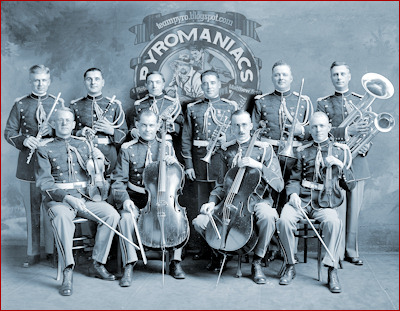

THIRD: the food was amazing.

What? Too shallow? Oh, sorry. Okay, here goes...

FOURTH: I am more impressed than ever with John MacArthur and the ministry he's headlined there.

That won't strike most of you the way it should, because a startling number of readers still (A) think I work for GCC; well, in fact, actually (B) think I'm Phil Johnson, who does work for GTY; and (C) assume all of us here are lockstep MacArthur fanboys.

Except I'm none of those things. Anyone who's ever heard me on the subject knows that I'm very critical of the whole concept of megachurches. Plus, in my entire 40+ years of Christian life, though I respect him, I probably have only heard a dozen MacArthur sermons all the way through (if that) and read maybe roughly a half-dozen books, give or take. "What would MacArthur do?" is not a question I ask myself, ever.

I say that to say this: I was immensely impressed that MacArthur even did this. At this point in his ministry, the man has ZERO to prove. He could retire today to a desert island, or to Cowlick, South Dakota and end his days in obscurity, and his entry in church history would remain secure and notable. And yet he did this.

Plus, he's not a stupid man. MacArthur knew he'd get grief, lies, slander, culpable misrepresentations, and vile bile — all of which began the moment he announced conference. He was sticking his finger in the fan, and he knew it. Why? What would possibly move MacArthur to put himself, his name, out there for this?

It can only be love for Christ, love for Christ's church, love for Christ's saints. That, and concern born of the abject failure of his younger peers to step up and sound this desperately needed cry, this trumpet-blast, themselves.

So MacArthur  asked the best people he could think of, he corralled his church, he put himself out there, and he gave it all he's got. My respect — and affection — for him has increased exponentially.

Plus talking with some of the folks there made me rethink GCC as a whole. I still have issues with the whole concept of a megachurch, any megachurch. But I am compelled to say this: if you're going to do it, that's the way to do it. GCC invests everything it has, as far as I can tell, into ministry that serves people in Christ's name. They are pedal-to-the-metal for getting the Gospel and the Word out. They've got tremendous resources, and instead of rushing them off to some fancy neighborhood in the hills, they stay right there and give it all they've got.

This conference — which my dear little church in Texas couldn't have pulled off in that way — is an example. GCC hosted the conference and treated all comers as beloved guests. Plus they gave them all a copy of the book. Plus they put the whole conference online, translated it into a bunch of languages, broadcast it all over the world... for free! And now it's all online. Give, give, give. Amazing.

(That's right: so all of the people spouting off "responses" to MacArthur who haven't listened to the conference do so in spite of the fact that it's been provided to everyone gratis.)


A cynical person might say the conference was a book-promotion. Seriously? It isn't as if MacArthur is — oh, I don't know — some obscure writer who did a book on the Gospel and needs all the help he can get just getting the word out so people know it exists. He's John MacArthur. He's a living brand-name. He's the Stephen King of evangelicals. He could publish pictures of his golf clubs, and plenty of people would pre-order copies.

That MacArthur would do this conference said a lot to me about his heart, and what it said was all good.

FIFTH and finally: I'm disappointed, but not surprised, at the aftermath.

All these folks who mouth great swelling words of respect for MacArthur (and Spurgeon and Lloyd-Jones and Owen and Calvin and the Bible) were explaining why MacArthur was dead-wrong and off-base before he'd even said a word. And they still are, great big surprise.

And what of Joni, Justin Peters, Conrad Mbewe? Ignored or treated ridiculously. That is, even the absolutely indisputable specifics regarding abusive false doctrine are largely brushed aside for the sake of saving Charismaticism's facade of respectability.

And what of MacArthur's dear esteemed colleagues? They launch "responses," in which they confess they haven't even listened to or read the conference or the book. That's what their swelling words of respect for MacArthur actually amount to.

In the process, unintentionally, they bear out every syllable of concern MacArthur and the other speakers voiced. It's almost a template:

  1. Profess great love, respect, admiration for MacArthur.
  2. Admit to not having listened or read.
  3. "Respond."
  4. Prove MacArthur right.

So in conclusion: it was a good conference. It was a desperately-needed conference. MacArthur is right about every central concern he sounded. Specifically, he's right to give out this note: with all the conferences and organizations setup to protect the Gospel and Christology, why so little to protect the truth about and dignity of the Holy Spirit?

I think they need to do another conference.

If they don't, I very well might. For whatever it's worth.


First post
Second post
My overall summary report to CBC
Third post
Fourth post
Fifth post
Sixth post
Seventh post
Eighth post

Dan Phillips's signature


19 November 2013

Strange Fire Conference #8: John MacArthur, final session

by Dan Phillips

The last session I'll cover is John MacArthur's closing address. He said he was speaking from the heart, and had told an associate that he didn't really know what he was going to say in advance.

MacArthur began by addressing some of the accusations that had been hurled at him from the very moment of the announcement of the then-future conference. The first was that such a conference was unloving. But, MacArthur countered, surely the most loving thing to do is tell a person the truth, and leaving him in error the most unloving. In Acts 20, Paul reminded the elders that he had warned them with tears for years, knowing that wolves would arise from without and within. Titus 1 says it is the God-given duty of elders to warn against errors and errorists. It isn't optional. To refuse is to be faithless.

But wouldn't it be divisive? Indeed it would. Truth divides. Jesus brought a sword, He said. It is more important to be divided by truth than to be united in error.

Is the issue unclear in the Bible? Does difference of opinion demonstrate that Scripture is unclear? If so, Mac responded, it has only become unclear under the influence of false teachers. Was it not clear enough to the apostles, to the church fathers, to the Reformers, to the Puritans, to the creed-writers, to the erudite noble Reformed theologians (Warfield, for instance), to Spurgeon, to Boyce, to Sproul? When did it become "unclear"? Was it made unclear by Swaggart, by Kuhlman, by Benny Hinn, by Todd Bentley, by Paul Cain?


But, it is said, Mac is talking only about the extreme lunatic fringe. Untrue, he replied: Error leavens the whole movement, and they show no great inclination to rid themselves of it decisively. 90% accept prosperity gospel, 24-25 million deny Trinity, 100 million are RCs.

Would the conference be attacking brothers in Christ? MacArthur wishes that were so; but many of these leading figures are not brothers. Then he asked, Who should police evangelicalism? His answer: every faithful pastor, theologian, leader in the movement. If they don’t police the movement, the spiritual terrorists will dominate – as with Islam. Many say that Islamic terrorists are a small minority on the lunatic fringe. If that is the case, then why don’t Muslims en masse rise to reject the terrorists? So with Charismaticism. A heavy burden lies on the back of all who know the Word to rise up and denounce the movement's errors.

Is MacArthur fixated on Charismaticism? Is he a one-trick pony, always harping on Charismatics? He replied that he’s preached the whole NT, and has been at GCC since 1969 — and he’s had one conference on the Charismatic movement.

Is he hurting people’s feelings? MacArthur replied that he does care about offending people. But he doesn't care about that nearly as much as he cares about offending God.

MacArthur then went on to stress: Charismaticism/continuationism is an alien movement. We teach in a stream that goes back through the Reformers to the Fathers. The stream of Charismaticism goes back to the 60s, when hippies entered and dominated the church scene. The distinctive pedigree is as bad as the distinctive fruit.

Then MacArthur pled with his continuationist friends. First, he called them to face the cold hard fact that when they say they’re continuationist, they lend credence to the whole false movement. They give their good name to bad doctrine and practice. They provide theological cover for a movement that’s harmful and deadly.

Second, he observed that Charismaticism degrades supernatural nature of true gifts. Hebrews 2:1-4 is meaningless, if what Apollos the writer speaks of applies to what everyone’s experiencing today. Redefining the gifts necessarily diminishes the glory of the real thing. If those attesting works were like these pale, laughable trivialities and parlor-tricks, they were nothing special. They they were nothing special, the era was nothing special. If the era was nothing special, the message it produced was and is nothing special. Hijacking Biblical terminology degrades the genuinely miraculous.


Third, the continuationist position severely limits its advocates in attempting to confront others who plunge into confusion. The movement should be denounced, wholesale – and we keep waiting for denunciation of the serious errors, and it hasn’t come. Good men who call themselves continuationists have given up the high ground, so that they cannot speak with the needed "punch."

Fourth, by insisting that God’s still giving new revelation to Christians today, the enablers unwittingly open the gates to more and greater confusion and error. Tongues, healing, prophecy are said to occur today – but these phenomena are not at all like what happened in NT times. If that is so, if that radical redefinition is accepted, then anything might be from God – gibberish, nutty notions, feelings, anything can be "prophecy." Open the door to any of it, and you've opened the door to all of it.

Fifth, the position tacitly denies Sola Scriptura. None of MacArthur’s continuationist friends would formally deny closing of Canon and all — yet they default on that claim by teaching believers to expect extra-Biblical revelation. Saying that babble is tongues and fallible hunches are prophecy necessarily opens the door to the mindless ecstasy of unintelligible expression. In reality, these folks are actually closet cessationists when they say the manifestations are not the same. What it means is that they’ve accepted a counterfeit – and that’s hardly a noble posture.

Seventh, say that the gift of healing is still around, though there’s no evidence whatever, and you give credence to the worst of the faith healers.

All of this dishonors the august person of the Holy Spirit by enticing people from His true ministry. “Give me more, give me that other thing” is the cry – what kind of deficiency does that attribute to work of the Spirit?

The broader Charismatic movement has flung open the city gates to more doctrinal error than any other movement, including liberalism, pragmatism, ecumenism, or any other previous enemy-attempt. Charismatic theology is the strange fire of our generation, and should be doused decisively by the Biblically faithful.


MacArthur's closing was very moving. He went to 1 Timothy 6, last two verses:
20 O Timothy, guard the deposit entrusted to you. Avoid the irreverent babble and contradictions of what is falsely called “knowledge,” 21 for by professing it some have swerved from the faith. Grace be with you.
Then he want to 2 Timothy 1:6-7 —
For this reason I remind you to fan into flame the gift of God, which is in you through the laying on of my hands, 7 for God gave us a spirit not of fear but of power and love and self-control.
MacArthur observed that this was a scary time for Paul. The baton was about to be passed to Timothy, and Timothy was looking weak. So Paul calls Timothy not to be ashamed of testimony of our Lord — what a frightening charge to have to put into words at this stage. Timothy must retain the standard of sound words. What God gave him through Paul was a treasure. "Guard the treasure entrusted to you," Paul pleads.

What effect did the words have on Timothy? How did Timothy respond? For the answer, MacArthur took us to Hebrews 13:23.
You should know that our brother Timothy has been released, with whom I shall see you if he comes soon.
Timothy had hung in there. He'd borne witness, and he'd gone to jail. Paul’s letter gripped his heart and emboldened him.

So it needs to grip ours. The Charismatic movement seeks to distract us from confidence in the sufficiency of God's word. It seeks to loosen our grip on the treasure, and pull us in a dozen different fruitless or positively harmful directions.

We must reject that pull, we must cling to God's Word, we must preach that Word... and so, only, can we avoid stoking (or roasting in) Strange Fire.

First post
Second post
My overall summary report to CBC
Third post
Fourth post
Fifth post
Sixth post
Seventh post

Dan Phillips's signature


23 October 2013

Strange Fire Conference #2: Session 1, John MacArthur

by Dan Phillips

Introduction. My intention in beginning these posts on sessions at the Strange Fire conference held last week at Grace Community Church will not be to reproduce everything that was said or done. You can consult such stalwarts who were there as Mike Riccardi, and eventually access the sessions themselves. I'll present highlights, impressions, conclusions that stood out to me.

Beyond this note, I won't comment on the singing that introduced each session, or special musical performances by GCC's soloists or the Master's Chorale — all of which were wonderful (particularly the latter).

John MacArthur fittingly welcomed us all, sharing that the Charismatic movement has been a concern of his since the first days of his ministry. He saw it as a threat, and wrote books on the subject in the late 1970s, the early 90s, and this month. This is the first conference he has ever held on the subject.


MacArthur likened Charismaticism to spiritual AIDS, which lowers a body's resistance and leaves a sufferer open to death by any of a hundred opportunistic infections. Some leaders in the movement are false teachers and know it; others are deluded unawares. Charismaticism as a whole is characterized by a lack of spiritual discernment, which God calls pastors to exercise in protecting the flock — yet many leaders are being remiss in fulfilling their calling when it comes to the Charismatic fad. Its false teaching has thrived in this vacuum. The conference was intended to help supply that lack.

MacArthur expounded Leviticus 10, whose narrative supplied the name of the conference. After Aaron's accepted (and authorized) worship, his sons sprang up to offer fire that was neither. God's fire, which had descended to consume Aaron's offering and leave the worshipers alive (Lev. 9:22-24), now descended with the opposite effect (10:2). God thus put Himself on record: He was to be treated as holy (10:3), which means approaching Him according to His word, not according to the creative notions of even the most prominent, privileged and respected.

To stress this, Mac twice said: "Most serious crimes against God occur in corrupt worship."

False representations of Yahweh, as we see in Exodus 32, are disastrous, and are a kind of idolatry. Think of the judgment and peril that disastrous experiment (and, I might add, complete failure in leadership) brought on Israel.

Good intentions has nothing to do with it; believing obedience to the Word has everything to do with it. This is where Charismaticism, as to its distinctives, has wholly failed. MacArthur made the same point we've often made here: Charismaticism as to its distinctives has made NO contribution to true worship, Biblical clarity, or sound doctrine. Biblically-faithful Christian people had already had all that for centuries. Charismaticism as to its distinctives has brought only chaos, confusion, misrepresentation, false doctrine, and delusion.

Are people saved within the Charismatic movement? Yes; but when they are, it is because of the gospel, which was not invented by that movement. God has always protected His gospel and raised up those who proclaim it, and He does so now. Some within Charismaticism also love and preach the Gospel, yet are heterodox (not heretical) when it comes to the Spirit.

However, many of the most prominent, influential, adored and spotlighted leaders in the movement are heretical and do not know God. For this reason, no movement has done more damage to the church. There may be 14 million Mormons, but there are 500 million Charismatics. In too many cases, the movement has proved to be a Trojan horse for destructive delusion at best, and damning error at worst. Welcomed with open arms by evangelical trend-surfers and accommodaters, the troops pour out, take over, and erect an idol in the City of God. They offer the world what it already wants with a sprinkling of "Spirit"-dust. The world pours into the professing church unconverted, and the damage is done.

Here MacArthur made a point I found arresting. He alluded to this passage from Hebrews:
Anyone who has set aside the law of Moses dies without mercy on the evidence of two or three witnesses. 29 How much worse punishment, do you think, will be deserved by the one who has trampled underfoot the Son of God, and has profaned the blood of the covenant by which he was sanctified, and has outraged the Spirit of grace? 30 For we know him who said, “Vengeance is mine; I will repay.” And again, “The Lord will judge his people.” 31 It is a fearful thing to fall into the hands of the living God. (Hebrews 10:28–31)
MacArthur noted that many groups of Christians have assembled to oppose the trampling underfoot of the Son of God by defending sound Biblical Christology, the first item mentioned by the writer. I could add that organizations like T4G and TGC and many others at least formally oppose the denigration of the Gospel and the blood of the covenant (the second item), by defending the Biblical Gospel.

But where, MacArthur poignantly asks, are the organizations and conferences held to respond to the outrageous treatment of the "Spirit of grace," the Holy Spirit, the third object? The verb that Apollos the writer of Hebrews uses is ἐνυβρίσας, which means to insult the Spirit, to treat Him with outrageous contempt. Is that not what vast swathes of Charismaticism do? Attributing to Him their atrocious and shameful behavior — punching and hitting people, manipulating people by falsely-claimed superpowers, bilking people, barking like dogs, jerking and rolling about like demoniac pagans, laughing like the insane, babbling incoherently, speaking words that range from trivia to heresy — is that not outrageous insult? Is it not blasphemy? Yet what are the organizations and conferences that have rallied to respond to this as robustly as others have to heresy and deception regarding Christ and the Gospel?

To add even great sobriety to this observation, we note that the oft-quoted words of vv. 30-31 relate to how seriously God takes such atrocities. He doesn't shrug these things off as adiaphora. He regards it as of the very gravest importance.

Do his most public, celebrated, rock-star Christian leaders?

To ask, is to answer, sadly.

Instead, what one hears (me talking now, not MacArthur) is wails and squeals about MacArthur talking about these abuses — not about the abuses themselves. It reminds me of how shocked (shocked!) Senatrix Barbara Boxer was for Senator Rick Santorum to describe partial-birth abortion on the floor of the Senate. The procedure itself didn't bother her a bit, she adores it as a sacred right. But describing it? Offensive! Unheard-of!

So here, invariably the dramatists who flutter and swoon in their horror over MacArthur's speaking out are not themselves known for their frequent and bold stances against the withering destructive errors of Charismaticism; but they do want to grab the spotlight as standing among the crowd of MacArthur's detractors. "Of course, some of that is bad," is the thought; "but this divisive conference is really, really bad!" Oh, yes? Color me unpersuaded.

Another sharp point Mac made was to point to the Spirit's ministry in Romans 8 — forming the character of Christ in us — and then point to the life of Christ Himself. MacArthur observed that the Holy Spirit was Jesus' constant companion, from conception to crucifixion. It is Jesus to whom the Holy Spirit strives to conform us. The Holy Spirit brings us to Jesus.

With that in mind, MacArthur asks: "When did Jesus ever bark like a dog? When did Jesus ever laugh uncontrollably for hours on end for no reason? When did Jesus ever moo, fall down and lose control, roll around and foam and quiver, or babble incoherently?"

Again, to ask is to answer.

MacArthur concluded that he'll start taking the movement as a whole more seriously when the most prominent leaders as a whole start looking more like Christ.

It was a powerful start to the conference, and set the stage well.

Dan Phillips's signature


06 April 2012

He Made Him to Be Sin for Us

Who Killed Jesus?
Isaiah prophesied a clear answer to that question several centuries before the crucifixion.

(First posted 12 June 1996)

by John MacArthur

The murder of Jesus was a vast conspiracy involving Rome, Herod, the Gentiles, the Jewish Sanhedrin, and the people of Israel—diverse groups who were seldom fully in accord with one another. In fact, it is significant that the crucifixion of Christ is the only historical event where all those factions worked together to achieve a common goal. All were culpable. All bear the guilt together. The Jews as a race were no more or less blameworthy than the Gentiles.

This is very plainly stated in Acts 4:27, a corporate prayer offered in an assembly of the very earliest believers: "For of a truth against thy holy child Jesus, whom thou hast anointed, both Herod, and Pontius Pilate, with the Gentiles, and the people of Israel, were gathered together." So there is no justification whatsoever for trying to fix the blame for Jesus' death on any one people group. This was, in essence, a corporate act of sinful humanity against God. All are guilty together.

And yet even that does not exhaust the full truth about who killed Jesus. Scripture emphasizes from cover to cover that the death of Christ was ordained and appointed by God Himself. One of the key Old Testament prophecies about the crucifixion is Isaiah 53. Isaiah prophetically describes the torture of the Messiah at the hands of a scoffing mob, and then adds, "Yet it pleased the LORD to bruise Him; He has put Him to grief" (Isaiah 53:10).

God put his own Son to death?

That is precisely what Scripture teaches. Why? According to Isaiah 53:10, it was to "make His soul an offering for sin." God had a redemptive purpose.

The designs of those who killed Christ were entirely murderous. They are by no means exonerated from their evil, just because God's purposes are good. It was still the act of "lawless hands" (Acts 2:23). It was, as far as the human perpetrators were concerned, an act of pure evil. The wickedness of the crucifixion is in no sense mitigated by the fact that God sovereignly ordained it for good. The truth that it was His sovereign plan makes the deed itself no less a diabolical act of murder.

And yet this was clearly God's holy and sovereign plan from before the foundation of the world (Revelation 13:8). Look again at that prayer from Acts 4, this time in its full context:
Lord, You are God, who made heaven and earth and the sea, and all that is in them, who by the mouth of Your servant David have said: "Why did the nations rage, And the people plot vain things? The kings of the earth took their stand, And the rulers were gathered together Against the LORD and against His Christ." For truly against Your holy Servant Jesus, whom You anointed, both Herod and Pontius Pilate, with the Gentiles and the people of Israel, were gathered together to do whatever Your hand and Your purpose determined before to be done (Acts 4:24-28, emphasis added).
Acts 2:23 echoes the same thought: "Him, being delivered by the determined purpose and foreknowledge of God, you have taken by lawless hands, have crucified, and put to death" (emphasis added).

God ordained the murder of Jesus. Or to put it starkly in the words of Isaiah 53:10, it pleased the Lord to bruise Him.

In what sense was God pleased by the death of his Son?

He was pleased by the redemption that was accomplished. He was pleased that His eternal plan of salvation was thus fulfilled. He was pleased with the sacrifice of his Son, who died so that others might have eternal life. He was pleased to display his righteous anger against sin in such a graphic way. He was pleased to demonstrate His love for sinners through such a majestic sacrifice.

For all the evil in the crucifixion, it brought about an infinite good. In fact, here was the most evil act ever perpetrated by sinful hearts: The sinless Son of God—holy God Himself in human flesh—was unjustly killed after being subjected to the most horrific tortures that could be devised by wicked minds. It was the evil of all evils, the worst deed human depravity could ever devise, and the most vile evil that has ever been committed. And yet from it came the greatest good of all time—the redemption of unnumbered souls.

The cross is therefore the ultimate proof of the utter sovereignty of God. His purposes are always fulfilled in spite of the evil intentions of sinners. God even works His righteousness through the evil acts of unrighteous agents. Far from making Him culpable for their evil, this demonstrates how all He does is good, and how He is able to work all things together for good (Romans 8:28)—even the most wicked deed the powers of evil have ever conspired to carry out.
John MacArthur


This article was excerpted John MacArthur, The Murder of Jesus (Nashville: W Publishing Group, 2002).

16 March 2012

Providence Is Sweet

by Phil Johnson


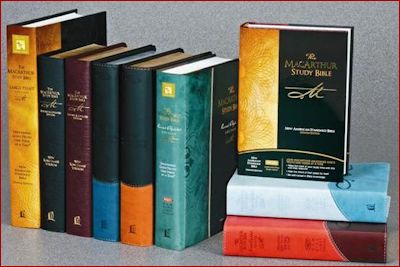
ast week during the Shepherds' Conference John MacArthur was presented with one of the first copies of the Arabic version of the MacArthur Study Bible. The Bibles were printed and officially released a couple of weeks ago in Beirut, Lebanon, and the first printing sold out immediately. A few copies were sent to America to be on display during the Shepherds' Conference.

I was unprepared for the reception the Bible would get. At least two dozen people stopped me during the conference to ask how to obtain copies. (Answer: Grace to You will make them available for purchase shortly, as soon as the second printing is available.)

One man who asked about the Bibles was visiting from Europe, where he ministers to a congregation of Arabic-speaking people, mostly expatriates from the Middle East. He was more eager than most to get a copy of the Study Bible as soon as possible, and I found his thumbnail description of his ministry so fascinating that I invited him to my office the week after the Shepherds' Conference. I resolved to get my hands on one of the display Bibles if possible and give it to him before he returned to Europe.

Turns out I was able to do that. When that pastor came to my office and I handed him the Bible, he took it with the kind of care and gentle touch you'd use when someone hands you a newborn baby. As he opened it, tears came to his eyes, and he turned to the middle and started reading aloud.

When he finished, I asked, "What was the section you read?"

"Psalm 121," he said.

"I have a special request," I said. "Would you read that psalm again? And may I record it as you read?"

He gave me permission to tape and post this short video, as long as I did not put his face on the Internet:


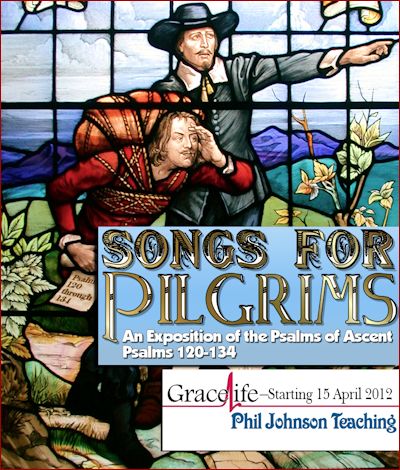
When he finished the second time, I asked, "What made you choose Psalm 121? Because that is the very text I'm currently studying." (I'm preparing to teach a series on the Psalms of Ascent:)


"That's my favorite psalm and the first text I ever preached on," he said.

The whole encounter was a wonderful reminder of how precious the Word of God is, how gracious God's providence is, how amazing the fellowship of the saints is, and how enjoyable heaven will be. If two believers from completely different cultures living half a planet apart can meet for the first time and instantly have so much in common and find so many reasons to rejoice together, I can't wait until heaven when our fellowship will be unhindered by sin, selfishness, language differences, or anything else.

By the way, I was able to get my hands on one other display copy of the Arabic MSB. I gave it to the Arabic-speaking cook at a Mediterranean restaurant I frequent. He's not a Christian (yet), but a friend of mine has been explaining the gospel to him. He also teared up when I gave him the Bible.

Phil's signature

17 February 2012

The MacArthur Study Bible (NIV)

by Phil Johnson


fter more than a year of discussion and analysis, Thomas Nelson Inc. and Zondervan have announced a joint project to publish an edition of The MacArthur Study Bible (MSB) with the New International Version (NIV 2011) text. All 20,000 study notes, plus outlines, articles, and other study aids will be included in the volume. Zondervan will license the NIV text to Nelson, and the Bible will be the latest addition to Nelson's growing line of products featuring the MSB notes.
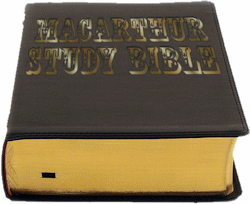
The NIV is more freely translated than any of the English versions used in previous editions of the MSB. That's because the NIV generally follows a "dynamic equivalence" approach to translation—more of a thought-for-thought rephrasing of the text, rather than staying as close as possible to a word-for-word correspondence with the original.


The NIV has also received criticism from The Council on Biblical Manhood and Womanhood (CBMW) because of how the translation deals with gender-related issues. In Mark 4:25, for example, plural pronouns ("they" and "them") are attached to a singular antecedent ("whoever") in order to avoid the generic use of masculine pronouns: "Whoever does not have, even what they have will be taken from them."

NIV translators increasingly favor egalitarian-friendly translations of texts that limit the role of women in church leadership. One example will suffice: Although the 1984 NIV translated 1 Timothy 2:12 the way it has historically been understood ("I do not permit a woman to teach or to have authority over a man; she must be silent"), the NIV 2011 edition has rendered that verse in a way that allows for an egalitarian interpretation, as if Paul were merely condemning rebellion, and not female headship over men in the church per se ("I do not permit a woman to teach or to assume authority over a man; she must be quiet"). NIV editors have generally followed contemporary editorial protocols preferring gender-neutral or gender-inclusive terms instead of masculine-sounding expressions—substituting "brothers and sisters" where the text says "brethren," using "humanity" where the text speaks of "men," or translating it "person" where the original word means "man."

John MacArthur's preference for word-by-word exposition is well known. He also shares CBMW's conviction that the gender distinctions in Scripture are precise and deliberate and should be kept intact. Clearly, he would not support any effort to feminize the language of the Bible or adjust it for political correctness.

So was Pastor MacArthur himself in favor of an NIV version of the MSB?

Yes, he was. In his words, "No matter what version of the Bible people are reading, I want to be able to help them understand the meaning fully and accurately. The NIV is the most widely used translation in the world, with millions of users. Some prefer it because they find it easier to read than other translations. All English versions of Scripture have translation problems and ambiguities. That's one of the major benefits of a good study Bible. The notes and other tools built into the volume can highlight and clarify the proper meaning—or at least give a more precise understanding of what the original text actually says. My prayer is that these insights and explanations, together with the acclaimed readability of the translation, will help illuminate the true meaning and unleash the divine power of Scripture for NIV readers."

Those who are using the most inadequate translations obviously need the most help to understand the Scriptures properly. Personally, I would be delighted to see the MSB notes in every commonly-used translation—and in as many languages as possible.1

We submitted to Zondervan's editors a generous sampling of notes adapted to the NIV wording. We purposely chose notes that deal with some of the key problem passages. Zondervan and Nelson both have assured us they want to retain the full integrity of John MacArthur's explanation of the text, and the sample notes were all accepted as submitted. We're excited about the potential of this product for people who are already using the NIV, and we are hopeful that when the finished product is complete, even critics of the NIV will be satisfied with the result.

Phil's signature


1. The MacArthur Study Bible (NIV) will be the fourth English version of the work (following the New King James Version, the New American Standard Bible, and the English Standard Version editions). Counting Spanish, Italian, French, German, Russian, Portuguese, Arabic, and several other non-English editions, the MSB-NIV will be the fourteenth translation worldwide to be paired with the MSB notes.

16 December 2011

Open Letter to John MacArthur

by Frank Turk


Dear Dr. MacArthur,

My dear friend Dan has already written you an open letter this year, and one may think that's the end of it as he has given you a friendly encouragement to do something really hard for the sake of the faithful as part of finishing strong.  However, what Dan had to say has absolutely nothing to do with what I have to say, so I'll say this bit myself.


I've had the great pleasure to visit SoCal twice in the last year or so, and both times I got to tour the GTY offices because, well, I was living in Phil's house for the week and from my perspective it's always instructive to see where the magic happens (and we go see Disney while we're there, too, since we're middle American tourists).  Both times I had the pleasure to chat with the staff and both times I got to view your office at GTY -- and I found that I had to simply just walk out quickly.  I had this really unnatural fear that if we stuck around too long, you'd show up and I'd have to meet you face to face.

Now, honestly: I'm not a fan-boy.  I can remember that the last time I was at T4G I was walking from the hotel to the conference and as I turned to my left, the guy crowding up on me was CJ Mahaney, and I didn't get all creeped out.  I didn't grab for my pen to get an autograph.  He's a guy, I'm a guy, and we were walking down the hall together.  No Problem.

I once rode in an elevator with John Eldredge when he was a big name at CBA and I was a little disappointed at what a short little fellow he was, and that he needed a handler to make his way around the conference center, but I wasn't overcome with awe for a guy who has sold a million books.  Ergun Caner once forced his book on me back when people thought he was an ex-jihadi and he told me (without every talking to me about what I believed) that everything I knew about the Crusades was wrong.  He made me feel the way the guy selling scented anointing oil made me feel, which is not star-struck.  My wife once (accidentally) cut in line to get Third Day's autograph (she thought she was meeting the sales rep from Provident), and we had a good laugh about that.  I didn't get all giddy when she handed me Mac Powell's and Mike Lee's autographs.

But when I stood in your office, I was remembering when I was a very young Christian, living in a place called Sackett's Harbor.  I barely had a local church, and I was working at a thankless job for a guy who hated me, and I had to drive 20 minutes to work every day at 4:30 in the morning.  On the way back from work at 3 PM, I would hear J. Vernon McGee.  But on the way in -- and I remember almost every drive as a drive through icy cold in the snow-covered hell-bow of NY State and Lake Ontario -- you were preaching through the Bible.

I wasn't in the worst place anyone has ever been.  I wasn't homeless, or unemployed, or without prospects, or unsaved.  But I was disoriented spiritually, and undisciplined, and unfocused; and because of the situation I had at work, I was also depressed, and looking for some sort of hope in a world which, frankly, could care less about me.  And I was still making the rookie mistakes a newly-saved adult makes every time.

What happened to me through your preaching was not personal discipleship -- it couldn't be.  You don't know me, and you could not have known me or my problems then.  But through the work of GTY assembling your sermons for the radio on a daily basis you saved my spiritual life.  You planted a seed in me which others were also working to plant, and which others still cultivated for a good harvest as I later became a husband and father and leader at work.

And in doing this, you really didn't do this for me: you did it for Christ.  I get that -- I get it that you don't really preach with anyone in mind but with Christ in mind so that those who are listening, whosoever they are, will hear it and come.  I get it that you sort of did it to me and not for me.  But when I think of the massive benefit I have received simply because you were a faithful servant to Jesus, I am taken aback.

The only other man in my spiritual life to have this kind of impact on me was my pastor, and he did personally disciple me.  He did take the time to make me talk about spiritual things and consider spiritual reasons for following the narrower path rather than a wider path which would just be easier.  But here's the thing: what he was trying to tell me and do for me would never have mattered if, when I was driving in the dark and the snow each morning, you hadn't also spoken the words of life into me when I was preparing to go to a job I hated, working for a man who distrusted and denigrated me even though I was doing things for him he didn't even know he needed.  You spoke daily into my doubt and my downcast state with sound spiritual wisdom, and it changed me.

So when I stood in your office, I wasn't in the office of a famous man.  I was in the office of a fellow who saved my spiritual life, and the life of my marriage, and of my professional vocation, and the life of my family.  For me, I'm not sure I could meet you and not over-react, because you have given me so much which was so essential for the start of my walk with Christ.  Everything that has come after it is a consequence of what you have done, and the least I owe you for that is thanks.

So today: thank you.  Thank you that you taught me about Christ so I could love my wife better.  Thank you that you taught me about humility so I could think of others as more important than myself.  Thank you that you taught me how to confess my sins for the sake of repentance.  Thank you that you taught me that I have a refuge from all my doubt in Christ's resurrection.  Thank you that, with other faithful men, but in a place they could not reach me, you were  filling up what was lacking in Christ’s afflictions for the sake of his body, that is, the church.

Thank you that what you have given me makes Christmas brilliant and sweet.  I hope that this season brings good tidings of great joy to you and yours.  Thanks for being a good friend and good boss to Phil.  I look forward to seeing what God has for you as you finish the race well for the sake of your savior.


25 July 2011

Why Shallow Evangelicals Are So Susceptible to Charismatic Frauds

The Death of Discernment and the Rise of the Lakeland "Revival"
by John Macarthur
(Adapted from Ashamed of the Gospel, 3rd ed., Crossway)


ome of the most popular and dangerous evangelical fads of the past fifteen years have involved waves of charismatic fervor that have sown confusion and discord in every culture where they have been embraced. I'm talking about the Toronto Blessing (where "holy laughter" and other forms of pseudo-drunkenness were declared to be signs the Holy Spirit was moving); the Kansas City Prophets (a movement led by a group of self-appointed seers whose prognostications were usually false and whose private morals were even worse); the Pensacola outpouring (whose major features were gold dust and gold tooth fillings that supposedly appeared miraculously, but the revival disbanded amid charges of fraud and embezzled funds). Then (most recently) those movements were all eclipsed by a supposed revival in Lakeland, Florida whose leader embodied all those errors and turned out to be twice as much a son of hell as all the religious scoundrels he imitated (cf. Matthew 23:15).
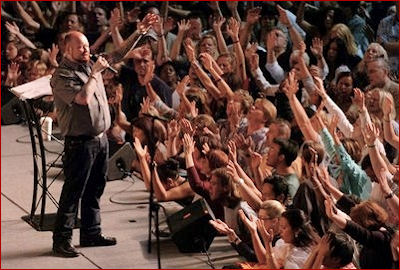

Here's how Charisma magazine summed up that debacle:
[Lakeland Revival founder Todd] Bentley's faith and exuberance impressed seasoned, prominent revivalists while his wild tactics often tempered the enthusiasm of other leaders. When praying for healing, the tattooed evangelist was known to hit the sick in the stomach with his knee in a move more common among wrestlers than preachers. Bentley even recounted kicking a woman in the face in an act of "obedience to the Lord."

Yet, with the exception of a few ministers, many charismatic leaders chose to overlook Bentley's peculiar methods for the sake of what they saw as "fruit." They claimed the revival stirred many Christians worldwide to pursue God with a renewed hunger.

"Personally, I believe that the Lakeland Outpouring was another wave of revival like Toronto and Brownsville," said Los Angeles-area pastor [Ché] Ahn, referring to the Toronto Blessing and the Pensacola Revival, both of which occurred during the 1990s. "Each wave has its own life span." [Paul Steven Ghiringhelli, "Lakeland Revival Officially Ends" Charisma (13 Oct. 2008).]


You might think the cumulative effect of so many "prophetic" movements, all of them being totally discredited in fairly rapid succession, would heighten a craving for more careful discernment among evangelicals. But every new charismatic tsunami seems to grow larger and confound more people than the previous ones. Each wave is considerably more bizarre and certainly more grossly unbiblical than all its predecessors, yet each one pulls in Christians who previously seemed fairly mainstream. Craving something more than the shallow fare they are force-fed in the average evangelical church, they are eager patsies for a charlatan who promises supernatural signs and wonders instead of the superficial skits and tomfoolery they have grown accustomed to.

John MacArthur's signature

25 March 2011

Who's Afraid of the Big, Bad Heretic?

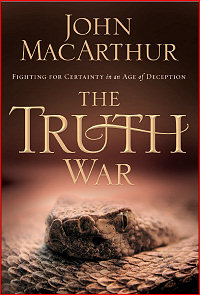
Evangelical Apathy and the Danger of False Teaching by John MacArthur The following is excerpted from The Truth War (Nelson, 2007, pp. 165-68)

hy do so many evangelicals act as if false teachers in the church could never be a serious problem in this generation? Vast numbers seem convinced that they are "rich, have become wealthy, and have need of nothing'; and do not know that [they] are wretched, miserable, poor, blind, and naked" (Revelation 3:17).
In reality, the church today is quite possibly more susceptible to false teachers, doctrinal saboteurs, and spiritual terrorism than any other generation in church history. Biblical ignorance within the church may well be deeper and more widespread than at any other time since the Protestant Reformation. If you doubt that, compare the typical sermon of today with a randomly-chosen published sermon from any leading evangelical preacher prior to 1850. Also compare today's Christian literature with almost anything published by evangelical publishing houses a hundred years ago or more.

Bible teaching, even in the best of venues today, has been deliberately dumbed-down, made as broad and as shallow as possible, over-simplified, adapted to the lowest common denominator—and then tailored to appeal to people with short attention spans. Sermons are almost always brief, simplistic, overlaid with as many references to pop culture as possible, and laden with anecdotes and illustrations. (Jokes and funny stories drawn from personal experience are favored over cross-references and analogies borrowed from Scripture itself.) Typical sermon topics are heavily weighted in favor of man-centered issues (such as personal relationships, successful living, self-esteem, how-to lists, and whatnot)—to the exclusion of the many Christ-exalting doctrinal themes of Scripture.

In other words, what most contemporary preachers do is virtually the opposite of what Paul was describing when he said he sought "to declare . . . the whole counsel of God" (Acts 20:27). Not only that, but here's how Paul explained his own approach to gospel ministry, even among unchurched pagans in the most debauched Roman culture:

I, brethren, when I came to you, did not come with excellence of speech or of wisdom declaring to you the testimony of God. For I determined not to know anything among you except Jesus Christ and Him crucified. I was with you in weakness, in fear, and in much trembling. And my speech and my preaching were not with persuasive words of human wisdom, but in demonstration of the Spirit and of power, that your faith should not be in the wisdom of men but in the power of God.
Notice: he deliberately refused to customize his message or adjust his delivery to suit the Corinthians' philosophical bent or their cultural tastes. He had no thought of catering to a particular generation's preferences, and he used no gimmicks as attention-getters. Whatever antonym you can think of for the word showmanship would probably be a good description of Paul's style of public ministry. He wanted to make it clear to everyone (including the Corinthian converts themselves) that lives and hearts are renewed by means of the Word of God, and by nothing else. That way they would begin to understand and appreciate the power of the gospel message.

By contrast, today's church-growth experts seem to have no confidence in Scripture's power. They are convinced the gospel needs to be "contextualized," streamlined, and revamped anew for every generation. Forty years of that approach has left evangelicals grossly untaught, wholly unprepared to defend the truth, and almost entirely unaware of how much is at stake. The evangelical movement itself has become a monstrosity, its vast size and visibility belying its almost total spiritual failure. One thing is certain: the cumbersome movement that most people today would label "evangelical" is populated with large numbers of people who are on the wrong side in the Truth War.

We are right back in the same situation the church was in a hundred years ago, when modernists were busily re-inventing the Christian faith. Far from being a strong voice and a powerful force for the cause of truth, the evangelical movement itself has become the main battleground.

John MacArthur's signature

09 August 2010

MSB ESV

by Phil Johnson


he long-awaited MacArthur Study Bible ESV edition is at the bindery right now. The completed books will be available from retail outlets within a couple of weeks.

Our friends at Crossway were kind enough to send me an unbound preview copy, fresh off the press. It came as a block of bound signatures, printed, folded, stitched together—with the pages untrimmed (as you see in the picture to the right). We have an industrial-strength paper cutter at Grace to You, so I trimmed the pages myself in order to have a feel for what the finished Bible will be like.

It's beautiful. Crossway printed two-color pages—black text and blue highlights. The maps, the layout, the paper, and the Smyth-sewn binding are all first class, making this the most durable and best-looking MacArthur Study Bible yet. The typefaces are especially easy on the eyes. I'm very pleased with it. I've been using the ESV for a couple of years, and I'm thrilled finally to have a copy with the MSB notes built in.


If you are already on the Grace to You mailing list, you'll be getting a letter in the mail shortly offering a free copy of the MSB-ESV hardcover edition. (If you're not on the GTY mailing list, you should be. Grace to You offers free resources every month. It's too late to get in on the free Study-Bible offer; those letters have been printed and will be mailed this week. But you can still take advantage of future offers.)

Here's a short video about the MacArthur Study Bible and how it came to be. Enjoy:


Phil's signature


02 July 2010

Creation from a Heavenly Perspective

by John MacArthur

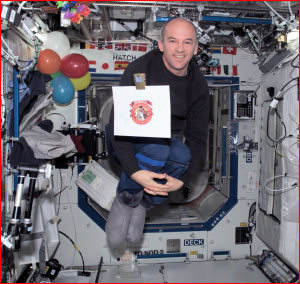
Today's post is from the foreword to Colonel Jeffrey N. Williams's recently-published book The Work of His Hands. The book is a gorgeous album of spectacular photography from the International Space Station, blended with Col. Williams's own account of his first 6-month tour of duty in space (Expedition 13, in 2006).

Longtime TeamPyro readers will recall that we kept in touch with Jeff—and he with PyroManiacs—during his first long stint in the the Space Station.


After writing this book (but before it was published), Jeff spent another six months in space. So we're expectantly hoping for a sequel to this book.

Jeff has photographed virtually the entire planet, and his book compiles hundreds of his best shots. Even better than the pictures are Jeff's biblical reflections on the glory of creation.

Your coffee table needs one of these. It's available at Amazon.com


"Lord, how majestic is your name in all the earth! You have set your glory above the heavens . . .. When I look at your heavens, the work of your fingers, the moon and the stars, which you have set in place, what is man that you are mindful of him?" Psalm 8:1-4

avid wrote Psalm 8 while gazing into the night sky. He probably penned that song as an adolescent, while tending his father's flocks in some remote field. As he pondered the vast expanse of the heavens and the orderly nature of such an immense universe, he was awestruck by the realization that God, who created so many amazing wonders, is even greater, more glorious, and wiser than all of them combined.

While he was thinking about that, David was overwhelmed with a deep consciousness of the relative insignificance of humanity. He marveled that God has shown so much grace and kindness to the human race. After all, God has revealed Himself to us not only implicitly (in the glory of His creation) but also explicitly (in His Word) and (above all) personally through the incarnation of Christ. That is the prophetic subject matter of Psalm 8, according to Hebrews 2:6-9. The idea that the Creator of the universe would thus stoop to redeem fallen creatures elicited from David a profound outpouring of pure praise.

Anyone who takes time to study the heavens can appreciate David's amazement at the spectacle. Even without a telescope or satellite photos, David could see that the glory of the universe was beyond the ability of human language to describe.

As a matter of fact, you can look from any perspective at any portion of creation, great or small, and the message built into every aspect of it is exactly the same. God's invisible attributes—namely, his eternal power and divine nature—are clearly perceptible in the things He has made. That has been true since the very beginning of creation (Romans 1:20).

Only in our generation, however, has it been possible to study earth from heaven's perspective. Jeff Williams has had the rare privilege of doing just that, and the experience likewise impressed him with the greatness, glory, and grace of God who "made heaven and earth, the sea, and all that is in them; who keeps truth forever" (Psalm 146:6).

During his six-month stint at the International Space Station in 2006, Colonel Williams orbited the earth more than 2,800 times. He worked on hundreds of experiments while suspended in microgravity. He walked in space twice (spending more than 12 hours hanging by a tether in the atmospheric void outside the spacecraft). And while doing all that, he took more photographs of earth than any astronaut in history.

In a journal entry written from the Space Station and posted on a NASA website near the end of his first month in orbit, Jeff wrote:

Another activity that we really enjoy is earth photography or what we formally call "earth observation."

You can never tire of looking at the part of God's creation we call Earth. Traveling around the globe every 90 minutes provides lots of opportunity to view the geography, oceans, cloud formations, sunrises and sunsets, thunderstorms, city lights and many other things in vivid detail.


Jeff preserved as much as possible of that vivid detail in an amazing collection of stunning digital photographs.

I was privileged to see some of Jeff's photography almost immediately via e-mail while he was still in orbit. One shot that especially stands out in my mind is an extraordinary view of California from above, with the coastline mostly obscured by a massive smoke-plume from the sixth largest wildfire in California history. Known as the Day Fire, it burned out of control for nearly the entire month of September that year. For several days that smoke-plume permeated and overshadowed the community where I live and minister. But a photograph of the fire from orbit is what enabled me to appreciate the true size of the fire—and the amazing mercy seen in the fact that not a single life was lost in it.


That was just one snapshot. Every view from the window of the Space Station contains countless vivid lessons about the meticulous goodness of divine Providence, God's care for His creation, and His wisdom in ordering the universe. Jeff Williams has a wonderful gift for seeing those things and pointing them out.

This book tells the story of Expedition 13 from Jeff's perspective as flight engineer—while giving us a front-row seat in the space station and letting us look with Jeff through the lens of his camera. These photos and the descriptions Jeff has written are filled with graphic reminders about the greatness and power of God, our own relative insignificance, and the great mercy whereby God cares for us.

John MacArthur's signature

23 June 2010

Humanistic Religion and the Origin of Life

by John MacArthur

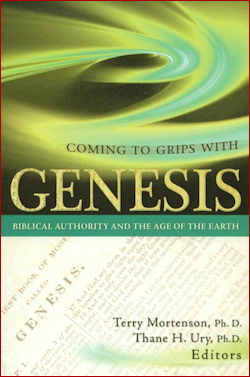
The following article is taken from John MacArthur's foreword to Terry Mortenson and Thane H. Ury, eds. Coming to Grips with Genesis: Biblical Authority and the Age of the Earth. The book is a festschrift in honor of Dr. John Whitcomb.

he apostle Paul closed his first epistle to Timothy by urging the young pastor to guard the deposit of truth that had been entrusted to him, "avoiding the profane and idle babblings and contradictions of what is falsely called knowledge" (1 Timothy 6:20-21). In the King James Version, the text famously speaks of "science falsely so called."

Over the course of human history, all kinds of speculative ideas have been falsely labeled "science" and mistakenly accepted as true and reliable knowledge by otherwise brilliant people. The now-discredited dogmas of older scientific theories are numerous—and in some cases laughable. They include alchemy (the medieval belief that other base metals could be transmuted into gold); phrenology (the Victorian belief that the shape of one's skull reflects character traits and mental capacity); astrology (the pagan belief that human destiny is determined by the motions of celestial bodies); and abiogenesis (the long-standing belief that living organisms are spontaneously generated by decaying organic substances). All those false beliefs were deemed credible as "science" by the leading minds of their times.

Consider just one of those—abiogenesis. Popularly known as "spontaneous generation," this idea has long been, and continues to be, one of the archetypal expressions of "science falsely so called." It is also one of the most persistent of all demonstrably pseudoscientific fictions. The notion that aphids arise naturally from dew on plant leaves, mold is generated automatically by aging bread, and maggots are spontaneously begotten by rotting meat was more or less deemed self-evident by most of humanity's brightest intellects1 from the time of Aristotle until 1861, when Louis Pasteur conclusively proved that non-living matter cannot spawn life on its own.

It is one of the great ironies of scientific history that the first edition of Charles Darwin's On the Origin of Species was published exactly two years before Pasteur's famous experiments proved that life cannot arise spontaneously from non-living matter. The publication of Darwin's book marked the apotheosis of evolutionary theory, and it was rooted in the basic presupposition that under the right circumstances, life can spring on its own from non-living matter.

In other words, two years before abiogenesis was scientifically debunked, it was in effect canonized as the central dogma of modern secular belief about the origins of life. The discovery that fleas don't magically form out of decomposing dander on the backs of dirty dogs did not dissuade most in the scientific world from embracing the theory that all life in the universe arose by itself out of nothing. The belief that life spontaneously came from non-life remains to this day the great unexplained (albeit easily disprovable) assumption underlying the dogma of evolution.

The irony of that is utterly lost on many in the scientific community today, where evolution has become an article of faith—unshakable faith, it turns out.

Evolutionists have conveniently "solved" the problem of abiogenesis by repeatedly moving their estimates of the earth's age backward toward infinity. Given enough time, it seems, anything is possible. Trying desperately to keep the biblical concept of eternity at bay, evolutionists have thus devised an alternative kind of infinitude. Every time a challenge to current evolutionary theory arises, geologists and astronomers dutifully tack billions and billions of eons onto their theories about the earth's age, adding however many ancient epochs are deemed necessary for some new impossibility to be explained.

In the introduction to my 2001 book, The Battle for the Beginning, I suggested naturalism had become the dominant religion of contemporary secular society. "Religion is exactly the right word to describe naturalism," I wrote. "The entire philosophy is built on a faith-based premise. Its basic presupposition—a rejection of everything supernatural—requires a giant leap of faith. And nearly all its supporting theories must be taken by faith as well."2

Here, then, is a classic example of what I was talking about: the typical evolutionist's starting point is this notion that life arose spontaneously from inanimate matter sometime in eternity past. That requires not merely the willful suspension of what we know for certain about the origins of life and the impossibility of abiogenesis—but also enough deliberate gullibility to believe that moving-target estimates of the earth's antiquity can sufficiently answer all the problems and contradictions sheer naturalism poses.

Meanwhile, in the popular media, evolutionary doctrine and ever-expanding notions of prehistory are being promoted with all the pious zeal of the latest religious sect. Watch the Internet forums, programs on the Discovery Channel, interviews and articles published in the mass media, school textbooks, and books aimed at lay readers—and what you will usually see is raw assertions, demagoguery, intimidation, and ridicule (especially when the subjects of biblical theism and the Genesis account of creation are raised).

But question the dogma that all life evolved from a single spontaneously-generated cell, point out that the universe is full of evidence for intelligent design, or demand the kind of proof for evolutionary origins that would ordinarily pass scientific muster, and the ardent evolutionist will simply dismiss you as a heretic or a bigot of the worst stripe. What they are tacitly acknowledging is that as far as they are concerned, evolution is a doctrine that must be received with implicit faith, not something that can be scientifically demonstrated. After all, the claims of true science can always be investigated, observed, reproduced, tested, and proved in the laboratory. So to insist that evolution and so-called "deep time" doctrines must be accepted without question is really just a tacit admission that these are not scientific ideas at all.

Consider these quotations from typical evolutionist writers:

  • No biologist today would think of submitting a paper entitled "New evidence for evolution;" it simply has not been an issue for a century. (Douglas J. Futuyma, Evolutionary Biology, 2nd ed., Boston: Sinauer Associates, 1986, p. 15)
  • It is time for students of the evolutionary process, especially those who have been misquoted and used by the creationists, to state clearly that evolution is a fact, not theory. . . . All present forms of life arose from ancestral forms that were different. Birds arose from nonbirds and humans from nonhumans. No person who pretends to any understanding of the natural world can deny these facts. (R. C. Lewontin, "Evolution/creation debate: A time for truth," Bioscience (1981), 31:559)
  • Here is what separates real scientists from the pseudoscientists of the school of intelligent design. . . . One thing all real scientists agree upon is the fact of evolution itself. It is a fact that we are cousins of gorillas, kangaroos, starfish, and bacteria. Evolution is as much a fact as the heat of the sun. It is not a theory, and for pity's sake, let's stop confusing the philosophically naive by calling it so. Evolution is a fact. (Richard Dawkins, "The Illusion of Design," Natural History (November 2005), 53)
But as those statements themselves show, evolution is a dogma, not a demonstrable "fact." I stand by the position I took in The Battle for the Beginning: "Belief in evolutionary theory is a matter of sheer faith. [It is] as much a religion as any theistic world-view."3

I'll go even further: science cannot speak with any authority about when the universe began, how it came into being, or how life originated on earth. Science by definition deals with what can be observed, tested, measured, and investigated by empirical means. Scientific data by definition are facts that can be demonstrated by controlled, repeatable experiments that always yield consistent results. The beginning of the universe by its very nature falls outside the realm of scientific investigation.

To state the case plainly: there is no scientific way to explain creation. No one but God actually observed creation. It did not happen by any uniform, predictable, observable, repeatable, fixed, or natural laws. It was not a natural event or a series of natural events. The initial creation of matter was an instantaneous, monumental, inexplicable miracle—the exact opposite of a "natural" phenomenon. And the formation of the universe was a brief series of supernatural events that simply cannot be studied or explained by science. There are no natural processes involved in creation; the act of creation cannot be repeated; it cannot be tested; and therefore naturalistic theories purporting to explain the origin and age of the universe are unverifiable.

In other words, creation is a theological issue, not a scientific one. Scripture is our only credible source of information about creation, because God Himself was the only eyewitness to the event. We can either believe what He says or reject it. But no Christian should ever imagine that what we believe about the origin of the universe is merely a secondary, nonessential, or incidental matter. It is, after all, the very starting point of God's self-revelation.

In fact, in its profound brevity, Genesis 1:1 is a very simple, clear, and unequivocal account of how the universe, the earth, and everything on the earth came to be: "In the beginning God created the heavens and the earth." That is not an ambiguous statement. Until Darwinian evolution undertook a campaign to co-opt the story of creation and bring it into the realm of naturalistic "science"—and especially before modernist skepticism began to seep into the church—no one who claimed to be a Christian was the least bit confused by the Genesis account.

Christians should not be intimidated by dogmatic naturalism. We do not need to invent a new interpretation of Genesis every time some geologist or astronomer declares that the universe must be older than he previously thought. Nor should we imagine that legitimate science poses any threat to the truth of Scripture. Above all, we must not seek ways to circumvent the clear meaning of God's Word, compromise our trust in the Creator, or continually yield ground to every new theory of falsely-so-called science. That is precisely what Paul was warning Timothy about.

Sadly, it seems evolutionary thinking and qualms about the Genesis account of creation have reached epidemic levels among professing Christians in recent decades. Too many Christian leaders, evangelical schools, and Bible commentators have been willing to set aside the biblical account of a relatively young earth in order to accommodate the ever-changing estimates of naturalistic geologists and astronomers. They have thrown away sound hermeneutical principles—at least in the early chapters of Genesis—to accommodate the latest theories of evolution.


When I encounter people who think evolutionary doctrine trumps the biblical account of creation, I like to ask them where their belief in the Bible kicks in. Is it in chapter 3, where the fall of Adam and original sin are accounted for? In chapters 4-5, where early human history is chronicled? In chapters 6-8, with the record of the flood? In chapter 11, with the Tower of Babel? Because if you bring naturalism and its presuppositions to the early chapters of Genesis, it is just a short step to denying all the miracles of Scripture—including the resurrection of Christ. If we want to make science the test of biblical truth rather than vice versa, why would it not make just as much sense to question the biblical record of the resurrection as it does to reject the Genesis account? But "if Christ is not risen, your faith is futile; you are still in your sins! . . . If in this life only we have hope in Christ, we are of all men the most pitiable" (1 Corinthians 15:17-19).

John MacArthur's signature

1: Alexander Ross, an early seventeenth-century Scottish writer and intellectual, harshly criticized Sir Thomas Browne for questioning the dogma of spontaneous generation. Under the heading "Mice and other vermin bred of putrefaction, even in mens bodies," he wrote: "He doubts whether mice can be procreated of putrefaction. So he may doubt whether in cheese and timber worms are generated; Or if Betels and wasps in cowes dung; Or if butterflies, locusts, grasshoppers, shel-fish, snails, eeles, and such like, be procreated of putrefied matter, which is apt to receive the form of that creature to which it is by the formative power disposed. To question this, is to question Reason, Sense, and Experience: If he doubts of this, let him go to Egypt, and there he will finde the fields swarming with mice begot of the mud of [the Nile]." Arcana Microcosmi, (London: Newcomb, 1652), book 2, chapter 10, 156.

2. The Battle for the Beginning, Nashville: W Publishing Group, 2001, p. 11.

3. The Battle for the Beginning, p. 12.