Showing posts with label Manhattan Declaration. Show all posts

15 July 2011

Documentiasis

A Manifesto against Manifestos
by Phil Johnson

Another silly manifesto has been issued by some "top evangelical, Catholic, and mainline" officials, outlining new rules of engagement for missionary and evangelistic work. The document is full of ecumenical argot and liberal gobbledegook. It employs the most passionate special pleading for pluralistic, postmodern, and politically correct values—urging Christians to "cooperate with other religious communities engaging in interreligious advocacy towards justice and the common good and, wherever possible, standing together in solidarity with people who are in situations of conflict."

But the document never once shows the slightest concern for getting the content of the gospel message correct. It is, in fact, a denunciation of evangelical principles; it is by no means a valid statement of evangelical mission.



hy are front-row evangelical leaders so enthralled with drafting formal statements and grandiose-sounding declarations? Virtually every year since the release of the first "Evangelicals and Catholics Together" statement in 1994, some group or another (usually consisting of self-appointed "evangelical" strategists and Christianity Today contributing editors) gets together to repudiate evangelical principles and discuss post-evangelical strategies—while pretentiously laying claim to leadership in the amorphous evangelical movement.

In the end, with great fanfare, they invariably issue "a historic manifesto." The profound historic significance of their work is typically declared by the drafters themselves in the lead sentence of all their press releases. And for some reason or another, Chuck Colson's name is prominent in most of the groups drafting these documents.

There was, of course, ECT II, "The Gift of Salvation" in 1997; ECT III, "Your Word Is Truth" in 2002; ECT IV, "The Communion of Saints" in 2003—and so on, all the way through ECT VII in 2009.

(There may actually be more ECT documents than that. I don't know. I've lost count, and I've lost interest.)

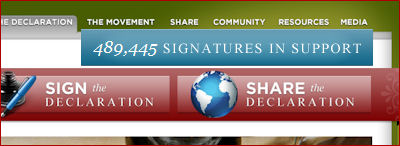
There have also been several non-ECT manifestos—most recently the highly publicized but quickly fizzling "Manhattan Declaration" (2009). That document aimed to garner one million signatures within a month. But almost two years after the PR campaign began, that charter still has not been able to acquire even half that many signatures.
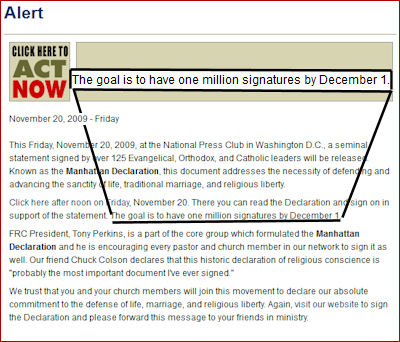
1 Million?
November 2009


Nope.
July 2011

One can't help noticing the common thread in this growing quiltwork of documents: virtually all of them strongly promote an ecumenical agenda. And the urgency of the ecumenical appeal is inversely proportional to the level of enthusiasm for whatever few shreds of evangelical conviction (if any) are expressed therein. If I read the trend correctly, the ecumenical agenda being pushed in these documents is growing more brazen and more demanding with each new document.

For example, ECT II included this statement, carefully crafted to sound as if it were full of evangelical conviction: "In justification, God, on the basis of Christ's righteousness alone, declares us to be no longer his rebellious enemies but his forgiven friends, and by virtue of his declaration it is so." But, of course, the statement simultaneously solicited signatures from Catholic priests and others who formally disavow the principle of sola fide. So notice: that sentence (the best in the whole statement) purposely omitted any mention of imputed righteousness and gave just enough wiggle-room to permit, say, a Jesuit theologian to put his own spin on the words and sign. It was a subtle approach to undermining the central evangelical distinctive.

Twelve years later, ECT VII (titled "Do Whatever He Tells You: The Blessed Virgin Mary in Christian Faith and Life") took a much less subtle approach. That document repeatedly scolds Protestants for their "neglect of Mary" and the supposed lack of evangelical reflection on Marian themes in their soteriology. The document goes on to make this promise: "We [evangelicals and Catholics] will seek together the mind of Christ about Mary." Then it states: "Evangelicals need to consider whether more reflection on Mary would strengthen their relationship with Jesus Christ."



Now, does anyone truly believe these ecumenical diatribes are strengthening evangelical conviction? Isn't the real point rather to undermine the very truths that make evangelical doctrine distinctive, so that (quietly setting all such things aside) we can join hands with the Vatican in the name of brotherhood and unity?

No one who understands what historic evangelicalism is could possibly think that type of "unity" represents anything other than the wholesale rejection of everything that truly differentiates evangelicals from Roman Catholics, Eastern Orthodox, Coptic Christians, and the cults.

As a matter of fact, that is exactly what these statements are aiming for. Sadly, the evangelical movement is being commandeered by people who do indeed reject evangelical doctrinal distinctives and would like to see a brand of evangelicalism that can easily syncretize almost anything from Roman Catholic mysticism to postmodernized versions of Socinianism.

You know: Christianity Today-style religion.
The epitome of this, once again, is Charles Colson, a politically shrewd, worldly-wise, fully-educated, well-spoken man who nevertheless manages to sound stunningly clueless at times. For example, he claims to believe the Manhattan Declaration failed because people who are apathetic about doctrine were afraid of it. Anyone who paid attention knows the precise opposite is true. Those most outspoken voices against the Manhattan Declaration were conservative evangelicals who insist on being far more precise in their doctrine than the drafters of that manifesto want evangelicals to be.

But Colson said this in Christianity today:
An aversion to doctrine caused some thoroughly orthodox young evangelicals to decline to sign the Manhattan Declaration (which defends human life, traditional marriage, and religious liberty), even though the document is rooted in Scripture.


So the latest document being peddled to evangelical leaders is "Christian Witness in a Multi-Religious World." It's nothing more than old-style ecumenism re-stated in the patois of postmodernism.

Describing what's wrong with the document, one of my favorite fundamentalist bloggers, Dave Doran (president of Detroit baptist Theological Seminary and Senior Pastor of Inter-City Baptist Church) writes:

To me, the wrongness of this project is magnified by its uselessness. "What's valuable about the document is that Christians are letting the world know that they are intending to be respectful, loving, and transparent in their approach to missions and that they do not intend to be seen as violent or coercive," claims Craig Ott from Trinity Evangelical Divinity School. Seriously? Publishing this document will do that? Is "the world" really reading documents put out by groups like this? Why do evangelicals keep chasing after the elusive dream of getting the world to think differently about them? Why do they keep chasing that elusive dream with ecclesiastical tokens like documents and statements?

The view from the separatist ghetto looks like this: professing evangelicals keep getting hoodwinked into publishing documents that never accomplish their purpose, but do in fact erode the boundaries of the faith. The world will not even notice this document, but the World Evangelical Fellowship and the World Council of Churches will feel better for playing nicely with each other, and Rome is happy that they are doing [it] on their way back home.

Hard to think of any argument against Dave Doran's analysis. In fact, it would be hard to sum up any more succinctly than that all the problems with the past decade's torrent of ecumenical manifestos.

Phil's signature


26 January 2010

Un-signing the Manhattan Declaration: a PSA from Pyro

by Dan Phillips

As you know, the "Manhattan Declaration" (hereafter MD) was a bad idea that became a bad document that undeservingly boasted some very good names.

In our various discussions, many regretted having signed the document. They had, at first, understandably seen wisdom in co-belligerency in opposing abortion, the loss of freedoms, and the forced normalization of perversion. However, they had missed the deliberate muddling of the vitally-important edges of the Gospel. Now they wanted to un-sign.

But how to do so?

In answer comes a reader, John Taylor, who emailed me to let me know that he had both asked that his name be removed, and had received a response. He said I could share the saga with you.

So, for you who've wondered how: go to this page, and request that your name be removed. [UPDATE: that is now a dead link. I'll update when someone gives me, or I find, a valid URL.]

It took a while for John. He submitted his first request to that link on November 23rd of last year. Receiving no response, twenty days later he wrote a follow-up email (December 12). It was not until January 19 that he received a response — some 58 days after his first request.

In this email, they write: "We will remove your name from the list of signers, but it may take a few days."  This makes us both wonder if they only removed his name after two requests.

Perhaps the "takeaway" there is that you should ask them to acknowledge your request; and then, if you've received none in a few weeks, ask again.

On January 20, I wrote the email address John gave me, asking (1) the best way to get one's name removed, and (2) how many have asked that their names be removed. No answer yet. If I receive a helpful response, I'll likely update this or post it.

Dan Phillips's signature

21 December 2009

Robert George and the New Ecumenism

by Phil Johnson


    know what you're thinking: we've already beaten the Manhattan Declaration to death, and we don't need another TeamPyro post on the issue.

I was feeling the same way myself two weeks ago, but the horse keeps coming back to life. Last week, for example, the New York Times published this feature profiling Robert P. George, the sole Roman Catholic in the triumvirate of authors who wrote the Manhattan Declaration. George is a professor of jurisprudence at Princeton and heir to the late Richard John Neuhaus's mantle as American conservatism's leading Catholic intellectual.

George, like Neuhaus, is ecumenical in a uniquely Roman Catholic and conservative sense. In a recent Touchstone article pleading for Christian unity in the midst of cultural division, he celebrates the fact that "the pro-life movement and . . . other godly causes to protect the vulnerable and heal a wounded culture" have brought Protestant, Catholic, and Eastern orthodox believers together despite their fundamental doctrinal differences. George seems to suggest that the moral issues are, after all, vastly more important than whatever points of doctrine once divided Protestants from Rome (and Rome from Constantinople).

In fact, George implies that the main reason the ecumenical movement exists and is growing today is because the old doctrinal issues that divided Orthodox, Catholics, and Protestants simply aren't relevant in the culture war. Allowing doctrinal differences to keep us from putting up a completely united front in the culture war is "misguided," George says. How could our benighted spiritual ancestors have been so foolish as to disfellowship one another over differences about the gospel? Take, for example, "the differences between Catholics and Lutherans regarding justification." Were those really fundamental differences in the first place, or were the Reformers and the Council of Trent mostly just talking past one another? George offhandedly asserts that those things were mostly "misunderstandings" that have now been "clear[ed] away."

He writes,
For Christians who are part of this new ecumenical alliance, ancient animosities and mutual suspicions have quite simply vanished. No longer do we view each other as "heretics" or "apostates," much less as "infidels." Many of us find it increasingly difficult to fathom how it could be that generations of Christians did perceive and speak of each other in these harsh terms. Despite our differences, we regard each other—effortlessly—as brothers and sisters in the Lord. We joyfully work together across the old lines of division; we pray together; we support and counsel one another; we listen to—and learn from—one another; we seek understanding and, much more often than not, are able to find or establish it. Together we pray for the "complete and visible" unity that would truly be the fulfillment of Christ's prayer.

Yet read the rest of the article and see if you don't come away with a strong impression that George's own idea of "a more perfect unity of mind and spirit" can never truly exist unless Rome's Pope is in charge of it.

Anyway, be sure to read the New York Times piece. It's an insightful behind-the-scenes look at how the conservative movement's agenda is being shaped. It further highlights some troubling ideas underlying the strategy that produced the Manhattan Declaration.

In short, Robert George's contribution has been to seek ways to argue against gay marriage, abortion, and other social evils by appealing to "natural law" rather than Scripture. George is convinced that conservatives in the culture war need to build their case on "principles of right reason and natural law," not biblical law. George wants conservatives in the culture war to make their appeal to logic, not the Bible. In the words of the NYT article, "George is the leading voice for a group of Catholic scholars known as the new natural lawyers. He argues for the enforcement of a moral code as strictly traditional as that of a religious fundamentalist. What makes his natural law 'new' is that it disavows dependence on divine revelation or biblical Scripture—or even history and anthropology. Instead, George rests his ethics on a foundation of 'practical reason': 'invoking no authority beyond the authority of reason itself,' as [George himself] put it in one essay" (emphasis added).

Even the New York Times writer (David D. Kirkpatrick) seemed to sense that the biblical truths of original sin and human depravity posed a fairly fundamental challenge to Robert George's notion that society can be won to righteousness through human reason alone. He writes,
I asked George several times if he was really hoping to ground a mass movement in abstract principles of reason so at odds with the prevailing culture. It was a bet, he said, on his conviction about the innate human gift for reason. Still, he said, if there was one critique of his work that worried him, it was the charge that he puts too much faith in the power of reason, overlooking what Christians describe as original sin and what secular pessimists call history.

It is a debate at least as old as the Reformation, when Martin Luther broke with the Catholic Church and insisted that reason was so corrupted that faith in the divine was humanity's only hope of salvation. (Until relatively recently, contemporary evangelicals routinely leveled the same charge at modern Catholics.) "This is a serious issue, and if I am wrong, this is where I am wrong," George acknowledges.

This is indeed a serious issue, and George is wrong. What sinners in this decaying culture need is redemption and spiritual rebirth, not merely sounder moral logic and more convincing rational arguments about why their sin is bad.

Read the first three chapters of 1 Corinthians for an extended biblical rebuttal to George's strategy.

As we have been saying for years, the gospel—not natural law, moralistic logic, philosophical reasoning, or political strategizing, but the gospel—is the power of God unto salvation. God's Word doesn't need an intellectual's rational arguments to prop it up. It may sound foolish to suggest that the gospel of Jesus Christ proclaimed clearly and supported only with "thus saith the Lord" carries more weight or is actually more efficacious than an elaborate philosophical argument, but that is, after all, what God himself says—and "the foolishness of God is wiser than men, and the weakness of God is stronger than men" (1 Corinthians 1:25). That verse comes in a context where Paul is explaining in detail why the wisdom of this world is foolishness with God, and why the gospel is ultimately a more persuasive and more effective means of individual and cultural transformation than all the philosophical arguments, moralistic reason, and academic logic the brightest minds and most eloquent orators of this world have to offer.

If evangelicals really want to make an impact on our culture, we need to keep that in mind. We need to get to work proclaiming the gospel in our own communities. And frankly, we ought to leave the philosophical strategy in the culture war to people who have no sharper weapon. Declarations of spiritual unity with moralists, academicians, and religious figures who reject the gospel are a sham and a lie, and such declarations do undermine the gospel and muddy our testimony—regardless of anyone's original intent.

Phil's signature

09 December 2009

Idealism vs. Normally-Wise Pragmatism

by Frank Turk

I'm almost hesitant to blog today because the last time I blogged here I posted a link to a somewhat-helpful article about Twilight and its apparent analogical apologetic for Mormonism, and it turned into, well, something else. I enjoy blogging, especially when I think I have something useful, helpful or otherwise edifying to share, and sometimes people just take the fun out of it.

{sigh}

Anyway, again leap-frogging from a post by a co-blogger at Evangel, the Manhattan Declaration rears its ugly head as some over there are again taking up its torch. James Grant has pointed to a blog post by Father Patrick Reardon. What we should think about today is the center of Fr. Reardon's assessment of the position of (for example) Dr. John MacArthur (and for those who missed it, RC Sproul):
The critics I have in mind, rather, are those Christians who confessed agreement with the substance of the Declaration while declining to associate with the other signers. Their objections, I believe, are significant in the sense of deserving comment. Considerations of available space impose brevity here.

We may take the example of the Evangelical spokesman, John MacArthur, Jr. His complaint was very simple: The Manhattan Declaration scans only the symptoms of these social evils but neglects to address their root cause. That is to say, this document fails to proclaim the Gospel of salvation, which is the sole remedy for every social ill.

Substantially identical was the objection of the Orthodox Christian priest, Father Jonathan Tobias, who faulted the Declaration for not preaching repentance. This writer went even further, nonetheless, lampooning at length the document's form and rhetorical style. (Ironically, the somewhat softened Father Tobias has of late chastised James Carroll, for a similar mockery of it.)
That underlined part (emphasis added) is the part that interests me -- because here's what Dr. MacArthur actually wrote:
In short, support for The Manhattan Declaration would not only contradict the stance I have taken since long before the original “Evangelicals and Catholics Together” document was issued; it would also tacitly relegate the very essence of gospel truth to the level of a secondary issue. That is the wrong way—perhaps the very worst way—for evangelicals to address the moral and political crises of our time. Anything that silences, sidelines, or relegates the gospel to secondary status is antithetical to the principles we affirm when we call ourselves evangelicals.
Now, you know what? I'll be glad to concede for the sake of this post and whatever argument you think you want to start at this point that it is possible for someone with a clean conscience to have signed this document. You know: Al Mohler deserves the benefit of the doubt. Ligon Duncan deserves the benefit of the doubt just in case he's reading here. I think it's possible that some people have made an error not because they have some aim to deceive even the elect (as if that was possible) but because they think public proclamations of morality are prophetic in nature.

To that I say: I respect your motives, but your are letting your idealism obscure your normally-wise pragmatism.

What I'm posting about here is about Fr. Reardon's approach to justifying the MD's signers. The idea that John MacArthur has merely decided that if we just preach the Gospel we don't need to do anything else is, frankly, unfounded for two reasons:

[1] Plainly, Dr. MacArthur's objection is grounded on the idea that the three major groups named in this declaration all define the Gospel of Jesus Christ differently! That is: all his other objections are in orbit around the point that you cannot possibly say that confessional Evangelicals and Roman Catholics can say, "preach the Gospel" and mean the same thing. This fact obscures the Gospel.

[2] Only someone who has never read Dr. MacArthur and his thorough stand on holiness and godly living could possibly say he advocates for just preaching the Gospel "as the sole remedy for every social ill". The Gospel has real-world, real-life consequences, and Dr. MacArthur is one of the loudest and clearest preachers to this point in the English-speaking church.

So in that, let's please not think that if one has repudiated the MD he has repudiated living among people, doing good works, actually protecting the down-trodden and the orphan the the widow, and suffering for the sake of others. What he has repudiated is doing that in the context of an undefined "gospel" for an inexplicable Jesus. Someone has already said this, but it bears repeating:
[the Manhattan Declaration] assumes a big tent for the definition of what it means to be a “believer”, assumes that law is greater than grace in reforming the hearts of men, and provides moral reasoning that those who are unbelievers have no reason to accept — because they are unbelievers. And in making these three items “especially troubling” in the “whole scope of Christian moral concern”, it overlooks that the key solution to these moral concerns is the renovation of the human heart by supernatural means established by the death and resurrection of Christ.
I also have a beef with the red herring of "declining to associate" which Fr. Reardon mentions. Many of the signers of this document are either hopeful or fearful (I just can't tell which) that the disagreement over this document is going to lead to some manner of quasi-fundamentalist "separation" over the matter.

We'll have to take that up another time. It's enough to say for now that this document doesn't hardly cause a person to be a rank heretic or disqualify himself from ministry. It's just a mistake which, one hopes, many of the signers will reconsider and therefore remove their names from the list.


Manhattan Declaration again: R. C. Sproul puts another one in the ten-ring

by Dan Phillips

Worthy men such as Alistair Begg and John MacArthur explained why they were unable to sign the Manhattan Declaration.

Shortly after, in Nineteen Questions for Signers of the Manhattan Declaration, I tossed in my widow's mite. The post demonstrated that the document (A) was necessarily theological, (B) unfortunately communicated some significantly bad theology, from the perspective of Biblically-faithful Christianity, and that (C) it was not a document that someone concerned with the clear delineation, definition, and declaration of the Gospel should want his name associated with.

Then in NEXT! #19, we skewered the dodge that refusal to sign the document had anything to do with unwillingness to "work with" anti-Christian faiths in opposition to abortion.

After that, Michael Horton also published a demurral.

Now R. C. Sproul has contributed a forceful, gracious, and yet trumpet-like blast to the discussion. In The Manhattan Declaration: Why didn’t you sign it, R.C.?, Sproul gives eloquent voice to the same basic objections that others of us also sounded. Here are just a couple of particularly choice extracts.
While I would march with the bishop of Rome and an Orthodox prelate to resist the slaughter of innocents in the womb, I could never ground that cobelligerency on the assumption that we share a common faith and a unified understanding of the gospel.

The framers of the Manhattan Declaration seem to have calculated this objection into the language of the document itself. Likewise, some signers have stated that this is not a theological document. However, to make that statement accurate requires a redefinition of “theology” and serious equivocation on the biblical meaning of “the gospel” (2 Cor. 11:4).

...how could I sign something that confuses the gospel and obscures the very definition of who is and who is not a Christian? I have made this point again and again since the days of ECT. Though the framers of the Manhattan Declaration declaim any connection to ECT, it appears to me that the Manhattan Declaration is inescapably linked to that initiative, which I have strenuously resisted.  More than that, this new document practically assumes the victory of ECT in using the term “the gospel” in reference to that which Roman Catholics are said to “proclaim” (Phil. 1:27).
I am sorely tempted to quote a great deal more; instead, I'll just urge you to get over there and read the entire post. It is masterful.

I'll just close with one portion that resonates with me:
The Manhattan Declaration puts evangelical Christians in a tight spot. I have dear friends in the ministry who have signed this document, and my soul plummeted when I saw their names. I think my friends were misled and that they made a mistake, and I want to carefully assert that I have spoken with some of them personally about their error and have expressed my hope that they will remove their signatures from this document. Nevertheless, I remain in fellowship with them at this time and believe they are men of integrity who affirm the biblical gospel and the biblical doctrines articulated in the Protestant Reformation.
...It is only in our united proclamation of the one, true gospel of Jesus Christ that any heart, any mind, or any nation will truly change, by God’s sovereign grace and for His glory alone.
 Amen.

Dan Phillips's signature

30 November 2009

Nineteen questions for signers of "The Manhattan Declaration"

by Dan Phillips

Like many of you, I am absolutely slack-jawedly baffled at some of the names on "The Manhattan Declaration." I have already briefly expressed my own thoughts on that document.

Were I able to get their ear and interview them, these are the questions I would ask of the genuinely evangelical brothers and sisters who signed that thing:
  1. Is the Bible your sole, sufficient, ultimate source and authority for faith and practice?
  2. Do you believe that the Biblical Gospel is the good news that lost, sinful man can be reconciled to God by grace alone, through faith alone, in and because of Christ's person and work alone, to the glory of God alone, as seen with final authority in Scripture alone?
  3. Do you see — note well my wording — Scriptural warrant for applying the word "Christian" to anyone other than one who is yoked as a student to the words of Christ and His apostles (Acts 11:26), who affirms the Gospel as described in #2 above (Acts 26:28), and who has been spiritually regenerated by grace alone through faith alone (1 Peter 4:16; cf. 1:3-5)?
  4. Do you see — again, note well my wording — Scriptural warrant for applying the word "Christian" to anyone who would distort and oppose that Gospel, either personally or by aligning himself directly as a supporter (let alone promoter) of such institutional distortion and opposition?
  5. Do you believe that "distortion" of that Gospel is a damning heresy, such as falls under the thundering apostolic condemnation of Galatians 1:6-9?
  6. Do you believe that Roman Catholicism's official formulation of the gospel is such a damning heresy?
  7. Can a church be a Christian church if it has the Gospel wrong?
  8. What do you believe the Reformation was about?
  9. Do you believe the Reformation was vital and necessary, or a mistake?
  10. Do you agree with the document you signed, that the Popes of the 16th and 17th centuries were Christians (remembering ##1-6, above)?
  11. As to the central themes of the Reformation, has anything fundamental changed today, so that the Reformation is no longer relevant?
  12. Do you believe that persuading people to assent to a vaguely-Biblical opinion about homosexuality, marriage, or abortion is more critical than clearly presenting the Gospel, as described in #2 above?
  13. Do you admit that "The Manhattan Declaration" identifies as Christians men and women who are members of — indeed, leaders within — sects which (A) formally and officially oppose the Gospel as described in #2, above; and which (B) make a great deal of the fact that all adherents of those institutions must walk in lockstep conformity with their formal and official positions?
  14. If your son or daughter were to tell you that he or she wants to join the Orthodox or Roman Catholic church, "Because anyway, you said they were Christians just like you are, except for 'ecclesial difference'" — how would you respond?
  15. Can  your fellow-signatories rely on the "Gospel" that their sects officially proclaim — which "Gospel" contradicts the Gospel as defined in #2 above — and still go to Heaven?
  16. Which is more important and more critical in our day: to define marriage, life, and civil liberty; or to define the Gospel?
  17. How can it be helpful to join hands in defining the former, with those who cannot define the latter?
  18. Can any civic gains that this document achieves for the issues of abortion or marriage offset the spiritual damage it causes in blurring the line between a true, Biblical, saving Gospel, and a false, un-Biblical, damning distortion?
  19. If you have answered all of the preceding questions, can you explain why you would not ask that your name be removed from "The Manhattan Declaration," which over and over again identifies both you and adherents of Gospel-distorting sects as alike Christians, which says that you and they alike "are compelled by our Christian faith," and which repeatedly suggest that you and they alike proclaim "the Gospel"?
The co-signatories made a public statement by endorsing this document. It seems fitting to convey these questions in the same arena.

What I would ask of those who have signed, I would press all the more urgently on anyone tempted to sign.


Now, nobody has to read all of those questions.

EXCEPT: if you want to comment on this post, you do. If you don't seem to have read them all, you will be asked to do so. And if you refuse, your comments will be deleted.

Therefore, if you comment, you will know that it is all about the Gospel.

That means that —
  • We will not have any comments by anyone attempt to derail this into a discussion of homosexuality, abortion, or "co-belligerent" social involvement.
  • We won't have anyone attempt to derail this into a discussion of the relative value of minimalist creeds.
  • We won't have anyone attempt to derail this into a discussion of sociological definitions of "Christian."
  • We won't have anyone attempt to derail this into a discussion of whether non-leaders who attend bad churches without accepting their damnable heresies can individually be saved.
  • We won't have anyone attempt to derail this into a discussion of the spiritual condition of long-dead men or women.
UPDATE: follow-up posts HERE, HERE, and HERE.

Dan Phillips's signature