wice recently (here and there) I have mentioned Scot McKnight's article on the Emerging Church from last January's Christianity Today. The article sparked several thoughts when I read it earlier this year. At the time, I was busy preparing for Grace Church's Shepherds' Conference. Then I had a book chapter to write. After that, I taught a week of systematic theology in Italy. Next I went to Atlanta for the FIRE conference. And yadda yadda. By mid-May, blogging about a January CT article seemed so—yesterday. So I was going to let it go.
But every week, it seems, I encounter fresh references to McKnight's article. "Here's an article that will surely ease your mind about Emerging Christianity," someone recently told me (with a kindly pat on the shoulder). "It turns out that most of the movement is really, really good! You just need to understand how diverse it is. See: there are these Five Streams of Influence, and most of them are very positive and healthy developments. . ." And all the things I originally wanted to reply to in that article keep coming back to me.
So here's another one:
Scot McKnight grossly understates the influence of postmodern thinking in the Emerging Church movement. Notice (on the one hand) that McKnight himself can't even manage an introductory description of the movement without using the P-word over and over. But (on the other hand) he dismisses D. A. Carson's Becoming Conversant with the Emerging Church with the patented Friends-of-Emerging shrug-off: "Carson's book lacks firsthand awareness and suffers from an overly narrow focus—on Brian McLaren and postmodern epistemology."
For whatever reason, McKnight hates it when the question of postmodern epistemology comes up in the emerging Conversation—regardless of whether friends or critics are the ones raising the issue. "Instead of epistemology, the EM is concerned with ecclesiology—how to 'do church,'" he insists.
But most (if not all) of the typical Emerging innovations in ecclesiology and methodology are in fact rooted in the postmodern epistemological shift, and McKnight is simply wrong if he seriously wants to deny that. In fact (and here's something you will rarely hear me say), on this point, McKnight is wrong and McLaren is right. Practically everything that makes the Emerging movement distinctive is closely related to postmodernism's cynical attitude about knowledge and truth—and that includes all five "streams" identified by McKnight.
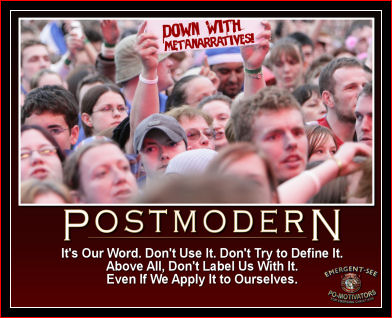
Of course, there was no way for McKnight to deny that postmodernism is a major influence (if not the definitive ingredient) in the movement as a whole. Still, he tries to mitigate that admission every way he can think of. Instantly after listing postmodernism as "a second stream of emerging water," he reflexively takes a defensive tone: "Postmodernity cannot be reduced to the denial of truth."
Well, OK. That's true, but what serious critic ever said otherwise? Indeed, Postmodernists don't generally "deny" anything outright. Instead, the usual postmodern response to truth-claims is suspicious skepticism. But even so, it still wouldn't be right to "reduce" postmodernism to that. No credible critic would. So McKnight's comment sets up straw man—a caricature that backhandedly misrepresents why critics are wary of postmodern epistemologies. Perhaps he would benefit from another reading of Carson.
I'm certain Carson would gladly agree (as I do) that postmodernity cannot be "reduced" to the denial of all truth. On the other hand, postmodernists can legitimately be charged with a general reluctance to affirm truth unequivocally. That's the issue McKnight needs to come to grips with, because it does have a seriously adverse effect on the way lots of postmodernists—including several of the most vocal leading voices in the Emerging conversation—handle (and mishandle) the revealed truth of Scripture.
Anyway, after that brief, gratuitous remark about what postmodernism isn't, McKnight gives a not-particularly-enlightening explanation of what postmodernism is. He says (in typically postmodern terms): "It is the collapse of inherited metanarratives . . . like those of science or Marxism."
He seems determined to downplay the problems with Postmodernism's know-nothing approach to epistemology. He makes an offhanded reference to Jamie Smith's Who's Afraid of Postmodernism?: Taking Derrida, Lyotard and Foucault To Church in order to buttress the preposterous suggestion that despite postmodernism's addiction to uncertainty, "such thinking is compatible, in some ways, with classical Augustinian epistemology."
What does McKnight mean by that, you ask? Just this: "Emerging upholds faith seeking understanding."
Yeah, right. "Doubt seeking justification" would be my own assessment of the dominant Emerging approach to epistemology, but let's not get sidetracked with an argument about that just now.

McKnight next borrows some categories from Doug Pagitt to classify three different categories of attitudes toward postmodernism within the Emerging Church. He says some in the movement want to "minister to postmoderns, others with postmoderns, and still others as postmoderns."
It is true enough that the attitude toward postmodernism within the Emerging movement is not uniform. Driscoll seems to belong to category one of the Pagitt/McKnight taxonomy and McLaren probably exemplifies category three. (Although these days, McLaren himself might very well describe himself as a Class-Two Emergent. In fact, I'd think most in the movement would want to place themselves in the center category, because people who are enthralled with postmodernism love those Hegelian syntheses, and they hate to be labeled. No true postmodernist would therefore ever admit to being one.)
McKnight suggests that critics of Emerging spirituality are usually preoccupied with the Class-Three Emergents because they stand out (and thus presumably make the easiest targets). In McKnight's words, "The third kind of emerging postmodernity attracts all the attention."
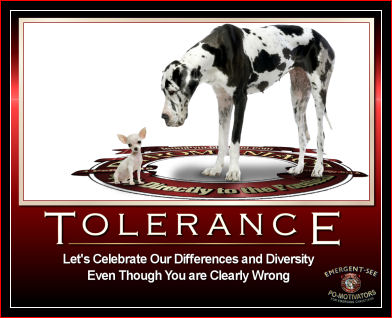
I think McKnight has misunderstood the critics' concern. My one complaint with our Emerging friends is that (whether they formally embrace postmodern epistemologies or not) they tend to be far too accommodating when they meet postmodernism face to face. Rather than answering postmodern skepticism and refuting it with biblical truth proclaimed confidently, they typically try to tiptoe around the sensitivities of the postmodern unbeliever.
But it is nevertheless quite true that Class-Three Emergents are by far the most problematic. In McKnight's words, "[They] have chosen to minister as postmoderns. That is, they embrace the idea that we cannot know absolute truth, or, at least, that we cannot know truth absolutely."
Now, judging from what's written in the Emergent/Emerging blogosphere, I think that is a far more popular perspective among the rank and file in the Emerging Church movement than McKnight cares to admit. But without George Barna's help, I don't know that it would be possible to cite actual statistics that would prove whether my pessimism or McKnight's optimism is more justified.
It's true, however, that the most troublesome voices in the Emerging Church movement are those who plainly and simply have embraced postmodern skepticism about truth, knowledge, and certainty. I would include Chris Seay, for example, in that number. (I wouldn't be surprised if Seay himself objects to that characterization and says I'm "labeling" him unjustly, but again, that's a predictably postmodern thing to say anyway. I'm sticking by my assessment for now, and hopefully what I quote below from Seay himself will be sufficient to explain why.)
Seay is a third-generation pastor in the Houston area. I can't resist mentioning in passing that one of his books is The Gospel According to Tony Soprano: An Unauthorized Look Into the Soul of TV's Top Mob Boss and His Family. That has nothing to do with any point I'm making, but it does illustrate that Emerging Christianity is no less tawdry and shallow than the seeker-sensitive approach that most "Emerging" Christians emerged from—and which they claim to be in rebellion against.
Especially Seay. He is legendary for the way he savages his own father's and grandfather's pragmatic styles of ministry.
So on one of Seay's recent podcasts, an interviewer was asking him about his struggle with youthful rebellion against the beliefs of his parents. Here's Seay's answer:
My bigger question was could we find truth, right? So, um, that we could believe it was true. But who's really to determine what is true? And I still am at a place that I question the reality of objectivity, and what "objectivity" really means. So who can say what is objectively true? Unless you could actually be objective, which none of us are capable of because we can't get to a third place beyond where we are.That's actually a much better summary of the postmodern attitude toward truth than McKnight gave. But it isn't really a Christian position at all. Note: Seay can't answer the question "who's really to determine what is true?"
That's a serious problem, and it's a much more widespread problem throughout all streams of the Emerging Church movement than I think Scot McKnight wants to acknowledge. I do read a lot of Emerging and Friend-of-Emergent blogs. I see what the grassroots participants in the emerging conversation are saying.
Now, let's be clear here: The Friends of Emergent need to be at least half as fair with their critics as they want their critics to be with them. No intelligent, rational, serious-minded student of theology would ever insist that we have a "complete"—i.e., perfect—understanding of any doctrine.
Postmodernism thinks that admission is fatal to all knowledge. If we don't know anything perfectly, we can't ultimately be certain about anything, right?
That's not a question that suddenly occurred to the people of God now that the age of postmodernism has enlightened us about what true humility really is. Thoughtful Christians have contemplated that same question in every generation, and the historic Protestant confessions answer it plainly.
First, God's Word is truth. It is pure truth, revealed by God, and it is the sole and sufficient final arbiter between what's true and what's false.
Second, while we may not understand any doctrine exhaustively, we can nonetheless be confident that what we do know accurately is true. That's the beauty of propositions. They recognize that truth by definition includes facts, and even though no finite set of facts or propositions ever exhausts all truth about God, we can know lots of true facts about God, and we can even know God Himself (albeit through a glass, darkly) because those facts, and God Himself, have been revealed to us by God Himself in Scripture.
So (lo and behold!) I can actually affirm penal substitution without being guilty of "reducing" the gospel to only that one point.
Mark Dever was saying something very similar in a very fine article which McKnight objected to two Easters ago. Look how far we have come since then. The "conversation" is going nowhere fast, it seems.

|



 cot McKnight's Christianity Today article on the major streams of influence within the Emerging movement
 Several of the best-known leaders in evangelical politics are former pastors who have left church ministry behind in order to become full-time lobbyists and political commentators. The evangelical movement as a whole has mirrored that trend for the past couple of decades, I fear—abdicating the teaching ministry in favor of more worldly affairs. Judging from the books that typically rise high on the Christian best-seller lists, evangelicals nowadays are a thousand times more concerned with politics and public relations than with studying and proclaiming Scripture. And it's no accident that the elevation of worldly entertainments in evangelical megachurches has gained popularity right alongside evangelicalism's obsessive craving for clout in the political arena. I'm convinced these trends are closely related. Perhaps I'll blog about that one day.
 McKnight acknowledges that he himself is a political liberal at heart, but he also say he is concerned that if Emerging Christians get too caught up in politics, they will repeat the error of the modernist churches who embraced the social gospel and abandoned the biblical gospel in the process. To his credit, McKnight says he is wary of that tendency. He seems to sense, however, that a large segment of the movement is already barreling that direction. ("Sometimes . . . when I look at emerging politics, I see Walter Rauschenbusch, the architect of the social gospel," he says.)
 n
n  In other words, Emerging Christians tend to think good works generally trump sound doctrine. If our Emerging friends sometimes seem to sweep aside more conservative Christians' concerns about the soundness of their doctrine, this is the main reason. McKnight writes, "Here is an emerging, provocative way of saying it: 'By their fruits [not their theology] you will know them.'"
 McKnight anticipates that argument: "Many will immediately claim that we need both or that orthopraxy flows from orthodoxy. Most in the emerging movement agree we need both, but they contest the second claim: Experience does not prove that those who believe the right things live the right way."