We know a lot about angels, and that we don't know a lot about angels. There is a great deal of Biblical material, on the one hand; but there are many gaps, holes, and lacunae.
We know that angels are spirit beings of great knowledge, antiquity and power. They can move quickly (Daniel 9:21; Luke 2:13), can appear on earth (Genesis 18:2), or in the throne room of God (Job 1:6). They are spirits (Hebrews 1:7), but can take tangible form and interact with matter (Daniel 10:10). They have consciousness of self and of others (Luke 1:19).
Artists have represented angels often, but almost always clearly wrongly. The effeminate—indeed, often female!—angels of the painters are dead wrong in almost every
 respect. Angels are never certainly depicted as female in the Bible, and virtually always depicted as definitely masculine. Not merely masculine, but awesome and fear-inspiring. Artists' angels look as if they're about to say "Please, may I have another chocolate?" Real angels usually have to start out with saying, "Dude, dude — try not to die!"
I surmise that there's a reason for that.
What fills an angel's day, though? The Bible seems to indicate various classes or even species of angels, with differing functions or specialties. As to the angels' potential scope of interest and activity, perhaps one can be forgiven to reflect on the information we have.
Being spirit, angels presumably wouldn't be limited by any need for a particular atmosphere or temperature-range, or gravity. They'd not need food or water. They could travel wherever they needed to, within the will of God.
So, in theory at least, an angel could choose to make a study of marine life at the ocean's depth, or the life of the most distant glittering star; of the tiniest atom on the highest mountain peak, or the rotations of Jupiter or Neptune. They could equally wander the Gobi Desert or the Milky Way, watch a homeless man in New York, or a prince in the Middle East or Europe.
But unlike Tolkien's angelic Istari such as Gandalf the Grey and Radagast the Brown, who study hobbits or animals, real angels are mostly interested in God. Usually, they're seen functioning as their title indicates: as God's messengers. We observe them characteristically running errands, carrying messages, sent on missions.
Still, the Bible does give us strong indication as to what fascinates angels. Both Testaments indicate that angels are particularly fascinated with our redemption.
Consider Exodus 25:18—"And you shall make two cherubim of gold; of hammered work shall you make them, on the two ends of the mercy seat." Isn't it interesting that they are not described? It is as if Moses says, "Okay, you know what cherubim look like, right? So, make two of them, and...." Wouldn't it be interesting to know what they knew about cherubim, and how they knew what they knew?
But if that were important, God would have given the details. A crucial rule of interpretation is to make much of what God makes of (and the converse). So what is of interpretive importance to us is that the cherubim's appearance is not of interpretive importance to us, or else they would have been described. God tells us what matters about them. What matters about them is that they are of hammered gold, they are at the two ends of the mercy seat, and that...
...[t]he cherubim shall spread out their wings above, overshadowing the mercy seat with their wings, their faces one to another; toward the mercy seat shall the faces of the cherubim be (Exodus 25:20)
So what are the cherubim looking at, as they face inward? They are depicted, by command of  God, as forever fixing their unblinking gaze upon the mercy seat, the kapporeth, the solid gold lid to the chest of the covenant.
What is the significance of this lid? Yahweh appears and speaks there (Exodus 25:22), and bloody atonement is made there, on the great and highest holy day (Leviticus 16, especially vv. 14-15). This locus is the focus. The angels' two objects of fascination are closely tied to it: Yahweh, and believers' blood-bought redemption. The turning away of Yahweh's wrath by means of blood atonement absorbs them fully, as they are depicted as frozen in rapt attention towards that spot.
Does Peter possibly have this in mind as he writes? The apostle tantalizingly remarks, as it were in passing, that angels intensely desire to bend over and get a good look [παρακύψαι] at the truths of the Gospel that we preach (1 Peter 1:12). It is an object of great interest and perhaps curiosity to them. God constituted the church as an eternal exhibit of His grace and wisdom — for the angels (Ephesians 3:8-10).
Think of it: angels know nothing of redemption themselves, except as spectators. Some of their number fell into rebellion, and not one of that company will be redeemed. The others stood fast with the Triune God, and not one of them needs redemption. Angels experience nothing of redemption. They either have no chance of it, or they have no need of it.
That Yahweh Himself would undertake to set His love on filthy rebels, would design an intricate tapestry of pointers to that redemption, would come in person to effect that redemption — these are great mysteries to the angels, and are objects of intense fascination to them.
Reflect just a moment longer. Once again, can we even imagine the vantage-point of the angelic mind? Thousands of years old, unclouded by sin, mighty in power and great in knowledge — what couldn't they study, if they wished to and God permitted? Planets, suns, comets, meteors, processes we can scarce imagine; all these are tomes available at the angelic library for their casual checkout.
But what draws angels and holds them is the drama of redemption.
And here we can't but tarry one moment longer to wonder if there isn't even a greater mystery to the angels — an absolute bafflement, in this case?We know what fascinates them. But as they observe us (1 Corinthians 11:10; 1 Timothy 5:21), what do they see fascinating us? As we gather together, ostensibly in the name of Christ, what is it that occupies us, that draws us, that fascinates us? Is it the truths of redemption: its Author, its plan, its unfolding, its implications, its consummation, its celebration, its communication? Is it the Word that ALONE reveals these truths?
Or is it games, pageantry, frippery, triviality, entertainment, froth, foam, and inanity?
 We must be much smarter than the angels, mustn't we, to yawn and shrug at what so absorbs their vast attention?
Yeah. Right.



 Few biblical topics have provoked more wild speculation and fruitless debate than angels. Scripture doesn't begin to answer all our questions about the subject. But there's a lot more information about angels in the Bible than you might think. (As a matter of fact, the Old and New Testaments combined speak of angels more than 250 times.) And it's important that we understand the biblical doctrine of angels correctly, especially in an age like ours, when so much popular superstition surrounds and obscures the truth about these glorious creatures.
 ow many angels can dance on the head of a pin? The question is raised nowadays only to caricature people who like to indulge in useless squabbling over theological fine points.
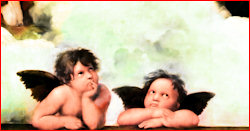 The cherubim, far from the chubby-faced childlike figures often pictured in popular art, seem to represent the power and majesty of the angelic host. They were positioned as guards by the entrance of Eden (Genesis 3:24). They were also the symbolic guardians of the ark of the covenant (Exodus 37:6). And they formed a living chariot of fire on which the Lord would ride (2 Samuel 22:11; Psalm 18:10; cf. Ezekiel 10:1-22). They are always described as fearsome and awe-inspiring creatures.


 have done them a terrible disservice.
 It's clever, it's creative, and it does have going for it that it at least does cite a verse in the Bible: 1 Corinthians 13:1. However, this fragile little