Showing posts with label blogosphere. Show all posts

02 April 2013

Briefly: Resurrection Day, singles, sales and modalism ascendent

by Dan Phillips

Still more or less recovering from our Easter activities, and working on a long post reviewing the first volume in Logos' very promising Evangelical Exegetical Commentary series. So I don't have a single long-form post for you; just a few variouses. For instance...
  • The Resurrection Sunday array of events was a joy and a cause for gratitude — particularly because I'd just taken ill a few days' previous. The last cold was a whopper, almost more of a flu, laying several of us out with fever, chills, plugged sinuses, and wracking coughs. God was very kind, and this was a much milder cold. Fellow-elder Jacob Young handled our Good Friday service, dwelling on Christ's love for us from Romans 5. Then on Sunday we had a Sunrise Service, a breakfast, the normal Sunday School class, and our morning worship. Did not know whether I'd have enough voice, but I trusted God's good will — and we made it. If you like, you can hear:
  • And then I'd like to point out to you that Logos users can buy the works of D. A. Carson at a hefty 75% discount. That's a terrific deal, and I took advantage of it!
  • If you've missed it, for the last few weeks there has been an absolutely extraordinary series of posts back and forth between Thabiti Anyabwile and Douglas Wilson. It all started here. Well, in a way, it all started here, with a rant from Bryan Loritts (last seen throwing around skin-color-obsessed accusations at anyone not snowed by Jakes and MacDonald), who basically said Wilson's book Black and Tan had hurt his feelings: he didn't care whether Wilson was right or wrong, wasn't willing to discuss it, but demanded that Wilson withdraw the book because Loritts said so. Thabiti took up the subject in a sound, serious, and formidable manner, and a most extarodinary dialogue began. You can trace it at Thabiti's and Doug's blogs. Reading the series has been like taking a college-level course in how gracious adult Christians should dialogue; both men have been models of grace, patience and candor. The commenters, not so much; but that's par for the course, eh? 've always known Doug was a force to be reckoned with, and have thought well of Thabiti — but through this, I've come to appreciate just how formidable (in a good way) a brother Thabiti is. 
  • Thabiti provides the service of posting a round-up of the series thus far, as it comes to a close.
  • My own take is that my head's dizzy. I think they're both right about many things, and I think they're both not exactly completely hearing each other — and I think that's in spite of the fact that both are trying their level best. Which is discouraging, because I'm not in either one's league; so what hope do us pikers have of finding resolution on such issues? I only wish Thabiti would take Doug's repeated invitation for a further public conversation.
  • Finally, practicing what I preach, I'd like to give recognition by listing out all the names, complete with links, of the folks who have welcomed the privileges and perks of being high-visibility bloggers, and now have joined in expressing concern (proactively, this time) that yet another prominent evangelical leader is promoting the ministry of reputedly dogged Modalists. I'd really, really like to. Sincerely, I would.
And when I get some, I'll share them.
But time's running out.

Dan Phillips's signature


19 March 2013

Et tu, Chuck? (Swindoll hosts singing elephants? What?)

by Dan Phillips

Before James MacDonald's disastrous and still unaddressed decision to host T. D. Jakes as a "Christian leader," I didn't know MacD from Adam. So I wasn't as shocked as others who had known and previously thought well of him — simply because I had no baseline.

When I wrote on it, therefore, it was simply a concern over the issues. I think my first weighing-in was 9/2011. But my two most substantial contributions were this and this. The latter two were the more important, and the third was, in my judgment, the most important.

That third post was proactive and put up in plenty of time to do some good. Had (for instance) any TGC or otherwise high-profile bloggers — even one! — taken up my specific call centering around the Biblical concept of repentance, and made it an inescapable issue, MacDonald and Driscoll might have been unable to avoid it. It might have made a difference. The trainwreck that resulted might have been avoided.

But history's history; so we now know that TGC bloggers and other high-visibility bloggers did not echo that call, and many high-profile leaders remained silent until it was too late, and bad things happened. You know what they say— of all sad words on tongue or pen, the saddest these: "it might have been."

And now here we are yet again, with a different but similar situation.

It's different in that I do know Chuck Swindoll. Well, not personally, though I did sit next to him in Talbot Chapel once. But I've heard Swindoll, read him, enjoyed him a lot in years past. He's earned a good reputation in many ways, at least as being sound and stable on the fundamentals. He has been and remains associated with Dallas Theological Seminary, which itself at least soundly affirms basic theological doctrines.

So whyever would Swindoll's church host singers who are (to say it as charitably as possible) unclear on the core doctrine of the Trinity?

My attention was first drawn to this by Mark Lamprecht, whose Open Letter to Chuck Swindoll and Stonebriar Church on Phillips, Craig & Dean does a fantastic job documenting the concerns any Christian should instantly have on hearing this absolutely baffling news. At last notice, Mark has received no response.

Look: Neither of these matters is new.

I refer first to the Biblical doctrine of the Trinity. This isn't a doctrine that's been recently detected in the text of Scripture. Christians have not only recently turned their attention to studying what Scripture says about the nature of God. The truth of the trinity of persons in the one God been seen and expounded with increasing clarity from the very earliest days of the church. To my mind, Scripture is absolutely crystal-clear and emphatic in its revelation of the Triune God — the God who, one as to essence, has eternally existed in three distinct Persons.

It isn't a newly-identified subject, nor a newly-expounded truth.

And it isn't that the heresy of modalism raised new and baffling questions last Tuesday, questions which haven't been answered finally, thunderously  and decisively since the first time they were posed many centuries ago.

And it isn't as if those answers are little-known or difficult to obtain; or as if the issue is not vital and foundational. And it isn't as if it's impossibly difficult (A) to express the basic truths of the doctrine, or (B) to sniff and (C) ferret out when false teachers are squidging or fudging or dodging those truths.

Second, I refer to serious and (as far as I know) utterly unanswered concerns expressed about Phillips, Craig and Dean's view of God. These are long-standing, easily-located, and all over the place. James White has spoken up, Eric Nielsen has a lengthy treatment at White's site. Neither of these is recent nor difficult to find.

The Wikipedia quotations are typical of PCD's "responses," and can serve as representatives of all the others I've seen. While they might work for the "top men" who gave T. D. Jakes a thumbs-up (and in Bryan Loritts' case as much as said that only racist "middle-aged white guys" weren't satisfied), these pathetic dodges wouldn't work for most Biblically and theologically prepared Christians.

So, all that said, here I am again.
  1. What possible excuse or explanation can there be for Chuck Swindoll to promote anyone who isn't crystal-clear on the Biblical doctrine of the Trinity?
  2. ...and if anyone wants to say "they've changed," then I refer you right back to this and this.

That is, I asked how a man can held up as a Christian leader in any sense when he is not crystal-clear on such fundamentals as the Gospel and the nature of God. And so I now am asking again: how can singers lead in worship if they are in any way unclear as to their understanding of the nature of God and the Gospel? Hello? what does "worship" mean? Does it matter what god we're worshiping, whether we are worshiping the same god as the worship-leaders? Does it matter what we are conceiving of as the basis of that relationship that underlies our worship?

Chuck Swindoll has always identified himself with the school of thought that affirms what should be obvious: these things matter. And now, this? What possible sense does this make?

In fact, may I be forgiven a "See, I Told You So" moment? I have tried again and again to raise the issue of what a shame it was that high-visibility leaders and bloggers feigned unawareness of Pyromaniacs, or inability to read what we right write right in writing. Every time I've tried, I have either been ignored (at best), or snarkily criticized for not letting that issue die (at worst).

Well, here's why I didn't. I was already thinking of the next time. Since the last time was mishandled so tragically, it was a "lock" that there'd be a next time. Would anything different be done, that time? Were any lessons learned?

And here we are. It's the next time. And I'm sounding the same issues, the same two issues, the same two questions that were ignored last time:
Wouldn't it be nice if, this time, high-profile leaders didn't ignore warnings such as mine this time, and idly watch a brother make a huge mistake?

I sure think so. We'll see.

Dan Phillips's signature


06 December 2012

Reflections on the Word in Paul's writings

by Dan Phillips

As I preach through Titus, I've taken occasion now and again to share insights gained after the event ("the event" being the sermon). Today, we'll get ahead on the curve.

I'm about to preach on Titus 1:9, Lord willing, which goes something like this: "holding fast to the faithful word according to the teaching, in order that he might be able both to urge to action by healthy instruction, and to reprove those who contradict it." It's the last in the catalog of requirements for an elder/overseer/steward. Some list it as the seventh positive requirement, but I pare it off from the focus on the leader's family-life (v. 6) and his character (vv. 7-8).

At any rate, the particular focus from v. 9 for this post is the expression "the faithful word according to the teaching." I was using BibleWorks 9 (duh!) to search for occurrences of logos ("word"). I singled out a rafter of instances. This is just one of those cases where I won't be able to preach but a fragment of what I'm seeing, unless I take fifteen sermons on that one verse — which, God love 'em, my dear folks would support, but just because I can doesn't mean I should!

So I'll take this opportunity to share a data-dump with you in fairly raw form. You fellow hardcore GreekGeeks will love it just fine as-is; everyone else can mouse-over the references. So, without further eloquence:

The term logos occurs 1569 times in Gk. Bible, 330x in NT, 84x in Paul generally, 20x in Pastoral Epistles specifically. Here are some notable (in this connection) uses in Paul:

It's half the twofold division Paul makes of his ministry:
Romans 15:18  οὐ γὰρ τολμήσω τι λαλεῖν ὧν οὐ κατειργάσατο Χριστὸς δι᾽ ἐμοῦ εἰς ὑπακοὴν ἐθνῶν, λόγῳ καὶ ἔργῳ,
Paul's preaching is summarized as Ὁ λόγος ὁ τοῦ σταυροῦ ("the word of the cross"):
1 Corinthians 1:18  Ὁ λόγος γὰρ ὁ τοῦ σταυροῦ τοῖς μὲν ἀπολλυμένοις μωρία ἐστίν, τοῖς δὲ σῳζομένοις ἡμῖν δύναμις θεοῦ ἐστιν.
The λόγος is powerful:
1 Corinthians 2:4  καὶ ὁ λόγος μου καὶ τὸ κήρυγμά μου οὐκ ἐν πειθοῖ[ς] σοφίας [λόγοις] ἀλλ᾽ ἐν ἀποδείξει πνεύματος καὶ δυνάμεως,
The Gospel is summarized as a λόγος :
1 Corinthians 15:2  δι᾽ οὗ καὶ σῴζεσθε, τίνι λόγῳ εὐηγγελισάμην ὑμῖν εἰ κατέχετε, ἐκτὸς εἰ μὴ εἰκῇ ἐπιστεύσατε.
Paul didn't adulterate or hucksterize the word:
2 Corinthians 2:17  οὐ γάρ ἐσμεν ὡς οἱ πολλοὶ καπηλεύοντες τὸν λόγον τοῦ θεοῦ, ἀλλ᾽ ὡς ἐξ εἰλικρινείας, ἀλλ᾽ ὡς ἐκ θεοῦ κατέναντι θεοῦ ἐν Χριστῷ λαλοῦμεν.
2 Corinthians 4:2  ἀλλὰ ἀπειπάμεθα τὰ κρυπτὰ τῆς αἰσχύνης, μὴ περιπατοῦντες ἐν πανουργίᾳ μηδὲ δολοῦντες τὸν λόγον τοῦ θεοῦ ἀλλὰ τῇ φανερώσει τῆς ἀληθείας συνιστάνοντες ἑαυτοὺς πρὸς πᾶσαν συνείδησιν ἀνθρώπων ἐνώπιον τοῦ θεοῦ.
Paul's preaching was a word of reconciliation to God:
2 Corinthians 5:19  ὡς ὅτι θεὸς ἦν ἐν Χριστῷ κόσμον καταλλάσσων ἑαυτῷ, μὴ λογιζόμενος αὐτοῖς τὰ παραπτώματα αὐτῶν καὶ θέμενος ἐν ἡμῖν τὸν λόγον τῆς καταλλαγῆς.
...and of truth:
2 Corinthians 6:7  ἐν λόγῳ ἀληθείας, ἐν δυνάμει θεοῦ· διὰ τῶν ὅπλων τῆς δικαιοσύνης τῶν δεξιῶν καὶ ἀριστερῶν, 
Ephesians 1:13  Ἐν ᾧ καὶ ὑμεῖς ἀκούσαντες τὸν λόγον τῆς ἀληθείας, τὸ εὐαγγέλιον τῆς σωτηρίας ὑμῶν, ἐν ᾧ καὶ πιστεύσαντες ἐσφραγίσθητε τῷ πνεύματι τῆς ἐπαγγελίας τῷ ἁγίῳ,
...and of life:
Philippians 2:16  λόγον ζωῆς ἐπέχοντες, εἰς καύχημα ἐμοὶ εἰς ἡμέραν Χριστοῦ, ὅτι οὐκ εἰς κενὸν ἔδραμον οὐδὲ εἰς κενὸν ἐκοπίασα.
...and of the truth of the Gospel (or this could be epexegetical, "the word of truth, the Gospel"):
Colossians 1:5  διὰ τὴν ἐλπίδα τὴν ἀποκειμένην ὑμῖν ἐν τοῖς οὐρανοῖς, ἣν προηκούσατε ἐν τῷ λόγῳ τῆς ἀληθείας τοῦ εὐαγγελίου
...and of Christ:
Colossians 3:16  Ὁ λόγος τοῦ Χριστοῦ ἐνοικείτω ἐν ὑμῖν πλουσίως, ἐν πάσῃ σοφίᾳ διδάσκοντες καὶ νουθετοῦντες ἑαυτούς, ψαλμοῖς ὕμνοις ᾠδαῖς πνευματικαῖς ἐν [τῇ] χάριτι ᾄδοντες ἐν ταῖς καρδίαις ὑμῶν τῷ θεῷ·
...and of the Lord:
1 Thessalonians 1:8  ἀφ᾽ ὑμῶν γὰρ ἐξήχηται ὁ λόγος τοῦ κυρίου οὐ μόνον ἐν τῇ Μακεδονίᾳ καὶ [ἐν τῇ] Ἀχαΐᾳ, ἀλλ᾽ ἐν παντὶ τόπῳ ἡ πίστις ὑμῶν ἡ πρὸς τὸν θεὸν ἐξελήλυθεν, ὥστε μὴ χρείαν ἔχειν ἡμᾶς λαλεῖν τι. 
2 Thessalonians 3:1  Τὸ λοιπὸν προσεύχεσθε, ἀδελφοί, περὶ ἡμῶν, ἵνα ὁ λόγος τοῦ κυρίου τρέχῃ καὶ δοξάζηται καθὼς καὶ πρὸς ὑμᾶς,
...and of God:
2 Timothy 2:9  ἐν ᾧ κακοπαθῶ μέχρι δεσμῶν ὡς κακοῦργος, ἀλλὰ ὁ λόγος τοῦ θεοῦ οὐ δέδεται·
It is welcomed by the elect as a powerful word:
1 Thessalonians 1:5-6  ὅτι τὸ εὐαγγέλιον ἡμῶν οὐκ ἐγενήθη εἰς ὑμᾶς ἐν λόγῳ μόνον ἀλλὰ καὶ ἐν δυνάμει καὶ ἐν πνεύματι ἁγίῳ καὶ [ἐν] πληροφορίᾳ πολλῇ, καθὼς οἴδατε οἷοι ἐγενήθημεν [ἐν] ὑμῖν δι᾽ ὑμᾶς. 6 Καὶ ὑμεῖς μιμηταὶ ἡμῶν ἐγενήθητε καὶ τοῦ κυρίου, δεξάμενοι τὸν λόγον ἐν θλίψει πολλῇ μετὰ χαρᾶς πνεύματος ἁγίου,
...indeed, as the Word of God:
1 Thessalonians 2:13  Καὶ διὰ τοῦτο καὶ ἡμεῖς εὐχαριστοῦμεν τῷ θεῷ ἀδιαλείπτως, ὅτι παραλαβόντες λόγον ἀκοῆς παρ᾽ ἡμῶν τοῦ θεοῦ ἐδέξασθε οὐ λόγον ἀνθρώπων ἀλλὰ καθώς ἐστιν ἀληθῶς λόγον θεοῦ, ὃς καὶ ἐνεργεῖται ἐν ὑμῖν τοῖς πιστεύουσιν.
Submission to the apostolic word is a test for fellowship:
2 Thessalonians 3:14  Εἰ δέ τις οὐχ ὑπακούει τῷ λόγῳ ἡμῶν διὰ τῆς ἐπιστολῆς, τοῦτον σημειοῦσθε μὴ συναναμίγνυσθαι αὐτῷ, ἵνα ἐντραπῇ·
The apostolic word should be welcomed and embraced without reservation or qualification:
1 Timothy 1:15  πιστὸς ὁ λόγος καὶ πάσης ἀποδοχῆς ἄξιος, ὅτι Χριστὸς Ἰησοῦς ἦλθεν εἰς τὸν κόσμον ἁμαρτωλοὺς σῶσαι, ὧν πρῶτός εἰμι ἐγώ. 
1 Timothy 4:9  πιστὸς ὁ λόγος καὶ πάσης ἀποδοχῆς ἄξιος·
To be good servants, pastors must themselves be nourished in the words of faith and of good apostolic doctrine:
1 Timothy 4:6  Ταῦτα ὑποτιθέμενος τοῖς ἀδελφοῖς καλὸς ἔσῃ διάκονος Χριστοῦ Ἰησοῦ, ἐντρεφόμενος τοῖς λόγοις τῆς πίστεως καὶ τῆς καλῆς διδασκαλίας ᾗ παρηκολούθηκας·
The activity God most values in an elder is hard work in the word and teaching:
1 Timothy 5:17  Οἱ καλῶς προεστῶτες πρεσβύτεροι διπλῆς τιμῆς ἀξιούσθωσαν, μάλιστα οἱ κοπιῶντες ἐν λόγῳ καὶ διδασκαλίᾳ.
The elder is to herald that word above all, insistently and persistently, no matter what the societal prevailing winds or climate or pressures:
2 Timothy 4:2  κήρυξον τὸν λόγον, ἐπίστηθι εὐκαίρως ἀκαίρως, ἔλεγξον, ἐπιτίμησον, παρακάλεσον, ἐν πάσῃ μακροθυμίᾳ καὶ διδαχῇ.
Anyone who teaches other than the apostolic word is an inflated, deluded, obsessive ignoramus:
1 Timothy 6:3-5  εἴ τις ἑτεροδιδασκαλεῖ καὶ μὴ προσέρχεται ὑγιαίνουσιν λόγοις τοῖς τοῦ κυρίου ἡμῶν Ἰησοῦ Χριστοῦ καὶ τῇ κατ᾽ εὐσέβειαν διδασκαλίᾳ, 4  τετύφωται, μηδὲν ἐπιστάμενος, ἀλλὰ νοσῶν περὶ ζητήσεις καὶ λογομαχίας, ἐξ ὧν γίνεται φθόνος ἔρις βλασφημίαι, ὑπόνοιαι πονηραί, 5  διαπαρατριβαὶ διεφθαρμένων ἀνθρώπων τὸν νοῦν καὶ ἀπεστερημένων τῆς ἀληθείας, νομιζόντων πορισμὸν εἶναι τὴν εὐσέβειαν.
There is a template for reliable apostolic words:
2 Timothy 1:13  Ὑποτύπωσιν ἔχε ὑγιαινόντων λόγων ὧν παρ᾽ ἐμοῦ ἤκουσας ἐν πίστει καὶ ἀγάπῃ τῇ ἐν Χριστῷ Ἰησοῦ·
All effort must be expended to handle it correctly, which means laziness results in handling it crookedly:
2 Timothy 2:15  σπούδασον σεαυτὸν δόκιμον παραστῆσαι τῷ θεῷ, ἐργάτην ἀνεπαίσχυντον, ὀρθοτομοῦντα τὸν λόγον τῆς ἀληθείας.
The apostolic word reveals the eternal counsels of the unlying God:
Titus 1:3  ἐφανέρωσεν δὲ καιροῖς ἰδίοις τὸν λόγον αὐτοῦ ἐν κηρύγματι, ὃ ἐπιστεύθην ἐγὼ κατ᾽ ἐπιταγὴν τοῦ σωτῆρος ἡμῶν θεοῦ,
The elder must hold it fast, regardless the pressures to the contrary:
Titus 1:9  ἀντεχόμενον τοῦ κατὰ τὴν διδαχὴν πιστοῦ λόγου, ἵνα δυνατὸς ᾖ καὶ παρακαλεῖν ἐν τῇ διδασκαλίᾳ τῇ ὑγιαινούσῃ καὶ τοὺς ἀντιλέγοντας ἐλέγχειν.
Unholy living brings slander to the word:
Titus 2:5  σώφρονας ἁγνὰς οἰκουργοὺς ἀγαθάς, ὑποτασσομένας τοῖς ἰδίοις ἀνδράσιν, ἵνα μὴ ὁ λόγος τοῦ θεοῦ βλασφημῆται.
The man who possesses that word must insist on the word being respected by believers:
Titus 3:8  Πιστὸς ὁ λόγος· καὶ περὶ τούτων βούλομαί σε διαβεβαιοῦσθαι, ἵνα φροντίζωσιν καλῶν ἔργων προΐστασθαι οἱ πεπιστευκότες θεῷ· ταῦτά ἐστιν καλὰ καὶ ὠφέλιμα τοῖς ἀνθρώποις.

Do you see the cumulative impact of this, and how counter-cultural — indeed, how counter-evangelical cultural — it is? Does it leave you (as it does me) all the more impressed with what a catastrophe it is to dash off in pursuit of the approval of the age, what a betrayal it is, what rank unbelief it is, not only to think we have something other than the Word of God to hold forth, but (God grant us repentance!) something better?

Pastor-bros, preach the word. Sheep-bros, support churches that preach the word, and individuals who proclaim it in any venue. They're rowing against the tide. They need all the support they can get, and it's worth it.

I think doing that would revolutionize Christians globally, the church scene, the publishing and music business... and, for that matter, the blogosphere.

Dan Phillips's signature


13 November 2012

Some good reads, 11/13/2012

by Dan Phillips

Howdy gang.

In case you missed these, here are some items in which I thought you'd find pleasure and profit, and perhaps meet some sites worth bookmarking in the process.
  • Good word from Bill Mounce on logical flow of thought in Greek writing, the role the conjunction γὰρ (gar, often translated "for") plays, and how translations — ::cough::NIV!!!::cough:: — shouldn't just decide to drop them as if invisible.
  • Lists are fun, particularly when they're well-done (rhyme!), and H. B. Charles, Jr. has a great list of (103!) things he's learned along the way in pastoral ministry. Not all God-breathed, of course; but all worth pondering. H. B.'s list is longer than mine; so I guess he's learned more.
  • Last Sunday's sermon at CBC featured Titus 1:4 and was called "Titus: the right man for the job." We went into Titus' experience and qualifications for ministry and, along the way, the issue of racism in the professedly Christian church. I may write more on this, later.
  • My two favorite written responses to last week's election in America are Tom Chantry's and Nathan Machel's (the latter known to Pyro readers as commenter "Trogdor"). Chantry's is both visceral and Biblical. Machel's is more visceral and, as usual for him, eminently quotable. For instance: "We believe it is the government's job to legislate morality, so long as that morality is immoral"; "We believe that when the government fails spectacularly and creates problems, the solution is more power for the government"; and "We think that "you have the right to use a product" and "someone else must pay for it" are equivalent." I love both posts.
Enjoy.

Dan Phillips's signature


13 July 2012

Now! Get Blogging!

This Friday, to commemorate the stellar contributions to internet apologetics and punditry made by our founder and benefactor, Phil Johnson, the unpaid and overworked staff at TeamPyro is posting a "best of Phil" post to give your weekend that necessary kick.

This excerpt is from the original PyroManiac blog on June 2005, on the topic of the trend at the time of people starting blogs.


For the sake of irony, the comments are closed.


Virtual drinking guilds and smoking-fraternity group blogs are all the rage these days—especially those devoted to picking fights about theology and religion. Here's a step-by-step guide to everything you need to start your own similar frat-house-cum-religious-debate blog. Follow my advice, and you and your coterie of compadres can soon be starting your own theological food-fights in the virtual realm, just like the Big Boys:

  1. You have to have a clever name. Pub-names (as well as names of famous writers' brotherhoods who once hung out in pubs) have been done to death. Yawn. Try something fresh: adapt the name of your favorite sports team ("Manchester Separated"), motorcycle club ("Heaven's Devils"), fast-food joint ("Bloggo Bell") or something similar. (I don't think "Posse Blogitatus" has been used yet. Whoever takes it first can have it, courtesy of the PyroManiac.)
  2. Recruit five to ten contributors with major attitudes. They don't necessarily have to be able to think; but they must be outspoken. Some of the über-bad-boy bloggers use copious amounts of brew to achieve the desired effect. I don't recommend this. Your blogger-team can include women, but they must be kept mostly in the background—and it's good if they at least try to be cruder than the guys.
  3. Always blur lines. Especially blur the lines between humor and malevolence; between cleverness and bad taste; and between fresh thinking and old heresies. Mock what is sacred and celebrate what is worldly, but never do this overtly or without a disclaimer—no matter how insincere the disclaimer.
  4. Speaking of fresh thinking, be careful to guard against affirming any old ideas. You don't want to be thought of as too staid. You must be provocative if you are going to compete in the cutting-edge religious-frat-house-blog marketplace. If you are concerned about retaining your good standing in your church or some Christian organization that you work for, you don't really need to advocate anything unorthodox to accomplish this. It's sufficient just to question the old orthodoxies.
  5. In fact, be careful not to affirm too much of anything. Instead, ask questions; raise doubts; stir controversy; foment scepticism. Again, always include the requisite disclaimers.
  6. Tolerate no criticism from readers. You might have to turn off the comments at your blog if your blog-team isn't clever enough to answer detractors. (By "answer" I mean, of course, that you need to insult and belittle them with personal put-downs.) One blog ran out of insults before running out of critics, so they devised a brilliant all-purpose answer for every criticism: Just tell people you are having a "private" conversation, so would-be critics of your ideas should pay you no mind. Inventive, huh?
  7. Now, here's the coup de grâce—a virtual cheat-sheet so that when you can't think of anything truly clever, you can still sound theologically erudite: Do-It-Yourself Impressive Theological Constructs®.

Voila! Your own group blog.


19 June 2012

Alas, poor Johnson... a fellow of infinite jest, of most excellent fancy

by Dan Phillips

Have you ever heard a eulogy about someone you barely knew and thought "Dang! He sounds like he was a pretty great guy. Too bad it's too late!" I have; and I've often thought it might be more serviceable to deliver eulogies before our beloveds get their "promotion," so to speak.

So, since Phil's reached a significant turning-point, and though (if God says "yes" to my prayers) he'll still be "the troubler of Israel" for many fruitful decades to come, I thought I'd offer a bit of an encomium. And since Frank's already raised his glass in an incredibly witty, pitch-perfect toast, the more sonorous essay falls to me.

I've heard that it's a saying in government work that if you stick your finger into a glass of water and then pull it out, and leave a hole, then you're irreplaceable. Phil Johnson is leaving a hole in the watery world of Christianoid blogdom.

Phil started blogging in 2005, his first post bearing a Latin title, explaining the name "Pyromaniac" (trivia: the blog was almost named PurpleHaze), and laying the ground rules. From there, Phil made his mark with his unique and inimical style. What is that style? It's a rare combination of wit, eloquence, substance, clarity, maturity, sagacity, wisdom and passionate intensity. Maybe it's simpler to say that Phil Johnson writes like a man. A Christian man. Sadly, that alone is enough to make him stand out in Christian blogdom today.

I began reading in 2005, made Phil's Blogspotting feature and entered the comment meta as a distant blip of a fanboy. What captured me about Phil's writing was his way of slicing right through to the heart of things in such a deft yet common-sense way that it left you feeling both stupid and smarter at the same time. Stupid, as in "Oh, duh, why didn't I see that?"; smarter, as in "All right, I totally get that now."

I've often told the story about how I got The Email That — to use a florid but accurate phrase — Changed My Life. It popped up in my Inbox on January 19, 2006. Ironically, I had actually emailed Phil (not sure whether he knew me from Adam, or Jay Adams, for that matter) about the fact that I didn't feel like I was getting anywhere in my blogging. I had a couple of hundred visitors a day, I think, and just wasn't penetrating, wasn't getting anywhere, wasn't making a dent.

Phil responded graciously and, at the end, said this:
Meanwhile, because of the drain on my time and creative energies, I'm planning to convert "Pyromaniac" to a group blog, and you're one of the first I thought of as a possible team member. Are you interested?
I was stunned. My first thought was that he'd written the wrong "Daniel." Phil had confused me for another Daniel, probably the Canadian Daniel. I was actually afraid to answer. Can you understand that? The bubble would pop in due course, so let's enjoy the illusion while we can.


In fact, Phil had to write the next day:
Dear Dan,
Did you get the e-mail invite from blogger to join the new blog team? I sent it last night.
Pretty sad, eh? The "Dan" encouraged me that Phil knew who he was writing. I fell over myself accepting, and on the 23rd I received an email with rules for writing for the blog. I still hadn't met the man.

That would happen in June of 2007, when I flew out to meet Phil for the Founders Conference in Oklahoma, where Phil was saved and grew up. Frank also came, so we three were together for the first time. Phil was just as he is in print: gracious, funny, sharp, smart, pretty much a fountain of information. I had a terrific time. Phil's parents were a sheer joy to meet and begin to know. They were fun to visit with, and they fed Frank and me like sultans. It wasn't hard to see where Phil learned to be so generous and gracious.


Phil gave me a tour around town, showing me the window to the very room in which he trusted Christ as his savior and Lord. We also encountered my first Bass Pro shop, Elmer's, the Oral Roberts complex, the GUTS church, and the awe and mystery of my first (but not last!) Sonic.

My life had already been changed, thanks to Phil. Blogging at this level in itself was a new, heady and fun experience. Because of it, I had been invited to speak at a conference in Arizona later that year. But at the Founders Conference itself I heard David Wells speak, and an almost offhand remark he made sparked a cascade of fireworks in my mind which eventually issued in my first book.

In fact (since this post is in danger of turning into a novella) let me just trace that theme. The best parts of my life are knowing God in Christ, and my loving family. Apart from that, so much of what I have enjoyed most in the past six years has been related directly or indirectly to Phil Johnson:
  • The Johnson, Turk and Phillips families becoming friends
  • Opportunity to open the Word for an international audience through blogging
  • Cyber-friends all over the world
  • Opportunity to do conferences in Arizona, Tennessee, and England (so far)
  • The World-Tilting Gospel, endorsed by Phil and, thanks to him, by John MacArthur
  • God's Wisdom in Proverbs, also endorsed by Phil
  • My current pastorate in Houston, Texas
  • Sonic!
  • Cracker Barrel!
Okay, those last two are well down the list.

Regardless, while God can do whatever He wants with or without means, He used Phil to bring an amazing flood of good into my life, and my family's life. This is a debt I can never repay.


And I'm sure I'm one of hundreds, or more likely thousands all over the globe, who could say that to some degree. Other big names you know are very self-absorbed, ungracious, grimly dedicated to building their kingdoms and making names for themselves. They're happy to hear the Clubhouse door slam shut behind them on their way to their easy chair. Not Phil. He is an incredibly giving, caring man. First time he was in my neck of the woods was when he flew up to encourage a disheartened friend. That's Phil.

So let's get back to the singularity that is Phil as a blogger. There simply is no one blogging who does what he has done, let alone do it as well as he. I am not saying there aren't great and valuable bloggers. But there simply isn't anyone who combines Phil's sharp wit, his humor, his robust jocularity, his directness, his clarity, his steady ability to keep first things first, and his ability to cut directly to the heart of the matter memorably and forcefully.

Elitist blogs pretend not to see him, but they do, and we all know it. The errant and erring pretend not to know who he is, but they do, and we all know it. We all laughed at Frank's absolutely hysterical video — but, you know, I laughed and winced at the start. Things will happen, those who should know better will say idiotic and  harmful things, and those who should speak up will remain silent.

And you know what I'll be thinking?

"I really, really want to read what Phil thinks about that."

Now Frank Turk, in addition to being a menace whom to stop is imperative, writes like a force of nature. Watching Turk do what he does is like watching Niagara Falls fall. He is amazing, he's unique, he's Phil's big "find," and I hope he does what he does forever. God willing, I will continue to do what I can.

But I'm sure Frank would agree with me: there's just the one Phil. He was needed. He's still needed. He'll be missed in blogdom, and I pray someone with his stature will begin doing what he did as well as he did it, or that we who do will bring up our game accordingly. We'll see.

I take solace in looking to Phil to put out books in his own name and voice. Frankly, I hope MacArthur tells him "I've written enough for now. You take a year off and you write something."

When he does, I'll be there, I'll read it.  Even if it's mostly about schmerodactyls, meat chubs, or the TSA.

And you will, too.


Coda (to use a Phil-like word)

Readers may be wondering, "But, you're still friends, right?" Oh thank God, yes. I'll still plague the poor soul with emails and phone calls, and see him whenever I can, until the doctor tells him "Actually, I was mainly talking about Phillips." That's all good for me.

My genuine point is that I care about the Christian blogosphere, I'm concerned about it, I'm actually pretty torn-up about it in some regards — and if I had to pick 25000 names I'd like to see stop blogging altogether (if I even knew that many) [Note from Frank: I'll make the list ...] Phil Johnson wouldn't be on that list. I'd be on that list before Phil's name.

Other readers probably think, "You know, seven years later, you're still a fanboy." Guilty. The privilege of getting to be Phil's friend hasn't made me think less of him, but more.

Clear enough?

Dan Phillips's signature

02 May 2012

BoB2012: The Gooey Center

by Frank Turk


For those curious, the audio of the event is still stored at the Southern Seminary archive (click to listen; right-click to download)

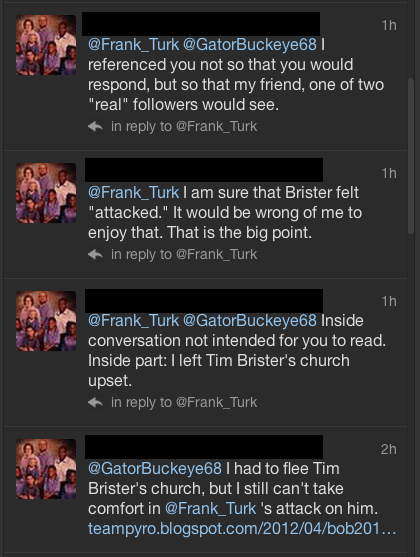
The  most interesting thing that happened last week after starting this 3-part series on Band of Bloggers 2012 was not the passive-aggressive tweets which, when called out, got deleted.  It was this tweet stream I received literally yesterday:

OK: STOP a second.  I have been advised that, for the sake of good order, it ought to be noted that the tweets below are utterly false -- that the people mentioned here are not and have never been members of Tim Brister's church.  


That is actually my point in saying these tweets are a "parable" of how comments work on the internet.  If that was not clear, please let it be clear now: in no way were these tweets clipped and posted here to reproach Grace Baptist Church, its members, or its elders for any behavior in their local church.  These comments, as they say in the KJV, stinketh, and ought to be a lesson to the rest of us as to how not to behave on the internet.


As evidence of such a thing, note that these comments are now evaporated -- as is the habit of people who can't engage the "edify" filter before hitting "post".


You know who you are.


Timmy, whom I could not identify in the first two minutes of the audio, was attacked -- according to this person who fled his church.  Mull that over as a monument to how the internet works.

Anyway, I was going to undertake an extended consideration of the reflections on how blog comments work and ought to work according to the young men of Band of Bloggers, but this example and the tweets which got deleted last week will have to be a parable of the whole thing.  I'll lay off for a week and just post my rough outline of BoB for you as a PDF you can download, right here.

Next week, in our final installment, I'll undertake to discuss, in a helpful way, section 3 of that outline.  It's the part you're dying to read anyway, so consider today a breather.


25 April 2012

BoB2012: Nice Guys with a Hobby

by Frank Turk

Just because it happened, as I started writing this little fiasco, my wife asked me what I was doing, and I told her, "I'm drafting the blog."

She looked at me and said, "You mean you're riding it too close to the truck in front of you again?"

Since she put it that way, yes.


Let me confess a few things about this topic before I start the disreputable and unhelpful blogging.  The first is this: I had a hard time following the audio of the Band of Bloggers 2012 session because I only know Tim Challies' and Justin Taylor's voices, and I can't tell the rest of them apart by voice.  Collin Hansen sounds like Timmy Brister, and one of them sounded like Tullian Tchividjian to me even though I know he wasn't on the panel.  And you would think that I could pick Kevin DeYoung's voice out of the crowd, but honest to pete I just couldn't tell [UPDATED: Turns out KDY was absent that day, so I am not utterly deaf].  So the attributions in this and the next few pieces of bloggeration presented on this subject will be muddled at best because except for Tim and Justin, I can't tell who is who.

The second is this: I am obligated to say that there is not a group of less-offensive men in the whole world who actually speak out loud.  You couldn't find English-speakers who were more concerned with avoiding offense if you tried -- and that includes all English-speaking practitioners of Jainism and Catholic Trappist monks.  You can't catch these guys intentionally saying something barbed in public unless a large thumbtack and a mischieviously-placed stool was involved, and only then the most sharp-edged epithet would probably sound something like the Beaver would say.  God bless 'em for being such nice fellows.

So why blog this audio?  I mean: I simply couldn't be caught walking past the session, and I said my piece via GoAnimation the day of the event, and that should be enough, right?  There's enough evangelical fire-power involved in this panel discussion to see to it that I never publish anything ever except via blog if I somehow irk them.  And may it never be said that they somehow "overlooked" a finalist for best new author of the year because of his associations -- but it could in theory happen.  It would be wrong of me to expect they would behave that way, but it would be foolish of me to think that these guys owe me any favors when I seem to be usually at odds with them and their flavor of edification.

That is to say: blogging this audio is marginally-dangerous -- and some would say, done simply for the controversy.  It draws traffic, after all.  But here's the thing: it seems rather ill-considered that a handful of reasonably well-known bloggers would chat about blogging as such and no other blogs would have anything to say about it.  In some sense, if no one ever brought it up again, it would be too fantastically ironic.  The Band of Bloggers assessed all of Christian blogdom and no one heard it?  No one was edified? Or perhaps: no one cared?


May it never be: I cared.  Or rather, I care.  So let's begin: one of three posts on this interesting event.

The right place to start is with my dear friend and fellow blogger David Kjos who is one of the most gifted bloggers having at it.  David gave his brief assessment of the event here, and it elicited Justin Taylor's response -- to the negative, if you can believe that.  So while I didn't pay my $15 for Chic-Fil-A and the free books, I was a little intrigued to find that David would not think it was entirely satisfying and Justin would find David's comments worthy of disavowal.

The audio, it turns out, is stored at the Southern Seminary archive -- for which we are all grateful.  I gave it a listen or three, and I commend it to all of you for review and discussion.

So here's the transcript of the first few minutes:
(Starting at 00:00)
Owen Strachen: Let's just kick it off with the state of Blogging.  A few years back, I think it was in 2009 at the Gospel Coalition, at that iteration of Band of Bloggers, we wondered whether blogging would continue.  There was a lot of talk in 2009 about whether Blogging was dead -- and Tim (Challies) for example said it wasn't and it seems that he was right.  What is the state of blogging today in 2012 both in terms of the general market if you're interested in talking about that and in terms of the evangelical blog scene.
I start with Justin and go down the line. Any thoughts you have. 
Justin: I'd rather hear from Collin first.  I don't spend a lot of time thinking about that question necessarily.  I do think it's right that blogging is not dead; it will probably never die as long as people want more than 140 characters.  I think twitter is a great gateway into reading longer-formed content which blogs tend to specialize in. I don't think its going anywhere, I think Collin is more gifted at looking at the whole lay of the land.  But it's what I like to do; I'll keep doing it as long as I still enjoy it and people continue to read it.  And my blog is just more of a gateway to other things out there, so I think as long as people want content, blogging in some form will exist. 
Challies:  I just wanna ask a question - how many people here subscribe to the print version of Christianity Today? raise your hand if you would. (pause) How 'bout World Magazine? (pause) Blogs aren't going anywhere. Right?  How else are you going to know what's going on in the Christian world?  That's just the way ideas are carried.  It's the way people are finding out things now -- through the blogosphere.
(Ends about 02:00)
Now, it would be wrong, really, to criticize them for speaking briefly -- the whole session is only an hour, and everyone there was really there for T4G which started hard upon the end of this pre-conference huddle, so what I'm not going to do is pelt these guys for keeping it inside the time they had available.  Good on them, to be sure, for honoring other people's time.

But here's what strikes me about the fellows lined up here: they are all of one stripe.  Here's the list of who was there (in Alpha order):
Tim Brister
Tim Challies
Kevin DeYoung -- Absent, so noted!
Collin Hansen
Owen Strachen
Justin Taylor
Except for Timmy (who is his own brand among Southern seminarians, SBTS being the general host of T4G) and Challies (who is his own brand in the larger internet ecosystem, ranking about the same as the Sport blog for the Boston Herald, and just slightly ahead of this very blog), these guys represent "The Gospel Coalition" brand of Christianity.  You should bookmark that for future reference in this series, but to say that these fellows are anything but one slice of bologna (let's be fair: probably a decent yard of beef and not some skimpy hors d'oeuvre) in the deli of Christian writers -- let alone Christian thinkers or Christian bloggers -- is unreliable.  And in that case, it seems to me that the ice breaker here is a little much.

However, it does give us some stellar foundations by which to track the rest of this discussion.  The core connection (that they are rather monolithic) is the first foundation; the second strikes me as rather obvious: Tim and Justin see this stuff as a rather conspicuous hobby.  You know: neither one earns a living via blogging, but somehow they have both gotten into their current professions via blogging.  They have somehow made a name for themselves which carries over into something else more lucrative, and I credit them for it.  But they do this sort of thing because they like it -- which is an important motivation which we'll need to review in another installment.

The last foundation is that they don't have any illusions about the state of the medium: it is what it is, and it is here to stay.  It is exactly like moveable type amped up on Red Bull and a megadose of B-Complex vitamins, and the great leap forward in terms of the democratization of information and ideas is more like a quantum jump.  "How else," ponders Challies, "are you going to know what's happening in the Christian world?"

And that, I am afraid, is the first fantastic irony.  If you read the blogs these guys publish and link to -- and because you're a Gospel menace you also read this blog -- tell me: what's going on amongst the 1200 Calvary Chapel Outreach Fellowship churches these days?  Whither the BBFI and it's 1.2 million members in this day of trouble?  How about the lowly Methodists or Anglicans?

What they must mean, of course, is, "what's going on in our corner of Christendom," which is not all it's cracked up to be.  It's a pretty narrow and fallow patch of the harvest compared, for example, to what's happening in Africa and South America -- and a patch the world thinks needs more missionaries sent to it.

So is it a fun hobby?  Sure it is.  But it's a clever little hobby that makes us into something terrifying and untrustworthy: it makes us into the center of attention.  And when we become the center of attention, we seem to forget that most people are simply not like us.

Anecdotally, as I was preparing to go to T4G a couple of weeks ago, one of the guys I worked with asked me how I was going to spend my vacation.  "With my wife," I said rather coyly as I was seeking to get my desk sufficiently cleared prior to leaving.

"Ha." he said.  "I mean 'where'?"

So I looked away from the customer car wreck in my In-Box and took off my glasses.  "We're going to a conference called 'Together for the Gospel,'" I said simply.  "It's hosted by a seminary in Louisville, and we're going to see some old friends and listen to a week of talks about whether or not we take the Gospel of Jesus Christ seriously.  Al Mohler will be there; Mark Dever; John Piper."

He looked at me blankly, thinking.  "Amy Grant?"

I put my glasses back on.  "No." I said, returning to my work. "Bob Kauflin."  I might as well have said, "Armin Shimerman."

My point being: even our heroes in that circle of influence are pretty much unknown by the world at large.  And for us to think that our blog reading (let alone: our blog writing) is somehow expressing "what's going on in the Christian world" is, at best, poor accounting.


So maybe the first stop in my tour through the 60 minutes which was Band of Bloggers is this: let's not kid ourselves about the size of the teapot in which we think we are tempesting.  It's not hardly the world -- and not hardly the whole Christian world.  It's a narrow band of blogging, and would be better off expressed that way rather than as something more influential.

That's enough for today.  Comments are open; mind your manners.


28 February 2012

Spurgeon and the tantalizing hope of Biblical blogging

by Dan Phillips

I am almost done re-listening to the audio-book of Spurgeon's autobiography (see here and here). Here is a bit that just leapt out at me as worth sharing with you, with reflection:
In one case, a portion of one of the Australian papers was blessed to the salvation of a reader under the singular circumstances thus related:—

“I was preaching,” says the writer of the narrative, “in the Baptist Chapel, Aberdeen Street, Geelong, a few years ago, when, at the close of an evening service, an elderly man came to the platform to bid me ‘good-night.’ As he was a stranger, I asked him where he came from, and how long he had known the Lord; he then told me the story of his conversion, and the strange way by which he was led to the Saviour. About five years before, while keeping sheep some miles beyond Ballarat, he picked up a sheet of a weekly newspaper, which the wind had blown over the plains. He glanced at a few sentences, and these drew him on to read more, and then he found he was eagerly perusing a sermon by Mr. C. H. Spurgeon. ‘If I had known it was a sermon,’ he said, ‘before I had begun to read it, I should have tossed it away;’ but having commenced the discourse, he wanted to see how it finished. It set him thinking; he carefully preserved it, reading it over and over again in deep concern, until finally it became the means of leading him to the cross. For many years he had not entered a place of worship, and he was utterly careless about his soul till this paper was blown to his feet. Now, when he has the opportunity, he always attends some Baptist service; but this is a rare pleasure, owing to his lonely life and employment in the bush. He does, however, get the weekly sermons, which cheer and comfort him with spiritual nourishment.”

[Spurgeon, C. H. (2009). C. H. Spurgeon's Autobiography, Compiled from his diary, letters, and records, by his wife and his private secretary: Volume 3, 1856-1878 (327). Bellingham, WA: Logos Research Systems, Inc.]
This is the tantalizing promise of blogging. I have often reflected that only eternity will tell what comes of these posts. These posts go places I will never visit. My blog gets maybe 1000 visits a day, up and down; this blog gets 3000-5000, up or (seldom) down. I look on a map of visitors to my blog, and they are from all over the globe, including countries effectively closed to evangelism.

Who are those people? What brought them? What did they read? What effect did it have?

Emails and metas give only some little glimpse. Here's one who wrote me on the verge of suicide; here's one who's an unbeliever, but listening; here's one in marital straits, in a troubled church, in no church at all...

This is why it's worth it. I thought it was worth it some seven years ago, when I had a bare trickle to my blog. I still think it. I am certain that Paul would use it, or would assign someone to it. Spurgeon likely would have as well, judging by his profligate use of every means at his disposal.

So take heart, be sobered and encouraged. You only have 100 a day? 50? 10?

Those are 10, 50, 100 people you (nor anyone else) might never have talked to by any other means.

Sow profligately and well, that we might reap profligately and well; and sow in hope (Eccl. 11:1, 6; Matt. 13:1-9, 18-23)

Dan Phillips's signature

19 October 2011

Open Letter to the Gospel Coalition

by Frank Turk

UPDATED: I am certain that this Open letter did not inspire James MacDonald and Thabiti Anyabwile to get on the phone -- guys like that have calendars that have to align.  But today at about 8:30 central time, Pastor MacDonald tweeted this:


While it's not a press conference, it is a response on-par with the original twitter angry-eyebrows.  We should note it and keep it in mind as we think about this letter and what it has asked for.

Gentlemen --

First of all, when I look at the list of men on the council of the Gospel Coalition, I am humbled. Some of you are my age in years, but you have committed yourselves to the local church and the necessity of the Gospel and have served God in ways which, frankly, I will never approach. You are all pastors, church planters, and ministers of the Gospel who are personally faithful, and have blessed not only your congregations but all of the English-speaking church with your commitment, as Paul said, to fill up what is lacking in Christ’s afflictions for the sake of his body, to make the word of God known.

After all: I am just a blogger. On my best days, I am a street sweeper with a half-worn broom who tries to keep the broken glass off the sidewalk where the kids play.  It's a role which I have sought after, and which I possess, and which gives me a certain kind of reputation. I will never attend seminary, I will never pastor a church, and I am fortunate that anyone finds my reflections our common faith of any use at all. In that context, I thank you for your attention. I will be uncharacteristically brief.

On your site, you lead with this video:


It's a simple confession of what you intend to do as a parachurch organization -- and I think that's an important distinction to make. You are, as you say there, not a church or a denomination. You are a helper to the church.

Sort of inside the tent of that, the following appeared from James MacDonald a few weeks ago:


What particular action that ought to be taken toward this is not my place to say at all. This is a man of a lifetime of good faith, and we should see him as such. The lunatic fringe are the ones who would call for his dismissal or his removal from all good company.

Here's my comment on the matter, and you can take it for what it is worth, namely free advice from someone who has chosen to work in the secular world rather than in the household of God: It doesn't matter what action you take on this matter.

What matters, in order for you to be true to your mission statement, is that you do actually do something. That is: In order to promote Gospel-centered ministry to the next generation; in order to get the Gospel right, and to get it out; in order to avoid detracting from the local church; in order to serve the church; in order to demonstrate the lowness of Evangelicalism by juxtaposing it against the healthly fellowship which should be shared by men of good faith; in order to clarify the difference between fads/distractions and eternal relevance; in order to underscore biblical convictions; in order to put the Gospel at the center of the matter; in order to demonstrate the unity of your aim; in order that you do all these things well, you must do something.

By no means does that mean you must either have some sort of shunning, some sort of group hug, or some sort of steel-cage match -- by no means does it mean that someone must lose their standing either in your assembly or in the eyes of the larger church or the world. What it does mean, however, is that quietly scooting the matter under the rug is, frankly, cowardly, confusing to weaker brothers, disorderly, passively deceptive, and unkind to those involved in the sense that Prov 27:6 helps us to define kindness and friendship among men who serve Christ.

So I exhort you: this matter is a public matter, and it speaks directly to the core mission of your Christian associations. Make your action to resolve it public without teasing anyone's voyeurism; make your action public to teach the weaker brother how men of mature faith treat each other in disagreements; make your action public so that Christ can be glorified by the way you take each others' fault and work through them together for the betterment of each other.

I think you are those kinds of men. May God either prick or console your conscience on this matter as you seek to do his will.


12 October 2011

Open letter to Chris Rosebrough

by Frank Turk

Dear Chris --

Back on 2 Oct 2011, as the Elephant Room controversy was really kicking into high gear, Pastor James MacDonald re-tweeted the following from Rick Warren:


And I knew I have most of the open letters I had to write lined out for me for the rest of the year. To keep the "open" readers of this letter fully informed, Warren's bit.ly link is to this blog post from Thabiti Anyabwile which outlines the massive failures of the Multi-Site church movement. But as I made a mental list of the open letters I had to write based on this tweet from Warren via Pastor MacDonald, I knew the first one had to be to you.

Now, why is that? They didn't mention you there -- didn't even link to a post that you had, at that time, either worked up or worked over. Why would I think of you when Rick Warren decrees that a pastor calling the Multi-site trend "from the Devil" is "burning [other christians] while the world goes to hell."

Well, that's easy: I owe you an apology. Back when you were kind enough to exhaust a couple of hours with me to do an interview about the Mike Horton dust-up, we talked briefly about whether or not Rick Warren was in the tent or out of the tent -- and I told you you probably couldn't convince me that he was out. Well, you never know what the future holds.

Let's think about a couple of things:

Thabiti's article is stellar. The high point for me was probably not the high point for you (you being a wicked Lutheran and me being a wicked Baptist), but when he says this:
A very thoughtful pastor pointed out this morning that we surely need a better theology of the unity of the church beyond the local church. But I think the multi-site, multi-campus strategy that is not speedily and intentionally moving to church planting unravels the local church with an absentee pastor model. Indeed, “church” becomes a strange moniker for this situation. A “church” is not just an assembly, it’s an assembly that is also a “family” where the members do all the one anothers and also a “body” where the joints are connected to supply to one another and a “flock” kept in a corral where the shepherds feed, bind, lead, and guide in personal relationship. Multi-site churches reduce the family, body, and flock to an anonymous assembly. In that way it trades in the lowest common denominator (assembling) while effectively mimicking “local.”
The argument is pretty much over. Sure: there are no bible verse numbers decorating his statement, but even the marginally bible-literate observer can fill in Titus 1&2, 1 Cor 1-3, Acts 2, Rom 14, etc. to get Thabiti's rudimentary point. Everything after that is simply working through the yeah-buts.

His context was from the Gospel Coalition website, and to the TGC Network of readers and pastors who may or may not have seen Pastor MacDonald call congregationalism "from Satan". That context is not a watchblogger context -- it's not a reactionary, discretionless context where someone is always finding something from someone else with which to make an example of them. If anything TGC is usually too genteel to name names (except when they link or otherwise recognize the remarkable Carl Trueman, selah), so when Thabiti unleashes the frank facts about his position and those who are making an idol of their ministry, their personality, their technology and their pride, it's a stunner. But it's not like this is Thabiti's usual approach. It's not like he's one of the bloggers Warren and Perry Noble and many people kvetch about when they are put under the open-source microscope of internet discernment. But it's the right kind of stunner.

And his motive? Pastoral. He wants those who are doing this to reconsider and, insofar as is necessary, reverse course. He didn't throw anyone out of the church or under the bus. It was a post we could all read and get something out of, from his tone and his biblical reasoning to his actual point and how it applies to our local churches.

But Rick Warren dismissed it with a single tweet -- and said this post was "burning other Christians." This post -- where no one was called out, and no one was particularly exemplified, and no one was told to do anything but repent from putting "me" ahead of the church and the welfare of God's people -- has broken out the torches and the pitchforks. This from a guy who says he always learns something from his critics -- or tries to. This from a guy who says that doctrine matters to him deeply. This from a guy who wants to gain friendship and credibility from the T4G crowd and, I think by association, the TGC crowd. The bridge too far for Warren is not, for example, T.D. Jakes appearing at the Elephant Room: it is when a third-world pastor tells first-world trend setters that their view of the local church is, frankly, not God's view.

You know: I see Rick Warren as, in many ways, the average SBC pastor. He has all the strengths and weaknesss of the breed. So when he fibs a bit in public because he wants to be a gracious guest in whatever circle he is in, I can offer good will and read that as polite manners and not wobbly doctrine. When he writes books that do a lot of trading of translations to find the right version of a verse of Scripture to make his point (even if that translation isn't a good translation or taken from the right context), I can offer good will and chalk that up to baptist populist homiletics, for good and ill. And when he simplified the Gospel to "Come and see," I can offer good will to cut him the slack he requires to make his point that, in some sense, the call to be reconciled to God is an announcement and an invitation from God to all men -- a sort of grammar school view of how Christ may be lifted up. He means it for the sake of evangelism and not for the sake of anything else, if we off him good will. In all those things, I have a history of giving him the benefit of the doubt and saying he definitely means well.

That is, until we find him here excluding the good will he requires of others when someone indicts a trend he endorses. His willingness to actually trade in good will is here exposed as fraudulent, and his reaction to biblical counsel from a credible source is simply a giveaway for who he really is and has been all along. Because now it's easy for him to say, "I like my way of doing it better than your way of not doing it." It's easy for him to now say that he has better things to do than actually engage this issue, "like ministry". He can toss out the critic as someone who is burning heretics and therefore not deal with him at all. He puts himself in the place of the uncorrectable teacher, which means that all the good will we have granted him for all the other issues has to now be questioned.

So that leaves me with some unenviable questions to consider. Why should we grant him good will in his abuse of Scripture when he rebukes those with kind, pastoral biblical counsel? Why should we grant him good will when he intentionally waters down truth and the Christian message when he slanders those offering him the truth as the Bible expresses it? Why should we offer him good will toward his double-minded talk about the Gospel in other cases when, in this case, when the cause of the Gospel is utterly clear, he calls the counsellor with Christ in mind a person callous to the world as it goes to hell?

There is only one answer to those questions, and it prompts me to this: to you, Chris, I apologize. I was wrong about Rick Warren, and he could not have made himself clearer. Please forgive me for contesting your good judgment with what was essentially only my act of good will. I was wrong, and I hope you and others will forgive me for it.

Please keep up the good work at Fighting for the Faith, and my God richly bless you for it.


08 June 2011

Open Letter to Our Readers

by Frank Turk

Dear Readers,

Briefly today as my week is surfeit, I have a backlog of open letters to write. I owe Greg Damhorst & Cameron Nations a response to their open reply to me; I have an open letter to William and Katherine about their future as the Royal Family of England; I have some notes for President Obama; I have a retrospective to the man who baptized me and discipled me before I was even able to understand what exactly he was doing for me; and I am sure other items will come up.


Today I only have about 30 minutes to get something worth reading up, so I'll interject this for your edification: has anything happened in the last 6 months which has made you reconsider your own self-perception as a Christian? That is to say, do you live in such a way that there are moments when what you thought was the right-minded routine of your life, heading you in God's grace toward sanctification, turned out to be an idol -- something actually standing in the way of your sanctification?

My opinion is this: if we are living with a real appreciation of the Gospel, this will happen often. And the reason it will happen often is that we are sinful people. We don't want to die to the things we really want: we want to believe rather that what we really want is what God wants for us. So if we really want to be bloggers, for example, that must be what God wants for us. If we really want to be rich, God must want us to be rich. What if the Gospel is supposed to be breaking us down instead?

Now, that sounds rather cliched, and like one of those posts after which someone has a theological melt-down. I get that. You can follow Scotty Ward Smith on Twitter and get that sort of Biblical wisdom in 144 characters or less (without the meltdown) -- you don't need 3 pages from me to have a healthy dose of self-deflating Gospel to get that. But here's my point to you today: coming here to read my open letters each week ought to inspire you to (at least) a weekly gut check. Am I reading Frank's letters so that I can see Frank give yet another famous person the what-for? Am I reading them so I can yet again see what a sniveling ingrate Frank is, and thank God I am not a sinner like him? Or am I reading these letters, and seeing myself in them -- the bits and pieces of my own human flaws, my own human errors, my own mistakes, misgivings, misdemeanors for which I ought to be repentant -- and thereby find a little bit of grace and mercy toward my fellow human beings who are just like me, and need a savior just like me?

So my open letter today is to you. Check yourself. I'm checking myself today, and I'm writing an open letter to my own soul. You can do the same, and then take the rest up with our good and great savior.


22 March 2011

On the nature of blog-posts: strengths and limitations

by Dan Phillips

In reading and understanding Proverbs, it is sometimes helpful to preface a verse by mentally supplying "Other things being equal," or "Generally speaking." For instance: "[Other things being equal,] a soft answer turns away wrath, but a harsh word stirs up anger" (Proverbs 15:1). Without that understanding, for instance, John 18:19-23 is a contradiction.


No one (I hope!) will ever publish a version of Proverbs with these additions, because that would spoil the particular beauty of the book. After all, the point of a proverb is to make a point pithily and memorably. Brevity is a necessity. No one who reads wisely reads as if he had a legal contract or a magic spell book in his hands. It's the particular genius of a proverb to make a categorical assertion as if it were a statement of universal truth — but its success depends on the reader realizing that it is usually not intended as any such thing.

Which brings us to posts on blogs.

I see posts as short-form literature, as a rule. I don't go to blogs for long studies. Some very popular blogs do regularly feature what seem to me to be very, very, very long posts. They lose me, frankly. I don't bother with them. There, I've said it. If I want a study, I'll buy a book or consult an academic journal. The closest a blog will come to that for me will be if it posts a series on a topic — a series of mid-sized or shorter posts.

I think most people understand this, though clearly some do not. For instance, I wrote a post on depression last week. I've also done one on marriage. And another on parenting. And one on pastoral ministry. And on and on and on.

Now, could anyone fairly read any of those posts, and think I was setting out, in 800-1600 words (or whatever) to say everything that could be said on the subject? On any of those subjects?

That would be a fair approach to a post titled "Everything that can possibly be said about _____." I don't think any of us has written one like that. The first comment would point out something we missed, and all would be lost.

As it is the nature of a proverb to make compress some truth about a subject and make it unforgettable, so it is the design of a post to examine one or two aspects of a subject. If it's a good post (as I judge posty goodness, anyway), it will do it informatively, memorably, and perhaps a bit provocatively.

But anyone who sets to at the post to complain about all the things the post didn't say has quite a long row to hoe. But in that, it's a bit like this post about Jesus' teachings on truth and love. We noted that when Jesus said disciples would be known by their love, His omission of other marks was not in itself meaningful. It just meant He set out to make that point, not to exclude everything else He'd already said (and would say) on matters of faith and truth and obedience.

Most of you don't need me to point this out.

But in cases where we do need to remind some folks who pass by, perhaps now Phil or Frank or I can just link to this post. As a reminder.

A brief one.

Dan Phillips's signature