
Showing posts with label NTW. Show all posts

26 April 2010

Tom Wright, T4G, and "Unity": "Can We All Get Along?"

by Phil Johnson


hristianity Today has posted an opinion piece by Brett McCracken comparing this year's Together for the Gospel (T4G) sessions unfavorably with Wheaton College's recent Theology Conference: "Jesus, Paul and the People of God: A Theological Dialogue with N. T. Wright."

The speakers at T4G, of course, firmly believe that "The Gospel" is what binds us "Together." All of them agree that the heart of gospel truth is summed up in the doctrine of justification by faith, and getting that doctrine correct is vital to sound, biblical Christianity. All of them also believe the atonement Christ rendered on the cross was a penal substitution—a propitiatory sacrifice offered to God by His Son on behalf of sinners. There is much more to the atoning work of Christ than that, of course, but the T4G speakers all are convinced that part is essential to a right and full-orbed understanding (and proclamation) of the gospel. In short, all of the T4G speakers hold the historic position on these matters that is spelled out in all the Protestant confessions of faith.

And the theme of the T4G conference this year was "The (Unadjusted) Gospel."
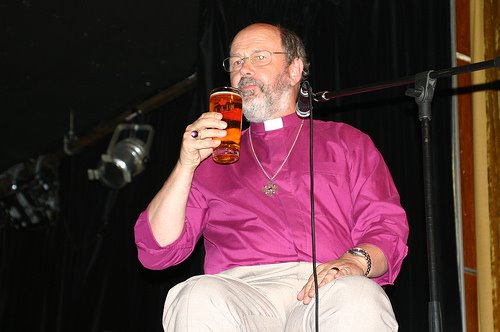


N. T. Wright, on the other hand, is controversial chiefly because he wants to make significant adjustments to the doctrine of justification by faith and our understanding of the atonement. He doesn't like the language of imputation. He's uncomfortable with the idea of penal substitution and the language of propitiation.

For Wright, justification is more about ecclesiology than about soteriology. Indeed, he says, "The doctrine of justification . . . is not merely a doctrine in which Catholic and Protestant might just be able to agree on, as a result of hard ecumenical endeavour. It is itself the ecumenical doctrine, the doctrine that rebukes all our petty and often culture-bound church groupings, and which declares that all who believe in Jesus belong together in the one family. . . . The doctrine of justification is in fact the great ecumenical doctrine" (What St. Paul Really Said [Grand Rapids: Eerdmans, 1997], 158).

Between 2002 and '05 I did seminars at a couple of conferences on both sides of the Atlantic critiquing Wright's doctrine of justification (transcripts HERE and HERE). One of the things I keep trying to point out is that despite Wright's professed contempt for reading Reformed and Augustinian concerns back into the Pauline text, high on his own agenda is a determination to bring Paul's doctrine of justification into line with 21st-century standards of political correctness. Wright's whole hermeneutic seems driven by the credo of Rodney King. Wright seems to be looking for a new perspective on the gospel that would allow Catholics, Protestants, and all kinds of wayward Anglicans to set their "differences" aside and have a great group hug in the name of ecumenical unity.

It comes as no surprise, then, that in Wright's mind, "Nothing justifies schism."
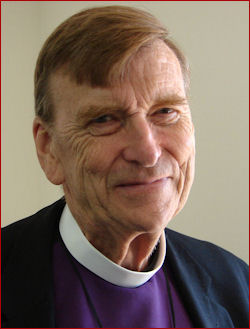
Now: let's bear in mind that statement comes from an Anglican bishop who is currently in communion with this bishop, this bishop, this bishop, and a menagerie of other bishops including several agnostics, heretics, and theological miscreants of virtually every stripe.

That fact surely sheds light on what Bishop Wright might be aiming at in his radically ecumenical re-reading of the doctrine of justification. And the mess that we know as "The Anglican communion" also must be carefully borne in mind when we read this solemn assurance in the CT op-ed piece: "Wright, perhaps the world's leading Christian theologian/writer/intellectual, was calling for the church to prioritize unity and emphasize common ground, not at the expense of doctrine and not in a universalist way."

Really?

The shopworn not-at-the-expense-of-doctrine warrantee is of course standard language these days in everyone's ecumenical efforts—ranging from "Catholics and Evangelicals Together" to the early rhetoric of the Emergent fiasco (where, in fact, everything came at the expense of doctrine). Such assurances especially ring hollow when the people making such promises in the very same breath relegate a principle like sola fide to "the details of theological minutia."

"After all," Brett McCracken says, "[Paul] speaks of justification only in a few places (Romans, Galatians, etc.), while unity is a topic that shows up constantly in nearly everything he writes."

Yikes. Seriously?

That's about the worst summary of the Pauline perspective I have ever heard.

McCracken should have listened more closely to the T4G messages. His cynical description of T4G ("like a club patting each other on the back for their mutual buttressing of the 'unadjusted gospel' against threats from various corners") puts his yearning for "unity" in clear focus. If we're not willing to relegate all our differences with everyone who claims to "love Jesus" to the category of "theological minutia," we are the "schismatic" ones—not the Anglicans (and their ilk) who have winked at (and even given their benediction to) virtually every kind of sin and apostasy, as long as their own bishops are involved.

The cost of that kind of cosmetic unity is simply too high. Far from being "a sign to the world" and "a message to the would-be rulers of the world," it dishonors Christ. The artificial peace of compromise and mandatory-cease-fire solidarity isn't authentic unity anyway. It is nothing like the kind of unity Paul called for. It certainly is not the kind of unity Christ prayed for.

Of course some points of doctrine are theological minutiae, and we don't need to argue endlessly about them. Most of us don't. But justification by faith is not one of those peripheral points. Luther and the other Reformers were driven by the unshakable conviction that the doctrine of justification by faith is the primary soteriological essential, the article by which the church stands or falls. Unless we're willing to declare the Reformation a mistake (something Bishop Wright needs to do—and may yet do—in order to be consistent with his own rhetoric), we should resist these incessant pleas from so many quarters to see "church unity" through postmodern eyes. Instead, we need to keep striving for the kind of unity Scripture describes—a unity that is possible only when we are walking in the light (1 John 1:6-7).

Phil's signature

18 June 2009

N. T. Wright on Hell

or, "Honey, I shrunk the Lake of Fire!"

by Dan Phillips

This is not new, but it is new to me; and may be to you.


Here's part of a transcript from this page, with some cleaning up and emphasis:
The word hell has had a checkered career in the history of the church. And it wasn't hugely important in the early days. It was important, but not nearly as important as it became in the middle ages. And the in the middle ages, you get this polarization of heaven over here and hell over there, and you have to go to one place or the other eventually. So you have the Sistine Chapel, with that great thing behind the altar. This enormous great judgment seat, with the souls going off into these different directions.

Very interestingly, I was sitting in the Sistine chapel just a few weeks ago. I was sitting for a service, and I was sitting next to a Greek Orthodox...who said to me, looking at the pictures of Jesus on one wall. He said, these I can understand. The pictures of Moses on the other wall, he said, those I can understand. Then he pointed at the end wall of judgment, and said, that I cannot understand. That's how you in the west have talked about judgment and heaven and hell. He said, we have never done it that way before, because the Bible doesn't do it that way.

I thought, Whoops. I think he's right actually. And whether you're Catholic or Protestant, that scenario which is etched into the consciousness of Western Christianity really has to be shaken about a bit. Because if heaven and earth are to join together. Its not a matter of leaving earth and going to heaven. Its heaven and earth joined together.

And hell is what happens when human beings say, the God in whose image they were made, "We don't want to worship you. We don't want our human life to be shaped by you. We don't want, who we are as humans to be transformed by the love of Jesus dying and rising for us. We don't want any of that. We want to stay as we are and do our own thing." And if you do that, what you're saying is you want to stop being image-bearing human being within this good world that God has made. And you are colluding with your own progressive dehumanization. And that is such a shocking and horrible thing, that its not surprising that the biblical writers and others have used very vivid and terrifying language about it.

But people have picked that up and said, "This is a literal description of reality. Somewhere down there, there is a lake of fire, and its got worms in it and its got serpents and demons and there coming to get you. But I think actually, the reality is more sober and sad than that, which is this progressive shrinking of human life. And that happens during this life, but it seems to be that if someone resolutely says to God, "I'm not going to worship you . . ." (It's not just, "I'll not come to church." Its a matter of deep down somewhere, there is a rejection of the good creator God), then that is the choice humans make. In other words, I think the human choices in this life really matter. Were not just playing a game of chess, where tomorrow morning God will put the pieces back on the board and say, OK that was just a game. Now we're doing something different. The choices we make here really do matter.


There's part of me that would love to be a universalist, and say, "It'll be alright. Everyone will get there in the end." I actually . . . The choices you make in the present are more important than that.

Some of my thoughts:
  1. Did the polarization of Heaven and Hell into two diametrically-opposed destinations really arise during the Middle Ages (cf. Matthew 25:32-46; Revelation 20:4-15)?
  2. If someone "cannot understand" the concept of a final judgment, is that a comment on the concept, or the individual?
  3. Is Hell something that "happens" when we make certain philosophical choices, or is it a place of judgment and punishment?
  4. If Hell were an actual place, what language would the Bible have had to use to make that fact clearer than it is in the text as we have it?
  5. If the writers of Scripture saw Hell as "shocking and horrible," and used "vivid and terrifying" language to describe Hell, but it is a mistake to take it as a "literal description" of Hell — (1) then shouldn't the reality be more terrifying than their language?; and (2) is what Wright describes more shocking and horrible and terrifying?; and (3) how could they have signaled more clearly that they were not speaking metaphorically?
  6. Does Wright leave the impression that avoiding Hell is worth cutting off precious and irreplaceable parts of our body (Matthew 5:29-30)?
  7. How does Wright's notion of Hell relate to Jesus' flat statement that God throws the damned, body and soul, into Hell — and that He should be feared above all else for that reason (Matthew 10:28; cf. Revelation 20:15)?
  8. Is there something un-Biblical about viewing the last judgment as a separation of two humanities with two starkly different eternal destinations (Matthew 25:32-46; Revelation 20:4-15)?
  9. Is it that view of judgment and Hell that is "Western" — or is it not Wright's own existential, philosophized presentation that is thoroughly and almost squeakingly "Western"?
  10. Does Wright's explanation of Hell as the "progressive shrinking of human life" strike you as "more sober and sad" than unquenchable and eternal fire, endless gnawing of worms, in fathomless darkness, cut off from every vestige of God's goodness?
  11. Do you have to been born in the East to understand fire and darkness and wrath and judgment?
  12. Does Wright present his unbelieving listeners with a Hell that is just and unbearable punishment for crimes of infinite gravity and guilt that we committed against a blindingly holy God; or with a Hell that is a rather tame, if "sad," natural consequence of our philosophical bent?
  13. Which is truer to Jesus' presentation of Hell?
  14. Does Wright communicate any urgency in escaping Hell?
Your thoughts?

UPDATE:
see also this companion-piece.

Dan Phillips's signature

24 April 2007

Discerning Wrong from Wright

by Phil Johnson

om Wright has posted a screed on the atonement controversies. (I made note of that fact in a comment under yesterday's post but didn't say much more than that.) I still need to read the full article carefully, but Adrian Warnock's observations closely mirror my own first impression. Wright seems to think since Steve Chalke read some of the Bishop's books and echoed his positions at some key points, he can't possibly be far wrong on the atonement. Also, since Wright endorsed Chalke's book before it caused a flap on the atonement issue, he apparently feels obliged to explain what Chalke really meant.

I dunno. I thought Chalke's own explanation left little doubt about his position, and it does not seem to be what Wright insists it is.

In his article, Wright has some pretty harsh things to say about the book Pierced for Our Transgressions, a recent, generally well-reviewed book on the atonement co-authored by Steve Jeffery, Mike Ovey, and Andrew Sach. Near the end of his post about Wright's article, Adrian Warnock lists some typical samples of the scorn Wright pours on that book.

The authors of Pierced for Our Transgressions have responded to Bishop Wright's article here.

Meanwhile, D. A. Carson has put out a review of Wright's Evil and the Justice of God (HT: Justin Taylor), which review contains some candid remarks about Wright's position on the atonement. Following the linkbacks to Justin Taylor's post on the subject will take you to some stimulating discussions.

Doug Wilson (as usual) had the pithiest comments, and this reflects my response exactly when I read Wright's response to the atonement debates:

The really strong language from Wright is reserved for the men from Oak Hill [who wrote Pierced for Our Transgressions], and this is where things get really weird—"almost funny," "Go and read the book," "hopelessly sub-biblical," "it becomes embarrassing," and so on. This is because (as I take it from this distance) they offered a case for penal substitution in the language of systematic theology and not biblical theology. I don't know (not having seen the book) if I would even agree with Wright's point. But what I can say, from this distance, is that Wright has a wildly skewed view of who needs to be praised, who placated, and who challenged.
On the perennially pro-Wright side, Alastair has already weighed in. When Mark Horne speaks, I listen (even though I often disagree). Mark is almost always sympathetic to whatever Wright says, and this is no exception.

My own lack of enthusiasm for Wright's opinions on the atonement, justification, and Pauline theology is well known enough. So don't look for me to jump into this dogpile this week. I'm just going to pretty much sit back and watch it all unfold.

Remember: John Piper has a critique of Wright coming, too.

Phil's signature

15 December 2006

Where I am Right Now, Part 143

Is my solipsism showing again?
by Phil Johnson

ell, Darlene and I are back from the UK, and coming home reminds me why I don't like to travel for more than 2-3 days at a time (especially in December). My desk is piled high with stuff I need to do immediately. I brought home a chest cold and a case of fatigue (or jet lag, or something) that is making it hard for me to think straight after 5:00 PM.

But I wanted to list some of the highlights of our UK visit:

  • First, I'll give the obligatory disaster rundown. Last year I blogged about how bad things happen when I go places. In a different post, I chronicled and documented an amazing string of six earthquakes that followed me from continent to continent over three years' time. For years now, whenever I have returned from traveling, people who know me always ask what disaster accompanied me.
         On this trip, we encountered a freak tornado. It went over our heads like a freight train while I was at the Metropolitan Tabernacle, meeting with Dr. Peter Masters.
  • We also had a drunk and disorderly man two rows away from us on our flight home who had to be subdued, handcuffed, and duct-taped to a back-row seat for most of the 11-hour flight home. That incident delayed our arrival, because the FBI and LAPD needed to meet the flight and remove the miscreant before anyone else could deplane. But that was more annoying than truly "disastrous."
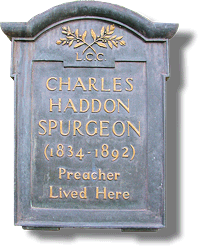
  • Spurgeon was hereSpeaking of Dr. Masters, he kindly arranged for me to examine a priceless file full of handwritten letters from Charles Spurgeon, mostly pastoral letters written to the congregation at the Metropolitan Tabernacle.

         The collection included all the weekly letters he wrote from Mentone, France, in 1891-92, in those final weeks before his untimely death in a Mentone hotel, January 31, 1892. They are tender and touching letters, but reading them in sequence mostly helped make me aware of the unbelievable amount of constant pain and discomfort Spurgeon endured from gout and other complications of kidney disease, on top of the oppressive sense of stress he felt after being shunned by so many of his friends and fellow ministers in the Down Grade controversy.
         The pain is clearly reflected in the letters, and holding these documents and reading the words in Spurgeon's own handwriting made for an unforgettable evening. I managed to get excellent scans of five of the most important letters. If I had the time, I would have scanned them all. I'd post one of the scans, but I don't know if these letters have ever been published before, and I don't want to violate any copyright that might belong to the Metropolitan Tabernacle, so I need to wait and ask permission before doing anything with them.
         I told Dr. Masters I was tempted to steal a letter or two, but I managed to mortify my flesh in the nick of time.
  • Speaking of Spurgeon, I made my first visit to the Helensburgh House on Nightingale Road in Clapham. That house, with some modifications, is the same one Spurgeon lived in for most of his ministry in London. It's called "Queen Elizabeth House" today, but the above plaque commemorating Spurgeon marks it as his famous home. It's literally within walking distance of where my friend (and frequent Pyro-commenter) Doug McMasters now lives. Doug was recently called to pastor Trinity Road Chapel in Tooting, a historic church with a close connection to Spurgeon.
Helensburgh House in Spurgeon's time
Helensburgh House today

  • I rarely get sick, but it seems when I do, it's after I've been on a long flight, breathing those recycled germs in a compressed airliner. Within 24 hours of our arrival in Britain, I had symptoms of laryngitis and a head cold. The night before the "Men of Kent" conference, I went to bed very early, wanting to rest my voice so that the laryngitis wouldn't keep me from speaking at the conference that brought me to England in the first place.
         Just the day before, I had received and printed out the draft of several chapters from a book John Piper is working on in response to N. T. Wright on the doctrine of justification by faith. So I started reading it. I couldn't put it down and wound up staying up late anyway. The book is unfinished and Piper is currently working on other things.
         Since it's not ready for publication yet, I can't quote from the book and won't say much about it except to say that Piper's defense of sola fide and his exposition of the ramifications of divine grace literally moved me to tears. It's an excellent, irenic, thoughtful, informed, thoroughly biblical, and fair response to Wright. I've done a couple of one-hour seminars examining Wright's statements on justification. In the process I've read carefully what Wright has written on the subject, and I have thought for many hours—no, many months—about the subject. But Piper's book made points and highlighted things that have never occurred to me. Piper's analysis of Wright is a thousand times better than my measly efforts. I learned a lot from Piper about this whole controversy, and I can't wait to see his book completed and in print. Keep an eye out for it.
         When the final manuscript is ready, I hope to get a copy I can review and preview here.
  • I met the esteemed Dr. Adrian Warnock again. Same place as last time: Starbucks in the lower level of Waterloo Station.
         He has posted his notes and a photo from our meeting at his blog. He has also posted this video, which Darlene took with Adrian's really cool camera. As always, I enjoyed the time with him and wish it could have been longer. But he is gainfully employed in the real world and like me is not really a full-time blogger. So we only had about an hour together.
         We discussed the difficulty of blogging with a real job on the side, controversy in the blogosphere, our respective styles and different approaches to certain issues and people, and the problem of troublesome commenters who seem to aim at being irksome. If you're wondering whether we talked about you or not, we probably did. We did not argue about the charismatic issue. (There wasn't nearly enough time for that, or we would have, I'm sure.)
         But Adrian revealed to the world during my visit that he is about to be a father once more. Congratulations to him and Mrs. Warnock.

There's prolly more I could say about the past two weeks, but this is enough for now. I have some thoughts about evangelicalism in the UK that I want to crystallize and post one of these days, but not today.

I also have two important articles due this week, plus all the urgent stuff that stacked up whilst I was gone, so don't expect much more from me this week.

It's good to be home.

Phil's signature


16 August 2006

The "It's not for me to say" dodge

by Dan Phillips

Billy Graham.

N.T. Wright.

What do they have in common?

"Not much," you'd think. Okay, they both talk funny. But that's it. Billy

Popular conceptions have the former as the straight-shooting, simple "The Bible says" evangelist, and the latter as the sophisticated, well-spoken, ultra-scholarly academic clergyman.

Well, here's something "Rev."* Graham said in a recent Newsweek interview with Jon Meacham:
A unifying theme of Graham's new thinking is humility. He is sure and certain of his faith in Jesus as the way to salvation. When asked whether he believes heaven will be closed to good Jews, Muslims, Buddhists, Hindus or secular people, though, Graham says: "Those are decisions only the Lord will make. It would be foolish for me to speculate on who will be there and who won't ... I don't want to speculate about all that. I believe the love of God is absolute. He said he gave his son for the whole world, and I think he loves everybody regardless of what label they have."
Nor is this the only time Graham has expressed such notions—and worse.

Now here's something Right Hon. "Rev." Dr. Wright said in an interview:
Q So we won't all be saved?

A According to the New Testament there is a real possibility…

Q No according to you … I want you to tell me.

A … I'm sorry - I'm a Christian theologian - therefore the New Testament is where I must start. And yes I'm affirming this. That there is a real possibility of loss but just at the point where we think the New Testament is going to say 'Bang - there it is. We're going to tell you who's in, who's out,' there are hints and vague suggestions, that actually yes, there will be those who will look God in the face and say 'Sorry that's not for me and I'm going to go the other way,' and that God will ratify that decision, because we are human beings with the dignity of making those decisions - that there are many others who are being drawn towards the light, many others who are being wooed into the love of God. And that it's not up to me to say exactly where that line is drawn on a page. I do believe that there is a real possibility and actuality of final loss, but that immortality is this strange, new gift. It's not that, as Plato said, we've all got an immortal soul and we're all just going to carry on. No, that's not the Christian belief. The Christian belief is that God promises this as a fresh gift to be received gratefully....
(H-T to CraigS, an admirer of Dr. Wright's who nonetheless expresses concern about Wright's unclear position on universalism, and provides further quotation as grounds for concern.)

At this point, everyone knows what I'm going to say. Right? Some are already really angry about it, and already know how they're going to blister the comments section. Well, don't be so sure.

Both of the interviews contain other statements by both men that range from good to very good. And I don't, by these two interview, judge the entire ministry or career of either men. (Though, candidly, it's awfully hard to have read Iain Murray's excellent but depressing Evangelicalism Divided and not see Graham's remarks as further points along a decades-long path. But I digress.)

And do I object to either man saying "I can't guess every aspect of God's judgment in every case"—if that's what they're saying? Absolutely not. I've often said, and with great sincerity, that I couldn't be happier that those decisions are not mine to make. I couldn't be happier that they are God's provenance alone (Psalm 50:6; John 5:22).

Here's my problem: it's the "It's not for me to say" dodge. What's that? It's where someone asks you point-blank—
  • "So if someone lives a good life, gives to charity, and never hurts a fly—will he go to Hell forever when he dies, just because he didn't believe in Jesus?"
  • "So what about good, moral Jews, or Moslems, or Buddhists, who live good lives, are just and kind and loving—they go to Hell if they're not Christians?"
  • "So what about folks who never hear the Gospel, but they're not like headhunters or rapists. They go to Hell forever?"
  • "My mother wasn't a Christian, but she was a really good mother and loved me. Is she in Hell?"
Maybe they're sincere questions. Maybe they're trick-questions. Often they're trick-questions, feints, ploys. The questioner thinks it's a slam-dunk damning question, guar-on-teed to make you and your whole Jesus-thing look foolish and mean and stupid. He can't even imagine you giving him a straight-up answer.

And you feel the pressure. You know how you'll look and sound if you fall into his trap. So... you have the temptation to hedge. You have the urge to just wiggle a little, just apply an itty-bitty touch of verbal lubricant, and slip the noose you think is hanging in front of you.

Now, one would hope that if someone has put himself forward, and thrust himself into the spotlight as a spokesman for Christianity—as, say, Billy Graham, and N. T. Wright, and Joel Osteen, and T. D. Jakes have done—one would hope, I say, that they'd be ready not to dodge the hard ones.

But it sure looks to me like Graham and Wright have given in to the temptation. They punted, where God spoke plainly. Billy Graham certainly gave his interviewer that impression. Here's what Meacham writes, in hardy praise of Billy Graham:

But more recent years have given him something he had little of in his decades of global evangelism: time to think both more deeply and more broadly. As he has grown older, Graham has come to an appreciation of complexity and a gentleness of spirit that sets him apart from many other high-profile figures in America's popular religious milieu—including, judging from their public remarks, his own son Franklin Graham, and men such as Jerry Falwell and Pat Robertson.

Others relish the battlefield; Graham now prizes peace. He is a man of unwavering faith who refuses to be judgmental; a steady social conservative in private who actually does hate the sin but loves the sinner; a resolute Christian who declines to render absolute verdicts about who will get into heaven and who will not....

You give answers like this because you want to be liked. You want to be everybody's friend. You want to be admired by all. You don't want to be mocked and scorned. You want to be well-thought-of. By men. And you've forgotten how deadly that motivation is (Proverbs 29:25; Luke 6:26; James 4:4).
My sputtering readers are still sputtering. "So... so what are you saying?! You're ready to say who's going to Heaven, and who's going to Hell?"

Well—of course I am. Aren't you?

In fact, I'm not just "ready"—I'm obliged. At worst, it would be craven, rebellious, cowering unbelief to know my Lord's standard of judgment, and not to affirm it.

Beyond that, it would be loveless, and would paint me with the blood of my hearers, whose admiration and applause I would win at the cost of their souls (Proverbs 24:11-12; Ezekiel 3:18; 33:8; Acts 20:26-27).

Now, I'm not ready nor able to read off a list of names, and I'm not prepared to predict the end of every specific circumstance. But here is what I am ready to do:

I'm ready to tell my questioner that all—all natural-born sons of Adam, without exception—have sinned, fall short of the glory of God, are without excuse, and can justly demand nothing of God but His eternal wrath and the fires of Hell (Romans 1:20; 3:9-20, 23).

I'm ready to tell my questioner that, whatever excuse he may try to apply to a tribesman who never hears the Gospel, it will not work for him, nor anyone else within hearing (Matthew 11:22, 24; Luke 12:47; John 15:22).

I am ready to tell my questioner that the only hope God holds out is personal, conscious faith in Jesus Christ (John 14:6; Acts 4:12), through faith in whom alone we can find forgiveness and reconciliation to God by grace alone (Ephesians 2:4ff.).

I am ready to tell my questioner that his hearing of the word of the Gospel from me serves to heighten his guilt before God if he rejects it, if he refuses to repent and believe in Christ (Luke 12:47; John 3:36; 12:48; Romans 2:4-5).

I am ready to tell my questioner that what the Bible says, it isn't saying to the other guy; it's saying it to him, and to me —and besides, he won't do the other guy any good by going to Hell with him.

No, it isn't for me to say—but it is for God to say, and it is for me to affirm what He has said, boldly and plainly.

And honestly: suppose I ever get too sophisticated, or too educated, or too popular (bwahhhh hahahaha), or too feeble to be willing to say that much, just that plainly. In that case, please, someone—gently, firmly, love God, and love souls, and love me enough tell me to stop talking where people can hear me. Give me something else to do, where I won't obscure the Gospel issues, and bring damage to the cause of Christ.

Dan Phillips's signature

*It's not the men, it's the title that bugs me. Don't ever call me "Reverend."


19 May 2006

The Key to the Gospel

With an Unexpected Addendum about My Criticism of NT Wright
by Phil Johnson

I've been reading the comments for the past two days, and it occurs to me that someone desperately needs to post something of substance here. So I'm going to do something I've wanted to do since I started blogging last year: This is the start of a series on the doctrine of justification by faith and the principle of imputation.
Second Corinthians 5:21 is one of my favorite verses of Scripture: "For he hath made him to be sin for us, who knew no sin; that we might be made the righteousness of God in him."

The whole gospel message is contained in embryo in those words. That short statement is crucial to our understanding of the nature of the atonement, the doctrine of justification by faith alone, and the twin principles of imputation and substitution. It teaches great truths about the character of God, the sinlessness of Christ, and the simplicity of salvation. It summarizes the core truth of biblical soteriology. It has important implications for Christology. And it even says something about theology proper, because it plainly assumes the sovereignty of God, the love of God, the justice of God, and the grace of God.


This is one of those crystal-clear verses that helps us make sense of all the rest of Scripture. It helps explain the significance of the priestly and sacrificial laws of the Old Testament. It thoroughly illuminates the meaning of the cross of Christ. It reminds us why Christ is the only way of salvation from sin. It shows why no good works performed by sinners could ever contribute an iota to their salvation. And it demonstrates how salvation was accomplished for us without any of our own works—and yet in a way that completely fulfilled God's law, upheld His justice, and vindicated His own righteousness.

In other words to borrow an expression from Romans 3:26, here is how God can "be just, and the justifier of [those who believe] in Jesus." This text explains how God can pardon sinners and treat them as righteous without compromising His own impeccable righteousness or lowering His perfect standards in any way.

I love John MacArthur's summary of the meaning of this text, and it bears repeating. It's also a pretty good paraphrase of the text itself: "On the cross, God treated Christ as if He had committed all the sins of every sinner who would ever believe, so that He could treat believers as if they had lived Christ's perfect life."

In a series of posts that will probably stretch across the next two weeks or longer, I want to explore further the far-reaching ramifications of this simple verse. I think it's a good corrective for much that is lacking in contemporary evangelicalism's truncated gospel message.

Phil's signature

PS: The Pulpit Live blog now has open comments and an RSS feed. We've put a graphic link in the form of a small ad in our right sidebar to highlight the best of whatever is current over there. But here's something a lot of people missed anyway: Some interesting details about the size and shape of the pulpit at Grace Community Church.

The Wright Stuff

PPS: Somewhat germane to the topic of sola fide and justification by faith, over at Reformed Catholicism, Jamey Bennett posts this critical review of my comments on NT Wright and the New Perspective on Paul. (He's reviewing a chapter of mine from the book Fool's Gold, which chapter was a slightly edited version of a seminar I did at the Shepherds' Conference a couple of years ago.)

I'll say this for Jamey: his comments are measured and reasonable, absent the tone of smug and ill-humored snideness often favored by a few of the regulars over at Reformed Catholicism. He rightly zings me for referring to Wright as an "Archbishop." (But then he commits a similar gaffe by referring to John MacArthur as my editor. Well, OK. On second thought, JM does sometimes edit me.)

Jamey at least did me the favor of reading the chapter before criticizing it, and he interacts with what I actually said (something some better-known critics have egregiously failed to do), as opposed to merely questioning my right to criticize the Bishop at all.

As a matter of fact, Jamey turns the normal defense of Wright completely on its head. Instead of complaining that no one has a right to critique Wright's popular-level books without first doing dissertation-level work on all his scholarly tomes, Jamey acknowledges that he himself has read only Wright's "... for everyone" commentaries. He confesses that he hasn't even read the book I was critiquing.

Nonetheless, Jamey objects to my criticism of Wright's view of justification as an incomplete process which culminates in a "declaration [that] will be made on the last day on the basis of an entire life." My complaint was that Wright seems to smuggle the believer's own works into the justification formula with that definition. But Jamey says he sees no difference between that and John MacArthur's view that salvation (note: MacArthur does not say "justification") is a process that won't be complete until we are glorified.

Jamey's comments reflect a point of confusion—the equating of justification with all of salvation—that I would regard as the source of many evils in the world of contemporary Protestant soteriology. It's the very same error made by the advocates of antinomian no-lordship theology (though they push it to the extreme opposite conclusion from the "Reformed Catholicism" gang).

Anyway, the timing of this is propitious. My current series of blogposts on 2 Corinthians 5:21 will enable me to elaborate on some of the issues Jamey's review deals with.

19 April 2006

The Wright Stuff


A parting gift
from Phil Johnson

Here's a letter I wrote to the iMonk a year ago this very week, before I ever even considered entering the blogosphere. (As a matter of fact, the episode that precipitated the following letter, closely followed by a campaign of terror at the Boar's Head Tavern, is the biggest factor that finally provoked me to start blogging. I made that decision last year, a couple of weeks after this letter was written.)

Some background: Last March, the iMonk stumbled across a critical review of an NT Wright book from a lecture I gave in London more than a year before that. (I also gave a completely different review of the same book last year at the Shepherds' Conference, a couple of weeks before Michael Spencer's diatribe. The two reviews were for completely different audiences. They complement, but don't contradict one another, and—just to be clear—it was the earlier one that was the object of so much derision from Michael Spencer last April.)

It's putting it mildly to say that the iMonk hated my critique. He dashed off an angry post about it at the Boar's Head Tavern Blog. He didn't bother interacting with the substance of what I actually said, but he took quite a bit of liberty misrepresenting what I said. For example, here's how he paraphrased the thrust of my message: "Just keep reading those Macarthur commentaries, and all will be well. Consider us warned."

Of course, I hadn't mentioned MacArthur or anyone's commentaries anywhere in my critique. I had described Wright's book and disagreed with four points, all related to his view of justification.

Anyway, the following letter was my response to Michael's suggestion that Wright should be off limits to lesser beings like me:

13 April 2005

Dear Michael,

Readers of your blog have informed me that there is some controversy there concerning how much of N.T. Wright I may or may not have actually read. Someone sent me a collection of remarks you have posted about me ["he hasn't read the people he's citing. . . . He's only read WSPRS {What St. Paul Really Said} and he's only going to critique WSPRS. Tell-tale sign of what you are getting. . . . If I'm wrong about this, I will publically apologize"]—and strongly suggested that in the interests of self-preservation I need to write and give you an accounting.

At the moment, I'm supposed to be editing a book that's due to the publisher at the end of the month, so I don't have time to peruse many blogs or even keep my own website up to date. I apologize for missing the brawl over at The Boar's Head Tavern. But you have my permission to post this e-mail in full as my one and only contribution to the brouhaha. I wish I could come and join the fray personally, but my schedule seriously doesn't permit me to do so at the moment.

Anyway, to the business at hand:

I am by no means any kind of expert on Wright's written corpus (nor did I ever claim to be). On the other hand, I've read a little more Wright than you originally guessed.

Of Wright's large works, I have read only The Resurrection of the Son of God and a generous helping (but not much more than half) of Jesus and the Victory of God. Of his smaller works, I have read The Challenge of Jesus, Who Was Jesus? and What Saint Paul Really Said. I actually had to read WSPRS multiple times, because after my first reading, I participated in two semester-long discussion groups with a dozen or so seminary students who were particularly keen to study that book. Then I was asked to review it twice in separate conferences.

Also, when N. T. Wright was canon theologian of Westminster Abbey, the gift shop there used to carry his books. (They quit doing that when he became Bishop of Durham. So much for brand loyalty.) I once stopped in there and bought a bagful of his little commentaries in the "For Everyone" series. I've used them frequently (the "Galatians" volume is particularly dog-eared); I have listened to several lecture series by Wright; and I have read virtually all the short pieces by him posted at http://www.ntwrightpage.com/.

WSPRS is the only Wright book I have ever formally reviewed. For the most part, I thought The Resurrection of the Son of God was superb. I do greatly appreciate Wright's unrelenting defense of the historicity of Jesus and the resurrection. I've seen him a couple of times on the BBC, dismantling the latest skepticism, and I appreciate how he handles that kind of nonsense. As I have said often and publicly, we owe him a great debt for the clarity and force with which he has answered the left wing of contemporary "Jesus scholarship."

But I don't think it necessarily follows that it's impossible or unreasonable for anyone who truly appreciates those contributions to conclude that Wright's view on justification by faith poses certain serious dangers.

And to suggest that all my concerns about Wright boil down to "four paragraphs in a small book" is the very kind of ham-handed hyperbole I think you rightly deplore. (Likewise for your comment that I am "freaked out" and "panicked" about Wright's "attack on transactionalism.") Wright has written a considerable amount to try to clarify his position on sola fide. I have read as much of it as I have been able to obtain. I still have grave concerns. Sorry, but I do.

The earliest thing I read from Wright on justification was a chapter titled "Justification: The Biblical Basis and its Relevance for Contemporary Evangelicalism," which he originally wrote in 1980. I first saw a reference to it in the late '90s in Philip Eveson's book on Justification. (Eveson's published criticism of Wright actually preceded WSPRS.) So I acquired a copy and read it. That chapter contained the seeds of almost everything that troubles me about Wright's view of justification and the atonement. It was written 20 years before WSPRS, so to suggest that Wright only recently got himself in trouble with Reformed critics because of "four paragraphs" in one of his less technical books doesn't really do justice to the larger argument.

The folks at http://www.ntwrightpage.com/ have kindly posted that chapter from 1980, as well as several other articles by Wright in which the Bishop attempts to defend his views on justification. I've read all of those, and obviously, I remain deeply troubled about Wright's position.

However, let me address the larger issue of "the Grand Canyon of scholarly gravitas that exists between Phil Johnson and N.T. Wright," and the corresponding question of whether a "hack" like me has any right to subject a scholar like Bishop Wright to the kind of scrutiny the Bereans employed when they analyzed the teaching of the apostle Paul:

  1. I admit freely and without reservation that there is a vast, almost unbridgeable chasm—nay, virtually a bottomless pit—of "scholarly gravitas" between Wright and Johnson. No argument there.
  2. And insomuch as my first review of WSPRS (especially the printed editions of my transcripts) may have failed to pay due respect to the Bishop's scholarly credentials, I do humbly acknowledge and bewail my manifold sins and wickedness, which I, from time to time, most grievously have committed, by thought, word and deed. And I promise to try to do better in the future.
  3. On the other hand, I wasn't actually critical of Wright's scholarship so much as his theological opinions. Oh, sure—I noted at one point that there are still some fairly competent New Testament scholars who would strongly disagree with Wright's characterizations of Second Temple Judaism. But I didn't pretend to be one of them. If that wasn't completely clear, I herewith apologize for that, too, and I repent in dust and ashes.
  4. Still, hopefully even you would agree that the world's most decorated canon theologian's academic status doesn't ipso facto translate into sound doctrine. Nor should scholarly credentials be used as a shield to guarantee immunity from criticism. Else you and I both might be forced to put our hands over our mouths whenever John Dominic Crossan speaks.
  5. I'm not the least bit offended by those who notice my lack of scholarly credentials. I'm not even offended by legitimate questions about whether I have done my homework. From time to time I have had to be put right on theological issues by people who know better than me. No one needs to apologize for challenging me. I herewith formally absolve you from any guilt on that score.
  6. However, I don't think the dispute between NPPers and critics like me hinges on the issue of anyone's academic credentials. It's a fundamental difference of enormous magnitude, encompassing basic theological, hermeneutical, and world-view issues.

Which is to say that I don't think the debate over the New Perspective on Paul is going to be won by Wright's devotees if their only answer to every argument is, "You just haven't read enough Wright." I know only one guy who really has read all of Wright. (Who can keep up with the Bishop's pen? Does the man never SLEEP?)

But the argument is little more than a convenient dodge. Every time I hear it, I am tempted to ask why Wright never seems to explain his controversial statements in the context where he MAKES them. After all, why do I have to read all 741 pages of Jesus and the Victory of God plus 300+ pages of The Climax of the Covenant to understand Wright's attack on the concept of imputation in WSPRS? Or is your real point that no one can possibly understand Wright without agreeing with him?

Some Wright enthusiasts have flatly denied sola fide. Others (usually his more Reformed devotees) insist that his views pose no threat whatsoever to the formal principle of the Reformation. Wright himself rather weakly and obliquely seems to make that same claim in WSPRS (p. 113), but he's not explicit enough to know for sure what he means. Do we really have to wait for his next volume before we're allowed to complain about this rather glaring ambiguity?

In short, how much of Wright should I expect to have to read before I am entitled to criticize what he has written specifically about the doctrine of justification?

(By the way, the apostle Paul himself really isn't that hard to make sense of.)

Meanwhile, Wright is aiming books like WSPRS and his small commentaries at lay people, some of whom are under my pastoral care. He has also given a glowing, unqualified recommendation to Steve Chalke's blundering attempt to blend post-modernism and Socinianism and sell it to grass-roots churchgoers as a "lost" form of Christianity. I'm not going to stifle my criticism of stuff like that just because someone tries to intimidate me with insults about what a hopeless Luddite I am intellectually, academically, or theologically. I'll accept those criticisms, but they don't really speak to the doctrinal and biblical issues I have raised, do they?

Phil Johnson
The Spurgeon Archive http://www.romans45.org

P.S. BTW, if you really think about it, John MacArthur or Michael Horton aren't really germane to the differences between us, either. I'm a little mystified about why their names keep getting thrown in and kicked around in this particular discussion. After all, trashing MacArthur doesn't really answer what I have written. And as far as the New Perspective is concerned, Horton has raised concerns that are strikingly similar to mine. So he isn't really going to help you much here, either.

I am surprised to see how well the letter works a year later. I am even trying to finish another major editing project. (I wish this stuff would come up in August, when my schedule isn't so hectic.)

Anyway, what made me think of this letter was a comment by "Dr Thomas" (an imaginary character with an imaginary degree) in the mega-thread of comments under Dan's post. Several of us had taken pains to explain why we think nothing—no academic credentials, and no philosophical sophistry—could possibly justify Wright's endorsement of Marcus Borg's "passionate" love for "Jesus." (Especially given the fact that Borg's actual idea of Jesus is that He was a mere human who is now dead.)

Then "Dr. Thomas" wanted to know if I was familiar with Wright's epistemological framework as explained in Wright's 550-page tome, The New Testament and the People of God. I gotta admit: That's one of Wright's books I haven't read yet. (Though I did finally finish with Jesus and the Victory of God.)

But I still think what Wright said about Borg is unjustifiable, no matter how much "academic respectability"-capital it may have earned for Wright.

Phil's signature


23 March 2006

Christian academics: not an oxymoron

by Dan Phillips

The recent discussion over N. T. Wright, and some of the frankly off-base comments in that thread, jogged some memories and stirred some thoughts.

After the Lord saved me in 1973, the first real Biblical scholar I remember reading was F. F. Bruce. Most of you will know the name. If you're old enough, you'll know that particularly in the '70s and '80s, it was "cool" to be able to name Bruce as "one of us." He was reputed to be both an evangelical and a first-rank scholar.
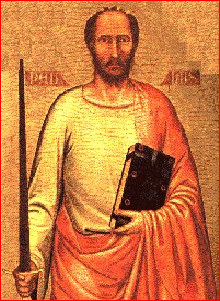
In my little experience of him, he was also a very nice fellow. I had been absolutely bowled over by the man's body of work. It seemed has if he'd written on everything, had scholarly "chops" both in Old and New Testament, and all his work was meticulously footnoted and detailed and sourced and painfully precise. In Answers to Questions (Zondervan: 1972), the sort of book I devoured as a new believer, he answered all sorts the widest variety of questions. (Much later, I realized that many of the answers were very... wriggly.)

So I wrote Professor Bruce over there in England, myself being around 18 years old and just getting my Biblical feet under me. I told the professor that I couldn't believe that he was just one man. No, he had to be a committee of scholars writing under a pseudonym. Otherwise, how could he do it?

To my delighted startlement, Professor Bruce actually took the time to answer me. He assured me he was an individual. "My name is not Legion, for we are not many," he added wryly. Then he gave me a priceless bit of advice. "How do I do it?" he mused, to my question. Then he said he'd never stopped to think about it. He supposed it was a matter of "filling up odd moments." That very practical little nugget has helped me ever since.

But as I grew in my studies, I began to wonder about Bruce's own convictions. I was learning about Biblical criticism, and liberalism, and some of his writings left me a bit unsettled. He characteristically couched everything he said, hedged, cited this or that scholar, or the "early Christian community's" beliefs. He often seemed evasive. What did he believe?

I naively asked him if he believed the Biblical books were "authentic." He replied that, if I meant were they "authentic witnesses to Christ," then yes he did. I realized I'd left some weasel room... and he'd leapt for it. (I was learning about talking to "academics.")

So I wrote and asked him point-blank who wrote the Pastoral Epistles, and the like. I came to learn that he did not accept the Bible's attribution of the Pastorals (among others) to Paul, nor various other straightforward canonical evidence. He had a fairly standard liberal line, but he seldom came out with it in his writings, which evangelicals like me bought prodigiously.

At the time, I was disappointed. But years later, my disappointment turned to real sadness as I read Bruce's Paul: Apostle of the Heart Set Free, from 1977. Published when Bruce was in his late 60's, this should have been the seasoned product of decades of immersion in the text of Scripture. Surely years of deep Pauline studies had touched the heart of this evangelical scholar.

Yet what I found was constant, once-removed, third-person academicisms. Still, one could read between the lines; and what one read was not heartening. Bruce saw Paul and Luke as disagreeing with each other, he batted about what the early Church believed about Scripture rather than what it says; in fact, Bruce did not seem to think that the meaning they took from OT texts was legitimate.

Since Bruce wrote the book, of course it had a wealth of good academic information. What it didn't have was heart, contrary to the title. No proclamation, and a troubling concern about and from the wrong side of issues from Paul -- usually between the lines. Since Bruce rejected Pauline authorship of some of the apostle's last and most passionately personal letters, a fair bit was left out of the portrait of the great apostle.

Now, back more broadly to the issue of academics. Going just by the interview, I continue to grow in my sense of the mass of frustrating confusion that evidently is N. T. Wright. Consider:

What Wright says about anastasis is just wonderful, right-on. His defense of the eyewitness character of the Gospels, and his broadsides at Bultmann and his ilk -- simply delightful. But then it comes down to some "touchy" issues, and he waffles, is diffident, double-spoken, tepid.

Wright's defenders say, "Oh, sticklebats. That's just how academics talk." So... academics get a "pass" from being Christians 24/7? And besides, what's that word that comes before "Wright"? Isn't it "Bishop"? What's that mean? What are the office-hours for a "Bishop," anyway? Did he do the interview in his "off" hours?

I've done academics, I've got some dusty "creds," I guess; taught beginning and advanced Hebrew in seminary, Old Testament Theology elective, and this and that here and there. But I never got the idea that my discipleship ended when I opened a book, or stood behind a lectern. No one ever explained that doing academics gave me a "pass" from being passionately gripped by a Biblical worldview.

Here's the Christian vision: "The earth is the LORD's and the fullness thereof, the world and those who dwell therein" (Psalm 24:1). God is not confined to a ghetto. It's all His property -- everything, material, spiritual, conceptual. There is no atom in all the universe that is not His possession, not His by right, does not own Him as its master. Or else the Bible is nonsense, and you shouldn't bother with it.

Historiography? God's. Lexicography? God's. Theology? God's. Higher criticism, lower criticism, middlin' criticism? God's. See the pattern?

Consider the attitude that speaks thus: "Well, that's all very nice, but to be an academic, to speak and walk in that world, one must put aside one's religious convictions, and concern oneself objectively with facts, not faith."

That's an urbane way of saying, "You know all that Bible stuff? Nonsense. Sheer bosh and fairy-tales."

Am I making a naive or obscurantist statement? I don't think so. While the Bible bears the marks of its human authors (it is "letters" and "Scripture"; 2 Timothy 3:15, 16), it is unlike any other book in that it is theopneustos, God-breathed (2 Timothy 3:16). It claims to present God's words from the first verses to the last.

Now, with all due apologies to pomo's (i.e. none), this is a categorical statement. It is true, or it is false. And in approaching the Bible, we approach it as necessarily what it claims to be, or not necessarily. For all intents and purposes, "not necessarily" = "not."

What about being all things to all men? That's potentially the subject of a much longer post, and probably by a better man than I (Phil?). But I do note that in Athens (Acts 17), Paul was able to hold his own with the philosophers, and quote some of their own writers from memory. Yet they knew he preached Iesous and Anastasis (Jesus and the resurrection), and they had no doubt that he was making an authoritative proclamation to them.


Now, I can hear objectors sputtering, "So you are saying that a man should warp and twist the evidence to fit his religious convictions?!" That is in fact exactly what I am not saying. Think: that charge rests on the premise that the Bible is not what it claims to be.

Think further. If I have to twist and hide facts to treat the Bible as the Word of God, then it isn't the Word of God. I'm deceiving... someone. Myself, my readers; someone.

But equally, if the Bible is what it claims to be, and I speak of it as if it is not, it is then that I am twisting facts and being deceitful.

I don't really see any way around it. Read Matthew 22:34-40 carefully. Find me an exemption-clause for academics. In what settings should one love God will less than his whole heart and mind and soul and strength? In what interview-settings should one not be lovingly concerned for the souls of his interviewer and listeners? How could not being ready to answer the question, "What must I do to be saved?" possibly be seen as a positive Christian quality?

If you and I are not striving to be genuine Christians fulltime and everywhere, will we be genuine Christians anytime, or anywhere?

Dan Phillips's signature


22 March 2006

Wright's Wrongs

Here's some stuff you might have missed but need to see
by Phil Johnson

Yecch.

Tim Bayly made a post yesterday that struck a chord with me. It was a response to an interview with Bishop N. T. Wright that was broadcast on Australian radio in Sydney last week. Tim was replying to a transcript. I had listened to the actual broadcast. But Tim's reaction put into words my very thoughts about the Bishop's trademark style of verbal shuffling—more powerfully and more succinctly than I ever could have done. Tim's post was also a fitting addendum to Sunday's Spurgeon excerpt about the evil of ecclesiastical double-talk.

David Gadbois at Mongrel Horde added some thoughts about Anglicanism in general that likewise echo my opinion exactly, almost as if he read my mind.

Anyway, a discussion between Tim Bayly and our old friend the Blue Raja broke out in the meta here. Since it was buried in a days-old post, I thought I'd bring it to the top, at least for an hour or two, because it deals with issues that are very much at the heart of what this blog is all about.

Phil's signature