Showing posts with label death of Christ. Show all posts

24 November 2010

His own Personal Collected Upanishads

by Frank Turk

The hardest part of this blog post for me is going to be the introduction -- because, like Rick Warren, what hasn't been already said about Brian McLaren? I mean: is there anything really interesting to say about McLaren anymore? Unlike Rick Warren, McLaren isn't actually a Christian -- he's some kind of neo-Bahá'í-ist or Bhakti Krishna-ist with an interest in the Christian narrative as it relates to his own personal collected Upanishads. And the more he speaks, the less likely it is that he's going to come back around to the Christian faith which he allegedly started in before he got so wise.


So it came around on Twitter on Monday -- while I was in the middle of a killer post which was an open letter to President Obama about human dignity on the eve of Thanksgiving day as it relates to TSA agents treating any American citizen who wants to get on an airplane as if it was rush week at Abu Ghraib -- that McLaren gets e-mail and respond to it from time to time. For me the comedy begins right at the start as the title of the post is "Q & R: The Propitiation Question". That's right -- "Q & R", not "Q & A" because of course it's not very humble to have "answers", only "responses".

That said, I'm going to skip the bulk of the post because it will do for another time when I have more time to unpack the kind of follower McLaren attracts. Today we are going into the woods to follow papa bear to his cave and see what's actually inside there. The meat of the post goes like this (McLaren in BLUE; his fan's letter in RED):
So what is your straight, non-sidestepping, no-holds-barred take on "The Propitiation Question?"

The best way I can reply, since I think the category of propitiation is often defined within an unhelpful and other-than-biblical narrative, is in the form of some questions:
1. Who was the primary audience for the suffering and death of Jesus? Was it intended to bring about a change in God, or in us? Since I don't think God needs to change, but rather we do, I'd vote for the latter.

2. Where do we centrally locate God the Father on good Friday - in and with the political and religious leaders, condemning and torturing Jesus? Or in Jesus, suffering injustice with and for us? Again, I'd vote the latter.

3. Does Jesus, in some mysterious way, absorb/redirect the hostility of God towards us, or the hostility of us towards God? Again, I'd vote for the latter. (I think this is what C. S. Lewis was after in his idea of "the perfect penitent.")

In each case, perhaps a case could be made for the former; there are ways we could say there is truth in the former. But I think the weight of meaning is found in the latter option. Many people see everything from within the conventional narrative and so they can't even imagine Jesus being important apart from it, and that's a major reason why, I think, they are so adamant in defending it. I'm sorry you have suffered so much rejection for raising honest questions ... my heart goes out to you. My hope is that you will be able to avoid what Paul called "fruitless quarrels," and by your questioning, challenge people to deeper and higher perspectives. It's not easy, I know, but it is important. You're in my prayers today.
Just to grind an axe here briefly, a watchblogger would here just snort about how important "propitiation" is and stop his feet that abandoning it as "unhelpful" is just heresy, which is why the church is shot to Hell, etc. Whether that's true or not doesn't depend on some apologetical log falling in the woods with the hope that someone will hear it go "Oomph" with proper reformed footnotes.

Someone trying to actually diffuse this ticking mess, however, would do a little leg-work first. You know: what is the "propitiation question?" Why does McLaren care, and why should you, the reader, care?

To answer the first question, so to speak, the "propitiation question" is this: in the ESV, for example, the word "propitiation" is used 4 times -- Rom 3, Heb 2, 1 John 2, and 1 John 4; the KJV does not use the word in Heb 2, but that's their loss. It's in place of the Greek word "ἱλαστήριον" (thx, greekbible.com), and also for the word "ἱλασμός" - both of which refer to "a means of appeasing (God)", the former often used to refer to the Mercy Seat of the Ark of the Covenant where the blood of the sacrifice had to be spilled. So the question comes up, "What is the meaning of 'propitiation' in the New Testament as it relates to Christ?"

And it's funny: if you read the 4 places I have mentioned here where the word "propitiation", you can probably answer that question. I mean, if our real concern is, as McLaren says here, is to find "the weight of meaning," some reference to the actual narrative and the actual story or the story's own explanation of itself might do. So in Hebrews -- which is a great example of early actual-Christians reading the teleology of Christ for the sake of knowing how to live in the story they find themselves in -- we find the writer saying this:
It's obvious, of course, that he didn't go to all this trouble for angels. It was for people like us, children of Abraham. That's why he had to enter into every detail of human life. Then, when he came before God as high priest to get rid of the people's sins, he would have already experienced it all himself—all the pain, all the testing—and would be able to help where help was needed.[Heb 2:16-18, MSG]
Or better yet, if we read the actual translation of that passage:
For surely his concern is not for angels, but he is concerned for Abraham’s descendants. Therefore he had to be made like his brothers and sisters in every respect, so that he could become a merciful and faithful high priest in things relating to God, to make atonement for the sins of the people. For since he himself suffered when he was tempted, he is able to help those who are tempted.[Heb 2:16-18, NET]
or the one you probably have in your iPad:
For surely it is not angels that he helps, but he helps the offspring of Abraham. Therefore he had to be made like his brothers in every respect, so that he might become a merciful and faithful high priest in the service of God, to make propitiation for the sins of the people. For because he himself has suffered when tempted, he is able to help those who are being tempted. [Heb 2:16-18, ESV]
I mean: there's no question here. There's an answer which says something like this:

God is helping somebody -- and it's not angels but people like Abraham. And the kind of help he's giving is not good counsel or even good therapy -- it's the kind of help a priest would offer in the temple of Solomon where what is at stake is sin and what needs to be done has to satisfy God's requirements.

So the answer to the "propitiation question" is given at least once in Scripture is not that everything must change, or that there is a secret message to uncover on your own: it is that Christ's explicit goal in this world was to suffer and die because God requires it of Him for the sake of those he came to save.

While I think and believe this, I didn't invent it. I'm not inserting my paleo-orthodoxy into the text of Hebrews. Christ Himself makes a big deal of this to the Disciples:
And Jesus went on with his disciples to the villages of Caesarea Philippi. And on the way he asked his disciples, "Who do people say that I am?" And they told him, "John the Baptist; and others say, Elijah; and others, one of the prophets." And he asked them, "But who do you say that I am?" Peter answered him, "You are the Christ." And he strictly charged them to tell no one about him.
Now look: before we get to the punchline in Mark 8 here, the Disciples get it right and identify Jesus as the Messiah. And this would be a great opportunity for Jesus to redo the Sermon on the Mount if his objective was to teach them that His death was really about a "change in them," or about they themselves "suffering injustice" or what have you.

Instead Jesus finished up with this:
And he began to teach them that the Son of Man must suffer many things and be rejected by the elders and the chief priests and the scribes and be killed, and after three days rise again. And he said this plainly. And Peter took him aside and began to rebuke him. But turning and seeing his disciples, he rebuked Peter and said, "Get behind me, Satan! For you are not setting your mind on the things of God, but on the things of man." [Mark 8:27-33, ESV]
Right? I mean, Jesus is intent that his life's purpose is to die and be resurrected -- and that when Peter says that's too much to really accept, he tells Peter that he's thinking about this all wrong -- he's doing Satan's work by saying that the death of Christ is a teaching we ought to rebuke. And this is why McLaren cares about this: because he is personally thinking about the things of man, as we can see in the questions he asks.

So when we think about McLaren's clever question #1, we can point out that regardless of what he thinks about God's immutability -- which is not the question -- there's no denying that human beings are brought from life to death by Christ's death. The problem is that McLaren doesn't believe man needs changing -- he admits he's very happy and comfortable with the Pelagian view that man just needs to obey because he can. The Bible is clear that man needs changing -- and the way that God changes men is by the work of Christ. Trying to say that is is not the traditional view is dishonest of McLaren and a kind of pandering to his anonymous fan's biases against those who are trying to call him back to orthodoxy and good faith.

And when we consider his question #2, he simply ignores the cry of Christ: "My God, why have you abandoned me?" If God the Father is on the cross, why does Christ believe he is abandoned? Voting for another choice is simply ignoring what Christ says himself -- which is a screwy hermeneutic for a red-letter Christian.

Finally, when we consider his question #3, McLaren has simply not read Hebrews with any seriousness, or any of the Old Testament, or even the book of John for that matter. He's simply a spiritual pundit opining with regard to his own feelings and impressions -- so at least in that respect, we should be glad he calls these his "responses" and not his "answers".

With that, be thankful tomorrow that Brian McLaren is not coming to your house for the meal and the family reunion, and enjoy instead the bounty which you will receive through Christ our Lord.


16 September 2010

Samson and Jesus: studies in contrast

by Dan Phillips

Judges and kings all foreshadow Christ, one might say — yet, in some, the foreshadowing is by way of contrast. Was there a greater than Samson, in this way?

One might say that Samson  was dedicated to God from the womb (Judges 13:7), as was Christ (Luke 1:35), but there the similarity ends. Samson's dedication was external and formal, Christ's was internal and real.

Samson's outer strength belied a great and fatal weakness within; Christ's outer meakness belied literally infinite power within. Samson exerted his strength to suit his passions, which were made to serve Yahweh's purpose (Judges 14:1-4). Christ veiled his strength, that He might consciously fulfill Yahweh's purpose (Philippians 2:5-11). And so Samson started strong and finished his life in weakness, but for one vengeful burst, while Christ started weak and will continue an eternal career of power, because of one concentrated burst of self-humbling (Philippians 2:8b-9).

But the real contrast occurred to me in my reading today. I'm reading through Judges in Hebrew and Matthew in Greek, and my hap was to light on Judges 16 and Matthew 27, reading of the respective ends of Samson's and Christ's lives.

For one thing, Samson was arrested against his will due to weakness, complete loss of power, through his own idiocy (Judges 16:18-21). By contrast, Christ exerted a brief glimpse into His own undiminished reserves of infinite power (John 18:4-6), after which He willingly allowed Himself to be arrested and, ultimately, put to death (John 10:18).

Samson died as a result of his own personal foolishness, while Christ died in the wisdom of God. Samson's lifelong eye-problems (Judges 14:3) led to his eyes being bored out. Worse, in a damning indictment we read that Yahweh had departed from Samson and he did not even know it (Judges 16:20b). By contrast, the righteous Christ died, innocent from any personal sins (as even Pilate admitted; Matthew 27:23), bearing the sins of others; and because of that imputed sin, God the Father turned from Him — and, in agony of soul, He knew it (Matthew 27:46).

Samson died in an act of personal self-revenge, killing many others in his death (Judges 16:28-30). In Christ's death, He saved others.

Let us focus a bit more on that. In words thick with unintended irony, the leaders of Israel taunted Christ, urging Him to save Himself, come down off the cross, promising that they would then believe in Him (Matthew 27:42). But had He done so, had He exerted His own strength in self-vindication, surely He would have judged and damned them, temporally and eternally. But what is more, even if He had not done so, and even if they had believed in Him — it would then have been to no avail. They would have been eternally wed to their sin, with no atonement for their souls. Their faith would have been in vain. They would have been lost.

So, to sum this very brief meditation: does Samson point to Christ?

Absolutely.

But mostly by way of contrast.

Dan Phillips's signature

07 April 2009

"Jesus was a Good Teacher" dodge (NEXT! #9)

by Dan Phillips

Challenge: I believe Jesus was a moral example and a great sage and teacher.

Response: ...who sagaciously taught that He was God incarnate, the only sufficient sacrifice for man's sins, and the only mediator between God and man; who made worship of Him as God a moral imperative; and taught that anyone who doesn't believe in Him, and believe all those things about Him, is going to Hell? Hey, yeah! Me too!

(Proverbs 21:22)

Dan Phillips's signature

19 March 2008

Oh, you have GOT to be KIDDING me

by Dan Phillips

In the meta to my previous post, Mike Hall pointed me ultimately to something that had me literally slack-jawed.

Step away from sharp objects, sit down, have your heart-medicine at hand, take a few deep and slow breaths...

...and read this.

You'll see "A Special Note About Easter" which, according to pastor Blake Hickman, came from the First Look Sunday School publishers.

In the letter they explain how — you are sitting down, right? I wasn't kidding. They explain why they are leaving Easter out of their Easter materials. They've decided that the story of the Cross is too violent and disturbing for young children, and the Resurrection wouldn't make any sense without it, so they "are focusing on the Last Supper, when Jesus shared a meal and spent time with the people He loved."

I just... is this Scrappleface? Is this some sort of joke?

See further comments:
Tom Ascol
Tim Ellsworth
Russell D. Moore
Do any of you use this curriculum? Are they barking-mad in other ways as well?

At this point, I run out of post-conversion, sanctified vocabulary. Over to you.

Dan Phillips's signature


16 November 2007

Drama and Dogma

by Dorothy Sayers

Dorothy Leigh Sayers (1893-1957) was the daughter of an Anglican pastor. Born at Oxford while her father was headmaster and chaplain of Christ Church Cathedral school there, she grew up in Cambridgeshire (the heart of Spurgeon country) and spent her college years at Oxford. (She was, as a matter of fact, one of the first women to earn a degree from Oxford.) In most ways she seemed an unlikely person to be an inflential lay theologian. Her main claim to fame was as a mystery writer and playwright. She had a turbulent romantic life and gave birth to a son out of wedlock (whose birth she kept secret even from her parents).

Sayers nevertheless kept the faith, holding devoutly to the same conservative Anglican perspective her father held. She was a friend of both C. S. Lewis and Charles Williams and thus a contemporary of the Inklings (but being a woman she was excluded from their get-togethers). Never one to shy away from controversy, Sayers had a gift for defending her views with grace and good humor. That quality is evident in this piece, which is as relevant today as is was when it was first published, posthumously, in The Poetry of Search and the Poetry of Statement (London: Gollancz, 1963).

fficial Christianity, of late years, has been having what is known as a bad press. We are constantly assured that the churches are empty because preachers insist too much upon doctrine—dull dogma as people call it. The fact is the precise opposite. It is the neglect of dogma that makes for dullness. The Christian faith is the most exciting drama that ever staggered the imagination of man—and the dogma is the drama.

That drama is summarized quite clearly in the creeds of the Church, and if we think it dull it is because we either have never really read those amazing documents or have recited them so often and so mechanically as to have lost all sense of their meaning. The plot pivots upon a single character, and the whole action is the answer to a single central problem: "What think ye of Christ?" (Matthew 22:42). Before we adopt any of the unofficial solutions (some of which are indeed excessively dull)—before we dismiss Christ as a myth, an idealist demagogue, a liar, or a lunatic—it will do no harm to find out what the creeds really say about him.

What does the Church think of Christ?

The Church's answer is categorical and uncompromising and it is this: That Jesus Bar-Joseph, the carpenter of Nazareth, was in fact and in truth, and in the most exact and literal sense of the words, the God "by whom all things were made." His body and brain were those of a common man; his personality was the personality of God, so far as that personality could be expressed in human terms. He was not a kind of demon pretending to be human; he was in every respect a genuine living man. He was not merely a man so good as to be "like God"; he was God.

Now, this is not just a pious commonplace; it is not commonplace at all. For what it means is this, among other things: that, for whatever reason, God chose to make man as he is—limited and suffering and subject to sorrows and death—he [God] had the honesty and the courage to take his own medicine. Whatever game he is playing with his creation, he has kept his own rules and played fair. He can exact nothing from man that he has not exacted from himself. He has himself gone through the whole of human experience, from the trivial irritations of family life and the cramping restrictions of hard work and lack of money to the worst horrors of pain and humiliation, defeat, despair, and death. When he was a man, he played the man. He was born in poverty and died in disgrace, and thought it was worthwhile.

Christianity is, of course, not the only religion that has found the best explanation of human life in the idea of an incarnate and suffering god. The Egyptian Osiris died and rose again; Aeschylus in his play, The Eumenides, reconciled man to God by the theory of a suffering Zeus. But in most theologies, the god is supposed to have suffered and died in some remote and mythical period of prehistory. The Christian story, on the other hand, starts off briskly in St. Matthew's account with a place and a date: "When Jesus was born in Bethlehem of Judea in the days of Herod the King." St. Luke, still more practically and prosaically, pins the thing down by a reference to a piece of government finance. God, he says, was made man in the year when Caesar Augustus was taking a census in connection with a scheme of taxation. Similarly, we might date an event by saying that it took place in the year that Great Britain went off the gold standard. About thirty-three years later (we are informed), God was executed, for being a political nuisance, "under Pontius Pilate"—much as we might say, "when Mr. Johnson-Hicks was Home Secretary." It is as definite and concrete as all that.

Possibly we might prefer not to take this tale too seriously—there are disquieting points about it. Here we had a man of divine character walking and talking among us—and what did we find to do with him? The common people, indeed, "heard him gladly"; but our leading authorities in church and state considered that he talked too much and uttered too many disconcerting truths. So we bribed one of his friends to hand him over quietly to the police, and we tried him on a rather vague charge of creating a disturbance, and had him publicly flogged and hanged on the common gallows, "thanking God we were rid of a knave." All this was not very creditable to us, even if he was (as many people thought and think) only a harmless, crazy preacher. But if the Church is right about him, it was more discreditable still, for the man we hanged was God Almighty. So that is the outline of the official story—the tale of the time when God was the underdog and got beaten, when he submitted to the conditions he had laid down and became a man like the men he had made, and the men he had made broke him and killed him. This is the dogma we find so dull—this terrifying drama of which God is the victim and hero.

If this is dull, then what, in Heaven's name, is worthy to be called exciting? The people who hanged Christ never, to do them justice, accused him of being a bore—on the contrary, they thought him too dynamic to be safe. It has been left for later generations to muffle up that shattering personality and surround him with an atmosphere of tedium. We have very efficiently pared the claws of the Lion of Judah, certified him "meek and mild," and recommended him as a fitting household pet for pale curates and pious old ladies. To those who knew him, however, he in no way suggests a milk-and-water person; they objected to him as a dangerous firebrand.

True, he was tender to the unfortunate, patient with honest inquirers, and humble before heaven; but he insulted respectable clergymen by calling them hypocrites. He referred to King Herod as "that fox"; he went to parties in disreputable company and was looked upon as a "gluttonous man and a winebibber, a friend of publicans and sinners"; he assaulted indignant tradesmen and threw them and their belongings out of the temple; he drove a coach-and-horses through a number of sacrosanct and hoary regulations; he cured diseases by any means that came handy with a shocking casualness in the matter of other people's pigs and property; he showed no proper deference for wealth or social position; when confronted with neat dialectical traps, he displayed a paradoxical humor that affronted serious-minded people, and he retorted by asking disagreeably searching questions that could not be answered by rule of thumb.

He was emphatically not a dull man in his human lifetime, and if he was God, there can be nothing dull about God either. But he had "a daily beauty in his life that made us ugly," and officialdom felt that the established order of things would be more secure without him. So they did away with God in the name of peace and quietness.

"And the third day he rose again." What are we to make of this? One thing is certain: if he were God and nothing else, his immortality means nothing to us; if he was man and no more, his death is no more important than yours or mine. But if he really was both God and man, then when the man Jesus died, God died too; and when the God Jesus rose from the dead, man rose too, because they were one and the same person. The Church binds us to no theory about the exact composition of Christ's resurrection body. A body of some kind there had to be, since man cannot perceive the Infinite otherwise than in terms of space and time. It may have been made from the same elements as the body that disappeared so strangely from the guarded tomb, but it was not that old, limited mortal body, though it was recognizably like it. In any case, those who saw the risen Christ remained persuaded that life was worth living and death a triviality—an attitude curiously unlike that of the modern defeatist, who is firmly persuaded that life is a disaster and death (rather inconsistently) a major catastrophe.

Now, nobody is compelled to believe a single word of this remarkable story. God (says the Church) has created us perfectly free to disbelieve in him as much as we choose. If we do disbelieve, then he and we must take the consequences in a world ruled by cause and effect. The Church says further, that man did, in fact, disbelieve, and that God did, in fact, take the consequences. At the same, if we are going to disbelieve a thing, it seems on the whole to be desirable that we should first find out what, exactly, we are disbelieving. Very well, then: "The right faith is, that we believe that Jesus Christ is God and man, perfect God and perfect man, of a reasonable soul and human flesh subsisting. Who, although he be God and man, yet is he not two, but one Christ." There is the essential doctrine, of which the whole elaborate structure of Christian faith and morals is only the logical consequence.

Now, we may call that doctrine exhilarating, or we may call it devastating; we may call it revelation, or we may call it rubbish; but if we call it dull, then words have no meaning at all. That God should play the tyrant over man is a dismal story of unrelieved oppression; that man should play the tyrant over man is the usual dreary record of human futility; but that man should play the tyrant over God, find him a better man than himself, is an astonishing drama indeed. Any journalist, hearing of it for the first time, would recognize it as news; those who did hear it for the first time actually called it news, and good news at that; though we are likely to forget that the word Gospel ever meant anything so sensational.

Perhaps the drama is played out now, and Jesus is safely dead and buried. Perhaps. It is ironical and entertaining to consider that at least once in the world's history those words might have been spoken with complete conviction, and that was upon the eve of the Resurrection.
Dorothy L. Sayers


14 August 2007

Preaching the Cross to those without the categories to understand it

by Dan Phillips

Back in late June, I had the great joy of being at the Founders Conference in Tulsa, Oklahoma, with Frank and Phil.

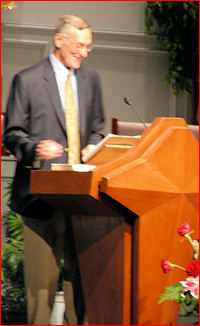
One of the best of many excellent addresses was that by Dr. David Wells, in the 6:30pm session on June 27. The title was "Preaching the Truth of the Cross for the Modern Age." M'man Frank Turk live-blogged it, and you should read his notes. What follows is from mine own.

Wells painted a vivid picture of the breakdown in our moral world. He pointed to four major sign-posts, indicating changes that hasten people out of the moral world that the West long inhabited. Thinking has shifted from the objective and/or transcendent, to the subjective and culturally relative. The sign-post shifts are:
  • from thinking about virtue, to thinking about values
  • from thinking about character, to thinking about personality
  • from thinking about nature, to thinking about self; and
  • from thinking about guilt, to thinking about shame.
Follow these, Wells observed, and you’ve exited a moral world. The Cross then becomes simply incomprehensible. [Update 12/26/2011: Wells expands on this in The Courage to Be Protestant, 143ff.]

And Wells made this very powerful statement, as my notes have it:
Our task today is to tell people — who no longer know what sin is, no longer have the categories to understand it, no longer see themselves as sinners, and no longer have room for these categories in their non-moral universe — that Christ died for sins of which they do not think they’re guilty.
Then he said that this is why the Bible does not begin with John 3:16, but with Genesis 1. Again, from my notes:
What we see at work between those two points is the patience of God who, bit by bit and stone by stone, lays the foundation and builds an edifice of understanding, which corresponds to what is there. Only when this long work of preparation had been completed, when the last stone had been put in place, God sent His Son, born of a woman, to redeem those under the Law. Cross is a message of substitution – Him, for us. It is not just a formula, nor a product to be sold. It is to be anchored in true truths. God’s enduring character of holiness has been established long before John 3 was written.

From that previous revelation, we know about ourselves, made in the image of God, a people who are willingly sightless. So when John 3:16 was penned, this message of the Cross was positioned to connect with these other foundational truths, without which the message of the Cross is incomprehensible.
So our question to our PoMo neighbors and colleagues, is (or should be): which of these points do you not understand, or do you reject? But often we don’t have the patience to do this. We want instant results, now!

So between Gen 1 and John 3 is a long, patient work of God, so that people can understand the Cross. Can’t we learn something from God’s slow, long, patient work? If we did, we might end up with disciples, instead of simply converts.
Doing, not just talking. I found this all very incisive and thought-provoking. But regular readers will know that I grow a bit impatient with discussions about "how we ought to" do this or that, which don't themselves issue in doing it. I read so many wonderful debates and expatiations about how we ought to "do" apologetics, but none of them issued in a "Here, let me show you." So I attempted one myself.

Well similarly here, what Wells said really lodged in my brain, and excited my thinking.

And so on August 5, at Soaring Oaks, I attempted to do just what Wells suggested. The sermon I preached is titled, "Why Does It Matter That Jesus is a Ransom?"

You can listen to it HERE. My intent was, and my hope is, that it could find its way into the hands of just some such folks.

Dan Phillips's signature

27 June 2007

Day 2 Session 3 (evening)

by Frank Turk

Let me say that I'm proud of all of you for enduring my lousy liveblogging. Pheh upon me for being such a lousy formatter and note-taker. I hope these notes do someone some good.
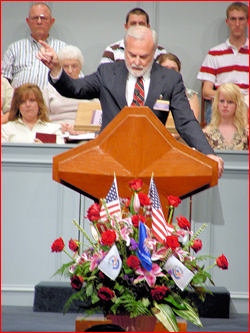
As expected, David Wells is presenting this evening. We're leading off by singing And Can It Be. For the record, this has been a regular "favorite hymn" week for me personally. The singing has been at least as edifying as the preaching, so kudos to the Founders guys for their spiritual insight and willingness.

Amazing Love! How can it be that Thou my God shouldst die for me?
Amen?

It's also pretty incredible to hear a congregation of pastors and their wives singing the great hymns of the faith. We should be praying that all our congregations will "get it" the way this body of about 300 "got it" this week.

Don Whitney is the moderator tonight – Phil introduced us to him earlier today, and he's a great, humble fellow.

There's a plea here for founders-friendly churches and donors to support Founders Ministries directly through pledged support. It's a good idea – go to Founders.org to do something about that.

Next hymn: A Mighty Fortress is our God. The choir also provided worship in song this evening. They have a huge choir for a church this size, which is good on them.

Tonight's message: Preaching the truth of the Cross for the Modern Age

2 Cor 5:11-21 is the text for foundation this evening.

He starts by citing Jesus Christ Superstar – Judas' lyrics.

Every time I look at you
I don't understand
Why you let the things you did
Get so out of hand
You'd have managed better
If you'd had it planned
Now why'd you choose such a backward time
And such a strange land?
Why did God let things end the way he did? This is the question for Pomos to understand. Somehow the world is uncontrolled, Jesus was snuffed out by accident rather than God's place was worked out in the evil act of the cross.

The natural man does not accept the truth of God seems apparent. But this spiritual blindness is being given cultural confirmation today – this makes the blindness more resistant to the Gospel.

Consider Eph 2: the spirit of disobedience is in the children of wrath, those who are in fallen culture. We need to be redeemed from sin and from walking in the course of the world. This double redemption is freedom from bondage of both nature and culture.

Paul engages the culture of his time (cf. books of Acts, Acts 13, Acts 14, Acts 17; contrast the preaching to the Jews, to natural revelation, to what occurs at Mars Hill). In the main points, Paul was engaging the world view, deconstructing it, and puttinga Christian worldview in its place. Moral, nature, meaning, ourselves, God: all are given in Christian terms before he points at what is wrong in mankind, and then to the coming judgment and the resurrection.

This is what Dr. Wells is going to try to do tonight. Why do Pomos find the death of Christ incomprehensible?

[1] The disintegration of the moral world

4 Major signposts out of the moral world of the west
1. virtue v. values
a. virtues are aspects of the "good" which is right for all people at all times and places
i. The Bible speaks of the moral excellency of God, which never changes
ii. Surely it is better for a society if people have virtue rather than vice; morality is better than immorality
iii. Applies to all men
b. The word "values" does not exist prior to 1928
i. Personal rather than public
ii. Competence matters far more than character today; it is more profitable
iii. Non-transferrable; non-judgmental
2. character v. personality
a. Character is the internalizing of virtues
b. Morality, manners, duty, honor, "full day's work for a full day's pay"
c. Personality is the way we come off to other people; how we present ourselves as a character – not who we are measured by some external standard
d. God may judge the heart, but we think the appearance is more important
e. The appearance of success is everything (Frank adds: note this in your view of your church)
i. People then engage in selling themselves.
1. Likable
2. Believable
3. "sincere"
ii. Lying becomes the tender of exchange; the truth has no value
f. This is a symptom, not the disease
g. The "old world" value is sacrifice and restraint; the "new" value is self-promotion and self-satisfaction
3. nature v. self
a. Human nature, some kind of meta-anthropology
i. This is what distinguishes us from animals
ii. A common possession in the whole human type
iii. More basic than the surface characteristics of gender, race, age, standing, economic status
b. This idea is under attack.
i. Nature is called an insult because it assaults the uniqueness of self
ii. The self is my interior world where my personal story and achievements come together to make my feelings and perceptions which are unique to me: my Self.
1. Thus: Self Esteem
2. Private values and meaning
3. Liberty to express self, or else "tragedy"
a. Racism
b. Violence
c. Poor grades
d. Etc.
iii. Establishes the therapeutic world view
4. guilt v. shame
a. Guilt is what lines up our actions vertically in relation to God
b. Shame is what lines up our action to someone who is not above us
i. About getting caught, not about doing wrong
ii. Shame must be removed
iii. Shamelessness = freedom
c. Eliminating shame is the exit door from the moral world

When people follow these signposts, they exit the moral world philosophically. Without the moral world, the cross becomes incomprehensible

Our conscience still bears witness against us because God is still God. We are caught in God's moral universe, and we cannot escape from it.

Harold Wilson story: a morally-earnest man who was somewhat unprincipled in fact. In one debate, one of his foes said that he was always wrestling with his conscience, and winning.

We remain moral beings even when we are sinning. But this is the context in which we find ourselves.

[2] The way the NT presents the Cross

When you look at what is said about the cross in the NT, you can put them into one of two categories:
A. The statement of the fact of Christ dying
-- died for us, laid down his life, etc.
-- e .g. - Mark 10:45, John 10:15, John 15:13-14, Rom 5, 1Thes 5, 1Pet 3:18
-- He did something is death which He did not do even in his life
-- restoring our relationship with God
B. The explanations of that death
-- Died for sin, to deliver or spare us, etc.
-- Mat 26, Rom 4:25, 1 Cor 15:3, Gal 1:4, Eph 1:7, 1 Pet 2:24, 1 John 2:2
There is no Gospel except that God forgives us because Christ died for us; God forgives our sins because He bore them in our place; His death was –necessary- to pay the price of sin; the Father and the Son united to save sinners.

Wells condemns the "Cosmic Child Abuse" slogan.

Christ paid our debt. Cf. Luther on Galatians 3; we were absolved by all sins … through him. When Christ carried away these monsters, he was doing the work that no mere mortal could do. This is the work … of almighty God.

We have lost our capacity for wonder today. Our world is saturated with artificiality. We know that we are superficial; we are seeking the hidden agendas; we are suspicious and cynical. We are also quite jaded – our expectations are completely out of line.

This is true especially in the church in our loss of wonder in creation, God's goodness, the great providences of God. Is it not a wonder that God remembers out sin no more in the death of Christ? Should we not stand in awe of the cross and how huge and incomprehensible that is – even before a cynical generation?

[3] How they work together

We must tell people who no longer understand sin, who have no categories for sin, who think they are not sinful and do not inhabit a moral universe about a Christ who died for things they cannot and do not understand.

The Bible does not begin with John 3:16 but Genesis 1:1. What occurs between is the patience of God as He lays the foundation and an edifice of understanding that corresponds to what is there – a worldview. And when the prep is complete – at the right time – God sent his son to die under the Law.

The Gospel is the message of His substitution of Him for us. It is not a formula or a product. This is a message which is anchored in truths which is a message for all of life and reality. God's enduring character of holiness who created a moral world is established before we get to John 3:16. He will sustain that difference, the distinctions of what is right and what is not. We have learned who and what Christ is, as both God and man. We know ourselves, both in God's image and fallen and corrupted with no sight and willfully disobedient.

When we come to John 3:16, this message connects to the other things – the whole story – without which the cross is incomprehensible.


Our message is: which of these points do you not understand? What can you not accept? Why? Our job is –remedial- work, not a quick sale.

God's preparation was a long time; Jesus came at the right time. Why can we not do what God did, and prepare people as he did, and establish his categories, and show men what they do not know. What we would get would be disciples and not merely converts.


29 May 2007

Memorial Day, a day late

by Dan Phillips

I've been out of town, and my betters here at Teampyro are busy, so I offer you this brief thought.

As Memorial Day approached, I found myself focused on this simple truth: every bit of freedom we Americans enjoy was bought and paid for by the blood of men and women, and those willing to shed their blood.

That I can write these posts without being jailed for seditious ideas, or tortured and killed for reproaching the "Prophet" Mohamed; that my family can worship publicly in the church of our choice; that I can call some portion of my earnings mine; that I can vote in open elections — these and countless other freedoms are mine because of blood. You who preach the Word here, week in and week out, do so because of blood shed or risked.

Philosophers philosophized, theoreticians theorized, speakers spoke, writers wrote, and preachers preached. But until some people put their "Lives, [their] Fortunes and [their] sacred Honor" on the line to secure the actualization of those ideals, no actual liberty was secured. And it has only been preserved to the degree that we still have it because men and women have pledged their own lives to its defense.

So our family honored those sacrifices at a service in a cemetery yesterday.

But as a Christian, all this talk of freedom purchased by blood makes me think of Jesus and His sacrifice. Perhaps the similarities and contrasts could be developed further in a less hurried post, but I immediately think of these, and offer them to you:
  • They died to secure and/or preserve temporal freedom; He, eternal freedom
  • Some of them died with no immediate effect; by His death He actually "saved sinners"
  • Some of their deaths may have been tragic mistakes due to flawed policy or tactics; He died according to the eternal, infinitely wise, just, and perfect plan of the Triune God
  • When they died, they had no guarantee of success; He died "for the joy set before Him"
  • Their lives were taken from them; He had the authority to lay down His life, and the authority to take it up again
  • Their graves are marked by crosses, headstones, flags; He has no grave, having risen bodily and ascended to the right had of the Father
  • Some use the liberty their deaths secured to sin more flagrantly; His death breaks sin's bonds forever
If you haven't, thank the vets you know for taking the risk that Memorial Day could have been about them, and tell them you thank God that it wasn't. (Thank you, vets!)

But also thank your Savior and the Captain of your salvation, for His perfect atonement for sin, for having given all He had to secure your freedom not just now, but forever.

Dan Phillips's signature