Showing posts with label fear of the Lord. Show all posts

30 July 2013

The key idea (and sine qua non) for understanding Proverbs (and everything else of consequence)

by Dan Phillips

Joe Carter, good brother that he is, had a very clever, creative idea. He asked himself: What if wise King Solomon were the speaker at a graduation ceremony? What sorts of things might he say?

As it turns out, Joe figures that the sagacious sovereign would make a number of disconnected, semi-random observations about life. Joe gets this from his read of the book of Proverbs which, I take it, Joe sees as doing about the same thing. In fact, Joe characterizes Proverbs as "a wildly popular advice book." This is how many people view Proverbs.

And so Solomon's speech is a series of largely disconnected bits of wisdom, including this: "One of the most important things I know is this: Fear of the Lord is the beginning of knowledge."

"One of the most important things I know," he says. Towards the top of a long list. There are many other important things on the list, but this one shares a place at the top, along with them.

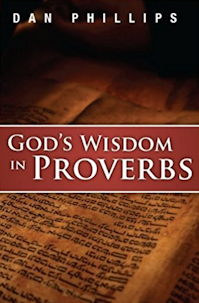
As you doubtless know, Proverbs has long been a love of mine. And as you Faithful Readers know, I actually wrote a book on it. In that book I make the case that all of Proverbs actually centers on a particular theme, a theme that Solomon characterizes not as "one of the most important things" he knew, but the most important thing, the sine qua non of knowledge and wisdom. Without that foundational reality at the very start, there's no knowledge and no wisdom.

That theme is the fear of Yahweh.

I say all that to point you to the sermon I recently preached on that verse and that concept. In that sermon I sketch out both the meaning and importance of the idea in all of our thinking. I also show how revolutionary this truth is when it comes to to how we read and understand the book of Proverbs.

A number of  you have shared that the Proverbs book has been helpful to you in seeing Proverbs in a new light. In fact, a number have told me that the chapter on the fear of Yahweh is "worth the price of admission" all by itself. Hearing that, to say the least, doesn't ruin my day.

If that sermon and concept, and/or the book, are of any value to you, may I ask you two favors?
  1. Tweet and blog the link to the sermon.
  2. Tell people like Joe (though I think Joe himself now knows about it) about the book.

As to that latter, I'm still finding that a surprising number of people — including those with well-earned reputations for being information-centers for YRRs — somehow seem unaware of God's Wisdom in Proverbs. Well, only God can know everything. Right? So share it with them, if you're willing. Assume that (A) they don't know about it, and (B) since they have great love for the OT and for Proverbs and for Christian books of substance on both, they will be delighted to learn of, and spread the word about, a new book that God is using to open up Proverbs to all who read and use it.

After all, don't we all hope to see significant gains in reading, understanding, preaching and living the marvelous book of Proverbs? Old Testament scholars like David Murray and Jim Hamilton (both rightly much-loved by TGC-type bloggers and Challies and all) say this book helps in that direction. The publisher did a terrific job in presenting it, for which I'm very grateful. You can help do the sort of word-spreading that larger publishers like Crossway and Nelson and others have built in to their much-larger organizations. Nothing is so catching or persuasive or winsome as enthusiasm, and I know many of you have it for this book.

Some of you have said, "I only have a few readers/followers." Sure, I get that; but you read and enjoy writers and pastors and conference speakers who influence a great many. Share this with them, warmly and winsomely and persuasively, and they may thank you for it!

I surely do!

Dan Phillips's signature

10 November 2011

The fear of Yahweh involves revelation (excerpt from God's Wisdom in Proverbs)

by Dan Phillips

When we think of fear, our first thought is probably of the emotion—that paralyzing, mouth-drying, stomach-clenching dread that seizes hold of us in the face of an imminent threat. This connotation is not altogether absent. Anyone who can think of God and shrug is not thinking of the God of Scripture.

However, a primary and basic element in the fear of Yahweh is revelation. Read Deuteronomy 4:1–15, a passage with which Solomon would have been intimately familiar. The chapter opens with a call to Israel to hold tight to the words of God (vv. 1–3), which is equivalent to clinging to God Himself (v. 4–5). Moses stresses that it is the possession of this verbal revelation which is both their national wisdom and their point of distinction on the international scene (vv. 6–8). So they must hold fast the words and the memory of their encounter with God (vv. 9–10).

Of particular interest to us is Deuteronomy 4:10, where Moses recalls
“…the day that you stood before the LORD your God at Horeb, the LORD said to me, ‘Gather the people to me, that I may let them hear my words, so that they may learn to fear me all the days that they live on the earth, and that they may teach their children so.’”
From this verse and the larger context I isolate two observations:
1. “Fear” here clearly is not merely an emotion—or else I think that the fire and all (v. 11) would have done the trick.


2. “Fear” here is something that must be learned, and that requires revelation from God. God commanded that the people hear His words “so that they may learn to fear” Him, and that they might teach the fear of Yahweh their children.
And then we see in verses 12–14 where Yahweh Himself directs the spotlight in that entire encounter. So many today pine and yearn for anything remotely supernatural—and here it is, on bold display. Darkness, clouds, fire, the very voice of God. Is that where Yahweh fixes their attention?

No. In fact, Yahweh expressly says, “You heard the sound of words, but saw no form; there was only a voice” (v. 12b). He goes on to relate at length the fact that He revealed and inscribed the Ten Commandments (v. 13) and commanded Moses to teach them “statutes and rules” that they might do them (v. 14). There was no form, only the word of God (v. 15). God emphasizes His word, and specifically stresses that He spoke to them, that He rendered Himself quotable.Therefore, if anyone wishes to learn to fear God today, he will not chase off after reports of supernatural outbreaks here and there. Instead, he will open his Bible, and he will pray that God open his heart to hear His voice speaking through it, and will teach him to fear God thereby (cf. Psa. 119:18; Heb. 3:7ff.).

The point comes up again in Deuteronomy 31:9–13, where Moses commanded the Levites to read the Word of God to the people at their national assembly “in order that they may hear and learn and fear the LORD your God, and be careful to observe all the words of this law” (v. 12 NAS, emphases added), and that their children may also hear, and learn to fear Yahweh (v. 13).

The soul of national worship, then, was not music or dances or entertainment or emotions. If those elements were present, they were not what Yahweh stressed. What He stresses is the reading of His Word as essential to Israelites coming to fear Him.

Deuteronomy 31:13 is worth further emphasis, in that God expressly declares that this is how the children “who have not known” would learn to fear Him. “Have not known” what? In context, they have not known His miraculous deeds (cf. 11:2). By saying this, God is indicating that the truth and power of His Word are sufficient. Unlike some late-arrivers who have attempted to make the case that supernatural “special effects” are necessary for vital Christian faith, God says that His Word is not only sufficient, but superior.

(Excerpt from Chapter Three, "The Foundation of Wisdom," in God's Wisdom in Proverbs, 71-72)

Dan Phillips's signature

27 October 2011

Fear and comfort: a healthy blend

by Dan Phillips

Wouldn't you think that "fear" and "comfort" are antonyms, like "love" and "hate," or "darkness" and "light"?

In a Biblical context, we might most quickly associate the word "fear" with "of the LORD," or "of Yahweh." That topic — "the fear of Yahweh" — is a major Biblical theme. Clearly, in Proverbs, it is a literally foundational thought (cf. 1:7; 9:10; 31:30). In the Proverbs book, a chapter of 40+ pages traces the concept its older Old Testament appearances, just so we can begin to understand of Solomon's use throughout the book of Proverbs. One discovery is that the concept itself frames and must color our understanding of each individual verse within the entire book.

When we develop the concept Biblically, we feel the burden to show that the fear of Yahweh is not (as some might think) an Old Testament concept as opposed to a New Testament concept. Indeed, it is quite literally a pan-Biblical concept.

This stood out to me in a recent daily Bible reading. Acts 9:31 leapt out at me in this context:
Ἡ μὲν οὖν ἐκκλησία καθ᾽ ὅλης τῆς Ἰουδαίας καὶ Γαλιλαίας καὶ Σαμαρείας εἶχεν εἰρήνην οἰκοδομουμένη καὶ πορευομένη τῷ φόβῳ τοῦ κυρίου καὶ τῇ παρακλήσει τοῦ ἁγίου πνεύματος ἐπληθύνετο.

So the church throughout all Judea and Galilee and Samaria had peace and was being built up. And walking in the fear of the Lord and in the comfort of the Holy Spirit, it multiplied.
There's that same phrase we find in the OT; in fact, the Septuagint of Proverbs 9:10 has φόβος κυρίου ("fear of the Lord), as the beginning of wisdom. The post-Pentecost Christian church proceeded in that same fear. They lived their life from that motivation, the very same motivation found throughout the OT, and identified by Solomon as the necessary starting-place of knowledge (1:7) and of wisdom (9:10).

That in itself is instructive and thought-provoking. Though they'd been saved by the shed blood of Christ, though the Spirit had been outpoured, though non-Jews were beginning to be brought in, yet one thing that united them all is that they moved on in their Christian lives with the motivation of fear of the Lord.

It poses the question: how dominant of an element is this in the modern Christian's life? How does it affect the way he thinks, the way he forms views, the way he talks and lives and chooses and writes? How much is a lack of this quality a factor in the situations that vex us here at this virtual gathering? How many bloggers, writers, pastors are limp and passionless because they are less motivated by fear of the Lord than by fear of man, which is a snare (Prov. 29:25)? How many doctrinal errors, or errors of ministry or practice, can be traced to the want of that fear (cf. 3:7; 14:2; 15:33; 23:17; 28:14)? There's fertile ground for self-analysis, and re-examination of the genesis of wandering, in that topic.

But then notice the next phrase: "and in the comfort of the Holy Spirit." Luke sees and depicts this quality as seamlessly joined with the preceding. The two are joined by a simple "and," not "and yet" or "and by contrast," nor qualified by "sometimes... sometimes."

Clearly, the jarring disconnect we feel between fear and comfort was not a problem to Luke. It was fear that gave the heart and mind the right stance before God; it was comfort given by the Spirit that assured and encouraged him in the life he was moved to live.

I conclude that either, to the exclusion of the other, is an unhealthy imbalance. Conversely each, coupled with the other, is a spiritually healthy blend.

What God has joined, we shouldn't sunder.

Dan Phillips's signature