Response: Hold up there, Turbo. If I listen to what you just said, I shouldn't be listening to what you want to say. Or to what you just said. So... I guess we're done here!
NEXT!
(Proverbs 21:22)




 Once there was a man with much to boast of; and boy, did he.
Everyone caught in a sin will either repent, or double downSin snowballs.

Whoever conceals his transgressions will not prosper,...and its companion warning:
but he who confesses and forsakes them will obtain mercy
(Proverbs 28:13)
One who becomes stiff-necked, after many reprimandsThe lesson to us is clear: we should humble ourselves, lest we be humiliated. "Humble yourselves, therefore, under the mighty hand of God so that at the proper time he may exalt you," Peter admonishes (1 Pet. 5:6).
will be shattered instantly— beyond recovery
(Proverbs 29:1 CSB)
 Before you read too far, let me admit upfront that this post is two things: an adaptation of a post I made at my blog in 2008, and a rider on the theme Dan and Phil have been setting up this week so far. So if it reads a little familiar, thanks for being a studious reader of my blog. For the other 3,000 of you, let's proceed.
However, Warren said, in our day criticism is marked by the following four factors:He forgot "mean" and "impersonal" (meaning "they don't apologize for disagreeing", and "they don't call you on the phone first"), but I take exception to the idea that internet criticism is "permanent". Blogging, or erecting a web site, for the sake of some argument or issue doesn't make it "permanent" any more than getting your book published makes its contents "permanent".
1.Instant
2.Constant
3.Global
4.Permanent
 I'd also like to add that the attribute of "constant" criticism is only born by those who are doing something which somehow keeps drawing attention -- usually to their foibles or errors. For example, I am unaware of Mark Dever having to field "constant" criticism -- unless I should have read [insert your fav watchblogger here] lately or something.

You rebuke the insolent, accursed ones,Three times we see the insolent, who are arrogant and presumptuous. What characterizes them? God's word is not enough for them. They wander from God's commandments, they turn away from His law, they do not live according to His revelation.
who wander from your commandments (Psalm 119:21)
The insolent utterly deride me,
but I do not turn away from your law (Psalm 119:51)
The insolent have dug pitfalls for me;
they do not live according to your law (Psalm 119:85)
 Thus it ever was. Satan started right there: the conversation-starting open inquiry "Did God really say?" soon led to "God was wrong."
 f you have been reading the blog very long, this shouldn't come as any surprise:
I was envious of the arrogant when I saw the prosperity of the wicked. For they have no pangs until death; their bodies are fat and sleek. They are not in trouble as others are; they are not stricken like the rest of mankind. Therefore pride is their necklace; violence covers them as a garment. Their eyes swell out through fatness; their hearts overflow with follies. They scoff and speak with malice; loftily they threaten oppression. They set their mouths against the heavens, and their tongue struts through the earth. Therefore his people turn back to them, and find no fault in them. And they say, "How can God know? Is there knowledge in the Most High?" Behold, these are the wicked; always at ease, they increase in riches. (Psalm 73:3-12)
All in vain have I kept my heart clean and washed my hands in innocence. For all the day long I have been stricken and rebuked every morning.
 Well, not exactly. In fact, the point Asaph is making is precisely the opposite: "If I had said, 'I will speak thus,' I would have betrayed the generation of your children" (v. 15).

 ere's the closing zinger from an article in this weekend's New York Times Magazine:
[The] New Calvinism underscores a curious fact: the doctrine of total human depravity has always had a funny way of emboldening, rather than humbling, its adherents.

The PyroManiacs devote some space each weekend to highlights from The Spurgeon Archive. The following excerpt is from the sermon "The Glorious Gospel of the Blessed God," preached Sunday morning, 30 June 1867, at Camden Road Chapel, London. In that sermon, Spurgeon carried on an imaginary dialogue with the "epistemological humility" of his day.
 omeone demands, "How am I to know which is the gospel?"
 ext, as good stewards we must maintain the cause of truth against all comers.
 xactly a year ago, I was in precisely the same position I am in right now: burdened with deadlines and commitments, unsure of how I would ever get everything done, and generally over-stressed. One of several Swords of Damocles hanging over my head last year was an overdue chapter I had agreed to contribute to a book on evangelical postmodernism edited by Ron Gleason and Gary Johnson. I had worked on that chapter almost every spare minute during my teaching time in Italy but had not finished it, so it was the first thing I had to do after returning to the States. Almost a year ago to the day, I posted an excerpt from one of my footnotes to save having to write a blogpost.
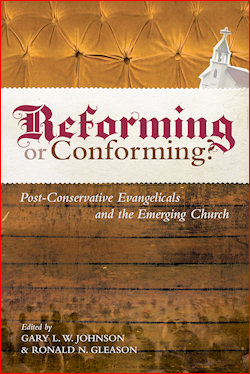 Anyway, that book is titled Reforming or Conforming?: Post-Conservative Evangelicals and the Emerging Church (with a Foreword by David F. Wells). For some reason (which I hope was unrelated to my chapter), the book's release was delayed for nearly a year, and it is now slated for this coming September. I received a .pdf copy of the entire book while in Italy this year (just last week), so I'm now reading the full book for the first time. The chapters I have read so far are amazingly good and insightful. Since I contributed a chapter, I won't attempt an objective review of the whole book, but watch for it. It will definitely be worth your time.
|

"Then Satan entered into Judas called Iscariot, who was of the number of the twelve" (Luke 22:3)And now, whatever Judas' childhood, his youth, his other accomplishments; whatever it took to bring Judas to this point or make him the man he was, everything is erased and overshadowed by this one event: Satan found in him a willing host. All his yesterdays do not matter. Whatever his family, his friends; his accomplishments, his hopes, his dreams. All are blotted out. All that remains is this: Satan himself made Judas his base of operations from which he could launch a killing strike on the Son of God.
 And now, when we think of Judas, we think of this, we think of what came of this. Not of the preaching, the following, the miracle-ministry. No, Judas' name is the eponym of a traitor. We remember his treachery, and we remember his foul kiss.
 him?
him?For we have come to share in Christ, if indeed we hold our original confidence firm to the end (3:14)
Since then we have a great high priest who has passed through the heavens, Jesus, the Son of God, let us hold fast our confession (4:14)
…by two unchangeable things, in which it is impossible for God to lie, we who have fled for refuge might have strong encouragement to hold fast to the hope set before us (6:18)
Let us hold fast the confession of our hope without wavering, for he who promised is faithful (10:23)
Therefore, since we are surrounded by so great a cloud of witnesses, let us also lay aside every weight, and sin which clings so closely, and let us run with endurance the race that is set before us, 2 looking to Jesus, the founder and perfecter of our faith, who for the joy that was set before him endured the cross, despising the shame, and is seated at the right hand of the throne of God (12:1-2)
 by Frank Turk
 For the verse-number guys who think you can't spill out God's truth without the verse numbers, check out 1 Pet 5:6, Luke 14:11, Zeph 2:3, and Dan 5:21-23.
But then there's one verse which has to catch your eye as you bumble through BibleGateway.com:
Likewise, you who are younger, be subject to the elders. Clothe yourselves, all of you, with humility toward one another, for "God opposes the proud but gives grace to the humble."(ESV)(again, for the verse people, 1 Pet 5:5) And while we might expend 1000 words on the nuances there, one thing's for sure: Peter is talking about relational humility of people to people, so in some way "orthodoxy" causes "humility" one to another among Christian people.
 Cap in hand, I get the appeal of wanting to be like David Carradine in the 70's TV series Kung Fu. I get the appeal of a pseudo-monastic lifestyle because it seems a little mysterious to people who don't really know what you're up to. But even Kwai Chang Caine had to stand up for what's right every now and again -- about once every 20 minutes (including commercial breaks) if memory serves me right.
So in the end, if that's actually humility -- taking action in truth after being transformed by the truth in the first place to right action -- should we care that some people will interpret our (metaphorically speaking) moral and spiritual Shao Lin disciplines as being unhumble and ungracious?
If so, when should we care?
That's what the meta is for, and I leave that to you today.


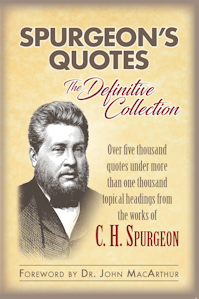
Amazon also has it. See details at Kress
Also available at Logos

Available on Kindle and in Logos
View readers' favorite Kindle excerpts
|
Remember that you are our guests. We will, at our discretion, delete comments that we find off-topic, derailing, un-civil, slanderous, trollish or troll-feeding, petulant, pestiferous, and/or otherwise obnoxious and non-constructive. If we warn you, stop it. After no more than three warnings, you will find yourself banned, and all your future comments will be immediately deleted.
See an error in the post? How clever of you! Email the author. If you comment a correction, expect the comment to disappear with the error.
If you are confused about how the specifics of these principles play out in practical terms, you'll find a longer list of rules HERE.

 |
| The opinions expressed in this blog do not necessarily represent the views of all contributors. Each individual is responsible for the facts and opinions contained in his posts. Generally, we agree. But not always. |