
Showing posts with label language. Show all posts

21 May 2010

Not yet. We're getting there.

by Phil Johnson

've had a few things to say in recent years about preachers who translate the gospel into profanity in the name of "contextualization." If you're one of those who think I have exaggerated the problem or been too shrill in pointing it out, have a look here.


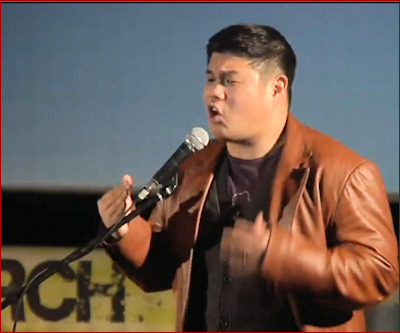
That's Sam D. Kim, founding and senior pastor of 180 Church, a Manhattan-based missional community. His specialty, and the trademark of 180 Church, is (in Sam Kim's own words) "effed-up theology." Watch his sermon, and pay close attention around the 8-minute mark, where he says he got a nod of approval for this type of "contextualization" from an elite group of "theologians and professors" at a Lausanne meeting in Dallas.

"Do you actually use the [f-]word?" they asked.

"Not yet. We're getting there," he told them.

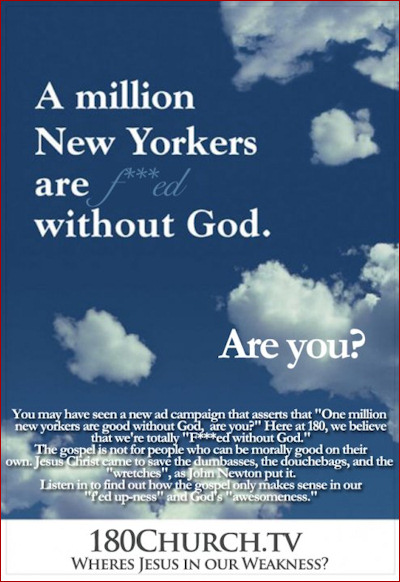
Tragically, it looks like some of our Young, Restless brethren are moving that direction at breakneck speed. Here's what 180 Church's current ad campaign looks like:


Now, here's the thing: Sam Kim apparently understands the gospel. He has a Bible and refers to it now and again. So why does he think it necessary to exegete pop culture and translate the gospel message into gratuitous profanity? Why doesn't he preach the Word of God undiluted and on its own terms?

See, I think this whole approach to ministry reflects a fatal lack of confidence in the power of the gospel itself. If we really believed the gospel is the power of God unto salvation, why would we think it necessary to dress the message in such shabby rags?

Phil's signature

19 October 2009

Cussing Again

by Phil Johnson


ussing is back on the table for debate again, it seems. Last week I was twitted by Twitterers, poked by Facebookers, IMed by chatmongers, and berated by bloggers on this subject. (Apparently there's a gang of angry people prepped and ready to throw down any time I breathe a sigh of disapproval about cussing—especially if some Christian celebrity is the one doing the cussing.)

Anyway, although we've dealt with that subject several times in the past, every time it comes up, the same tired arguments get trotted out to defend the casual use of crude slang, profane language, or perverse speech by Christians. The most popular arguments in favor of cussing seem to be 1) that to cuss or not to cuss is purely a matter of Christian liberty, not a biblical issue; 2) that cussing is necessary these days in order to contextualize our message and to prove to the world that we're not "legalistic"; 3) that compared to being disagreeable, cussing is practically a virtue; and 4) that a more lenient attitude toward cussing would prove we really do care that AIDS and hunger are killing large numbers of people in Africa.

That fourth argument is the one that baffles me most. I'm not sure why anyone would think liberalizing our tolerance for vile language and recreational profanity among Christians might ease the AIDS crisis or do more to cure poverty than recruiting more people to serve alongside the thousands of non-cussing evangelical missionaries and relief organizations who are already providing medical services, food, and clothing for sick and impoverished people worldwide. But evidently some very vocal people are convinced that liberal use of scatology is the only valid badge of authenticity for one's social concerns. Bono was a pioneer in the use of such verbal emblems, of course, but Tony Campolo is the one who brought it into the evangelical mainstream and made a whole generation of students think of cussing as practically a sacrament. Now Derek Webb has canonized the idea in a song.

We often hear people suggest that because the apostle Paul used the word skubalon, (translated fittingly as "dung" in the KJV), scatology has thereby been sanctified. Have at it. If Paul could say that, nothing should be taboo. Christians nowadays likewise try to justify even worse kinds of crudeness on the grounds that Paul spoke harshly and indelicately about the Judaizers in Galatians 5:12. (He hinted that since they believed circumcision makes a person holier, they ought to take their doctrine to the next level and emasculate themselves.) I've responded to those argumentsrepeatedly.

But notice what Paul himself said about lewd and off-color language. He classifies it as impurity in Ephesians 5:3-6, where he treats indecent language as one of several worldly substitutes for love. The Greek term Paul uses is akatharsia, a word that refers to every kind of filth and pollution—"uncleanness" in the KJV. Paul is talking about real spiritual uncleanness, not ceremonial defilement, but moral filth.

And when he gives some specific examples of akatharsia in verse 4, all of them have to do with the misuse of language: "obscenity," "foolish talk," and "coarse jesting." He is talking about the words we use, the things we talk about, and the spirit of our conversation. He covers all the bases.

Now, you might well wonder, if the context is dealing with genuine love vs. counterfeit love, how do smutty words, base conversations, and vulgar jokes fit into any category of phony love?

Think about it; those are the peculiar characteristics of worldly companionship: "filthiness . . . foolish talking . . . coarse jesting." Those are the main emblems of membership in any carnal brotherhood. Look at any of Satan's strongholds; any place where wickedness operates unrestrained; wherever you find a band of thieves or a federation of scoundrels—from the juvenile gangs that roam our streets to the old-men's club that hangs out at the neighborhood tavern. "Filthiness . . . foolish talk [and] crude joking" are always their main stock in trade. That's what will consume the leisure time they spend together. Because those are the main badges of fleshly fellowship, and that is the glue that substitutes for authentic love virtually every worldly fraternity. That is exactly what Paul is describing, and he says, Don't let such things characterize your fellowship with one another.

In order to obey the principle Paul sets forth here, we need to be intentionally counter-cultural, because our culture values evil companionship much more than wholesome love. Have you ever considered the degree to which this is true? "Filthiness . . . silly talk, [and] coarse jesting" are virtually the trademarks of secular society. Vile language, crude subject matter, silly talk, and sheer folly are the main currency of the contemporary entertainment industry. The corrupt notion of brotherhood Paul is attacking here is exactly what most of our culture has substituted in the place of real love.

That's why movies are filled with dirty words and smutty themes. That's why contemporary comedy is so dependent on vile language and filthy subject matter to get a laugh. Situation comedies on television used to feature families and plot lines. Now they are shows about nothing dealing mainly with relationships between friends who are unmarried, unattached, and lacking any discernible direction in their lives. "Filthiness . . . foolish talk[, and] crude joking" describes about 99 percent of the content of programs like that.

Our culture insists those things are perfectly benign, but Paul says they are not. Carnal camaraderie is practically the antithesis of true, godly love. Crude language, filthy joking, and risque entertainment are "not fitting" for Christians. They have no place in the Christian's walk. Verse 12: "For it is a shame even to speak of those things which [they do in secret]." Keep those things out of your life. More than that, keep references to things like that out of your conversation, Paul says.

And notice this: he categorizes spicy talk about frivolous subject matter along with some of the most serious of all sins. Don't get addicted to that brand of language and humor, and especially don't allow that kind of companionship to characterize your own life.

Phil's signature

23 March 2009

More On the Pornification of the Pulpit

by Phil Johnson


he message I gave at the Shepherds' conference three weeks ago on the pornification of evangelical pulpits continues to generate e-mail and questions. (The message was on Titus 2:7-8 and was titled "Sound Doctrine; Sound Words.") I don't particularly want a drawn-out discussion of that message to dominate our blog. So I answered three or four of the best questions about it HERE two weeks ago and hoped we could move on to other topics.

But a new wave of questions followed that post. In fact, the volume of feedback I am getting seems to be increasing. Positive replies still outnumber negative ones by a very large margin, but the negative ones are getting more and more aggressive. I commented two weeks ago that only a few people had challenged my position and most of them were gracious. I can't honestly characterize the negative e-mails in this second wave as "gracious."

But it seems those who disagree with my position are the most eager to keep me talking about it. My detractors are nothing if not persistent, so today I'm going to answer some of the best questions from that second wave of e-mails:

Are your ears so tender that you are truly injured by the sound of coarse words?


I wish I could say I'm so thoroughly "innocent in what is evil" (Romans 16:19) that I'm traumatized when I hear vile words, dirty jokes, or the casual patois of the porn industry. Sadly, before I became a Christian I was a master at telling smutty jokes. I come from a line of Oklahoma cattlemen. I think my great grandfathers and their sons were blissfully unaware that polite society considered any words or topics off limits. I first learned how to cuss fluently in grade school while fishing with my grandfather. Then I spent my summers from high school through college working on roofing crews, where profanity flows more freely than hot asphalt.

So my problem is not that I am naïve when it comes to filthiness, foolish talk, and crude joking. On the contrary, I have had far too much exposure to such things to be fooled by the claim that they can be harnessed and employed as tools for contextualizing the gospel.
Incidentally, my concern about such things is not that they are injurious, but that they are spiritually defiling. Words that inflict pain on those who hear may or may not be sinful. Talk that defiles the hearers is always wrong.

I have heard you use expressions like "damnable heresy" and "pompous ass." How is that different from the strong language you condemn?


1. I don't condemn "strong language" per se. On the contrary, I like robust, vivid language. What I deplore is profane, filthy, lewd, or irreverent talk.

2. Words such as damned and damnable are inappropriate when employed as casual curses, but such words are fitting and proper when we're speaking of literal damnation.

3. Can I justify calling someone a "pompous ass"? In most instances, probably not. But that's not because it's a profane expression. It is not. In that context (as well as all 90 times the word ass appears in the KJV), the term is a reference to a braying donkey.
    Nevertheless, it would be fairly easy to make the case that an expression like that cannot be applied to a fellow believer without violating Romans 12:10 (and probably the spirit of Matthew 5:22). Even using such a label to describe an egotistic unbeliever might violate Colossians 4:6—especially if it's used in an offhand or jeering way.
    Have I been guilty of that? To my shame, yes. A too-sharp tongue is one of my besetting sins. I made a comment about that two weeks ago, near the end of that 400-comment thread: "I'm certainly not proud of every parody I have ever invented or every wisecrack I have made. The sudden rise of profaneness in the pulpit over the past 3 years is one of the things that has driven me to rethink how freely we ought to indulge in hard-edged humor."

In your message at the shepherds conference you used the word defecating. Why is that any better than a shorter, more common word that means exactly the same thing?


Every culture has words that are considered taboo, or in biblical terms, "filthy." It's not merely their meaning that has caused them to be deemed inappropriate. I could give you a dozen or more synonyms for ordure that occupy varying levels of social acceptability, ranging from baby-talk expressions that are not really banned by our culture (but I wouldn't normally use them in the context of Bible teaching)—to words like guano, bear scat, manure, or feces. These would include several more or less clinical terms for specific kinds of excreta.
Contemporary culture is not really as vague as some like to pretend when it comes to the question of which words are "filthy" (like the words that decorate so many hard-core rap songs) and which words are merely vivid and repulsive (like the word diarrhea.)

Scripture expressly says the former is to be avoided; Scripture itself employs the latter, but only judiciously.

Who determines which words are "filthy" and which ones are merely clinical? Is there a list of forbidden words you can send me?


Culture determines this. It's quite true that the standard may be different from culture to culture and generation to generation. But both history and literature prove that it's not nearly as fluid or as nebulous as postmodern language-theorists suggest.

I listened to your anti-Driscoll message and read everything you wrote on your blog about it. You still haven't cited a single sermon where Mark Driscoll used cuss words.


1. If you had read everything on my blog about it, you would know that I have never once accused Mark Driscoll of using "cuss words." Furthermore, I have made that point multiple times—every time someone demands examples of Driscoll's "cussing."

2. If you had given my message a fair hearing, you could surely find a more fitting way of describing it. How about "your message on Titus 2:7-8?"


ne intriguing fact stands out in all the criticisms of that message: not a single critic has challenged my interpretation of Titus 2:7-8; Ephesians 4:29; 5:3-4; or the third commandment (Exodus 20:7). My detractors' disagreements fall into two categories: 1) some complain that I don't understand the importance of contextualization; and 2) some complain that I've exaggerated the problem.

If I could ask just one question of them, it would be this: What, precisely, do you think Ephesians 5:4 forbids?


Phil's signature


10 March 2009

Preachin' Dirty

by Phil Johnson

ulpit Live is currently posting transcripts from Friday morning's plenary session at last week's Shepherds' Conference. The comment-threads there would be a perfect place for me to answer some of the questions I have received since the Shepherds' Conference, but for reasons unknown, the Pulpit website won't accept my comments. (I'm dead to them.)


On top of the many comments posted in various on-line forums, I've received about two dozen e-mails from people who have written me directly to ask questions or lodge complaints about Friday's message. All who have written me directly have been very gracious, and I believe all of them have been sincere. Most have asked the same two or three questions, so today I want to answer those questions (plus a few of the not-so-sincere objections that have showed up here, there, and on Facebook). These are roughly in order from the most common questions to the most bizarre:

Have you or Dr. MacArthur ever personally shared your concerns personally with Mark Driscoll?

Yes. I sent Mark a 6-page letter the first week of December, telling him what I was planning to deal with at the Shepherds' Conference. I explained why I thought his message at the Desiring God Conference in September left some of the most important objections to his own use of crass language unanswered. I also enumerated six specific questions that I thought would help my understanding of his position.

Mark didn't reply or acknowledge my letter until one week prior to the Shepherds' Conference. Then he phoned and said he would answer me by video since the timing was late. When the video arrived, Driscoll had addressed his reply not to me but to the attendees of the Shepherds' Conference—as if I had invited him to share my time slot at the conference.

His reply also ignored the six questions enumerated in my letter. Instead, he answered a question of his own choosing, saying he believed that one answer would suffice as an answer to all my questions.

John MacArthur likewise attempted to correspond with Driscoll a year and a half ago. He too received no answer for almost six months, and when the answer finally came, it was routed indirectly, through an e-mail sent by Driscoll's secretary to John MacArthur's secretary. Curiously enough, Driscoll's reply to John came on the first day of last year's Shepherds' Conference.

Driscoll clearly does not take his critics very seriously. Communication with him hasn't done anything so far to convince me that he understands (or wants to understand) the concerns some of us have tried to express to him.

Didn't you know that Driscoll has already repented of using bad language?

So I hear. I mentioned that fact in my letter to Driscoll and cited three well-known instances of ribald jokes and profane remarks that occurred long after he said he was sorry for past sins of the tongue. The first of my six questions to him was, "How do the above remarks differ from things you previously said you had repented of?" He did not answer that question.

I had someone else listen to your message. He went semi-ballistic, claiming that you'd misquoted Driscoll, and used 5- and sometimes 10-year-old arguments against him, etc.

I mentioned Driscoll by name only in two places in my message—once at the start and once at the end. The first time I mentioned him, I quoted from the opening sentence of an article in the New York Times Magazine about Driscoll. I attributed no words to Driscoll himself. The second time I singled out Driscoll by name, I referred to a joke he has told repeatedly. I made no attempt to "quote" the joke, because doing so would have violated the principle I was attempting to affirm. So I described the joke in oblique terms. Again, I attributed no words to him.


Both of those references dealt with material that has been published since January 1 of this year. So I would be curious to know where the critic thinks I "misquoted" or made use of "5- and sometimes 10-year-old arguments against him, etc."

Can you cite a single sermon where Driscoll used "cuss" words?

Why?

Not only did I not accuse him of using "cuss" words; I did not even mention Donald Miller's infamous nickname for Driscoll.

My complaint about Driscoll's language in the pulpit is much more serious than the question of whether he cusses or not. And I think I made that fairly clear.

Did you see Driscoll's Twitter comment right after your message?

There's no reason to assume that had anything to do with me, or that it meant anything sinister. He said he was meditating on Proverbs 26:4: "Answer not a fool according to his folly, lest you be like him yourself." It's a good verse. I meditate on that verse virtually every day, whenever hostile or hateful comments show up on my blog.

But you know what? Even if I thought Mark was aiming that Tweet at me, I wouldn't make an issue of it. I'm not particularly interested in what his visceral reaction was on Friday afternoon. I'm curious what his response will be when he has had time to think through the biblical substance of my message.

You lumped Mark Driscoll together with Ed Young. That's not fair.

Precisely how did I "lump" them? By naming them both? Both of them have shown a predilection for dealing with sexual topics in lurid terms. But not only did I not draw that connection or imply that the two of them are in any way in league with one another, I don't believe I even made any specific mention of Driscoll's series on sex from Song of Solomon—even though I think some aspects of that series and the accompanying Q&A were even more offensive than Ed Young, Jr.'s smirking interviews on the cable news programs that featured his sex challenge.

I have noticed, however, that all the questions I'm getting are about Mark Driscoll. Where are the defenders of Ed Young, Jr., ChristianNymphos, and xxxchurch's inflatable mascot?

Here's the point: My message was not actually about Driscoll per se. If the problem were just one guy who likes to talk dirty, I wouldn't have even dealt with the topic.

What my message actually decried was the atmosphere in evangelical and post-evangelical circles that deliberately glorifies everything lewd and lowbrow at the expense of any serious call for holiness.

I think I made that pretty clear, too.

Phil's signature


21 March 2008

Context and Contextualization

by Phil Johnson

More about why I've been so adamant in my refusal to embrace and celebrate a word so many people seem enthralled with.

efore the 1970s, the word contextualize was pretty hard to come by. It was, however, listed in unabridged dictionaries as a verb meaning "to study something in its own context." (The Oxford English Dictionary still gives that as the word's primary meaning.)
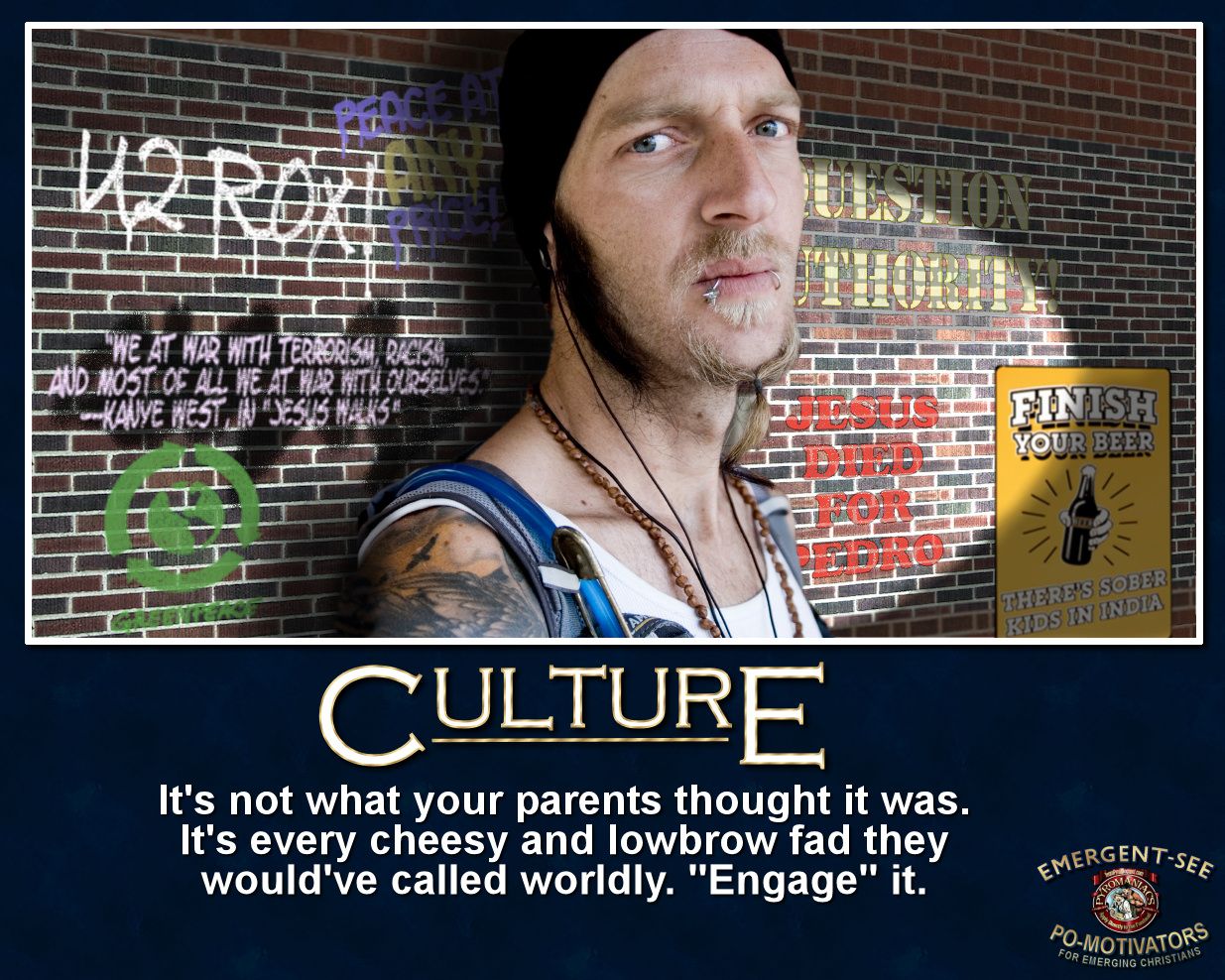
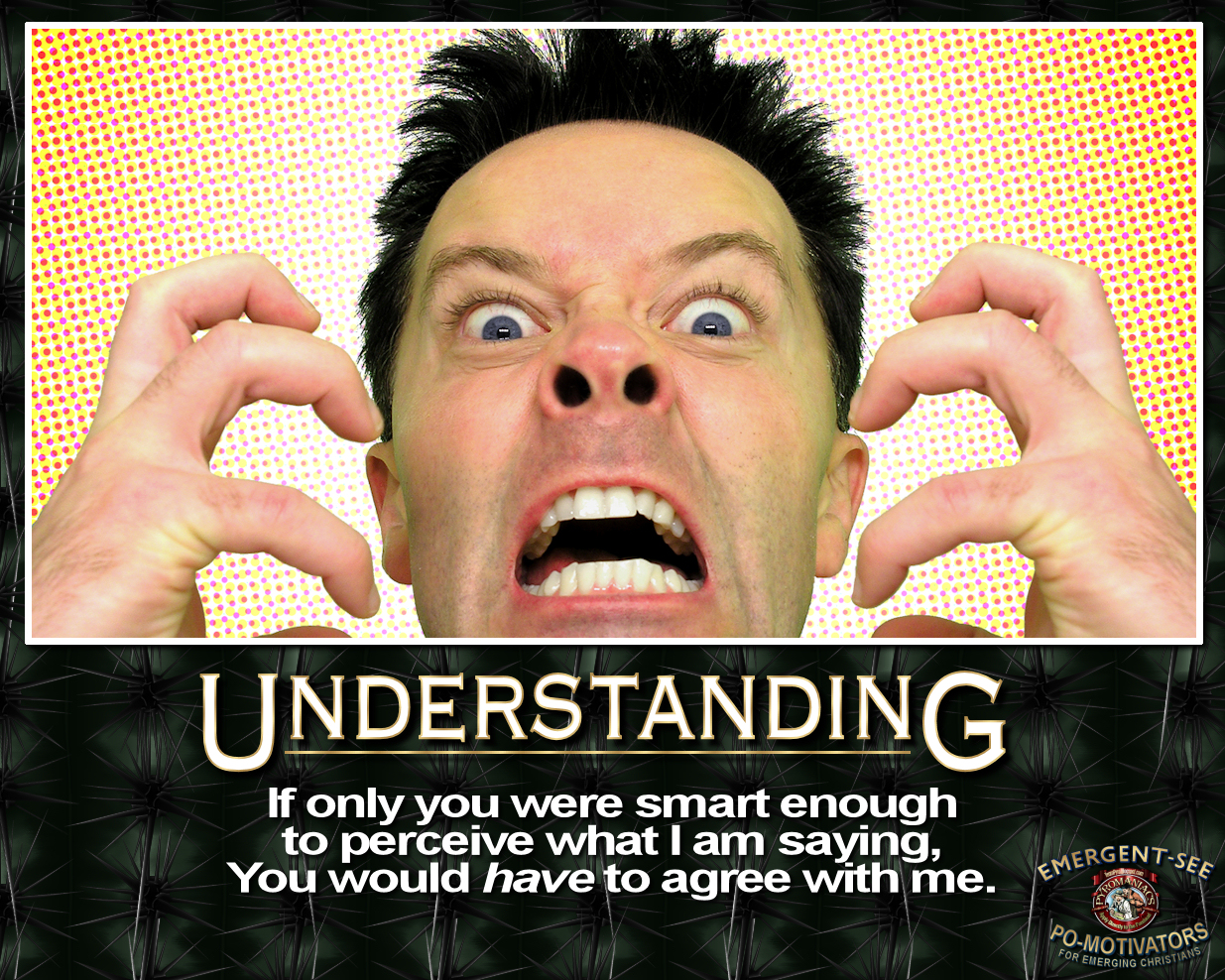
In the early 1970s, left-leaning missiologists made contextualization into a religious shibboleth. They also turned the dictionary definition of the word inside out. They weren't talking about studying or explaining biblical truth in its own context; instead, what they wanted to do was adapt and stylize religious ideas and symbols to fit into the cultural context of their target audience—namely oppressed and marginalized people groups.

It wasn't long before hip, young evangelicals discovered and embraced the basic concept, and then franchised it. Instead of targeting impoverished and downtrodden people, however, they turned contextualization into a tool for attracting Yuppies. People-pleasing activities quickly replaced God-exalting worship. Popular entertainment, apparently, was the one "context" the new evangelicals' target clientele were drawn to en masse.

Now post-evangelicals have canonized contextualization as the one essential belief they all agree on. The "context" that seems to interest them most is the postmodern underbelly of western youth culture. (They evidently believe nihilistic post-generation-Xers are the very epitome of an oppressed and marginalized people group, so in effect they have brought the term back to its roots.) They defend contextualization with a zeal most of them don't even have for the authority of Scripture.


A fundamental problem in all those cases is that the starting point of their hermeneutic is not a careful study of the biblical text in its own context—but a sympathetic self-immersion into various contemporary cultural contexts. The favorite emblems of faddish subcultures are then borrowed and blended with spiritual imagery in order to make selected elements of the Christian message seem as comfortable and familiar as possible. Re-contextualization or even de-contextualization would be more fitting terms.

I realize there are some sensible and sane evangelicals who are quite fond of the word contextualization—and they generally try to define it in innocuous terms that defy the word's actual derivation and history. That strikes me as an utterly wrong-headed way of thinking—especially for those who profess to be concerned about context and communication. And yes, I know the word is currently in vogue and gaining ground even in conservative circles. I don't mind being countercultural and uncool, so that plea carries no weight whatsoever with me.

Let me be clear: My objection to "contextualization" in evangelical and post-evangelical parlance is not because I think context is unimportant. On the contrary, context is vitally important—and when we're dealing with revealed truth from God, biblical context is vastly more important than the context of any contemporary subculture.

In that context, consider this comment from a semi-prominent post-evangelical blogger:

Phil Johnson’s current post on contextualization . . . should be read to get a clear picture of what Johnson and his supporters hear when they hear "context." Summary: the worst aspects of culture embraced at the most cost to the clarity of the gospel. Is that what missiologists and missional pastors mean by contextualization?


  1. First, the fellow utterly misses my whole point. My objection to the popular notion of contextualization has nothing whatsoever to do with any phobia about context—either the word or the concept—properly considered. I'm simply pointing out that of all the contextual issues we must consider as ministers of the gospel, biblical context must always be first in order and is always of supreme importance.
         But biblical context is not what the word contextualization refers to. I frankly wouldn't care if the very finest aspects of culture dominated the concerns of contextualizers. I'd still reject the concept. What I object to is the utterly fallacious idea that something other than the biblical context should be the starting point for our understanding or application of spiritual truth.
  2. Second, when considering our own contemporary cultural context, we need to make honest and biblically-informed assessments about what's compatible (or not) with timeless biblical principles—rather than uncritically embracing the ephemeral icons of popular culture.
  3. Third, in questions about spiritual truth, biblical context is infinitely more relevant than any cultural context is. That's because meaning and truth are properly determined by the Author, not by the ambassador, and certainly not by the audience.
  4. Finally, with regard to the question of what missiologists and missional pastors mean by contextualization," one of the problems with the term, as I pointed out the other day, is that no two people ever seem to mean quite the same thing when they use it.
The Emerging Conversation illustrates this problem. Some think in order to reach a generation weaned on Ultimate Fighting, South Park, and hip-hop, you have to live and breathe and speak that language, with all its profanity and vulgarity and sexual innuendo. Be loud and proud with it. And, they insist, if you don't frame the gospel in that kind of context, you simply cannot reach postmoderns.

Others take "contextualization" a whole different direction, saying that if you really want to reach postmodernized cultures and subcultures, you can't preach anything with strong convictions. Certainty is offensive to postmodern sensitivities; firm doctrinal positions are perceived as arrogant; so traditional approaches to Christianity are not only uncool; they are hopelessly ineffectual.

What both sides of the Emergent/emerging divide do agree on (in practice if not in precept) is that the application of spiritual truth should begin with the contemporary cultural context, not the biblical context. That's precisely where I think the idea of missiological contextualization went astray, and it happened at the very start.

Oh, and one more thing: the supreme irony here is that the word contextualization itself is a kind of religious jargon—the very kind of thing most contextualizers say we ought to eschew. Do a Google search for the term and see who is using it. Religious people—stylish evangelicals, postmodernized pundits from the emerging conversation, missiologists, church-growth experts, CT editors, missionaries who toe the School of World Mission line, and evangelical jargonauts of all types. Collectively, they seem to use the word at least 75 times more than anyone else. So it is exactly the kind of Christianese the champions of contextualization say we should stay away from. Odd, isn't it?

Phil's signature


25 October 2006

Fed Up


erhaps you are one of those who thinks I have been too hard or too shrill in my criticisms of "the Emerging Church." In all honesty, the more I have been exposed to the various streams of the movement, and the more closely I have examined the agglomeration of trends and ways of thinking that make Emerging-style "ministry" distinctive, the more I want to distance myself from everything "Emerging." If any ostensibly-Christian movement since late-nineteenth-century modernism was more deserving of a shrill warning, I can't imagine what it would be.

Here is a lie writ large: "Postmodern Ministry Takes Us Back to The Bible." I invite you to follow that link; read the page; notice the sound file linked at the bottom of the page; and give it a careful listen.

It's a sermon by Rob Bell. David Posthuma introduces the message with this hopeful claim: "I present this teaching for one purpose alone . . . to illustrate how radically different postmodern Biblical facilitation is from the Seeker-Sensitive Topical Talk model so prevalent within our churches today."

OK. I'll grant that Bell's message is completely and radically different from anything you would hear in a seeker-sensitive context. But Posthuma's blogpost seems to imply that Bell's sermon proves Emerging-style ministry is somehow more "biblical" than seeker-sensitive worship.

Hardly. Bell's message is not only unbiblical; it's anti-Christian. He takes a bit of drivel he apparently learned from a yoga instructor somewhere, badly rephrases in quasi-biblical terminology, and spends 36 minutes doing "exposition" on a breathing exercise.

The result is not merely trivial: it's flat-out heretical. And in more ways than I care to enumerate.

I'll give one brief example, though. Here's a sample of what Bell does with the gospel: "You can't get enough points to get in with the Big Guy. You can't do enough good deeds and then God will like you. One of the things the Spirit does is remind us that we belong. Period. Just exactly as we are. You are loved by God."

Bell's syncretized amateur yoga exercise is not Christianity by any stretch of the definition. I'll go further: if this is what Bell really believes, he himself is no Christian.

The message actually proves that the stream of Emerging religion represented by Rob Bell hasn't a clue or a care about basic biblical truth. It's nothing but an experiment with the deconstruction of Christianity.

On a side note, but a related subject I thought in the interests of balance, after hearing that sermon by Bell, I ought to listen to a sermon from the "conservative" side of the Emerging movement. So I listened to this one by Mark Driscoll. I wish I hadn't. Driscoll's smutty language and preoccupation with all things lowbrow are inappropriate, unbecoming, and dishonoring to Christ. I completely agree that many Christians fail to appreciate the true humanity of Jesus. But it's not necessary to get vulgar in order to communicate the truth about His humanity.

This is the first time I have ever posted anything critical of Driscoll. I have appreciated his defense of the atonement and his willingness to confront the neo-liberalism of other Emerging leaders honestly. But I don't think his perpetually coarse language in the pulpit and his apparent preoccupation with off-color terms and ribald subject matter are merely minor flaws in an otherwise healthy ministry. It is a serious shortcoming.

No, it's actually worse than that, because it blatantly violates the clear principle of Ephesians 5:3-4. It is shameful (v. 12) and therefore a reproach. It's characteristic of the old man and one of the fleshly behaviors we are expressly commanded to put aside (Colossians 3:8). Scripture even seems to indicate that unwholesome language signals an impure mind (Matthew 12:34). And yet this is a deliberate, calculated, and persistent practice of Driscoll's. It is practically the chief trademark of his style.

That's troubling, and even more troubling when I see young Christians and older believers who ought to know better mimicking the practice. If this is the direction even the very best Emerging-style ministry is headed, it's not a trend any Christian ought to find encouraging, much less one we should follow.

Phil's signature

19 May 2006

Some thoughts on bad language

by Phil Johnson

This subject has been batted around the blogosphere for as long as I can remember. Ever since I began blogging, I have been planning to comment on it eventually.



Recently, heated discussions about the impropriety of vulgar language in the mouths (and blogs) of Christians have been provoked by episodes on two of my favorite blogs—one being a protracted comment-thread several days ago on our own Frank Turk's blog, and the other being a widely-discussed post at Challies.com today.

Where should we draw the line in deciding what language is appropriate or inappropriate for Christians, especially in a public context like a book or a blog or a sermon, when the whole world might be listening?

Here are some points I want to make clear:

  1. It's hard to be perfectly consistent on this question, because so much about it is inherently subjective. What's profanity in Hindi doesn't offend my ears at all, because it evokes no meaning in my mind. For that matter, certain English words that have no evil connotations throughout the Commonwealth are jarringly offensive here in America, and vice versa. (The late, greatly beloved founder of our ministry's New Zealand branch used to plead with me to try to convince our pastor not to use the word bum to describe a drunken derelict, because that word was simply not used for any reason in polite society by Kiwis from his generation. There's a totally innocuous British expression meaning "stay cheerful" that probably shouldn't be used in mixed company in America. I'd go on giving examples, but I don't want to offend anyone unnecessarily.)
  2. Nonetheless, we ought to aim at matching our words to our profession of faith. One of the World's Great Powerbloggers accused me of gross hypocrisy a couple of days ago for supposedly winking at Frank Turk's use of an earthy two-syllable Saxon expression. Powerblogger claimed I was being inconsistent with my own policy because I "didn't de-link him." But in point of fact, I did not link to that episode at Frank's blog for the very same reason I haven't linked to other posts elsewhere that have used PG-13 language. The reason I didn't comment publicly about Frank's use of the expletive when it happened is that I was quite literally in a plane on my way home from Europe on the day it happened, and I didn't catch up with the blogosphere until the whole thing was well and truly over. By then Frank had already apologized and spent his time in the penalty box. But he did apologize. And I resolved to post about "bad language" as soon as an opportunity presented itself. So here we are. There's no apathetic double standard here. We're going to try to keep it that way. (Note: Although I once refused to link to a post with an offensive expression at the Whimpering Nexus of the Intellectual Universe, I haven't totally de-linked them, either. Yet.)
  3. Dirty language and casual cussing seems to be a besetting sin in the "Emerging Church" movement. I don't know if it's a generational thing, a cultural thing, one of the ramifications of the blithe worldliness that pervades the philosophy behind the "Emerging Church," or all of the above. But I listened to the first few podcasts from Emergent, and I was floored by how freely vulgar language and "mild" profanity flows in the so-called "Emerging Conversation." "Out of the same mouth proceed blessing and cursing. My brethren, these things ought not to be so" (James 3:10).
  4. I heartily affirm everything Daniel at Doulogos said about this issue. The comments in reply to that simple post show how volatile the issue is, and how recalcitrant some Christians these days can be in defending their indefensible use of bad language. Ditto for the comments at Challies today. (Here's an issue where I think we would all do well to listen to what Carla, Kim, and the majority of the homeschool moms are trying to tell us.)
  5. The Bible isn't all that confusing in what it says about this issue. In the comments at Challies today, several commenters pointed out that the Bible contains some language that would not be deemed polite for public reading under most normal circumstances. Others seemed to be suggesting that if there's no convenient set of rules or list of disapproved words in the Bible, pretty much anything short of taking God's name in vain is OK. Granted that the Bible records some instances of indelicate language, and there are a few occasions when godly men—including Paul, Elijah, and Ezekiel—used some shockingly graphic lowbrow imagery. But it's not true that Scripture is utterly devoid of any restrictions on the use of coarse language.
  6. Ephesians 5:3-4, for example, was cited by several commenters (and summarily dismissed by several others) at Challies today. That passage and its cross-references do establish a clear, albeit subjective, principle governing the use of coarse, vulgar, and filthy language: "But fornication and all uncleanness or covetousness, let it not even be named among you, as is fitting for saints; neither filthiness, nor foolish talking, nor coarse jesting, which are not fitting, but rather giving of thanks." The Greek expressions for "filthiness . . . foolish talking . . . coarse jesting" are speaking of exactly the same kind of language your mother used to wash your mouth out with soap for. Check any lexicon. It's a pretty sweeping prohibition against every kind of "bad" words. See also Ephesians 4:29.
  7. Granted, there's no banned-word list, and based on Scripture's own example, the prohibition against the mere mention of fornication is not as absolute as a woodenly-literal reading of that text might suggest.
  8. What's more, all of us are guilty of violating the standard these commandments give us. We do it all the time. In practical terms, it's impossible for us not to sin in this. "We all stumble in many things. If anyone does not stumble in word, he is a perfect man" (James 3:2).
  9. Nonetheless, Ephesians 5:3-4 means something, and it's worth pondering carefully. When we have an admittedly subjective commandment like this, that's not a warrant to push the envelope and see how close to impropriety we can come, especially for the sheer shock value of being heard. Rather, it's a good time to exercise extreme caution and stay as far away as possible from whatever is obviously in bad taste—perhaps even what is merely questionable.
  10. Finally, for those who always insist that absolute guidelines or rules written in black and white are necessary to make sense of (or practically apply) a principle like that of Ephesians 4:29, I can't help you. Just keep your coarse and filthy words off my blog.
Phil's signature

PS:To save unnecessary comments, let me anticipate and address two arguments the pro-vulgarity lobby always makes:

  1. Are these biblical commands really concerned with words, or is this about attitudes and ideas? Both. Colossians 3:8 is expressly concerned with what kind of words we use. Ditto with Ephesians 4:29 and 5:4.
  2. Why are some words deemed taboo when an exact synonym might be perfectly acceptable in mixed company? The question has interested me for a long time. I work with words for a living, so I think about language a lot. The distinctions between acceptable and unacceptable words are admittedly hard to account for. But I still think there are good reasons to recognize and respect the boundaries civilized society places on language. For one thing, it affects our testimony. That alone should be sufficient reason for Christians to honor the distinction between bad words and their more socially-acceptable substitutes. After all, the fact that Paul bans "filthy language" in Colossians 3:8 without giving a banned-word list or any further guidelines suggests that he was expecting them simply to follow whatever convention was recognized in the polite society of that time. Again, there is a measure of subjectivity here. But that's no reason to throw out the principle altogether.