Showing posts with label legalism. Show all posts

10 July 2011

Eccentricity, Criticism, and Courage

Your weekly dose of Spurgeon
posted by Phil Johnson

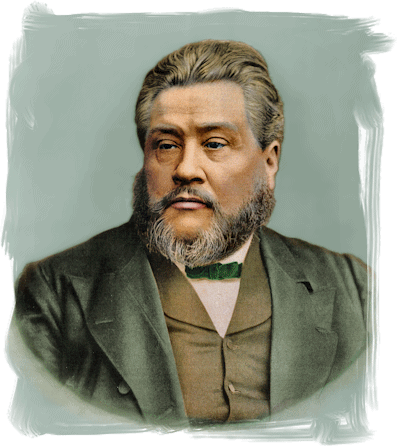
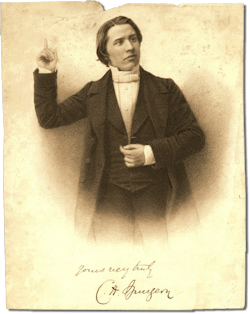
The PyroManiacs devote some space each weekend to highlights from The Spurgeon Archive. The following excerpt is from "What is Eccentricity?"—an article published in the June 1879 issue of The Sword and the Trowel, later used as the opening chapter in a book by Spurgeon entitled Eccentric Preachers.


    Dutchman, who from the very orderly style of his handwriting, and the precision of his phrases, should be a very exemplary individual, once wrote me a sternly admonitory letter. From having read my printed discourses with much pleasure he had come to consider me as a godly minister; and, therefore, being in London, he had availed himself of the opportunity to hear me. This, however, he deeply regretted, as he had now lost the power to read my sermons with pleasure any more.

What, think you, had I said or done to deprive me of the good opinion of so excellent a Hollander? I will relieve your mind by saying that he considered that I preached exceedingly well, and he did not charge me with any extravagances of action, but it was my personal appearance which shocked him.

I wore a beard, which was bad enough, but worse than this, he observed upon my lip a moustache! Now this guilty thing is really so insignificant an affair that he might have overlooked such an unobtrusive offender. But no, he said that I wore a moustache like a carnal, worldly-minded man!

Think of that. Instead of being all shaven and shorn like the holy man whom he was accustomed to hear, and wearing a starched ruffed collar all round my neck, about a quarter of a yard deep, I was so depraved as to wear no ruff, and abjure the razor. His great guy of a minister, with ruff and bands and gown, and a woman's chin was not eccentric, but because I allowed my hair to grow as nature meant it should, I was eccentric and frivolous and carnal and worldly-minded, and all sorts of bad things.

You see, what is eccentric in Holland is not eccentric in England, and vice versa. Much of the eccentric business is a matter of longitude and latitude, and to be quite correct one would need to take his bearings, and carry with him a book of costumes and customs, graduated according to the distance from the first meridian.

Moreover, we may not forget that as in religion there have been times of persecution, and times of toleration, so has it been with the pulpit. At one date propriety ruled supreme, and men were doomed to instant ostracism if they passed beyond the settled line; while at another date a sort of Eccentric Emancipation Act is passed, and every man does what is right in his own eyes. At the present moment great latitude is allowed, and several persons are now saying and doing very remarkable things, and yet are escaping the charge of eccentricity.

It is well for them that some of us lived before them, and for far smaller liberties were set in the pillory. For myself, I venture to say that I have been severely criticized for anecdotes and illustrations of the very same kind which I meet with in the very excellent discourses of my friend, Mr. Moody, whom I appreciate probably more than anybody else. Many dear, good souls who have heard him with pleasure would not have done so twenty years ago, but would have regarded him as very eccentric.

As to Mr. Sankey's singing, of which I equally approve, would not that have been unpardonable even ten years ago?

Would Ned Wright and Joshua Poole, and brethren of that order, have been tolerated in 1858? According to the rules which judged Rowland Hill to be eccentric, I should say that these brethren are quite as far gone, if not further, and yet one does not hear an outcry against them for eccentricity. No, the bonds are relaxed, and it is just possible that they are now rather too slack than too tight.

It is, however, very curious to watch the moods of the religious public and see how what is condemned to-day is admired to-morrow. Such an observation has a great tendency to make a man rise superior to the verdict of the period, and choose his own path. To promote a manly, courageous course of action in such matters is our main object in delivering this lecture.

Let us, if we are ministers, do that which we believe to be most likely to be useful, and pay little heed to the judgment of our contemporaries. If we act wisely we can afford to wait; our reward is in a higher approbation than that of men; but even if it were not, we can afford to wait. The sweeping censures of hurried critics will one day be blown away like the chaff of the threshing-floor, and the great heart of the church of God will beat true to her real champions, and clear their reputations from the tarnish of prejudice and slander.

The eccentricty of one century is the heroism of another; and what is in one age cast out as folly may be in the next revered as a wisdom which lived before its time. Well said the apostle, "With me it is a very small thing that I should be judged of you, or of man's judgment: yea, I judge not mine own self."

C. H. Spurgeon


02 May 2011

Against Legalistic "Holiness" and Morbid Self-Examination

Your weekly dose of Spurgeon
posted by Phil Johnson


The PyroManiacs devote some space each weekend to highlights from The Spurgeon Archive. The following excerpt is from Spurgeon's Autobiography.


   have found, in my own spiritual life, that the more rules I lay down for myself, the more sins I commit. The habit of regular morning and evening prayer is one which is indispensable to a believer's life, but the prescribing of the length of prayer, and the constrained remembrance of so many persons and subjects, may gender unto bondage, and strangle prayer rather than assist it.

To say I will humble myself at such a time, and rejoice at such another season, is nearly as much an affectation as when the preacher wrote in the margin of his sermon, "Cry here," "Smile here." Why, if the man preached from his heart, he would be sure to cry in the right place, and to smile at a suitable moment; and when the spiritual life is sound, it produces prayer at the right time, and humiliation of soul and sacred joy spring forth spontaneously, apart from rules and vows.

The kind of religion which makes itself to order by the Almanack, and turns out its emotions like bricks from a machine, weeping on Good Friday, and rejoicing two days afterwards, measuring its motions by the moon, is too artificial to be worthy of my imitation.

Self-examination is a very great blessing, but I have known self-examination carried on in a most unbelieving, legal, and self-righteous manner; in fact, I have so carried it on myself. Time was when I used to think a vast deal more of marks, and signs, and evidences, for my own comfort, than I do now, for I find that I cannot be a match for the devil when I begin dealing in these things. I am obliged to go day by day with this cry,—

"I, the chief of sinners am,
But Jesus died for me."

While I can believe the promise of God, because it is His promise, and because He is my God, and while I can trust my Saviour because He is God, and therefore mighty to save, all goes well with me; but I do find, when I begin questioning myself about this and that perplexity, thus taking my eye off Christ, that all the virtue of my life seems oozing out at every pore.

Any practice that detracts from faith is an evil practice, but especially that kind of self-examination which would take us away from the cross-foot, proceeds in a wrong direction.

C. H. Spurgeon


18 June 2010

How Can God Justify the Ungodly?

by John MacArthur

This is part 3 and the last of a series begun here and continued here. At the end of Monday's entry, we were seeing that Scripture says the justification of a sinner is utterly impossible on purely legal grounds.


ow, then, can we be justified? How can God declare guilty sinners righteous without lowering or compromising His own righteous standard?

The answer lies in the work of Christ on our behalf. In Galatians 4:4, the apostle states that Jesus Christ was born "under the law." Obviously, this does not mean merely that Jesus was born Jewish. It means that He was under the law in the Pauline sense, obligated to fulfill the law perfectly as a means of justification.

In this same context, in the span of two verses, Paul twice employs the phrase "under the law." There is a clear logical connection between the last phrase in verse 4 and the first phrase in verse 5: Christ was "made under the law, to redeem them that were under the law.

We've already said that the law cannot be a means of righteousness for sinners. But Christ was no sinner. He lived impeccably "under the law." Hebrews 4:15 tells us He "was in all points tempted like as we are, yet without sin." He fulfilled the law perfectly, to the letter. First Peter 2:22 says He "did no sin, neither was guile found in his mouth." Hebrews 7:26 says He is "holy, harmless, undefiled, separate from sinners, and made higher than the heavens." Thus His flawless obedience to the law earned the perfect merit that is necessary to please God.

If Christ was perfectly sinless, then He did not deserve to die. As one "under the law," He would have been subject to the curse of the law if He had violated even one command, but of course He did not—He could not, because He is God. He fulfilled every aspect of the law to the letter—to the jot and tittle.

Yet He did die. More than that, He suffered the full wrath of God on the cross. Why? Scripture tells us the guilt of our sin was imputed to Him, and Christ paid the price for it. Consequently, the merit of His perfect obedience can be imputed to our account. That is the meaning of 2 Corinthians 5:21: God "hath made [Christ] to be sin for us, who knew no sin; that we might be made the righteousness of God in him."

His death takes care of our guilt, and His perfect life supplies us with all the merit we need to be acceptable to God. That is how God overcame the two great obstacles to our justification. And as Paul says in Romans 3:26, that is how God can remain just, and justify those who believe in Jesus. Christ has personally paid the penalty for their sin, and He has personally obtained a perfect righteousness on their behalf. So He can justify the ungodly (Rom. 4:5).

Scripture teaches no other means of justification. This is at the core of all gospel truth. As early as Genesis 15:6, Scripture teaches that Abraham was justified by an imputed righteousness. Anytime any sinner is redeemed in Scripture, it is by an imputed righteousness, not a righteousness that is somehow earned or achieved by the sinner for his own redemption.

Romans 4:6-7 says David also knew the blessedness of the man to whom God imputes righteousness apart from works. In fact, this is the whole point Paul is making in Romans 4: Justification has always been by faith, not by works, and through a righteousness that is imputed to the believer. Abraham understood the doctrine of justification that way. David knew the same truth. So from the beginning of Scripture to the end, we are taught that the only merit God accepts is a merit that is imputed to our account. He never pronounces us righteous because of our own works of righteousness.

On the contrary, God says all our righteousnesses are fatally flawed. They are of no more value to God than filthy rags (Isa. 64:6). But that is how God sees our works—no matter how good they are by human standards. They are unacceptable, filthy, to God.

That is why our obedience can never be good enough. That is why those who hang their hope of heaven on their own good works only doom themselves.

How Deadly is Legalism?

All of this should make it very clear that the legalism Paul condemned as "another gospel" is a brand of legalism that seeks to ground our justification in personal obedience rather than the imputed righteousness of Christ. How deadly is such legalism? The apostle Paul suggested it was precisely what caused the majority of Israel to reject Christ: "They being ignorant of God's righteousness, and going about to establish their own righteousness, have not submitted themselves unto the righteousness of God" (Rom. 10:3). Turning aside from the perfect righteousness of Christ (which would have been imputed to them by faith), they opted instead for an imperfect righteousness of their own. They mistakenly assumed, like most people today, that the best they could do would be good enough for God.

Here is the good news of the gospel: for everyone who believes, Christ's blood counts as payment for all our sins, and His fulfillment of the law counts as all the merit we need. Romans 10:4 therefore says, "Christ is the end [Gk., telos, "the thing aimed at"] of the law for righteousness to every one that believeth." Christ is the fulfillment of everything the law intended. In Christ, the ultimate goal of the law—a perfect righteousness—is made available to every believer. His righteousness is imputed to us by faith, and that is why God accepts us in Christ and for Christ's sake.

To the apostle Paul himself, this truth had deeply personal implications. He had labored his whole life as a legalistic Pharisee trying to establish his own righteousness by the law. He described his efforts in Philippians 3:4-8:

If any other man thinketh that he hath whereof he might trust in the flesh, I more: Circumcised the eighth day, of the stock of Israel, of the tribe of Benjamin, an Hebrew of the Hebrews; as touching the law, a Pharisee; concerning zeal, persecuting the church; touching the righteousness which is in the law, blameless. But what things were gain to me, those I counted loss for Christ. Yea doubtless, and I count all things but loss for the excellency of the knowledge of Christ Jesus my Lord: for whom I have suffered the loss of all things, and do count them but dung, that I may win Christ . . .

What was so important to Paul about dumping all his own righteousness? Why did he count a whole lifetime of good works as mere rubbish? Because he knew it was flawed. And he knew that in Christ he would be the recipient of a perfect righteousness. Notice verse 9: " . . . and be found in him, not having mine own righteousness, which is of the law, but that which is through the faith of Christ, the righteousness which is of God by faith."

Any righteousness other than the imputed righteousness of Christ is mere legalism. It is incapable of saving anyone. More than that, it is an affront to God—as if we were to offer him soiled rags and expect Him to applaud us for doing so. That kind of legalism is spiritually fatal.

How Is Christian Obedience Different from Legalism?

It has become fashionable in some circles to pin the label of legalism on any teaching that stresses obedience to Christ. At the beginning of this series I quoted someone who stated that "the whole difference between legalism and true Christianity" is sewn up in the issue of whether we view obedience as a duty.

Biblically, there is no basis for such thinking. The Christian is still obligated to obey God, even though we know our obedience in no sense provides grounds for our justification. That is precisely why our obedience should be motivated primarily by gratitude and love for the Lord. We are free from the threat of eternal condemnation (Rom. 8:1). We are free from the law of sin and death (v. 2), and empowered by God's grace both to will and to do of His good pleasure (Phil. 2:13). We have every reason to obey joyfully—and no true Christian will ever think of obedience as something optional.

We are not under law, but under grace. Far from being a manifesto for antinomianism or a authorization for licentious behavior, that important truth teaches us that both our justification and our obedience must properly be grounded in Christ and what He has done for us, rather than in ourselves and what we do for God.

The doctrine of justification by faith therefore provides the highest, purest incentive for Christian obedience. As Paul wrote to the Romans, the mercies God displays in our justification provide all the reason we need to yield ourselves to Him as living sacrifices (Rom. 12:1). Freed from the penalty of the law—loosed from the threat of condemnation for our disobedience—we are thus empowered by grace to surrender to God in a way we were powerless to do as unbelievers. And that is why the Christian life is continually portayed in Scripture as a life of obedience.

John MacArthur's signature

14 June 2010

How Does Grace Free Us From the Law?

by John MacArthur

This is Part 2 of a three-part series that we began last week.


he phrase "under the law" occurs at least ten times in Paul's epistles, so we know it is a crucial concept in his theology. In Galatians 3:23, for example, He writes, "Before faith came, we were kept under the law" (Gal. 3:23). Now, however, he says as Christians we are "not under the law" (Gal. 5:18).

I often hear Christians recite the phrase "not under the law, but under grace" as if it meant no standard of law whatsoever is ever binding on believers. Grace is seen as a grand permissiveness, contrasting with the uncompromising moral standard of the law.

One man wrote,

According to Paul, I am not under law. That has radical practical consequences for my Christian life. It means I do not have to look over my shoulder at the law and judge my life by it. The law was a negative standard. It was filled with prohibitions and punishments. Grace is the opposite. It is filled with positive inducements and promises. Which would you rather have as a rule of life? I live under grace, not law. And that means whenever the law brings its negative message—when it says, "thou shalt not"—it does not apply to me.


The notion that no law is binding on the Christian is antinomianism. This type of thinking sets grace against law, as if the two were antithetical. It has some dire theological consequences.

It is crucial to understand that in terms of moral standards, grace does not permit what the law prohibits. "Grace" never signifies the lowering of God's moral demands. The word grace in scripture signifies a lot of things, but licentiousness is not one of them. In fact, those who turn the grace of God into promiscuity are expressly condemned as false teachers (Jude 4).

Grace according to Scripture is the undeserved kindness of a sovereign God. More than that, grace means that God mercifully gives us the very opposite of what our sin merits. Grace includes not merely pardon for our sin, but also the power to live a transformed life.

In other words, the grace Scripture describes is a dynamic force—the sovereign influence of a holy God operating in the lives of undeserving sinners. This is the key to grace: it is God working in us to secure our working for Him (Phil. 2:13). Grace first transforms the heart and thus makes the believer wholly willing to trust and obey. Grace then conveys upon us both the desire and the strength to fulfill God's good pleasure. Far more than mere pardon, grace also is a motive for obedience; it gives us a true love for God; it transforms our lives in every sense. Ultimately grace totally conforms us to the image of Christ (Rom. 8:29). Even now, grace is doing what the law could not do: it is fulfilling the righteous requirement of the law in us (Rom. 8:3-4).

So the moral standard set by the law does not change under grace. Indeed, it could not; it is a reflection of God's character. But divine grace actually empowers us to fulfill the moral demands of the law in a way that the law alone could never do.

Just what does the apostle Paul mean when he says we are not under law? There are two ways Scripture clearly teaches we are not under law:

We are not under the ceremonial law

Paul's epistle to the Galatians uses the expression "under the law" several times (3:23; 4:4-5, 21; 5:18). Paul wrote this epistle to confront the influence of the Judaizers. They were Jewish legalists who were trying to impose the ceremonies and rituals of the Mosaic law on all Christians. According to the Judaizers, in order to become a true Christian, a Gentile first had to become a Jewish proselyte.

Circumcision and the dietary laws became the test issues. This had been a running dispute in the early church from the very beginning. The earliest church council in Jerusalem had been convened to deal with this very question. According to Acts 15:5, some Pharisees who had converted to Christianity rose up and demanded that Gentiles who joined the church be circumcised and directed to obey the law of Moses. Luke records what happened:
The apostles and the elders were gathered together to consider this matter. And after there had been much debate, Peter stood up and said to them, "Brothers, you know that in the early days God made a choice among you, that by my mouth the Gentiles should hear the word of the gospel and believe. And God, who knows the heart, bore witness to them, by giving them the Holy Spirit just as he did to us, and he made no distinction between us and them, having cleansed their hearts by faith. Now, therefore, why are you putting God to the test by placing a yoke on the neck of the disciples that neither our fathers nor we have been able to bear? But we believe that we will be saved through the grace of the Lord Jesus, just as they will." (vv. 6-11).

The council saw a heated debate on the question. But led by James, they ultimately came to consensus: "we should not trouble those of the Gentiles who turn to God, but . . . write to them to abstain from the things polluted by idols, and from sexual immorality, and from what has been strangled, and from blood" (vv. 19-20).

This meant that the ceremonial requirements of the Mosaic law were not to be imposed upon the church. Circumcision could not be required of the Gentiles. Strict adherence to the dietary laws was not to be prescribed. But in order not to offend the Jewish brethren, the Gentiles were asked to abstain from the most offensive dietary practices: the eating of meat offered to idols, the eating of strangled animals, and the eating of blood. Even those restrictions were not imposed as binding matters of legal necessity, but were required of the Gentiles only as a matter of charity toward their Jewish brethren.

How do we know that these prohibitions against eating certain things were not meant to be a permanent standard for the church for all time? As Paul wrote to Timothy, nothing is to be viewed as ceremonially unclean if it is received with thanksgiving (1 Tim. 4:4). But these measures were called for by the Jerusalem Council in the primitive church as a matter of charity to the many Jewish believers who saw such practices as inherently pagan. The apostle Paul summed up this principle of freedom and deference in Romans 14:14-15: "I know and am persuaded in the Lord Jesus that nothing is unclean in itself, but it is unclean for anyone who thinks it unclean. For if your brother is grieved by what you eat, you are no longer walking in love."

A side note is necessary here with regard to the restriction against "fornication." The biblical prohibitions against fornication are moral, not ceremonial, commandments. So why was it necessary to include a ban on fornication in the Jerusalem Council's instructions? After all, fornication would clearly be deemed morally reprehensible and strictly forbidden under any standard in the early church. And from the beginning the dispute that prompted the Jerusalem Council had to do only with the ceremonial aspects of Moses' law.

The answer lies in an understanding of the pagan religions from which many of these Gentile converts had come. The practice of ceremonial fornication was common. Many of the pagan shrines featured temple prostitutes, with whom acts of fornication were deemed religious experiences. So when they forbid "the things polluted by idols, and . . . sexual immorality," the Council was prohibiting the observance of pagan religious ceremonies. And when they called for abstinence "from what has been strangled, and from blood," they were asking the Gentiles to have respect for the deeply-ingrained scruples of their Jewish brethren, resulting from lifelong obedience to Mosaic ceremonies.

In other words, pagan religious ceremonies were forbidden, and Jewish ceremonies were not made the standard. But charity was enjoined upon all.

It is crucial to see that this Council was explicitly not establishing the Mosaic ceremonial law—or any portion of it—as the standard for the church. The New Testament is explicit throughout that the types and ceremonies of the Law are not binding on Christians. The dietary and ceremonial requirements of Moses' law "are a shadow of the things to come, but the substance belongs to Christ" (Col. 2:17). The priesthood and Temple worship of the Old Testament economy also "serve a copy and shadow of the heavenly things" (Heb. 8:5). Christ is the fulfillment of all that, and He is the Mediator of a New Covenant. To cling to the types and shadows of the Old Covenant is in effect to deny that Christ, the One foreshadowed, is superior. Therefore, the ceremonial aspects of Moses' law have no place whatsoever in the Church.

Why did both Paul and the writer of Hebrews view the Judaizers' doctrine as such a serious error? Because by retreating to the types and shadows of the Old Covenant, these people were guilty of replacing the all-important reality of a living Savior with outmoded symbols that only pointed to Him. Their attachment to those now-barren religious emblems necessarily thrust them into a system of works. To return to the Old Covenant was a de facto rejection of Christ in favor of obsolete types and symbols.

In one of the most unusual encounters between two apostles recorded anywhere in Scripture, Peter and Paul had a very public conflict over the question of obedience to the ceremonial law. Paul describes the confrontation in Galatians 2:11-14:
when Cephas came to Antioch, I opposed him to his face, because he stood condemned. For before certain men came from James, he was eating with the Gentiles; but when they came he drew back and separated himself, fearing the circumcision party. And the rest of the Jews acted hypocritically along with him, so that even Barnabas was led astray by their hypocrisy. But when I saw that their conduct was not in step with the truth of the gospel, I said to Cephas before them all, "If you, though a Jew, live like a Gentile and not like a Jew, how can you force the Gentiles to live like Jews?"

The issue at stake here was no longer the question of charity toward Jewish brethren, but the whole doctrine of justification by faith. Apparently, even after the Jerusalem Council had rendered its decision, the Judaizers nevertheless reverted to demanding circumcision for every Gentile convert. They were actually suggesting that observance of the ceremonial law was essential for justification. And as Paul suggests, Peter, of all people, should have known better, "we know that a person is not justified by works of the law but through faith in Jesus Christ, so we also have believed in Christ Jesus, in order to be justified by faith in Christ and not by works of the law, because by works of the law no one will be justified" (v. 16).

We are not under the law for justification

The centerpiece of New Testament theology is justification by faith. This is the doctrine that makes Christianity distinct. Every other religion in the world teaches some system of human merit. Christianity alone teaches that the merit necessary for our salvation is supplied by God on our behalf.

Justification is defined theologically as that act of God whereby He declares the believing sinner righteous. When God justifies a sinner, he looks at the person and says, I accept that person as completely righteous. It is a divine "not guilty" verdict—and more. It elevates the sinner from the condemnation he deserves to a position of divine privilege in Christ.

Justification poses a huge theological problem. Proverbs 17:15 says, "He who justifies the wicked and he who condemns the righteous are both alike an abomination to the Lord." In other words, God Himself strictly forbids us to declare a guilty person righteous. And God says definitively in Exodus 23:7, "I will not acquit the wicked."

Two obstacles exist with regard to justifying sinners. One is our sin. We accumulate guilt every time we sin, and true justice demands that every sin be punished. To let an evildoer go unpunished is by definition unjust. So God is obligated by His own perfect standard of justice to exact a full penalty for every sin.

The second obstacle to justification is our utter lack of merit. Not only do we accumulate guilt (or demerit) every time we sin, but we also lack the necessary merit. Even if our slate could be completely wiped clean, all we would have would be a blank slate. But in order to be acceptable to God, we are required to have the full merit that comes with perfect obedience His law. Forgiveness for our sin isn't enough. We still need the merit of an absolutely perfect righteousness (Matt. 5:20, 48).

From the human perspective, those would seem to be impossible obstacles to the justification of any sinner. We can certainly understand the disciples' bewilderment when they saw these same difficulties: "Who then can be saved?" (Matt. 19:25).

However, there were people in Paul's day who thought if they could just be as good as they could possibly be, they might earn enough merit to please God. This was the attitude behind the Judaizers' insistence on adhering to the ceremonial laws. They were trying to justify themselves before God through their own works. They were trying to earn their own righteousness. That is the very definition of "self-righteous."

Jesus' Sermon on the Mount was an attack on that kind of thinking. He pointed to the Pharisees—legalists who kept the law more fastidiously than anyone else. By human standards they were as "good" as it is possible to be. But Jesus said their goodness is simply not good enough to earn God's favor: "I tell you, unless your righteousness exceeds that of the scribes and Pharisees, you will never enter the kingdom of heaven" (Matt. 5:20).

Jesus was teaching as plainly as possible that God will be pleased with nothing but an absolutely perfect righteousness. He taught that it is not good enough to avoid killing; we must also avoid the sin of hatred (v. 22). He said if you lust in your heart, it is the same as committing adultery (v. 28). He set the standard as high as possible, and then said if you don't have a righteousness that perfect, you cannot enter the kingdom of heaven. And thus He condemned us all.

The apostle James perfectly understood that the law's own perfection destroys any vestige of hope we might have for being justified by law. That's why he wrote, "whoever keeps the whole law but fails in one point has become accountable for all of it" (Jas. 2:10).

What are we supposed to conclude? That we cannot be justified by the works of the law. It is utterly impossible. The apostle Paul underscores this same truth again and again:
  • Acts 13:39: "You could not be justified by the law of Moses."
  • Romans 3:19-20: "Now we know that whatever the law says it speaks to those who are under the law, so that every mouth may be stopped, and the whole world may be held accountable to God. For by works of the law no human being will be justified in his sight, since through the law comes knowledge of sin."
  • Romans 4:15: "The law brings wrath."
  • Galatians 3:10: "All who rely on works of the law are under a curse; for it is written, 'Cursed be everyone who does not abide by all things written in the Book of the Law, and do them.'"
  • Galatians 3:11: "No one is justified before God by the law."

Paul could not state it any more clearly than that. To make the fatal mistake of thinking you can be justified by being good enough to make yourself acceptable to God is to put yourself under the condemnation of the law.

That was the heart of the problem in Galatia. People were teaching that it was necessary to obey the law in order to be justified. In chapter 1 Paul calls this "another gospel," and he pronounces a solemn curse on those who were teaching it.

When Paul spoke of those who were "under the law," he was speaking of people who thought they could be justified by obedience to the law. Two parallel expressions in Galatians make this extremely clear. One is Galatians 4:21: "Tell me, you who desire to be under the law, do you not listen to the law?" (emphasis added). If they had listened to the law itself, they would have heard that it establishes impossible conditions for justification. It condemns those who fail to obey it. For sinners, the law could be a means of condemnation, but never a means of justification. For a sinner to embrace the law as a means of justification is sheer folly. Yet there were those in Galatia who "desire[d] to be under the law" (4:21).

Notice the parallel expression in Galatians 5:4: "You who are seeking to be justified by law" (NASB). Those who were seeking to be "justified by law" in Galatians 5:4 were the same as those who desired to be "under the law" in 4:21.

Therefore, to be "under the law" in Paul's terminology is to be under the law as a means of justification. It is crucial to understand the way the apostle Paul uses this expression. When he says we are not under the law but under grace in Romans 6, he is not discarding the moral teachings of the law. He is not lending credence to any sort of antinomian doctrine. He is not minimizing the sin of disobedience to the moral teachings of the law. He is not disparaging the law itself. In fact, in Romans 7:12, he calls the law "holy and righteous and good"

Paul's consistent teaching with regard to the law is that it can never be a means of justification. And when he says we are "not under law," he means we do not ground our justification in our own personal obedience. We are no longer trying to justify ourselves by obedience to the law. We are justified by grace through faith, not by the works of the law (Gal. 2:16). And therefore we are no longer under the condemnation of the law.


John MacArthur's signature

11 June 2010

Do We obey out of Love, or out of Duty?

by John MacArthur


I'm in Denver for a day-long conference today, and my back is still killing me. I had an MRI Tuesday, and the doctor called yesterday with an urgent referral to a neurosurgeon. So evidently the fix will require something more radical than the calisthenics and pills prescribed so far.

But I could have told you that 3 weeks ago.

Anyway, I haven't the strength or the time to write fresh material for our series on legalism, so here's something even better. It's a piece by John MacArthur, excerpted from a chapter in Trust and Obey (Pittsburgh: Soli Deo Gloria, 1997).

Phil's signature


t the height of the Lordship controversy a few years ago, a fellow pastor wrote me:


Dear John,

I am sympathetic to your stance on the lordship of Christ. You are quite right in teaching that the gospel calls sinners to repentance and calls for their obedience to Christ as Lord. His lordship is as crucial to the gospel message as His deity. In fact, as you point out, His deity and His lordship are so inextricably bound together that a christ who is not Lord of all is not the Christ who saves. The modern notion that the sinner can reject Christ as Lord but receive Him as Savior is foreign to all the historic creeds. To my way of thinking, any message that excludes the lordship of Christ is not the gospel at all.

If you don't mind, however, I would like to offer a criticism that I hope you will find helpful, not hurtful:

I notice that you present Christian obedience as a duty. You often cite the biblical passages that speak of the Christian as a bondservant—as if this meant we are abject slaves to Him. Your stress is on the Lord's authority to command obedience. And therefore you speak of obedience as an obligation to which the believer is bound.

I see a different emphasis in Scripture. Faith works through love (Gal. 5:6). The Christian obeys Christ out of sheer love for Him. Obedience for the Christian is not so much a duty as it is a delight. Believers obey because that is where they find their satisfaction—not because they are bound to do so. We obey out of love for Christ, not out of fear, and not out of duty.

I believe this perspective is essential to joyous Christian living. It is the whole difference between legalism and true Christianity.

I sincerely appreciated that man's comments. And I agree that it is possible to place so much stress on the duty of obedience that we lose sight of the joy of it. After all, the Christian's obedience should be a delight. Love for Christ is a higher motive than fear. So there is certainly some sound truth in what this man wrote.

Nonetheless, the danger of overemphasis is very real on both sides of this truth. It is not quite right to say "We obey out of love for Christ . . . and not out of duty." Duty and love are not incompatible motives. A father provides for his children because he loves them. Yet it is also his legal and moral duty to do so. The fact that a man loves his children does not lessen his duty to them. The more he loves them, the more he will see the duty as a joy and not a drudgery. But even when the duty is a delight, it should not diminish the father's solemn sense of duty.

Our obedience to Christ is like that. Certainly we ought to obey Him out of a deep love for Him. And the sheer joy of pleasing Him should permeate our obedience. Yet we should never think of obedience as anything less than a sacred duty. Our love for Christ does not make submission to Him elective. Christ is still our Master, and our relationship with Him carries a great weight of responsibility. We ought to serve Him as loving, devoted bond servants. "Abject slaves" is not too strong a term.

Jesus Himself underscored this very thing:
But which of you, having a servant plowing or feeding cattle, will say unto him by and by, when he is come from the field, Go and sit down to meat? And will not rather say unto him, Make ready wherewith I may sup, and gird thyself, and serve me, till I have eaten and drunken; and afterward thou shalt eat and drink? Doth he thank that servant because he did the things that were commanded him? I trow not. So likewise ye, when ye shall have done all those things which are commanded you, say, We are unprofitable servants: we have done that which was our duty to do (Lk. 17:7-10).

That imagery paints a clear picture of the kind of servitude we are expected to render to Christ as His servants.

But that's only half the picture. Our Lord also called for the obedience of love: "If ye love me, keep my commandments" (Jn. 14:15). And He elevated those who obey to the level of friends:
Ye are my friends, if ye do whatsoever I command you. Henceforth I call you not servants; for the servant knoweth not what his lord doeth: but I have called you friends; for all things that I have heard of my Father I have made known unto you (Jn. 15:14-15).

Obviously, our Lord viewed our love for Him and our duty to Him as motives for obedience that are inextricably and necessarily bound together: "He that hath my commandments, and keepeth them, he it is that loveth me" (Jn. 14:21). "If ye keep my commandments, ye shall abide in my love; even as I have kept my Father's commandments, and abide in his love" (Jn. 15:10).

Far from being a drudgery, Christian obedience is thus the bond of our relationship with Christ and the source of our deepest joy. And the fact that we are obliged to submit to His lordship should never alter the joy we find in doing so.

Of course, because we are still fleshly creatures, our obedience is not always joyful. And so we must realize that even when our hearts are not brimming with the joy of the Lord, obedience remains our duty. We are to obey when it brings us pleasure, but we also must obey even when we do not feel like it. Both our love for the Lord and our sense of duty to Him should motivate this obedience. One must never cancel out the other.

John MacArthur's signature

06 June 2010

A Word to Legalists

Your weekly dose of Spurgeon
posted by Phil Johnson

The PyroManiacs devote some space each weekend to highlights from The Spurgeon Archive. The following excerpt is from "Strange Dispensations and Matchless Consolations," a sermon preached in the autumn of 1859 at New Park Street Chapel, Southwark.


he reasons for God's grace to us are far above all human reason, for he himself has told us, "As the heavens are higher than the earth, so are my ways higher than your ways, and my thoughts than your thoughts."
Nay, I will go further than this, and say that, not only are God's modes of reasoning far above our own, but they often seem as if they were even contradictory to ours. Where we should draw one inference, God draws the very opposite.

See you poor penitent sinner; he "would not lift up so much as his eyes unto heaven; but he smote upon his breast, and cried, God be merciful to me a sinner." What is our inference from this, looking at the publican as he stands there? Why; that he is a rebellious creature, and that God cannot and will not accept him, but must punish him.

Doth God draw this inference? Nay; for "this man went down to his house justified."

See yonder Pharisee; with outstretched hands he stands, and prays thus with himself, "God, I thank thee, that I am not as other men are," and so on. What is our inference therefrom? Surely God will accept so good a man as this; he will be sure to justify a man so holy and so moral. Not so; for that man went down to his house without justification, unsatisfied, unblessed with the smile of heaven, while yon sorrowing publican received God's gracious forgiveness.

We, ever since the Fall, have learned to reason badly; our reasoning faculty has been as much confused as any other power that we possessed; we have turned aside from the straightforward path, and we know not how to draw the true inference which God draws from our sins. So far from looking at any reason for mercy to anything that is good in man,—if God ever seeks in the creature a reason why he should show mercy, he looketh not to the good, but to the evil.

When we come before God, it would be well if we would always remember this. We are committing great folly if, when we are spreading our case before him, we dare for one moment to speak of ourselves as good or excellent. We shall never succeed in that way; he will not listen to us, for this plan has no power with him; but if, when we come to him, we can plead our sin and our misery, then shall we prevail. Nay, we may even go the length of the psalmist, David, when he prayed, "For thy name's sake, O Lord, pardon mine iniquity;"—and for a strange reason, you would say,—"for it is great."

He used the greatness of his sin as an argument why God should have mercy on him!

O ye legalists, who are looking to yourselves for some arguments with which to prevail with God; O ye who look to your sacraments, to your outward forms, to your pious deeds and your almsgivings, for something that will move the heart of God; know this, that these things are no lever that can ever move him to 1ove. Nothing but your sin and misery can ever stir his mercy, and you look to the wrong place when you look to your merits to find a plea why he should show pity upon you.

C. H. Spurgeon


31 May 2010

Legalism and Christian Liberty Again

by Phil Johnson


"For freedom Christ has set us free; stand firm therefore, and do not submit again to a yoke of slavery" (Galatians 5:1)

hat one verse captures the essence of Paul's whole appeal to the Galatians. It could be called the key verse of the book of Galatians. It distills Paul's whole answer to the Judaizers in a single statement.

Note: it is an imperative. It gives us an order to obey. It is a strong and unequivocal command to stand fast in the liberty Christ has given us. It powerfully reminds us that our freedom in Christ is a sacred trust to be carefully guarded. Liberty is not just one optional benefit of our salvation; Paul says it lies at the very heart of God's saving purpose.

In other words—contrary to those who like to define Christianity with a list of rules that govern our public behavior—Scripture defines the Christian life as a life of complete and total liberty. It's the purest kind of heavenly freedom. It's the only true freedom.

That's about as foreign to most people's thinking as it can be. The world tends to think religion should be a confining, constraining thing. But Scripture portrays Christianity as just the opposite: a liberating, emancipating, bondage-breaking freedom. Jesus said, "You will know the truth, and the truth will set you free" (John 8:32). And, "if the Son sets you free, you will be free indeed" (v. 36).

At the very outset of Jesus' ministry, when He read the Scriptures in the synagogue in Nazareth, he read from Isaiah 61:1, that prophetic passage that says, "The Spirit of the Lord is upon me, because he has anointed me . . . to proclaim liberty to the captives . . . to set at liberty those who are oppressed" (Luke 41:8). So the idea of setting people free was very much at the heart of Christ's redemptive work, and it is therefore the very heart of Christianity.

Of course, when Jesus spoke of freedom for captives and liberty to the oppressed, he was not describing something as mundane as political liberty for people under earthly tyranny. He was not planning the overthrow of the Roman government, as despotic as that system was. He was not trying to foment political revolution. He was not employing those terms the way modern political radicals employ them.

Instead, He was speaking of a spiritual liberty—the birthright of every believer. It is a vast freedom from the yoke of any earthly, sinful, or Satanic bondage. It is the greatest liberty imaginable. It includes both freedom from the bondage of sin and freedom from the yoke of the law. There's a built-in equilibrium to the whole principle.

And the principle itself is the very antithesis of the Pharisees' idea of holiness. Their answer to sin was a list of rules and a catalogue of rituals. They tied up heavy burdens, hard to bear, and laid them on people's shoulders" (Matthew 23:4). But Jesus wonderfully set sinners free—free from sin, and free from the burden and the condemnation of the law.

There's an inexorable tendency toward legalism in every fallen human heart. We're all more or less naturally inclined to try to deal with sin the way the Pharisees tried to—by compensating for our sinfulness and trying to constrain the flesh through manmade rules and rituals. It doesn't work; in fact, it is sinful in and of itself. It compounds guilt and weighs the sinner down with false duties and false hope.

Last Thursday's post made that point, and the long comment-thread following the post illustrates how difficult it is to shed legalistic ways of thinking.

Today is a holiday (in America, anyway), so I'm not going to write any more on this subject this morning. (I slept in and am late with this post already as it is.) But in the days and weeks to come, we'll be looking in closer detail at this subject of Christian liberty and it's twin foes: legalism and libertinism.

As we discuss these subjects from Scripture, I hope we can set aside the vitriol and snarkiness that surfaced a few times in last Thursday's comments.

In fact, let's make a rule for today's comment-thread: no arguing, from either side. Instead, use the meta of this post to pose some of the questions you'd like to see us address as we delve into this surprisingly difficult subject.

Phil's signature

27 May 2010

That Massive, Deadly Ditch on the Opposite Side of the Road from Libertinism

by Phil Johnson

Note: I didn't participate in the comment-section of Tuesday's post, so I have no axe to grind there. I didn't watch Lost, so I don't care about the program or its much-debated ending. In fact, I'm so apathetic about it that I would not have even read Dan's Tuesday post if I hadn't noticed (fairly late Wednesday) that the comment-count had gone over a hundred. What was all the fuss about? I wondered. After reading, I decided to post my comment here.
    I should point out first of all that we rarely do movie reviews or cultural commentary on this blog, and there are two reasons for that. One is that we're much more concerned with important things that are happening in the church than we are with the trivial things that already get too much of the world's attention. (Please understand: we're neither hermits nor pietists, but what I'm saying is that the blog has a fairly specific focus, and that's on purpose.)
    The second reason is more complex. Let's face it: we usually aim our critiques at those who are having the most influence among evangelicals these days—those who are so concerned with being cool and gaining the world's approval that they show little concern about holiness. Because that has been our emphasis, we have attracted more than our fair share of very vocal legalists who are convinced that the person with the weakest conscience (or the Bible college with the strictest rules) should get to define holiness for everyone—rather than letting Scripture define it for us. They believe it is their prerogative to dictate to everyone else what's acceptable and what's not, rather than following the principles of Romans 14 with regard to matters that aren't altogether clear. Those people surface at every opportunity, and they seem to love making a fuss. Sometimes it's fairly humorous (as in the "Chiquita" kerfuffle a few years ago). Other times (like this week) the debate quickly becomes highly emotional and unduly personal.
    I don't like that. Yet I'm convinced that legalism in the name of Christ is far more spiritually destructive than the libertinism that dominates secular society.
    So here's my entry into this week's discussion. And I'm officially closing Monday's comment-thread.


egalists sometimes defend themselves by claiming that legalism, properly understood, is just what Paul condemned in Galatians 1: the sin of making justification conditional on some work or ceremony performed by the sinner. In other words, legalism is works-salvation. So, they say, if you formally affirm the principle of sola fide and preach that people can be saved without any prerequisite work, you can't possibly be a legalist, no matter how many rules you make and impose on the consciences of people who are already converted.


No. Legalism is the error of abandoning our liberty in Christ in order to take on a yoke of legal bondage (Galatians 5:1). There are actually two kinds of legalism.

First is the one recognized and despised even by the fundamentalist with his thick rule-book. It's the legalism of the Judaizers. The Judaizers wanted to make circumcision a requirement for salvation. They had fatally corrupted the gospel by adding a human work as a requirement for salvation. That is certainly the worst variety of legalism, because it destroys the doctrine of justification by faith and thereby sets up "a gospel contrary to the one you received" (Galatians 1:8-9).

But another kind of legalism is the legalism of the Pharisees. It's the tendency to reduce every believer's duty to a list of rules. This is the kind of legalism that often seems to surface in our comment-threads. At its root is a belief that holiness is achieved by legal means—by following a list of "standards." This type of legalism doesn't necessarily destroy the doctrine of justification like the legalism of the Judaizers. But it does destroy the doctrine of sanctification, and it is certainly appropriate to call it what it is: legalism—i.e., a sinful misapplication of law; an attempt to make law do work that only grace can do. Like the Judaizers' brand of legalism, it brings people under a yoke of bondage Scripture has not placed on them.

As a matter of fact, that is exactly what Jesus said about the legalism of the Pharisees: "They tie up heavy burdens, hard to bear, and lay them on people's shoulders" (Matthew 23:4).

Pharisaical legalists are not content to live life in the power of the Spirit, cultivate discernment, and avoid things that are clearly profane or immoral; they make lists of rules that prohibit Christians from practically everything but church activities. It's not enough to avoid gambling; they insist that good Christians will avoid card-playing altogether. They're not content with doing things in moderation and with self-control, they make rules that call for strict abstinence from everything doubtful—and they try to impose those rules on other Christians—saddling people with a yoke that they imagine exists somewhere in the white spaces of Scripture.

You want rules? Here's a good one to start with: When it comes to the question of spiritual duties, where Scripture stops speaking, we should, too.


The Pharisees' sin was making rules that went beyond what Scripture actually said. For example, they read in the law that it is a sin to take God's name in vain (Exodus 20:7), so they expanded the rule to forbid the use of God's name at all. They invented euphemisms to be used in place of God's name (Matthew 23:22).

The Pharisees saw the stress that was laid on ceremonial cleanness in the Old Testament, so they invented all kinds of extra washings and required people to observe those as well. In fact, Matthew 15 tells how the Scribes and Pharisees tried to condemn Jesus for not making his disciples observe their extrabiblical traditions: "Then Pharisees and scribes came to Jesus from Jerusalem and said, 'Why do your disciples break the tradition of the elders? For they do not wash their hands when they eat'" (Matthew 15:1-2).

There was no biblical commandment requiring people to do any ceremonial washing before they ate. The priests were supposed to wash their hands before offering sacrifices to God, but no law required everyone to wash up before every meal.

Jesus' response to the Pharisees was a stern rebuke: "He answered them, 'And why do you break the commandment of God for the sake of your tradition?'" (Matthew 15:3). In other words, He rejected their tradition because it was not what the Word of God taught. Even though we all know that washing before meals is good hygiene, and a good idea, He flatly rejected their notion that it is "sinful" not to do it.

He said their legalism transgressed the Scriptures. Legalism always has an anti-biblical tendency. You cannot go beyond Scripture without ultimately setting yourself at odds with Scripture.

That is precisely what happened in the fundamentalist movement, and one of the major reasons that movement has failed so notoriously. Legalism diverts people's attention from sound doctrine, so that the typical fighting-fundie legalist is doctrinally ignorant, reserving his or her "convictions" for a silly manmade system of rules. Ask the typical self-styled fundamentalist to define the difference between imputed and imparted righteousness, and he will not be able to do so. Suggest that it's OK for women to wear pants, or for people to use another version besides the KJV for Bible study, and the same fundy will lock and load his angry dogmatism, ready to do battle or even die for some ridiculous manmade "standard." Thus, as Jesus said, they have nullified the Word of God for the sake of their manmade traditions.

Let me say this plainly: It is a sin to impose on others any "spiritual" standard that has no biblical basis. When God gave the law to Israel, He told them, "You shall not add to the word that I command you, nor take from it, that you may keep the commandments of the LORD your God that I command you" (Deuteronomy 4:2). And, "Everything that I command you, you shall be careful to do. You shall not add to it or take from it" (Deuteronomy 12:32).


The same principle is repeated in the New Testament. In 1 Corinthians 4, Paul was rebuking the Corinthians for their sectarianism, saying "I am of Paul"; "I am of Apollos," and so on. His rebuke to them includes these words in 1 Corinthians 4:6: "I have applied all these things to myself and Apollos for your benefit, brothers, that you may learn by us not to go beyond what is written."

That is a good guideline for how we should exercise our Christian liberty: Don't go beyond what is written in Scripture. Don't make rules to impose on others; don't devise rituals and forms of worship that are not authorized; and don't speak on such matters where God has been silent. That's the whole principle of Sola Scriptura applied to Christian living. If we really believe Scripture is a sufficient rule for the Christian life, then we don't have to add anything to it.

Nor is there virtue in applying every principle of Scripture in the strictest possible way. "Put[ting away] obscene talk from your mouth" (Colossians 3:8) doesn't mean you are guilty of sin every time you hear someone else use an obscenity or take the Lord's name in vain. "Keep[ing] oneself unstained from the world" (James 1:27) doesn't mean you have to avoid contact with the world or hole up in a nunnery (1 Corinthians 5:9-12).

If we add rules that Scripture doesn't make—especially if we try to impose our manmade rules on other people's consciences as a standard of spirituality—we are guilty of the same sin as the Pharisees and worthy of the same harsh rebukes Christ leveled at them.

Phil's signature

25 March 2008

What is a "legalist"?

by Dan Phillips

Were I forced to pick the most overused and undefined word in Evanjellibeanism today, and I might pick legalist. I think most Evanjellybeans think of legalism as Associate Justice Potter Stewart (January 23, 1915 - December 7, 1985) thought of hard-core pornography: he wasn't sure he could define it, but said "I know it when I see it."

We all know legalism when we see it — or so we think. But do we? Here are some definitions that I have culled from common use, by means of hearing, reading, observation and/or analysis. There will be some overlap and repetition.

Got all that?

Here we go, then:

A legalist is...
  1. Anyone who thinks Christians are under the Ten Commandments
  2. Anyone who thinks Christians are under the Law of Moses (more broadly)
  3. Anyone who thinks that we must obey law (— any law, whether of Moses or of Christ) to merit salvation
  4. Anyone who thinks a Christian should obey the commands of Christ and the apostles
  5. Anyone whose example makes me feel bad about my life
  6. Anyone who imposes man-made rules on other Christians' consciences
  7. Anyone who lives by standards that I don't share
  8. Anyone who tells me that I should not do something I want to do, or do something I don't want to do
  9. Anyone who tells me that a sin I sinned was sin, that I must repent before God and man, and that I must make it right with those I've wronged
  10. Anyone who seriously thinks that what the Bible says is more important than what I strongly feel
  11. Anyone who seriously thinks that the Bible should be our only rule of faith and practice, and that it is wholly sufficient to that end
  12. Anyone who quotes a Bible verse I don't want to hear
  13. Anyone who affirms a Biblical truth I don't want to think about
  14. Anyone who thinks that, just because I say I believe in Jesus, I should take seriously anything that Jesus or His apostles or prophets say, even if I don't want to
  15. Anyone who evaluates my outpouring of emotions and reactions in a Biblical manner, however humanly and compassionately
  16. Anyone who holds to a lot of rules
  17. Anyone who applies the Bible accurately, but without so much as a breath of grace, patience, compassion or humility
  18. Anyone who thinks we should ever say "No" to anything we really deeply feel in our hearts
  19. Anyone who goes to church when he doesn't feel like it
  20. Anyone who takes literally parts of the Bible that I don't take literally
  21. Anyone who thinks I should go to church when I don't feel like it, just because I say I believe in Jesus
  22. Anyone who thinks I should respect an authority I don't agree with
  23. Anyone who thinks that, just because I call Jesus "Lord, Lord," I should actually do what He says
  24. Update: Anyone who tries to hold another to a biblical standard [credit: Carrie]
  25. Update: Anyone who thinks that there is no problem that cannot be solved by more and better rules
In the meta, tell us:
  • Which of these have you heard most frequently?
  • Which do you think is (or are) accurate and legitimate uses — and on what basis?
  • Which do you think are inaccurate and illegitimate — and on what basis?
My chum: it is unlikely that anyone will be able to make a case that legalist is never used in any of the senses given above. I observe that this plethora of competing usages creates two very serious problems:

First, Christian A preaches or writes or otherwise rails fiercely against "legalism" in, say, senses 3, 6 and/or 17, but is heard by Christian B as denouncing legalism in, say, senses 9, 10 and/or 23. (Or vice-versa!)

Second, Christian A bitterly denounces Christian B as embodying senses 3, 6 and/or 17, when Christian B was in reality motivated along the lines of senses 4, 10, 11, 15, and/or 23 — because this pious dodge sounds and looks so much better than simply admitting the truth of the matter.

Have at it.

Dan Phillips's signature