Showing posts with label rant. Show all posts

05 October 2010

I just realized it

by Frank Turk

First things first: over the weekend someone tweeted me about Rick Warren's taped appearance at Desiring God's National Conference, and my reply was, "did he say something vile? I heard he phoned it in to avoid panel discussions."

For the record, after hearing his talk via download, that was unwarranted and a little snide, and I apologize for it.


I'll have more to say about the conference tomorrow, but Dan has a new computer and is not using it to blog yet, so I have the podium this morning. I'll say this today, and we can come back to my larger concerns tomorrow.

I listened to two panel discussions from DGNC, and I listened to half of Francis Chan (who was recently berated in a friendly way by Mark Driscoll for his pastoral whimsey in leaving his church), and then I listened to the Rick Warren talk.

John Piper called Pastor Warren a "master communicator."

Burk Parsons said Pastor Warren has an obvious "child-like faith."

Hmph.

I listened to the same talk while working today and also while driving home from work in ridiculous traffic for Little Rock, and just before he closed in prayer, I just realized why I don't like Rick Warren.

And that is really the problem: I just don't like him. You'd think that with my defense of him here and in other places that somehow I liked him or thought he was a secret pearl in the oyster of evangelism, but I don't feel that way at all. He said probably 15 things in his hour of power at DGNC which were tweetable and repeatable. I may have agreed with every substantive point he made. But even as I was nodding my head in the car in agreement to his words, I couldn't must up any listener good-will toward him.

I just realized I just don't like Rick Warren, and I know exactly why. I just can't muster up the spite to say why in public.

I'll post about DGNC2010 tomorrow. Today I'll leave the thread open, but don't drag the guy (me, or Pastor Warren) through the mud. Say something useful that demonstrates you listened to the conference since this weekend, and then go about your business.


UPDATED


Yeah, ok: I guess this got buried in the comments for this post, so I'm going to put it here at the bottom of the post for your edification, such as it will be.

I realized why I do not like Rick Warren: He does not have the fear of God in him. His talk at DGNC2010 was self-serving, self-approving, self-interested and self-centered. Not a lot of room for God or a savior when there's that much you in the sermon sandwich.

Back to your thing.


08 June 2009

The End of Evangelical Innocence

by Phil Johnson


oday I'll be in the studio with John MacArthur, taping an interview about the contemporary evangelical obsession with sex. "The Case Against the R-Rated Church" is the working title, but the interview is unscripted, so we'll see where it goes.

Anyway, I was looking up facts and various news items on the subject and three things struck me.

One: This is a huge and widespread problem. The "Christian" districts of the World Wide Web are filled with places that aren't safe for family viewing—everything from "Christian" sex shops to lurid advice columns.

Two: Modesty is all but gone from the evangelical movement. Not only have today's evangelicals cast aside innocence as if it were something to be ashamed of; they are proud to have done so. They are keen to show a comfortable familiarity with the very things Scripture says it is shameful to speak of in public (Ephesians 5:12), and they would be embarrassed to be thought squeamish about such things.

Three: Sermons with graphic sexual themes and church-wide sex challenges are merely symptoms of a much bigger problem. In short, the church is fornicating with the world and intoxicated with the spirit of the age. Some of neo-evangelicalism's favorite jargon—missional, contextualization, authenticity—has been tortured and misappropriated in order to justify and institutionalize gross worldliness.

Holiness is the missing note from the contemporary evangelical message—and no wonder. It's hard to speak credibly about holiness when you're trying so hard to impress the world (James 4:4). When unrepentant porn stars are congratulating you on your savvy and commenting on how cool your religion is, you're probably not exemplifying the aspect of sanctification Jesus spoke of in John 15:19.

In that vein, I was going to comment on this article by Lauren F. Winner, author of the best-selling book Real Sex: The Naked Truth about Chastity. Both the article and the book embody every problem I've pointed out above. But my time is limited. So instead of dissecting the article, I'll just link to it, and note the irony of one sentence therein: "We Christians spill plenty of ink moralizing about sex, but we seem unwilling to talk about it in any honest or theologically engaged way." (Winner strongly implies that we're not being "honest and theologically engaged" unless we discuss sexual topics freely and openly, without making uncomfortable moral judgments.)

Her assessment of where the evangelical movement is right now is exactly backward. For more than three decades—ever since Marabel Morgan's The Total Woman (not to mention the plethora of evangelical sex manuals that followed in its wake), evangelicals have been congratulating themselves on their candor and expertise when it comes to the topic of sex. This article by Mark Oppenheimer from Slate Magazine chronicles a long list of evangelical sex manuals (by the Lahayes, Ed Wheat, Dobson, etc.) noting, "The Wheats and LaHaye offer finely wrought anatomical diagrams, [but they] . . . do not invoke the language of sin."

Now read this extremely disturbing account of Ted Haggard's tasteless bragging about evangelical sex, made on film sometime before the debauchery of his private life became public.

Haggard's fall was only one incident in a long line of shrill wake-up calls that have been utterly ignored by the evangelical movement. Instead of heeding the clear warning signs, evangelicals have somehow managed to convince themselves that obsessive talk about sex in explicit terms is necessary for "reaching" people in a culture that is already hopelessly sex-crazed. They keep telling one another that they are too prudish, and (after all) naivete is really the greatest threat to chastity. They strive to mirror the world's preoccupation with sex, arguing further that this is what serious contextualization demands in a culture like ours.

Meanwhile, they keep insisting that evangelicals still aren't talking enough about sex. Lauren Winner again: "We shy away from discussing sex because, like most other matters in our highly atomized, individualized culture, we think of it as private."

Hmmm. Well, it's certainly not private if you talk about your own sexual "indiscretions" as freely and casually as Winner and her friends seem to. She boasts of a friend, "Jill, a Wheaton College grad who lost her virginity in the Billy Graham Center." Winner's point in that context is that making premarital sex taboo doesn't stop people from having premarital sex.

The fact is that endless, explicit sex talk doesn't encourage chastity, either. I contend that it also aggressively undermines holiness, and the evidence of that is abundant within the evangelical movement itself.

This morning, I'll be getting John MacArthur's perspective on it. Let me know if there are questions germane to this subject you want me to ask him. I'll ask as many of your questions as time permits.

Phil's signature


PS: One of the perks of my job is that I get to ask John MacArthur any hard question I want, any time I want. But I really enjoy these taped conversations, because they're longer, more focused, and more intense than the typical casual lunchtime conversation. If you're on the Grace to You mailing list, you'll be able to request a free copy of this interview on CD in July.

02 March 2009

A Follow-Up to Friday's Post

Some Comments on those Comments
by Phil Johnson


ere are some further thoughts on worldliness and contextualization that occurred to me this weekend as I read the comments under last Friday's post:

Notice (first of all) that the topic of hell was only incidental to the actual point of my post. But the comment-thread was utterly dominated at first by the question of how prominent hell should be in our preaching. Discussion later turned to the question of how seriously we should take the Bible's warnings about hell. Nevertheless, as my title ("James 4:4") somewhat cryptically announced, the post itself was supposed to be about the dangers of friendship with the world, not about hell per se.

I wrote the post to point out that the evangelical movement is worldly in the extreme—yet most in the movement seem not to notice or care. (That goes for most self-styled post-evangelicals as well, who like to mock evangelical kitsch, but in their own way are just as worldly as anything they profess to deplore in the evangelical movement.)

In fact, the opinion that utterly dominates the evangelical/post-evangelical universe today (including all the various flavors and styles that were flung out of the erstwhile Emergent[ing] Movement) is that the church urgently needs to become more worldly yet—i.e., we need to work harder than ever to adapt our message to the changing tastes, expectations, and likings of Gomorrah. After all, we are supposed to be all things to all men so that we can by all means be "missional." We therefore must adopt the Gomorrahan lifestyle and value-system in order to win the wayward citizens of Gomorrah.

You know: like Lot did.

Evangelicals and their wayward offspring are so busy painting the church like a cheap prostitute that they haven't noticed the effect of what they have done. Our collective testimony to the world has been ruined and our best men have been drained of strong convictions.

In other words, we have altered our message—in a profound and utterly disastrous way. Meanwhile, the average evangelical seems absolutely convinced that more of the same strategy is exactly what we need.

To illustrate my point, I cited some statements from a seven-year-old article that was published in one of the most liberal secular newspapers in the whole world, the Los Angeles Times. That paper's writers noticed as early as 2002 that evangelicals were deliberately and systematically avoiding saying anything about hell. Christians evidently had grown uncomfortable with the subject. "It's just not sexy enough," was one evangelical pastor's assessment of why most men in his position were deliberately avoiding the topic of hell.

In fact, despite some disturbing deficiencies, that Times article gave a surprisingly cogent analysis of why evangelicals have shifted their message and what it means. Even the Times can see that evangelicals' 50-year-old obsession with methodology over theology has radically altered the content of our preaching. Why does that point seem so difficult for hard-core contextualizers and pathologically "relevant" church leaders to grasp?

At the forefront of the evangelical movement today is a phalanx of self-styled experts and pollsters who talk incessantly about connecting with the culture—putting our message to Gomorrah in terms Gomorrahan "culture" can feel comfortable with. They insist there is no conflict whatsoever between the free use of such timely methods and our faithfulness to a timeless message. The medium is not the message, they constantly assure themselves.

Hordes of worldly young evangelicals, post-evangelicals, and post-Emergent[ing] bobble-head droids have dutifully fallen in behind these Gomorrahan Gurus, mindlessly reciting the mantras of relevance and contextualization, slouching along with "the culture" toward the brink of the abyss. Now and then one of them will make a brief pit-stop in our comment-threads. They rarely pause long enough to have a serious thought—just long enough to tag us with a condescending graffito about babies and bathwater.

Now, you would think those who most want to stay in step with "the culture" would be the very first to acknowledge something articulated so clearly in a front-page article in the Gomorrahan Times Los Angeles Times.

Not so. Seven years after that article was published, the problem it identified is worse than ever. Most in the broad evangelical movement simply don't want to acknowledge the problem the Times article pointed out. Even less do they want anyone talking about hell in clear and biblical terms within earshot of people whom they are trying to impress with their own coolness and "relevance." In fact, it seems those enthralled with contextualizing the gospel are the very first to criticize anyone who suggests that perhaps hell is not a subject we ought to ignore.

And yet, exceeding even my expectations, the baby/bathwater cliche made it into Friday's meta less than 2 hours after sunrise last Friday.

What is wrong with this picture?

Anyone?

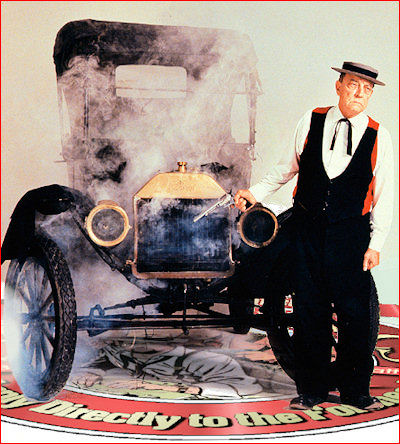
Bueller?

Phil's signature


PS: Incidentally, I do quite agree that it's possible to over-emphasize hell or speak of God's wrath in such a callous and insensitive way that we defeat the whole point of the gospel (cf. 2 Corinthians 5:20). But surely that is not the most imminent threat facing the evangelical movement at the moment. Let's not be so concerned about how far the pendulum might swing the other way until we start to see the momentum diminishing as the pendulum swings this way. When a secular newspaper article is pointing out how dramatically evangelicals have toned down the gospel, our kneejerk response certainly shouldn't be panic about the grave dangers of expounding on hell the way Jonathan Edwards did.

It utterly amazes me how predictably (and how eagerly) evangelicals will queue up to take a poke at a straw man like that—and then solemnly assure one another that they have said something profoundly serious.

PPS: This week is the Shepherds' Conference at Grace Church. Don't expect to see a lot of me here on the blog, but if you come to the conference, look me up.

11 July 2008

More Vintage Pyro-Posting

by Phil Johnson

ere's an entry from the early days of my original blog. Darlene and I had just returned from London and one of the most eventful trips we have ever made. My Journal of that trip starts here and ends here. All the entries can be found by Googling "London Journal" at my old blog. If you have a couple of hours to read it, I think you'll enjoy it.

Anyway, less than a week after our return home someone directed me to a news item about the BBC's language policies when it comes to reporting on murderous bombers. That in turn prompted the following post.


Cack-handed circumlocution and cold-hearted moral ambiguity as "aids to understanding"

(First posted 13 July 2005—exactly 3 years ago this week)
by Phil Johnson

Darlene and I were in south-central London (Southwark) when we got the earliest reports last Thursday that the London Underground had been brought to a halt by something. First reports were unclear. It was a power surge; multiple power surges; a series of explosions. No one at first seemed quite sure what had happened.

We returned as soon as possible to our hotel room to try to make some phone calls overseas. Darlene flipped on the BBC, and it was there that we—and most of London—first learned definitively that what we feared and expected most was indeed true: this was a series of coordinated terrorist attacks.

Early reports from the BBC freely referred to the unknown perpetrators as "terrorists," of course. Terrorists is the right word. It describes precisely what the perps were.

It now appears, however, that such plain language violated the BBC's own canons of political correctness. The Beeb regards the term terrorist as derogatory and therefore unsavory. Such words are officially deemed undesirable in all BBC news reports.

BBC editorial guidelines instruct writers in the nuances of careful, creative ambiguity, and they specifically cite the word terrorist as a prime example of what not to say: "Our credibility is undermined by the careless use of words which carry emotional or value judgements. The word 'terrorist' itself can be a barrier rather than an aid to understanding."

Therefore as soon as the initial shock from the attacks subsided, a memo went out by e-mail, reminding all BBC writers about the policy. The early accounts of the attacks (originally written while the news was breaking) were subsequently re-edited to refer to the terrorists with a more neutral term: "bombers." (Gene at "Harry's Place" has posted a few examples of The Beeb's revisionism.)

In response to queries about this issue, a BBC spokesperson insisted, "The word terrorist is not banned from the BBC." But another look at the editorial guidelines reveals this (and I quote): "We should try to avoid the term [terrorist], without attribution. We should let other people characterise while we report the facts as we know them." In other words, if someone else uses the T-word and you quote it, that's OK. But the word terrorist is indeed officially banned from the BBC's own writers' descriptions of terrorist acts. Those who make policy at the BBC are apparently convinced their own "credibility" would be undermined by such unbridled moral and linguistic clarity.

Thus yesterday's BBC stories about the suicide bombings in Netanya were devoid of any mention of "terror," "terrorism," or "terrorists." The organization known as Palestinian Islamic Jihad—rank terrorists who have repeatedly claimed credit for many suicide bombings and other acts of terror, and whose central business seems to be the recruiting and outfitting of various kinds of bombers who deliberately target innocent civilians—are never properly referred to as a "terrorist" organization by The Beeb. Palestinian terrorists are always referred to with words that don't have such strong "emotional or value-judgment" connotations. Those guys blowing up mothers and babies on public buses are merely "militants."

Aftermath of terrorNow we see that the BBC won't deliberately refer to suicidal killers as "terrorists" even when they bomb civilians on the London Underground. No, the geniuses who drive editorial policy at The Beeb are convinced that neutral and ambiguous expressions are much better aids to "understanding."

It's one of the amazing and disturbing ironies of our generation that so many of the gatekeepers in the world of professional journalism (whose main business ought to be communication) subscribe to the postmodern hypothesis that double-talk and euphemism actually increase "understanding," while clarity is actually deemed an impediment to communication.

And it's not just the BBC, unfortunately. While we're at it, let's be really blunt: the same philosophy drives most of the mainstream news media. And the same sort of genteel wordsmithing is also ubiquitous in the academic world, in the world of theological dialogue—and more and more in everyday public discourse.

It all stems from several basic assumptions that have been uncritically adopted by multitudes over the past half-century: "Conversation" is invariably a better option than combat. Uncertainty is always intellectually superior to strong convictions. And moral and ethical neutrality is clearly more desirable than the hopelessly medieval belief that objective standards of good and evil exist.

Postmodernism, not merely liberal media bias, is the real culprit here.

Now, don't misunderstand. I would by no means suggest that war is always superior to peace talks, that dogmatism is inherently better than diffidence, or that neutrality per se is wrong. I believe the duty spelled out in Romans 12:18 is binding: "If it is possible, as much as depends on you, live peaceably with all men." And "Blessed are the peacemakers: for they shall be called the children of God" (Matthew 5:9).

Nonetheless, Scripture also teaches that the soldier, policeman, or executioner who wields a sword against an evildoer is doing something good. "He beareth not the sword in vain: for he is the minister of God, a revenger to execute wrath upon him that doeth evil" (Romans 13:4).

By the way, miscreants and evildoers do exist, although value-judgments are sometimes necessary to identify them. Moreover, it is gross injustice to insist on always remaining morally neutral. True justice requires not only the ability to recognize evil, but also a willingness to punish it.

In other words, there are clearly times when combat is called for and "conversation" with an evildoer is folly. In some cases, strong convictions are needed and any pretense of benign deference is immoral.

That goes for journalists the same as anyone else—or it ought to.

Yet the high priests and priestesses of the mainstream media remain blindly committed to their credo: moral neutrality is the one permissible dogma of this postmodern era.

It is a particularly foolish—and potentially fatal—article of faith in an age of Islamofascist terrorism.

Mind the Gap


11 January 2008

Land of 1000 Dances

by Phil Johnson

Throwing both caution and long-established protocol to the winds, I'm going to import part of a debate from Frank Turk's blog (where these intramural squabbles really belong) to PyroManiacs (where we almost never argue amongst ourselves). I'm doing this to try to extract the question of whether it's good to turn the church into a discotheque from the more volatile and not really essential question of teetotalism. So the latter subject is off limits in this thread, and let's be nice in the meta.


Do not be conformed to this world, but be transformed by the renewal of your mind, that by testing you may discern what is the will of God, what is good and acceptable and perfect (Romans 12:2).


n the topic of church activities, Christian testimony, and our collective influence on the world, I wanted to point out that the message we send with our lifestyle is to a very large degree subject to the interpretation of the observer anyway.

Let's concede (for the sake of argument) that if some quixotically missional church advertises cigars and poker as the centerpiece of their men's ministry, that may very well be all it takes to convince some spiritually-naive, intellectually-stunted biker type that Christians really aren't just stuffy prudes whom he could never relate to. But it seems just as likely (much more likely, really) that relegating "men's ministry" to the smoke-filled room would offend many more than it would "reach." I'll go further: that approach is likely to derail some men for whom a man-sized dose of Jerry Bridges, J. C. Ryle, or the apostle Paul would be a thousand times more edifying than another stogie.

(Yes, I know: Spurgeon smoked. Not during church meetings, though.)

o I grew up in a modernist church where we had dances all the time. It was the default activity for our youth group. And if you think church dances are a novel idea, you've been wading in the shallow-evangelical end of the pool for too long. In fact, the most famous incident regarding a church dance I can think of occurred in 1949.

HT: to James White for what follows. I spent all day Tuesday with him. (That, of course, was before the current flap arose. We were no doubt conspiring to commandeer Technorati for the "TR blogosphere," or something like that.) In the course of our conversation, James reminded me of the following true story.

In 1948, Sayyid Qutb was part of an early wave of privileged middle-eastern Muslims who came to the west to study. He spent a couple of years at the State College of Education in Greeley, Colorado—taking classes toward a master's degree in education. Displaced from his own culture and relatively isolated in middle America, he viewed almost every aspect of American society with a jaded eye. He found American jazz melodramatic and distasteful, American sports crude and primitive, Americans themselves materialistic and shallow. But above all, he was utterly appalled by how self-centered, "distant," worldly, and utterly unspiritual American religion looked from inside a typical place of worship.

Where'd he get that impression? Well, it seems someone invited Qutb to a dance at a Methodist church in Greeley. Here's an excerpt from Qutb's own description of that evening, taken from his book The America I Have Seen:

After the religious service in the church ended, boys and girls from among the members began singing hymns, while others prayed, and we proceeded through a side door onto the dance floor that was connected to the prayer hall by a door. . . Every boy took the hand of a girl, including those who had just been singing hymns!

The dance floor was lit with red and yellow and blue lights, and with a few white lamps. And they danced to the tunes of the gramophone, and the dance floor was replete with tapping feet, enticing legs, arms wrapped around waists, lips pressed to lips, and chests pressed to chests. The atmosphere was full of desire. When the minister descended from his office, he looked intently around the place and at the people, and encouraged those men and women still sitting who had not yet participated in this circus to rise and take part. And as he noticed that the white lamps spoiled the romantic, dreamy atmosphere, he set about, with that typical American elegance and levity, dimming them one by one, all the while being careful not to interfere with the dance, or bump into any couples dancing on the dance floor. And the place really did appear to become more romantic and passionate. Then he advanced to the gramophone to choose a song that would befit this atmosphere and encourage the males and the females who were still seated to participate.

And the minister chose. He chose a famous American song called "But Baby, It's Cold Outside" . . . and the minister waited until he saw people stepping to the rhythm of this moving song, and he seemed satisfied and contented. He left the dance floor for his home, leaving the men and the women to enjoy this night in all its pleasure and innocence!

Sounds pretty tame by comparison to the kind of things that are happening today, doesn't it? But to Sayyid Qutb in 1949, it was a shocking sign of superficiality and an impertinent lack of proper reverence. He saw it as proof that Christianity is not a faith to be taken seriously—because it isn't even taken seriously by "believers." That night was a major turning point in Qutb's thinking, and it was one of the main reasons he later gave for rejecting Western values and the Christian religion altogether.

Qutb went back to Egypt seething with outrage and contempt against the West's unbridled materialistic selfism, and he began to produce a body of writings that became the manifestos and chief handbooks for today's Islamofascism. Qutb was chief mentor to Ayman al-Zawahiri, who in turn mentored Osama bin Laden. One of bin Laden's closest friends reported that bin Laden read Qutb's works intently and considered him the most important influence in the rise of radical Islamism in the current generation. (See Dinesh D'Souza on Sayyid Qutb.)

Anyway, before someone accuses me of being sympathetic with Qutb's values, let me just say I'm advocating no such thing. I'm not suggesting his perspective of Americans or Christians in general was fair and accurate. It clearly wasn't, and Qutb belongs in a hall of shame alongside Hitler, Stalin, Idi Amin, and Pol Pot as some of the twentieth century's most demented megalomaniacs.

Also, I'm not suggesting (as some of our more zealous fundamentalist brethren might want to) that the club atmosphere in that one Colorado church is directly to blame for the fall of the World Trade Center towers.

But the Greeley church dance episode certainly does illustrate that not all the world is charmed by worldly religion, and the apologetic value of "Disco Night in the Sanctuary" is by no means a given. In short, taking pains to demonstrate how hip and liberated we can be in our places of worship might not always be the finest "missional" strategy.

That's one reason I personally don't find such arguments persuasive. Those who want to turn the church into a dance hall really ought to try to find more legitimate biblical support for what they are advocating. And if they can't (which, BTW, they won't,) they should reexamine the strategy.

So, whether you eat or drink, or whatever you do, do all to the glory of God. Give no offense to Jews or to Greeks or to the church of God (1 Corinthians 10:31-32).

Therefore, preparing your minds for action, and being sober-minded, set your hope fully on the grace that will be brought to you at the revelation of Jesus Christ. As obedient children, do not be conformed to the passions of your former ignorance, but as he who called you is holy, you also be holy in all your conduct, since it is written, "You shall be holy, for I am holy" (1 Peter 1:13-16).

You adulterous people! Do you not know that friendship with the world is enmity with God? Therefore whoever wishes to be a friend of the world makes himself an enemy of God (James 4:4).


by Phil Johnson

18 December 2007

Emerging Martyrology

by Phil Johnson


he excerpt below contains every single word from The Truth War that makes any reference whatsoever to Kristen Bell. Note that John MacArthur makes precisely one factual statement about who she is (set in bold type below). That's literally all he says about her. Then he quotes a paragraph from a Christianity Today article that quotes her:

A recent issue of Christianity Today featured a cover article about the "Emerging Church." That's the popular name for an informal affiliation of Christian communities worldwide who want to revamp the church, change the way Christians interact with their culture, and remodel the way we think about truth itself. The article included a profile of Rob and Kristen Bell, the husband-and-wife team who founded Mars Hill—a very large and steadily growing Emerging community in Grand Rapids, Michigan. According to the article, the Bells
found themselves increasingly uncomfortable with church. "Life in the church had become so small," Kristen says. "It had worked for me for a long time. Then it stopped working." The Bells started questioning their assumptions about the Bible itself—"discovering the Bible as a human product," as Rob puts it, rather than the product of divine fiat. "The Bible is still in the center for us," Rob says, "but it's a different kind of center. We want to embrace mystery, rather than conquer it."

"I grew up thinking that we've figured out the Bible," Kristen says, "that we knew what it means. Now I have no idea what most of it means. And yet I feel like life is big again—like life used to be black and white, and now it's in color." [Andy Crouch, "The Emergent Mystique," Christianity Today (November 2004).]
One dominant theme pervades the whole article: In the Emerging Church movement, truth (to whatever degree such a concept is even recognized) is assumed to be inherently hazy, indistinct, and uncertain—perhaps even ultimately unknowable.


So here's how Andrew Jones (our lanky, lean friend from the Antipodes) described that passage from The Truth War: "[Rob Bell] seems pretty sound theologically, despite the attacks. I know John MacArthur chewed out Rob's wife in his book for a comment about the Bible. I never heard how Rob's wife responded to the criticism."

Andrew's first commenter, "Adam S," ramped up the accusation several degrees of magnitude, claiming MacArthur had "viciously attacked" poor Mrs. Bell.

A similar complaint arose here at PyroManiacs in Monday's meta, when commenter Art wondered if it's not inconsistent for someone who believes women shouldn't have teaching authority over men in the church to criticize a doctrinal pronouncement made by a woman. I don't get the rationale behind that question at all, but Art continues: "Would you find it out of order if someone brought up some[thing] your wife said, especially when that person holds a view that, biblically, women cannot teach or have authority over a man?"

Andrew Jones was pondering a similar question: "I guess I was wondering what would happen if we were to put other well-known pastors' wives up on the stand and question them. How well would Mrs MacArthur answer the questions? How well would anyone's wife [or husband] respond?"

I have several observations about that line of argument:

  1. Both Mrs. Johnson and Mrs. MacArthur are members of my Sunday school class, and I know them well. They are extremely thoughtful and intelligent women who hold strong, well-informed opinions on matters of doctrine and Scripture. But neither of them would ever volunteer any kind of doctrinal pronouncement for publication in Christianity Today. On the other hand, I am confident that if some wily CT editor managed secretly to coax a doctrinal opinion from either one of them, their focus would be on what they believe rather than a euphoric celebration of their doubts.
  2. I've seen no indication from Rob Bell that he is embarrassed or in disagreement with what his wife said in CT, and that's been in print and in wide circulation for at least three years. It seems fair to take Mrs. Bell's statement at face value as representative of the Bells' worldview.
  3. MacArthur's critical comments were in no way focused on Kristen Bell specifically; he cited a lot of similar comments from Emergent celebrities, and then disagreed with the glorification of doubt. But his disagreement was with the idea, not with any one individual. In fact, he said nothing that could possibly be construed as personal or even specific about Kristen Bell.
  4. Still, it seems like bringing my wife and my pastor's wife into a hypothetical argument violates whatever point our emergent friends might have been trying to make about the propriety or impropriety of making an argument that brings someone's wife into the polemical conflict—and it actually compounds the problem by resorting to hypotheticals in order accomplish the very thing the argument pretends to deplore.
  5. The whole objection is reminiscent of Mr. Clinton's complaint when he scolded his wife's political opponents for not treating her like a lady after she verbally slapped them around. You can't legitimately put a woman on the front line of defense for such a horribly low view of Scripture, and then hide behind her skirts when someone points out that the opinion she expressed to the whole evangelical world is so very wrong-headed. If someone wants to defend Kristin Bell's statement, do it. But let's drop the facile accusations that merely disagreeing with her is somehow inherently cruel.
  6. Emergents seem to have a pattern of this sort of behavior. A few of the most virulent trash-talkers in the Emergent blogosphere are women. I generally try to ignore them, but I've seen the "that's no way to talk to a lady" defense hauled out whenever someone answers them with a firm but contrary opinion.
  7. Note: I'm not the one who brought up the egalitarian/complementarian debate. But now that it's been mentioned, let me say to the radical egalitarians in the emergent movement: You are not going to be able to sustain even the illusion of credibility in the egalitarian position if you want to pretend it's somehow cruel, inhumane, or brutish to contradict what a woman says. It's a contradiction of the egalitarian claim to believe that women such tender souls that to contradict them is to subject them to a de facto martyrdom.

Selah.

Phil's signature


22 October 2007

Still Not Clear on the Concept

A Two-Part Rant Prompted by Things I Found in My In-Box
by Phil Johnson

ut of Ur has this post provocatively titled "Willow Creek Repents," and I've been getting e-mails from people who wonder what I think about it. The tone of a few of those e-mails has been like, "See there? Now you need to get on the Willow Creek fad-wagon."

No, thanks. Out of Ur includes a link to a video of Bill Hybels explaining how he supposedly got "the wake up call of [his] adult life." I watched the video, and frankly there's not a hint of "repentance" in it. It's just a slick announcement about Willow Creek's latest program.

So am I the only one who finds it both ironic and disturbing that when the framers of ministry philosophy at Willow Creek finally are faced with the desiccated fruits of their program-driven approach to ministry, their instant response is to announce a new program?

Really, I would love to sound more positive and affirming about Hybels' "wake up call." But critics of Willow Creek have been pointing out for years that the seeker-sensitive ministry philosophy severely stunts Christian growth. Even worse, Willow Creek's methodology seems to multiply the number of almost-converts who dabble in spiritual matters until they are no longer amused, and then fall away without ever coming to authentic faith in Christ.

Hybels has blown off all those criticisms for years. He only reluctantly and partially accepts them now because he can't very well wave aside his own staff's opinion-poll data.

Get it? Opinion-poll data?

Try to caricature that.

n a similar vein, several people have pointed me to some recent articles by J. Lee Grady, editor of Charisma magazine. He has been exposing and condemning some rather egregious examples of charismania gone to seed, and his articles illustrate how easily blind Charismatic credulity can breed moral rot. An e-mail I received this morning urged me to recognize and commend Grady "for the work he is doing" to "expose the systemic corruption, lies and immorality" in certain high-profile charismatic circles.

OK. Fine. But he's not saying anything that wasn't already being said thirty years ago by sober critics of the charismatic movement. And these are not new problems he is "exposing," but corruption that Charisma itself knew about and worked hard to conceal for many years.

As a matter of fact, Grady starts this week's column with the stunning revelation that his first task at Charisma fifteen years ago was "to sort through dozens of files of disturbing allegations" made by numerous women against Bishop Earl Paulk. He now admits "national charismatic leaders" should have listened to those allegations (which were credible if only for the sheer number of witnesses against Paulk), rather than permitting the Bishop to "thrive unchallenged."

But again: What Grady is now saying is precisely what many critics of latter-day charismatic "prophets and apostles" have been saying for more than three decades. Bishop Paulk is no anomaly in the charismatic world, nor is he even close to being the most heinous example of gross moral failure among the charismatic elite. So I think it's seriously overblown to hail J. Lee Grady (the way some have) as prophetic.

What's most striking about Grady's article, however, is this paragraph: "We charismatics, who claim to have the gift of discernment, should have smelled this cultic deception a mile away. But instead, even though the list of allegations grew year by year, leaders in our movement continued to allow Paulk to air his broadcasts on national television."

I'm glad he said that. I could not have said it without incurring the wrath of every charismatic friend I have. But it is, after all, a point that really does need to be dealt with: Charismatic claims about questionable prophecies, miracles, gifts, and callings regularly and systematically breed willful gullibility, not discernment.

Just like seeker-sensitive methodology stunts rather than stimulates spiritual growth.

The problems in both of those movements are serious and systemic, not superficial and cosmetic. They are problems that are rooted in their respective movements' most distinctive ideas. Until their leaders see that and actually change direction, it seems a bit overly optimistic to refer to their mea culpas as "repentance."


Phil's signature

04 October 2007

Wasted pulpits: a rant

by Dan Phillips
NOTE: this has been percolating and marinating for some time. The incident just related gives an opportunity to rant.
There was a point in the late eighties when I was between churches, and we were looking for a church home. We'd heard that the pastor was preaching on the Psalms. He told me he knew no Hebrew, but I thought, "Hey — Psalms! How can you go wrong?"

I found out.

It was... not good. Gent didn't even do right by the English text. But the killer was when my dear wife nudged me and said, "Look at all the notepads." And sure enough, there were pads, and poised pens, all around.

Then Valerie said, "They're not writing anything."

And sure enough, they weren't. There was nothing to write, because he wasn't giving them anything.

It just killed me. Here it all was: a church building, a pulpit, a microphone, and a bunch of people, ready to learn something. And he was using it for nothing. All that Bible to teach, and he was teaching/preaching nothing.

Then occasionally, you'll read about preachers plagiarizing their sermons. Or you'll see places that sell sermons, or sermon ideas.

And I always think: sixty-six books in the Bible, over thirty-one thousand verses... and you can't think of anything to preach on, yourself, from your own interaction with God and the text? You've run out of things to preach? Seriously?

(Note: I am thinking particularly the full-timers, not the noble souls who have to divide their time as "tent-makers.")

See, I can't even begin to sympathize with that one. In my life, I suppose I've preached/taught many hundreds of sermons/lessons. But I am crushingly aware that I have barely even scratched the surface of what I — dim bulb that I am — could preach out of the pages of Scripture. If I were immediately installed in a pulpit this Sunday... well, if that happened, I'd be a deliriously happy man. But if it happened, and if I began preaching, and the Lord spared me another forty years, I'd still barely be skimming the face of the unfathomable depths of the Word.

My dear and dearly-missed father, who at the time was an unbeliever, used to say, "I just don't know how you get up and find something to talk about every week." And I'd say, "Oh, Dad — Scripture is so alive and powerful and rich and alive that my problem is never having something to say; my problem is always where to stop!" My wife's (too-true) joke is that every time I sit down to shorten a sermon, it gets longer.

Now, in the great drawer of the Lord's silverware, I see myself as one of the duller, scratched-up plastic blades, not one of the shiny scalpels. Yet I simply cannot imagine coming to a place where I have nothing to say from the Word when I take the pulpit. If there's a verse I haven't preached on, there's something to say. If there's a Biblical doctrine I haven't taught, there's something to say.

I think of it another way. Here are these people, who've stopped everything else that they do. They have come to where I am going to speak, they've sat down, and they're looking to me to say something. Maybe there are ten of them, maybe there are hundreds, it doesn't matter. And what shall I say?

I do not have a clue what is going on in their hearts and lives. Is that woman considering an affair? Did that man write a suicide note, and he's just come in for his farewell church visit? Is that girl's boyfriend pressuring her to "prove" that she really loves him? Are that lad's professors on the verge of dinning him into walking away from his profession? Did that woman come to church for the first time, because someone told her we believed the Bible, and she wanted to see what that was about?

Who could possibly be equal to these things? If I even began to communicate how emphatically it isn't me, I'd be in violation of Rule 2. My philosophy, my experiences, my stories, my jokes, my analogies, my turns of phrase — worthless, meaningless, powerless... and worse!

No, not a one of them needs me, in my own mortal, finite, silly, dense, fallen/redeemedness. I have nothing to give them from myself. They need God. But here's the wacky thing: God, who could have chosen angels as His sole heralds, instead stooped to save men and women through the foolishness of preaching (1 Corinthians 1:21). The risen Christ gave men to the church, to preach and teach the Word (Ephesians 4:11-13). And, God help us all, I'm one of those men.

So here's what life is for me right now. I'm providentially situated where I do not get to preach regularly. Praise God, we attend a church where the pastor knows his God-given role, and uses the pulpit for all his considerable worth.

Yet I know that all over this city, this county, this state, this nation, churches are bursting at the seams with people crowded around a little second-rate song-n-dance show, with a man (or woman) who occupies the pulpit, and wastes it, or shames it, trivializes it, abuses it, ruins it. And the people who gather before God, needing a word from Him, are denied, starved, misdirected; filled up on spiritual junk food of the gaudiest and most cloying variety, when the unopened larder is so full of rich, nourishing meat that it is about to explode.

It just kills me. Jeremiah 20:9 definitely keeps coming to mind.

I want to say to these men, in the fear of God,
"What in God's name did you just do? That pulpit was loaned to you by the providence of God, those people were brought before you — and you squandered it! You prostituted yourself and your calling! And for what? To be popular? To be trendy? To be 'cool'? God help you! What are those people going away with? What did you give them? You thought you had something better than what God said to give to them? You actually thought you had something better than His Word? How will you stand on the last day? Will this survive the fire? Will what looks 'cool' now, look 'cool' then? God help you!"
So, look here: If the pulpit has become a drudgery to you, a mere burden, and you just don't really feel like you have anything worth saying from it, I have your solution:

Give it to me.

It isn't that I'm anything. No wait, scratch that: it isn't that I'm anything good. It's that the Bible is simply bursting with so much vital, revolutionary, cryingly-needed truth; and so much of that truth is lying neglected, off in the corner, while we sleep-walk and play our games and amuse ourselves to death.

Someone has to tell it! Someone has to tell it!

It doesn't get much sobering than Paul's parting words to Timothy. Read this slowly and reflectively. Don't hurry past the opening words. Could Paul have said anything more thunderously powerful to make Timothy set down his coffee mug, lean forward, and give his full, even his trembling attention to what the great apostle has to say, as he faces his own death?
I charge you in the presence of God and of Christ Jesus, who is to judge the living and the dead, and by his appearing and his kingdom: preach the word; be ready in season and out of season; reprove, rebuke, and exhort, with complete patience and teaching. For the time is coming when people will not endure sound teaching, but having itching ears they will accumulate for themselves teachers to suit their own passions, and will turn away from listening to the truth and wander off into myths. [But] you, always be sober-minded, endure suffering, do the work of an evangelist, fulfill your ministry.
(2 Timothy 4:1-5)

< /rant >

Dan Phillips's signature

24 July 2007

Getting by on Christian vapors: a rant

by Dan Phillips

[If I wasn't trying to swear off of starting open-ended series, I'd make this #1 of "Things I Will Die, Still Not Understanding."]
Think for a moment, if you will, Gentle Reader, of the distinctives of Christianity.

Ponder the Christian explanation for why man is such a mess, of how everything began and why, of what God has done to address the whole.

Or, think more specifically of who God is, of His oneness, of the Trinity, of His character, acts, decrees, will, and plan for the future.

Think of Jesus, of His divine nature and eternal goings-forth, of His incarnation and life and teachings, of His penal, substitutionary sacrifice, His bodily death, resurrection, and assumption into Heaven, His present activities from the right hand of God, and His future return.

Think of the Gospel plan in its eternal conception and historical fulfillment; think of God's terms for reconciliation to Himself, and His expressed will for how we think, make decisions, and live our lives.

Now, assuming you know any truth about any of those things — where did you get that?

Were you born knowing it? Did it simply come to you, through breast or bottle? Did you receive it by prayer and meditation, reflecting on a sunset, gazing at tea leaves? Did an emotional state communicate it to you?

No. If you know any truth about any of those things, you know it from the Bible. Period.

Now, maybe you've heard wonderful pastors preach, are blessed with marvelous godly friends, have read pithy and deep books, and are a lover of classical confessions. But insofar as any of those sources are worth anything to you, they are passing along truths gleaned straight from the Bible.

And yet....

How many Christians couldn't demonstrate some of their most cherished notions directly from the Bible to save their lives — and don't care?

The first part of that statement troubles me some, of course. But it's the second part that absolutely thunderstruck slackjawed brain-itchingly baffles me.

We say God is the most important person in our life, and....

Well, wait. Should I even assume that much? Am I justified in assuming, today, that someone knows that when he identifies himself as a "Christian," he is, at the very least, saying that he believes, and believes in, Christ? And that he has some muzzy notion that Christ said (among many other things) that the command to love the Lord your God with all your heart, mind, soul and strength is the most important thing in the universe (Matthew 22:36-37)?

Okay, so reason it through with me here:
  1. Christ says that we are supposed to love the Lord our God with everything we've got.
  2. If we say we're Christians, we necessarily say we believe that to be true.
  3. The only way we are going to know anything about who this God is who we're supposed to love, or what it means to love Him, or how He wishes to be loved, is by personally studying the Bible.
  4. ...but we don't...
  5. ...and we don't care...
  6. ...and we revile, despise, and destroy the character and name of anyone who tries to provoke us to care.
See, I just don't get it. I honestly do not. Americans aren't required to be any particular religion at all. No one has to say he's a Christian. It isn't hereditary, it isn't a genetic trait. So why say you're a Christian, voluntarily, and then just live like the claim is a big joke and you're a whopping great liar?

I wasn't a Christian. I hated Christians, I despised them. Then, by an act of God's sovereign grace, I became one. I wasn't all that bright, but I did know that I didn't know much. And I knew I needed to know. And I knew that the only way I could know was by (hel-lo?) studying the Bible.

Well, actually and honestly, no one needed to tell me. I wanted to. I believed because, well, I believed. So I wanted to know.

Now, I can understand some reasons why people who have been Christians for some time not knowing much. Maybe they're under pathetic teaching, or even positively discouraging teaching, and don't know any better. But not wanting to know? You start trying to talk to them about the Bible, and they shut you down? And then they're angry when challenged to know more?

I see myself saying, "Wait, wait — you're telling me you don't want to know God better? You don't want to know more of His person, His will, His plans? That if you're believing and telling lies about Him, you'd rather not know?"

Once, a fellow in a church I pastored got the idea of asking Christians to name the four Gospels. You know, just the four Gospels. Not the Minor Prophets or anything hard; just Matthew, Mark, Luke and John

He asked dozens of Christians. They were mostly mainstream Charismatics, but they included worship leaders, lay, all sorts, and all had been Christians for years.

His informal survey yielded two startling results:
  1. Either none, or only one, could name all four Gospels.
  2. They were, to a person, not upset with themselves for being so appallingly ignorant, but were upset with him for asking.
Then there is the related phenomenon of scores of Christians who actually seem to believe that a position without a fragment of direct Biblical substantiation is actually superior to one that has a rich Scriptural basis.

I've run into this countless times. Here's a man who wanted to do something. I showed him from Scripture that it was a course of action that was expressly forbidden in Scripture. What was his answering case, from Scripture? None, not even a try. No, his answer was, "I don't want to hear any more of that Bible stuff." (As far as I recall, that's an exact quotation.)

Was he saying he wasn't a Christian anymore? Nope, not to his mind. He thought, and as far as I know still thinks, that he's a Christian. He'd simply joined the thronging masses of Christians-who-don't-care-what-the-Bible-says.

"But that's a contradiction in terms," you say.

Should be, I respond.

Pyro readers probably could contribute horror stories of their own.

So how do these people get by? Well, I think most would tell you they "just know." The feel the truth in their hearts, and they follow their hearts. Christian vapors.

Now it really doesn't take a PhD in Bible to say, emphatically and pointedly, that while this is a religious position, it is not a Christian position. From Testament (Genesis 18:19) to Testament (John 8:31-32) God makes it plain that His people must be taught, instructed, informed. That is Christianity. Anything else is a fake.

What it actually is, is the Gospel of Hollywood. "Follow your heart." What scares and appalls me about that is not merely how many people believe it, but how many professedly evangelical Christians believe it.

But an actual, card-carrying, practicing Christian should be able to tell you that anyone who follows his heart, who believes that his deep and certain feelings communicated divine truth to him, is a FOOL. Period. Why?

Because God said so (Proverbs 28:26; Jeremiah 17:9).

And if we got our religion from the Bible instead of our culture, we'd know that — and a whole lot more.

< /rant >

Dan Phillips's signature