09 July 2009

Karate exegesis [requested classic re-post]

by Dan Phillips
[By special request from Witness, we reach 'way back to May of 2006 for this classic repost, slightly edited.]
Yes, it's true: I "do" karate, using the verb in its very broadest sense. My three sons were in first, and then it became possible for me to join in and start making with the kiyai!

One of the (to me) counter-intuitive strategies one learns about sparring is to present a profile, not a flat-on wide target. That way, there's less to hit — and you're positioned to move outside. So if your opponent lunges at you, you just let him follow his momentum, you step to the side, and you work a little mayhem as he passes. Remember that: let him lunge, then do some mayhem from the side.

This same principle — allowed lunging, then angular mayhem — applies well in exegetical debates. Too often, we allow ourselves to be put unnecessarily on the defensive. Somebody cites a problem verse, and we start with the 47-page frontal-assault exegetical answer defending our position... and when we finish, they just go on to the next attack unfazed, untaught, unchallenged. We stay on the defensive.

I probably shouldn't tip my hand so publicly, but here's the sort of thing I try to do. Say we're making the Biblical case for Purposeful Redemption — that is, the view that our sovereign Lord died so as actually to save particular people (Matthew 20:28; 1 Timothy 1:15), not to save everyone in general but nobody in particular. (Or "Effective Redemption," in that we affirm that Christ Jesus came into the world to save sinners [1 Timothy 1:15], not merely make it possible for them to add the necessary critical ingredient to save themselves.)

Our friend pulls out 1 John 2:2 — "He is the propitiation for our sins, and not for ours only but also for the sins of the whole world," and slaps it on the table with the air of a gambler laying down the winning card.

"'The whole world,'" our friend emphasizes meaningfully, perhaps tapping the verse in his Bible. "'Not for ours only.'"

How do we answer?

Well, we could do a lo-o-o-o-o-ong riff on every occurrence "world" in and out of John's writings. We could go to John 11:51-52, and 12:19, and discuss them at length. We could do lots of frontal, defensive things, and take a long while and expend a lot of energy doing them.

Or we could step aside, let our friend plow on through... then work a little mayhem from the side.

That is, we could nod sympathetically and say, "Yes, I can see how that is a real problem for your position."

Our friend (if he's not read this post) will likely do a double-take, say "Yes, I... wait — my position? Huh? It isn't! It's a problem for your position!"

You see, he has lunged. Now we make with the mayhem.

With a puzzled look, we could say, "How so? Your idea is that 'world' means every human being who ever was, or ever will be born, right?" (Nod.) "So, do you believe that every human being ever born will go to Heaven?"

Aghast, our friend will assure us that he believes no such thing.

"I didn't think you did. But that means you have a real problem with this verse, don't you?" we could continue. "John writes that Jesus Christ is — not 'would really like to be,' or 'wishes He could be,' or even 'stands ready to be,' but is — the propitiation for the sins of the whole world. What is a propitiation?"

Our friend, an astute soul that he is, replies, "A 'propitiation' is a sacrifice that turns away the wrath of God."

We agree. Then with knitted brow, we ask, "So, if you're right about 'the whole world,' then John is saying that Christ has turned away the wrath of God for the sins of every human being ever born — you, me, Judas, the Beast, the False Prophet — everyone.

"On that understanding, how can anyone be under God's wrath, which Christ propitiated? How can anyone be in Hell? Why are they there? For what are they being judged and punished?"

"For their unbelief," our friend may offer.

"Oh, I see. Is unbelief a sin?" we ask innocently.

Our friend may nor may not allow as much. If he does not, we could add, "From what I read, unbelief certainly is a sin. Or is it not a moral issue to call God a liar (1 John 5:9-10)? See," we can conclude sympathetically, "you have a real problem. On your view, either unbelief isn't a sin, in which case God is a liar; or everyone's going to Heaven, in which case, again, God is a liar; or Christ really isn't a propitiation for all the sins of everyone without exception — in which case, one more time, God is a liar. Do you think God is a liar?"

Maybe now our friend might be willing to consider that the text is capable of a better construction.

We might help him open up to the possibilities with another question: "I think it's your idea of what John means by 'world' that is giving you such trouble. Can you think of any verses where 'world' unambiguously means 'everyone who ever was born or ever would be born'? I can certainly think of many that do not. Maybe that isn't the best way to read that verse?"

At the very least, he'll now know that, if the verse is a problem for Calvinists, it isn't a problem for us alone. If he's honest, that is. (And why would we have dishonest friends?)

In your mind, try the same exercise with 1 Timothy 2:6 or 4:10, or other similar "problem" passages. I think you'll find it pretty effective.

Allow the lunge. Step aside.

Mayhem.

Dan Phillips's signature

08 July 2009

What's obvious

by Frank Turk

To the pure, all things are pure, but to the defiled and unbelieving, nothing is pure; but both their minds and their consciences are defiled. They profess to know God, but they deny him by their works. They are detestable, disobedient, unfit for any good work.

But as for you, teach what accords with sound doctrine.
After our brief interlude to the non-pastors among our readers (and we can see how well that went, so dear pastor reader, your work is obviously cut out for you), we back to seeing how Paul told Timothy to engage in the ministry -- and we have come to a simply phrase: "teach what accords with sound doctrine".

I was tempted to go on from there today and roll out the bulk of Titus 2 for you, but this phrase has some particular interest. First of all, it does say "teach" -- as in "to use words in order to declare one's mind and disclose one's thoughts". It's not a subtle word, really: it's sort of a clear command word -- sort of a present active imperative: teach it. Preach it. Declare it. Use words. Now.

And in case one doesn't see it, Paul does say "YOU teach". Don't just see to it that it's taught: YOU teach.

And Paul is not exhorting Titus teach just anything. He says to teach "the things that stand out or are conspicuous" -- which is an interesting thing when one is taking a sentence apart word for word. But Paul wants Titus to teach not the minutiae or the sub-subtle lexical nuances: he wants Titus to go after what's obvious -- get the big rocks in, as they say in 7 Habits class.

But here's the thing: it's not what's obvious to the world, or what's obvious to the Cretans: it's what's obvious about healthy doctrine.

You know: while we believe in some really interesting and deep stuff, how about the obvious stuff that is healthy doctrine as opposed to (for example) what is "detestable, disobedient, unfit".

Because here's the thing: often, we overlook the obvious. The problem in the Christian life is that it's loaded with obvious stuff, and we get caught up in endless genealogies and stupid myths. What if we stuck to the obvious stuff, like somehow being grateful for the forgiveness of our great debt, and generous because we have been given so much we do not deserve, and loving because we have been loved in a rather lavish way?

Because I think that's what Paul means here by "adorns": that which is just hangin' right off sound doctrine.

Dear pastor reader: pick the low-hanging fruit. Use words in order to declare one's mind and disclose one's thoughts. Preach it. You.


07 July 2009

Pastordude: please, before you say that word....

by Dan Phillips

So you're a pastor, and you're preaching this passage, and you want to mention some Hebrew or Greek word that is in the passage. Fine. Great, in fact. Terrific.

One request.

Say it right, or don't say it.

Now, many would advise that you just not say it, period, because it's not going to help your largely (linguisitically) unschooled audience, and may just look like preening. Most of the time, I think that's good advice.

But because I know we pastordudes can be a bit thick, let me break it down and be very specific.

You're preaching a passage. There's a Hebrew or Greek word in it that is cool, that you think is worth commenting on. Fine.

If you do not actually know Hebrew or Greek:
  1. You should learn Hebrew and Greek. (After all, you are an instructor in ancient Hebrew and Greek literature. Your Principal wrote the class textbook in those languages. Your students have the right to expect that you're conversant with them, or working on it.)
  2. Until then, you probably should not say any Hebrew or Greek word.
  3. If you do, find someone who has studied, and ask him whether you're about to say it right.
If you studied Hebrew and Greek in seminary but haven't kept it up:
  1. Tsk. Make time. Get current. (See #1, above)
  2. See #3, above.
I can easily think of two pastors I've heard, very different traditions, but both well-known for Bible teaching. I know neither personally. Both said Greek words in these sermons I recall. Both said them badly. In the case of at least one word each, both clearly had no idea what they were doing — just sort of made a running, stumbling lunge at the respective words. It wasn't pretty.

Now, I know a lot of you are thinking, "So? Good heavens, man — only you will care!" To that, three thoughts:

First: I'll admit, it's a reflection of how seriously I take the pulpit. I think the pulpit is a terrifying place in which to stand. I think everyone should think that same way, or not stand there (James 3:1). Most people should not stand there at all, if you think about it.

I'll admit this, too: when I see a guy in a pulpit, chatting and yarning and speculating and obviously casually pulling things off the top of his head... well, you know, even typing this, I stop and struggle for words. I just cannot fathom that. C-a-n-n-o-t.

Simplest and most charitable way I can put it: obviously such an one and I view the pulpit very differently.

Second: if you don't know it, you shouldn't be preaching it. Do I really need to expand on that? Say what you know, know what you say, or shoosh.

(I do, by the way, strive to practice what I'm preaching here. I may be current in Hebrew and Greek, but I don't really know French, or Latin, or German. Yet I've had occasion over the last 30+ years to use words from those languages — and I've done due diligence before doing so. You know, they're not just funny-looking English words. If you apply American pronunciation canons to a Latin word such as oratio, or a French word such as métier, you will mispronounce the word.)

Third: think about overall credibility.

Suppose I choose to draw an illustration from the field of biology, or anatomy, or a physical science, or an historical event. Suppose, further, someone in my audience happens to be well-studied in that field. And suppose he instantly recognizes that I'm full of beans, that I pulled out some old chestnut that every well-studied ____ist/ian/ologist immediately knows to be an urban myth, or a common but long-since-exploded misconception.

What will he think of my faithfulness? of the seriousness of my intent? of the thoroughness with which I research what I am about to hold out for people's trust and acceptance?

He'll instantly know I'm willing to say things of which I haven't taken the time to make sure.

And he'll wonder — he'll have good reason to wonder — how thoroughly I have researched and thought through the other claims I'm making. He'll have good reason to think, "Okay, I know anatomy, and I know that what he just said is simply beans. But I don't know Greek, or theology, or much about the Bible. How do I know whether he knows what he's talking about on those subjects, or whether he's just as sloppy about them as he was about this?"

Think about it, brothers.

It matters.

One Dan's viewpoint, your mileage may vary.

Dan Phillips's signature

06 July 2009

Divine Sovereignty and Human Responsibility. Again.

by Phil Johnson


cts 27 is that great chapter where Luke chronicles Paul's journey to Rome and describes how he was shipwrecked along the way. Two verses in that chapter make an interesting contrast.

In verse 22, Paul prophesies: "There will be no loss of life among you, but only of the ship." But in verse 31, when some sailors try to escape the sinking ship secretly, Paul tells Julius (the Roman centurion in charge of his transport to Rome): "Unless these men stay in the ship, you cannot be saved."

There you have the twin principles of divine sovereignty and human responsibility perfectly juxtaposed against one another. These are the very truths so many people (ranging from the rankest Arminian to the most rigid hyper-Calvinist) insist are contradictory truths. But here they appear side by side and in perfect harmony in the Bible.

There is no contradiction. Both things are true. Not one soul on that ship was going to die, because God had decreed it. Yet unless the crew stayed on the ship and brought it aground on the island of Malta, the passengers could not be saved.

How can both truths be simultaneously true? Simple. Because God ordained the means as well as the end, and the means He had ordained for saving that ship depended on the crew's ability to steer the ship to the island of Malta and run it aground in the sand and surf. God's sovereignty did not annul the sailors' responsibility. In fact, God's sovereignty is the very thing that established their responsibility.

God works through instruments. And He often uses human instruments. He could, of course, accomplish all His good pleasure solely by the direct agency of His own hands. He could accomplish His will simply by speaking the word,as He did when He first said in Genesis 1:3, "'Let there be light,' and there was light."

But most often, God works by secondary causes—indirectly—through whatever instruments He chooses. He set the sun in the heavens to give light to the earth. Could He have illuminated the earth by direct light from His own glory? Certainly. That is how heaven will be illuminated. Revelation 21:23 says the New Jerusalem has "no need of sun or moon to shine on it, for the glory of God gives it light, and its lamp is the Lamb."

God can work any miracle He chooses and accomplish His will with or without means. But in ordinary cases, He uses ordinary means. That is how He has established His universe, and that is why we are responsible to do as He commands, even though we know He is utterly sovereign and His will cannot be thwarted.

It was absolutely and perfectly true that God's ultimate purpose was for every man in that vessel to be saved from the storm. It was also absolutely and perfectly true that unless the sailors remained with the ship, lives would be lost. The same God who decreed the end determined the efficacy of the means He chose. His sovereign decree to save every passenger did not nullify the duty of the sailors; it established and affirmed their duty.

Verse 22 makes clear that it was God's certain and infallible purpose to save every soul on that ship. Verse 31 establishes the fact that their salvation would be brought about by the actions of the centurion, and on the subsequent actions of the crew. The whole thing was done by the appointment and the decree of God. It was also accomplished by voluntary action on the part of the centurion and the sailors. Both things are true, and there is no difficulty whatsoever, if you understand that God ordained the means as well as the end.

Paul's knowledge of God's ultimate purpose did not prevent him from issuing a warning and directions to Julius. Neither did the knowledge of God's purpose prevent Julius and the soldiers from doing what they needed to do. Remember this: The belief that God wills something is a powerful reason to use every means available to effect God's will; it is not a reason to fold our hands and say, "God will do it, whether we do anything or not."

People often claim that God's sovereignty in salvation nullifies our duty in evangelism. If God has ordained that His elect will be saved, what need is there for preaching and personal evangelism? That is one of the favorite arguments Dave Hunt, Ergun Caner, and most of the rabid anti-Calvinists in the SBC (and elsewhere) like to use against the doctrine of predestination. But it's nonsense if we understand that God ordains the means as well as the end, and the means He chose by which to call the elect is by the preaching of the gospel.

Romans 10:14-15: "How then will they call on him in whom they have not believed? And how are they to believe in him of whom they have never heard? And how are they to hear without someone preaching? And how are they to preach unless they are sent?" In fact, "knowing the fear of the Lord, we persuade others" (2 Corinthians 5:11).

It is in no sense incompatible with the truth of election or the principle of God's sovereignty in salvation to persuade sinners, plead with them, beseech them—even beg them as ambassadors of Christ, in His stead, to "be reconciled to God" (v. 20). That plea is the very instrument God has ordained to turn the hearts of people to Himself. That's what Scripture means when it says the gospel "is the power of God unto salvation." First Corinthians 1:21: "For after that in the wisdom of God the world by wisdom knew not God, it pleased God by the foolishness of preaching to save them that believe."

If you understand this principle—that God in His sovereignty normally accomplishes His plan through the use of ordinary means, it will clear away most of the confusion and perplexity that is so often associated with the doctrine of divine sovereignty and its twin truth, the doctrine of human responsibility.

Our duty as ambassadors of Christ is to proclaim the promise of forgiveness, to urge men to repent, and to plead with them to be reconciled with God. Those are the very means God uses to save those whom He effectually draws to Christ. He does not save sinners apart from the means He has chosen.

Phil's signature

05 July 2009

Keep to the Old Truth

Your weekly dose of Spurgeon
posted by Phil Johnson


The PyroManiacs devote some space each weekend to highlights from The Spurgeon Archive. This short but potent excerpt comes from "Additions to the Church,"a sermon preached Sunday morning 5 April 1874, at the Metropolitan Tabernacle.


ear brethren and sisters, never give up the grand old truths of the gospel. Let no excitement, even though it be the whirlwind of a revival, ever sweep you off your feet concerning the great doctrines of the cross. If God does not save men by truth he certainly will not save them by lies, and if the old gospel is not competent to work a revival, then we will do without the revival; we will keep to the old truth, anyhow, come what may! Our flag is nailed to the mast.


C. H. Spurgeon


03 July 2009

What Price Freedom? [Requested classic re-post]

by Dan Phillips

[By special request from Scott, we reach back to June 30, 2006 for this classic 4th of July repost, slightly edited. Stay safe and sane, and don't forget the price of freedom.]
“…and from Jesus Christ, the Faithful Witness, the Firstborn over the dead, and the Ruler over the kings of the earth. To Him who loves us, and loosed us from our sins by His blood; and He made us a kingdom, priests to His God and Father — to him be the glory and the might unto the ages of the ages! Amen!” (Revelation 1:5-6, my rendering)
In America, we enjoy a degree of freedom unknown throughout most of the history of the world. This freedom had its formal birth with the Declaration of Independence, July 4, 1776, in which the 13 colonies declared themselves independent of Great Britain, and which ended with the words “for the support of this declaration…we mutually pledge to each other our lives, our fortunes and our sacred honor.”

Was that just big talk, or flowery rhetoric? Well, the 56 signers were marking themselves as traitors to the Crown. “By the end of the war, almost every one had lost his property; many had lost wives and families to British guns or prisons; and several died penniless, having given all to the Revolution” (Larry Schweikart and Michael Allen, A Patriot’s History of the United States [Sentinel: 2004], 81).

Americans enjoy freedom today because of the blood spilt by thousands of men and women from before 1776 until this very day. Our freedom, as Americans, is not free. If it hasn’t cost us personally, it surely has cost someone else!

But my mind turns today to a far deeper bondage, however, and an infinitely greater freedom — and to the far more dreadful price that was paid for that freedom.

It is found in Revelation 1:5b: “To Him who loves us, and loosed us from our sins by His blood.”

I'd like to focus on two aspects only of that text: the love of Jesus, and the cost of that love.

As to the love of Jesus, we can discern four aspects here:

First, Christ's love is FREE. God is, by definition, the one and only truly free Being. He is under no external controls, subject to no overrides nor limitations. He can will and do anything in accord with His nature. Therefore, He was under no external nor moral compulsion to love guilty rebels. No committee or authority had petitioned nor ordered Him. Certainly His love was provoked by nothing in us — no foreseen faith, no anticipated holiness, as if the ultimate cause lay in us.

More accurately, He loves in spite of the continued rebellions, treacheries, and unbelief of the objects of His love. When He loves, He loves because He loves. It is the only satisfactory and Biblical answer.

Second, Christ's love is DISTINGUISHING. The text says that He loves "us.” The context defines "us" as “His servants" and "his servant John” (1:1; cf. v. 4), as “the seven churches” (1:4), and as people who were “loosed …from sins… made… a kingdom, priests to his God and Father” (1:5-6). They are contrasted with false, pretend-Christians (chapters 2—3).

They stand apart from those who try to hide “themselves in the caves and among the rocks of the mountains, calling to the mountains and rocks, “Fall on us and hide us from the face of him who is seated on the throne, and from the wrath of the Lamb, for the great day of their wrath has come, and who can stand?” (Revelation 6:15-17).

It was a targeted love, a definite love, a particular love. There were people — "us" — whom Christ meant to free. Not "offer freedom to," but free, "loose."

Would anyone dare say He failed to free even one soul whom He determined to deliver?

Third, Christ's love is ETERNAL. John calls Jesus “Him who loves us.” The verb is present in tense, but it is a participle, not a finite verb. It marks no starting point, it erects no terminus. It isn't “Jesus loved us," nor "Jesus will love us.”

Being a verbal noun, it is a characteristic of Jesus'. It was true when John wrote it, it is true as we read it, it will be true through all the centuries and millennia and ages of eternity. Before a world began, He set His love on His own. When the last rebel fist has been shaken, and judged, still He will love His own.

This characteristic trumps all of the fears of God’s people. “But I am unworthy!” So are we all; yet Christ is He “who loves us.” “But I sin!” So do we all; yet Christ is He “who loves us.” “But I am going through a dark, awful time!” So have we all; yet Christ is He “who loves us.”

There is no “use by” date, no expiration, no sunset provision. Because it is eternal, it is invincible; nothing can separate us from the love of God which is in Christ Jesus.

Fourth, Christ's love is revelatory of HIM, not of US. If ever you find yourself starting a sentence, “Well, I think God loved me because I…” — bail out! Quick! Step away from the stupid statement! The only true and Biblical way to finish that is, “God loved because God loved." And the fact that God loved, and the wretches whom God loved, and the invincible fierceness with which God loved all say a great deal about God — and nothing about me.

Away with all self-help pop-psychologizing, that tries to find self-esteem in the Cross. Many say, “God loved me so much that He gave His Son to die for me — so I must be worth a lot! I must be worthy! I must be special!” I can’t easily imagine a more perverse line of reasoning. What the Cross says about us is that we’re helpless, we’re hopeless, we’re lost and doomed, and only the most extreme, radical, scandalous act on the part of God could redeem us from the wreck and ruin in which we’d buried ourselves!

The Cross says horrible things about us, as we are in ourselves, as Christ finds us! But it says wonderful things about God!

In fact, as a brief aside, to speak of loosing is to assume binding. That is, only those who are bound are interested in deliverance from their bonds. So what is it that binds us? The world, the flesh, and the Devil -- mighty, ubiquitous, tireless forces. [Sheerly because of the length of this post, I expand on this point elsewhere.]

Now let's turn to the COST undertaken by Jesus, because of His love: He freed us from our sins “by His blood.” We'll focus on three aspects.

First, Christ's blood is PRECIOUS blood. It is precious because of whose blood it is. It belongs to God’s Messiah, the Anointed One, the Faithful Witness, the ruler of the kings of the earth. It belongs to the blood of God incarnate; the Bible calls it the blood of God (Acts 20:28). This blood is of infinite worth. Dare anyone set a limit on the value of this blood? I would not! (It is a great misrepresentation of the Calvinist position to think that we do. We see its value as limitless, and its aim as specific.) Thus could Christ shed it on behalf of, and actually accomplish the redemption of, countless scores of multitudes of sinners from every nation, tribe and language.

Second, Christ's blood is PURE blood. The blood that looses us from our sins is itself that of a sinless Man. This is the blood of the one Man who did not share Adam’s guilt, and did not replicate Adam’s sin. It is the blood of one who never violated God’s law in thought, word or deed, who kept every bit of God’s law in thought, word and deed. Can the contrast between the Lord Jesus and those for whom He died be any starker and more immense?

Third, Christ's blood is POWERFUL blood. The apostle John does not say that Jesus made it possible for us to loose ourselves from our sins by His blood. Nor does He say that Christ made loosing from our sins available by his blood. Rather, Jesus Christ actually loosed us from our sins by His blood!


Christ's blood is powerful, and it is effectual. Can any imagine that a drop of that blood would be wasted, would fall to the ground defeated and impotent? I cannot.

Notice the wonders He accomplishes by His blood (vv. 5b-6). Before, we were lost, rebellious, hopeless, impure slaves. After, we are a kingdom, and we are priests. We need no mere man to rule us. We need no man to stand for us before God. We are members of Christ’s kingdom, and priests to God through Him.

This, my brothers and sisters, is freedom!

But at what a cost!

Now, it's beyond us to know who reads our posts. So let me just say, Dear Reader, if your thinking is, “Oh, I don’t need such a drastic conversion; religion is all very well for weak men and old ladies, but I have a fulfilled and meaningful life. I must follow my heart. I don’t need fairy tales to brighten up my life,” then you are still a slave to the world, the flesh, and the Devil. The worst slave is the one who has grown accustomed to his chains.

What power on earth can save us from these things? No power on earth! Only Christ can — but at what a dreadful price! No mere example, or teaching, or method can save. Only the blood of God incarnate can loose us from our sins! Do you know that freedom?

If you do, praise and honor Him alone who loves you, and loosed you from your sins at such a staggering price!

If you do not, throw yourself on the mercy of God, believe in the Lord Jesus Christ, look to Him this day!

Dan Phillips's signature

Emergent Flowchart

posted by Phil Johnson


Submitted by Ben Mordecai.
(click chart for larger version)

Phil's signature

02 July 2009

A Reasonable Question

by Frank Turk

Someone shrewdly asked this question in the meta yesterday:
    Do you think that the "insubordinate, empty talkers and deceivers" were Christians or false teachers?
And my response was, "That's a great question."

Because a question like that deserves at least more than a one-line answer, I'm back today to give you some things to think about here.

So here's my first thought: the apostle Peter was a Christian man.

Now, I bring him up because, sadly for him, he went to Galatia Antioch (corrected, thx CB Shearer), and while he was there (this being the alleged holder of the keys to the kingdom of heaven as first Pope, they say), he decided he couldn't eat with the Gentiles because of the influence of some Jews among the Christians.

In that small respect, and for what appears to be a notable but brief time until Paul came around and fisked him publicly for it, Peter was a small-time false teacher. His actions and practices briefly taught others something which Paul said, in words to this effect, "voided the Gospel".

Peter did. And he was a Christian. It wasn't either/or for Peter, though we have to at least admire him for admitting he was wrong and repenting when he was rightly-ashamed for his cultural concessions.

What? Don't look at me that way. I'm talking about Peter.

So I use that Bible example to bring us to a contemporary example: John Stott is, unequivocally, a Christian man. And I can hear the wolves at the door already, but I can hold them off long enough to explain to you what I am saying and where I am going.


Stott is by almost any account a hero of the faith. His writing has been formative for many of us, and informative for many more, and he's also one of the better men among the Anglicans. D.A. Carson and J.I. Packer both speak highly of him, so F. N. Turk isn't going to try to pull the rug out from under those guys, who have probably thrown away better 3-pages essays than I have ever posted on this or any blog.

But as all the watchbloggers and discernment ministers know, Stott is sort of an unrepentant annihilationist. That is, he believes in a final judgment of the lost by Christ, and when Christ pronounces, "away with you - I never knew you!" to them, they are greeted with the momentary realization of what they have done, and then they are simply snuffed out of existence forever.

So John Stott, the Christian, is also a false teacher.

Now look: in one sense, this should be of no shock to you. Everyone reading this blog ought to believe some version of this:
    The purest churches under heaven are subject to mixture and error; and some have so degenerated as to become no churches of Christ, but synagogues of Satan; nevertheless Christ always hath had, and ever shall have a kingdom in this world, to the end thereof, of such as believe in him, and make profession of his name.
Some of you have the "Synagogue of Satan" part there sort of printed in raised letters and highlighted with neon colors as if that was the point of this section of the LBCF, but the underlined part is actually the point: the church is not hardly perfect, but Christ will always have a kingdom in this world which he has called out to profess Him and make him known.

So you know about "mixture and error" in the church. But some of you fail to see that this is because every single one of us is also in the throws of mixture and error.

So in that respect, you're like John Stott, and nobody's running you out of the church yet, are they?

"But cent," says someone gravely concerned, and troubled, and deeply, deeply watchblogging, "are you saying that we should do nothing about someone like John Stott who is a leader in the church?"

Well: No.

I'm with Paul on this one, who instructed Titus to rebuke the ones who needed rebuking sharply. Rebuke the false teacher as one who is full of God's word and all the mature fruit of the spirit.

Peter needed a rebuke. John Stott prolly needs a rebuke. God knows that Frank Turk needs more than one rebuke -- all of them, for false teaching. That doesn't mean that any of them are not Christians.

Some false teachers are Christians. It disqualifies them as teachers, not as men or women who are being saved by grace. Some non-Christians are also false teachers. If we can keep that straight, we will avoid a lot of personal experience as false teachers.


01 July 2009

Rebuke them especially

by Frank Turk
For there are many who are insubordinate, empty talkers and deceivers, especially those of the circumcision party. They must be silenced, since they are upsetting whole families by teaching for shameful gain what they ought not to teach. One of the Cretans, a prophet of their own, said, "Cretans are always liars, evil beasts, lazy gluttons." This testimony is true. Therefore rebuke them sharply, that they may be sound in the faith, not devoting themselves to Jewish myths and the commands of people who turn away from the truth. To the pure, all things are pure, but to the defiled and unbelieving, nothing is pure; but both their minds and their consciences are defiled. They profess to know God, but they deny him by their works. They are detestable, disobedient, unfit for any good work.
Well, welcome to the second paragraph of the letter to Titus (finally), and it's a doozer. We've pretty much pointed the finger at pastors over the last umpteen weeks (and that's what I intended to do, as you will remember), but here the pastor gets a brief respite because, as it turns out, the rest of you are no prize catch.

"They rest of us?" you say. "We're not Cretans, cent. We're Christians. We read this blog -- we must be pretty good stock even among the breed."

Yeah, well, take a closer look. There are "many" among the Cretans who are "insubordinate, empty talkers and deceivers", especially among the young, restless and reformed. Oh wait -- he said "the circumcision party", and by that he didn't mean those who read a lot of books, memorized a lot of Scripture, and looked up to the great heroes of the faith in the past to tell us today how we might better follow the covenant God of Abraham, Isaac and Jacob, by taking on the signs and seals of the culture, did he?

Well, at any rate, these evil beasts and gluttons and liars need to be rebuked sharply to be sound in the faith. They profess to know God, but they deny Him by their works. They are in fact unfit for any good work.

So to that end, dear pastor reader, is the charge you have to consider today: is your job to see to what degree you can cut in on the culture's empty talk and deception in order to get somebody's attention, or is your job to rebuke those who are full of empty talk and lies and deception?

Whichever your hand finds to do in this section, do it with all your might. And that's the last time I'll mention it.


29 June 2009

At Home with the Lord (2 Cor. 5:8)

by Phil Johnson

Jackie and Mike
Jackie and Mike Taylor


ike Taylor was the first friend I made when I came to work here at Grace to You in 1983. His office was right next to mine, and we almost immediately formed a mutual respect and deep affection for one another that did not diminish with time.

In those days, Grace To You operated under the oversight of Grace Church's elders, and I was the first non-Grace-Church person ever hired (from Chicago, no less) to work for the ministry. Mike was still a fairly new Christian—a one-time bartender and frustrated film-school graduate who had been hired to edit study guides. (The study guides were those simple outline-style curricular books Grace to You used to publish as companions to each new series we broadcast on the radio.) Mike's full-time employment began just two or three months before I arrived, so we were the newest employees in the building.

Ironically, although I had worked as an editor at Moody Press, my first job at Grace to You was answering listener mail. Mike was inexperienced as an editor but devoted to the task and committed to excellence. For the first year and a half or so, I deliberately kept my nose out of all editorial affairs. But I needn't have worried. Mike welcomed me heartily from day one, and there was never any tension (and not one cross word that ever passed between us) in more than 26 years of friendship.

As it turned out, Mike had numerous innate abilities that perfectly suited him for editorial work. He was an excellent writer with a powerful instinct for clarity and brevity. He was also a quick learner. Everything he ever wrote or edited was superb. He had enough natural talent and developed enough wordsmithing skills that he would have qualified to work for any publisher anywhere.

When Mike first started working for Grace to You, it was only on an hourly ad hoc basis. Even when he was first hired full time, I presume he still thought of the job as temporary and transitional; not exactly a promising career move. But as a new Christian, he was hungry to learn the Word of God, and that job gave him an opportunity to study Scripture for long hours and get paid in the process. He could hardly believe that Providence would bless him with such a privilege.

Many years later, more than two decades after Mike moved into management at Grace to You and embraced the job as his life's work, he still felt exactly the same way—utterly amazed at the thought that God took him from tending bar in a joint on Hollywood Boulevard to serving in such a strategic, far-reaching role of ministry alongside John MacArthur. Mike had a loud, infectious laugh that echoed daily through our hallways. He became more knowledgeable about doctrine and Scripture than many seminary graduates. He proved to be an excellent teacher himself and was a key person in the leadership of GraceLife (the group Don Green and I jointly pastor at Grace Church).

Mike met his wife, Jackie, at Grace Church in 1982 or so and married her shortly after I first met him. Jackie and Darlene became lifelong friends, too. The Taylors had two precious daughters, Amanda and Emily, who grew to adulthood alongside my three boys, attending all the same schools, riding in the same carpools, and going to all the same church activities together. All five of them are still active in young-adult activities at Grace Church. Amanda and Emily both serve on the church staff. My eldest son, now 29, found a kindred spirit in Mike. They loved going to hockey games together. Our families were close at every level.

Anyway, two or three years ago, Mike contracted Valley Fever, a fungal infection that in most cases causes nothing worse than mild flu-like symptoms. In a narrow percentage of people, however, it can be very serious, or even prove fatal. Mike seemed to recover from the worst of the fever after that initial severe bout, but a few nagging symptoms remained. By March of this year, he was feeling back pain and losing his sense of balance; his walk became slow and deliberate, and he finally began using a cane. By April, those symptoms worsened; Mike was experiencing a creeping paralysis, and he was obviously losing mobility at a disturbing speed. We were all concerned. Mike, however, remained upbeat. He answered all my concerns with reassurances that he was regularly seeing doctors and he believed they understood what was wrong and could treat it.

The problem, as I understand it, is that the fungus had invaded Mike's spinal column, causing scar tissue that constricted those central nerves and was gradually paralyzing him. The lead doctor proposed a heavy steroidal treatment to knock the fungus out.

About two weeks ago, Mike entered the hospital for ten days of treatment with powerful doses of anti-fungal medication and steroids. Apparently the medication had side-effects that caused massive internal bleeding. Doctors were unable to stop the bleeding, and Mike went to heaven Saturday morning.

The entire Grace to You staff is still in a deep state of shock over Mike's death, and we will all miss him greatly.

Mike and I went together from being the youngest rookies to being the longest-tenured employees in the whole building. I find it hard to believe so many years have gone by so quickly, and I can't imagine what life at Grace to You will be like without Mike's laughter echoing in the hallways.

Please pray for Jackie, Amanda, and Emily. The loss for them is surely even more bitter-tasting than it is for us, and that is almost unimaginable.

And yet in the midst of all that sorrow is a sense of unspeakable joy and rejoicing when we think of Mike. We know he is in the presence of Christ, basking in the glory of heaven, and surely more amazed than ever at by the grace that carried him from Hollywood Boulevard to heaven. Words can't possibly express the triumphant gladness the truth of the gospel brings in moments like this.

What a profound blessing assurance is!

Phil's signature

28 June 2009

Precious in the sight of the Lord

Your weekly dose of Spurgeon
posted by Phil Johnson

The PyroManiacs devote some space each weekend to highlights from The Spurgeon Archive.The following excerpt is from the sermon "Precious Deaths," preached Sunday morning, 18 February 1872 at the Metropolitan Tabernacle. (HT: Steven Hall)

"Precious in the sight of the Lord is the death of his saints."—Psalm 116:15.

e it known that while we are sorrowing Christ is rejoicing. His prayer is, "Father, I will that they also whom thou hast given me be with me where I am," and in the advent of every one of his own people to the skies he sees an answer to that prayer, and is, therefore, glad. He beholds in every perfected one another portion of the reward for the travail of his soul, and he is satisfied in it. We are grieving here, but he is rejoicing there.

Dolorous are their deaths in our sight, but precious are their deaths in his sight. We hang up the mournful escutcheon, and sit us down to mourn our full, and yet, meanwhile, the bells of heaven are ringing for "the bridal feast above," the streamers are floating joyously in every heavenly street, and the celestial world keeps holiday because another heir of heaven has entered upon his heritage.

May this correct our grief. Tears are permitted to us, but they must glisten in the light of faith and hope. Jesus wept, but Jesus never repined. We, too, may weep, but not as those who are without hope, nor yet as though forgetful that there is greater cause for joy than for sorrow in the departure of our brethren.

. . . . . . . . . .

Death, too, we may be sure from this statement cannot be any serious detriment to the believer after all; it cannot be any serious loss to a saint to die. Looking upon the poor corpse, it does seem to be a catastrophe for death to have passed his cold hand across the brow, but it is not so, for the very death is precious; therefore, it is no calamity. Death if rightly viewed is a blessing from the Lord's hand. . . . It is not a loss to die, it is a gain, a lasting, a perpetual, an illimitable gain.

The man is at one moment weak, and cannot stir a finger; in an instant he is clothed with power. Call ye not this a gain?

That brow is aching; it shall wear a crown within the next few tickings of the clock. Is that no gain?

That hand is palsied; it shall at once wave the palm branch. Is that a loss? The man is sick beyond physician's power; but he shall be where the inhabitant is never sick. Is that a loss?

When Baxter lay a dying, and his friends came to see him, almost the last word he said was in answer to the question, "Dear Mr. Baxter, how are you?"

"Almost well," said he, and so it is. Death cures; it is the best medicine, for they who die are not only almost well, but healed for ever. . . .

Death to the saints is not a penalty, it is not destruction, it is not even a loss.

C. H. Spurgeon


26 June 2009

After the Sermon

by Phil Johnson


ne of our frequent commenters, Sir Aaron, posted a comment the other day which prompted some thoughts about preaching and the typical kinds of on-the-spot feedback preachers get. He wrote:

I'm always fascinated by stories from Pastors who are accosted immediately after their sermon. When I hear these stories, I always remind myself that I'm not that different in my own pride. So if I find I have a question, I never ask the Pastor after the service (especially since he wants to greet and talk to other people too). I merely tell him that I may have questions and ask permission to talk to him later. Then I take some time to research, study, and pray about the situation.

I think that's a generally sound policy. Almost every pastor I know will tell you that few things are more annoying than the guy who always wants to straighten out some fine detail in your theology right after you finish your sermon. It's invariably some incidental detail, hardly germane to the point of your sermon. But this guy can't wait to explain to you why something you said is wrong and if you only understood the meaning of the seventh toe in the image of King Nebuchadnezzar's vision your whole perception of the Bible would be opened up. This fellow never wants to discuss it during the week. But he figures the 10 minutes immediately after your closing prayer belong to him, and he wants to make the most of it.

Or there's the guy who has a novel view of sanctification. It's really just a re-tread version of some old antinomian/perfectionist scheme, but no one has ever understood it quite like him, and rather than being chastened by that fact, he is proud of it. Every week he wants to try to convince you how much better your sermon would have been if only you shared his understanding of "the crucified life," or whatever.

Somehow, a few of these people, piranha-like, usually manage to get to the front of the auditorium first. Their criticism colors your mood as you try to interact with other people. It can really be a severe trial, especially if one of the perennial critics wants to stand there and debate with you for a long time.

Having said that, however, in most cases, I don't mind it at all when people give me feedback right after a sermon, even if it's negative. (In fact, negative comments from people who aren't constantly negative are almost always helpful on one level or another.) What's frustrating about the type of people I just described is not that they disagree with something I said in the sermon—it's not even that they are predictably negative—but that they clearly have an agenda or a mental defense-mechanism that keeps them from hearing the real point of the sermon and taking the preaching seriously.

I actually love it when someone raises a question or objection that shows he or she was listening carefully and with a discerning heart. If they are right, I might actually learn something. (Hey: it happens more often than you might think.) If they are correcting a fact I got wrong ("You said 'Henry James,' but you meant William James"), they might even save me some embarrassment in the second service. If I have stated something in an unclear or muddled way, it gives me an opportunity to clarify. Or, if they have a wrong belief that was challenged in my sermon, it's an opportunity to refer them to some book or other sermon that will give them a better understanding.

So I don't want to discourage people from approaching the pastor after a sermon if they disagree or don't quite understand something. Go for it.

Just don't drag it out, and don't make it your weekly habit. And if you're going to tell your pastor on the spot when you think he got something wrong, be sure that you are even more diligent to give him encouraging feedback on the spot when you benefit from his teaching (Galatians 6:6).

Phil's signature

25 June 2009

Using the Bible to diss the Bible dodge (NEXT! #15)

by Dan Phillips

Challenge: We've got to go by the Spirit, not the literal Bible; after all, "the letter kills, but the Spirit gives life."

Response: Yep, that's what the Bible says. Literally.

(Proverbs 21:22)

Dan Phillips's signature

24 June 2009

Planted by

by Frank Turk

This is why I left you in Crete, so that you might put what remained into order, and appoint elders in every town as I directed you - if anyone is above reproach, the husband of one wife, and his children are believers and not open to the charge of debauchery or insubordination. For an overseer, as God’s steward, must be above reproach. He must not be arrogant or quick-tempered or a drunkard or violent or greedy for gain, but hospitable, a lover of good, self-controlled, upright, holy, and disciplined. He must hold firm to the trustworthy word as taught, so that he may be able to give instruction in sound doctrine and also to rebuke those who contradict it.
If you recall, back when I started this series, I said this:
    So you're saying to yourself, "cent -- don't be like this. Pastors have it hard enough, and the people who go after them are worse than wicked." Oh wait -- no: most of you are saying something like, "I sure wish my pastor was reading this," or, "I sure hope my ex-pastor is reading this -- maybe it'll drive some sense into his fool head."
And for those of you who thought that, you were waiting for us to get to this part of Paul's letter so that we could get very serious and systematic about the sufficiency of Scripture and the need for expositional preaching.

Yeah, well, hold on a second: that's quite a mouthful there -- none of which I would deny in principle, but none of which I would actually endorse from this passage.

What this passage says is not that he will open a Bible (which they didn't actually have at that time -- no bound books, no printing press) and read out loud and then expound from it. It says first that he will "hold firm" to the trustworthy word as it was taught to him. That word there "ἀντεχόμενον" means to hold one's self up with, or to cleave to, or to pay special attention to another -- in this case, to the word which is itself trustworthy.

If you mull this over for a few hours, you'll find yourself seeing something here which you probably didn't expect: that what Paul is exhorting Titus to find is men who are informed by the word, not men who are particularly informative about the word. That is: when Paul gets to the "instruct and rebuke" part, it's not because Titus has found seminary graduates where there were no seminaries. It is because there are men there who have, in the end, listened to what the word teaches them, and they are made into something better for it.

So all this fruit of the spirit stuff -- the "blameless" stuff -- is one aspect of this kind of man, and the other is that he's not just a kind and generous soul but he is in fact made into a disciple by the word, therefore he is able to disciple and discipline others.

Yes: he prolly can open the word and teach from it. He prolly talks good. But that's not what Paul is getting at here. The man who is qualified to be an elder in the church is one who is cleaved to the word and listening to the word and standing up against the word -- and from that place, he can therefore tell others something they don't know, and turn away those who are doing themselves and others harm by their false teaching.

And this goes back to his character, dear pastor reader. You might say it this way: Blessed is the man who does not walk in the counsel of the wicked or stand in the way of sinners, or sit in the seat of the mockers -- because his delight is in YHVH's testimony, and on His word he meditates day and night. That man is like a tree planted by streams of water that bears fruit in season, and its leaves do not wither. All that he does will then prosper.
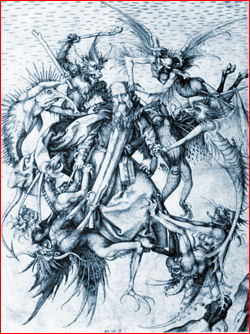
You might find another way to say it; I'm not sure it'd be better. But that's what the comments are for.


23 June 2009

What prayer is and isn't [requested classic re-post]

by Dan Phillips

[From September of 2006 comes this (slightly-edited) post, requested by Jude (who also caught my attention with a string of non-top-40 Chicago titles off of their third album). The post swings a Louisville slugger at a couple of evangelidom's most treasured traditional fictions, as both part of the original meta and a couple of attempted rebuttals on other blogs attest. Enjoy. Or whatever verb fits.]

The minefield that is prayer. I can't offhand think of one specific doctrine which is more tradition-laden, nor buried under sentimentality, than that of prayer.

For that very reason, it's a risky topic. Step in any direction, and you land on someone's toes. Worse, diverge from the "party line," and it's as if you're insulting Mom. Only a fool, or someone with nothing to lose, would knowingly poke a stick at that particular venerated bovine. (Say... why are you looking at me like that?)

Christianoid notions. Common Christian coinage describes prayer as a conversation, declares that "there is power in prayer," makes prayer out to be the be-all and end-all of Christian living. Prayer is "the greatest power on earth," we're told. Is this Scriptural thinking?

Think of Frank Peretti's Darkness books. I read one or two. I thought them imaginative and fast-moving, but neither great theology nor great literature.

In his imagination, Peretti pulls the curtain aside on the spiritual battle that Scripture describes. He shows demons and angels alike in action, fabricates their dialogue, fantasizes their attempts to ruin or protect human beings.

Here's what sticks in my mind. What do you suppose strikes terror into Peretti's demons? When does everything start to turn around, for the demons' defeat and the saints' victory? It's when the saints pray. Nothing scares fallen angels, apparently, like praying Christians.

Now, it strikes me that all of this is backwards at worst, sideways at best.

Biblical teaching. What is prayer, in the Bible? It's one thing, and one thing only: prayer is talking to God. Period. That's it.

Prayer might be talking-to-God in the form of praise, petition, confession, supplication, exclamation, or a host of other forms. It might be talking to God while happy (Psalm 43:4), sad (Psalm 42:9), mad (Psalm 10:15), hurried (Nehemiah 2:4), guilty (Psalm 51:1), busy and distracted (Nehemiah 4:9), or near death (Acts 7:59-60). But it all boils down to that one irreducible: prayer is what you say to God.

No arguments so far? Great. Now fasten your seatbelts, and consider this:
  • Prayer is not a dialogue.
  • Prayer is not a conversation.
  • Prayer has no intrinsic power, whatever.
"What?! Heresy! Get the comfy chair!"

Oh? Fine: show me from the Bible. In the Bible, what I say to God is prayer, what He says to me is revelation, it is prophecy. If I am a Christian, I talk to Him. If He talks directly to me, unmediated, so that I can inerrantly communicate that to others, I am a prophet, or a seer.

And I'm neither; nor are you.

Scripture constantly urges believers to pray, in both covenants (Psalm 32:6; 72:15; 1 Thessalonians 5:17; 1 Timothy 2:1f., etc.).

By contrast, Scripture never urges believers to pray and then wait for God to speak back in that prayer, expecting (demanding?) that God engage us in conversation as a regular facet of normal Christian living. (I am using "conversation" in the strict sense: I speak, then God talks back, unmediated, verbally. "How's your day?" "Oh, fine, thanks. Yours?"). Scripture never directs us to an Eastern-style emptying of the mind and listening in and to the numinous silence, for an imaginary "still, small," never-promised "voice" of God.

Prayer, if you will, is depressing the button on the walkie-talkie, and talking. No more, no less. It has been described as a soldier in the field calling for supplies and reinforcements, and that's not bad. Prayer is you, talking.

Now, if you want to hear God speak to you, go to His Word in faith, and He will (Proverbs 6:20-23; Hebrews 3:7ff.; 2 Peter 1:19-21, etc.).

Not only is prayer not the be-all and end-all; in fact, sometimes it is positively wrong to pray.

What? More heresy? Where's that chair?!

Except it isn't heresy if your Bible contains Proverbs 28:9, which reads "He who turns away his ear from listening to the law, Even his prayer is an abomination" (NAS). Such prayer is appalling to God. It (so to speak) turns His stomach, when someone turns a deaf ear to His voice in Scripture, but expects God to hear him rattling off his "honey-do" (or "Deity-do") list of requests.

Nor is it heresy if your Bible still features the devastatingly wondrous first chapter of Isaiah, where we read in verse 15, "When you spread out your hands, I will hide my eyes from you; even though you make many prayers, I will not listen; your hands are full of blood." (Remind me sometime to tell you what I think of the National Day of Prayer. Or maybe you can guess. [A few years later, I did.]

What does this mean? It means that sometimes, when someone says "I'll pray about that," the most Biblical response is, "No, please — don't pray. Don't bother. You'll only make it worse." In such cases as these, the only appropriate prayer would be a prayer of broken, heartfelt repentance and confession (Psalms 32; 51; 1 John 1:9).

Now, wonderful things can happen in response to prayer. When prayer is expressive of a relationship with God, and in accord with God's will as revealed in the Bible alone, prayer can accomplish much (James 5:16; 1 John 5:14). But of course, in these cases, the prayer itself is of no power, whatever. It is the God who hears prayer — He is the powerful one.

Think about it. When the bully is beating you up, and all you can choke out is "Dad!" What is it that dooms your tormentor? Is it the power of your word, your cry for help, your "prayer"?

Or is it the big, angry man who loves you, hears your voice, and comes running?

So is it prayer per se that really strikes terror into demons' hearts in this spiritual battle of ours? I do read some detail about the armor of God, crafted in Heaven to equip us for that battle (Ephesians 6:10ff.). I do read somewhere around there of prayer, and I do read of a weapon.

One weapon.

But the weapon isn't prayer (Ephesians 6:18). Prayer is just us talking to God. Our words are without intrinsic power. I don't think that us talking, per se, scares demons. In fact, I'm pretty sure that sometimes it positively cracks them up.

The weapon is the sword of the Spirit, which is the Word of God (Ephesians 6:17). God's Word sent Satan running from our Lord (Matthew 4). It will do the same for us.

Now, there are some words with power (Psalm 33:6, 9; Jeremiah 23:29; Hebrews 4:12)! Read, them, study them, believe them, embrace them, glory in them, live them — and use them in prayer.

That would result in some quaking, shaking, and glory.

Dan Phillips's signature