21 November 2014

Some here, some there — November 21, 2014

by Dan Phillips

Here's the first burst. I'll start some major adds after my Bible etc. reading, so check back. Priorities!

  • I go to Doug Wilson's site daily. But it may be a week, two or three, before something grabs me. Then when Doug's in the ten-ring, he is just In. The. Ten. Ring. Like this brilliant takedown of Greg Boyd.
  • Friends don't let friends indulge their revulsion against God's sovereignty. See Pinnock. See Boyd. See a host of others.
  • It often seems to be the case that when Doug is brilliant, he's brilliant by clusters. So the above was followed soon thereafter by Remanded to Sensitivity Camps, which is, well, brilliant. It's a thought from the same seedbed as this post, which even Challies admitted seeing.
  • Which makes it hard not also to recall:
  • Pause to reflect on the commentary that subsequent history added to both Tweets.
  • Now, to be fair: if anyone knows of any retractions and apologies — which is to say, any welcome deviations from PA#2 — let me know so that I can share.
  • Not related, and not theological, but still fairly awesome.
  • To us:
  • To the Pope:
  • In between? Don't know.
  • Used to be that Multnomah Press was a sure sign of Biblically-faithful Christian books. No longer. But in a rarity, the publisher is splitting into two labels, to deal with conservative titles and those that aren't so much. They're being up-front with buyers, that some of their titles are going away from Biblical fidelity. You know, just like Eerdmans, Baker, and Zondervan didn't.
  • Remember how Houston's lesbian mayor Annise Parker was seeking sermons and correspondence from some local pastors touching on homosexuality, her conduct in office, related matters? Remember how her legal team launched it, she doubled down, then she retracted? Turns out it seems to be ongoing.

Dan Phillips's signature


20 November 2014

"Remember Lot's Wife"

by Phil Johnson


From 2006 to 2012, PyroManiacs turned out almost-daily updates from the Post-Evangelical wasteland -- usually to the fear and loathing of more-polite and more-irenic bloggers and readers. The results lurk in the archives of this blog in spite of the hope of many that Google will "accidentally" swallow these words and pictures whole.

This feature enters the murky depths of the archives to fish out the classic hits from the golden age of internet drubbings.


The following excerpt was written by Phil back in November 2011. Phil used the account of Lot's wife to remind us of the dangers and consequences of "loving the world."


As usual, the comments are closed.
Lot began his career as a tent-dweller like Abraham. But after he parted from his uncle, Genesis 13:12 says "he pitched his tent toward Sodom." Soon he moved into the city and became comfortable there.

In fact, Lot apparently became a man of some importance in the community, because Genesis 19:1 says "Lot was sitting in the gate of Sodom"—which tells us that he ultimately became a kind of civic official there. To have a claim on that place, you had to be someone of importance, recognized by everyone in the city.

As much as he may have enjoyed the comforts of city life, he never felt at home in Sodom. Peter tells us Lot's righteous soul was vexed every day by the wickedness of that city's rampant perversions (2 Peter 2:7-8). No matter how settled Lot became in Sodom, his heart was never at home in that city. He never came to love the debauchery and evil indulgences that characterized that place.

Mrs. Lot was different. She was attached to Sodom. If that city was not her home when Lot married her, it became her home in every sense. She grew to love to the place. No matter how evil it was, she did not want to leave. She probably loved being the wife of a prominent person in such a sophisticated, morally liberated city. There is no suggestion that her soul was vexed by the wickedness there.

First John 2:15 says, "Do not love the world or the things in the world. If anyone loves the world, the love of the Father is not in him." That was precisely the thing that caused Mrs. Lot's downfall. She loved Sodom.

Why did she love that evil place so much? Because the love of the Father was not in her. Her values were worldly values. The things she loved were worldly things. She was a friend of the world, and therefore she was an enemy of God. And when faced with the necessity of fleeing a world that was perishing, with the way of divine deliverance open before her, she could not tear herself away from what she really loved.

Here is the danger of such a wayward love: First John 2 goes on to say, "For all that is in the world—the desires of the flesh and the desires of the eyes and pride in possessions—is not from the Father but is from the world. And the world is passing away along with its desires, but whoever does the will of God abides forever."

You can think about it like this: you will spend eternity with whatever you truly love the most. If your heart is fixed on the things of the Lord; if you love righteousness; if you find your sweetest joy in fellowship with Him, that's where you will be throughout eternity. But if your affections are set on the things of this world, if what really delights you the most is the things that are passing away—if your life is characterized by the lust of the eyes, the lust of the flesh, and the boastful pride of life—then like Lot's wife you will perish in the destruction of all that you truly love.

19 November 2014

Pitting Holiness against Holiness

by The Late Frank Turk

As most of you know, I spent most of my childhood reading comic books in the peace and quiet of my room.  On one of those days, my youngest brother came in looking for some affection from his older brother who had his head in a comic book, and the lad innocently asked, "Frank: Who would win in a fight - the Hulk, or Captain America?"

Now: of course Cap would win in a fight, but that is not the point of this brief blog post.  The point is to look with some bewilderment at the question "Which is better: Justification or Sanctification?"

Some of you right now are recognizing that this post is reworked from another one which can't be found anymore on the internet, but I thought the matter was good enough to bring it back from oblivion.  Why? Because the point of theology is not to pit holinesss against holiness to see which one will win -- or whether one or the other is made less for its lack of victory.

Paul, to avoid that sort of untoward dismay, put it this way to good Timothy: "As I besought thee to abide still at Ephesus, when I went into Macedonia, that thou mightest charge some that they teach no other doctrine, Neither give heed to fables and endless genealogies, which minister questions, rather than godly edifying which is in faith: so do. Now the end of the commandment is charity out of a pure heart, and of a good conscience, and of faith unfeigned: From which some having swerved have turned aside unto vain jangling; Desiring to be teachers of the law; understanding neither what they say, nor whereof they affirm."  In Paul's view, it was not a question of whether justification was better than sanctification: rather, it was that justification created sanctification, and those who were teaching and doing otherwise were jangling in vain.

Of course Jesus comes first; of course we are nothing but sinful wretches without him; of course good works do not save us and we have no confidence in them for that.  But for us to say that the good works are therefore not "better" than that which makes them possible seems to forget that we are justified for the sake of doing good works, or as Paul also said, "For we are his workmanship, created in Christ Jesus unto good works, which God hath before ordained that we should walk in them."

When my brother asked me if a Gamma-Ray mutant could smash the Sentinel of Liberty, he was asking me a question to show how much he knew about something I definitely loved.  He was trying to connect with me over something which should be some common ground -- and at 5 years old, he didn't realize it wasn't the smashing which we both enjoyed most of all.  There's something like that going on here.  I think those of us who are in various stages of reformed intoxication ought to be careful of it. We should be much more worried that we have idolized one kind of holiness in such a way that it has dismantled and buried another kind of holiness which God says is part of the total package.  It leads us to say things like, "my sanctification is more imaged than real," which is an explicit denial of WCF XVI.2 and XVI.3 -- not to mention the letter of James and the last half of the letter to the Galatians.

While we may affectionately ask the question which is "better" in order to establish our bona fides amongst ourselves, the truth is that somehow the thing which ought to be caused is the way we do the things God expects us to do -- and it causes the ordinary grace God has ordained in this world which shows the lost who God really is.

We certainly have an invisible and invincible holiness, but if it doesn't cause a holiness which the world sees and is conflicted over -- that is, one with a beauty it cannot deny, but also it cannot resist hating -- what kind of holiness is that?

This brings to mind another personal anecdote.  When my son was a baby, he was of course the most precious and fantastic child ever born (until his sister was born, at which time I was overcome by the number of perfect children God had given me and my wife) -- but he was also quite perplexed by vocabulary.  For example, every kind of non-vegetable was called "chicken".  And in this state of minimalistic linguistic development, he was frequently out of words for what he meant to say or what he wanted to say -- so much so that he quickly mastered one phrase with gusto: "I! CAN'T! DO! IT!"

This occurred to me recently as he went on a ministry trip with his youth pastor and some of his guys to the local juvenile detention center to share the Gospel with some of the fellows there.  As we debriefed on the way home, my dear lad was telling me of this young fellow he spoke with who said he accepted Jesus, but wasn't sure that he was ready to turn away from sin.  This young fellow confided to my son, "I guess I just have to do better."

My boy had been waiting for more than 15 years to say this to a person for a theological reason, and he was quite proud to tell me that his response to this incarcerated fellow was, "But you! can't! do it!"

Which, of course, sounds a lot like reformed theology -- or at least one kind of reformed theology.  Of course nobody over here affirms that we do anything for justification, or denies that even the regeneration necessary to receive justification is God's work.  But sometimes (as we visited above) we get it in our heads that because we cannot earn justification, justification is better than sanctification, and that somehow being holy ought to cause us to be unburdened by actually being holy.  Because that fellow in prison thought that his participation in the holiness God gives to those who are in Christ is optional, or some kind of hobby, he sounds suspiciously like someone who says something like, "I am so thankful for my right standing with God because, after all, my sanctification is more imagined than real. But my justification is more real than imagined."

Compare that to Spurgeon's recent tweet in the same vein:


Spurgeon doesn't say his sanctification is mostly imaginary: he says that sin becomes more obvious and our grief over it increases as we draw nearer to God.  Paul, the greatest of sinners (he says), doesn't for a moment doubt he is not yet perfect -- but he also doesn't see that as a ground for saying that his justification is somehow better than his sanctification (or vice versa).  It seems to me that the same fellow who wrote 1Tim 1:15 also wrote 1Cor 11:1a.  For Paul, it's not a question of which is better -- one adorns the other, and one causes or draws out the other.  They are both necessary, and one is not a Christian without both.

So as my boy and I discussed this fellow in prison who is not ready to "try harder," we didn't discuss the fantastic irony and religious metaphor he found.  We discussed the idea that while we don't do a thing to be saved by God -- the saving is all of God -- saved people have something right now to show for this salvation.  We aren't pitting an eternal decree of holiness against an immediate inclination toward holy deeds, or shouldn't be anyway.  We are glorifying God, and enjoying him for ever, starting right now.


18 November 2014

Here, let me help you help yourself

by Dan Phillips

First: We get inquiries all the time like "What is an RPB?" and "Have you written on ____?" I'm here to help you with that.

We know readers (surely!) don't expect us to drop everything and do their searching for them, or re-write what we've already put out in public. But perhaps they lack some skills for finding the information they're after fairly easily, themselves.

Here's the easiest way to do it, as simply as I can put it. Let's say you're asking "What's an RPB?"
  1. Go to Google.
  2. In the Search field, type RPB site:teampyro.blogspot.com.
  3. Click on the Google Search button, and voila! there's your answer.
You can use that formula for any other word or topic. Just substitute prophecy or schmerodactyl whatever for RPB in the example, above.

If you're using Chrome, it's even easier. If the address field above doesn't already say teampyro.blogspot.com, then just click on our banner at the top and it will. Then stick in RPB site: to the left of the address, and do your search from there.

In either case, Google will search for the word or words you type to the left of "site." If you want to search for an exact phrase, put it in quotation-marks, like so:

"leaky canon" site:teampyro.blogspot.com

Second: We also get, "Do you have an email address?"

Well, of course we do. And they're public-knowledge.

Click on our names in the side-column. Frank's takes you to a page that lists an email address. Mine takes you to my personal blog where, in the side column, you'll actually see a link that says "My profile, email, the whole nine." Which is kind of a giveaway

This is partly to help you, and partly to save Frank and myself time, so...

You're welcome!

Dan Phillips's signature


16 November 2014

Your creed must bend to the Bible

Your weekly dose of Spurgeon
The PyroManiacs devote some space each weekend to highlights from the lifetime of works from the Prince of Preachers, Charles Haddon Spurgeon.  The following excerpt is from Words of Counsel, pages 35-36. Pilgrim Publications.
The path of obedience is generally a middle path. “Turn not from it, to the right hand or to the left.”


There is sure to be a right hand, there is sure to be a left hand, and both are probably wrong. There will be extremes on either side. I believe that this is true in ten thousand things in ordinary life, and also true, in spiritual things in very many respects.

The path of truth in doctrine is generally a middle one. There are certain tremendous truths, such as divine sovereignty, the doctrine of election, covenant transactions, and so forth; and some men cast such a loving eye upon these truths that they desire to be, and are, quite blind to all other truths besides.

These great and precious doctrines take up the whole field of their vision, and another and equally valuable part of God’s Word is either left unread, or else twisted round into some supposed reconciliation with the first-named truths.

Then, again, there are others who think much of man. They have deep sympathy with the human race. They see man’s sin and ruin, and they are much charmed with the mercy of God and the invitations of the gospel which are given to sinners, and they become so entranced with these truths in connection with the responsibility of man, and man’s free agency, that they will see nothing else, and declare all other doctrines, except these, to be delusions.

If they admit the doctrines of grace to be true, they think them valueless, but they generally consider them to be untrue altogether.

It seems to me that the path of truth is to believe them both; to hold firmly that salvation is by grace, and to hold with equal firmness that the ruin of any man is wholly and entirely his own fault; to maintain the sovereignty of God, and to hold the responsibility of man also; to believe in the free agency of both God and man; neither to dishonour God by making Him a lacquey to His creatures’ will, nor, on the other hand, to rid man of all responsibility, by making him to be a mere log or a machine.

Take all that is in the Bible to be true. Never be afraid of any text that is written by the sacred pen. When you turn the pages over, I do hope you never feel as if you wish that any verse could be altered. I trust you never desire that any text might be amended so as to read a little more Calvinistic, or a little more like the teaching of Arminius.

Always stand to it that your creed must bend to the Bible, and not the Bible to your creed, and dare to be a little inconsistent with yourselves, if need be, sooner than be inconsistent with God’s revealed truth.


15 November 2014

Annual Turkey Recipe

By Frank Turk

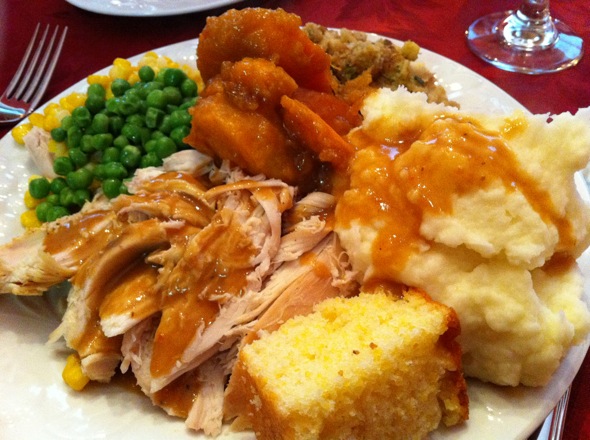
Just a picture from the Internet
I'm trying to escape the tradition of posting this too late for you to use it, so I'm tossing it up as a weekend extra.  For those who are opposed to Turkey, it also works great on Chicken.  It makes utterly-lousy Pizza.

You do not have to be "truly reformed" to use this recipe. You just have to like Turkey and stuffing.

Roasting a turkey isn't as hard as it sounds. Here's a basic recipe to get you started. In this case, the turkey is stuffed. DO NOT stuff the turkey and put it in the fridge overnight: that's bacteriologically a bad idea, and we want you all to enjoy Thanksgiving on the sofa, not on a hospital gurney.

Ingredients:

12- to 14-lb. turkey, thawed if purchased frozen
1 bag, your favorite "Italian" croutons
2-4 bouillon cubes
2-3 stalks, celery, chopper or cubed
1 cup carrots, chopped
½ cup onions, finely chopped
1 tsp, dried parsley
1 cup, cashews
Pepper and Garlic Salt

STEPS:
  1. Preheat your oven to 325. Remove the cooking racks, then place one rack into oven at the lowest position.
  2. Unwrap your THAWED Turkey in a clean sink, and remove the giblets – that bag of stuff that you never thought you would use for anything because it looks gross. It's not gross. You may have to unhook the metal clip which holds the legs together in order to get all the giblets out; you may have to run some warm water into the bird to get the giblets out. Don't be afraid.
  3. Start a medium-sized pot of water boiling – not more than 3 cups. Put your packet of giblets in the water (sans wrapping paper), along with your bouillon cubes and the carrots, celery and parlsey. 2 cubes will make a somewhat-mild flavored stuffing; 6 will make a very salty and spicy stuffing. You know what you like best, so add the cubes to the low end of your tolerance for spicy. For your reference, I usually use 4 cubes. Boil this mix for about 30 minutes – long enough to cook the giblets thoroughly.
  4. While the soup (yes: you very smart readers knew that we were making soup, didn't you?) is cooking, wash the Turkey thoroughly, inside and out. I wouldn't use soap as you might miss a spot in the rinse and ruin your hours of hard work here, but washing the bird is an important health safety tip. If we were deep frying the bird (that's the Christmas recipe), washing is pretty much unimportant because if some germ can survive the deep fryer, it will kill you before you eat any of the dinner. Anyway, clean the bird thoroughly and put it in a large roasting pan. For this recipe, the deeper the roasting pan, the better. I suggest a large disposable roasting pan from WAL*MART even though it might possibly ring up at the wrong price.

    If you get bored waiting for the soup to finish up, this would be a good time to rub salt and pepper into the skin of your bird. Visually, salt and pepper the skin so that it looks like very light TV static. Do the top (the breast side) and the bottom (where the shoulders are); do not worry if you put less on the breast side. Because of the way this bird is going to cook, pay special attention to salting and peppering the wings and drumsticks.
  5. You now have a clean, prepped bird and a very delicious-smelling pot of soup. You have to make stuffing now. Remove the soup from the heat and remove the giblets. If you are a complete carnivore (like me), take the fully-cooked giblets to your food chopper and chop them up and put them back into the soup (you can't chop up the neck, but if you have 20 minutes, de-bone the neck and put your neck meat into the soup).

    Those of you grossed out by chopping up the giblets can throw them away. The rest of us will weep for you.

    Now empty the bag of croutons into the soup. If you used about 2 cups of water, you will get a somewhat-damp bread-and-soup mixture; if you used about 3 cups of water, you will get a very wet bread-and-soup mixture. I like the latter better, but some people like their stuffing more dry than others. The extraordinary secret here is that a soupier stuffing makes for a more-moist bird in the final product. After the soup and the bread are well- mixed, add the cashews and mix again.
  6. When you have this mixing complete, use a tablespoon and start loading the stuffing into the bird. Pack the stuffing down into the bird to get the cavity of the body completely full of stuffing. Don't leave any air pockets. Once the Turkey is completely stuffed, position it in the roasting tray breast-side down (I learned that from watching Emeril) in the center of the pan, and load the pan with the rest of your stuffing mix.
  7. Cover the Turkey, and place it inside your oven. After 2 hours in the heat, remove the cover and roast for another hour. In this final hour, the skin of the exposed parts should turn golden brown. At the end of the third hour, test the bird with a meat thermometer; the center temperature should be 175-180 degrees F. It will be the most unbelievable bird you every ate.

14 November 2014

John Piper and Mark Driscoll: lessons not learned?

by Dan Phillips

NOTE: this week's SHST is pushed aside by a recent turn of events. To wit:

A recent "Ask Pastor John" segment is titled "Do You Regret Partnering with Mark Driscoll?" An answer to that question could have been very helpful. However, once the question is asked, the word "partnering" never recurs. Piper instead poses and answers a question of his own: "Do you regret befriending Mark Driscoll?"

I don't doubt that question was more appealing. Low-hanging fruit always is. However, it is is a question I've heard no one ask. I asked my Tweeps if anyone had heard that question asked, and no one had. (I also offered some other thoughtlets on Twitter: here, here.)

"John Piper has no regret for befriending Mark Driscoll," Piper said Bob-Dole-ically, answering the question he alone asked himself. Piper did go on to admit that he regrets not being a more effective friend. But then Piper somewhat undoes that admission, by saying that Mark knew he had flaws of leadership attitude, unsavory language, exegetical errors, and that Mark knew Piper knew. Piper says he always hoped the relationship would be redemptive and helpful. So it's really Driscoll's fault. Which, of course, ultimately is true...and, once again, was not the question.

Then, somewhat oddly, Piper stressed that Driscoll gave Piper a lot of time and counsel and "guidance." Driscoll gave guidance to Piper and his elders. "He certainly gave me more time and counsel than I deserved." Oh? What is this? Taken seriously, this rather subverts the perception that Piper was an elder brother taking Driscoll under his wing to sober, mature, guide and mentor the famously loose-cannon leaky-Canoneer. Instead, Piper depicts them as equals, giving and receiving counsel to each other.

Would that make Piper still less responsible for the direction Driscoll took? Is that the intent?

But this is all wide of the mark (no pun intended). The issue is that Piper had, as far as I know, a well-earned stellar reputation. He was regarded as a sagacious elder statesman. He lit the fires of devotion to God, delight in God, open celebration of God's sovereignty. He did and represented much that is really great and good. I myself have often admitted with enthusiasm (and do so again, here) that Piper's writings have done me great good, particularly Future Grace.

So when Piper extended his embrace to Mark Driscoll, all that gravitas and bona fides was added to Driscoll's resume. Driscoll had been "the cussing pastor" and all; now he was "John Piper's protegee," "John Piper's partner." When anyone started to express misgivings about Driscoll, he might hear the response, "But John Piper embraces him. Piper's working with him. Driscoll must be OK." Driscoll himself had that card to play, as needed.

Good men cautioned Piper privately and publicly, warned him, begged him to reconsider what he was doing. But Piper resolutely brushed them all aside and stayed the course. And so has Driscoll.

So now where are we? We are exactly where Piper's friends warned him he'd be. Driscoll has come to a sad place, yet remains defiant and undaunted, and it's Piper who has to explain their connection.

But Piper still doesn't seem to take it all that seriously.

In a way, Piper seems to ackonwlege that things are sort of bad now, though for unspecified reasons. Piper says he sees why Driscoll's books might be off of shelves temporarily. Yet he also immediately goes on to say he sees a day when they could be replaced and stand on their own merit. Which underscores something I'm going to say, below, about "echo-chamber":

Before we leave that paragraph, Piper says, "If he is disqualified from being an elder should he still exercise the teaching office of an elder through his books?" "If"? Is he, or isn't he? Driscoll himself insists that he is not disqualified. His hand-picked committee that was supposed to be counseling him insists that "we do not believe him to be disqualified from pastoral ministry." Is Piper saying differently? If so, he is not saying it very clearly.

Despite all that publicly known information, what Piper does say clearly is that he has "no regret." Hear Piper:
John Piper has no regret for befriending Mark Driscoll, going to Mark Driscoll’s church and speaking at his events, or having him come to the Desiring God conference. I do not regret that.
Instead, Piper sees himself as in a position to issue lessons that he says he has learned, and which he says we should all take from the whole affair. Having admitted no errors in judgment, and detailing nothing specific that he would do differently, he's ready to bid adieu to the whole thing, it appears, with this list. Here it is, and I shall add my own brief thoughts in brackets:
  1. People are very complex. Some of our sins are hidden to ourselves. [Amen. But I didn't need this, to know that; and all the harm that has been done was not necessary for this point to be made.]
  2. We need to take very seriously what wise counselors tell us about ourselves. [Ironic. The advice of wise counselors to Piper himself that he should distance himself from Driscoll, or be more public in his rebukes, apparently is excepted.]
  3. Sometimes you can see what others are saying about yourself, sometimes you can't. If you see it, you repent and fight the sin. But if you can't? What then? You have to go with what you see, or you'd be hopping to everybody's varying opinion, something neither Paul nor Jesus did. Says Mark stood down instead of a fight (implying he did the right thing). [This paints Driscoll's stepping down as a noble act, given Driscoll's inability to get what his critics are saying. Putting it mildly, I do not see it that way.]
  4. Biblical leadership structures are not luxuries. [Amen. Yet Driscoll was unwilling to follow the counsel even of his hand-restructured structure.]
  5. Salaries shouldn't be huge. Corporate mindset, beware. [Like a pastor seeing himself as "the brand"?]
  6. Same theology on paper can coexist with very different personalities and leadership styles and sins. No theology on paper or merely in preaching that keeps a man from sin. See Peter — what he did in Galatia had nothing to do with his theology. Peter and those who erred with him believed the truth, but did not walk in step with it. [Amen.]
  7. God's kingdom and his saving purposes never depend on one man, church, denomination. His word is not bound. [Amen, and thank God. But is it not also true that "one sinner destroys much good" (Ecclesiastes 9:18)?]
  8. Let him who is thinks that he stands take heed lest he fall; restore such a one. For Mark's detractors to sniff "Good riddance" is sin and un-Biblical.  Renew and restore all, including Mark. [Already? It's time to talk about restoring Driscoll, already? To what? After what process? After assuring ourselves of what, and how? Should repentance play a part in restoration? Shouldn't we be talking about what repentance looks like (— like this, and this, and this, and this) before moving on to restoration?]
I'm not reassured to see that Piper thinks these are the main lessons he should learn from this. He did not already know these things? If not, what would he have done differently, knowing them?

Here are the lessons I'd like to suggest might be more helpful to learn from this. Were I someone whose judgment meant anything to John Piper, I'd be putting this before him:
  1. To whom much given, from him much is required (Lk. 12:48; Jas. 3:1). Piper should have been much, much slower to extend his good reputation to someone with such a genuine and palpable cloud around him (1 Ti. 5:22, 24). Piper made a mistake. I have no trouble believing that it was good-hearted and well-intentioned, but it was a mistake. I think it he should own it, not double-down about it. That would serve him and the church better.
  2. To turn a deaf ear to wise and godly counsel, as Piper did, is not wise (Pro. 11:14; 12:15; 15:22; 26:12).
  3. Widen your circle and get out of your bubble. The echo-chamber clearly did not get the word through to Piper. They did not serve him well. So I'll just say it, and take the hate that will come: what if Piper had read Pyro? What if he'd really thought about what (for instance) Phil Johnson was writing, years ago? What if Piper were to say, "Someone pointed me to this blog nobody'd ever told me of, it's called Pyromaniacs. Years ago, Phil Johnson and others warned that exactly this would happen. I wish I'd been reading and listening; I've learned I need to widen my circle among those sharing my core convictions but seeing things differently. I regret that I didn't do that then, and urge others not to repeat my mistake." Would that be constructive, specific, and perhaps admonitory to others who keep making the same sorts of errors?
  4. Re-think your enabling of Charismaticism. And then withdraw it. If you had read this (and additional comments like this and this), and had thought it through, you would have seen. Please, please consider what I am about to say very slowly and very seriously: there is a very short and straight line between (A) thinking God tells you stuff He tells no one else, yet (B) taking no responsibility and accepting no consequences for your claims to such revelation, and (C) abusive, egotistic, narcissistic, damaging leadership. History's told many such tales, and you just witnessed another firsthand. With such rotten fruit, shouldn't the tree be reassessed?
  5. Force yourself to admit the extent of the damage caused.
I don't begrudge Piper's befriending Driscoll, for my part. I have been befriended by men much, much, much better than I. Thank God for them. I feel like they're all slumming, having me for a friend. So what I do is (A) I try to learn all I can from them, and (B) I try not to make them regret their friendship.

So what I am sad about is Driscoll abusing the friendship Piper extended. And what I particularly regret is that Piper simply is not admitting the extent of the bad public decisions he made, the damage that resulted, and the utter preventability of the whole thing.

Which simply assures more iterations. And does nothing to correct the specific situation we're discussing.

Thus endeth the post that, of all my many posts, I probably most hated having to write. I hope it does someone some good, for the sake of Christ's name and church.


Dan Phillips's signature


13 November 2014

How God defines humility and arrogance

by Dan Phillips


From 2006 to 2012, PyroManiacs turned out almost-daily updates from the Post-Evangelical wasteland -- usually to the fear and loathing of more-polite and more-irenic bloggers and readers. The results lurk in the archives of this blog in spite of the hope of many that Google will "accidentally" swallow these words and pictures whole.

This feature enters the murky depths of the archives to fish out the classic hits from the golden age of internet drubbings.


The following excerpt was written by DJP back in February 2010. Dan reminded us of Scripture's definitions for both terms.


As usual, the comments are closed.
The stance of the Word on this matter is plain and univocal, more than one post can do justice. But we'll give it a whack.

Let's start by way of Hebrews 11. We all know that the men and women in that chapter were flawed, yet they are held up as examples. In what way are they examples? In their weakness and vacillation? Not at all, but "by [faith] the people of old received their commendation" (v. 2).

Again and again, the writer focuses on the faith that motivated the believers of old, and describes them as those "who through faith conquered kingdoms, enforced justice, obtained promises, stopped the mouths of lions,  quenched the power of fire, escaped the edge of the sword, were made strong out of weakness, became mighty in war, put foreign armies to flight" (vv. 33-34). It was as they were nerved, strengthened, and moved to action by resolute faith that they served as models.

So cast your mind back to Psalm 1. You know the characteristic of the blessed man: rather than join in the walk and worldview of the wicked, he delights in and dwells on God's Word. To what does God liken him? To a tree, transplanted by streams of water (v. 3).

Think of trees. They're boring! They just stand there. And stand there, and stand there, and stand there. Imperceptibly, yet steadily, they grow and bear fruit — but their characteristics are (1) life, (2) fruitfulness, and (3) a certain immobility.

Much more exciting is the chaff. Watch the chaff driven by the wind: now here, now there, ever in motion, ever moving, ever dynamic — ever dead. See, that's why it's so mobile. It has no roots, no life, and no future (vv. 4-5).

Three times in Psalm 119 (Psalm 119:21; Psalm 119:51; Psalm 119:85) we see the insolent, who are arrogant and presumptuous. What characterizes them? God's word is not enough for them. They wander from God's commandments, they turn away from His law, they do not live according to His revelation.

And there is the soul of pride: God has spoken, but it is not convicting, not compelling, not enough.

Thus it ever was. Satan started right there: the conversation-starting open inquiry "Did God really say?" soon led to "God was wrong."

Very little has changed. When you hear A, start looking for B.

The believing perspective is the opposite. The believer is the one who finds God's word utterly sufficient, and utterly compelling. "The lion has roared; who will not fear? The Lord GOD has spoken; who can but prophesy?" (Amos 3:8).

It is interesting that this stance will infuriate compromised ditherers not content to take the minority position. The psalmist notes, "The insolent smear me with lies, but with my whole heart I keep your precepts" (Psalm 119:69). Desperate to shush their throbbing conscience or quiet the fears of God's judgment, they must slander those whose example stings them.

God's stance is very plain. He in no way calls dithery, compromising instability "humility." In fact, listen to what He does so categorize: "But this is the one to whom I will look: he who is humble and contrite in spirit and trembles at my word" (Isaiah 66 2b).

So, in sum:

The soul of humility is to seek a clear word from God, and respond with "Amen" — that is, to find it, and stand on it without compromise or apology. It is about God and His glory.

The soul of arrogance is to take a clear word of God, and respond with "Has God really said?" — that is, to put energies into defending compromise, dithering, uncertainty, unbelief. It is about man and his straying.

God grant us true humility as He defines humility.

12 November 2014

My Last Post on Race

by The Late Frank Turk

Since coming back from Hiatus, I have laid down a lot of self-imposed blogging limits.  No more Mark Driscoll posts.  No posts which wouldn't serve as Sunday School material.  No more Global Warming posts, no more political posts (those two I haven't made much of, but note it).  No more posts about TGC.  It seems like all the things you might expect from a menace who must be stopped is ending, and the show is getting new writers.

Anyway, this video turned up last week:


Black and White: Learning from Ferguson Together from Desiring God on Vimeo.

And Thabiti is, frankly one of those guys I only want the best for. He seems like the most human and the most natural of the T4G luminaries, and frankly I just like him.  I like his books.  I like his blog.  Every time I see him speak to people, I like the way he treats people.  I want to actually meet him someday, but because I am also swearing off conferences which are not at my local church I think that's entirely unlikely.

Also, while I hold him in high esteem, I am still a fan of him as a public mediator on the subject of race in America.  I am 100% certain he is one of the guys who is rightly theologically moored to handle the discussion; I am also certain his personal experience has something to teach us about this issue.

Last, before I say what I have to say here, I had a private on-line conversation with him about this subject which, frankly, was not my best interpersonal moment, and while you will never see it, let me say that he was the better man in that exchange who called a brother to repent and to turn away from sin, so I also owe him a spiritual due.

I cannot say enough good about Thabiti because he's obviously full of grace and truth.

So in order to not hurt myself by now saying, "yeah but ...," I am going to offer some bullet points about this video, and this will be my final post about race and theology ever on the internet.
  • Time 0:44 - 2:44
    • While Thabiti starts by saying there is something he has learned, it's actually about something he wants other people to learn.  While I think what he says in the last 60 second of that piece of this video is interesting and useful for me personally (it's a version of this post from 2008), I think that there is something being missed in making that point.  Personally, I am 100% confident that the police have done wrong to young black men in America.  I'm not sure conflating that with the death of Michael Brown in Ferguson (which is what Thabiti does in making his point) makes this discussion better.
  • Time 2:44 - 3:12
    • The reason why we shouldn't say more about the issue in the previous 2 minutes is that Thabiti cleans it up himself.  He recognizes that there is a problem of conflation, and a problem of profiling on both sides due to (using his phases) the history between blacks and the police.  It's right of him to point it out.
  • Time 3:12 - 4:15
    • My first reaction to this segment about the center of modern civil rights leadership is, "from your lips to God's ear."  If this were also true about "white" America, I think a new and more productive dialog could take place.
  • Time 4:15 - 6:32
    • The question of the discipline of the original civil rights movement vs. the current iteration of community action is a very good one, and his point about the Christian roots of the civil rights movement in the 50's and 60's is utterly necessary.  Anyone who ignores this is missing a huge difference between what happened then and what is happening, and how it is lead, right now.
  • Time 6:32 - End
    • I think this is the weakest part of the whole video for one reason only: the side being tarred as evil (I think: unjustly) is also being lectured for somehow usurping the dignity of the other side for complaining about the injustice of the charges against them.  What I think Thabiti has meant to say here is that there's a way to mourn with those who are mourning that gives them dignity while they are mourning, and that there should be a way to distinguish between language from pain and language meant to advance the conversation.  What he has instead wound up saying, it seems to me, is that when one group lashes out in pain and labels another group "X", the group labelled "X" doesn't have any ground to object until the time of mourning is over.
That's it.  Saying more than that would be piling on.  If you want to know what I really think about race and the Gospel, go here and read all the posts.


11 November 2014

If I could change Christian vocabulary: "Closed Canon"

by Dan Phillips

I've remarked in the past that it often seems as if bad doctrines (and problematic denominations/cults) have all the best names, while orthodoxy gets stuck with negative terms. More than once, I've tried to spur a search for more positive terminology...with varying degrees of success. I've also tried to find less gauzy, more realistic descriptors for bad doctrine.

Wellsir, well ma'am, I'm back with another.

We're wont to talk about the closed Canon. By that we mean a great thing: we mean that the millennia-long process of revelation has reached its climax (Heb. 1:1-2), and no fresh revelation is being imparted.

It's a wonderfully robust truth. But the term is negative. It just says closed. No more. It doesn't mean that the process was successful or satisfactory; just that you aren't getting any more. Closed. You've gone to the pharmacy to get some medicine for your flu... but it's closed. You wanted to take your honey to your favorite restaurant... but it's closed. You wanted to register for the Sufficient Fire conference, but... well, thank God, that's not closed yet. But it will be.

See? Closed. Disappointing, dissatisfying. Final, yes; but not happy. Not gladsome connotations.

So what if in stead of "closed" we spoke of the...

Full Canon

"Full," as in "No, thanks, really, I'm stuffed. Not another bite!" As in "Everything I could possibly need." As in "Replete, well-stocked, abundantly furnished, neither room nor need for one bit more." Full.

Doesn't that describe the situation better and more truly both connotatively and denotatively? It isn't that the last apostle had a bunch he needed to say, but just expired before he could, and now the doors are closed. It isn't as if it's an inadequate product, but it's the one we've got, so we've got to make-do.

It's that God has given us everything for which we need a word from God. It's bursting with His wisdom, His mind, His heart, His direction, His instruction. It has more in it than we will ever be able to take in, process, savor, and put into practice! It has enough to make us wise to salvation (2 Tim. 3:15), and fully to equip us for every good work (2 Tim. 3:16-17)! It's full!

Which then correctly depicts the sort of person who'd try to come up with some sort of lame supplement in the light he deserves: foolish, futile, ignorant, and in the final analysis of-little-faith.

So I submit that for your mulling-over and discussion. What if we began speaking of the "full Canon" instead of the "closed Canon"? Would the newer phrase say all the older one did even better, and say more besides? Plus, it makes a nice set with another contribution of mine, "leaky Canon."

Have at it.

Dan Phillips's signature


09 November 2014

Things which cannot be shaken

Your weekly dose of Spurgeon
The PyroManiacs devote some space each weekend to highlights from the lifetime of works from the Prince of Preachers, Charles Haddon Spurgeon.  The following excerpt is from Morning and Evening, June 22, McDonald Publishing Company.
"We have many things in our possession at the present moment which can be shaken, and it ill becomes a Christian man to set much store by them, for there is nothing stable beneath these rolling skies; change is written upon all things." 

Yet, we have certain "things which cannot be shaken," and I invite you this evening to think of them, that if the things which can be shaken should all be taken away, you may derive real comfort from the things that cannot be shaken, which will remain.

Whatever your losses have been, or may be, you enjoy present salvation. You are standing at the foot of His cross, trusting alone in the merit of Jesus' precious blood, and no rise or fall of the markets can interfere with your salvation in Him; no breaking of banks, no failures and bankruptcies can touch that.

Then you are a child of God this evening. God is your Father. No change of circumstances can ever rob you of that. Although by losses brought to poverty, and stripped bare, you can say, "He is my Father still. In my Father's house are many mansions; therefore will I not be troubled."

You have another permanent blessing, namely, the love of Jesus Christ. He who is God and Man loves you with all the strength of His affectionate nature—nothing can affect that. The fig tree may not blossom, and the flocks may cease from the field, it matters not to the man who can sing, "My Beloved is mine, and I am His."

Our best portion and richest heritage we cannot lose. Whatever troubles come, let us play the man; let us show that we are not such little children as to be cast down by what may happen in this poor fleeting state of time.

Our country is Immanuel's land, our hope is above the sky, and therefore, calm as the summer's ocean; we will see the wreck of everything earthborn, and yet rejoice in the God of our salvation.

07 November 2014

Some here, some there — November 7, 2014

by Dan Phillips

Here we go:
  • The next day David Murray posted a very fine expansion of Biblical thinking about such things, which I would apply to a whole slew of daredevil things men (husbands! fathers!) sometimes do, and sometimes die doing. Yet note the appalling comments. Perhaps they came from Challies, who commendably (reportedly) saw and linked to a good article. Whatever the reason, they clearly weren't prepared for a clear-minded, unsentimental Biblical analysis of the sort of thing Americans admire — men with wives and children acting like boys to prove something and accomplish nothing, at best, or a pointless death leaving a widow and fatherless children, at worst.
  • A couple of SHSTs ago we noted the leading-evangelical-ethicist-who-no-one-has-ever-heard-of, David Gushee, who decided to go with the world's thinking on a cluster of perversions while continuing to profess some sort of Christian faith. Worse, he professes to be an evangelical — and yet sets out a way of thinking and (ironically) of ethical processing that could hardly be more opposite.
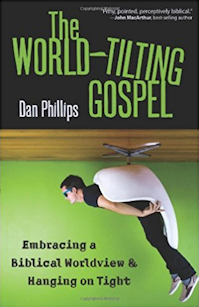
  • Aside: I will understand if it irritates anyone for me to note this, but when I read this, I think that this is exactly why I wrote TWTG. What passes for Christian conversion these days is a shallow, pale, inconsequential minor course-adjustment. It isn't the radical earthquake of total paradigm-shift that the Bible envisions, and which I try to depict at accessible length.
  • It sounds as if TWTG anticipated the line adopted in a pro-homosexual video that Rick Phillips thoroughly takes down.
  • Denny Burke responds to Gushee appositely, as usual.
  • As you know, this is one of those topics on which Michael Brown is biblically sound, which is what makes his advocacy of Charismatic error so disappointing. As if in anticipation of Gushee's dismissive piece, Brown lamented that homosexualist advocates are averse to debate. And since Gushee slams Gagnon as well, it seems fitting to link a second time to Gagnon's excellent piece responding to Gushee's defection.
  • For the moment, thanks to a ruling from the Sixth Circuit, sanity reigns on the same-sex mirage issue for Michigan, Ohio, Kentucky, and Tennessee. Even a glance at the majority opinion is like a breath of fresh air — if only a breath. (h-t Robert Sakovich)
  • I doubt I'm the only one who wishes we could hold non-threatening visitor-exit interviews. How did you decide you did not want to come back? Was it something non-negotiable, like our core convictions; was it a misunderstanding, that could have been clarified if we'd had a chance; or was it something easily-correctible that we should work on changing
  • Thom Rainer offers a list from a twitter poll listing top ten ways churches drive away first-time guests. The first two seem in conflict to me. What do you think?
  • Maybe the resolution in part is in the observation that people aren't so much looking for friendly churches as they are looking for friends?
  • That said, I still come back to my own bottom-line: if you're hungry for God, the preached word, and genuine Christian fellowship (in that order), you can work through a lot.
  • Here's a tract y'all might enjoy (h-t Sir Aaron).
  • You'll want to get this commentary on Philippians. Eventually, I'll likely review it. But I had the privilege of reading and offering comments on the manuscript, and it really is stellar.
  • Well well. The Vatican is hosting reps from many religions to talk about marriage. One of those religions is Christianity, represented by Rick Warren and Russell Moore. Would you go? (I would.)  What do you think you'd say? What do you think Rick and Russ will say?
  • Thinking of preaching or teaching through Philippians? Great idea... but I'd wait until late January...
  • You won't believe who this rapper cites as his main inspiration; at the end of the article.
Check back later for some more; but today's a Date Day. So probably not!

Dan Phillips's signature


06 November 2014

The intersection of Truth, Unity, and the Church

by Frank Turk


From 2006 to 2012, PyroManiacs turned out almost-daily updates from the Post-Evangelical wasteland -- usually to the fear and loathing of more-polite and more-irenic bloggers and readers. The results lurk in the archives of this blog in spite of the hope of many that Google will "accidentally" swallow these words and pictures whole.

This feature enters the murky depths of the archives to fish out the classic hits from the golden age of internet drubbings.


The following excerpt was written by Frank back in October 2011. Frank discussed proper and improper views of Truth and Unity within the church.


As usual, the comments are closed.
I have three pictures for you today to think about.

Figure #1


Here's a picture we might call "Unity in Truth," right?  A simple Venn diagram which puts all aspects of "Unity" as a subset of "Truth," and I think it's easy, when you see "Unity" this way, you can (and must) believe that as long as you're talking about "Unity," you must be talking about "Truth."

There are some transparent problems with this.  For example, if you start talking about having spiritual solidarity with Muslims because all Unity is a subset of Truth, you are off the rails -- because you are denying some part of what is True in order to obtain Unity. This view of Unity and Truth doesn't actually work.

So let's try another one:

Figure #2

This one eliminates the problem that the first one had by illustrating that there are some aspects of "Unity" which are actually not part of "Truth" -- but it assumes that if you are talking about "Truth" you will automatically demonstrate "Unity."  That is, all Truth is in Unity, but some Unity is outside Truth.

Hey: this is the Internet, folks.  You don't have to go very far to find contrafactual evidence for that statement.  So let's toddle over to yet another attempt to diagram the relationship between "Truth" and "Unity" in order to have a reference point mentally for what we ought to be talking about when we say something like "Unity in Truth."

Figure #3

To which all the readers say, "Aha!"

On the one hand, we have the kind of Unity which is absent from the Truth; on the other hand, we see that some kinds of Truth have nothing to do with Unity; and on the third hand we see that there is a place where we find Unity and Truth together.  This is the one which should help us visualize the relationship between Truth and Unity.

But so what?  Why break out the Gadfly color scheme and make us think using something other than words on a Friday?  Well, here's what:

Figure #3A

This is what we need to talk about.  There are probably 10,000 applications of Figure 3 -- like how to think about the "Occupy" movement, for example -- but Figure 3A here now makes us think about US for a second in a way that isn't going to be self-congratulatory.  Because the first thing we have to realize or recognize is that the church, walking around today (as it has from the day after Pentecost) really looks more like this:

Figure #4


That is: while we would love it that the Church actually is the place where Truth creates Unity and Unity reinforces Truth, we actually have some places where we are unified over the wrong things, and we are clinging to kinds of Truth in a way that harms Unity, and we also have things we do which are neither in Truth nor in Unity -- and these are, by a lot, our worst moments.  This is what the LBCF means when it says, "The purest churches under heaven are subject to mixture and error; and some have so degenerated as to become no churches of Christ, but synagogues of Satan; nevertheless Christ always hath had, and ever shall have a kingdom in this world, to the end thereof, of such as believe in him, and make profession of his name."  The Church ought to be the place where Unity and Truth intersect, but because we are talking about people here and not a bag of dimes, it's not going to be a uniform thing from the standpoint of what is and isn't inside it.

We can make a big thing of this because the church is actually tasked to be Figure #3 in spite of actually being Figure #4 -- in fact we must make a big thing of it, if we believe our Bibles as we say we do.  We make a big thing out of it because what the Confession warns us about is becoming this:


What we categorically do not want is to become so concerned with Unity that we are simply giving up on Truth for Unity.

Last thing today: this is the struggle which produced the confessions and the creeds.  This concern about how much truth needs to be present in our unity is what caused the Church (big "C") to make creeds and confessions so that the clarity of the Gospel -- the whole Gospel, and all its necessary consequences -- can be both proclaimed and received.  When we choose a path -- no matter who we are, no matter what else we have accomplished for Christ's sake in the course of out lives -- which abates the drift, above, we are doing it wrong.  We are part of the problem and not part of the solution.

05 November 2014

Election Results, 2014

by the Late Frank Turk

This is a brief note to you all about what just happened in the United States. Sorry to bore our international friends.  It is a reprint of a classic from November 2011.


There were no surprises last night, least of all to God. This seems like a really hackneyed point of God's sovereignty, but I think that those thinking that are not really thinking very hard.

See: when Barack Obama was elected president, God wasn't surprised. His plan wasn't sent into a tailspin -- not for the U.S., and not for the grand scheme to glorify himself and save people. But many of our dear friends were very undone by the election of President Obama -- and today I think we will see many of others outdone by the results from yesterday.  Some may in fact put too much confidence in those results; others will despair too much.
That doesn't mean it doesn't matter how you voted or how you should vote. What it does mean is that we cannot trust in salvation through politics. We also cannot trust in salvation through our nation.

We have to trust in a salvation which actually addresses our true danger, a salvation which saves us from what we are actually dying from. This is what God is working on.

And those are the election results we should be focused on.


04 November 2014

"Problem of evil" syllogism, reworked

by Dan Phillips

I'm sure you're all familiar with some form of this:
  1. If God is all-powerful, He can prevent evil.
  2. If God is good, He would want to prevent evil.
  3. Evil exists.
  4. Therefore, there is no God. (Or: God is either not all-powerful, or He is not good.)
But it's a loaded syllogism — well, both loaded and unloaded, if you follow my meaning. It snips a couple of Biblical truths, but holds them in isolation from everything else the Bible teaches.

A more honest version would be:
  1. If God can do anything He wishes, He could prevent evil if He wished.
  2. If God is good... I can't think of a reason why he would not prevent evil.
  3. Evil exists.
  4. Therefore... um, I don't know why God might choose to permit evil.
That's a lot more truthful, and it leaves the problem where it belongs: not on God, but on the arguer. Here's another:
  1. If God can do anything He wishes, He could prevent evil.
  2. If God is good, He would want to prevent evil.
  3. But I don't believe in God anyway, so I can't have an opinion on what "evil" is or whether it exists.
  4. Therefore, what's for dinner?
Or this:
  1. If God can do anything He wishes, He could prevent evil if He wished.
  2. If God is good, He would want to prevent evil.
  3. I have the vague feeling that the Bible says more about God than that He's almighty and good, but I just really haven't cared enough to study it out for myself.
  4. Therefore... well, nothing about the God of the Bible. But the God I made up might have issues.

Here's the best of the lot:
  1. If God can do anything He wishes, He could prevent evil if He wished.
  2. If God is good, He will not allow evil to go unpunished or reign forever.
  3. Evil exists, will be punished, and it both has been and will be dealt with permanently.
  4. Therefore, repent and believe in the Lord Jesus, or be part of that evil that will be judged and dealt with.
(I give more on the subject, here. You must admit: it's nothing if not red.)

Dan Phillips's signature


02 November 2014

How not to be disappointed

Your weekly dose of Spurgeon
The PyroManiacs devote some space each weekend to highlights from the lifetime of works from the Prince of Preachers, Charles Haddon Spurgeon.  The following excerpt is from John Ploughman's Talk, pages 66-68, Pilgrim Publications.

"He who boasts of being perfect is perfect in folly."

If we would always recollect that we live among men who are imperfect, we should not be in such a fever when we find out our friend's failings; what's rotten will rend, and cracked pots will leak. Blessed is he who expects nothing of poor flesh and blood, for he shall never be di
sappointed. The best of men are men at best, and the best wax will melt.

It is a good horse that never stumbles,
And a good wife that never grumbles.

But surely such horses and wives are only found in the fool's paradise, where dumplings grow on trees. In this wicked world the straightest timber has knots in it, and the cleanest field of wheat has its share of weeds. The most careful driver one day upsets the cart, the cleverest cook spills a little broth, and as I know to my sorrow a very decent ploughman will now and then break the plow and often make a crooked furrow. 

It is foolish to turn off a tried friend because of a failing or two, for you may get rid of a one-eyed nag and buy a blind one. Being all of us full of faults, we ought to keep two bears, and learn to bear and forbear with one another; since we all live in glass houses, we should none of us throw stones. 

Everybody laughs when the saucepan says to the kettle, "How black you are!" Other men's imperfections show us our imperfections, for one sheep is much like another; and if there's an apple in my neighbour's eye, there is no doubt one in mine. We ought to use our neighbours as mirrors to see our own faults in, and mend in ourselves what we see in them.

I have no patience with those who poke their noses into every man's house to smell out his faults, and put on magnifying glasses to discover their neighbour's flaws. Such folks had better look at home, they might see the devil where they little expected. What we wish to see, we shall see or think we see. Faults are always thick where love is thin. 

A white cow is all black if your eye chooses to make it so. If we sniff long enough at rose water, we shall find out that it has a bad smell. It would be a far more pleasant business, at least for other people, if fault-finders would turn their dogs to hunt out the good points in other folks, the game would pay better, and nobody would stand with a pitchfork to keep the huntsmen off his farm. 

As for our own faults, it would take a large slate to hold the account of them, but, thank God, we know where to take them and how to get the better of them. With all our faults, God loves us still if we are trusting in His Son. Therefore, let us not be downhearted, but hope to live and learn, and do some good service before we die.