14 August 2012

Charismatic lexicon - Part One

by Dan Phillips

In the interests of communication and instruction, and because I'm here to help, I offer this lexicon. I'm calling it Part One because (A) I'm sure there'll be more, because (B) I'm pretty sure readers will supply some great stuff that (C) I will steal, publish here, and claim as my own.

First, then: the term as used by a Biblically-oriented Christian (BibC); then the Leaky Canon Charismatic equivalent (LC2). I paint, as I must, with a broad brush... but not that broad.

BibC: Culmination of millennia of revelation in a completed, wholly sufficient and closed Canon
LC2: Whatever. (Alternate: And then that happened...)

BibC: Feeling.
LC2: The Holy Spirit.

BibC: Hunch.
LC2: The Holy Spirit.

BibC: Silly passing thought.
LC2: The Holy Spirit.

BibC: Impulse, best to be rejected after a bit of wise and critical reflection.
LC: The Holy Spirit.

BibC: Testing by Scripture and rational examination.
LC2: Unbelief.

BibC: Walking in gracious, faith-driven obedience, which definitionally and consciously rests on the written Word alone.
LC2: Deism.

BibC: Living impulsively and irresponsibly, eschewing Biblical analysis and responsible decision-making, and blaming the whole mess on God.
LC2: Moving in the Spirit.

BibC: Undocumented anecdote allegedly done in a corner thousands of miles away and transmitted through the world's longest game of "telephone."
LC2: Proof that "the gifts" continue.

BibC: The undeniable absence of substantiated and globally-accepted claims to revelatory/attesting gifts among the Biblically orthodox from the first century until 1906.
LC2: "The man behind the curtain." (Alternate: "Look! A comet!")

BibC: The undeniable fact that modern instances of substantiated and globally-accepted claims to revelatory/attesting gifts among the Biblically orthodox depends on drastic reinterpretation of Scripture and playing fast and loose with the laws of evidence.
LC: (See above)

BibC: Prophecy is an explicitly Biblically-defined phenomenon in which God gives inerrant, binding, direct revelation to someone and assures that it is communicated as such. It is objectively verifiable.
LC2: Whatever you say it is. Except not verifiable or falsifiable.

BibC: Insisting on redefining the Biblical teaching about and descriptions of revelatory and attesting gifts so as to smuggle pale imitations into a time-frame some twenty centuries after their disappearance.
LC2: Non-negotiable essentials.

BibC: Affirming the all-over-the-Bible teaching of the sovereignty of God in salvation.
LC2: Totally negotiable, relatively minor.

...and one reverse:

LC2: A divine healing that undeniably proves all charismatic claims.
BibC: Answered prayer, God healing — which all Christians have always confirmed and distinguished from the gift of healing.

UPDATE: Chris Rosebrough of Pirate Christian Radio had a lot of very creative, hysterical fun with this.

Dan Phillips's signature


12 August 2012

Falling Asleep

Your weekly dose of Spurgeon
The PyroManiacs devote some space each weekend to highlights from the lifetime of works from the Prince of Preachers, Charles Haddon Spurgeon.  The following excerpt is from The Metropolitan Tabernacle Pulpit, volume 46, sermon number 2,659, "Fallen Asleep."
“For a Christian to die, is, according to Scripture, an act of the most natural kind, for it is but to fall asleep.”

The more you think this matter over, the more clearly will it appear to you that there cannot be any pain in death; all pain must be connected with life, it is the living who suffer. In death, we forget all pain. That gentle touch, that divine love-pat that, shall end all pain and sorrow, is, the thing which men usually call death, but which the apostle rightly calls sleep. There is nothing to be dreaded in it; it may be altogether unattended with pain; I believe that, full often, it is so. To fall asleep is a very natural act, and so it is for us to die. A little child has been playing in the field gathering buttercups and daisies all day long; but, at last, tired right out, he drops asleep upon his mother’s lap; what could he do better? So, though we may be unwilling to die, the time will come when we shall have finished our life,—work or play, whichever you may please to call it,—and we shall fall asleep upon the bosom of our God; what better thing could we do? There is a dear old friend of mine, now in heaven; and, when he came to this house, one Sabbath-day, I said to him, “Our old friend So-and-so has gone home.”

The one to whom I spoke was an old man himself, one of our most gracious elders, and he looked at me in a most significant way, and his eyes twinkled as he said, “He could not do better, dear Pastor; he could not do better; and you and I will do the same thing one of these days. We also shall go home!” Our aged friend, as I told you, has himself gone home since that time, and now I may say of him, “He could not have done better.” Why! that is where good children always go at night,—home. If they ran away, where would they go? When our night comes, beloved children of God, you and I also must go home; do we feel at all afraid of such a prospect? If so, surely our love to our Heavenly Father, and to our Elder Brother, and to our home above, must be growing somewhat cold.


10 August 2012

Moral Imperatives

by Frank Turk

As a lead, Friday is usually "Best of Phil" day, and I have changed it up on you this week because someone on the internet is wrong, and of course my office is holding all my calls until the matter is resolved.  "Best of Phil" will return next week.   BTW, if you are an able-bodied Blogger user and you wanted to join the unpaid and over-worked TeamPyro staff for a thankless job of reviewing the Phil Johnson Archives to provide us with a weekly "Best of" post using an anonymous account and receive no recognition for it, please contact me at frank@iturk.com.

SERIOUSLY.

Also:
[1] Adult theme.  Homeschool families are warned and should act appropriately
[2] Pack a lunch.  This goes way of the 1200-word guideline for posting here.  Again.


I was alerted to this story earlier this week by a concerned reader, and it's one of those stories where all manner of addled thinking comes to the surface from everyone on the spectrum of lifestyle blogging -- from the secular liberals and conservatives to the panoply of Christian bloggers in the weird polygon of ideas bounded by points produced by mixing the adjectives "conservative," "liberal," "radical," "progressive," "traditional," "biblical," and "missional," with the proper noun "Christian."

Let's start here: praising or condemning any private letter without considering context or source is, I think, probably of limited value.  Most people don't write private letters with any thought that they will be shared publicly -- let alone shared on a global platform -- and there ought to be some kind of  filter we have in place to read anything written in that mode.

The other thing we ought to put in place before discussing this is a very simple question: "What must a parent do when his child is trapping himself in a mistake (willful or otherwise)?"  The question is not really changed up a lot when the child is an adult child.  It may actually be a more-important question when the child is an adult because dealing with an adult trapped in a mistake is, in all cases, dealing with a person who is removing all the means at his own disposal frankly to recognize his own ways of destroying himself.  A child can be restrained from destroying himself; an adult will simply do it and be destroyed unless he does what any reasonable adult would do -- and take good advice at face value.  I think it's utterly unquestionable that a loving parent will give the best advice he knows how to give.

But this assumes something which, I think will not be assumed in this discussion: declaring and embracing homosexuality as a lifestyle is a self-destructive mistake.  You know: embracing the homosexual lifestyle is not dangerous because it is likely to make you a target of violent hate crime.  It's true enough that a homosexual is 10 times as likely to be a victim of a hate crime in the United States as the average citizen, but let's unpack that.  According to the FBI, the last year they have a uniform crime report for is 2009.  In that report, in the general population the likelihood of being a victim of a hate crime is 0.2 per 10,000 citizens; being a LGBT victim of a hate crime occurred at a rate of 2 per 10,000 citizens -- which, the be fair, is 10 times as likely, but still not a raging epidemic of violence.  You're five times more likely to be the victim of a fatal traffic accident than you are to be the victim of a LGBT hate-motivated hate crime if you are a homosexual.

But think about this: the CDC reports that when we observe all reported cases of STDs in the United States, 63% of primary and secondary cases of Syphillis occur in the LGBT community.  If that population is, as they say they are, 10% of the population, that means it is 15 times more likely to contract Syphillis in a LGBT lifestyle than it is in the general public.  If the LGBT population is more realistically 3% of the population, it means that the LGBT community is 55 times more likely to contract Syphillis than the average person in the general population.  That's not to mention the problem of AIDS at all.  This isn't happening because there is hate against the LGBT community: this is happening because of how that community conducts itself towards its own members.

So when a father wants to discuss this matter with his son, who is coming out with his confession of his situation, a father ought to be cut some slack if he is deeply and grievously concerned about his son's safety from a strictly secular and humanitarian standpoint.  He ought to be excused if he sees the confession more as a resignation from "inner turmoil" to "active danger" so terrible that in some sense, he wants to give up all hope and protect the rest of his family from the consequences.

But then, from a Christian standpoint, there is a problem greater than self-harm: there is the problem of sin.  A Christian father talks to his son about sin -- not just from an accusatory place as if, as a father, one has arrived at the dizzying heights of human sanctification, but from the place as (one hopes) a battle-scarred soldier in the war against sin in one's own life.  A father, it seems to me, confesses his own sins against his own son when they are apparent to him -- and seeks forgiveness.  So when a Christian father has to talk to his own son about this young fellow's sin, it is not as an impeccable jurist with nothing on the books against himself, but as a known felon who is, at least, confessed as guilty of his crimes -- and working to seek the solution to sin in his own life before seeking to apply it to the unsuspecting lives of others.

They say that you can't "live the Gospel," or "obey the Gospel" (in spite of, for example, 1 Pet 4:17), but you can, in fact, live as if the Gospel is completely true.  It has necessary consequences -- and if you are caught up in all the things you cannot do which Christ must do, you will overlook all the things which you must do if the Gospel is true, and is for you.  For example: living as if we are created in Christ Jesus for good works, which God prepared beforehand, that we should walk in them.

So to be uncontroversial for a moment, let's imagine that my son came to me and said, "Dad, I have something to tell you, and it's not going to be something you want to hear.  I know something about myself which has always been a part of me, and I just am tired of trying to deny it: I'm a heterosexual, and I'm going to live a heterosexual lifestyle and follow all those desires because that's who God created me to be.  I have to be honest with myself and I can't fight it any longer."


What should my reaction be?  Maybe I could say this: "Son: you are who you are.  Wear the right PPE, keep off the drugs, and make sure you do what makes you happy."

But listen: that's frankly moral malfeasance.   That's ignoring all the things frankly-wrong with embracing physical urges as moral imperatives.  If you said that to a 12-year-old, you would be brought up on charges for fostering delinquency; if you say that to a 25-year-old, you are giving a grown man license to ruin his life and the lives of others.

Before you go on, put my view of it to the test: watch any two episodes of the Maury Povich show (which, unbelievably, is still in new-episode syndication).  Tell me that the version of heterosexuality represented there is just fine -- just what two consenting adults ought to be proud to do.  If that is a totally-acceptable moral way of living, then don't bother to read the rest of this post.  If that way of living is morally-sound either my post here is utterly false, or else you have no way to understand what it is saying.  In either case it will be of no use to you.

My view of it, then, is that somehow the topic of sex is, in anyone's view of it, governed by some set of principles which are not utterly dictated by the reprehensible slogan, "The heart wants what it wants," and all its more-repugnant cognates.  What makes Will Ferrell's oafish lout characters tenable at all is that everyone knows it is utterly and patently obscene to behave that way -- and their failure to see themselves clearly is what makes them laughable (if not actually funny).

But if this is true, what should a father do for his son who has to confess that he must live that lifestyle because that's who God created him to be?  I would say that, in the first place, a letter is not at all adequate.  It would take 10,000 more words to say that in a way which would convict you, but I'll settle for this: you can't mail in your paternal responsibilities to the next generation any more than you can mail in your duties as a husband or even an employee for a decent company.

That said, if it were a letter to be sent, or you wanted to round up your thoughts before sitting down with this young fellow, maybe something like this would work for starters:
Dear Son,

You've made a confession to me that you do not expect me to receive well, and I admit that what you have said has wounded me, because it is not what I wanted for you. In fact, it is not what I still want for you, which is only the best personally, mentally, and spiritually. While it took some sort of single-mindedness on your part to admit this to me, I think it was difficult in part because you knew it would hurt me. I am not going to lie to you: I am, in fact, hurt.

What puzzles me is that you want me to accept this for you and from you when you know I don't think this is what's best for you. I can accept that this is what you want for yourself, and that it seems good to you right now, and that in some sense you cannot help yourself but feel this way. But let's face it: there are many things we know we want which are not even good for us, let alone right or worthwhile.

Since you have made your confession about your situation, let me confess mine: I have never really been a good man at all. I could make a list here of all the times I have failed you, and your mother, and your siblings, and my employer, and the elders at church, and so on -- but I'll bet you can make that list also. You may remember some things I have forgotten, and I'll simply stipulate to the entire exercise. I want you to know that I know I am not a good man, and I come to this problem we now face as a man who, at the end of the day, can't advise you from the moral high ground.

I can only advise you, my son, as a man who has spent his life utterly at the mercy of Jesus Christ.

You know: in some sense, I feel like I love you, so it's easy for me to have done things for you all our life together like buy you clothes and give you a house to live in and feed you and play games with you. But let's face it: every day has not been a day full of duckies and puppies of paternal love overflowing from me to you. Some days I was angry at you, or tired of your shenanigans, or just tired from work and marriage, and I didn't feel loving toward you -- I just felt sort of numb, or worse: burdened by you because you were a handful (as any human being is). In those moments, I was what I know I am, and I didn't want to do what I knew otherwise was right. The difference between those moments and this moment, with you, is that in those moments, I knew that my feelings and urges and dissatisfaction were wrong, and did not justify failing to do the right thing.

Having said that, let me make a confession: there were a lot of those days. That's not because you were especially bad, but because I am. And when I knew my own sin, my own weakness, my own unwillingness to do what I would do if I were full of emotions to point me in a direction that looks so good to other people, I knew that I needed a savior for more than just some kind of final victory: I needed him for a victory today, minute by minute, to become a person grateful for what he has done for me. In some way, I had to remember that the grace of God has appeared, bringing salvation for all people, training us to renounce ungodliness and worldly passions, and to live self-controlled, upright, and godly lives in the present age, waiting for our blessed hope, the appearing of the glory of our great God and Savior Jesus Christ, who gave himself for us to redeem us from all lawlessness and to purify for himself a people for his own possession who are zealous for good works.

So I didn't just accept that Jesus loved me, or even that he died for me -- as if that kind of story really means anything except as a spectacle anyone could watch in a movie. I accepted that his obedience made out of love, which caused him to want to die on a cross for a person like me, was so that I would know how to obey when I was personally out of love, and out of strength, and out of patience, and all that was left was the way I felt when I felt like I wasn't made to do any of this stuff.

Now: so what? What does that have to do with your confession that this is who you really are? It is my answer back to you, which I think somehow you do not expect: this is also who I really am. The difference between you and me is that I think I need to be saved from it, and you think you do not need to be saved, but rather accepted, so that other people's acceptance of your problem is substituted for real redemption and real resolution.

I love you. I want what is best for you. What you are committing to right now is not it. I am willing, after all these years, to die for you, or die with you, in pursuit of putting the sinful things we both face here and now to death. But I cannot tell you that your decision today is the right decision, and I can't tell you that your confession is anything but a resignation to do what is right in your own eyes in spite of what you know to be true about the moral and spiritual order of the world. We both have a problem -- and it is the same problem. Thank God, we both have a solution, and it is the same solution. Please do not toss out the solution, because it is the only one for you. I am praying for you, and will pray for you, and until you accept the solution, I am also weeping for you.

With love in spite of disappointment,

Dad.
Now, consider it: if that makes any sense at all, what ought we to then say to our son who, frankly, changes only one word in that confession?  What if his confession is that he is lazy?  Or full of rage?  or what if he says he wants to be a liar?

Why would we think that we would respond in any way to those things except in this way?

Now in utter seriousness: if the sin is homosexuality, and that is just like all the other sins we would ache over if our son or daughter was convinced it was simply "who they were," why would we not address it just like this -- like the source of death which Christ died to overcome?

Do we not believe the Gospel?  If not: OK, but lets cut the malarkey with the conferences and books and websites and projects with the "G" word in the title.  But if so, let's get ourselves together on this subject.  Let's Gospel Up.  Let's get serious about the reasons we need the Gospel so that we can get serious about expressing it to our friends and children who need it as much as we do.


09 August 2012

Phillips' axioms

by Dan Phillips

When you get old, experienced and opinionated, you build up a stock of axioms. Here are some of mine, for whatever use, ponderance, reflection, passing whimsy, and/or outright theft, you might make of them. They range from the theological to the practical to the political. What use will you make of them? None, maybe. But I've used various of them variously in sermons, conversation, evangelism, counseling, teaching, and writing.

Unlike Biblical Proverbs, they're uninspired. Like Biblical proverbs, the aim is memorable, thought-provoking, stick-in-your-mind brevity.

Strictly, some of these are proverbs or apothegms... but that would make too long a title!

If this list has no interest to you, I'd just ask you graciously to remember what you paid for it.
  1. If you ever weren't God, you never will be.
  2. When you sin, or say or do something really foolish, you have two choices: repent, forsake, and rectify; or start an endless cycle of doubling-down degradation. Most people do the latter.
  3. Don't be the last to know you're wrong.
  4. Trolls are thoughtful people. Nail them for what they are, and they immediately prove you right.
  5. Pastors who don't pastor aren't pastors, they're lecturers.
  6. Anyone who claims to be an apostle today is 'way, 'way too young.
  7. Any woman who seeks to lead men in church is eo ipso disqualified—if open rebellion against the Lordship of Christ is still a disqualifier.
  8. Folks who are full of themselves don't leave much room for anyone else.
  9. Every vote is a vote for the lesser of two evils.
  10. Men shouldn't let our eyes rest anywhere our hands shouldn't.
  11. Looking may just be looking, but doing starts with a look.
  12. Only way to be certain not to forget something is to do it now.
  13. Preach like God's watching, like you'll never get another chance, and like every second of your hearers' time is precious.
  14. Don't let truth lose by default through your laziness, indifference, cowardice or ignorance.
  15. If nobody else has ever seen what you're seeing in the Bible, that's probably because it isn't there.
  16. The world is far better at being the world than the church ever could be, so don't even try.
  17. Don't be shocked when unbelievers act like unbelievers.
  18. Do be shocked when believers act like unbelievers. Especially when it's you.
  19. Counsel the person who's there. 
  20. Better to have it and not need it, than need it and not have it.
  21. Excelling at anything is a matter of wisely investing odd moments.
  22. Better to know a little truth, and believe it deeply, Than to know a lot, and not.
  23. Anyone can be taught — except the dead and the proud.
  24. Everyone does what he does because he thinks it will make him happy. (Added 12/5/12)
  25. Unhappy complainers are always louder and more insistent than happy people with praises. This works both horizontally and vertically, and is equally a reproach to both categories of people. (Added 1/3/2013)
  26. When a man opposing God's truth is destroying his own argument with every word, sometimes it's best to stay out of the way and let him get on with it. (Added 1/18/2013)
  27. Kid, life's not a game. Hasty decisions cast long shadows. (Added 4/8/2013)
  28. When someone wants to misunderstand, no power on Earth and no amount of explanation can make him understand. (Added 9/26/2013)
  29. Everyone in the embrace of a sin dismisses Biblical rebuke by claiming to be misunderstood. (Added 9/27/2013)
  30. The problem with the person who thinks he's too strong to be able to join himself in fellowship with imperfect Christians in a local church is that he is actually too weak to sustain it. (Added 9/27/2013)
  31. Being married is like being a Christian, only more so. (Added 9/27/2013)
  32. Sin is always the problem, never the solution. (Added 9/27/2013)
  33. Every time someone tries to be a "'progressive' Christian," (s)he ends up being a whole lot of the one, and not much of the other. (Added 2/24/2014)
  34. With stubborn, unrepentant sin, lack of information is rarely the real problem; so pouring in information is rarely the solution. (Added 2/24/2014)
  35. God didn't give kids sense. Instead, He gave them parents, told the parents to teach the kids His Word, and told the kids to honor their parents. (Added 4/26/14)
  36. If anyone makes you feel better about thumbing your nose at God, that person does not love you. (Added 5/6/14)
  37. Arguing X does not necessarily mean that there is a real argument worth making for X. (Added 7/8/14)
  38. The hands do what the hands do because the heart is what the heart is. (Added 8/22/14)
  39. "Love" should not be defined as the compulsion to force others to subsidize the idle, the immoral, and the illegal. (Added 2/20/15)
  40. When one loves God, no reason is a large enough obstacle to prevent us from serving Him. When one does not love God, no excuse is too puny, paltry, or pathetic to keep us from serving Him. (Added 5/11/15)
  41. The moral obligation of leading by example is absolute; its efficacy, however, is often grossly, grossly overstated (2 Chron. 27:2). (Added 8/26/15)
  42. Racism is not the cure for racism. Only the Cross of Christ is. (Added 2/12/16)
  43. Atheists tend to blurt bombastic clichés rather than read, reflect, and respond. (Added 11-7-2017)
  44. Big names are often small people. (Added 1-9-2018)
  45. Youth, dirt-ignorance and hubris are a deadly combination. (Added 1-9-2018)
  46. The mark of a truly big person is how he treats "little people." (Added 1-9-2018)
  47. No human authority has the right to command what God forbids, or forbid what God commands. (Added 4-11-18)
  48. Obedience isn't a technique. You don't "try" it, to see if it "works." (Added 5-14-2018)
  49. {Instant acclaim + massive soapbox} minus {coherent, thought-out, well-grounded, long-demonstrated convictional, Biblical worldview} = disaster. Generally not a matter of if, but when, and how bad. (Cf. 1 Timothy 5:22). (Added 5-14-2018)
  50. Sin snowballs. That's its propensity. No sin likes to remain alone. (Added 7-23-2018)
  51. You can't make someone see what he doesn't want to see. (Added 5-12-2020)
  52. The existential distance between "humiliated" and "humbled" is so much vaster than the lexical distance. Many who are the former, are not the latter — to their destruction. (Added 4-5-2021)
  53. Once Pride makes an investment, it will defend it to the death...of everything. (Added 8-2-2021)
  54. You can lead a "continuationist" to Scripture, but you can't make him think. (Added 12-15-2022)
  55. God is good, but He plays the long game. (Added 2-22-2024)
  56. Anyone who will cheat with you will cheat on you. (Added 4-10-2026)
There y'go.

[By the way, there is a companion-post: 25 Things I've Learned. You're welcome!]

Dan Phillips's signature

08 August 2012

If God is Good

by Frank Turk

By the way, this series on the Goodness of God was a single lesson taught in Sunday School at the Bible Church of Little Rock, and you can hear the whole thing as originally delivered right here.

Before we oversimplify Psalm 34 or the Goodness of God, let’s remember when David, the writer here, wrote this Psalm.  David finds himself on the run in 1 Sam 21, where he and his men take refuge with Ahimelech at Nob, and Ahimelech gives him the showbread to eat.  And then David asks Ahimelech for further help.
8 Then David said to Ahimelech, “Then have you not here a spear or a sword at hand? For I have brought neither my sword nor my weapons with me, because the king's business required haste.” 9 And the priest said,“The sword of Goliath the Philistine, whom you struck down in the Valley of Elah, behold, it is here wrapped in a cloth behind the ephod. If you will take that, take it, for there is none but that here.” And David said, “There is none like that; give it to me.”

10 And David rose and fled that day from Saul and went to Achish the king of Gath. 11 And the servants of Achish said to him, “Is not this David the king of the land? Did they not sing to one another of him in dances,

‘Saul has struck down his thousands,
    and David his ten thousands’?”

12 And David took these words to heart and was much afraid of Achish the king of Gath. 13 So he changed his behavior before them and pretended to be insane in their hands and made marks on the doors of the gate and let his spittle run down his beard. 14 Then Achish said to his servants, “Behold, you see the man is mad. Why then have you brought him to me? 15 Do I lack madmen, that you have brought this fellow to behave as a madman in my presence? Shall this fellow come into my house?”

Chpt22 David departed from there and escaped to the cave of Adullam. And when his brothers and all his father's house heard it, they went down there to him. 2  And everyone who was in distress, and everyone who was in debt, and everyone who was bitter in soul, gathered to him. And he became commander over them. And there were with him about four hundred men.
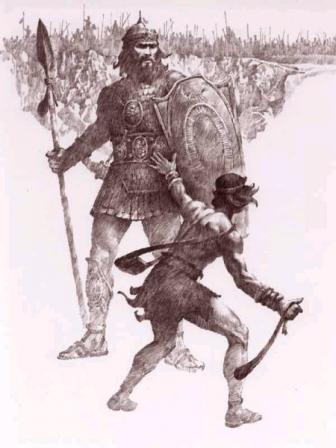
That’s where David is, in a cave with other disenfranchised people – people down on their luck, people in distress and (as the writer of Samuel says) bitter.  Now look: in my view of it, if I were David, and I had been anointed by God to be King because Saul was an unfaithful man, and I had been the one to strike down the Giant from Gath – even by God’s power and not merely my slingshot -- I’m not sure I’d be willing to run away and hide like this.  I’d want God to finish this thing up and make me King already.  I shouldn’t have to run in the wilderness because of a madman – if God is Good.

But David doesn’t reason like I would.  Instead, he writes a song that says this:
4 I sought the LORD, and he answered me
    and delivered me from all my fears.
5 Those who look to him are radiant,
    and their faces shall never be ashamed.
6 This poor man cried, and the LORD heard him
    and saved him out of all his troubles.
7 The angel of the LORD encamps
    around those who fear him, and delivers them.
From our perspective, David is not only the subject of trouble which, frankly, the Lord has created: David is stuck between a madman who wants him murdered, and the King of Gath – that is, the King whose Giant he just killed, and whose sword he has strapped across his back.  David finds himself marching from the claws of his enemy into the mouth of his enemy – and rejoices!

Think about that: David sees that God’s goodness is not found in a kingly court.  Trouble is actually found in the kingly courts.  David finds himself in a cave surrounded by people who, frankly, have been on the receiving end of all the trouble in the world, and he sees God’s hand there with them. With them, there is a refuge from the madness he is escaping on both sides.  In David’s view of it, God has protected him, literally surrounding him with the protection of angels.

I think it’s important here to see that David is not saying, “wow: at least it’s not as bad as it could have been.”  David is in fact saying that God has delivered him from an evil end.  On the one hand, he has been delivered from the hands of Achish who is his true enemy.  David was not put to shame to be either killed or put in debt to the enemy of God’s people.  But on the other hand, David is also delivered from Saul – who ought to be his ally and friend, but is instead jealous of him to the point of madness.

David sees God as delivering from his enemies.  How does he justify that?  We'll talk about that next week.


07 August 2012

Better word than "cessationist"? Almost! So close!

by Dan Phillips

Labels are a necessary evil. Few of them really capture a position sufficiently, but the alternatives just don't work. What chafes is the frequent necessity of using a well-known label for the sake of communication, but knowing that with it comes unwanted baggage and connotations.

And so for instance — as I've posed before — what do you call yourself if you unreservedly affirm the sufficiency of Scripture and the Holy Spirit's definition of the nature, role and ministry of His gifts and works? What are you? Decades ago, there wasn't a well-known name, then along comes "cessationism."

And so, though we affirm a robustly positive and vibrant position, we find ourselves stuck with negative label.  We're stuck with describing ourselves by what we don't think is currently happening. If it's a PR battle, we lose from the outset. I tried suggesting a more negative (and more accurate) label for the opposition but, as expected, it went nowhere.

I've long wanted (and called for) a positive word, connoting the robust fullness of the position, the happy and God-honoring affirmation that the Holy Spirit had succeeded in His work. He succeeded in affirming the Gospel by His revelatory and attesting works (Heb. 2:1-4), He succeeded in bringing to completion the process of piecemeal revelation (1 Cor. 13:8-10), He succeeded in producing a Word that contains everything we need to know for salvation and service (2 Tim. 3:15-17).

And then it dawned on me:

SUCCESSIONIST!

What is a Successionist? It's someone who celebrates the the Lord Jesus' success in giving the apostles all the information He wanted to communicate through them (Jn. 16:12-15), who rejoices in the Trinity's success in revealing and attesting the Gospel (Heb. 2:1-4), who affirms and celebrates the Holy Spirit's success in producing a truly sufficient Word (2 Tim. 3:15-17). He is a successionist.

So what if it's a coined word? So was Charismatic. So was Cessationist. So are many theological labels.

Ah, but I fear that my newborn is a stillborn. Though I don't think I've ever heard the term used, it turns out that word has been around for a long, long time, and already has many connotations which have nothing to do with my intent.

Sigh.

Oh well, the search continues.

But next to "too late," two of the saddest words in English have to be...

...so close!

Dan Phillips's signature


05 August 2012

Imaginary Trouble

Your weekly dose of Spurgeon
The PyroManiacs devote some space each weekend to highlights from the lifetime of works from the Prince of Preachers, Charles Haddon Spurgeon.  The following excerpt is from "Jesus Christ--'The Breaker,' " a sermon preached on 23 April, 1856 at Queen's Square Chapel, Brighton.

“It is not dying that is the great difficulty; it is living.”

What foolish people even many Christians are! There is an old proverbs which says, ‘Never cross a bridge before you come to it.’ How many Christians are filled with sorrow on account of imaginary troubles! Many timid Christians have a trouble manufactory in their own houses; they sit from morning to night endeavouring to make trouble for themselves. We have quite enough real trials to bear; and if we make any more of our own, we have no promise that God will give us grace to bear our self-made sorrows. How unwise are those people who crowd a whole year’s troubles into a single day!

The brave Spartan ranged his little troop in a narrow pass, Thermopylae, and slew his enemies as they came up one or two at a time. If he had been foolish enough to have ventured into the plain to fight that mighty host of Persians all at once, he would soon have been overcome. Believer, stand in the narrow path of today; as thy troubles come, by divine grace slay them one by one; but, I beseech thee, never go into the broad plain of tomorrow, lest thou be overwhelmed by the vast hosts. Troubles usually come one or two at a time, and when they do come, it is for us to have at them, strong in the strength of Jehovah, and so to destroy them. If thou puttest together the troubles of a year, and seekest to bear them in a day, how canst thou expect to have grace sufficient? Thou didst ask this morning, ‘Give us this day our daily bread;’ dost thou want all at once a month’s supply? Thou hast the promise: ‘Thy shoes shall be iron and brass; and as thy days so shall thy strength be.’ Dost thou expect a year’s strength in a single day? Believe me, my fellow-Christian, thy cup of sorrow will be quite full enough without thine additions. Let this cheer thee wheresoever thou art going: ‘The Breaker is come up before them: they have broken up, and have passed through the gate, and are gone out by it: and their king shall pass before them, and the Lord on the head of them.’ Oh, methinks it is sweet to go anywhere where Christ has gone before! Pilgrims in the Holy Land delight in spots where they can find traces of the Saviour. Christians may find a Holy Land in all their experiences of sorrow, for their Saviour was ‘a man of sorrows, and acquainted with grief.’ Sorrowing Christian, in all those gloomy Gethsemanes of thine, thou dost hold fellowship with Jesus Christ thy Lord and Saviour! Cheer up, Christian! Take heart, man! Courage, O believer! ‘The Breaker is come up before them,’ ‘and the Lord on the head of them.’


03 August 2012

A Brief (?) Biography of Charles Spurgeon

This Friday, to commemorate the stellar contributions to internet apologetics and punditry made by our founder and benefactor, Phil Johnson, the unpaid and overworked staff at TeamPyro is posting a "best of Phil" post to give your weekend that necessary kick.

This excerpt is from the original PyroManiac blog in August 2005.  Phil provided us with a relkatively-brief biography of Charles Spurgeon, and in the process extolled the virtues of a godly upbringing.


As usual, the comments are closed.

It is well known that Charles Spurgeon came to Christ when he ducked into a small church to escape a snowstorm and heard the gospel proclaimed. Some wrongly think Spurgeon was thus suddenly converted to Christ out of a life of sheer paganism. Spurgeon himself used to talk about how he had suffered for a long time under the weight of sin before he finally found Christ. Because of the way he described himself as a great sinner utterly in debt to divine grace, many who heard him preach came away with the impression that he was a man who had gone deeply into sin and come to Christ fairly late in life.

But the facts are that Charles Spurgeon was converted to Christ while still in his youth, and he was the product of godly upbringing in a pastor's home. Spurgeon's two main role models, his father and his grandfather, both were godly pastors.

Spurgeon was raised in his grandfather's home from his infancy until he was nearly six years old. Something, possibly economic difficulties, made it necessary for Charles to live with his paternal grandparents, in a village near the one where his parents lived, from the time he was nearly two years old until he was ready to start elementary school. Charles Spurgeon was his grandfather's constant companion, both in the pastor's study and when the elder Spurgeon made pastoral visits. Young Charles loved his grandfather's books. He was a prodigy when it came to reading, and he developed a love for books very early. He especially loved Pilgrim's Progress.

By the time Spurgeon returned to his parents' home at age six, he already had three younger siblings, two sisters and a brother. He seemed already to feel very deeply his responsibility as the elder brother to influence them for good. That perspective, which was surely part of his grandfather's pastoral legacy, made him mature beyond his years. And this was a persistent trait of Charles Spurgeon's. As a young boy, even before he was a teenager, his hobbies were writing poetry and editing a magazine. Even then he was honing the literary skills that would make him legendary both as a preacher and an author.

You can look at Spurgeon in any stage of his development and what you will see is someone who was wise beyond his years, with an exceptionally mature outlook on life. Even Spurgeon himself made reference to this. When he was 40 years old he lectured a group of young men, and he said in that lecture that he was already an old man at age 40. He told them,

I might have been a young man at twelve, but at sixteen I was a sober, respectable Baptist parson, sitting in the chair and ruling and governing the church. At that period of my life, when I ought perhaps to have been in the playground, developing my legs and sinews, which no doubt would have kept me from the gout now, I spent my time at my books, studying and working hard, sticking to it, very much to the pleasure of my schoolmaster. [W.Y. Fullerton, Charles Haddon Spurgeon (Chicago: Moody, 1966), 21.]

At age 6, when Spurgeon returned to his parents' home, he entered school for the first time. With his ability to read and his love for books, his teachers immediately recognized him as a gifted student, and he excelled from the beginning. He was ahead of his classmates from the start, even though he was a late-comer to school. (There was only one time in his school career when his grades began to fail and his performance wasn't what it ought to be. The teacher was shocked, because Spurgeon was her best student. Then it occurred to this teacher that the top student's place was away from the fire and next to a drafty door. He realized that Spurgeon was actually doing poorly in school work on purpose because he didn't want the best seat. After all, it was the most uncomfortable. So the teacher reorganized the seating arrangements, and Spurgeon's academic performance rebounded. He never failed again.)

When Spurgeon was about 14, he and his brother James went to school in Maidstone, where Spurgeon's uncle was one of the teachers. It was there, as a very young teenager in a conversation with the school staff, that Charles was first exposed to the Baptist view on baptism. (Spurgeon's grandfather was a congregationalist who practiced infant baptism, and that was all that Spurgeon had ever known.) An Anglican school was an unlikely place for anyone with a congregational heritage to embrace Baptist beliefs. But Spurgeon, even at that young age, felt compelled to study the issue from Scripture and make up his own mind. As he did so, he found the Baptist position unassailable. So he made up his mind at age 14 that if he ever experienced conversion, he would be baptized. Such was the seriousness of his interest in spiritual things, even before his conversion.

When Charles was about 10 or 11 years old, he began to be deeply convicted about his sin. He was convinced that he had no saving knowledge of Christ. So he set out on a quest for salvation that lasted about 5 years. This was an agonizing time of life for Spurgeon, because he already viewed spiritual matters with far more seriousness than any other boy his age. The knowledge that he himself was not a true Christian was something that weighed more heavily on him than language can express. It became a burden he carried around continually.

W. Y. Fullerton, one of Spurgeon's biographers and a close friend in Spurgeon's adult years, wrote this about those years of Spurgeon's searching for salvation:

Into those years was crowded a world of experience which enabled him in his subsequent ministry to probe the secrets of many hearts. He learned more of the things that matter in those years than most men learn in a lifetime.

That one so young, so sheltered, trained from his babyhood in the ways of God, could have felt so much and have had such exercises of soul may seem impossible, his own account of his darkness and despair may appear exaggerated; but those who are versed in the ways of God will understand [Ibid., 23].

Spurgeon's own account of his struggle to find salvation does indeed leave us marveling that such a boy could feel his own sin so deeply. After all, he grew up in a godly family, in a pastor's home; he had never committed any sort of scandalous sin (probably the most serious sin he had ever fallen into was a lie); and yet the burden of his sin weighed so heavily on him that he was brought to the brink of utter despair by it.

Here's what Spurgeon himself wrote about those dark days of conviction:

When I was in the hand of the Holy Spirit, under conviction of sin, I had a clear and sharp sense of the justice of God. Sin, whatever it might be to other people, became to me an intolerable burden. It was not so much that I feared hell, as that I feared sin; and all the while, I had upon my mind a deep concern for the honour of God's name, and the integrity of His moral government. I felt that it would not satisfy my conscience if I could be forgiven unjustly. But then there came the question,—"How could God be just, and yet justify me who had been so guilty?" I was worried and wearied with this question; neither could I see any answer to it. Certainly, I could never have invented an answer which would have satisfied my conscience . . .. I had heard of the plan of salvation by the sacrifice of Jesus from my youth up but I did not know any more about it in my innermost soul than if I had been born and bred a Hottentot. The light was there, but I was blind: it was of necessity that the Lord Himself should make the matter plain to me. [C. H. Spurgeon, Autobiography 4 vols. (London: Passmore & Alabaster, 1897), 1:98.]

Notice the poetic way Spurgeon describes the sense of guilt he felt. Remember, he's talking about himself as a boy. He was a young teenager at the time he is describing—perhaps not even in his teens yet. (The whole period of his conviction lasted from age 11 until he was 16.) He further writes:

There was a day, as I took my walks abroad, when I came hard by a spot for ever engraven upon my memory, for there I saw this Friend, my best, my only Friend, murdered. I stooped down in sad affright, and looked at Him. I saw that His hands had been pierced with rough iron nails, and His feet had been rent in the same way. There was misery in His dead countenance so terrible that I scarcely dared to look upon it. His body was emaciated with hunger, His back was red with bloody scourges, and His brow had a circle of wounds about it: clearly could one see that these had been pierced by thorns. I shuddered, for I had known this Friend full well. He never had a fault; He was the purest of the pure, the holiest of the holy. Who could have injured Him? For He never injured any man: all His life long He "went about doing good;" He had healed the sick, He had fed the hungry, He had raised the dead: for which of these works did they kill Him? He had never breathed out anything else but love; and as I looked into the poor sorrowful face, so full of agony, and yet so full of love, I wondered who could have been a wretch so vile as to pierce hands like His. I said within myself, "Where can these traitors live? Who are these that could have smitten such an One as this? Had they murdered an oppressor, we might have forgiven them; had they slain one who had indulged in vice or villainy, it might have been his desert; had it been a murderer and a rebel, or one who had committed sedition, we would have said, "Bury his corpse: justice has at last given him his due." But when Thou wast slain, my best, my only-beloved, where lodged the traitors? Let me seize them, and they shall be put to death. If there be torments that I can devise, surely they shall endure them all. Oh! what jealousy; what revenge I felt! If I might but find these murderers, what would I not do with them! And as I looked upon that corpse, I heard a footstep, and wondered where it was. I listened, and I clearly perceived that the murderer was close at hand. It was dark, and I groped about to find him. I found that, somehow or other, wherever I put out my hand, I could not meet with him, for he was nearer to me than my hand would go. At last I put my hand upon my breast. "I have thee now," said I; for lo! he was in my own heart; the murderer was hiding within my own bosom, dwelling in the recesses of my inmost soul. Ah! then I wept indeed, that I, in the very presence of my murdered Master, should be harbouring the murderer; and I felt myself most guilty while I bowed over His corpse . . .. [Ibid., 99-100.]

That, of course, was written by Spurgeon in his adult years, so it represents his mature way of describing how he felt as a child. But it is clear that even as an 11- or 12-year-old child, he was carrying around a sense of personal guilt that was unusually intense. The guilt was so profound that for 5 years it colored all his thinking. He never could get his thoughts completely away from the sense that he was a sinner, that he was guilty, and that he deserved hell.

Spurgeon's mother was the one whose influence first awakened him to the claims of Christ on his life. Her exhortations to her children, as well as her prayers on their behalf, made an indelible impact on Charles as a young boy.

Spurgeon's father played a somewhat lesser role in the children's spiritual instruction. He was a pastor and a godly man. He himself admitted that his wife more than he was responsible for the children's spiritual instruction. In fact, he used to recount an incident that occurred when he was on his way to some preaching engagement. (His ministry had an itinerant aspect that often took him out of the home.) On this particular occasion he became convicted that he was caring for other people and their spiritual needs, but neglecting his own family and his own children. He went back home. When he got home, upon entering the house quietly, he heard Mrs. Spurgeon in another room, praying for her children's conversion. John Spurgeon says he decided that his children's spiritual welfare was in good hands, and he returned to his preaching engagement.

It would be wrong to conclude, however, that John Spurgeon was inattentive or a compassionless father. He was devoted to his children. He was involved in their lives. Fullerton records a touching story about the father-son relationship:

When the boy returned home from his grandfather's house, he greatly scandalised the congregation on Sunday by singing the last line of each verse twice. His father took him to task, but he said that his grandfather did it, and he would do it too. So his father told him that if he did it again he would give him a whipping that he would remember as long as he lived. Sunday came, and again the boy sang the last lines twice. It must have been amusing, for he had no singing voice. After the service his father asked him if he remembered what he had said. The boy remembered. Father and son then walked into the wood, passing a wheat field on the way, the father trying to win his son to repentance. There they kneeled and prayed together, and both were greatly moved. Turning back to the wheat field, the father plucked a stalk of wheat, and told Charles to hold out his hand. The wheat stalk was laid gently across it. "I told you I would give you a whipping you would never forget. You will never forget that," said his father. The gentle sternness of the punishment broke him down and won him over, and he never forgot it [Fullerton, 25-26].

Spurgeon's father, obviously, was a man who deeply loved Christ. His great compassion and tenderness left an indelible impression on young Charles's life. Spurgeon's father, his grandfather, and above all his mother, were therefore strong influences on him spiritually.

On Sunday evenings, Mrs. Spurgeon would gather the children together around the table for Scripture reading and prayer. Spurgeon said she used to pray like this: "Now Lord, if my children go on in their sins, it will not be from ignorance that they perish. My soul must bear swift witness against them at the day of judgment if they lay not hold of Christ." Spurgeon said the thought of his own mother's bearing witness against him at the judgment seat of Christ pierced his conscience.

Because of such influences, Charles began to develop a keen sense of his own guilt by the time he was 10 or 11. The thing that burdened him so much was a clear understanding that he was guilty in God's sight. He didn't have the limited perspective so many children have—grieving only because they have offended their parents. Spurgeon very seriously seemed to realize, even at a young age, that all his sins were an affront against God Himself.

He also seems not to have suffered from that common human failure most of us have, comparing ourselves with one another and convincing ourselves that we're all right after all, because we're so much better than this or that person. Spurgeon knew better than to do that. He wrote this:

I could not believe that it was possible that my sins could be forgiven. I do not know why, but I seemed to be the odd person in the world. When the catalogue was made out, it appeared to me that, for some reason, I must have been left out. If God had saved me, and not the world, I should have wondered indeed; but if He had saved all the world except me, that would have seemed to me to be but right. And now, being saved by grace, I cannot help saying, "I am indeed a brand plucked out of the fire!" [Spurgeon, 103.]

Spurgeon's unique perspective explains why he regarded himself as one of those "who were kept by God a long time before we found him" [Ibid.]. In his mind, those years of carrying the burden of his sin must have seemed like an eternity. Remember, he was brought up in a pastor's home in a godly environment from his infancy. He never seems to have succumbed to any sort of vile or gross behavior. He never engaged in any reputation-destroying sins. No scandalous sins appear anywhere in any account of in his life. He was converted at a fairly young age, 16. Yet he kept in his heart until the day he died a very strong sense that he was nothing but a horrible sinner. He never thought of himself as better than anyone. For the rest of his life he retained the fresh memory of that burden of guilt he had carried. And for that reason, he felt a close kinship to people converted to Christ after a long time in the depths of sin.

He wrote,

I love that picture of dear old Christian [in Pilgrim's Progress]. I know, when I first read The Pilgrim's Progress, and saw in it the woodcut of Christian carrying the burden on his back, I felt so interested in the poor fellow, that I thought I should jump with joy when, after he had carried his heavy load so long, he at last got rid of it; and that was how I felt when the burden of guilt, which I had borne so long, was for ever rolled away from my shoulders and my heart [Ibid.].

During those years of conviction, Spurgeon was exposed to a lot of preaching about the law and guilt and sin, and all of this only intensified his woes. He records that some of the books that he read during this time included books like, Philip Doddridge's The Rise and Progress of Religion in the Soul, Richard Baxter's A Call to the Unconverted, Joseph Alllein's Alarm to Sinners, and John Angel James' book called The Anxious Inquirer. All of those books are written to convict over-confident people. Spurgeon said it was like sitting at the foot of Sinai. Fullerton adds this: "He read the Bible through, but found that its threatenings seemed to be printed in capitals and its promises in small type. With perverse ingenuity . . . he twisted everything to his own hurt, applying the cheering words to others and the woeful words to himself" [Fullerton, 27].

Spurgeon later wrote this about the turmoil that he experienced:

Day and night God's hand was heavy on me. If I slept a night I dreamed of the bottomless pit, and when I awoke I seemed to feel the misery I had dreamed. Up to God's house I went; my song was but a sigh. To my chamber I retired, and there, with tears and groans, I offered up my prayer without a hope and without a refuge, for God's law was flogging me with its ten-thonged whip and then rubbing me with brine afterwards, so that I did shake and quiver with pain and anguish [Ibid., 27].

In another place, Spurgeon likened all this preaching of the law to someone who was actually plowing the same ground over and over again, "with a team of ten black horses"—the Ten Commandments.

During those years of conviction no one who knew Spurgeon seemed aware of his inner turmoil. He turned it all inward. Fullerton wrote,

It must not be supposed that the lad became morbid during those years. He lived two lives, one keen, natural, bookish, observant; the other absorbed, fearful, doubting, insurgent. If he had spoken of his trouble, there were those round him who could, perhaps, have helped him out of it; but he battled alone, hiding his thoughts from them all, save once when he spoke to his grandfather of his fear of being a lost soul, and was somewhat comforted for a while. He would not believe because others believed; he must have an assurance of his own; he would not rest until he knew [Ibid., 26.].

Normally, people struggling with this sort of burden will talk to others and desperately reach out for comfort and assurance, and they want to feed off the verbal reassurances people invariably offer. The counselor's encouragement and comfort may last for a while, but because the issue isn't really settled in the sinner's own heart, he or she will go back to doubting. It can be very frustrating to counsel people with that perspective on their own sins.

SpurgeonBut Spurgeon knew better. He didn't feed off the assurance and encouragement that others could give him. He realized his business was with God, and he kept it between him and God. There's no doubt that it would have been good for Spurgeon to seek counsel from his grandparents, from his parents, or from other mature believers around him. They might have at least helped him bear the burden and certainly would have prayed diligently for him. But he didn't seek that kind of help.

He describes what happened in those dark days of conviction:

While under concern of soul, I resolved that I would attend all the places of worship in the town where I lived, in order that I might find out the way of salvation. I was willing to do anything, and be anything, if God would only forgive my sin. I set off, determined to go round to all the chapels, and I did go to every place of worship; but for a long time I went in vain. I do not, however, blame the ministers. One man preached Divine Sovereignty; I could hear him with pleasure, but what was that sublime truth to a poor sinner who wished to know what he must do to be saved? There was another admirable man who always preached about the law; but what was the use of ploughing up ground that needed to be sown? Another was a practical preacher. I heard him, but it was very much like a commanding officer teaching the manoeuvres of war to a set of men without feet. What could I do? All his exhortations were lost on me. I knew it, was said, "Believe on the Lord Jesus Christ, and thou shalt be saved;" but I did not know what it was to believe on Christ. These good men all preached truths suited to many in their congregations who were spiritually-minded people; but what I wanted to know was,—"How can I get my sins forgiven?"—and they never told me that. I desired to hear how a poor sinner, under a sense of sin, might find peace with God; and when I went, I heard a sermon on "Be not deceived, God is not mocked," which cut me up still worse; but did not bring me into rest. I went again, another day, and the text was something about the glories of the righteous; nothing for poor me! I was like a dog under the table, not allowed to eat of the children's food. I went time after time, and I can honestly say that I do not know that I ever went without prayer to God, and I am sure there was not a more attentive hearer than myself in all the place, for I panted and longed to understand how I might be saved [Spurgeon, 104-105].

SpurgeonSpurgeon's experience later helped shape his ministry. He remembered his frustration in wanting to hear the gospel but never hearing anything but law preached. That is why there is such a strong evangelistic thrust in almost every sermon Spurgeon ever preached. He almost never stood up in the pulpit without clearly giving the way of salvation and calling sinners to Christ.

Ultimately, Spurgeon's conversion came through the most unlikely circumstances. One Sunday morning, while Spurgeon was in this phase of sampling various churches, a terrible snowstorm virtually shut down the little town of Colchester. Spurgeon was home from his boarding school for Christmas holidays. The date can be determined with absolute precision. It was Sunday, January 6, 1850. The snowstorm started early in the morning. Spurgeon had gotten up early in the morning because he had plans to go to a particular chapel on the other side of town. But just as Spurgeon began to make his way to church, the snowstorm grew worse.

Spurgeon himself recounted what happened:

I sometimes think I might have been in darkness and despair until now had it not been for the goodness of God in sending a snowstorm, one Sunday morning, while I was going to a certain place of worship. When I could go no further, I turned down a side street, and came to a little Primitive Methodist Chapel. In that chapel there may have been a dozen or fifteen people. I had heard of the Primitive Methodists, how they sang so loudly that they made people's heads ache; but that did not matter to me. I wanted to know how I might be saved, and if they could tell me that, I did not care how much they made my head ache. The minister did not come that morning; he was snowed up, I suppose. At last, a very thin-looking man,* a shoemaker, or tailor, or something of that sort, went up into the pulpit to preach. Now, it is well that preachers should be instructed; but this man was really stupid. He was obliged to stick to his text, for the simple reason that he had little else to say. The text was,—

"LOOK UNTO ME, AND BE YE SAVED, ALL THE ENDS OF THE EARTH."

He did not even pronounce the words rightly, but that did not matter. There was, I thought, a glimpse of hope for me in that text. The preacher began thus—"My dear friends, this is a very simple text indeed. It says, 'Look.' Now lookin' don't take a deal of pains. It ain't liftin' your foot or your finger; it is just, 'Look.' Well, a man needn't go to College to learn to look. You may be the biggest fool, and yet you can look. A man needn't be worth a thousand a year to be able to look. Anyone can look; even a child can look. But then the text says, 'Look unto Me.' Ay!" said he, in broad Essex, "many on ye are lookin' to yourselves, but it's no use lookin' there. You'll never find any comfort in yourselves. Some look to God the Father. No, look to Him by-and-by. Jesus Christ says, 'Look unto Me.' Some on ye say, 'We must wait for the Spirit's workin'.' You have no business with that just now. Look to Christ. The text says, 'Look unto Me.'" Then the good man followed up his text in this way:—"Look unto Me; I am sweatin' great drops of blood. Look unto Me; I am hangin' on the cross. Look unto Me; I am dead and buried. Look unto Me; I rise again. Look unto Me; I ascend to Heaven. Look unto Me; I am sittin' at the Father's right hand. O poor sinner, look unto Me! look unto Me! When he had gone to about that length, and managed to spin out ten minutes or so, he was at the end of his tether. Then he looked at me under the gallery, and I daresay, with so few present, he knew me to be a stranger. Just fixing his eyes on me, as if he knew all my heart, he said, "Young man, you look very miserable." Well, I did; but I had not been accustomed to have remarks made from the pulpit on my personal appearance before. However, it was a good blow, struck right home. He continued, "and you always will be miserable—miserable in life, and miserable in death,—if you don't obey my text; but if you obey now, this moment, you will be saved." Then, lifting up his hands, he shouted, as only a Primitive Methodist could do, "Young man, look to Jesus Christ. Look! Look! Look! You have nothin' to do but to look and live." I saw at once the way of salvation. I know not what else he said,—I did not take much notice of it,—I was so possessed with that one thought. Like as when the brazen serpent was lifted up, the people only looked and were healed, so it was with me. I had been waiting to do fifty things, but when I heard that word, "Look!" what a charming word it seemed to me! Oh! I looked until I could almost have looked my eyes away. There and then the cloud was gone, the darkness had rolled away, and that moment I saw the sun; and I could have risen that instant, and sung with the most enthusiastic of them, of the precious blood of Christ, and the simple faith which looks alone to Him. Oh, that somebody had told me this before, "Trust Christ, and you shall be saved" [Spurgeon, 105-108.].

Spurgeon began preaching right after his conversion. He was converted in January, 1850. Amazingly, less than five years later he was called to be the pastor of the largest Baptist church in London. So within four years after his conversion, he preached his first sermon as the pastor in the pulpit of the congregation he would shepherd until the day he died. He never attended university or seminary. He seems to have sprung full grown into maturity as a pastor, preacher and a theologian.

But the truth behind Spurgeon's remarkable ministry is that many of the influences that made him what he was were related to his earliest upbringing. They were the influences he gained from a godly home life, under the oversight of godly parents and grandparents.

02 August 2012

Smart and wise ain't synonyms

by Dan Phillips

I really used to be smarter. Too bad you didn't know me then.

Really, I'll come across old sermon notes or study notes, or papers I did in seminary, and... well, the intellectual trajectory is not encouraging. Nostalgic, yes, but...

Let me illustrate. I've often told you that one of the things I love about BibleWorks is its ability to allow instant, limitless documentation on each and every individual verse. So if you have a thought, or you find an essay on the Intrawebs, or you find a sermon or a journal article, you just get the verse, paste, and it's there for you forever. Absolutely amazing.

So I've made notes during my dozens of Bible read-throughs in BW. The day I wrote this post, Luke 15 was part of my morning reading. Here's the note I found on Luke 15:1 in full and unedited, reflecting several readings.

First, I wrote this:
What is interesting about these parables is that Jesus puts the hearers — us — in the place of God the Father in them, asking us to reason from our own feelings to His.  How would you feel if you lost a sheep? What would you do? How would you feel when you found it? And you ladies, if you lost one of your coins...?  And you fathers: picture this.....
Then, on a later reading, I'd written this:
(Wow, was that my thought?  That's deep, for me! Usually I'll credit a source, if I get it somewhere else.  Guess I used to be smart! Dang!)
Then yet another time, I jotted this:
(Still later: no way I came up with that myself)
Can you identify? I've had that experience prepping my sermons in the current series at CBC, preaching over the basic doctrines touched on in our church's Doctrinal Statement. I'll sometimes find a sermon I'd preached on the subject 10 or more years ago and think, "Hey, that's pretty good... I'll use that!"

I don't know how that sounds to you. The feeling I have when I come across those earlier-me gems is that I'm reading something someone else wrote... except that it has my name on it, and I've never been a sermon-plagiarist. So it had to be have been me. Smarter-me.

But here's the other side of that. To this "other side," younger readers will say "Whatever," but the rest of us will moan, "Yeah, no kidding." Here it is:

At the same time I look back and marvel at how intellectually bright I was, I also marvel at how stupid I could be. Decisions, priorities, the way I handled issues of various sizes... just ouch, and groan, and head-shake, and facepalm, and pray.

Am I telling the yowwens not to study hard and learn a lot of facts and information? In no way whatever. I'm just cautioning that there is a lot more to wisdom than the accumulation (and even mastery) of impeccable truths and theories. It involves that, yessir; but it is more than that.

The moral of this story?

"Wise" and "smart" just ain't synonyms. At best, the latter can lead to the former, via a Proverbial path.

In fact, it had darned well better. For everyone's sake.

Dan Phillips's signature

01 August 2012

Our Bad Taste

by Frank Turk

Louis Berkhof says that the Goodness of God is one of three primary moral attributes of God – the other two being God’s Holiness, and God’s Righteousness.  Just to get the smart person quotient satisfied early, here’s specifically what Berkhof says in his Systematic Theology:
We speak of something as good when it answers in all parts to the ideal. Hence in our ascription of goodness to God the fundamental idea is that He is in every way all that He as God should be, and therefore answers perfectly to the ideal expressed in the word "God." He is good in the metaphysical sense of the word, absolute perfection and perfect bliss in Himself.   …

But since God is good in Himself, He is also good for His creatures, and may therefore be called the fountain of all good, and is so represented in a variety of ways throughout the Bible. …

All the good things which the creatures enjoy in the present and expect in the future, flow to them out of this inexhaustible fountain. And not only that, but God is also the highest good for all His creatures, though in different degrees and according to the measure in which they answer to the purpose of their existence. (Systematic Theology, 70)
That’s quite a mouthful.

It’s obvious that Berkhof is working hard to be as precise as possible to make his point as clear as possible, but the Psalmist takes a different approach.  The psalmist here tells us where our hope lies.  And let’s be clear: the Psalmist, in Psalm 34, is hopeful.  The Psalmist is somehow aligned with the Presbyterians who wrote the Westminster Catechism 3000 years later.  When they asked the question, “What is the chief and highest end of man?”  They responded, “Man's chief and highest end is to glorify God, and fully to enjoy him forever.”

TASTE AND SEE THAT THE LORD IS GOOD, he proclaims.  He is actually a little more emphatic than that, because the Pslamist doesn’t just say “the Lord” here in proper reverence: he says instead, “TASTE AND SEE THAT JEHOVAH IS GOOD!” “TASTE AND SEE THAT YAH-WEH IS GOOD!”  That is: this is not God-in-Theory. This is not a system of understanding an ineffable and incomprehensible God.  This is the God of Joshua, the God of Moses, and Joseph, and Jacob, and Isaac, and Abraham, and Noah.  This is God who called Samuel by name and gave him explicit instruction to anoint David the King of Israel.  This is God in Person, God in Fact, The God who has a living history of making promises, and keeping them.

And that’s the Psalmist’s trope here: Somehow, we have a God who is as real as a delicious meal.  Somehow, we have to get our mouth ready to receive him.  That’s actually what John Calvin says about this Psalm: “the Psalmist indirectly reproves men for their dullness in not perceiving the goodness of God, which ought to be to them more than a matter of simple knowledge. By the word taste he at once shows that they are without taste; … He, therefore, calls upon them to stir up their senses, and to bring a palate endued with some capacity of tasting, that God’s goodness may become known to them.”

Without overstating it, the Psalmist is saying that God is REAL – and that the primary way we know God is REAL is that He is knowably Good.

This is actually our problem, isn’t it?  This is actually the problem that we as people face all the time.  We have lousy taste.  I’m not talking about the way we dress, or the colors we paint our homes or the way we decorate them, or even the kinds of jokes we tell.  I’m talking about keeping our sensibilities on what God intends for this world.  And when bad things happen – things which are inexplicably bad, things which, let’s face it, one Sunday school lesson cannot possibly explain – our bad taste tends to take over.

We forget the broad ways in which the fact that God is Good which must anchor us.


31 July 2012

Thinking Biblically about church attendance, involvement, and membership

by Dan Phillips

As I continue in the "Thinking Biblically" sermon series, basically shaped after our church's doctrinal statement, we've had what could be called a "sub-series" on the church. It ended up being a trilogy. In the last installment, titled "What Do I Have to Do With Christ's Church?", I focused down as intensely as I could on just that juncture: attendance/involvement/membership.

How absurd is the condition of the confessing evangelical church? Absurd enough that you still have to say it's important actually to go to a local church. Absurd enough that you still have to say it's important actually to be involved in the church you attend, to whatever degree you're able.

My bottom line is: local church attendance and involvement is Biblically a crystal-clear moral imperative; something like membership is a necessity; and formal church membership makes sound Biblical sense, other things being equal.

The first aim in this sermon, of course, was to serve the dear folks whom it's being my great joy to pastor. All of the sermon should have legitimate specific application locally.

Second, just to be candid, my aim was to do what I could to produce a tour de force presenting the Biblical case the best I could in one sermon. Ambitious? You betcha. Out of my reach? Assuredly. But it's my job to reach (cf. Phil. 3:12-14; Col. 1:25, 28). There was so much more to say, but it was such a dense sermon that I actually handed out supplemental sheets listing off all the verses I mentioned, so that no one listening would be frustrated.

I hoped to give something online for Christians and/or pastors to share with those who haven't thought the issue through Biblically. That means I paint with a broad brush, in that larger context. There are some not in CBC who would hear the sermon and have a genuine issue in applying it. But they are relatively few, and they are far fewer than those who imagine they've got a note from Mom excusing them.

In preparing, beyond personal study and reflection and teaching and writing over the decades, some of the online resources from which I profited most were Aaron's open letter to Frank, and the Frank Turk posts to which Aaron referred therein.

Here's one passage from Frank that really struck me. The thoughts made their way into the sermon:
But here's the problem: from the day of Paul and his life after founding all those churches across the ancient world, the church was never perfect. Go back and read this post by me and look at the state of the churches Paul was writing to. The churches Paul founded were frankly not perfect -- they weren't even really very consistent. You know: it's not like 40 years had passed between the time Paul founded the church in Corinth and when they decided that the Lord's table was really a private party and not a public place where sinners demonstrate their unity in Christ, or where they had, apparently, forgotten the Gospel which is of first importance.

And Paul's first letter to Corinth didn't say, "Dudes: flee to the hills -- your pastors and elders are apostates." He said, in effect, "remember the truth of Christ and find unity in truth."
Woo, well-put. (Don't worry about Frank being puffed up by this; he never reads my posts.)

I've received some gracious feedback for the sermon, folks who found it helpful. And so now I offer this to you, hoping it's of help to you, and maybe beyond.

Now I get to figure out how to say everything about angels and demons in one sermon. Woo-tah!

FOR FURTHER READING:
Why you need to be in a church this Sunday.
Thinking like a slave

Dan Phillips's signature


29 July 2012

Why Evil?

Your weekly dose of Spurgeon
The PyroManiacs devote some space each weekend to highlights from the lifetime of works from the Prince of Preachers, Charles Haddon Spurgeon.  The following excerpt is from The Metropolitan Tabernacle Pulpit, volume 49, sermon number 2862, "The Way of Wisdom."
 “I am not so much troubled about how evil came into the world as about helping get it out.”

   There are ways of God, in dealing with the human race, which are very perplexing to the judgment of such poor mortals as we are. We try to study a piece of history; and—especially if it is a short piece of history,—it appears to us all tangled and confused. A further research, over a longer period, will often explain what could not be understood in the shorter range of vision; but even history as a whole, from the Creation and the Fall until now, contains many strange puzzles to a man who believes that God is, through it all, working out his own glory, and that a part of his glory will consist in producing the highest amount of good to the greatest number of his creatures.

   What a mass of mysteries meets us on the very threshold of human history. The serpent in the garden,—how and why came it to be there? And the devil in the serpent,—why was there a devil at all? And the evil that made the angel into a devil,—why was that permitted? And all the evil that has been since then,—why has it not been destroyed? We cannot answer any of these queries. The negro’s question to the missionary, “If God is stronger than Satan, why does not he kill him?” is another enquiry which we cannot answer. Depend upon it, if it were, on the whole, best that the devil should be killed, he would be killed; and if it had been, after all, most for God’s glory that there should be no evil, there would have been none. We do not know how and why certain things have happened, and we must be content not to know unless God reveals it to us.

   All through history, God seems to be aiming at a certain mark, yet his arrow does not hit the target so far as you and I can judge. Often, he appears to do as the rifleman does, who knows that, if he sent the ball in a direct line to the target, he would miss it, so he makes allowance for certain deflections which will be caused by the force of attraction, by the wind, and various other opposing influences, and aims accordingly. God often proves that the nearest way to attain his end is to go round about; so, when he means to cleanse a man, he sometimes allows him first to get more foul; when he intends to clothe him, he first strips him naked; when he resolves to enrich him, he first makes him as poor as Lazarus at the rich man’s gate; and, strange to say, when he means to make him alive, he kills him. God’s modes of procedure, then, allow for deflection, and every other kind of influence, and are not to be understood by us. If you take the whole range of history, and look at it carefully, you will be obliged to feel that, if God has been working there, as we are quite sure he has, ordering all things with consummate wisdom, then his pathway through the world is one which no vulture’s eye hath ever seen, and which no lion or lion’s whelp hath ever traveled.


   It may be that some of you are, at the present moment, complaining of a certain providential dealing of God with regard to you, and that you are thinking and saying that it must be an evil providence. Yet it is, all the while, one of the best things that has ever happened to you. That, over which you are now mourning, will give you good cause for singing in a little while. Probably, that tribulation, which fetches most tears from our eyes here, will be among the subjects of our choicest song in the eternal realms of joy. We need not know, and we cannot know, what God is doing, but we may be quite sure that he doeth all things well.