15 March 2008

Sound Familiar?

Your weekly dose of Spurgeon
posted by Phil Johnson

The PyroManiacs devote some space each weekend to highlights from The Spurgeon Archive. The following excerpt is from Spurgeon's book An All-Round Ministry, and this chapter is drawn from a lecture delivered to ministers.

et us get clearer views of what we believe. . . . Many are spiritual gipsies. They camp behind any hedge, but they abide nowhere, their theology consists of a few sticks and bits of canvas. It is easily upset, but then it is as easily set up. Well may they sing,—

"We've no abiding city here"!.
They prefer the chase after truth to truth itself; it is clear that such a chase has not much of reality in it, for the man is pleased that his prey should perpetually escape him. In olden times, the prophet was a seer; but, nowadays, a prophet is one who is too cultured to see anything. A man who protests that he has too much light to be sure that he sees anything is the favourite of certain intellectual hearers. David said, "I believed, therefore have I spoken;" but he was peculiar: our "thoughtful men" now speak because they doubt, and not because they believe.

C. H. Spurgeon


14 March 2008

On Sermons

by Frank Turk

DISCLAIMER: I posted this yesterday at my blog, and I liked it so well, I reposted it here -- because about 2500 of you didn't bother to come see it in the first edition.

I was flitting around today trying to avoid doing work, and I stumbled onto this post by iMonk at BHT about preaching.

Believe it or not, this is not a fisking of iMonk. This is the perspective of a guy who used to be an English major on the art of speaking publicly about some piece of literature.

You know: the degree most reputable universities and colleges give out to English majors is "B.A. (or M.A.) for Literature in English" – because one doesn’t really study grammar or the alphabet for 4 or 6 years in college: one reads way too many books. One reads poems until one either "gets" it or throws up. One reads plays, which is its own special punishment for majoring in literature.

And there's something interesting that happens there which is applicable to the art of preaching: not once in 6 years of studying literature did we do a "word study" for an hour to plunge the depths of meaning in one word over the larger portrait of meaning the author was communicating in his book or play or poem or whatever.

Now, the disjunction between what one does in reading Literature in English and what one does when reading literature in translation (cf. the Bible) is that in the latter case, the reader has to grasp what the translator was doing while at the same time seek out what the original author was doing when the text in question was written. That is: was the translator seeking to be as transparent as possible, or was the translator seeking to do something independent of the original work as well as remain faithful to the work?

For those of you who are really into this geekish analysis, think about Samuel Butler's translation of Homer's Odyssey, which is a prose translation of a poem. Butler's intent was to translate the words as best he could, but in doing that he sacrificed the matters of diction, form, and genre – so we get the story from classical literature well enough, but it's not hardly poetry: it's prose; it lacks the magic of poetic form even if all the words of the original are in tact. On the other hand, about 50 years earlier, Chapman translated Homer as a poem, and as such he took liberty with the words of the original poem in order to convey, in one poetic form/style in order to convey the art and power of the original in a second language. No real story changes were made by Chapman, but you can't line up his poem to Homer's and go line by line and learn the Greek – it would be impossible.

The translator does something to the text when he brings it from the source language to the receiving language, and understanding what he did is important for those who are only reading the receiving language. In that, word studies have a place in preaching. But my contention is that it is a subordinate place to preaching, as they say, "the whole counsel of God".

John MacArthur's excellent book on Bible study, Unleashing God's Word in you Life, makes this point clearly, as does any really good book on Bible study: you have to get the big picture before you try to sort out the details. For example, the book of Jonah is not about a big fish. There is a big fish in Jonah (or, well, Jonah does wind up in a big fish, right?), but this book is about the hardness of Jonah vs. the love of God toward the unrighteous. And if we read Jonah to try to justify the presence of the big fish, or to make the big fish into an allegory of this or that, we miss the actual point that God is willing and able to do things even for the enemies of Israel which we, as men, are not.

You have to read Jonah the first time to see how it comes together; then, you have to read Jonah to see what the parts are in order to better understand how they come together. And it's the same for any book of the Bible.

Listen: preach the word, in season and out of season – but don’t just preach on one word from the word. Preach the Word: preach Christ. Get the whole thing out there. Don't get so engrossed in one word that you miss all the others: that's called missing the forest for the trees.

And for the rest of you who aren't writing sermons today, be in the Lord's house on the Lord's day with the Lord's people this weekend. Jesus isn't stuck between some preposition and its object, even if all Scripture is God-breathed, and "all" means all.


13 March 2008

"It won't work" doesn't work

by Dan Phillips

(13:30 PST—See addendum below.)

It always irritates me when folks think they're smarter than God. (You may have noticed.)

One of the subtler forms is folks who, though faced with a directive from Scripture, "reason out" how they aren't obliged to obey because "it won't work." It's usually buried under a lot more verbiage than that, and made to sound deep and wise and plausible. But that's what it amounts to: "Sure, God says to do ___, but I've figured out that that won't work. So I don't have to do it. And I won't. Because I'm too smart."

In that light, ponder this interchange from Scripture.
Then the LORD said to Moses, "Go to Pharaoh, for I have hardened his heart and the hearts of his officials so that I may do these miraculous signs of Mine among them...." (Exodus 10:1)
"For" = because, the Hebrew conjunction kî. Simple causal conjunction. B, because A.

"Go in to Pharaoh and talk to him, for I have hardened his heart and the heart of his servants, that I may show these signs of mine among them" -- now, there's a verse worth pondering. Go in, because I have hardened his heart (and so, he won't listen to you). Can you imagine the dialogue a modern autonom might launch?
"Go in, because I've hardened his heart."

"But — You've hardened his heart!"

"Go in."

"But —"

"What 'but'? I have my purpose, you have your orders. You don't need to know the former. You do know the latter. Go."
Now, Yahweh does do for Moses what He does not always do for us. He gives him a peek at His grander purpose. It is so that He can show His wonders (v. 1), and "so that you may tell your son and grandson how severely I dealt with the Egyptians and performed miraculous signs among them, and you will know that I am the LORD" (v. 2).

God was not committing Himself to nightly miracle-displays, like some Las Vegas magician. Those living at Moses' time were to see the miracles, and tell their sons and grandsons. Generation after generation would be in the position in which we find ourselves (pace our signs-'n'-wonders friends): the Word of God was to be sufficient. Miracles were to be transmitted verbally, not repeated endlessly.

And as Yahweh said it would be, so it was.

But this didn't make hardened cynics out of Moses and Aaron. They
went in to Pharaoh and told him, "This is what the LORD, the God of the Hebrews, says: How long will you refuse to humble yourself before Me? Let My people go, that they may worship Me. But if you refuse to let My people go, then tomorrow I will bring locusts into your territory" (10:3-4)
What God would do, God would do. That wasn't the brothers' immediate concern. They had their marching-orders. That was their immediate concern. They didn't need polling, a focus-group, or slick marketing. They knew both what to do and what to say.

And, most of the time, so do we.
For since, in the wisdom of God, the world did not know God through wisdom, it pleased God through the folly of what we preach to save those who believe. 22 For Jews demand signs and Greeks seek wisdom, 23 but we preach Christ crucified, a stumbling block to Jews and folly to Gentiles, 24 but to those who are called, both Jews and Greeks, Christ the power of God and the wisdom of God. 25 For the foolishness of God is wiser than men, and the weakness of God is stronger than men (1 Corinthians 1:21-25)
Dan Phillips's signature

Note from Phil: I'm not really a fan of "The Steve and Kathy Show," but this video cracked me up, and since it touches obliquely on the problem of pragmatism, and that was Dan's theme in this post, I'm going to do something I almost never do and add this PS: to Dan's entry. Thanks, Dan. The rest of you: Enjoy.
Phil's signature


12 March 2008

Briefly

by Frank Turk

Last week I endorsed Kent and Barbara Hughes' book Liberating Ministry from the Success Syndrome, and I implied that I had more to say about this, which I do. But to get there, I want to recap something from 2007.

As a rule of thumb, you should not leave your church. If you want to ask, "yeah, but whaddif ...", check out the posts labeled "local church" here at TeamPyro, and read the comments for all the posts. We have covered this in-depth. Rule of thumb: you should not leave your church. There are good reasons to leave your church, but most people do not really have those reasons -- they want to make their reasons look like those reasons, but their situation is not as bad as they make it out to be.

And I say that in order to say this, briefly: the best reason for not leaving your church is to liberate your pastor's ministry from the success syndrome.

Here's what I mean: while you may couch your resignation letter and exit in confessional terms, it is nearly impossible for you to leave your local church without your pastor receiving this message clearly: "Count me out."

If you want to assist your pastor and his staff (if he has one) in getting over a consumerist or a PDC (profits-driven church) view of the ministry, you can't do that by forcing him to count you.

And I have a broader point to make about the pastoral ministry, but I have to teach the Youth in our church tonight and last week our Youth Pastor gave them both barrels from the book of Job, and the topic of his series is "Reasons we think we don't like God" (the subtitle is "but why God is Great"), and I have to get prepared.

Listen: while your pastor should be trying to liberate his ministry from the success syndrome, you should not be working to shackle him back into the success syndrome. You should be working to help him stay free from those pitfalls -- and you can't do that by running away. Running away causes him to count the numbers.

Think about it, and pray about it.


11 March 2008

A question about "seekers," and sensitivity thereunto

by Dan Phillips

Let's say there's someone who expressly says he wants to hear about Christ. That's right, he positively is interested in Christ. This in itself marks him off from the majority. We'd say it makes him a "seeker," wouldn't we?

But this man isn't so much interested in hearing about the holiness of God, the law of God, man's depravity, God's judgment, or the full story of the way of salvation. He certainly does not want to hear about his own sin. He's not interested in bad news.

Yet he does want to hear about "Christ."

Wouldn't conventional, seeker-sensitive evanjellybeanical sentiment dictate that we meet him right where he is, unconditionally, if it is in our power to do so? Give him what he's asking for? Let him set the agenda? Set these other issues aside?

Now, with those framing questions, read this narrative:
When Herod saw Jesus, he was very glad, for he had long desired to see him, because he had heard about him, and he was hoping to see some sign done by him. 9 So he questioned him at some length, but he made no answer (Luke 23:8-9)
Is it fair to observe that Jesus wasn't very "seeker-sensitive" in this encounter?

Discuss.

UPDATE: my own thoughts are comment #85.

Dan Phillips's signature

10 March 2008

A Quick Pastiche for One of the busiest Days of My Year

by Phil Johnson


ell, for me this week marks the annual transition from my merely-busy time to the truly hectic season. I'll be basically closeted away for several weeks whilst I help turn a stack of sermon transcripts into a book.

Yesterday the Shepherds' Conference officially ended. Today I need to get caught up with overdue e-mails and other miscellaneous things before immersing myself in the book project. So I really don't have time to write a long blogpost or deal with anything in depth. But to tide you over, here are a few miscellaneous items—mostly unrelated to each other or to anything else. A couple of these have been in my file of "Things to Blog About Eventually" for weeks:
  • Al Mohler interviewed me on his radio broadcast Friday (7 March 2008). You can download that broadcast at his website. It was fascinating to watch him do a radio program. We were broadcasting from an office at The Master's Seminary, through some equipment that fits in a briefcase and connects to his laptop. The laptop screen basically has a running timer, and the broadcast itself is totally unscripted. Despite how rapidly he speaks, Dr. Mohler never seems to be fumbling for words or thoughts. Its hard to keep up with him and exhausting to watch. I didn't know about the broadcast until a few minutes before going on the air, and I went in without a clue what he might want to talk to me about, so my part is unscripted as well. Note that both my brain and my mouth work considerably slower than Dr. Mohler's—and unlike Dr. Mohler, I can't seem to get both brain and mouth in gear at the same time. The guest mic also didn't seem to have enough horsepower. But if you are looking for something to listen to today and want to hear "Phil Johnson: Unplugged," there you go.
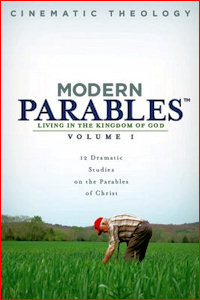
  • Modern Parables is video-based curriculum for studying some of Jesus' best-known stories. I received a set of these several weeks ago, and I've been wanting to do a proper review. Perhaps I still will get to do that, but in the meantime I noticed that they have been released for iPod, and that prompted me to say something about them. The production quality of these films is excellent, and the story adaptations are quite good—faithful to the spirit of the original biblical text but set in 21st-century culture. In other words, these are "contextualized" versions of the Parables—in the best sense of that word.
         My one rather mild criticism is that I wasn't equally impressed with the accompanying instructional material from parable to parable. Several teachers with assorted styles of teaching offer their insights on the stories, and let's just say that some of them are more insightful than others. The one other hesitation I have in recommending these films is that I know there are pastors out there who will be tempted to show a film like this in a church worship service instead of preaching a proper biblical sermon. Fie on anyone who does that. Still, the films offer excellent illustrative material for home Bible studies, family devotions, and similar settings.
  • Speaking of contextualization, in a few days, I plan to follow up on my Shepherds' Conference message with a discussion of that term and the various ideas that are most frequently associated with it. In fact, that might require an extended series of posts. So watch this space. Those who listened to the Shepherds' Conference messages may be surprised to learn that there is no official "theme" for the conference, and plenary speakers are not advised regarding topics they should or should not speak on. So it's interesting that every plenary speaker this year mentioned the problem of contextualization and how both that term and the concept it stands for are being abused nowadays. There wasn't any conscious strategy to make that this year's focus. We were all just being prophetic, I guess. Or whatever.
         Anyway, I haven't had an opportunity yet to read all the discussion pro and con in the blogosphere about the use and abuse of the word contextualization, but I'm aware there was some commentary posted about it, both in neighborhoods of the blogosphere that I enjoy and admire, as well as in some of the more seamy districts. I'll probably interact with some of those comments in the days to come.
         In the meantime, let me say this about the term itself: it's one of those problematic and increasingly useless terms like evangelical and missional. Contextualization is a fairly recent term of questionable origins to begin with, and it has been so badly abused and so infused with differing (and sometimes contradictory) meanings that it's hard to know whether any two people who use the word have the same meanings in mind. (For that reason I spent some time in my message at the conference defining what I mean by it.) I frankly don't like the word because it's laden with all the overtones of postmodern relativism. I recognize, of course, that there's a valid necessity for the translation and illustration of truth across cultural boundaries. The problem with the average Fuller-trained missiologist's notion of contextualization, however, is that more often than not, this entails not merely translation and illustration of the truth but a wholesale deconstruction/reconstruction process where the point is lost in translation.
         So I'll get into all that as soon as my schedule permits (probably later this week or early next week), but for now let me just toss this idea on the table for discussion: In contrast to all the books written, lectures delivered, and sermons preached over the past five decades about adapting the gospel message for different cultures, the greater need today is for evangelicals to remember that the central themes of redemptive truth—including sin, guilt, righteousness, faith, and grace—transcend culture, and if in our efforts to translate the message for other cultures we lose the transcendent truth of it, we've messed up big time. That was the actual point of the various messages at the Shepherds' Conference this year, and we'll try to tease some controversy and careful thinking out of that idea in the days to come.
  • For more than a year now, I've been watching (and trying to steer clear of) the unfolding drama at Cedarville University—featuring a multi-faceted disagreement over postmodernism, certainty, assurance, Emerging theologies, New Perspectives, and fads vs. fundamentalism. Here's a fairly dispassionate article from The Chronicle of Higher Education about the scandal over two tenured faculty members who were dismissed last summer, giving rise to "fear that other theologically conservative members within the department and the general faculty may be terminated." The dynamics of this controversy have been fascinating as it has played out. If you want to understand the subtleties of the postmodern drift among once-conservative evangelical/fundamentalist institutions, just watch what happens (and has already happened) at Cedarville.
  • The Pope has updated the Roman Catholic Church's list of mortal sins. Warning: Recycle or burn in hell.
Phil's signature

09 March 2008

A Fearful Thing

Your weekly dose of Spurgeon
posted by Phil Johnson

The PyroManiacs devote some space each weekend to highlights from The Spurgeon Archive. The following excerpt is from "Future Punishment a Fearful Thing," a Sunday-morning sermon preached at the Metropolitan Tabernacle on 25 March 1866.


read in a newspaper yesterday the notes of a sermon preached by a certain Congregational preacher in London, a sermon which I must confess did not altogether so much startle me as it would have done if I had not known the gentleman's antecedents; but it did startle me when I read these words.

I will quote a few sentences:

If I dwelt upon this doctrine Sunday after Sunday in this place of worship, and induced you to believe that people who have lived and died impenitent are thrown into a state of condemnation and misery,—I say if I believed that, how could I fail to feel for you or find rest to my spirit until I grasped every one of you and beseeched you to consider how terrible is your destiny, and how awful your danger! Are we not giving up ourselves to all sorts of pleasures and entertainments? When the work of the day is over, do we not try to obtain some sort of relaxation among the drama, the theater, the cards, and all kinds of social delights, to direct our thoughts from the terrible, piercing realities which are every day and every hour wearing out our lives? How dare you if spirits of men are going into everlasting damnation every instant that you breathe, if you believe that every breath you draw there is some soul damned for ever, some poor human being which has lost its way and come into utter misery? Are you to be playing games, are you to be going to concerts and sitting in front of stages and theatrical entertainments and finding your pleasures and recreations there? If you do, you are like demons; if you can look on and see unnumbered millions of your fellow creatures perishing for ever, and if you can live and enjoy yourselves, you deserve to perish for ever.

And then he goes on to say that if we can go to comfortable places of worship and sit there contentedly, and spend our lives in making money and live for nothing else, then we are false to our profession of belief in this doctrine, and he denounces the inconsistency, and adds:
If I believe that doctrine I dare not preach here; I do not know where I dare preach, but somewhere under the open sky where I should be able to say that human beings are being lost. If this doctrine of everlasting damnation be true, how ought you to labor to save souls from everlasting death! you ought never to think of anything else, but declare it from the house-tops, and never enjoy yourselves or make more money or sit quietly in chapel, you ought to wander over all the earth and bring spirits back again to the God who will damn them if they do not come unto him.

Now when I read all this, I thought, It is even so, the doctrine of eternal punishment should thus act upon us, and for this very reason it ought to be preached and insisted upon: one would not have been surprised to hear the preacher proceed to press the doctrine in order to produce just such hatred of frivolity and worldliness, and just such zeal and fervor, but who is not horrified to find that the next sentence is—
I really believe that the doctrine of everlasting damnation is a blasphemy against God! I believe it to be demoralising to the spirit of a man, and subversive of all the laws of humanity; I believe that the doctrine of Atheism would be better.

After first of all showing how we ought to live if that doctrine be true, and very properly showing its influence in promoting zeal and fervor, this misguided man declares that Atheism would be better than a doctrine so practically useful. No answer is needed beyond his own words. Surely that doctrine is not so very demoralising which would make ministers and hearers earnest to win souls, would keep them from vain amusements, and make them give up mere money-making, and pleasure-seeking and self-comfort, and drive them into earnest, passionate weeping, longing and labor for men that they might be saved. I pray God that such teachers may have a better mind, and that all of us may be kept faithful by the power of the Holy Spirit, working to win men because "It is a fearful thing to fall into the hands of the living God."

C. H. Spurgeon


08 March 2008

Weekend Extra: Monotheism

by Frank Turk

I have no idea what you people read when you're not reading the funny papers over here, but Justin Taylor has been interacting with a fellow named Rick Love over at his blog regarding whether or not it's profitable or right to say that Muslims worship the same God, via their monotheism, that Christians do.

I think that Rick's view is overgenerous -- which is often a mistake one makes which ultimately hurts one's self. But in this case, I think it also hurts those to whom one preaches the Gospel.

I have dragged Rick's latest 8 points over here to make some longer comments.
1. [Justin's] critiques vividly illustrate that not all monotheists are created equal. My previous response focused on the objective beliefs of monotheists and failed to acknowledge the subjective (or heart) dimensions of monotheistic worship. I was wrong in not pointing this out and stand corrected. In fact, there is a spectrum of “receptivity” among monotheists. There are people who are monotheists by confession but whose hearts are far from God, as you made clear in your reference to John 8. However, there are also monotheists who are receptive to God as the stories of Nicodemus (John 3), the Samaritan Woman (John 4), and Cornelius (Acts 10) make clear.
You have to give a guy credit when he can say something like "I was wrong". I think the problem is that Rick thinks here that he was only wrong by omission and not wrong in the conclusion he has drawn by this omission. The last sentence of this statement makes it clear that in spite of conceding that John 8 really fortifies the hard exclusivism of Christian monotheism, he doesn't really work out all the ramifications of that exclusivism.

See: in John 8, Jesus does something which echos the OT, and it's not merely in his reference to Abraham. He's telling the Jews what the prophets have told them before -- namely, that infidelity toward God defines their sin. It's rather odd that the Jews get this right away by saying that they are not illegitimate children -- but that Rick doesn't quite get how that relates to even older statements from God to Israel like Micah and Hosea's prophecies.

Activity in the temple does not equal right worship -- and that is what is at stake. Right worship is fidelity toward God, and that starts on the inside of man and moves outside of him. I'll have more to say on this in Rick's point #6.

What we call Muslims to is not merely changing the name of the God they worship -- I would be willing to concede that someone who worshipped "elohim" would be worshipping "Yahweh", and that in Arabic Bibles the name "Allah" there as a generic term is a fair reference to God. What we are calling them to is worship of the true God of all things, maker of Heaven and Earth, in whom the radiance of the glory of God and the exact imprint of his nature are given to us in Jesus Christ.

Rejecting Christ is rejecting God. Saying less than that, however nuanced, is falsifying the Gospel and leading people to false faith.
2. In the framework articulated in my previous two responses to Piper, I have made it clear that while monotheists worship the true God, they lack the revelation of Jesus Christ and are not saved. Therefore, the Jesus-denying monotheists of John 8 clearly fit into my framework (I just failed to make this explicit as I note in point #1 above). Moreover, I can’t find anything in the text where Jesus says that the Pharisees worship the wrong God. (Did I miss something?) It seems to me he is saying their hearts are not right before God and thus their worship is not acceptable. (We will come back to the issue of the heart shortly.)
In fact Rick did miss some things pretty significant. The first is this: Jesus says explicitly that God is not their father, but the Devil is. Just because Jesus didn't then say, "and because the Devil is your father, you are worshipping the wrong god," doesn't mean that we don't here have John putting the loadstone of idolatry around the necks of the Jews. Jesus says plainly that the Devil is a murderer and a liar, therefore these men are also murderers and liars; that statement ought to be contrasted with the statement Jesus makes about Abraham, namely, "If you were Abraham’s children, you would be doing the works Abraham did, but now you seek to kill me, a man who has told you the truth that I heard from God."

God's followers/children act like Abraham; the Devil's followers/children act like the Devil. It's a simple parallel construction, and it points to idolatry, not "lack of revelation".

And there is a worse omission here by Rick: Jesus says explicitly that it is not revelation that they lack. Jesus says to them, "Why do you not understand what I say? It is because you cannot bear to hear my word. You are of your father the devil, and your will is to do your father’s desires." The message is presented to them, but they cannot bear it because they are not of God but of a false god.
3. Parenthetically: unlike Jesus, we are not always able to accurately discern those who are Jesus-denying. Many people may appear like they are denying Jesus when in fact they really don’t understand who Jesus is and what He has done for us. Just as we cannot assume that all Jews were Jesus-denying people, in the same way, we cannot assume that all Muslims are Jesus-denying people. We CAN assume that they need to see and hear about the beauty of Jesus – His person and His work.
This is a mistake of taking our non-omniscience as a basis for radical skepticism. It annihilates our ability to know and therefore act on any external data. If it is true that "we are not always able to accurately discern those who are Jesus-denying", I think that we have only a handful of choices. One is then to preach the Gospel to all as if they are all lost, all Jesus-denying -- which leads to the radical fundamentalism of some who wind up in a theological circle so small that they can only keep one foot in it.

Another way to handle that is what Rick does here -- and that's to give everyone the benefit of the doubt, thinking they only know a little about God, and that their evangelism only requires us to fill in the missing details. I think that's a horrible mistake as it overlooks the radical implications of the Gospel.

It is possible to make the Gospel too fragile, as I think the radical fundamentalist does; I think it is equally likely to make the Gospel optional, or somehow so nuanced that it does not call men to a radical change. Neither option ought to be on the menu for evangelists and preachers of the word.
4. [Justin seems] to wonder how I could possibly say that monotheists worship the true God. I feel strongly about this because I think the Bible speaks strongly about this. First of all, a polemic against idols and an affirmation of monotheism is at the heart of the Ten Commandments "I am the LORD your God, who brought you out of the land of Egypt, out of the house of slavery. You shall have no other gods before Me. You shall not make for yourself an idol, or any likeness of what is in heaven above or on the earth beneath or in the water under the earth” (Ex 20:2-4).
I'm interrupting here because there's something Rick misses badly here, and that's the point that the 10 Commandments do not require monotheism but right worship of the true God. That is not merely "monotheism" any more than living with one woman right now is monogamy. You have to be married to the right woman, and be faithful to her, to be monogamous. Anything else is adultery.

In the same way, you have to be devoted to the right God, and live as if He is your God and you are one of His people. Anything else is idolatry. If that's not what the 10 Commandments require, then God was mad at the people for the wrong reasons when He told Moses to destroy the Golden Calf.
Secondly, the Shema (“Hear, O Israel! The Lord is our God, the Lord is one! Deut 6:4), describes the fundamental truth of Israel’s monotheistic faith. It was confessed daily during prayer in contrast to the idolatry and polytheistic beliefs of Israel’s neighbors. Thirdly, both Jesus and Paul clearly affirmed monotheism (Mark 12:29ff and Rom 3:30; 1 Tim 2:5). Therefore, it seems to me that polytheism vs monotheism is the big divide in Scripture re: worship of the true God (The 160+ references to idolatry in the Bible further strengthens this viewpoint). In the NT Paul says that when Gentiles offer sacrifices to idols they are really offering sacrifices to demons and not to God (1 Cor 10:19-20). In other words, polytheism and idolatry are clearly demonic in light of Scripture, whereas monotheism is always portrayed positively.
Let me re-affirm that the question is not whether there is one God or many gods: it is whether one is rightly seeing God as God.

What's at stake in the Bible is not philosophical monotheism: what is at stake in the Bible is the personal identity of the one true God above all false gods which man puts in His place. I'd say this is most vivid particularly in what comes after the Sh'ma -- in that God says to Israel, "listen: teach these things to your children so that you don't forget Me."
5. Ahh, you say. But what about James 2:19? “You believe that God is one. You do well; the demons also believe, and shudder.” I would argue that the intent of James 2:19 is not to critique monotheism, but rather to critique “faith without works.” In other words, it is not the objective belief content of monotheism that James critiques, but the lack of obedience-producing faith in their hearts. In fact, James’ argument only makes sense if we see his affirmation about monotheism as an orthodox confession. In keeping with the original intent of the text, I think we could apply James’ teaching to modern Christians as follows. If James were writing this to Evangelical churches in America he might say: “You believe that God is three in One – the Holy Trinity. You do well; the demons also believe, and shudder.” Demons know that God is one. I assume that they also know that God is three in one!!
Again, I think Rick misses the point here widely. If someone were to pull out James 2 for the sake of underscoring the true worship of God, one has to go to context here -- because James' real concerns in James 1-2 is "true faith" vs. "false faith". James says that faith which looks upon the Law and then forgets the Law -- that is, it doesn't do anything about the Law -- is a false faith. He is carrying that thesis forward in James 2, and when he comes to the religion of demons, he says, effectively, that the demons know the truth about God -- they just don't do anything about it.

The demons do not worship God, and are not saved by God -- that's James' implication. That is, if you want a faith like the "faith" of demons, you can have the same end as the demons.
6. The two key texts you used to critique my theology, John 8 and James 2:19, lead us to another very important point: worship is a thing of the heart – something that I did not carefully explain. I think we would both agree that right theology is not enough – whether a person is a receptive monotheist or a non-obedient Trinitarian. I think the story of Cain and Abel gives us insight into these issues. Both worshipped the one true God. But Abel’s worship was acceptable and Cain’s was not (Gen 4). So the issue is not just about worship of the true God, but more precisely about worship that is acceptable to God, i.e., “true” worship of the “true” God.
I'm not sure what this has to do with whether or not worshipping Allah is interchangable with worshipping Christ. What's at stake in preaching to Muslims is that they have a false revelation and therefore worship a false god, not that the make insufficient offerings.
7. Here’s how I would like to rework your illustration, recognizing the limitations of the metaphor. I would say that monotheism could be compared to an understanding that the U.S. has one President and that the U.S. is a great country to live in. There are those who acknowledge that the US has one President but they hate him and do not want to live in the U.S. (=unreceptive or hard-hearted monotheists). There are other people who actually respect and even love the President of the U.S. and long to live in the U.S. but neither know the President nor are they U.S. citizens (=receptive monotheists). Finally, there are those who respect and love the President of the U.S. and in fact have personally come to know him. They have also become full citizens of the U.S. (=repentant monotheists who come to follow Jesus).
The problem with this illustration is that the Bible doesn't make that many categories for those who are outside of Christ.

Christ is the light which shines on all men, exposing their evil deeds, and men reject the light. Period. The fullness of God is given to us in Christ, and those who reject the Son reject the Father. Period. Either one has right faith in God through Christ, or one is hell-bound because he has rejected God.

Those are the biblical categories. The Bible doesn't paint a gray area to which we can them shuttle people in the hope that we can make the Gospel less offensive to them. And if I haven;t said this clearly, I'll say it clearly right now: philosophical monotheism is an affront to God, who is personal, active, loving, just and holy. Effacing the identity of God is just as idolatrous as calling Dagan or Ashtoreth the god of your nation. It's a Romans 1 error for which men are condemned.
8. Justin, I think it is extremely important to note that there would be little or no difference between you and me in practice. Both of us would approach the monotheist with the goal of sharing the unfathomable riches of Christ. Both of us would ultimately seek to win him or her to follow the one who said, “I am the way, the truth and the life!”
I disagree strongly. The view you are advocating is that there is actually less to do for the Muslim than there is, for example, for the Hindu or the Buddhist. That will yield specific results in evangelism in practice.


07 March 2008

In Case You Missed It. . .

by Phil Johnson

Evers Ding has been liveblogging the Shepherds' Conference. Great summaries; tons of information and pictures. He has really captured the flavor of the week.

There's more at the Pulpit blog. (See right sidebar).

Phil's signature

Two religions in stark contrast

by Dan Phillips

In a very long post, I contrasted Luke Timothy Johnson's notion of religion with the Bible, and did some Proverbs 21:22-ing to it. Not everyone would want to wade through such a treatise, and I don't blame anyone who didn't. What I want to do here is give you the heart from a different and more constructive angle, without all the demo work and analysis. (See the other post for fuller analysis and documentation.)

Luke Timothy Johnson simply represents the latest head of a very old Hydra. It took life in the Garden, when our great-great grandma somehow found herself in the one place she knew she had no business being, looking at the one fruit she knew she need never eat. She already knew everything she needed to know about that fruit: God said it wasn't for her. Yet there she was.

If she were hoping for another perspective (than God's), she got it. The Tempter started out by insinuating that God's viewpoint was narrow and parochial. When she took him up on this, he took the next step of full denial and the rest, as we say, is history.

Thus began a millennia-long series of human-viewpoint religions ranging from perversion of truth to outright formal denial. In Judaism by Jesus' time the former had morphed into formal acceptance of the Torah, but in-practice denial, as a series of horizontal ideas had functionally displaced the vertical revelation (see Mark 7:1-14).

Though decrying Pharisaism, Johnson is in that line. In the name of the vertical, he is concerned solely with the horizontal: what are people's profound stories, passions, yearnings. The flesh is
renamed as the spirit, and it trumps the Word of God. This, I say, is just one form of the same process which, in and out of "Christendom" broadly so called, displaces the genuinely vertical by the actually horizontal.

Let's just contrast that with three passages from the Word. The first is from Jeremiah, who has so much to say to our age. It's one of my favorites. The prophet is in prison, and "
King Zedekiah later sent for him and received him, and in his house privately asked him, 'Is there a word from the LORD?' (Jeremiah 37:17 CSB).

Were he a Johnsonite, Jeremiah might have responded, "You tell me." Or he might have said, "Yes there is. I listen to the voice of God in our people's profound stories, and I find that God is expressing Godself in many forms, in the joyous festivals of Baal, Marduk, Dagon, and a host of other names God uses to embody Godself in our day."

Instead, we read this:
"There is," Jeremiah responded, and he continued, "You will be handed over to the king of Babylon."
Wow. And ouch. But there it is. Jeremiah did not always like what he was constrained to say, but since it did not come from within himself or his contemporaries, but instead came from God above, there he stood. He could do no other. God help him (Jeremiah 20:7-18).

Fast forward. God the Son Himself has come to earth, lived, taught, died, been buried, been resurrected, and is about to return to Heaven. What are His marching orders, charting the course of His church in the age to come? Does He say, "Go out and tell the deepest tales of your heart! Search within, discern the whispery, mumbly voice of God as you think God expresses Godself! It will fundamentally change and mutate from culture to culture, but whatever you think it is, share it, see how it goes!"? Is that it?

Not at all. God incarnate says:
..."All authority in heaven and on earth has been given to me. 19 Go therefore and make disciples of all nations, baptizing them in the name of the Father and of the Son and of the Holy Spirit, 20 teaching them to observe all that I have commanded you. And behold, I am with you always, to the end of the age." (Matthew 28:18-20)
Once again, their proclamation is to be backward-looking and upward-looking. They are to teach what He taught them to teach. They are to teach His word, as a fixed and objective body of revelation; as well, the Spirit had more objective and inerrant revelation to give through His apostles (John 14-16), but even that was a fixed amount. There could be no tampering or diluting or perverting or "improving," because it issued from Him who had all authority in heaven and earth. It was non-negotiable.

Fast forward to Paul, giving an apologia to the Corinthians. He says this:
...we have renounced disgraceful, underhanded ways. We refuse to practice cunning or to tamper with God's word, but by the open statement of the truth we would commend ourselves to everyone's conscience in the sight of God. 3 And even if our gospel is veiled, it is veiled only to those who are perishing. 4 In their case the god of this world has blinded the minds of the unbelievers, to keep them from seeing the light of the gospel of the glory of Christ, who is the image of God. 5 For what we proclaim is not ourselves, but Jesus Christ as Lord, with ourselves as your servants for Jesus' sake. 6 For God, who said, "Let light shine out of darkness," has shone in our hearts to give the light of the knowledge of the glory of God in the face of Jesus Christ (2 Corinthians 4:2-6 ESV)
Paul would have bristled at and abominated the very suggestion that what he preached originated from within himself to any degree (cf. Galatians 1). It was not, at bottom, his "profound story." Paul was absolutely insistent that his message came from without and from above, from the throne of God Himself. That is why it could not be tampered with (cf. all of Galatians), why he would proclaim it without apology or equivocation of any sort, and why anyone who proclaimed anything different should just go to Hell where he belonged (Galatians 1:8-9).

And that is why the focus of the church had to be above all, through all, always and only the Word of God (cf. Colossians 3:16; 2 Timothy 3:15-17; 4:1-2, etc.).

In spirit and in specifics, this could not be more chasmically distinct from and contradictory to Johnsonian horizontalism, or any variation thereof.

Machen told us 80+ years ago that it wasn't a variation of Christianity. It was another religion. The PCUSA didn't listen, it jumped the shark, and it's never jumped back.

Will we listen — not to the latest poll of sinners frolicking below, but to the extrinsic and transcendent word of God?

God grant we so listen, so believe, and so speak and write and live.


Dan Phillips's signature


06 March 2008

Long-Term Market Viability

by Frank Turk

In 1987, Tyndale house published a little book by Kent & Barbara Hughes called Liberating Ministry from the Success Syndrome. I point that out because that book subsequently went out of print. About 8 years later, Rick Warren published Purpose-Driven Church, and of course that book is in all sorts of editions and supplements and so on. I think it's somewhat beyond question that PDC as a franchise is one major factor in the modern megachurch movement (your opinion may differ), but there's a real problem sort of glossed over there which we should take a minute to examine.

It seems that most churches are not megachurches, and therefore most pastors are not megachurch pastors – that is, most churches are small and, apparently, are content to be that way. If you follow that link and do some simple math, you'll find that about 6.5% of all churches in the U.S. – and we can imagine, then, that about 6.5% of all pastors – have 500 or more on the rolls. The numbers get somewhat disheartening when we start talking about actual attendance, so we won't go there.

But I say that to say this: the ideal of the megachurch places by-far most pastors in the unenviable position of being rat-raced. Either by outsiders (meaning those not in the ministry of that local church, which can include members and volunteer leaders) or by insiders (other pastors from other churches, including denominational administrators and leaders, or the pastor himself) a pastor is pressured to measure success using secular, business criteria. You know: growth. Charts with lines that look like purple mountains majesty. Tithing up. More things going on. More baptisms.

And don't get me wrong: those can be good things. The question is really if that is the purpose of ministry – to produce results which drive shareholder equity and create an institution with long-term market viability.

Some people would say "yes": upon this rock I will build my church, and the gates of hell shall not prevail against it. The only good church is a church which grows and gets bigger, and all others are frankly suspect.

Other people would not be so quick to draw that conclusion, including, apparently, my heroes at Crossway books who have salvaged the Hughes' book and put it back into print. Kent is an editor at Crossway now, contributing to the Preaching the Word commentary, and has been a pastor for forty-one years, including twenty-seven years as the senior pastor of College Church in Wheaton, IL. His wife Barbara is a teacher and speaker, and has co-authored other books with Kent, including Disciplines of a Godly Family.

This is frankly a fantastic book – written personably, compassionately, and with a keen eye on the brother in Christ who is under the false pressure to produce Pentecost-like revival. And, as is my habit, I'm not going to spill a bunch of summaries of the book in this space for you to sort of parse and then pass over the book.

This book is sort of birthed on the back of Kent's experience as a pastor who, early in his calling and mission, suffered from a very serious crisis of faith because his church wasn't exploding with people. He himself calls this period "a gray, horizonless sea" in which he struggled with the thought, "God has called me to do something he hasn’t given me the gifts to accomplish. Therefore, God is not good."

But with his wife, and by reflecting on Scripture, Kent navigated the course from this deep dejection back to fruitful ministry – and he lays out the buoys for others to follow.

His reflections on what the Bible defines as success for the man of God – through faithfulness, service, love, belief, prayer, holiness and attitude – are told in a very compassionate and engaging style. This isn’t a book of preaching but a book of encouragement and of exhorting those who say they are called to God's work to do what God has called them to, and not other things.

In addition, Barbara's insights as the faithful wife of a life-long pastor round out the picture for the reader. Which brings me to a critical point to make about this book: it is not only for pastors, or for the wives of pastors: anyone who has a pastor, or wants to have a pastor, should read this book before attempting to think about how we should test or prove or otherwise scrutinize those who are in the service of the Gospel.

This book serves to humanize the pastoral ministry – which is not to say that it seeks to find the lowest common denominator to establish the standards for pastoral ministry. Indeed, I would say this books sets an extremely high standard for the minister of God's word – but it puts that standard in terms an actual human being can grasp and therefore live up to.

Read this book. You and your church need this book. I endorse it whole-heartedly, and God willing, I'll have more to say about it over the next couple of weeks.


05 March 2008

The Bible in the critical eye

by Dan Phillips

I was reading of Jesus' throwing out the merchandisers in Luke 19:45f., and it hit me.

Critics of the Bible reject miracles because nothing can happen only once.

Critics of the Bible reject two Temple cleansings because nothing can happen twice.

...if it's in the Bible.

Dan Phillips's signature


04 March 2008

Who does Luke Timothy Johnson think he is? God?

by Dan Phillips

Let's take a second look at another item that's been around the blogs.

Luke Timothy Johnson, the Robert R. Woodruff Professor of New Testament at the Candler School of Theology, Emory University, produced an article titled Homosexuality & the Church: Scripture & Experience. Johnson is a former Benedictine Monk, and is a Roman Catholic.

Warming up to the famous part, more or less:
I have little patience with efforts to make Scripture say something other than what it says, through appeals to linguistic or cultural subtleties. [Hear, hear!] The exegetical situation is straightforward: we know what the text says. But what are we to do with what the text says? We must state our grounds for standing in tension with the clear commands of Scripture, and include in those grounds some basis in Scripture itself. To avoid this task is to put ourselves in the very position that others insist we already occupy-that of liberal despisers of the tradition and of the church’s sacred writings, people who have no care for the shared symbols that define us as Christian. If we see ourselves as liberal, then we must be liberal in the name of the gospel, and not, as so often has been the case, liberal despite the gospel.
Sounds deep, eh? Promising? Then here it is:
I think it important to state clearly that we do, in fact, reject the straightforward commands of Scripture, and appeal instead to another authority when we declare that same-sex unions can be holy and good.
And finally, this:
...we explicitly reject as well the premises of the scriptural statements condemning homosexuality-namely, that it is a vice freely chosen, a symptom of human corruption, and disobedience to God’s created order.
Well, that's different. Johnson's not asking for a "five-year moratorium." He says the text is clear right now, we know what it says — and we reject it!

Now I'll pause to say that I have been this close to actually offering people money to get them to display that kind of candor. Roman Catholics, Mormons... and more than a few stripes of Christians. Just say it: "No way Scripture teaches ___, but I believe it anyway." Or "Scripture pretty clearly says __; but, instead, I believe ___." It would put the discussion on a whole different wheelbase. But no, such candor is rare. Again and again they get out The Pervertaneutical Rack, strap in those poor innocent texts, and start twisting until they scream out things they never meant.

By contrast, here's Johnson admitting, "Nossir, no way the Bible says what we wish we did. It says A, we say Z, and there's no denying it." Rather refreshing.

Johnson admits they must "appeal instead to another authority when we declare that same-sex unions can be holy and good." Another authority? Superior to Scripture? To Johnson, yes.

Johnson's article breathes disdain for Biblical Christianity from the first paragraph to the last. While Johnson may "have little patience" with people who pervert the text of Scripture, he even less for those who feel themselves in any way bound to that text. He complains that
If the neglect of Scripture is a form of sin ... a blind adherence to Scripture when God is trying to show us the truth in human bodies is also a form of sin, and a far more grievous one. ....it is a far greater risk to allow the words of Scripture to blind us to the presence and power of the living God.
"Blind adherence to Scripture" — an odd expression, that, given that Johnson's already granted that his opponents are right about what Scripture actually says. What is "blind" about that? They see it clearly. Are we "blind" because we not only see it and understand it, but believe it and try to live by it?

So let's say I'm convinced, or at least shamed out of my "blind adherence to Scripture." Let's say I want to throw off the shackles of the Bible, so that I can know this glorious freedom Johnson promises. What is this "still more excellent way"?

Here it is. Ready?
And what exactly is that authority? We appeal explicitly to the weight of our own experience and the experience thousands of others have witnessed to, which tells us that to claim our own sexual orientation is in fact to accept the way in which God has created us.
The authority is — me! You! Dr. Johnson! Our experience, and our stories. See what you feel like doing, what others feel like doing and, if it's the right kind of feeling, go for it.

Really, that's about it. Oh, Dr. Johnson might be deeply offended at that characterization. What he writes is all very nuanced and deep-sounding and full of profound catch-phrases. Devotees of his viewpoint aren't amoral, autonomous libertines; no (he insists), they are noble souls "who perceive God at work among all persons and in all covenanted and life-enhancing forms of sexual love." Got that?

So Johnson says listen to people's stories. (Indeed, story or stories occurs fifteen times in the article.) Not just any stories, though. We must use "careful discernment," mustn't follow "every idiosyncratic or impulsive expression of human desire," but only "those profound stories of bondage and freedom, longing and love, shared by thousands of persons over many centuries and across many cultures, that help define them as human." He says this itself is the ongoing saga of the work of God within the life of man, unfolding and disclosing himself in human stories, et cetera and so forth. Or, as Johnson says memorably (if not very coherently):
When read within the perspective of a Scripture that speaks everywhere of a God disclosing Godself [?!] through human experience, our stories become the medium of God’s very revelation.
Then of course, in spite of his earlier bracing cautions against doing violence to Scripture, Johnson finds he must do violence to Scripture. He can't just let the matter rest with his open rejection of Biblical teachings.

For instance, Johnson mercilessly flogs poor old Galatians 3:28 yet again.
[An aside: merciful bunions, is there nothing that beleagured old text can't be bludgeoned into rationalizing, these days? A few decades ago, we (= you, I, and the apostle Paul) were breathlessly informed that it cancelled out the Biblical prohibition against women pastors. Now (we learn) it cancels out the univocal Biblical condemnation of homosexuality. What next? "There is neither male nor female, gay nor straight... human nor animal, vegetable nor mineral, love nor hate, sin nor righteousness, God nor Satan, cephalopod nor houseware appliance, National League nor American League, smoking nor non-smoking"? The mind boggles! Does Paul, in glory, regret writing the verse? Surely not!

But I digress.]
Johnson even trots out 2 Corinthians 3:6. Well, part of it: "the letter kills, but the Spirit gives life." Doing merciless violence to the context (which not about believing the word of God versus believing that I am the word of God), Johnson actually opposes "the letter of Scripture" (sic) to the work of the Spirit of God — the very Spirit who breathed out that Scripture which He is now said to oppose (1 Corinthians 2:13; 14:37). For
...if the letter of Scripture cannot find room for the activity of the living God in the transformation of human lives, then trust and obedience must be paid to the living God rather than to the words of Scripture.
At this point my Irony-ometer is on overload. The letter of the text is being quoted to condemn the letter of the text. You see, "The letter kills" means exactly that, word for word and in isolation from all else (we are told). This part of the Bible means that everything other part of the Bible is nonsense. That's the only verse that means what it says — well, that and "Judge not." But you have to take both verses in absolute isolation from everything else.

I'll retire to Bedlam.

Like all humanly-devised systems, Johnsonanity as expressed in this article collapses under its own weight and incoherence. For instance:

FIRST: The real revelation of God is (not the Bible but) "profound stories of bondage and freedom, longing and love, shared by thousands of persons over many centuries and across many cultures"? Then what shall we say of the "stories" of the Bible-believing Christian church? Does Johnson's description, in itself, not describe those stories and those experiences as well? On what basis shall we oppose Johnsonites and their stories over against — what shall we call them? "Christians"? — and their stories? On the basis of greater numbers? That argument won't work very well to normalize homosexuality. Because they aren't "profound" enough for Johnson? Then we have to go to Johnson to have our stories sifted? "Profound... not profound... profound... definitely not profound...." Will Mt. Profundity replace Mt. Sinai, or the Sermon on the Mount? And will Johnson replace Moses... or Jesus?

Do we have an objective, transcendent standard to which we can appeal?

Well, we do. Johnson acknowledged it, rejected it, messed with it, puts himself in its place.

So why are Johnsonites' stories revelations of God, but diametrically-opposed stories of Bible-believers aren't? Why are Johnsonite libertines motivated by the life of God expressing itself in them, but those who hold to Biblical teaching are moved only by ignorance, and a "mix of fear and anger"?

And what's God's current story on the world, and whether we should love it and be conformed to it, or not?

SECOND (but related): have we really gained, by moving the locus of authority from an objective and external source to a subjective and internal source? Again, what will be our basis and our criterion? Johnson and I could look at the Bible and get into an exegetical discussion, with all of the data out there for everyone to see. But interpreting subjective stories as the voice of God? Why the stories of passion-enslaved libertines? Why not the stories of the far vaster numbers of Muslims? What's to prevent the Taliban from telling Dr. Johnson "Great! Thanks! We'll take it from here!" and then dealing with his homosexual friends according to their stories?

I don't think he'd like that story.

THIRD: none of this can claim the authority of any Jesus of Nazareth who ever actually lived. Johnson has gained some notice as a critic of the Jesus Seminar. Great; I'm no fan either. But the only Jesus who ever actually lived never, ever spoke disparagingly either of the word of God that we call the Old Testament (Luke 16:17; John 5:47; 10:35), nor of the words of God that we abidingly possess in His own teachings in person (Matthew 24:35; Mark 8:35 [very germane in this connection]; Luke 6:47; John 8:31-32; 12:48; 14:23-24; Revelation 3:8) or through His apostles (John 16:12-15; cf. 1 Corinthians 2:13 [NAS]; 14:37).

This flat rejection of the written word is found in neither prophet, apostle, nor God Incarnate.

FOURTH: Johnson is a Roman Catholic, presumably in good standing. You know, member of The One True Church® that is always trying to claim absolute unbroken unity, as opposed to Christians with our 45 bazillion denominations? Think about it.

And what of "the first pope," the apostle Peter, expressly ranking the written, prophetic word of God over even the best and most amazing stories (2 Peter 1:16-21)?

IN CONCLUSION
You can't read the Gospels without seeing Jesus at war with human tradition. His hearers were amazed by that very point: Jesus has not been moved from the text by profound human stories, but has instead returned directly to it, in all its naked power and authority (Matthew 7:29; Mark 1:22; 7:1-8).

And so now, two thousands years later, it bowls me over that so many of the Jews I read and hear are still in exactly the same place as the Jews of Jesus' day: chained to tradition, fenced off from the Word.

But if that is stunning, it simply kills me to see human tradition imposed again and again in the name of Jesus! For what is Dr. Johnson doing if not crushing the Word under human tradition? The only difference is that the Jews' tradition is old, and Johnson's is new, amorphous, still a-borning, chaotic, and imbued only with his authority.

(On second thought — is it really that new? Is it the next step in spiritual evolution? Or does it not go right back to the Garden, and echo the voice of him who also flatly contradicted the transcendent, objective, binding word of God, and who promised instead, "You shall be as God — let your story be the rule and the law!"?)

This returns me to why I became a Christian: I'm just not that smart, wise, nor good. I'm not fit to be my own Lord. "You shall be as God" is a lie. That's a foundational realization for my conversion and, I dare say, any genuine conversion. (That's my "profound story," by the way.)

Luke Timothy Johnson's position does not give any evidence of that realization. The twin foundational truths of "There is a God, and I'm not Him" are nowhere to be seen.

Goodness, if only someone had sometime publicly made the point that, "despite the liberal use of traditional phraseology modern liberalism not only is a different religion from Christianity but belongs in a totally different class of religions."

But of course someone did: J. Gresham Machen, over 80 years ago, in Christianity and Liberalism (p. 7). Machen was right then; he's right now. Did Johnson never read that story?

And so in Johnsonian liberalism the locus of authority is removed from the text of Scripture, and moved to Dr. Johnson, to you, to me. Anywhere except the Word. The word of God is strictly horizontal. It is found in Johnson's (and our) discernment of the right subtexts of the right human authorities.

Practically, if not formally, Dr. Johnson thinks he's God.

But he's not.

God is.

Final word: if some emergent leaders are wolves in sheep's clothing, what are people who expressly reject the word of God in favor of their own thoughts, feelings, experiences, "profound stories"?

Wolves in wolves' clothing — but with this difference: these wolves say, "No no no, this is how sheep really should look!"

Jesus Christ came into the world to save sinners, of whom I am foremost (1 Timothy 1:15). But there's Dr. Johnson, saying, "No no no, that's not sin, and you don't need saving from it!"

Me, I'll take God's word on what sin is, what I need, what all of us need.

That's my story, and I'm sticking to it.

Dan Phillips's signature

03 March 2008

Gospel Lite

Tastes Great; Less Filling
by Phil Johnson

[From an article published last year in GraceTrax.]

The defining principle of historic evangelicalism was an unwavering devotion to the gospel. But the broad movement that calls itself "evangelical" today no longer stands for any clear point of view and can't seem to find consensus on even the most basic of gospel truths. How did that happen?


he word evangelical used to be a good one. The term dates back at least to William Tyndale, and it refers to the belief that the gospel message—the evangel—is the vital heart of all Christian truth. To a real evangelical, everything that is of primary importance in Christianity is embodied and summarized in the gospel, and any belief system based on an aberrant gospel is not authentically Christian.

Evangelicals' passion for keeping the gospel at the center explains why historic evangelicalism has always been theologically conservative, biblically based, warm-heartedly evangelistic, and dynamically experiential.

But the contemporary evangelical movement has become something completely different. Evangelicals can't even seem to agree among themselves anymore about what the gospel is or whether the factual and doctrinal details of our message are really even all that important.

Practically every trend in the evangelical movement today attempts to redefine the very points of gospel truth earlier evangelicals had universally deemed essential. That's true of the New Perspective on Paul, for instance, which proposes a wholesale redefinition of what Paul meant by "justification." It's true of Open Theism, which redefines God Himself (denying His sovereignty and His foreknowledge) and then relentlessly shaves the hard edges off every doctrine thought to make Him seem "too harsh"—starting with substitutionary atonement. It's especially true of postmodern and Emergent approaches to Christianity, where almost anything goes and every truth of Scripture, including the gospel, is reimagined daily.

Yet postmodernism, Open Theism, and the New Perspective (along with several other similar aberrant ways of thinking) have managed to make themselves quite at home under the broad tent of the contemporary evangelical movement. Read any recent issue of Christianity Today if you doubt this.

How did it come to this?

For the past fifty years or more, people calling themselves "evangelical" have been systematically watering down the gospel; filtering out the hard parts; and trying every way they can think of to tone down the offense of the cross. They have been serving up "gospel lite"—a pale imitation of the true gospel, specially distilled to taste good and go down easy. As more and more "refinements" have been made to the recipe, few people in the movement seem to be asking whether the message we're now collectively proclaiming to the world even has enough gospel left in it to be considered authentically evangelical. (It's my conviction that the correct answer to that question is no.)

The problem can be traced, I think, to a craving for academic respectability and worldly admiration. In the middle of the 20th century, several leading evangelicals proposed a whole new kind of evangelicalism—less militant, more tolerant, and (above all) shrewd and market-savvy about public relations. The neo-evangelicals seemed to operate on the assumption that the way to win the world is by making the evangelical movement and its message as appealing as possible to worldly people. In other words, let's "sell" Christianity the way Budweiser sells beer.

Why not? If they like us, surely they'll like Jesus, too.

The early compromises were subtle—just a shading of the message here and there to make it sound more positive and winsome. Instead of starting with sin, the way Romans 1 does, evangelicals decided that God's love made a more harmonious opening note for our gospel presentation: "God loves you and has a wonderful plan for your life."

By the 1970s, evangelical preachers seemed to have little to say about sin and human depravity. And the wrath of God was hardly mentioned even in a whisper. The problem of sin was never actually denied, mind you—it was merely shifted more and more into the background. The gospel's call to repentance was dropped in favor of urging people to seek personal fulfillment and "a personal relationship with God."

Soon evangelicals weren't mentioning sin at all anymore. It was as if they suddenly forgot that the human dilemma is all about eternal and spiritual matters. Instead, by the mid 1980s, the issues that dominated evangelical pulpits were temporal and psychological: low self-esteem, interpersonal relationships, a sense of purpose in life, a feeling of belonging, and (of course) how to be happy, healthy, wealthy, successful, and full of self-esteem. Evangelicals portrayed "the gospel" as a quick 'n' easy answer to those questions, and little else.

By the 1990s, some evangelicals were making scarcely any reference to the gospel at all. They were so bent on winning the world's admiration that their "outreach" strategy was reduced to trivial attempts to put some kind of spiritual-sounding spin on virtually every kind of worldly entertainment. And if they couldn't make something sound spiritual, they would sometimes do it anyway—just to entertain.

During the heyday of the seeker-sensitive movement in the early 90s, someone showed me a video featuring one megachurch's idea of how evangelism ought to be done. It was a 90-minute variety show, featuring comedy, drama, and dancing. Not one mention was made of the gospel and not one verse of Scripture was ever cited during the entire parade of acts. It was sheer entertainment. But then at the very end, an "invitation" was given, encouraging those who wanted their lives to be more meaningful to "accept Christ." Nothing in the entire presentation had given viewers any clue about who Christ is, what He did, why we need Him, or what it means to believe in Him. In other words, the gospel was totally missing.

I remember thinking even then that the quest for milder-than-ever flavors of Gospel Lite had already destroyed the evangelical movement.

Now, after several years of that kind of gospel-deficient ministry, multitudes of people who think of themselves as "evangelicals" are suffering from severe spiritual malnutrition. If trees may be known by their fruits (and if the latest Barna polls give any indication of what the evangelical movement is truly like today) it seems fair to assume that multitudes who call themselves evangelicals have never really been converted at all. And without any clear concept of the gospel to guide them, they are gullible, naïve, and susceptible to whatever false doctrine or spiritual ambiguity happens to be currently in vogue.

There's no denying that the evangelical movement has utterly lost its way. If that fact weren't already sufficiently clear, the point has now been punctuated emphatically—twice in the past year—with the resignations of top leaders from the movement's two most important umbrella organizations.

First it was the president of America's flagship evangelical society, the National Association of Evangelicals (NAE). Exposed in a sordid scandal involving repeated instances of infidelity, homosexuality, and drug trafficking, he admitted that he was a "deceiver and liar"—and that he had been so "for all of my adult life."

Fewer than six months after that story broke, it was revealed that the president of the movement's largest and most important academic fraternity, the Evangelical Theological Society (ETS), had quietly converted to Roman Catholicism. He eventually resigned from ETS—even though (judging from various evangelical op-ed pieces and discussions on the Internet) he might well have been able to hang onto his post as ETS president if he had so desired. Majority opinion within the organization appeared to be in favor of keeping him in office. It seemed as if no one could think of any fundamental difference remaining between evangelicals and Roman Catholics.

When the NAE president disqualified himself, evangelicalism's house organ, Christianity Today, was having its 50th anniversary celebration. The magazine had marked the half-century mark by sponsoring a series of articles about the future of evangelicalism. In the first of those articles, CT's editors more or less admitted even they aren't really sure what a correct definition of evangelicalism would be nowadays. But their working description of the movement began with the observation that evangelicals are now amazingly broad, diverse, and ecumenical. Those, of course, used to be the primary badges of liberal Christianity.

It's crucial to understand that the demise of the contemporary evangelical movement does not stem merely (or even primarily) from a failure of leadership. It is mainly owing to the whole movement's chronic neglect of the gospel as it is presented in Scripture. All those attempts to tone down and tame the gospel have changed the fundamental character of evangelicalism's message. By systematically doing away with all the hard parts of the message, evangelicals have essentially done away with the gospel itself.



It is not now and never has been a valid goal to make our gospel message more winsome, more politically correct, more sophisticated-sounding, or simpler than it already is. Since Scripture recognizes and makes no apology for the fact that the message of the cross is itself a stumbling block and mere foolishness to unbelievers (1 Corinthians 1:23-25), Christians who are determined to devise a smart-sounding or inoffensive message are not being faithful ambassadors for Christ. He has commanded what our message should be. Our only duty is to deliver it without altering the sense of it.

Evangelicals for the past half-century have done a miserably poor job at that task, and it's time to take our calling more seriously.

The Gospel in Brief

The entire New Testament makes it clear that the gospel demands a response of faith and offers salvation and eternal life to all who do believe (Romans 1:16; Ephesians 1:13). In very simple terms, the gospel is the good news of how full redemption from sin has been accomplished solely through the atoning work of Christ, and how it can be applied to sinners (cf. 2 Timothy 1:10).

But what are the essential facts and doctrines that make up the gospel message?

The apostle Paul summarized the gospel succinctly in 1 Corinthians 15:1-4. That passage is an outline only, and not an exhaustive treatise on the gospel, but it is perhaps the best starting place in all the New Testament to get a concise overview of what the gospel message consists of.

Notice that Paul makes it clear both here and elsewhere that a correct understanding (and proclamation) of the gospel includes not only the historical facts of Christ's death, burial, and resurrection but also the true meaning of those events "according to the Scriptures."

So even though some might suggest that Paul's shorthand gospel outline omits certain other doctrines Christians generally regard as fundamental precepts of gospel truth (such as Christ's deity and incarnation—or the authority and inspiration of the Scriptures), those things are necessary presuppositions of the facts Paul does list. Those and many other truths are included implicitly in the words "according to the Scriptures."

Jesus' deity, for example, is essential to a right understanding of what Paul means by "Christ." The principles of substitutionary atonement and justification by faith permeated all of Paul's teaching and consumed his energies when he wrote in defense of the gospel, so that there's no doubt he regarded those truths as utterly non-negotiable, too. It would be a serious mistake to conclude that because he omitted explicit mention of those points in this summary, he must have regarded them as extraneous to the gospel message. They are clearly assumed and subsumed in the statement "Christ died for our sins."

Remember, Paul condemned the Galatian false teachers for proclaiming a different gospel (Galatians 1:8-9), even though nothing suggests they ever disputed any of the historical facts Paul gives in 1 Corinthians 15. Instead, their error related to the question of whether obedience to the law was instrumental in justification (Galatians 2:16). That, Paul said, is a fatal corruption of the gospel.

Phil's signature