by Dan Phillips
In the
first installment, O Pyrophilus, I sketched out the course a Christian reader must take in harvesting the full, Divinely-intended value from the Old Testament. One must neither
improve
the text by inserting ideas inaccessibly alien to its human authors or readers, nor
rob the text through denial of God's intended meaning.
I set as a challenging example the doctrine of
penal, substitutionary atonement as pointed to by the book of Proverbs. The
first of two signposts I found there was
the frequent use of "Yahweh," the name of Israel's God, who must be approached by faith on the basis of penal, substitutionary atonement. To name
Yahweh in the text of the OT
is to name the God of penal, substitutionary atonement.
The second signpost
The second signpost I see is in Proverbs 17:15 —
He who justifies the wicked and he who condemns the righteous
are both alike an abomination to the LORD.
At first blush, the intent of this text is plain: it sets the standard

for
forensic justice in the deportment of judges. Yahweh intends strict justice to be carried out. The judge may neither turn a blind eye to wrongs committed, nor falsely impute wrongs or crimes to the innocent, for the (Exodus 23:6-8; Deuteronomy 16:18-20; 25:1; Proverbs 17:26; 24:24).
Failure to uphold justice in court was one of the crimes for which Yahweh indicted and punished Israel (Isaiah 5:7, 20; 10:1-2; Amos 5:7, 12-15; Micah 3:9-11; Malachi 2:17, etc.).
What does any of that have to do with penal, substitutionary atonement?
So glad you asked!
The problem...
It is a
Biblical fact — not merely a NT fact — that all men are sinners by nature and by choice. Adam and Eve sinned and died spiritually (Genesis 2—3); and their children were conceived and born bearing that same broken, corrupted nature (Genesis 5:3). They still bear God's image, but that image is warped by a propensity to sin. God's universal assessment of mankind is not favorable (Genesis 6:5). David's depiction of mankind is similarly unsparing and stark (Psalm 53:1-3). And Solomon, author of Proverbs, echoes this same viewpoint: "there is no one who does not sin" (1 Kings 8:46). In fact, in that very book, he rhetorically asks, "Who can say, 'I have made my heart pure; I am clean from my sin'?" (Proverbs 20:9). Clearly the answer expected is, "No man."
"No man"? No man. "Including, say,
Abram?" Yes, of course: that would have to include Abram.
Uh-oh. In that case, we have a problem.

The
problem is Genesis 15:6, where we read that Abram "believed [Yahweh], and he counted it to him as righteousness." Abram —
wicked, sinful Abram — was counted
righteous, when he believed Yahweh.
Yahweh
justified the
wicked —
the very thing that Proverbs 17:15 says is an
abomination to Yahweh. How can this be? Did Yahweh Himself do what was abominable in His own eyes?
Here is where taking an approach that respects
the whole text of Scripture makes an immense difference.
In the short(er) run we know that Moses, who penned the problematic Genesis 15:6, was aware of the fundamental principle of Leviticus 17:11 — "For the life of the flesh is in the
blood, and I [Yahweh] have given it for you on the altar to make atonement for your souls, for it is the
blood that makes atonement by the life." Moses knew that atonement for sin, for sins, for sins such as Abram's, can only be made by the shedding of
blood. He knows that Abram had offered sacrifices (Genesis 12:7-8; 13:4, 18), and that Yahweh Himself had made
bloody sacrifice on formalizing His covenant with Abram (chapter 15).
Yet there is a tension within the OT itself on the subject of sacrifice. For one thing, the sacrifices themselves had no transformative power, and so many writers deride individuals who looked on them as if they were magical box-checking, formalistic remedies for their unrepented moral

crimes (Isaiah 66:3; Jeremiah 11:15). Solomon himself brought scorching barrages to bear on anyone who viewed sacrifice as being an externalistic "fix" for an unrepentant, unbelieving heart (Proverbs 15:8; 21:27).
Beyond all that there is the fact that, even in the case of those with repentant faith, the sacrifices had to be repeated over and over and over. The Day of Atonement occurred year in and year out, again and again. In expressing this, none can surpass the eloquence of Apoll... er, the writer of Hebrews, when he says:
For since the law has but a shadow of the good things to come instead of the true form of these realities, it can never, by the same sacrifices that are continually offered every year, make perfect those who draw near. 2 Otherwise, would they not have ceased to be offered, since the worshipers, having once been cleansed, would no longer have any consciousness of sins? 3 But in these sacrifices there is a reminder of sins every year. 4 For it is impossible for the blood of bulls and goats to take away sins. (Hebrews 10:1-4)
Trace it out, then:
- God does in fact declare the wicked righteous
- He declares the wicked righteous through faith
- He declares the wicked righteous on the basis of penal, substitutionary atonement that deals with their sins and His just wrath...
- ...But the atonement provided within the OT itself was imperfect and insufficient.
This was the state of affairs under which Solomon wrote Proverbs 17:15.
The tension, then, is not resolved within the OT. It is only moved forward.
However, the whole OT itself
does contain within itself
signposts to the ultimate and satisfying resolution of this awesome dilemma.
....and the promise
A major prophetic
promise comes in a book which, ironically, begins (in part) by a thunderous

and devastating denunciation of Israel's abuse of ritual and sacrifice to cover over their unbelieving lives (Isaiah 1:10-15). Yet I've long envisioned a contemporary of Isaiah's reading those words and thinking, "Yahweh doesn't want sacrifice? What does that leave us?"
Yahweh's ultimate and final answer is given in the jaw-dropping prophetic revelation of Isaiah 52:13 — 53:12. Though this isn't the place for a lengthy exposition, one can readily see the
sacrificial imagery throughout this oracle. Isaiah depicts this human being, this Servant of Yahweh — who clearly is not Israel idealized nor otherwise (cf. v. 8, and the repeated contrasts of the
one vs. the
many, the
we and the
Him) — offering Himself up to bear the wrath of God for sins not His own, but His people's. This individual, Himself righteous (v. 11), dying as a penal, substitutionary sacrifice for the ungodly and wicked (cf. vv. 4-10).
The
pivot, in connection with Proverbs 17:15, is found in Isaiah 53:11 — "Out of the anguish of his soul he shall seeand be satisfied; by his knowledge shall the righteous one, my servant, make many to be
accounted righteous, and
he shall bear their iniquities."
There it is:
- Many sinners...
- ...will be accounted righteous
- ...on the basis of the perfect and final penal, substitutionary atonement that the Servant of Yahweh would provide.
Note: we have seen all this without citing one verse about Jesus from the New Testament.

But it all makes the greatest sense of Paul's argument in Romans. Once again, on the face of it, these two verses stand in stark and obvious contradiction:
He who justifies the wicked and he who condemns the righteous
are both alike an abomination to the LORD (Proverbs 17:15)
And to the one who does not work but believes in him who justifies the ungodly, his faith is counted as righteousness... (Romans 4:5)
Yet final and ultimate reconciliation is found in the penal substitutionary atonement of our Lord Jesus Christ. Paul opens this up in Romans 3:25-26, which speaks of Jesus Christ —
...whom God put forward as a propitiation by his blood, to be received by faith. This was to show God's righteousness, because in his divine forbearance he had passed over former sins. 26 It was to show his righteousness at the present time, so that he might be just [δίκαιον, dikaion — righteous] and the justifier [δικαιοῦντα, dikaiounta — the one who declares righteous] of the one who has faith in Jesus.
Jesus Christ is God's ἱλαστήριον [
hilastērion], the sacrifice that absorbs and deflects His just wrath. His blood deals with our sin; our sin is imputed to Him, and His righteousness is imputed to us. In this way and in this way alone, God can be righteous,
and declare wicked Abram righteous through faith alone. He can be righteous,
and declare wicked
Paul righteous through faith alone.
And He can be righteous,
and declare wicked
you, and wicked
me, righteous through faith alone, by grace alone, on the basis of the sacrifice of Jesus Christ alone.
And so you see, the principle of Proverbs 17:15 is
the key to the
necessity of penal, substitutionary atonement
- If God, with no cause nor reason, pronounces guilty people righteous, then He violates His own principle of justice, and un-Gods Himself. However,
- If God imputes our sin to Christ, and imputes Christ’s righteousness to us, with Christ making full atonement for our sin, then is He just and the justifier of believers

It was well that Thomas Watson called redemption “the masterpiece of divine wisdom.” Watson envisions the counsels of eternity thus:
God’s mercy looked at us in our miserable and helpless estate, but how to do it without wronging the justice of God? It is a pity, says Mercy, that such a noble creature as man should be made to be undone; and yet God’s justice must not be a loser. What way then shall be found out? Angels cannot satisfy for the wrong done to God’s justice, nor is it fit that one nature should sin, and another nature suffer. What then? Shall man be for ever lost? Now, while Mercy was thus debating with itself, what to do for the recover of fallen man, the Wisdom of God stepped in; and thus the oracle spake: —Let God become man; let the Second Person in the Trinity be incarnate, and suffer; and so for fitness he shall be man, and for ability he shall be God; thus justice may be satisfied, and man saved. O the depth of the riches of the wisdom of God, thus to make justice and mercy to kiss each other! (Thomas Watson, Body of Divinity [Baker: 1979 (reprint of 1890 ed.)], 51.)
Amen!



 undeniably supernatural events, and desperately scrambling for explanations, any claimed miracles are nothing like real miracles (cf. John 11:47-48; Acts 3:9-10; 4:16).


 xactly a year ago, I was in precisely the same position I am in right now: burdened with deadlines and commitments, unsure of how I would ever get everything done, and generally over-stressed. One of several Swords of Damocles hanging over my head last year was an overdue chapter I had agreed to contribute to a book on evangelical postmodernism edited by Ron Gleason and Gary Johnson. I had worked on that chapter almost every spare minute during my teaching time in Italy but had not finished it, so it was the first thing I had to do after returning to the States. Almost a year ago to the day,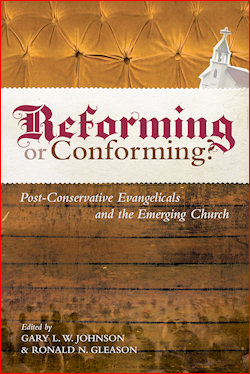


 ourtesies are thrown away upon antagonists whose cause is treason. Nor are we the men who should practice reserve; for if we are maintained from the king's palace, we are cravens if we do not stand up for our king.
 Let us, in the day of battle, use our standard; and if our arm be smitten off, we hope the standard will not fall, but that others will be found to hold it up as there were in the brave days of yore—when our fathers burned at the stake for these things, or went to the galleys, or perished amidst the Alps, sooner than the truth of God's own word should be without witnesses among the sons of man!
 'm not sure I've ever seen the thought reproduced
 t are they about? What is the subtext? Are they about making us look ____ — real, humble, authentic, tough, earthy, worldly? Pathetic, pitiable, needy?
 beings and not to steel automata. He did this for a reason. The Biblical writers were equally candid about their wayward weaknesses and their Godward zeal.

 (from memory).

 Yes, I get it: that's ugly. That is also the way it goes when you join a marketing group: you have to somehow get past the 20% junk and somehow capitalize on the 80% better-than-junk to try to get people to come back into the store.
 Seriously: read them both and compare them. In fact, if there's interest, I'll give you people three weeks to read both of them, and then come back here to an open thread on the subject of which book makes the more compelling case for what the church is and what it ought to be.
 we want to hold out Jesus Christ. Not ourselves. We want to point people to Jesus, want them to believe and love and cling to Him. Not us.


 hat's a familiar verse that practically interprets itself, with a command ("Let your light so shine before men"); an explanation of what the command entails ("[Let your light shine so] that [people can] see your good works"); and a reason for the command ("[So that people will] glorify your Father . . . in heaven.")
 And quite often, that has been under governments hostile to Christian truth, even while the church is suffering persecution. That's because the church's most powerful influence comes from the power of the gospel and the testimony of changed lives.

 n reference to ministers, many church-members are indifferent as to the personal piety of the preacher; what they want is talent or cleverness. What the man preaches does not matter now; he must draw a crowd, or please the elite, and that is enough. Cleverness is the main thing. One would think they were looking for a conjurer rather than a pastor. Whether he preaches truth or error, the man is held in admiration so long as he can talk glibly, and keep up a reputation as a speaker.
 've mentioned in the comments, but probably not in a proper blogpost, that I'm in Italy this week for
 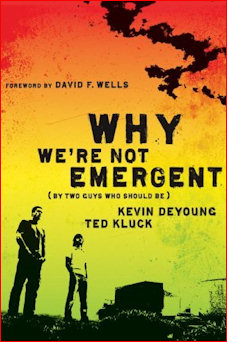 Anyway, just before leaving home last week, I grabbed two of the most interesting-looking books from my stash of
 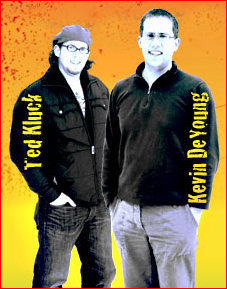 I'm really stoked about this book. It's the best, most even-handed, most interesting, most insightful, most well-written analysis of Emerging trends yet.
  The book rings all the right notes, at just the right tempo. DeYoung's style is very careful and a little more academic. His documentation is thorough and helpful. But his presentation flows like a breeze. His logic is crystal-clear and easy to follow. He is frugal with words and measured in his tone while being straightforward, definitive, unapologetic, and unequivocal. It's really no wonder he is not Emergent. His mind is too focused to enjoy wandering in the self-indulgent haze of postmodern ambiguity.
 Incidentally, I