Showing posts with label review. Show all posts

02 June 2015

BibleWorks 10 Review — the best gets even better!

by Dan Phillips

The best serious Bible Study software in the world keeps getting better and better.

The way to approach this is to begin with the oft-asked question, "Which is better: Logos or BibleWorks?" Rather than say that it's like comparing apples and oranges, I'd say it's like comparing apples and artichokes, or baked potatoes. They aren't two of the same thing, they're two different things. There is some overlap, obviously,  but the two different softwares have two different foci.

Logos 6 (which I plan to review later) is like having an incredibly powerful, fast, extensive library crammed into your device. It is the best I know of, at what it does, and I need what it does. BibleWorks 10 is like having the world's best infinitely-expandable polyglot study Bible, with margins that indefinitely extend to allow endless note-taking and note-making. It's the  best I know of at what it does, and I need what it does! I wouldn't want to do without either.

Most serious Bible students get a Bible with margin room enough to make notes, or (in my case) even insert Hebrew and Greek. But then when one wears out, you get another and start all over again. And there's never enough room; no one can write small enough to include everything.

BibleWorks solves that problem. Its fully-formatted Notes feature allows instant recording of thoughts, links, documentation, graphics, tables — anything. (See more, on an earlier version, here.) This has been a steady feature since its (as I recall) wobbly introduction in version 6. Now it is long-since robust and stable — and in version 10, expanded.

The first expansion is an additional frame, so that now the Search and Browse frames work with (not one, but) two analysis frames:

Click to enlarge
If you prefer, you can collapse the third analysis frame so as only to have one; but I always use the two, even on my 15" laptop. Depending on what modules you've gotten, you can use the two frames for notes and textual commentaries, cross-references, E-Pub books, other translations, editor, or a dozen other features. You can drag and drop the tabs to customize as needed.

On the subject of customization — though this is not a new feature — BibleWorks allows you to make and name your own configurations.


For instance, I have a Daily Bible Reading configuration that keeps track of where I am each day. It's like being able to leave as many ribbons as you need as place-keepers:

Click to embiggen
You can rename, add or delete the tabs. In my labeling, the OT tab has the Hebrew text for my OT read-through, the NT my Greek tab, and the EV my English Bible read-through tab. ("Bobby" is a random name for a tab I use for side-searches.)

Then I have a general configuration that I employ for all other uses.

Another new addition in version 10 is the User Lexicon. It is exactly what you might think it is from the name: a fully-formatted lexicon feature that the user can create. Note, for instance here, in Proverbs 4:8, when I mouse-over the word  סַלְסְלֶ֥הָ, this appears in the user lexicon:

Too small? Click!
That is the note I created, obviously culled from different sources. Now note: that will display any time I mouse over that lemma in any verse. It is not tied to the verse, it is tied to the word. The value of this is obvious. It works on any language, whether Hebrew, Greek or English. So you can make use of it whatever your level is.

I always translate what I expound, and I try to come up with consistent renderings. It can be hard to remember how I've translated a word last year, or three years ago. But with this tool, I can keep a record that pops up on every occurrence of the word in every book. And as with all the user-created notes, you can fill it as full as you like, from lexicons, journal articles, commentaries, sermons or personal studies.

Now from the heavy to the to the light relief, you can also customize the colors. If you like, you can even do this:

Click for great pinkness
But then, why would you? One of the other beta-testers made that little honey up and called it JapaneseKitten.

Yep. There's a back-story there, I'll bet... and I don't want to know it.

Here are some of the other new features:
  • Danker’s Concise Greek-English Lexicon of the NT. This is actually a very cool new independent lexicon from F. W. Danker, which provides "extended definitions or explanations in idiomatic English for all Greek terms." 
  • EPUB reader & library manager. You can add electronic books to your BW10 using this tool.
  • High-resolution tagged images of the Leningrad Codex
  • Two new NT manuscript transcriptions
  • Nestle-Aland Greek New Testament, 28th Edition
  • New English Translation of the Septuagint
  • Over 1,200 high resolution photos of the Holy Land
  • Complete audio Greek NT, which will read the Greek aloud either from the Byzantine or the Nestle-Aland, 27th edition.
  • Dynamically adjustable program text size, which is useful if you are projecting or using a large screen to demonstrate.
  • Now in both Mac and PC versions.
BibleWorks itself has a fuller and illustrated listing of new features in BibleWorks 10. (A full list of features, old and new, can be found here.) Also, you can watch BW's own videos demonstrating the new features.

In addition, I guested on a Theotek podcast, battling some bad sound quality and enthusing about the features I like best (starting at about 6:50.


As I've said, I say now: every Bible-teaching, Bible-preaching pastor should have BibleWorks. The same applies to professors and teachers of all levels, seminary students, and serious Bible teachers or students of the Word would benefit greatly from it. Practicing what I preach, I have personally given (or gotten a church to give) copies to pastors. If you are a pastor, get it. If your pastor doesn't have it, get the church to budget it and give it to him. It will reward both him and your church.

Upgrades are discounted, of course. But even if you are purchasing it for the first time, the full price of $389 purchases a stunning array of resources for serious interaction with the text. It is tremendous "bang" for your buck. Plus support is great, and a community of brainiac users is always ready to help.

I enthusiastically recommend it.

[BibleWorks let me be a beta tester and has provided a review copy, with no pressure to produce a positive review. My enthusiasm is all genuine, and all mine. Regular readers already knew that!]

Dan Phillips's signature


02 May 2013

Review: How to Answer the Fool: A Presuppositional Defense of the Faith, with Sye ten Bruggencate

by Dan Phillips

CrownRights graciously allowed me to see an advance copy of Sye ten Varfenklavemann's new training vid on apologetics, titled How to Answer the Fool: A Presuppositional Defense of the Faith.

Known to himself, his parents, and everyone except me as Sye ten Bruggencate (— whatever), the intrepid Canadian has well-earned the admiration of folks like Fred Butler, who introduced me to him, and myself, for his in-your-face approach to applied presuppositional apologetics. He's known for his wonderful web page, Proof that God Exists, and for the many videos of his encounters and debates with unbelievers. Sye has a bit of a separated-at-birth thing going with actor Terry O'Quinn ("John Locke," ironically enough, on the TV show Lost), and hardly ever says "eh" or "soe-ree."

Summary: in the span of about 80 minutes, this video does well what I think is most-needed today and I would commend it, even if only for that alone. It models an approach to apologetics that is both distinctly Christian in intent, and thus fittingly unapologetic. Its weaknesses are outweighed by its value and strengths.

What is good. The video is a well-done interweaving of Sye teaching a class on apologetics, Sye doing apologetics in various hostile environments, and contrasting clips and books from better-known Christian evidentialists such as Geisler and McDowell and Strobel and Lennox and Turek (not Turk) and others. It also features helpful on-screen definitions of key terms.

Sye does a wonderful job of explaining how the fear of the Lord really and truly and comprehensively is the beginning of knowledge (developed at great length textually elsewhere), and why therefore a Christian must start with God and not with doubt. I've never ever seen anyone do a better job of opening up why the unbeliever has neither the right nor standing to position himself as judge over God and His truth, and how we mustn't join him in that stance. We must not sell out the indispensable, authoritative, foundational nature of God's truth in a goodhearted but wrongheaded attempt to persuade the unbeliever that he really ought to see his way clear to give God a chance.

Sye also does at least a very effective introductory job of dismantling evidentialism and showing its inadequacy. He does this by many interwoven slices of evidentialists assuring unbelievers that they're not even talking about the Christian God or the Bible, that they just want to put out some evidence and allow the unbeliever to sit as judge over the evidence. In this way, Sye shows that his critiques are not merely theoretical.

Sye has a few well-crafted and well-honed-by-constant-use ways of reducing unbelievers to fuming, sputtering, enraged impotence, and he illustrates many of them in this video. When an unbeliever informs Sye that he can't claim to know absolute truth, Sye asks him if anything can be known with certainty. When the unbeliever replies that nothing can be known with certainty, Sye asks him whether he knows that with certainty. Often they say "Yes" — and then show that dazed, Wile E. Coyote-ish "What just hit me?" look.

We are shown Sye doing this on campuses and talk-shows. Among the things I admire about Sye is that he apparently is absolutely fearless, and will go absolutely anywhere to talk to absolutely anyone; a quality I also admire about Doug Wilson, though the latter is in a different league of the same general organization.

And Sye's no dainty nuancer. I doubt you'll see this video promoted on the big RPB sites; if you do, think, "Ironic!" For instance: one talk-show host reveals himself as a professor of bilious bloviation, substituting sesquipedalianism for cogent thought, as if the utterance of one obscure word is a death-blow. After a while, this poor soul burbles "I love Jesus."

"No, you don't!" Sye shoots back, indignantly.

Can you imagine {Bible scholar} or {theologian} or {big blogger} doing this? Nor can I.

Often, Sye takes a phrase and simply repeats it until he's kicked off a show or his hearer walk away in a rage. He explains what (I think) he's doing here thus: this is his "big weapon." His opponents want him to set it down and play the game by their rules. He refuses to set it down. As Sye sees it, they just want him to concede that they have the right to adjudicate God's truth (without demonstrating how they have that right), and he won't do it. He calls them on it. He asks for their ID, and when they refuse to show it (because they can't), he refuses to play nice and go on.

I think this is right, though I'm about to say it's incomplete. Too many evangelicals wobble out of misplaced charity. They land a philosophical death-blow, but when the God-hater sniff's "I'm not bovvered," they shrug in agreement and move on as if nothing's happened. Sye's no shrugger, and he's not out primarily to make friends. He's out to vindicate God's truth and announce God's terms for surrender. This is a needed corrective in a wishy-washy, apologetic (in the wrong sense), scared-of-our-shadows day such as ours.

I can easily see a church using this as a training video —  though I would follow up with...

What could be better. Let me put it too simply, then unfold and illustrate.

Sye seems to focus on utterly destroying the unbeliever and his worldview, period. Winning the unbeliever to a God-centered worldview (conversion) does not seem to be the priority.

You see very little appeal, very little bridge-building, very little outreach. Paul's concern that he might win as many as possible (1 Cor. 9:19-22) isn't at the fore.

Here's what I mean: it is as if Paul told the men at the Areopagus, "I saw an altar to an unknown god, and I am here to tell you that your worldview is hollow and bankrupt, and besides, you already know the unknown god, you just suppress that knowledge." But that isn't quite what the apostle did, is it? He took the altar to the unknown god as his "in," and used that confession of ignorance to proclaim the true and living God and, in the process of this positive proclamation and call to repentant faith, systematically demolished their bankrupt and apostate worldview.

I am saying that I think that everything Sye does is correct, true, and needed. I just think more needs to be done and modeled

This has long been my observation about presuppositional apologetics. In a way, presuppositional apologetics often is like that kind of "testimony" that we all object to: 40 minutes of lurid detail about what a wretched sinner I was, stealing drug money from toddlers and shooting heroin into my eyeballs, followed by 3 minutes about how Jesus saved me, He's great, yay Jesus, let's close in prayer. So, presuppositionalism tends to be 40 absolutely devastating and wonderful and solid-gold minutes about how bankrupt the autonomous worldview is, then "you really need to repent and cry out to the Lord because only He is true, which HEL-LO you know already anyway, so goodbye."

For instance: by all means, do what Sye does. Challenge the unbeliever. Listen (Sye generally does that very well). Interact. Do a round or two of "Do you know that? How do you know that?"

But then, instead of repeating that until the person walks off in a gnarled bird's-nest, stop, and say something like
Look, friend. Let me explain what is happening, and why. You have taken on yourself an impossible task. You can't live without knowing something, yet you aren't able to know anything the way you're going about it. Your final court of appeal is you, and you just aren't all that. I'm not, either. No man is! You would have to know everything, and understand everything you know — and you just don't. No man does. Right? But you keep doing that because you've convinced yourself that that's all there is. 
So let me ask you this: if it were possible truly to know true truth, would you be interested? Would you want to?
And deal with that response. If he says "Yes," preach Christ as Lord. If he says "No," say "Look, I understand. I was in that exact same place. We all really want to be our own gods. But I have already shown you — you don't have the résumé for it. None of us does. It's a doomed endeavor."And so on.

Or this:
Assuming that God is who He says He is in the Bible, to what higher authority do you think He should appeal, to get you to believe Him? He created facts, He created evidence, He rules history... these are small, petty things. What is the higher authority to which He should appeal?
Or a hundred other ways.

So, he tells this puffed-up "I love Jesus" doubletalker, "No, you don't!" We cheer, because we're starved to see anyone speaking edgily and with conviction. But would a better response have been, "You do? Can you love Jesus without believing anything He taught or submitting to His commands?", or "Describe this 'Jesus' you love"?

And so, rather than broken-recording one phrase until the person we're trying to win is utterly exasperated, alternate with "I would love to discuss that, but how can we do that when you won't deal with the elephant in the room?", or "How can we talk about truth when you don't have a way to know truth, and won't deal with that?", or "Is it fair to keep saying to me, 'This game has no rules except the ones I make up — but just play anyway, blast it'?"

There is, after all, something to the warning against winning an argument and losing a person.

Look, believe me: I am not saying this because I think I could do better than Sye. I do not. I admire Sye. I've learned from him. But as I watch him, again and again I get the feeling that he "counts coup" when a believer goes away in a rage. I think of Samuel Johnson saying "Well, we had a good talk," and Boswell replying "Yes, Sir, you tossed and gored several persons." He has won the argument, and lost the man. I think we should aim at both. That's an element which I wish I could see modeled more clearly in Sye's encounters with unbelievers.

If evidentialism goes too far in flattering the sinner (and it does), presuppositionists often go too far in flattening the sinner, without pointing robustly and thoroughly and patiently to Christ with equal thoroughness and conviction. Which takes more than 40 minutes of demo work followed by "So repent and call on Christ. Goodbye!" We must tear down, yes; but we do so in order that we might build up.

Imagine if the book of Romans ended at 3:20!

What you get: you get someone clearly explaining and showing why and how Christian apologetics must be different and distinct, must be unapologetic apologetics, and must aim at the demolition of the autonomous worldview. You also get illustration of this in process. It's an excellent and needed start, and with the reservations noted above, I do commend it.

Dan Phillips's signature


11 October 2010

Bible Study in the Cloud

The (very long) account of how I came to love Logos 4
by Phil Johnson


've been using Logos Bible Software for years—since the Windows 3.1 version in about 1993 or '94. It wasn't always my favorite Bible-study software (and even now I sometimes use as many as six Bible programs simultaneously when studying) but I never abandoned Logos because of the rich store of resources that were exclusive to Logos. (That includes, of course, the MacArthur Study Bible notes).



People sometimes ask how I do systematic study. I generally use Logos first, throughout the week, mainly for reading and research. At the end of the week, when I'm in the hands-on process of writing notes for a sermon, I use e-Sword. E-Sword is perfect if I just need to cut and paste Bible verses, check the Greek word for "lasciviousness," or look up something in a Bible dictionary quickly. It's free, easy to use, and much speedier than Logos or any of the other workhorse Bible programs.

But I consider Logos a must-have because of the wealth of excellent resources that have been formatted for Logos. For large-scale searches across a massive database of Bible-study material, Logos simply cannot be beat.

In 2001, when Logos released their third major upgrade—the one with the Libronix engine—I was deliriously happy with it. Its user interface was way cooler than any of its predecessors; it was more flexible and almost intuitive. That's when Logos became the software I preferred for reading, searching for obscure material, collecting hard-to obtain and out-of-print resources. I found loads of valuable Libronix-compatible books online, including a ton of Arthur Pink resources, Edwards' Works, and the complete works of John Bunyan. Great stuff.

Naturally, last November, when Logos announced the release of Logos 4, I was eager to see it.


It came at a very busy time, though, so I didn't try to install the new Logos right away. I read several reviews, all of which commented on the very long installation process. I decided not to upgrade until I could devote a full day to it. I also decided after reading the reviews that I was going to leave the older Libronix version on my computer until I was certain the advantages of Logos 4 warranted a full move away from software I liked so much.

That was a difficult decision, because all those resources take up lots of disk space. I had already heard Logos 4 couldn't use the Libronix format; it was going to reinstall all my books for me in a different format. I figured that would more than double the amount of disk space I had allocated to Logos. On my laptop that's no small matter.

For that reason, I decided when I did install Logos 4, I would install it on an external drive.

It turned out to be a good thing I waited, because when I finally did attempt to install Logos 4, the program kept crashing. It simply wouldn't install on my Windows XP virtual machines. Dan Pritchett, one of Logos's top executives, graciously offered help from the Logos technical staff when I was trying to track down the problem, but my schedule was jammed and I thought it likely that the problem was related to a configuration issue in my virtual machine. I didn't want to waste the Logos staff's time with that. Besides, I was still deliriously happy with Libronix, so there simply was no urgency to upgrade.


Then on August 4 (just a few weeks ago), Dan Pritchett e-mailed me to say he was making it possible for me to download the beta version of Logos 4 for my Mac. I jumped on the opportunity and downloaded it immediately. It installed flawlessly (though just like all the reviews had said, the process of downloading resources took several hours). It had a beautiful and informative home page that filled the screen on my 27-inch iMac. And (best of all) it gave me access to a fresh, new, more-complete-than-ever set of Spurgeon's works.

So my overall impression from the beginning was very positive. My only complaints were fairly minor: 1) it seemed just a bit sluggish; 2) it resided on the Mac side of my computer, and I do all my sermon prep in the Windows virtual machine, so switching back and forth was clunky; and 3) I couldn't find the location on my hard disk where Logos 4 put all those resources. (I don't think I ever did locate them, but after the first 10 minutes of searching, my attempts to find them were admittedly only half-hearted.)

Anyway, I liked Logos 4 enough that I thought I'd upgrade my Windows VM to Windows 7 and then try the Logos 4/Windows installation again. The switch to Windows 7 turned into a 4-week ordeal (but of course, that's not really germane to Logos, so I'll forego the details). When I finally got Windows 7 running well, one of the first things I did was try to install Logos 4 once more.

It crashed again. At exactly the same point in the installation process.

This time, however, I quickly figured out the problem. I was, of course, trying to install the Logos resources to an external drive. Even though the Logos install process offers a "custom" option where you can choose your preferred location for the program and resources, Logos 4 will not install happily anywhere except on the main hard drive. As soon as I allowed it to default to my C: drive, Logos 4 installed flawlessly.

Now I was in business, but not particularly happy about using so much of my disk space for that massive collection of Logos resources (especially since most of the same resources already existed on an external drive for the Libronix installation, and I also already had a copy of them somewhere on the Mac portion of my hard drive from the installation of Logos's Mac edition. In other words, I now had two copies of my all Logos data files on my main hard drive, and another set of the same data on an external drive. (Fortunately, I have a 2TB hard drive in my 27-inch iMac.)

I figured I would eventually default to either the Mac Version or the Windows version of Logos 4 (or else I could always revert completely to Libronix) and then I would uninstall whichever sets of data I wasn't going to use. I still liked the look of Logos 4, but one other thing puzzled me: That home page adds new information constantly. It draws all its data from an online source. You have to be connected to the Internet to use it. Logos 4 is also designed to keep all my settings, notes, and whatnot online—in "the cloud" rather than on my local drive.

I wasn't sure there was any great benefit to be derived from Logos's continuous connection to the cloud. I do a lot of study in out-of-the-way places, and I've always liked having my Bible-study software self-contained on my laptop so I can take it anywhere. I wasn't sure how much Logos relied on cloud computing, but it seemed like a lot, and I didn't see any serious advantage in that. I wondered what disadvantages I would notice when I needed to disconnect from the Internet and use Logos offline.

Then during last month's Ocean City Bible Conference, Logos expert Kendell Stellfox gave a presentation and demo on how to use Logos. He mentioned that there's an iPad/iPhone app that uses the cloud-based features of Logos 4 to maximum advantage. I don't know why I hadn't heard about the app before that; it wasn't exactly a secret; and it's even a free app! But that was literally the first I remember hearing about it.

So, sitting there during one of the sessions of the Bible conference, I downloaded the app to my iPad over the 3G network. It worked beautifully, immediately. All of my Spurgeon resources were right there, easily searchable, and (I suppose because the Logos files are well indexed) the search speed was about a thousand times faster than searching my local drive's .pdf versions of Spurgeon's works.

That opens up whole new vistas of advantages for me with Logos 4. Since I use it mainly for reading (as opposed to cutting and pasting texts), using the iPad as a reader offers some serious advantages. It's easily portable; it's a better interface for reading than a desktop or laptop screen; and all I have to do when I do need to cut and paste is use e-mail to send snippets to my desktop machine.



In short, the iPad/iPhone app alone makes Logos 4 worth the upgrade from Libronix. Meanwhile I'm learning the new desktop interface, and I'm almost as comfortable using it as I was with Libronix. If I can just learn how to move the data files for all those books to an external drive; consolidate the data files so that my Mac software and Windows software can use one set of data; and install my old Libronix .pbb files to Logos 4—then I'll be a really happy camper.

In the meantime, if you're still wondering whether the upgrade to Logos 4 is worth it, I strongly recommend it—especially if you can use the iPad/iPhone app.

Phil's signature

28 December 2009

Year-end Desk-Clearing Blogpost

(Reminding myself why I hate to review books)
by Phil Johnson


y desks (both at home and at the office) are piled high with books and other items I hoped to blog about this year and never got to. Not that I lacked opportunity; but I lacked motivation. After 5 years of blogging, I'm tired of writing on demand and (in case you haven't noticed) my posts for the past year or so have tended to reflect only whatever I'm most keenly interested in at the moment. I've been trying to stay away from themes and series that obligate me to write the next post on a specific topic in order to meet the daily deadlines.

Perhaps the most distasteful thing about blogging (to me) is writing reviews of books I've read, films or video series I have watched, or lecture series I have listened to. Challies does book reviews (and such) so much better than anyone, and why should I duplicate his efforts? Besides, after I've read or listened to something, my mind wants to move on. Obligating myself to write reviews is the closest thing to a book report I can think of, and I have hated book reports since junior high school.

On the other hand, I have reviewed book manuscripts professionally for various Christian publishers for the past 35 years, so you might think book reviews would be easy work for me. But the kind of reviewing I usually do for publishers is not intended for public consumption; I write a critique that will be read only by a single editor, so I can be as brief and blunt or long and detailed as I like. The editor often only wants a thumbs-up or thumbs-down from a trusted source with a few good reasons for the recommendation (or fulmination, as the case may be). Every passion from bitter sarcasm to weepy gratitude is suitable for that kind of review.

For obvious reasons, writing reviews for public consumption is a completely different thing—and for me, it's a lot harder work.

So I have accumulated a pile of books and stuff on my desk that I've read and planned to review, but the sins of sloth and procrastination have defeated me. But now I need to clear the desks. So today I'm going to choose the best stuff out of those piles and give each item a one-paragraph recommendation. Here (in no particular order) are some of my favorites from all the books I read and resources I have devoured in 2009:

  1. Heaven Without Her, by Kitty Foth-Regner. This is the very touching personal testimony of a secular feminist whose only interest in spiritual things tended toward New-Age mysticism—until the impending death of her mother brought her face to face with some difficult questions that have no satisfying answers outside biblical Christianity. I was greatly moved by this book, perhaps because I read it in the wake of my own mother's death in January. The book is a graphic illustration of how God providentially draws and redeems people—often people who (from a human perspective) might seem the most unlikely candidates for conversion. Kitty Foth-Regner's worldview at the start of her journey could hardly have been more radically at odds with the faith that finally brought her settled peace. But the sovereign hand of divine Providence (evident throughout her testimony) wisely and lovingly led her through some of life's bitterest trials and sorrows into the unimaginable riches of grace. It's a tender story, well told.
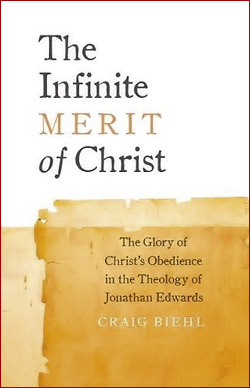
  2. The Infinite Merit of Christ, Craig Biehl. I absolutely love this book. I like everything about it from the page design (with ample margins, a feature that has fallen out of fashion nowadays); to the flow of Biehl's (and Jonathan Edwards's) logic; to the conclusions Craig Biehl draws from his careful analysis of Jonathan Edwards's writings. The book is a study of the doctrine of justification (my favorite theological topic) from the writings of Jonathan Edwards (my favorite post-Puritan New England theologian) with specific emphasis on the significance of Christ's obedience (my favorite aspect of justification). Biehl provides a helpful rebuttal to several currently-popular points of view that have (for various reasons) downplayed the importance of imputed righteousness and rejected the significance of Christ's human obedience to Moses' law. This is a book to be reckoned with in all those debates. I got two copies, one for my shelf of Edwards studies and the other for the "justification" section of my "doctrine" stacks.
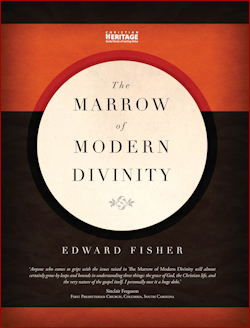
  3. The Marrow of Modern Divinity, by Edward Fisher. This is the book that sparked the Marrow Controversy in eighteenth-century Scotland. That's one of my favorite episodes of theological controversy ever, and it continues to be one of the most important intramural debates among Calvinists. Thomas Boston and the Erskine brothers were on the angels' side in that debate, in my assessment. They and their allies are sometimes known as "The Marrow Men." Their opponents were high Calvinists of a severe and and anti-evangelistic sort. The high-Calvinist group held to a cluster of ideas that to this day surface and resurface in Internet forums and tend to breed hyper-Calvinism. I wish more of today's Calvinists had studied the Marrow controversy. I think a lot more gracious, tenderhearted, and evangelistic brand of Calvinism would be the result. (Here's a series of messages by Sinclair Ferguson on The Marrow, if you want to get started.)
         Anyway, twenty years ago, before the Internet made used-book finding fairly easy, I looked high and low for many months for a copy of this book. When I finally found one, all I could get was a terrible edition printed by Jay P. Green in the 1960s or '70s with a small but too-bold san-serif typeface, narrow margins, and an ugly (but sturdy) green buckram binding. A year or so later I got a copy of The Marrow with Thomas Boston's annotations as part of the superb complete works of Thomas Boston published by Richard Owen Roberts. (If you use Logos, you can download Boston's complete works here, free. If you don't use Logos, it's worth getting, just to have this set.) Over the years I have located and acquired about a half dozen different quality editions of The Marrow.
         But the 2009 edition from Christian Heritage Books is the best one yet. Again, major kudos for the generous margins, which include sidenotes with Thomas Boston's annotations. This is a slightly oversized book, befitting the book's historic importance. If you fancy yourself a Calvinist and have never even heard of Edward Fisher's The Marrow of Modern Divinity, shame on you. Buy one of these, get Ferguson's lectures, and study this chapter of Calvinist history. Another good place to start is John MacLeod, Scottish Theology in Relation to Church History since the Reformation (Edinburgh: Banner of Truth, 1974)—which book has a whole chapter dealing with the Marrow Controversy. If you have sufficient interest to read a more definitive work, I recommend David Lachman's excellent Ph.D. dissertation (St. Andrews) titled The Marrow Controversy 1718-1723—but it is very hard to come by.
  4. The Book Academy's Puritan Library. Despite what it sounds like, this is not a book or a set of books but a collection of PDF files on DVDs. It is an exhaustive Puritan library, plus the complete works of Spurgeon—the kind of resource people thirty years ago would have gladly given thousands of dollars for access to. The complete 10-DVD set is available for a few hundred dollars. I obtained a copy just a few weeks ago and have only barely begun to delve into it, but I plan to spend lots of time with it in the days to come.
  5. David Brainerd: A Flame for God, by Vance Christie. This is a new, highly readable, supremely edifying biography of Brainerd. I had the privilege of reading it more than a year ago when it was still in manuscript form. The publisher sent it to John MacArthur for review, and he wrote the foreword. (I intercepted the manuscript and read it myself before turning it over to John MacArthur. Shame on me. But it was worth it.) I recommended the book in an earlier blogpost here, so I won't say much more about it, except to say that if you didn't get it when I recommended it, do it now.
  6. Risking the Truth: Handling Error in the Church, by Martin Downes. This is a refreshing compilation of articles on dealing with heresy and heterodoxy in the church, compiled and edited by Martin Downes, better known to Pyro readers as the blogger-in-chief over at the "Against Heresies" blog. I'm not always a big fan of symposium-style books (even though I have contributed to a few). But this one really hangs together. Keep it by your bedside and read a chapter a night. Good stuff.
  7. Dr. John MacArthur, Jr.: The Prince of Expository Preaching, by Hokyeom Kim. A short biography and long analysis of the ministry of my pastor. I had never heard of this book and had no idea it was being written until I saw the finished product. It's fascinating reading, and in general, I think, a helpful and insightful analysis.
That's it for now. I have a very busy week ahead. Darlene and I leave for India on Thursday, so my blogging will probably be sparse until mid-January. By then, Lord willing, Darlene and I will have another grandchild. We'll see what that means for my blogging habits. Until then, you can follow me on Twitter, if you're inclined to such things. Now, I have this nagging feeling that I have omitted several items I wanted to put on my "Best of 2009" list. If I can remember what they are, I'll probably follow this post up someday with a part two. In the meantime—Stay thirsty, my friends. Phil's signature

13 February 2009

BibleWorks 8 — the love goes both ways!

by Dan Phillips

I had to share this.

I'm in the process of learning BibleWorks 8 so that I can review the product (see BW7 review). As I do, I'm watching the instructive videos.

So I click on the one for the BW8 tool called Ermie (External Resources Manager). The instructor refers to websites and resources "that you typically open during the course of your study with BibleWorks."

And what is one of those resources featured in the tutorial video? I am not making this up:

There it is.

Over the Evangelical Textual Criticism blog, and the Greco-Roman coins blog.

And with no others!

(Can't stop grinning.)

Dan Phillips's signature


07 May 2008

It's a COOK BOOK! GAAAAGH!

by Frank Turk

Last week, Phil gave a raving review of a book I had already reviewed at the blog, and of course this is technically his house and he can do whatever it is he sees fit to do. I'm mostly glad that I get to ride on his coat tails and occationally get a word in edgewise, as I did last week on Paul Edwards' radio show. Thanks to Paul, btw, for being extremely gracious and treating me like I had something more to say than "ohh Ee ooh ah ah! Ting! Tang! Wallawalla Bing Bang!"

Anyway, since Phil re-reviewed the "Why We're Not Emergent" book, I thought I'd coat-tail him again and sort of pre-emptively review the other book he raved about in that post. But as I was reading it, I had this problem I had to resolve: I found another book which I thought needed a review in a much more urgent way.

That "more urgent" book is a little tome called Pop Goes the Church (hereafter PGTC) by a fellow named Tim Stevens, and I came across it in my own bookstore. See: we belong to this marketing group which helps us out by publishing very slick advertising materials and mailing them to our customer lists, which is of course a perfect thing -- except that it causes us, from time to time, to bring in books we wouldn't otherwise, um, proffer. The reason is simple: these books get the ad money from publishers, and that money ultimately pays for the catalog.

Yes, I get it: that's ugly. That is also the way it goes when you join a marketing group: you have to somehow get past the 20% junk and somehow capitalize on the 80% better-than-junk to try to get people to come back into the store.

Anyway, I grabbed the copy of PTCG and started reading it so I could review it, and the strangest thing happened to me: I realized that the other book was actually reviewing this particular book for me. If I were a charismatic, I think I would attribute this to the Holy SPirit speaking directly to me through these two books. But of course, I have to maintain the semblance of dignity here, so let's just say that God, in His providence, gave me the fodder for a brilliant blog post today, and you're merely fortunate enough to get to read it.

See: here's the thing. Over the last couple of weeks there has been a little dust-up in the blogosphere as to whether one should recommend that others not read a book one finds offensive. One blogger in particular tried to make his point very transparent by deleting posts at his blog which disagreed with him about his point of view -- which, I think, is not exactly the message he was trying to send, but we all have an idiom which we tend to drop into.

Anyway, rather than make the obvious "don't read this book" post about Tim Stevens' book, let me suggest something else instead: first read David Wells' new book The Courage to be Protestant and then read Tim Stevens' book. Because it seems to me that the only way to really "get" either one of these books is to actually put them side by side and, frankly, let the best man win.

Seriously: read them both and compare them. In fact, if there's interest, I'll give you people three weeks to read both of them, and then come back here to an open thread on the subject of which book makes the more compelling case for what the church is and what it ought to be.

Or read them both and then give them to your pastor. Just don't freak out when he realizes that one of these books is a cook book, and he likes that one better. It'll be perfectly creepy like that Twilight Zone episode "To Serve man", because that's exactly what one of these books is advocating: to serve man.


26 February 2008

ER's "Atonement" and the absent Gospel

by Dan Phillips

This clip from a recent episode of ER has made the rounds among the blogs, and deservedly so — it's very powerful.

The episode, titled "Atonement," was broadcast on January 17, 2008. Here's the clip:


The following scene is also telling, but has attracted less comment. The good doctor finds the distraught chaplain outside, sitting by herself, reeling over the exchange. She's played by the wonderful Reiko Aylesworth (who fared better as Michelle Dessler on 24) , and here's how it goes:
Chaplain: You know... doubt... it's uncomfortable. But certainty -- I don't think it's real. I -- I, I I went to seminary, I studied Buddhism, I spent time in an ashram... who really knows anything with absolute certainty.

Doctor: Not me. That's for sure.

Chaplain: That's why I thought an inclusive approach to spirituality would work well in a place like this.

Doctor: It does! It does. The patients, they appreciate what you do.

Chaplain: No, people in crisis want rules. They want structure, something to lean on. I get that. But it's not me.

[See it here, starting at about three minutes]
Count the ironies, intended and otherwise.

After this exchange, the doctor then encourages Chaplain Reiko to get back in there and help the patient. He'll be there with her. But she won't do it. He persists, and so does she. So he leaves her. The liberal, "inclusive" female chaplain has failed.

So later the doctor has to do it himself, has to try to help the guilty, haunted man.

What does he offer him? Not much. Insistence that the retired doctor's good deed counts for something. The suggestion is that his rescuing the boy from drowning outweighs his "bad" deeds (administering lethal injection to the boy's father, who later turned out to have been framed).

For some reason the man, though having just shredded young Chaplain PoMo, accepts this equally Godless, equally trackless, equally baseless, equally shapeless pablum, from the doctor.

And that's the resolution. (Watch it here.)

What the doctor offers is in no way better than what the chaplain offered. It's sheer human-viewpoint gobbledy-gook, double-talk, and equivocation. The rest of the episode wallows in such moral relativism. Ultimately, there is no "there" there. Absolutely wonderful windup; absolutely no pitch, whatever.

Still, it is refreshing to see Hollywood frame the question and the issue fairly vividly, isn't it? Yet even in that framing, the picture is blurred. The "cause" being championed is yet another Hollywood favorite: opposition to the death penalty. Did the doctor actually do anything immoral? He had come to think so, and his grief is turned as a comment against capital punishment.

Now, had the writers really wanted to stretch themselves and defy convention, they could have made the doctor an abortionist. For instance, he could have been one of the sorts of doctors who recently advised a British couple to abort their baby because the unborn child was diagnosed with rhomboencephalosynapsis, would be born deaf and blind, and would only live an hour or two.

In the actual case, the parents rejected the counsel, and the child was born perfectly healthy, in spite of the assured diagnosis his parents had received. But how many such children have been actually aborted, on the basis of equally flawed diagnoses? I know of another similar case myself.

The fictional doctor could have actually succeeded in convincing the couple to kill the child, and then discovered his error. That, or countless other of the living nightmares by which abortionists could rightly find themselves gripped when they paint a bull's-eye on a baby. Then we would have had a case of real guilt over a real moral wrong.

Ah, but the Hollywood that is wrought up over the fate of condemned killers, as a rule is not so concerned about the innocent unborn.

Even if they could have pulled this off — and the writers for House, M.D. and other dramas have indeed done some remarkable stretching — I still can't picture them being able to deliver on a credible Christian preacher.

As I've often observed and remarked: the most gifted screenwriters can concoct believable monsters, deviants, heroes, regular-joes, atheists, agnostics, all sorts of characters. But the believable depiction of a full-orbed Christian character is simply beyond them. Evidently they have never known (much less understood nor liked) even one credible, practicing, Biblically-faithful Christian. It's the one color missing from their palate — as starved for ideas as they are.

Otherwise, ER might have given us a real chaplain with a real God, a real Hell — and a real Gospel.

Rather than rehashes of the world's dyspel of tallied-works, judged by shifting, human, strictly-horizontal standards and laid in a balance, he might have preached the Gospel of Christ. He might have told them man of a just and holy God before whom indeed he stood guilty, condemned, and (in himself) hopeless (Romans 3:10-20). He could have shown sin to be a matter of real guilt, due to an offended Law that is without, above, and against us. He might have told him of the wrath of God against human sin, played out in the recurring cycles of our racial and individual rebellion (Romans 1:18-32).

And then he might have told of the righteousness of God revealed in the Gospel on the basis of faith alone — God's powerfully saving good news (Romans 1:16-17). He might have told of the Savior who came to meet the law's full demands, to absorb the full brunt of God's holy and righteous wrath, to pour out His blood in payment of man's incalculable debt (Matthew 20:28; Mark 10:45; Romans 3:21-25). He could have told him of Jesus' Christ's death, His burial, and His bodily resurrection — which was God's "all-clear," signaling that He had paid the price of His people's sin in full (John 19:30; Romans 4:25).

In this way, the pastor could have assured the man, God can be perfectly righteous, and impute perfect righteousness to the one trusts savingly in Jesus (Romans 4:25). "This," he could say, "is how you can know God."

But Hollywood, for all that does captivate it, is not captivated by the beauty of the Gospel.

Nor, probably, can it be (1 Corinthians 1:18 — 2:14).

Dan Phillips's signature

15 November 2007

Logos Bible Software: a review

by Dan Phillips

For several months now, I have been using Logos Bible Software in addition to BibleWorks 7. I began with the Scholar's Library: Silver, then upgraded to Gold. I've also added language reference modules and commentaries.

Forward
I've used various Bible study programs over the years. At first, in the 1980's, I used Gramcord for Greek. Then I used BibleWindows (now called Bibloi). Somewhere in the 90's I switched to BibleWorks, which I've used ever since (ever since version 3, I think). I've been through it's buggier and more awkward stage, and now enjoy robust and stable version 7 on a daily basis.

I stepped into the Libronix Digital Library System in order to use the Theological Journal Library, for a convenient way to search Biblically related journals.

And so, Logos? I'd always passed by Logos because of its price, frankly, because I didn't really love the Libronix engine. Besides, I was very happy with BibleWorks.

Now I'm a Logos initiate. Here are my....

Impressions: favorable
I've used Logos pretty extensively over the last half-year plus, and have developed a feel for it.

What stands out above all is what an amazing resource it is. You can do a "Passage Search" on any Biblical text and, within a few minutes, have all the references to that text in all the commentaries in your database, plus much more. For instance, I laid in Luke 4:29, and when the search was done I had about twenty commentaries, cross-references, listings in six Gospel harmonies, SermonCentral.com listings of ten sermons (with more available), a map, listings from the journals I have loaded, and a good bit more.

From that window, click on the "Exegetical Guide," and I have the text in Greek, references to any grammatical notes on it (Burton, in this case), the Novum Testamentum Graece's critical apparatus, and lexical listings on each word, including articles in TDNT and EDNT. Plus, there are syntactical diagrams.

If I click on "Search Entire Library," after a longer stretch I have every reference to that verse in every commentary, theology, book, dictionary, church father, journal, or any other Libronix resource in my database. The result is simply a massive array of resources, all available at a click. (In this particular case, it listed 665 resources.)

At that one click, the particular resource opens in its own window, at the place where the passage is referred to. If I then copy that passage to Word, it also automatically copies the bibliographical information in a footnote, formatted.

You can also study words, topics; you can set it up for a daily Bible reading schedule, or for use with devotionals. I have it set for Spurgeon's Morning and Evening.

My couple of experiences with their technical support were entirely positive. I had a live person online with me within a few minutes, and the answers I needed not long after that. Knowledgeable, friendly, responsive, top-notch.

Another wonderful feature is the extensive hypertexting. Every Bible reference is hypertexted, so that with a simple mouse-over you can see the verse. But it goes far beyond that. References such as Kittel's Theological Dictionary of the New Testament, or Metzger's textual commentary on the Greek NT, contain names and symbols you may not immediately be able to identify. No worries: mouse-over, and you'll be reminded the manuscript name, date, library, and contents; or the church father's date, the scholar's name, and on and on. This extends to all manner of acronyms and resources and names, all available at a mouse-over.

Also, the fonts and type-setting (to use an archaic term) are very pleasing to the eye. It isn't all just 12-point Arial; the font and the layout are, as far as I can tell, the same as the hard copy version.

Plus Logos provides a great variety of tools for interaction with the text, including the ability to highlight text and affix the equivalent of marginal notes.

As I mentioned, I've already added to my initial investment. I intend to keep doing so. In fact, Logos notifies its customer base when it is contemplating converting a book to its format. By expressing interest, you move the book towards listing as a project, and get a discount on it to boot; I'm lined up to purchase several as it is.

It used to be that I'd go on vacation with a ton of books. Now I just bring my laptop — and, with it, thousands of books and journals. Thanks to Logos!

Impressions: less favorable
It is a bit ponderous. The search on Luke 4:29 mentioned about took 77 seconds, on a pretty fast computer. If you leave Logos to work on other programs, then come back to it, it can take some time to "wake up." But Logos is searching a massive database and, while I don't love that about it, I don't mind it. I just start the search, go work in another program, then return after a couple of minutes.

Plus, it simply isn't easy to make one's way around in lightly, quickly, and deftly in Logos; or, if it is, I still haven't mastered it. Switching translations, looking up words, checking individual resources — I haven't found the quick and easy way to do it.

It is expensive, I won't lie to you. But some of the sting is taken off if you qualify for Logos' very generous Academic Discount program; but it's still quite a few Happy Meals. Nonetheless, the result is an extraordinarily useful and powerful resource. How many times have you paged through book after book looking for something you think you remember reading? Logos could do the search in a fraction of the time, if you have the resource electronically.

Also, I admit to my shame that I find it not totally intuitive. It's a very powerful program, but very powerful usually = very complex. You can customize it to a degree, but the customizations aren't easy to find nor manipulate — and I say this as an IT professional. Contrast this with BibleWorks, which concentrates virtually all its customizations in one place.

To offset the complexity of the program, Logos provides a wealth of training videos for free, both with the program and online. Plus there are online sites, blogs, and many resources. But I have the frustrating knowledge that I'm only scratching the surface of a very powerful tool.

So...which one?
You know I reviewed BibleWorks very favorably both here and at my blog. You have to wonder which tool I recommend.

First, let me dither and beat around the bush a bit. Choosing just one of the programs is an apples and oranges proposition, or scalpels and chain-saws. To tell you which is better, you have to tell me what you want it for. If you want to cut down a tree, a scalpel is a terrible tool; if surgery — step away from the chain saw. And so, each program does what the other doesn't.

At first, I wondered whether Logos could replace BibleWorks. I looked for my favorite BibleWorks features. I can tell you now: it can't, and they weren't there. Logos simply does not do what BibleWorks does, even fractionally as well. I am absolutely in love with BibleWorks' speed, lightness, power, and integration. For exegetical work, it's a dream. But almost above all, I love the verse-by-verse text editor that brings it all together. And BibleWorks is very decently priced. For under $400, you simply cannot beat the gold-mine of tools BibleWorks provides.
But you'll recall that I have upgraded Logos from Silver to Gold, have added resources, and plan to add more. Why? Because Logos has BibleWorks beat as a comprehensive, massive database. It simply is a tremendous work-horse of a resource for sermons, papers, theses, research — and Pyro posts! I'm glad to have it, and I expect to keep adding and upgrading.

The practical upshot is that when I do my Bible reading, studying, sermon prep, I have both open, and I use both. I use BibleWorks primarily, but also use Logos.

So which one do I recommend? Both. For working in the languages, and the text of Scripture directly, BibleWorks. For whole-field research and breadth and depth of study, Logos. My heart belongs to BibleWorks, but I've grown to respect and appreciate Logos. I only see it getting better and better, and expect to keep building and using it indefinitely. I'm glad to be able to use both.


For further reading
The review by Andrew D. Naselli discusses the concept, scope, strengths and future of e-books in general, and reviews Logos' Gold version in particular, comparing it with other Bible study tools.

Mark V. Hoffman has an impressive array of links Logos and BibleWorks, including user-created downloads that can be added to each of the to resources, reviews and discussions of programs.

Phil Gons posts a helpful brief comparison of BibleWorks and Logos that includes links to other reviews and discussions.

There are scads of pbb (Libronix compatible) files available for free at Truth Is Still Truth. The scope is amazing; you'll find works by John Owen, B. B. Warfield, Boston, Watson, John Gill, Alexander Maclaren, and a host of others. They're all formatted for Libronix (which Logos uses), and they're all free. Find instructions for using the downloads here.

Any such resource becomes part of the Logos database.

Dan Phillips's signature


09 May 2007

The Gospel in Spider-Man 3

by Dan Phillips

It isn't there.

Oh, wait; that's a terrible way to begin. Sorry, let's start again. Ahem:

What this is. This will be a spoiler-free reflection on some themes from the gargantuan smash movie Spider-Man 3. If you abhor spoilers as much as I, you can read safely, as I've fuzzed and vagued everything up sufficiently to discuss without ruination.

Background. I read Spider-Man comics from the start, and enjoyed them. I enjoyed the poorly-animated cartoon series less, and eventually just traveled away from comics. So I'm no expert on the Spider-Man "canon" since the late '60's, probably.

I liked the first movie, but I loved the second. I found it actually a very decent drama, whose protagonist just happened to be a super-hero. It had heart, comedy, action, conflict, pathos — very difficult to believe that the same man behind The Evil Dead (—not recommended!) helmed these movies.

But above all, it had Tobey Maguire, a fine actor who puts a believable, likable, fully-dimensional human being in the spandex suit. Some actors can't do justice to the words written for them; Maguire's face and body-language are so expressive, the words are almost more for our benefit. It didn't hurt that the supporting cast, both friend and foe, has always been equally strong.

Each movie has also had a moral center, such as the theme that "with great power comes great responsibility."

Spider-Man 3. This third movie in the franchise is no exception. In fact, it does a good bit of moralizing, while serving up all the other elements as well. Director Sam Raimi works wonderfully well with his talented actors to make very believable personal moments amid the heart-pounding action. But it's the moralizing that you and I will pause to consider.

This movie has themes of the folly of pride, of the agony of prioritizing, of the dangers of popularity; of vengeance, sin, forgiveness, and even arguably redemption. It features an American flag and a cross, at critical moments.

From a Christian perspective, what's not to love?

There certainly is a lot to like, and the enthusiastic reviewer for Christian Spotlight (warning: spoilers) says "As far as morals go, that is the strongest thing about 'Spider-Man 3' and all of the films in this series." She sees one of the main character embodying Romans 12:21 — "Do not be overcome by evil, but overcome evil with good." She gives the movie a moral rating of "Better than average," and with that I wouldn't disagree.

You feel a "but" coming, don't you? Here it is:

But the morals are groundless, and thus the forgiveness is man-centered and meaningless.

Before someone says (as someone always must say) the obvious, let me do it first: it isn't a Christian movie. Duh! Thanks! I agree! (A thousand pairs of hands move back from the keyboard, disappointed.)

Indeed, my expectations of Hollywood (I started to type "Hollowwood") are such that I'm plenty happy when a movie's morals are in any way Christianward. From that perspective, there is a lot to like in all three Spider-Man movies.

But get this:

At a pivotal moment, one major character intones words to this effect: "First, you must do the hardest thing. You must forgive yourself."

Ah. And there it all is, in a nutshell.

All of the "crimes" and "sins" in these movies are sins against man in the eyes of man. Which means they are not sins at all. (Douglas Wilson, whose greatest fan I've admittedly not been, makes this point wonderfully well in the opening of his debate with Christopher Hitchens.) No right and wrong, no sin. No sin, no forgiveness. No forgiveness, no hope. No hope, no purpose. Man the measure of all things = man the destroyer of all things.

And so while Spider-Man borrows heavily from Christian themes and imagery, it leaves out the central facet: it leaves out the Gospel. It leaves out the infinite-personal God who, as D. A. Carson says it so well, "is always the wronged Party in every sin."

It is just as plain and as true as that: if there is no God, there can be no sin, really. There can only be behavior that this group of people doesn't like... although that group of people actually likes it very much. So who's to say what is right and wrong?

We need to have our collective faces slapped by the starkness of David's outrageous confession, "Against you, you only, have I sinned and done what is evil in your sight" (Psalm 51:4a).

What! God only? The title of the psalm tells us that David was writing on the occasion of Nathan nailing him over his sin against Uriah, with Bathsheba. What of Uriah, then, for one? What of Bathsheba, sinned against as surely as sinned with? What of the nation? What of the child? God only? Madness!

"Madness" in the eyes of the man-centered, to be sure. But if there is no God, if there is no transcendent Law of God, then there is no sin. All we have is evolution playing itself out. We have one powerful collection of molecules using another collection of molecules to the loss of an inferior collection of molecules. There can be no basis for anything meaningful. Vanity, vapor, meaninglessness. Chasing after wind. No sin.

And certainly no forgiveness, and certainly no redemption.

But this is the world. It desperately wants what Christianity has to offer — but finds the price too high.

"Price?" you say. "But... say, you aren't going wobbly on sola gratia, are you, Phillips?"

Never. Never! The price is not an exchange. It is a consequence. If there is a real God of a god, such as the God of the Bible, then there is only one God. And if there is only one God, then it can't be me. Admit that He is God, and I of necessity admit that I am not.

And this, the abnegation of delusions of deity, the world will not have. The world bought the lying line in the Garden (Genesis 3:5), and it has been buying it — and selling it! — ever since. It is hopelessly tangled and snared in a web of its own weaving.

Yet here is the grand, tragic irony: it is only a real God of a god who can damn sin as sin, and sinners as sinners. It is only a real God of a god who can devise such a plan as the Plan of Redemption that finds its consummation in Jesus Christ. It is only a real God of a god who can pay the price justice demands to secure the forgiveness that grace and mercy would offer (Romans 3:19-26).

So, you see, my objection isn't so much against Spider-Man 3 which, as movies go, is a very good, fun movie.

My real objection is against the world, that shrinks in horror from the genuine Gospel of God, offering in its place the cheap, plastic, imitation, non-gospel that is the best it can provide.

And its best is so poor!

Conclusion: Spider-Man 3 is a fun, expertly-done movie. It contains a nice bit of moralizing. It preaches an appalling sermon.

Dan Phillips's signature