Showing posts with label The Gospel Coalition. Show all posts

30 May 2018

Regarding "Sexual Orientation," Evil Desire, and the Question of Moral Neutrality


by Phil Johnson

Full disclosure: Here is the development that finally provoked my sense of consecrated indignation enough to motivate me to start blogging again:



It's the latest "evangelical" superconference. As you see, their own ad copy tells us they are devoted to "supporting, encouraging, and empowering gay, lesbian, same-sex-attracted, and other LGBT Christians so they can experience the life-giving character of the historic Christian tradition." The conference is being organized and supported by a large cast of evangelical thought-leaders—including some people generally assumed to be sound and reliable spiritual guides.

Fred Butler blogged about it yesterday, and it'll save me some work if you read his assessment of the actual conference itself. (You may need a translator for the cornpone-and-pot-likker dialect he slips into occasionally, but the cardinal points he makes are unassailable.)

Anyway, I want to comment on the conference's underlying theory, because it strikes me as a Really Bad Idea (and a patently unbiblical opinion). Nevertheless, it seems to be gaining traction rapidly—even among many influential and hitherto trustworthy evangelical leaders. It's the notion that homosexual orientation is morally neutral. The claim being made is that gay desires are not really sinful unless they are acted upon. So a person can fully self-identify as lesbian, bi-sexual, gay, transsexual, gender-fluid, or otherwise "queer" and be a church member in good standing—as long as he, she, xe, (or whatever) remains celibate.

I first began to realize how widespread that idea has become in the evangelical community two years ago, when the following Tweet was posted from the official Twitter account of The Gospel Coalition (TGC):

"It's more masculine to be attracted to men yet obedient to God than attracted to women and disobedient to God."

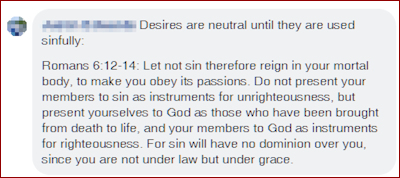
I referred to TGC's Tweet as a "hazy, misleading sophism" and added, "Lusting for something sinful is not 'obedien[ce] to God.'" A long argument ensued, with several friends on my FaceBook page and lots of my Twitter followers expressing shock and surprise that I would hold an opinion so egregiously out of step with postmodern political correctness. The "proper" postmodern opinion was succinctly stated by an exasperated commenter on my FaceBook page: "Desires are neutral until they are used sinfully," he wrote.


I fear that idea is finding currency among leading evangelicals. But it is dead wrong and subversive to genuine holiness. Scripture is chock full of statements emphatically condemning evil desires—from the Tenth Commandment (Exodus 20:17) to Jesus' words about mental and visual lust in the Sermon on the Mount (Matthew 5:27-29). What, after all, is lust but raw, sinful desire?

Those who argue that LGBT "orientation" is morally neutral often point out that an unmarried heterosexual man's attraction to women isn't necessarily deemed sinful, assuming he remains celibate. Why, then, should we consider a celibate gay man's attraction wrong, as long as he doesn't act on it?

I'd like to suggest two replies to that. First, a celibate heterosexual's attraction to women might indeed be sinful, if, say, he is attracted only to married women or underage girls. It would likewise be sinful if he allowed his interest in a particular young woman to become a fixation that distorts his perception of reality. A perfectly innocent attraction can even become a sinful passion for the person who indulges in immoral fantasies. No sane and reasonable person would try to argue that heterosexual desires are always wholesome. Second (and this is pretty straightforward:) Scripture says inordinate affections are sinful and commands us to mortify them (Colossians 3:5). I didn't make that up.

But my Bible uses the expression "evil desire" in Colossians 3:5. How do I know if a desire is "evil"?

In short, Scripture teaches plainly that any desire is sinful if it entails a wish for what we cannot righteously have.

Far from "supporting, encouraging, and empowering" people beset with perverse sexual desires, Scripture repeatedly urges us to repent of all sinful desires—especially those wicked sexual passions that so easily entrap young minds (2 Timothy 2:22; 1 Peter 2:11). All of us—not just LBGTQ folk—are commanded to renounce and mortify every desire for anything God has forbidden. Those who think people with impure or sinful desires can wear their peculiar lusts as badges of group identity merely demonstrate that they haven't a clue what repentance means. Furthermore, to omit or purposely obscure the Bible's clear call to repentance is to show contempt to one's unbelieving neighbors.

Let me be clear: I, too, have friends and close neighbors who identify as LGBT, and I abominate the way some Christians seem to think it's OK to heap unbridled scorn, mockery, or insults on them. All our neighbors should be shown Christlike, loving compassion with the dignified respect that befits anyone who bears God's image.

But to encourage them in their sin or offer them the false comfort of approval for their sinful desires is a serious breach of the Second Great Commandment.

Let's not try to make any sin seem less wicked than it is.

I would not necessarily single out homosexuality as the chief example of abominable sin if our culture didn't constantly insist on treating homosexual desire as a privileged category. Sodomy is only one of several notoriously odious abominations, and Jesus expressly said the hard-hearted unbelief of those who have actually seen and know the truth is a worse sin than all the evils of Sodom (Matthew 11:24).

Furthermore, I'm happy to assert, emphatically, that any evil attraction is appallingly sinful, including that heterosexual tendency to want to click on clickbait when the link features a picture of some scantily-clad tart.

But this one class of sins (LGBT etc.) is the only one that demands special status and unconditional affirmation.

So perhaps the main point I want to make will perhaps be clearer if we consider one of the sexual perversions that hasn't yet successfully lobbied for social acceptance and special rights.

Here's a real-life example:

During my first year at Grace to You (1983), a man wrote our ministry looking for affirmation and encouragement. He wanted us to agree with his belief that mere attraction to a forbidden object is not inherently sinful. He gave a convincing testimony about his conversion from a life of sin and rebellion. He said he was now serving as an AWANA leader in his church. Then he got specific about what he was asking us to sanction.

He said he felt sexually drawn to "large farm animals." (Those were his exact words.)

I wrote back, citing Matthew 5:28, and told him it is our position that the desires he was describing are not morally neutral at all but a sinful perversion that he needed to repent of and vanquish through the means of grace. I'd give him the same answer today, even after reading reams of sophisticated evangelical reasoning trying to argue that "attraction" and "lust" are categorically different.

One other point needs to be made before I wrap this up.

People sometimes suggest that all sin is equally vile. That's simply not true. It's true that all sin is damnably wicked, but Jesus Himself made clear that some sins are worse than others (John 19:11; Luke 10:12-14). And Scripture clearly portrays certain sexual perversions (lesbianism and bestiality among them) as unusually and unnaturally perverse. (See, for example, Romans 1:26-28.)

All of this raises an important question: How far do the culturally-engaged evangelical trend-setters want to take the notion that mere attraction is morally neutral? I hope we'd be concerned about the sanctification of someone who insisted on self-identifying as a pederast living a celibate life. Or my cowboy correspondent who harbored a secret desire for a closer relationship with his livestock. Or people drawn to any number of kinky fetishes too perverse to even talk about (Ephesians 5:12).
Yes, all of us struggle with evil desires. That's part of our fallenness. Even Paul struggled with covetousness—evil desire (Romans 7:7-25). But Paul's whole point was that those desires (even if never acted on) are sins to be mortified, not prize ribbons to be worn as badges of one's identity.

Phil's signature

01 May 2015

Some Here, Some There — May 1, 2015

by Dan Phillips

Very brief to start, will try to expand a bit up to noon, Texas time.
  • Oh, you have got to see this. I was on the fence about doing an SHST today, but this pushed me over — I had to do one, if only to send you to Tom Chantry's TGC-nuanced version of "Imagine."
  • Then, and relatedly, I think a lot of you somehow missed the Janet Mefferd interview. You shouldn't've. Read, and share: Part OnePart Two.
  • Kregel's 40 Questions series has now produced 40 Questions About Creation and Evolution. Read the review by Bob Hayton.
  • I love happy endings. Here's the testimony of a professor's conversion as a young man from Scientology (!) to faith in Jesus Christ.
  • M'man Mike Riccardi taps academics to give a good word on the Greek term translated "homosexual."
  • Interesting, in prepping to preach Ephesians 1:13 about being sealed with the Holy Spirit, to find Lloyd-Jones held that sealing was equivalent to baptism, and was a post-conversion experience. Even more interesting to realize that his reasons and conclusions were very like Sandemanianism (Dallas doctrine/no-lordship/gutless grace). Listen to the sermon here.
  • This week's But We Haven't Changed Our Mind About Jesus/Irony Can Be Pretty Ironic award winner.

  • Have a good weekend. Live like you're being watched. You are.
  • That's not what I meant, but anyway...

Dan Phillips's signature


28 April 2015

Janet Mefferd: the interviewer interviewed (Part Two)

by Dan Phillips

Introduction: see Part One. In this interview, Janet has the opportunity to share her thoughts and perspectives on some matters on which until now her voice hasn't been heard, or to which she has not yet been able to respond. Here, too, is the explanation of her move from her Salem Radio Network show.
****   ****   ****   ****

DJP:  What was the distinctive aim of your show? 
JM: Everyone always asks me that, and I never feel like I have a great answer.

We always billed the show as taking “a Christ-centered look at the news of the day, both in the church and in the world.” But I really wanted the show, from the very beginning, to be very Christ-centered and not a nonstop “culture war” show. I certainly covered politics and cultural goings-on, but I didn’t want the show be just politics or cultural stuff.

 I wanted non-Christians to hear the gospel, so I would share the gospel. I tried to encourage Christians who were listening to really trust the Lord, to obey Him, to honor Him. I did a lot of theological and biblical topics, and those were probably my favorite shows.

Along the way, I also thought it was important to tell the truth about a lot of things going on in the church that are just wrong and dishonoring to Christ, so that also wound its way into what I did on the air. And in that last category, I think we ended up distinguishing ourselves a little bit from other shows. I hate heresy and corruption, and I am outraged by the rampant child sexual abuse in evangelical churches. So I tried to speak out about those things whenever I could. 
****   ****   ****   ****

DJP:  Were you surprised at anyone who agreed to be a guest?
JM: Three come to mind: former Vice President Dick Cheney, Brother Andrew and the man who knew in advance he was going to get some tough questions and agreed to come on, anyway. And you know who that was.
****   ****   ****   ****

DJP:  Who was the most intimidating to interview, and why?
JM: Hands down, R.C. Sproul. He’s so biblically and philosophically brilliant, but he also has that good-natured ribbing edge to him that can come out. I just didn’t want to ask him anything stupid. If I did end up doing that, and I probably did, he was too much of a gentleman to point it out!
****   ****   ****   ****

DJP:  What were some of the greatest surprises in interviews, unexpected turns?
JM: There were a lot of funny moments.

I had one guest who was supposed to be on the air for an hour. But every time I asked him a question, he took a while to answer, and you could hear him loudly opening and closing doors and slamming cabinets in the background. I think he even went to the bathroom once; no joke. Uh, are you aware you’re doing a national radio interview, sir? Think you could hold it until the break? You have to
wonder what these guys are thinking. I had to cut him loose. 

Now and then, I would also get the guests (usually fellow radio hosts) who would just completely hijack the interviews and not let me get a word in edgewise. I also had a guest burst into tears on the air once. That was a little awkward.

But the end of the Mark Driscoll interview -- when he just didn’t answer at all and then hung up – was probably the most unexpected moment. Though if you listen to the preceding half-hour of that interchange, I guess it wasn’t at all surprising!
****   ****   ****   ****

DJP:  What feedback or contact from your audience stands out over the years?
JM: Again, the Mark Driscoll interview and its huge fallout would have to be the most memorable. I received so much hate mail, especially in the early days after the interview. That was tough. I was called everything from an “arrogant female” to “Satan.”

But there was a lot of supportive feedback, too, especially as time went on and I was vindicated in my accusations that Driscoll was a serial plagiarizer and worse. The emails that definitely meant the most to me were from inside Mars Hill -- from people who’d been personally abused by Driscoll or finally saw the light about him because of that interview. 
 ****   ****   ****   ****


DJP:  Did you have any relationship with Justin Taylor before his infamous Tweet? Have you had any contact from him since?
JM: He’d been a guest on my show once early on, but I didn’t know him at all. After that infamous tweet, someone also sent me a diatribe he wrote about me in the comment section of his own blog. He basically ripped me and falsely accused me of being a liar about the Driscoll hang-up, despite the fact that we’d released the raw audio and put out a statement about exactly what happened.

From the beginning, I told the absolute truth. But think about it: What possible motivation would I even have for staging a fake hang-up at the end of an interview in which I’d already proven  that Driscoll was a plagiarizer? The truly damning portion of the interview was already over at that point. It makes no sense, and I wouldn’t and didn’t lie about it.

On the other hand, a megapastor with a long history of lying and deceit and ties to The Gospel Coalition got the full benefit of the doubt from his Gospel Buddies. And in addition to playing footsie with Driscoll for years, Taylor’s M.O. was so obvious. He is the publisher for books at Crossway. Crossway has published a lot of Driscoll books. There’s a lot of money tied up in Driscoll. And there’s probably more plagiarism in them thar hills. KILL THE MESSENGER! Or at least discredit her so no one will listen to her. That’s all he was trying to do.

But no, he’s never contacted me to apologize for anything. Let’s be honest; that’s not what the Gospel Boys do. Repentance is just something they tell the little cash cows to do.
****   ****   ****   ****

DJP:  Tell us about the process that led you to decide to end the show?
JM: There were a lot of reasons for my decision to end the show, but one of the main reasons was the toll that my job was taking on my life and on my family.

I was talking not long ago with Dick Bott, founder of the Bott Radio Network, and he described my life better than anyone: “Doing three hours of live radio every single day is just a monster to feed.” He nailed it. If you want to do it right, and I did, it’s the kind of job that absolutely engulfs your life, 24/7.

For over five years, I was working on the show all the time, every day, weekends, evenings, even on vacations. I was staying on top of the news, reading books and articles, choosing guests, finding topics, doing social media. I was traveling. I was speaking at events. I had been approached to write a book, so I was working on that. And all the while I had a lot to do at home, too. I have a husband and four children, who I love more than my own life, and who I just missed all the time. I had no time to even be involved in something as basic as a group Bible study, which I did for years -- I even led a women’s Bible study for years -- and desperately needed and wanted and missed.

I did the best I could, but I was constantly exhausted and stressed out, and there was never any let-up. I eventually just reached my breaking point. Very few jobs are worth your life. So in January, I asked Salem to let me out of my contract early, and they agreed to let me do that. And I haven’t had one moment of regret. Sometimes the Lord just calls you to do something for a season, and then He calls you out. He’s definitely called me out of this particular job.
****   ****   ****   ****

DJP:  What’s next?
JM: Spiritual and physical detox. Uninterrupted time with the Lord and with my family. I’ve also got some more irons in the fire. I’ll have more to announce in the next month or so. Stay tuned. 
****   ****   ****   ****

DJP:  What talk show(s) will you listen to or recommend, now that you’re off the air?
JM: I’ve been a huge listener to talk radio for years. But I’m on a prolonged, intentional break from all talk shows right now. If I tune into any talk show in the next few months, it probably will be Mark Levin’s; he’s great. The only Christian radio I’m tuning into at the moment is KFUO via app. I’m not technically a Lutheran, but I love the hymns and the sacred music on that station. Soothes the savage, tired soul like nothing else.
****   ****   ****   ****

DJP:  Finally: as an expert interviewer, what question should I have asked?
JM: I can’t believe you didn’t ask me my life verse. Then again, I could never just pick one Bible verse as my favorite. 
****   ****   ****   ****

Thanks, Janet, for all you've done for the truths we hold precious. Godspeed.

Dan Phillips's signature


12 September 2014

Some here, some there — September 12, 2014 (special #TGCBlockedParty edition)

by Dan Phillips

Once again we'll start small. Do check back through the day, it will grow!
  • You've enjoyed some tweets I've lifted from the parody account The Gospel™ Corp. I have no idea who writes it, but it is just about the deftest parody-account I've seen. I mean, come on:
  • And how could you not love...
  • So I was genuinely surprised to find this:
  • I asked if it was a joke, learned to my astonishment that it was not. I honestly couldn't believe it. The TGC blocked this parody-account? How tone-deaf can you get? Were they trying to validate all criticism of their echo-chamber culture?
  • (By contrast, the Joel Osteen parody account is not blocked.)
  • So, moved by curiosity, I tried to follow TGC — to find that I too had been blocked at the user's request. Then others started checking and finding that they also had been blocked. So someone started the #TGCBlockedParty hash tag. Hilarity ensued. For instance:
  • ...and...
  • ...and...
  • Why did they do it? Was it a glitch? I've not been contacted, and I'm pretty high-profile and easy to find. I just checked the TGC account to see if there were any tweets about glitches creating false blocks, and found none. What did the blocked have in common? Some had objected to Mahaney and TGC's handling of all that, but I don't think I've written a word on that subject. What was the common factor?
  • Cripplegate's Jesse Johnson had a suggestion:
  • Jesse's other suggestion was this post about Driscoll.
  • The first result is that TGC is cementing its image of insular isolation and uber-prickly inability to entertain even the mildest criticism from outside clubhouse walls. Like this:
  • The second result is that being blocked by TGC is becoming a badge of honor. Like this:
  • I can envision the day when folks will say, "X is kind of a squish. I mean, he couldn't even get himself blocked by TGC."
  • Also, it's giving some good brothers a sad. Tony Miano felt left out for not being blocked.
  • And:
  • So: we've known for some time that its the stance of TGC and many of its writers that they are "unable to see" Pyromaniacs or anything we produce, no matter how effectively it forwards the convictions and truths they say they love and want to promote.
  • At least one TGC writer removed us from his blogroll (though he is still on ours). Why? Did we stop being Gospel-centered? Did our analyses of the scene drift from accuracy? History has since answered both. 
  • And so now apparently TGC is blocking critics of any sort on Twitter, though even then not with consistency.
  • What makes all this so sad — and what has taught me the bitterest, most unwelcome lesson in recent years — is how it relates to their own stated mission:
  • Yes, perhaps — but only if you're in The Club. Phil's question has now been answered.
  • Maybe if TGC isn't using their mission-statement anymore, another organization could take it over?
  • Chris Dean has a thought:
  • All these revelations have been hard on Carl Trueman. He's in our prayers.
  • Trueman is in interesting company, but he already knows that. Prof. Kevin T. Bauder may be on to something in some cases (obviously not in Trueman's), when he suggests that a better name might be The Gospel Coalition and Anti-Dispensational League. (h-t tweet from Scott Aniol)
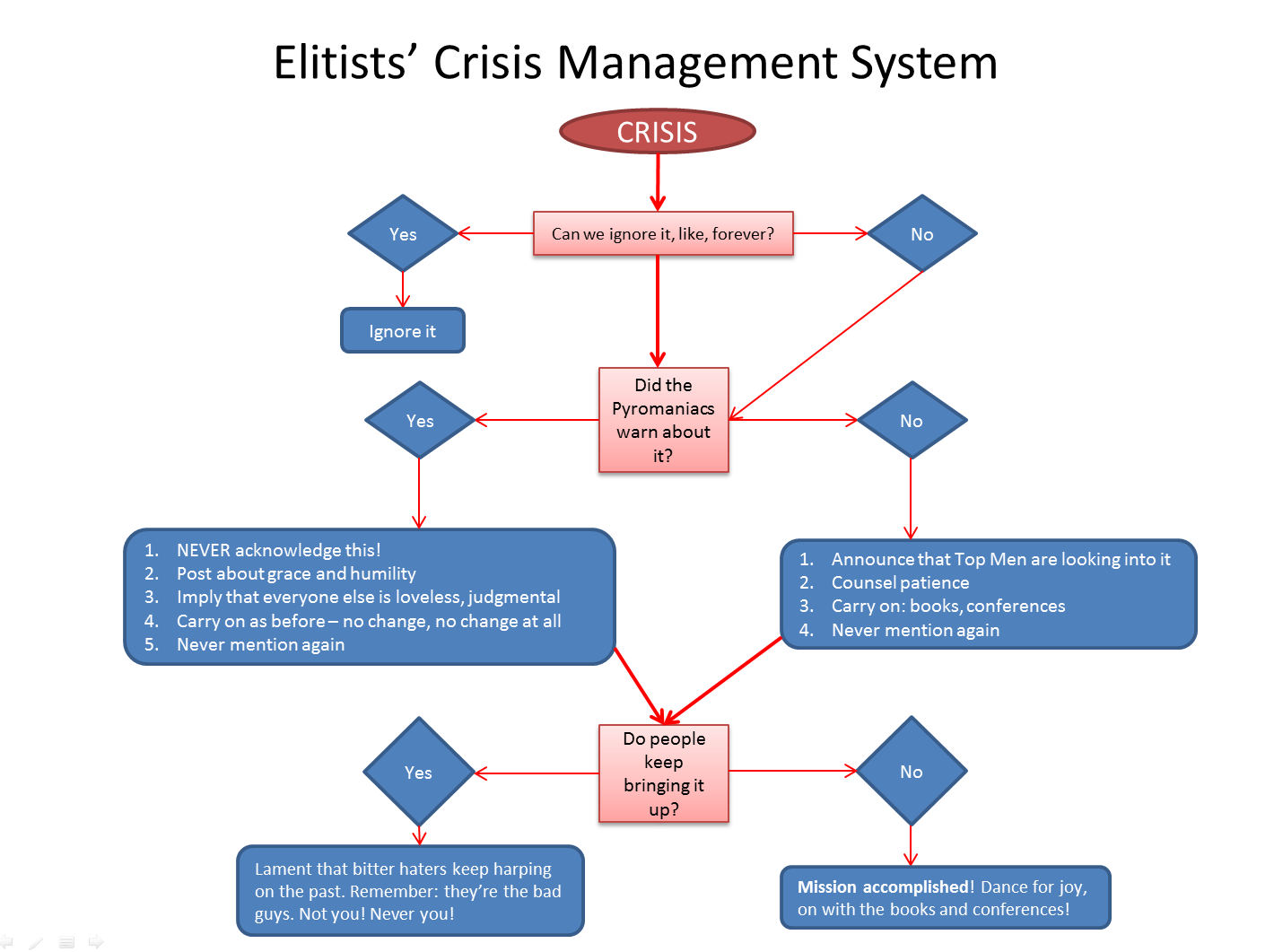
  • What are your predictions as to how this will resolve? Will they find a way to strike a hurt, offended pose and make it look like everyone else's fault, make everyone else look foolish and small? Will they just start unblocking, without a word? Will it follow the flow-chart?
  • In other news...
  • Clint Archer writes a post for single men that reads something like a companion-piece for this post, though he doesn't mention it.
  • Are you going to get the new Apple watch? I haven't heard yet whether or not Phil will...
  • Should Christianity be Cool? Gene Veith says what Phil Johnson was saying right here on this blog years ago. (See this from 2010, this from 2012, this from 2008.)
  • Well, that's all right. Evidently lots of people like writers and sites that do a lot of playing catch-up. But we already talked about TGC and its bloggers.
  • No no no, the Parliament of World Religions is going to be held in Salt Lake City. Not at Saddleback. So quit that.

Again, check back through the end of the day.

And you can only comment on this post if you've been blocked by TGC! (Kidding, kidding...)

Dan Phillips's signature


02 September 2014

Truth worth dying for? Anyone? Bueller? Today, anyway?

by Dan Phillips

Privately and publicly, Phil Johnson and I have marveled at the spirit of some moderns regarding God's truth. We've wondered how Christianity could have survived, had it been animated by this spirit at its inception. We've wondered what the early martyrs would think of today's sofa-sitting latte-sippers.

One breed that apparently considers itself exempt from All That has long been the Academy, on which subject we've offered some thoughts previously. These are scholars; they're a breed apart from, well, from the folks who pay their salaries. That's because they've had the benefit of special training and special discipline, and thus are privy to special knowledge. They're specialists. They know facts and truths that mere garden-working pastors and ditch-digging churchgoers just can't understand.

It is important (to these folks) that we respect these folks, that we not malign or criticize them or make them feel or look bad. No matter what they say or write, we mustn't challenge their convictions or character. If they tell us that they fit in with a school's doctrinal position or confession, we must take their word for it. If they tell us that their books or lectures or articles are sound and orthodox, well then, they wouldn't lie or dissemble, would they? They're academics.

Their defenders and enablers surely communicate to all that not much is at stake, that it isn't anything to "get het up" about. They'll spill equal amounts of ink lauding the Christian characters of those who depart from anything the great unwashed would recognize as a commitment to inerrancy, and casting aspersions on less sanguine critics or opponents. Because it isn't as if we should expect someone to commit himself to a position as being binding on his conscience, as being something... oh, I don't know... worth dying for, or anything so drastic.

For instance, we recently read this:
Belief in the truthfulness of the Bible, then, like belief in the truthfulness of Christianity or materialism or anything else [!], is provisional—scholars hold to it (or not) on the basis of the evidence they've seen. Affirming the Bible is true, just like affirming the Christian creeds, is a statement of current conviction: “Based on what I know now, I believe that the Nicene Creed/the New Testament is correct, when properly understood.” It doesn't prevent individuals from researching carefully, nor from abandoning or adjusting their commitment if the evidence takes them that way; the changes of conviction, affiliation, and worship practices of many of the “aha” scholars, as well as those who have moved the other way, should be evidence enough. In some cases, no doubt, belief in inerrancy is associated with fearmongering, closed-mindedness, misrepresentation, and rudeness. But the same is true of evangelicalism, and Protestantism, and Christianity as a whole, let alone atheism, Islam, feminism, materialism, and virtually all beliefs held by human beings. I’ve seen a fair bit of it on Pete Enns’s own blog, and I imagine he’d say the same of mine.
Where did I see that? Patheos? BioLogos? Huffington Post? No; in the rarified air of TGC — which, I remind you, ostensibly stands not for The Great Clubhouse, but The Gospel Coalition; and which, I am sure, is funded and read and has its conferences swell with people who certainly are fiercely committed to the Gospel and the truths that underlie it.

This was a post at that site. And since one of the commenters dubbed this article "incredibly thoughtful and nuanced," well then, from one perspective, it must be considered a rousing success, a paradigm of carefulness and all that.

I made a comment in the meta; Phil shared this in Twitter:
Which provoked this wounded-sounding, bemused response from the author:
Now, ponder that, for a moment. Here's a scholar, who knows more than we all know. He professes Christian faith, at least "provisionally," according to what he knows right now. (Well, it's what he knew when he wrote the article; I suppose that may have changed since then.) Yet, speaking of his own fellow-believers ("Christians") in the third person, he professes bewilderment at Phil's eleven-word comment.

Remarkably enough, though, while unable to make sense of Phil's eleven words out there in print, he can read Phil's mood from the unknowable privacy of Phil's heart— and it's angry. Perhaps Phil is one of those scholarship-despising, progress-slowing fearmongerers lamented in the article? Phil certainly isn't being treated to the paeans of praise that the author heaped on those "thoughtful, insightful Christian brothers and sisters" and "good guys" in the Academy who find fault with the Bible.

So: It's all well and good to tell the unwashed that the fear of Yahweh is the beginning of knowledge and wisdom (Prov. 1:7; 9:10). For them, maybe it is. For academics, however, it is at best a provisional conclusion tentatively reached, perhaps, at the end of investigation. It is held as today's conviction, which may be overridden tomorrow, depending on what our real starting-point dictates tomorrow.

Seriously: where would we be, had Doctor Martin Luther said "Here I stand —provisionally. At the moment. I think. Today. But tomorrow... who knows?"

Regardless, I wasn't going to say anything further about it — knowing the waves of anger and offense and indignation that it will provoke from folks who already haven't much use for me, if the usual "ignore it and it will go away" method employed for our posts doesn't serve as well as it usually does for them.

But then I came on this from Spurgeon. As so often, once Spurgeon says a thing, it can't be much improved on. So I'll give him the closing word, and he speaks for me:
I have often wondered whether, according to the notions of some people, there is any truth for which it would be worth while for a man to go to the stake. I should say not; for we are not sure of anything, according to the modern notion. Would it be worth while dying for a doctrine which may not be true next week? Fresh discoveries may show that we have been the victims of an antiquated opinion: had we not better wait and see what will turn up? It will be a pity to be burned too soon, or to lie in prison for a dogma which will, in a few years, be superseded. Brethren, we cannot endure this shifty theology. May God send us a race of men who have backbones! Men who believe something, and would die for what they believe. This Book deserves the sacrifice of our all for the maintenance of every line of it.
[C. H. Spurgeon, The Metropolitan Tabernacle Pulpit Sermons, vol. 35 (London: Passmore & Alabaster, 1889), 264.]
Aha, indeed.

And amen.

Dan Phillips's signature


19 June 2013

Full-Contact Rugby

by Frank Turk

Last week, I made a point to say that nobody wants to be, by analogy, this little fellow:


That is, nobody wants to always be the one with the voice that can peel paint off the walls when it comes to being the bringer of bad news.  And in some sense, that's what Keller and Powlison were on about 5 years ago when they published their paper to the internet about how to respond to bad reports.  It seems to me that yes, indeed, we should season our words with love and compassion and good will in that we do not want to be people who, frankly, thrive on gossip and slander.

But:

Of course to say that there's never a time or place to publicly discuss such things seems, at least, a little bit priggish or weak.  For example, as we considered last week (thanks to the anonymous internet reader's objections), Tim Challies has been on quite a tear into the use of pornography.  For him to do that, at the very least, requires the assumption that there's a bad report out there about someone's use of the internet -- someone on the internet, apparently, is wrong.  All the posts thereafter finally don't follow any of the advice of Keller and Powlison.  Tim does not suspend judgment.  Tim does not bother to think about whether he knows the heart of the people he's on about.  He certainly didn't speak to anybody personally.  Yet as even marginally-objective readers, Tim did the right thing by making every effort to recriminate the use of porn.

I think it turns out that we can be serious, sober, and kind -- and not have to face the world with a blank expression and a sphinx-like silence -- when we are faced with a bad report.  But if we find this to be true -- and I can list examples for you if you're interested -- then what do we do with the original essay which I said I agreed with?  What about the idea that we need to approach bad reports in such a way that we do not become the equivalent of the Hound of the Baskervilles trapped in the body of a fluffy lap dog?

Well, I think the first word missing from the Keller/Powlison essay is "pastoral."  You know: last year I spoke at two conferences and a church anniversary, and the greatest compliment I received from those events came from a single person who came to me and said, "you come across much more pastoral in person than you do at the blog."  Whether that's true or not, I think, is utterly subjective because I didn't write anything for those talks I hadn't written previously at one of the menagerie of blogs I keep from getting deleted by blogger.  But that point simply cannot be made too keenly: there is something pastoral necessary in dealing with bad reports.

The thing we should observe about being pastoral is that not everyone is called to be a pastor, but every Christian is called to somehow demonstrate the truth in love.  Every other internet christian cogitator thinks he is a Berean or follows the Berean methodology, but what's the sense of being a Berean rather than a Thessalonian?  Luke says that the Bereans were "more noble" than the Thessalonians.  Everyone gets very exercised about being as "biblical" as the Bereans, but the word which distinguishes them from those who attacked Paul in the previous city is that they were "εὐγενέστεροι."  What if we expressed our "εὐγενής" in Christ when we encountered a bad report as the first step -- because that's a pastoral thing to do.  It expresses the real care for the souls of those watching and care for the souls doing the things being reported as bad because it has the highest regard for truth, and that's the heart of pastoral virtue.

There also ought to be something brotherly or fraternal in our response to bad reports.  The problem with saying it that way, of course, is that it offends the egalitarians.  However, anyone with a brother knows for a fact that getting correction from him rather than from Mom or Dad or a Sister is not the same as from another source.  It's a combination of full-hearted love and full-contact rugby.  And because it is both loving and rough, it is unmistakable as meant for permanent change.  While it's nice that Keller and Powlison mentioned all the loving parts of responding to bad reports, somehow they omitted stuff like Prov 27:6, or Prov 27:5, or Prov 27:17.

Our reaction to a bad report also ought to be holy.  This is the one all of us fumble from time to time because for something to be "holy," it has to be, by definition, exactly what God would do -- not merely what we imagine God would do.  The quest for our reaction to be "holy" creates both permissiveness and legalistic condemnation, but we have to strive against that so that our reaction is both inside the Law and outpouring the Gospel.  It should not just name what it wrong, but also plead for what's right through the means of Jesus Christ.

And that brings us to the final point: our reaction has to be redemptive.  It has to show the other person that there is a path home in Christ for them.  The ultimate purpose in the Christian life is not to show others how poor, wretched and stupid they are: it is to show them that their poor, wretched, stupid problems are resolved by Christ, and that they can repent and be reconciled to God and to other people.

If you are doing that, you can be Tim Challies without any blushing.  You can be PyroManiacs without wincing.  You can receive and consider bad reports without disgracing yourself.


12 June 2013

A Pint of Baby Orphan Tears

by Frank Turk

Before we get too far here, two things.

Number One: Thanks for asking - my vacation was great.

Number 2 (HT: Fred Butler and DJP):


A truly-inspired video, and a truly-irreplaceable pet.  If my Big Dog screamed like that, I'd have him in movies, but only because it would be impossible to have him in a middle-class neighborhood around anything which would cause him to make that noise -- a noise which makes the shriek of a witch-king pierced by an unexpected woman on a battlefield sound rather cheery.

Now: why post that soul-jarring scream on a moderately-serious blog like this one?  Well, it came to my attention a couple of weeks ago that there is a 5-year-old white paper out there by Tim Keller and David Powlison (men I respect and have defended in the past, and would still do so) entitled Should You Pass on Bad Reports?

Unremarkably, their verdict is, "no."  I know it's unsurprising, but as they summarize the matter, it goes like this:
  • The first thing to do is to simply suspend judgment. Don’t pass on bad reports.
  • The second thing to do is “cover” it in love, reminding yourself that you don’t know all about the heart of the person who may have done evil—and you know your own frailty. Don’t allow bad reports to pass into your own heart.

  • The final thing to do is go and speak to them personally.

And they reach this conclusion through a significant exercise of walking through relevant Scriptural admonitions in order to reach a conclusion which, it seems, nobody can argue with.  It's offered, btw, from the blogger who posted it as something he hopes will resonate with all bloggers, to be posted far and wide on other blogs, to spiritually season Christian conversations on the internet.

Because: nobody wants to be the little white fluffy dog whom others perceive as howling like a cannibal's wedding feast.  Nobody wants to be the one whom others look at the way we all look at the little video above and be the object of dismay, scorn, and derision.  We don't want to be laughed out of the conversation, and moreover: we don't want to be dismissed because we are just a yowling mess.

In that respect: this is good advice.  Nobody should be a perpetual fault-finder -- if for no other reason than it actually makes less of you.  Someone who can find nothing good in other people is someone who is feeding himself only emotional poison.  Being constantly disappointed in other people -- or worse, always being outraged at them -- simply causes you to fail to see the image of God in those people.  Scripturally, you must do better -- and Powlison and Keller spell out why.


What?  Why are you looking at me like that?

I can't agree with good advice?

Oh, I see: you expect me to find fault with this particular consideration of bad reports of other people for a couple of reasons, not the least of which is because it is in some very specific and obvious ways responding to bad reports without, it seems, taking its own advice.  "Like Ministry" and all that.  Well, you seem to have worked that one out on your own.  Why do you need me to work it out for you?

What? You were actually hoping that I'd see if this advice actually works in realy life somehow -- like comment on Challies' on-going crusade against pornography as it relates to this good advice from pastoral minds?  Now: why should I do that?  Is there anyone reading this blog who is not actually aware that pornography is sinful and causes us to sin?  In fact, are there any readers of Tim's blog who are not readers of this blog (there are many of these people) who are not morally opposed to pornography?  We are on the same side of this issue -- why should I try to apply this advice to those posts?

What do you mean, "in what way is it in compliance with this advice to rail on against a particular sin abstracted from particular people? Doesn't that approach violate all of this advice -- first, by believing the worst of essentially all Christians; second, by judging the hearts of others; and third, by utterly neglecting to take the matter to them personally?"  Why would you say such a thing about a fellow everyone agrees is both discerning and utterly nice?  Do you think there's something wrong with general good advice?


Oh:  I see what you're driving at.  You're actually saying that the advice itself it a little bit too facile, too superficial -- that if somehow when it gets applied to the nicest fellow on the internet and somehow makes him out to be a watchblogger, it must somehow be faulty.  And by "Faulty," you mean the way a small dog that bays with the wails of demons demanding a pint of baby orphan tears is faulty -- it is neither useful, nor practical, nor as domesticated and harmless as it looked before it opened its mouth.

That's a pretty serious thing to say about useful fellows like Keller (who has sold a bajillion books, and gets to appear on Morning Joe) and Powlison (who has his own place in the pantheon of useful, center-bound Gospelistas in spite of his lesser status as a published author).

I'll consider your opinion and get back to it next week.


10 May 2012

Tag-ons to Frank's BoB2012 post

by Dan Phillips

Don't have anything ready to serve at the moment, nor the time to finish cooking what's on the drawing board (how many mixed metaphors is that?). So I'll point back to Frank's, and add a couple of tight-lipped thoughts.

I could not have said all that I think about BoB2012 (nor the, in equal parts, response and non-response to David Kjos' post) as politely as Frank did, so at the moment I'll mostly say "amen," and join you all in waiting to see if an appropriately substantial response is forthcoming, adding only these:
  1. Luke 12:48b is surely germane in this connection, is it not?
  2. I would also point out what Thabiti Anyabwile said about celebrity pastors at T4G12, if I understood him correctly: Actress X would not be a star if truckloads of people didn't buy tickets to her movies. Transferring the metaphor, readers must take responsibility that Blogger X would not have the prominence he enjoys without truckloads of clicks, retweets, follows and links. Just sayin'.
  3. Even granting that serious, weighty, dire, intense and personal discussions were being carried on behind closed doors, is there anything in this post or this post that relied on "facts not in evidence"?
  4. What would have happened differently if, instead of taking a posture of unawareness of (or sullen resentment towards) all such posts on various blogs, TGC blogs and leadership and other leading voices had taken such concerns seriously before (to quote Frank) "all the wrong that could be done was actually accomplished"?
  5. And finally, this can't be pointed to enough, if only for a needed sad chuckle:

Dan Phillips's signature

09 May 2012

BoB2012 - How the Other Half Lives

by Frank Turk

UPDATED:

OK - you came here for the fireworks, but there are a couple of things I need you to do before you start playing John Phillips Sousa for the Grand Old Flag.

1. A young friend of our family, who is named "Daniel," is going into surgery on Thursday, 9 May 2012, at about 5 AM, to have a pacemaker put in; his surgery is postponed one week.  When I say "young," I mean he's not old enough to drive.  Please pray for Daniel and his family, his doctor and the support staff, and that God will be merciful.

2. My beloved friend Mark Lamprecht, known to many of you as "Here I Blog," has a friend who is in dire need of medical treatments he cannot afford.  I haven't been given the liberty to share all the details, but I can say that Mark and I are trying to find a way to create a donation campaign for this fellow who is a father and a husband in order that he gets the minimum urgent care he needs, which will be about $12,000 to start.  Until I can find a way to make the donations payable to this fellow's church so that we know the funds will be property administered, I'm not linking to a donation site.  But for now, if you would be in very serious prayer for this man and his family, it would serve them well.

Well, I find myself with a LOT left to say after cutting some slack on section 2 of the outline last week, but I'm going to rein it in (a little) and stick to one last bit of what's left of the BoB2012 panel discussion, which we find thus:
[30:19]
JT:I think the one with [Jefferson Bethke], who is here someplace, I think that one was in some ways an easier thing because Jefferson does not represent a movement per se.  He's an individual person doing a video and received some, you know, hurtful comments, and also some iron sharpening iron push back.  I think that's in a little bit different category that, say, some of the controversy  with Sovereign Grace, or with Elephant Room.  Um, so much to say, about both those that could be said.  I take a little bit of a contrarian perspective on both of those in that there is so much dialog going on behind the scenes that not everyone is privy to.  Take Elephant Room as an example: There was just a lot of conversation going on behind closed doors, private communication, and some of the people in the blogosphere were saying, y'know, "why isn't TGC saying more?  Why isn't Carson or Keller saying more?"  I think if you're not privy to those conversations, it can seem like stone-walling or sweeping something under the carpet, and y'know, why aren't we being communicated to.  Some of that is that we're conditioned to, when there's information, it should be made public.
 
OWEN: Immediately.  Now. 
JT: And I think in the Sovereign Grace one, which I think is its own animal, very complicated, but there you have an example with uh, the wiki-leaks sort of mentality and strategy among some people who had left the movement, some who were still in it, just saying, "That's not good enough, we're gonna take this into our own hands.  We're gonna go public, make documents public, nothing's off limits."  There's literally no ethics involved.
[32:20]
The reason for it, to be as clear as possible, is that I think there's something to be said in defense of David Kjos' sparse review of the panel in which he said:
The debacle of the Elephant Room, according to the representatives of The Gospel Coalition on the Band of Bloggers panel, was the objections of numerous bloggers, and the criticism of The Gospel Coalition, of which MacDonald was a founding member, for its silence on the matter. We were scolded for expressing opinions without being privy to the inside discussions of The Gospel Coalition, as if that was at all necessary, as if T. D. Jakes was an unknown quantity instead of a public figure whose heresy is well known through multiple publications. Bottom line: if you’re not on the inside, you’re not qualified to speak.
Justin Taylor specifically said that this is a bad distortion of what he personally said, and I want to consider that as well as a further issue regarding the problem of transparency and disclosure overall.

Let's start where Justin starts: the Jeff Bethke incident which, as he rightly assesses, is an "easier thing".  But Justin's assessment is that it was easier because Young Jefferson is just a guy with a YouTube channel.


That is: a YouTube Channel that has received 20 million pageviews.  Just for comparison sake, "David after Dentist" has 110 million views in 3 years; Jeff has 20% of that in 4 months.  At this rate Jeff's video will have 100 million views by next summer and will be parodied by Chad Vader before the Fall.

My point being: Justin classes Jeff and his video as "just a guy," when in fact Jeff has captured more viewers than any one time Mark Driscoll has been on national TV.  Justin's view is an understatement at best -- and it minimizes what followed.

Jeff, who is not a pastor, or the leader of a movement, but who has gotten more views for his video than Jon Stewart gets for the Daily Show in any given 10 days combined, received some criticism for his video -- some of it constructive, some less than helpful.  But Jeff did something which, it seems to me, is instructive: he listened and admitted his mistake(s).  Of particular use for this teachable moment was the pastoral poking of Kevin DeYoungJeff's response to Kevin was, it seems to me, not just edifying but exemplary.  Jeff made some clear mistakes, Kevin lined them out clearly and fairly, and Jeff accepted them at face value.

Some things Jeff didn't do:
  • Jeff didn't pipe up on twitter toward nameless people who were vexing him
  • Jeff didn't delete posts he was thereafter ashamed of, or the original video because it took some hits
  • Jeff didn't ignore the comments, and didn't ignore Kevin in particular who was trying to point out his errors
  • Jeff didn't go into seclusion or go into radio silence while urgent and necessary private conversations were conducted for the sake of his soul and the real people who might somehow be damaged.
See: Jeff Bethke, when he put his foot in it publicly, took public criticism, and made public amends for it.  He even accepted that people criticizing him meant it for his good -- even if some of them were somewhat not good at goodness or at speaking the truth in love.  Let me say this clearly: if that's what we receive from a young fella with a YouTube channel, why would we expect less from the heroes of the reformed blogosphere?


Let's face it: saying nothing at all is actually less than what Jeff did.  Ignoring the public spin of those doing the wrong thing, which were tantamount to lies and obfuscations, is less than what Jeff did.  Failing to speak up until all the wrong that could be done was actually accomplished is far less than what Jeff Bethke did.  And doing less than Jeff when your position in a movement or in a coalition or in a band of men joined together for some para-church sake is less than what ought to be expected.

Yet here's where those I am talking about, and their advocates and surrogates, will start sniffing at the criticism.  JT has already hinted at the tactic in his statement, above: not everything has to be public.  In fact, as JT said, public statements would hurt the private conversations.

Therefore, let's think about the perfect example of that -- the mud fight surrounding SGM -- as it is also instructive.  JT, as the insightful and helpful blogger that he is, actually nails it in his statement: what happened to those with the (in my view: unreasonable) hunger and thirst for justice is that they gave up on any kind of ethics in order to make public every jot and tittle of perceived wrong-doing and to demand a pound of flesh because they said they were offended -- and not because there was any substantive offense.

From the AoR report:
One of the greatest factors that inflamed the conflicts and increased people’s wrath and clamor was the extensive use of sinful communication in talking, emails, blogs and meetings. 
While every Christian would agree that gossip and slander are sinful, many in SGM failed to recognize when they initiated, participated, or listened to and read sinful communications. 
When we met with people, they often justified their own judgmental and damning words with dangerous thinking such as:
• “It’s just the truth!”
• “I am loving this person by revealing this person’s sins to that person or to the community or even the world (e.g., through the Internet).”
• “Since I’m being ignored, I am justified in saying these terrible things about others.”
• “I need to protect the church or the world against these evil people.”
• “Because I was hurt, I am justified in how I hurt others by whatever kind of words I use!”
 
As mentioned above, AoR has often seen sins of the tongue in conflicted groups. But in working in this situation, we experienced first-hand an unusual severity of this grievous sin. It was simply shocking. 
For a people who take pride in humility, who claim to have been totally indoctrinated in biblical peacemaking, and who brag about the way they share Christ and his love, we were saddened that so many of these same people minimized sinful talk, justified gossip and slander, and refused to see how such activity itself exaggerated their troubles.
My point being: if this really is the only other choice as what "some bloggers" were demanding, then I agree with Justin: maybe we'd be better off just minding our own business.

But, in fact, that's not the only other choice -- and in a very specific sense, it's not what "some bloggers" were suggesting, and exhorting, and pointing out was missing.

One blogger (since we are not naming names) started an open letter to Carson and Keller when the ER2 hoopla was just getting ginned up by saying this:
As I begin to write this, I do so with a personal sense of indebtedness to both of you.  I am not merely grateful for your books and lectures and sermons which have taught me so much: I am grateful for the spirit with which you have done it all.  That is to say: while I am well-known through a reputation of being quite a pill for the sake of the Gospel, you both are known as fatherly men who have a graciousness I am certain I lack, and it is that spirit from which I learn much all the time.
And then this:
Recently, you have both penned a detailed statement about the nature of the Gospel Coalition, and about its duties or relationship to its readers and also its council members.  I found this essay instructive, and useful, and clarifying in the context it was coming from, but in my view, it misses the point of the concerns of almost all the critics of the dust-up over the Elephant Room.  I wanted to offer to you an outsider's perspective on what just happened and why it is not enough merely to say what you have said so far.
And then this admonition:
Now, here's what's not necessary: we don't need the reality TV version of whatever it is that has happened, is happening, and will happen between the various parties at TGC, including any trumped-up drama.  But when someone publicly makes an error of this size, the broad stokes of the public resolution are, frankly, necessary for the sake of those you started your internet site up for in the first place.
...
Saying what you might do is an interesting approach -- and it is the approach of the essay you have already written.  But showing the rest of us how to actually do it would be invaluable.  It would actually put into play something the Evangelical church lacks -- an education on how to exercise spiritual responsibility, and turn a brother away from wrong-doing and toward the right path, the right orbit in our center-bounded life which is around Christ.
So I ask you as a fan, and as your far-removed student, and as a Christian who is indebted to you: help us understand how to resolve this matter.  Please do not let the weak single tweet from James MacDonald that the parties #AgreeToDisagree stand as the milestone to this event.  That activity would be helpful to so many people for so many reasons that they cannot all be listed, but the one most important must be said: it will glorify Christ.
That's not badgering.  That's not unethical intrusion into private conversations.  But that's also not one of the choices JT is willing to proffer. See: what is said by JT (and to be fair: I think it is at least partially unintentional, partly a function of unprepared remarks) is that we can expect one thing from a young fellow with a YouTube channel, and we should expect that same thing from people with complaints about their churches, but we can't expect it from men like the guys who sit on the council for the Gospel Coalition.  These are important men, and they represent more than themselves, and we can't just expect them to take public rebukes for public misdemeanors and mistakes as if they might actually be wrong.

This is why David Kjos was offended by the table talk at BoB2012.  In fact, this is why I am offended by this little kaffeeklatsch of fellows under 40 who know things they wish they didn't know: there's no question they have a different standard for a James MacDonald or a D.A. Carson or a Mark Driscoll or a John Piper or a Mark Dever than they do for a Jeff Bethke -- and it's not a higher standard.

It really doesn't get better as you listen to this discussion: it gets worse.  Collin Hansen, God bless him, pulls back the curtain for us and makes it transparent what this means, ending around 34:50.  Again, to be utterly fair, I think he didn't intend to say it this way, but he said what he said.  In his view, in the same way that Christianity Today would never publish anything but nice about Billy Graham and his kin, the same barrier exists at TGC for the council and its members.  When you link this to Collin's foundering around about what's so bad about comments (negative comments being, on the one hand, welcome for the sake of "openness", but on the other hand, being from "parasites" who don't have any other platform or readers), it's sort of ghastly.  It's like finding that darned cat which has been missing for a few weeks behind the appliances -- it's not what one wanted to find, or meant to find, but you have (for good and ill) found it.  It answers a lot of questions.

But the choices are not to either do nothing or to produce a reality show that runs after Keeping Up with the Kardashians: a real third way could be to be like Jeff Bethke even though one might be James MacDonald or Mark Driscoll.  Or better still: specifically because one might be the leader of a movement, somehow one takes Jesus' admonition to be unlike the world but to instead save the world (or your demographical piece of it) by dying for it rather than jockeying for position.  The real third way is to be like Kevin DeYoung or Thabiti - to say what is right regarding what is wrong, in a clear and cogent and compassionate and public way so that what is actually wrong with a brother is made clear to those one intended to attract in the first place, and so that what is right about public discourse can be modeled for the plethora of hit-piece writers and undiscerning discernment bloggers.

There are more lessons to be learned here than the really-superficial and rudimentary issue that somehow Keller and Carson are aware that Jakes is a Modalist - and those lessons are actually lessons in applying the Gospel.  When a James MacDonald publicly embraces, from bad to worse, panderers, demogogues, and then a modalist, the least one can do is say, "I think my friend has made a mistake which, I hope, he will repent of."  And the least he can then do in return is to say, "I have received a general critique of what's happening here, and I hope I can resolve it with my friends."  And then let all the private enclaves and secret meetings which have jaded and disillusioned these poor young fellows with thoughts that cannot be mentioned ensue.  But that cannot be demonstrated because these men are, it seems, too great to be burdened with running the parachurch ministry they sought to build to this high a profile.  It's no wonder both James MacDonald and Mark Driscoll got a fond farewell from TGC rather than a sorrowful public final plea to repent of their terrible mistakes: there is a different standard for men like them, and men like Carson and Keller, than there is for men like me.

The proper standard, however, will be upheld in the comments, which are open. Play nice.