Showing posts with label evolution. Show all posts

01 May 2015

Some Here, Some There — May 1, 2015

by Dan Phillips

Very brief to start, will try to expand a bit up to noon, Texas time.
  • Oh, you have got to see this. I was on the fence about doing an SHST today, but this pushed me over — I had to do one, if only to send you to Tom Chantry's TGC-nuanced version of "Imagine."
  • Then, and relatedly, I think a lot of you somehow missed the Janet Mefferd interview. You shouldn't've. Read, and share: Part OnePart Two.
  • Kregel's 40 Questions series has now produced 40 Questions About Creation and Evolution. Read the review by Bob Hayton.
  • I love happy endings. Here's the testimony of a professor's conversion as a young man from Scientology (!) to faith in Jesus Christ.
  • M'man Mike Riccardi taps academics to give a good word on the Greek term translated "homosexual."
  • Interesting, in prepping to preach Ephesians 1:13 about being sealed with the Holy Spirit, to find Lloyd-Jones held that sealing was equivalent to baptism, and was a post-conversion experience. Even more interesting to realize that his reasons and conclusions were very like Sandemanianism (Dallas doctrine/no-lordship/gutless grace). Listen to the sermon here.
  • This week's But We Haven't Changed Our Mind About Jesus/Irony Can Be Pretty Ironic award winner.

  • Have a good weekend. Live like you're being watched. You are.
  • That's not what I meant, but anyway...

Dan Phillips's signature


04 December 2011

Spurgeon on Evolution

Your weekly dose of Spurgeon
posted by Phil Johnson


The PyroManiacs devote some space each weekend to highlights from The Spurgeon Archive. The Following excerpt is from Spurgeon's autobiography.


t one of the memorable gatherings under "The Question Oak," a student asked Mr. Spurgeon, "Are we justified in receiving Mr. Darwin's or any other theory of evolution?"

The President's answer was:—"My reply to that enquiry can best take the form of another question,—Does Revelation teach us evolution? It never has struck me, and it does not strike now, that the theory of evolution can, by any process of argument, be reconciled with the inspired record of the Creation. You remember how it is distinctly stated, again and again, that the Lord made each creature 'after his kind.' So we read, 'And God created great whales, and every living creature that moveth, which the waters brought forth abundantly, after their kind, and every winged fowl after his kind: and God saw that it was good.'

"And again, 'And God said, Let the earth bring forth the living creature after his kind, cattle, and creeping thing, and beast of the earth after his kind: and it was so. And God made the beast of the earth after his kind, and cattle after their kind, and every thing that creepeth upon the earth after his kind: and God saw that it was good.'

"Besides, brethren, I would remind you that, after all these years in which so many people have been hunting up and down the world for 'the missing link' between animals and men, among all the monkeys that the wise men have examined, they have never discovered one who has rubbed his tail off, and ascended in the scale of creation so far as to take his place as the equal of our brothers and sisters of the great family of mankind.

"Mr. Darwin has never been able to find the germs of an Archbishop of Canterbury in the body of a tom cat or a hilly goat, and I venture to prophesy that he will never accomplish such a feat as that. There are abundant evidences that one creature inclines towards another in certain respects, for all are bound together in a wondrous way which indicates that they are all the product of God's creative will; but what the advocates of evolution appear to forget is, that there is nowhere to be discovered an actual chain of growth from one creature to another,—there are breaks here and there, and so many missing links that the chain cannot be made complete. There are, naturally enough, many resemblances between them, because they have all been wrought by the one great master-mind of God, yet each one has its own peculiarities.

"The Books of Scripture are many, yet the Book, the Bible, is one; the waves of the sea are many, yet the sea is one; and the creatures that the Lord has made are many, yet the Creation is one. Look at the union between the animal and the bird in the bat or in the living squirrel; think of the resemblance between a bird and a fish in the flying fish; yet, nobody, surely, would venture to tell you that a fish ever grew into a bird, or that a bat ever became a butterfly or an eagle. No; they do not get out of their own spheres.

"All the evolutionists in the world cannot 'improve' a mouse so that it will develop into a cat, or evolve a golden eagle out of a barn-door fowl. Even where one species very closely resembles another, there is a speciality about each which distinguishes it from all others.

"I do not know, and I do not say, that a person cannot believe in Revelation and in evolution, too, for a man may believe that which is infinitely wise and also that which is only asinine. In this evil age, there is apparently nothing that a man cannot believe; he can believe, ex animo, the whole Prayer-book of the Church of England! It is pretty much the same with other matters; and, after all, the greatest discoveries made by man must be quite babyish to the infinite mind of God. He has told us all that we need to know in order that we may become like Himself, but He never meant us to know all that He knows."

C. H. Spurgeon


13 April 2011

Open Letter to Dr. Karl W. Giberson

by Frank Turk

Dear Dr. Giberson,

I enjoyed your post at CNN last week about what Jesus would believe about evolution, and I wanted to comment on it.


I'm pleased that you referenced one of the sayings of Jesus straight off in your post, but there's another one I'm thinking of right now. Let me tell you the story. It's the one where Jesus had finished teaching about the Kingdom of God, and he went away from Galilee and entered the region of Judea beyond the Jordan. Large crowds followed him, and he healed them there.

But the Pharisees came up to him and tested him by asking, "Is it lawful to divorce one’s wife for any cause?" Jesus answered, "Have you not read that he who created them from the beginning made them male and female, and said, 'Therefore a man shall leave his father and his mother and hold fast to his wife, and the two shall become one flesh'? So they are no longer two but one flesh. What therefore God has joined together, let not man separate."

Now, this is an interesting story for a couple of reasons. The first is one which Dr. John Piper has preached on powerfully (among other men) to point out that this is a great place to show what Jesus says about the nature of the Bible itself. Here Jesus says plainly that "He who created" man and woman also "said" that there is a command for marriage -- even though the bit in Genesis Jesus quotes is not directly attributed to the Creator but is simply the 3rd person omniscient narrator of Genesis. That is: all the words in Genesis 1-3 are God the creator's words.

Just to be fair to you, I think you would say such a thing -- I just don't think you would mean what I mean by saying such a thing. And that brings us to the second reason to consider this story: why Jesus would tell it. You know: why would Jesus go to a place in the Bible where, in your view, the historical and theological issues are very complicated and somewhat ahistorical to tell the Pharisees what they ought to have known (in his view) by simply reading the text?

Here's what I think: Jesus tells this story to straighten out the question of what Marriage is and ought to be because there is something authoritative in the origin of man (male and female) that speaks to who he ought to be. But the reason for that is not an ontological argument. It's not a deduction from fit, form and function to foundational principle. It's not something that science discovers for us. It is certainly not something science discovered for Jesus. Jesus appeals to the declaration of Scripture to define the origin of things -- in this case, Man.

You see: In the beginning there was the Word. The Word was with God, and the Word was God. He was with God in the beginning, and all things were made by him, and nothing was made without him. And then, the Word became flesh, and lived among us. And while you are right that Jesus said he was "the Truth," he wasn't the victim of truth the way you and I are; he wasn't just wise and educated so that he discovered the truth. His problem in life wasn't trying to make sense of the world because he didn't know anything about it.

Unlike you and me, Jesus knew the world because He is its creator and sustainer. So when he tells the story of Genesis 2, and says that man and woman were actually made for each other with an intention, it's not because he thinks evolution worked out nicely for us: it is because he made things this way, and is informing us of his view of the way in which it was made.

And this, my dear, unfortunately-eager friend and human brother, is where your reasoning goes completely haywire. In your view, Jesus must believe in evolution because you believe in evolution -- you and your whole tribe of rationalist, positivist scientific non-atheists (and also atheists). Because you have seen the shapes in the book of the world and have given us your authoritative reading for them -- that is, you have given us your words for what is there -- you demand that Jesus accept your words for what is there. Somehow your paraphrase for creation is the one which must lead the way.

But Jesus is the one who spoke these things into existence. Your words, compared to His words, are not even hot air. They are, like all human words including my own post here, like the flatulence from the wet tail of a ballon as it discharges and flies away: it may be good for a childish laugh, but it doesn't have eternal significance.

On the other hand, Jesus' words not only have eternal significance: they are the words which have established all of eternity. And my advice to you, before you say any more to those who do not believe and are willing to hear anything but Jesus' words on any subject, is to consider your place in the arrangement of things. Putting yourself in the position of speaking for God, the Creator, who knows more about the last 10 seconds than either of us could learn through fervent study for the rest of our lives, is a weightier thing than you have made it. Worse still, your dismissal and denigration of what God has actually said through your work at BioLogos and elsewhere is stunning for a man who says he believes that God is real. Isn't it strange that your explanation with words is somehow more important to you than God's explanation to you with words? Why exactly would that be true, if you were to speculate on it for a moment?

So I leave you with my simple concern that you repent of your blasphemy -- you repent of your idolatry of your own mind, and of human reason, and of the supremacy of created things over their creator when it comes to explaining what they are and why they exist. Repent -- because Christ died for sin, and came at the right time to save sinners like you and like me. There is forgiveness for repentance, and it is not yet too late for you.

May God richly bless you, and open your eyes, and show you his love, and change your mind. What Jesus said ought to mean more to you, and my prayer is that it will do so soon.


27 March 2011

Spurgeon Lectures on "The Gorilla and the Land he Inhabits"

Your weekly dose of Spurgeon
posted by Phil Johnson

The PyroManiacs devote some space each weekend to highlights from The Spurgeon Archive. The following excerpt is from volume 3 of Spurgeon's Autobiography. It is the account of how Spurgeon responded to some critics who had charged him with hypocrisy. Spurgeon was fairly young at this point in his ministry but was already well known for opposing the growing tendency for preachers to stupefy their congregations with a show of erudition or entertain them with pageantry, a performance, or a parade. Secular critics (and some fellow churchmen) attacked Spurgeon for lecturing on a topic deemed "secular."
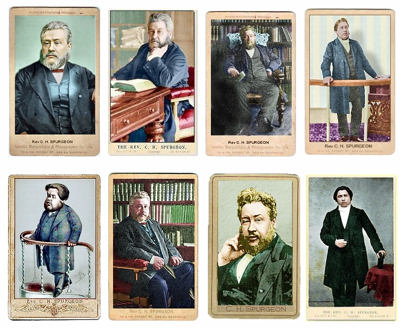
    Actually, Spurgeon used the opportunity to draw spiritual lessons from the naturalist's work, and he spoke passionately of the need for missionaries in unreached parts of Africa. But critics were relentless. The caricatures below are samples of how he was lampooned in the secular press.
    The episode nevertheless shows Spurgeon's thoughtfulness, tenderness, and good humor in the face of criticism.


We are now to be entertained by Mr. Spurgeon's lecture on the gorilla, but, in after ages,—according to the development theory,—we shall doubtless have a gorilla lecturing on Mr. Spurgeon."—Extract from the speech of the Rt. Hon. A. H. Layard, M.P., at Mr. Spurgeon's lecture on "The Gorilla and the Land he Inhabits"


N October 1, 1861, Mr. Spurgeon gave, in the Tabernacle, a lecture which was destined to attract more public attention than any which he had previously delivered. It was entitled, "The Gorilla and the Land he Inhabits," and was largely concerned with the volume, then recently published, and severely criticised,—Explorations and Adventures in Equatorial Africa, by Paul B. Du Chaillu (John Murray). A. H. Layard, Esq., M.P., presided, and by his side sat M. Du Chaillu. . . .

Coming to the gorilla,—a stuffed specimen of which was on the platform,—the lecturer said:—"He is an enormous ape, which claims to approach the nearest to man of any other creature. How nearly he approaches, I leave you to judge.

True, his claim to be our first cousin is disputed, on behalf of the koolo-kamba, by several very learned men. If we should, therefore, admit you (addressing the gorilla) to be man's first cousin, we fear that the koolo-kamba might institute a suit at law to claim equal rights, and so many cousins would be far from convenient.

Besides, I have heard that, if we should admit this gentleman to be our cousin, there is Mr. Darwin, who at once is prepared to prove that our great-grandfather's grandfather's father—keep on for about a millennium or two,—was a guinea-pig, and that we were ourselves originally descended from oysters, or seaweeds, or starfishes. Now, I demur to that on my own account.

Any bearded gentleman here, who chooses to do so, may claim relationship with the oyster; and others may imagine that they are only developed gorillas; but I, for my own part, believe there is a great gulf fixed between us, so that they who would pass from us to you (again turning to the gorilla) cannot; neither can they come to us who would pass from thence. At the same time, I do not wish to hold an argument with the philosopher who thinks himself related to a gorilla; I do not care to claim the honour for myself, but anyone else is perfectly welcome to it.

"Seriously, let us see to what depths men will descend in order to cast a slur upon the Book of God. It is too hard a thing to believe that God made man in His own image; but, forsooth, it is philosophical to hold that man is made in the image of a brute, and is the offspring of 'laws of development.' O infidelity! thou art a hard master, and thy taxes on our faith are far more burdensome than those which Revelation has ever made. When we have more incredulity than superstition can employ, we may leap into infidel speculation, and find a fitting sphere for the largest powers of belief.

But who can deny that there is a likeness between this animal and our own race? . . . There is, we must confess, a wonderful resemblance,—so near that it is humiliating to us, and therefore, I hope, beneficial. But while there is such a humiliating likeness, what a difference there is! If there should ever be discovered an animal even more like man than this gorilla is; in fact, if there should be found the exact facsimile of man, but destitute of the living soul, the immortal spirit, we must still say that the distance between them is immeasurable. . . ."


At the time of the delivery of the "gorilla" lecture, M. Blondin was performing at the Crystal Palace, and some wag wrote to him a letter purporting to come from Mr. Spurgeon. He sent it on to the Pastor, who endorsed it thus,—"This was received by M. Blondin, and is a specimen of the genus "hoax',"—and then put it away for future reference. The envelope contained the following epistle:—


"Metropolitan Tabernacle,
"Newington,
"Oct. 5, 1861.

"M. Blondin,
   "Sir,

"In consequence of the overflowing attendance at my Tabernacle, on Tuesday evening last, when I gave a lecture on the gorilla, it has occurred to myself, and to my brethren the Managers of the Tabernacle, that to engage your services for an evening (say, next Wednesday) for the following programme, would result in mutual benefit. You must meet me at the Tabernacle, on Tuesday next, at 12 o'clock, to confirm or to alter the proposed order of entertainment, which I flatter myself will be highly gratifying to all concerned.
"Programme.

"At 6 o'clock on Wednesday evening, Oct. 9th, M. Blondin to ascend from the platform in the Tabernacle, by an easy spiral ascent, five times round the interior, to one of the upper windows, opposite to 'The Elephant and Castle,' thence by an easy incline in at the first-floor window of that inn, and return the same way to the platform. The admission to be, as at the 'gorilla' lecture, 6d., 1s., and 2s. 6d.

"Yours sincerely,

"C. H. Spurgeon."

The lecturer could well afford to laugh at this clumsy attempt to hoax M. Blondin; but some of the newspaper attacks upon him, with reference to the "gorilla" and other lectures, were of such a character that they could not be reproduced here. One friend was sufficiently influenced by them to write an expostulatory letter to Mr. Spurgeon, and thus evoked the following reply:—
"Clapham,
"October 22nd, 1861.


"My Dear Sir,

"I have been dumb under the cruel rebukes of my enemies, and the ungenerous reproofs of pretended friends. I have proved hitherto the power of silence, and although most bitterly tempted, I shall not change my custom, or venture a syllable in order to stay these mad ravings. But your brotherly note deserves one or two words of answer.
    "(1.) Have I well weighed what I have done in the matter of these lectures? Aye,—and so weighed it that neither earth nor hell can now move me from my course. I have a life-work to perform, and towards its completion, through evil report and good report, I speed my way.
    "(2.) You imagine that my aim is merely to amuse, and you then speak very properly of "stooping'. Indeed, if it were so, if I had no higher or nobler aim in view, it would be stooping with sorrowful emphasis; but, then, think you that the devil would care to roar at me? Why, surely, it would be his best policy to encourage me in forsaking my calling, and degrading my ministry!
    "(3.) 'Is the Master's eye regarding His servant with pleasure?' Yes, I solemnly feel that it is; nor am I conscious of any act, or motive,—the common infirmity of man excepted,—which could cause me to incur Divine displeasure in connection with that which is, to me, the work of my life.
    "(4.) With regard to laughter,—you and I may differ upon this matter, and neither of us be quite infallible in our judgment. To me, a smile is no sin, and a laugh no crime. The Saviour, the Man of sorrows, is our example of morality, but not of misery, for He bore our griefs that we might not bear them; and I am not John the Baptist, nor a monk, nor hermit, nor an ascetic, either in theory or practice. Unhallowed mirth I hate, but I can and do enjoy my Father's works, and the wonders of Creation, none the less, but all the more, because I am a Christian. At any rate, I hold my own views upon this point; and, during eleven years of ministry, have seen no ill effect, but very much good from my preaching, although the charge has always been laid at my door that I sometimes provoke the risible faculties.
    "(5.) Concerning 'sowing to the flesh,' I have not done so in these lectures, but have rendered honest and hearty service to my Lord, and believe that spiritual fruit has already been reaped.
    "(6.) As to the grief of friends, let them, as well as myself, be ready to bear the cross; and let them not attempt to evade reproach by weeping where no tears are needed. I have given no cause to the enemy to blaspheme, or only such blessed cause as shall be renewed with greater vigour than ever.
    "And now for my explanation;—I have, in connection with my Church, a College for young ministers, which is a work of faith as to temporals, and a labour of love on my part in the highest sense of the term. There are about 150 young men, who are getting an education with a view, in most cases, to preaching the Word in the streets, villages, and towns of this land. Their studies are such as their capacities can receive, and the ministering brethren are mainly given to the searching of the Word; while reading it in the original is the ambition of each. In the course of instruction there are lectures, delivered by myself, a regular lecturer, and other gentlemen. We have had about twenty lectures on English History. I have given lectures on Sabbath-school teaching, Preaching, Church Discipline, Ethnology, &c., &c. The Rev. George Rogers has lectured on Books and Reading, Habit and Instinct, on Ministerial Prerequisites, and on other matters. Various brethren have taken up other topics; and, having attended all the lectures, I can testify that the best spirit has pervaded all, and each lecturer has laboured, not merely to instruct, but to do spiritual good.
    "My present course is upon Natural History. For the lectures already delivered, especially the abused ones, I have had the thanks of the members passed spontaneously and unanimously; and I believe the lectures have been as acceptable to the audience as any which were ever delivered. We who have seen the wonders of wisdom in anatomy, providential adaptation, and creating perfection, have gone home praising and blessing God. We have laughed, doubtless; and we have wept, too; but, with an audience of 150 young men, and a considerable company of men and women of the working-class, what would be the use of dull, drowsy formality? Last Friday week, the 'shrews' lecture came in due course, and I thought it might be useful to give a few words as to the value of love and kindness in Christian families, for which words I have had grateful acknowledgment. We went home, and I have not heard of one of the audience who did not feel that it was an evening well and profitably spent. Many Christian people gave me a hearty shake of the hand and glowing thanks.
    "But, lo! to our utter amazement, one morning we discovered that the lecture was considered vulgar, coarse, and I know not what. The gentlemen of the press had nothing else just then to do, so they said, 'Let us abuse Spurgeon, no matter whether he deserves it or not.' Since this abuse, I have asked scores who were there if anything had been said for which one might be sorry, and all have answered. 'No, nothing was said at all deserving censure, or anything but approval.' Think you that my hearers are all so degraded as to tolerate conduct such as a lying press imputes to me? O my brother, you do ill to judge a servant of the Lord from the lips of his foes, and one, too, who has had abuse enough on former occasions without having given cause of offence, which renders it inexcusable that brethren should readily believe reports concerning him!
    "This work of my Institution is of God; lectures are a part of the necessary plan, they do good, I have a call to this work, so all this opposition is a spur to increased zeal. I would the Lord's people cared more than they do for these young preachers, for I feel sure that God the Holy Spirit will raise up from our midst many who shall do exploits in His Name. To this work am I called, and the Lord is with me in it. Void of offence towards God and man, trusting for acceptance to Him who has washed away my sin, shall I flee because my conduct is misunderstood and my words are misconstrued? Nay, verily, Jehovah-nissi! And now let hell roar, and saints themselves forsake. Time and eternity will clear the character of one who has given up even his good name to his Master, without reserve.

"Yours wearily,

"C. H. Spurgeon."

"P.S.—Get the 'gorilla' lecture; read it, and see if there be any evil in it; yet it is the least religious of them all.—C. H. S."


The vote of thanks and sympathy referred to in the above letter, together with the Pastor's grateful acknowledgment of it, are thus recorded in the Tabernacle church-book:—

"At the church-meeting, held October 14, 1861, from which the Pastor was absent through illness, the following resolution was proposed, seconded, and carried unanimously:—'That the members of this church, constantly refreshed by the gospel ministry of their beloved Pastor, and deeply obliged to him for the lectures he gives upon secular and social subjects, have noticed, with sincere regret, and heartfelt sympathy with him, the scandals heaped upon his name by the public press, and beg to express to him their most loving confidence, their strong desire to endure with him a full share of his reproach, and their full determination, by God's help, to bear him constantly on their heart in prayer.'

"Church-meeting, October 28, 1861.—Our Pastor expressed his thanks to the church for the vote of sympathy with him passed at the church-meeting on October 14, and rejoiced in the fact that all the members had remained steadfast notwithstanding the virulent attacks made upon him."


10 February 2011

What did Jesus (not) say about... how to understand the OT

by Dan Phillips

"You know where you really go wrong? You just read the Torah 'way too literally."

Dan Phillips's signature

29 August 2010

False Alarms

Your weekly dose of Spurgeon
posted by Phil Johnson


The PyroManiacs devote some space each weekend to highlights from The Spurgeon Archive. The Following Excerpt is from "Discipline in Christ's Army," a sermon preached on Sunday evening, 13 July 1879.

t is a very great sin on the part of Christian soldiers, to make false alarms to discourage and dispirit their fellow-soldiers. There are some professors who seem to delight to tell us of a new discovery in science which is supposed to destroy our faith. Science makes a wonderful discovery, and straightaway we are expected to doubt what is plainly revealed in the Word of God.

Considering that the so-called "science" is continually changing, and that it seems to be the rule for scientific men to contradict all who have gone before them, and that, if you take up a book upon almost any science, you will find that it largely consists of repudiations of all former theories, I think we can afford to wait until the scientific men have made up their minds as to what science really is.

At all events, we have no cause to be distressed concerning science, so let no Christian man's heart fail him, and let him not raise any alarm in the camp of Christ.

C. H. Spurgeon


26 August 2010

Thinking like a Christian: a (sorta) parable with a pernt

by Dan Phillips

There was a young student who took an interest in math.

He bought himself a textbook, which came with a teacher's guide. He had heard much about this textbook, and looked to it for instruction.

Then in his studies, he came on a complex problem. But he had great confidence in his math skills. This was not the only book he had studied; he had learned from many other competing books as well. So he decided to apply their formulas and methods to this problem, and he did so with great diligence.

An hour's worth of calculation left him sweaty, proud at his achievement. He had the answer: 43,147,343,590. Now he was ready to reach for the plum, with the inevitable happy results.

Yet when he opened the teacher's guide, his face fell.

It said the answer was 47. He had come up with the wrong answer.

Wrong? But he couldn't be wrong. He'd worked it through, thoroughly and carefully. He'd applied every method and formula he'd picked up from the other books. Okay, maybe not, let's check.

So he went to the other books, reviewed, refreshed his memory. He bought the newest textbooks, and looked at them. He started all over, reviewed, re-calculated. This time he spent two hours.

But now the answer was 63,147,343,601.

He did it again and again, but each time his number got larger; and each time, the teacher's guide did not change. That 47 was crystal-clear, unambiguous.

And so he faced a choice. He had to choose:....


Before commenting, please read this, and this.

Dan Phillips's signature

23 August 2010

"Evangelicals" and Atheists Together

BioLogos takes their complaint against Al Mohler to Huffpo
by Phil Johnson


ast month several regular contributors over at the BioLogos blog wrote a series of posts exploring the question "How Should BioLogos Respond to Dr. Albert Mohler's Critique?"

That question was prompted by Dr. Mohler's June 19 message titled "Why Does the Universe Look So Old?" at this year's Orlando Ligonier Conference. Dr. Mohler took a position that is at odds with the central canon of the BioLogos credo. BioLogos most certainly needed to respond. The question was, How?

Evidently, the gentlemen at BioLogos have finally settled on their best strategy for replying to Dr. Mohler: Publish something at the Huffington Post accusing Dr. Mohler of dishonesty.

To paraphrase one of my Facebook friends: Even if they really do believe the abusive ad hominem argument they are making against Al Mohler, that's an interesting strategy. Let's air our differences at this bastion of secular humanism, and we'll invite some of the giants of discernment over at Huffpo to sort it out for us in their combox.

Dr. Karl Giberson, vice president of BioLogos, wrote the Huffington piece. The case he makes against Dr. Mohler has basically one point. Here it is: In his Ligonier lecture, Dr. Mohler claimed that Charles Darwin had a pretty good idea about what kind of "evidence" he was looking for before he ever boarded the Beagle; he was already sympathetic to evolutionary theory, and he was already hostile to biblical authority.

Not so, Dr. Giberson says. Darwin was a devout Christian and a creationist when he first set off on the Beagle. Giberson claims Darwin's very first doubts about the reliability of Scripture-as-history came as he collected his samples and observed and analyzed the biological evidence. Dr. Giberson evidently would have us believe Darwin was a typical evangelical until an honest inquiry into the scientific evidence forced him to take a more enlightened position.

I'm admittedly no Darwin scholar, but I do know for a fact that the only version of "Christianity" he ever adhered to was by no means evangelical. He was a product of that Unitarian intellectualism that dominated the established church in Georgian times. According to an 1887 article by Robert Schindler (published in Charles Spurgeon's magazine, The Sword and the Trowel):
If anyone wishes to know where the tadpole of Darwinism was hatched, we could point him to the pew of the old chapel in High Street, Shrewsbury, where Mr. Darwin, his father, and we believe his father's father, received their religious training. The chapel was built for Mr. Talents, an ejected minister [i.e., a Puritan who dissented from the established church order]; but for very many years full-blown Socinianism has been taught there. (Emphasis added.)

Furthermore, Darwin was enthralled with natural theology and (like BioLogos) held the truth-claims of Scripture to be less reliable and less authoritative than "scientific proofs." That was what prompted his interest in science to begun with. And—as Dr. Giberson himself notes in an earlier open letter to Dr. Mohler—"[Darwin] was a devotee of William Paley."

Perhaps the most succinct summary of William Paley's religious convictions comes to us from Sir Leslie Stephen, a younger contemporary of Paley's. Stephen was a respected English author and an Anglican clergyman. He described William Paley as "Socinian in all but name."

Given BioLogos's own theological trajectory (I'm thinking particularly of their dismissive attitude toward key doctrines like biblical authority and original sin), they may not recognize Socinianism—or its close cousins, Unitarianism, Deism, and theological liberalism—as anti-Christian worldviews. But Dr. Mohler certainly understands that those ideas are hostile to Scripture and antithetical to every major stream of historic Christian faith.

In other words, Dr. Mohler undoubtedly disagrees with Dr. Giberson's assessment of Darwin. As difficult as this may be for Dr. Giberson to receive and as hurtful as it may be to his academic ego, Dr. Mohler no doubt found Dr. Giberson's book Saving Darwin: How to Be a Christian and Believe in Evolution unpersuasive.

But as far as Dr. Giberson is concerned, the only possible explanation for Dr. Mohler's statement about Darwin is that Mohler simply doesn't care about truth. Giberson insists Dr. Mohler is a deliberate, cold-hearted, shameless liar.

I'm not exaggerating. Giberson loaded his Huffington article with just about every accusation and insult space would allow. He stops just short of making Mohler out to be a felon. Giberson alleges that Mohler "does not seem to care about the truth and seems quite content to simply make stuff up when it serves his purpose." "Perhaps [Mohler's] only real encounter with Saving Darwin was an instruction to an assistant to 'find something in Giberson's book that I can ridicule in my speech.'" "Mohler perhaps, is being a 'faith fibber,' something I have been guilty of, although not on this scale." "I am disappointed to realize that [skeptic Michael] Shermer, who repudiated his faith, has more respect for the truth than Al Mohler, who views himself as a caretaker of a faith that I share."

Really?

Because in the very next sentence, Giberson goes on to assert that "religious belief is complex and full of mystery, paradox, and contradiction" (emphasis added). That is tantamount to saying faith is an absurdity. I'm fairly confident Dr. Mohler would not view himself as a caretaker of that sort of faith. It's not true faith at all by any biblical standard; it's classic existential and neo-orthodox nonsense.

But anyway, let me get to the thing that chafes me most about BioLogos's answer to their own question, "How Should BioLogos Respond to Dr. Albert Mohler's Critique?"

My answer would have been, "Address the biblical and theological points he made." Dr. Mohler gave several clear doctrinal arguments to show why the peculiar brand of cosmological deism being touted by the BioLogos crew is incompatible with sound doctrine and hostile to a high view of Scripture. Their campaign is destructive to foundational doctrines of the Christian faith, starting with the authority of Scripture and the doctrine of original sin.

The theological case Dr. Mohler made was compelling. Until BioLogos responds to it, I'll stand by what I have said all along: They cannot be serious when they claim they are interested in bringing science and faith together. Indeed, they are steering people into the same spiritual blind alley that ultimately caused Darwin to abandon theism altogether. And the skeptical blogosphere is full of spiritual casualties who are living (and dying) illustrations of what happens when half-hearted faith hits that dead end.

Phil's signature

15 July 2010

Two radically different ways of thinking, and their cause

by Dan Phillips


Albert Mohler wrote yesterday about a lady (Anne Eggebroten) who contributed a piece for Sojourner (a magazine for liberals who still want to call themselves "evangelicals"). Mrs. Eggebroten was shocked! shocked! to find men leading at John MacArthur's Grace Community Church.

(I know what you're thinking: "Alert the media!")

Eggebroten provides a horror-struck narrative, in an alien-sociologist tone, about this odd group of pre-Pleistocene throwbacks who think (in agreement with God) that men should lead in the home and in the church. Then, as if thousands of devastating responses hadn't already been launched against Paul Jewett's lame reach for Galatians 3:28 in the last 30+ years, and as if it has anything whatever to do with function, Eggebroten trots it out again. We are all one in Christ. Therefore women can be pastors and needn't subordinate themselves to their husbands.

What of the Pastorals? No problem; they have to be recategorized as sub-Pauline. Other passages? They don't mean what they say, or they're interpolations. Galatians 3:28 — out of context — is Eggebroten's canon. In fact, you could call it The Eggebrotenian Canon.

(Eggebroten doesn't actually cite Jewett, by the way; instead, she reaches for lesbian "Christian" feminist Virginia Mollenkott and a few other Usual Suspects instead. None of which is actually an upgrade.)

What comes through loud and clear is that Eggebroten reveals no doubts that she should be allowed to do what she wants. Eggebroten is insistent on her rights, getting her way; appalled at any talk of submission, subordination, or even "helping." No actual on-the-scene authorities should stand over Eggebroten's wants, her wishes, her desires.  They are all presumed to be holy and good. She is sure of them. So sure, in fact, that she is willing actually to snip out part of the Word of God to accommodate them. Her desires, and her judgment, are superior to the Word of God.

Then comes Professor of Biblical Studies and BioLogos blogger Kenton Sparks, who writes: "I have no interest in preserving Christianity . . . I believe because, as I understand it, it makes sense of human experience. But if it turns out that Christianity fails to do that, I’ll simply turn elsewhere."

Like Ms. Eggebroten, you see that Professor Sparks has absolute confidence in his moral judgment, his personal powers of reason, his spiritual acumen. He announces that Scripture "stands in need of redemption"; and apparently Sparks himself will step in to do the job.

In the words quoted above, Sparks betrays no doubt whatever that he is up to the task. He seems himself as able to judge rightly; in fact, is in no doubt that his judgment potentially superior both to the Bible and thus to the God and Father of our Lord Jesus. The Bible (and Christ) may well be wrong. But Sparks? Never! If the Bible offends Sparks, he'll simply walk away, no big deal. Sparks will follow his own judgment wherever it takes him. It is adequate, sound, whole, sufficient.

It is as Gleason Archer and others warned decades ago: abandon the inerrancy of Scripture, and God's supremacy is replaced by the supremacy of personal human judgment.

In these comments, Mrs. Eggebroten and Professor Sparks together stand over the Word. The Word is in the dock, they are the judges. They will massage, manipulate, torture the parts they don't like (creation, created order). If those parts will not subject themselves to EggeSparks' will, they'll either relegate it to sub-Canonical status (Eggebroten) or call it "broken," and perhaps move on in search of something better (Sparks).

As I have argued elsewhere, the point at which the heart shows itself is that point at which God's will and His truth cross our wills and our biases.

Contrast both of these attitudes with that of men and women on whom the Holy Spirit has effectually done the work of conviction of sin, who have had a glimpse of the living God.

Recall Isaiah 6, the throne room vision. How did the sight of the thrice-holy Yahweh affect Isaiah? Remember: Isaiah was a good man: a holy man, a godly man, an incredibly eloquent man. What did he think of himself, after he saw God?

Did Isaiah say, "Now I really feel empowered! I really have to get after asserting my rights"? Did Isaiah say, "You know, that really wasn't bad — for now. You know, until something better comes along"?

Not so much.

When the Holy Spirit deals with a man, a woman, that person is brought face to face with certain game-changing truths. He sees God in His limitless, vast wisdom and purity, His immensity and holiness, His absoluteness and majesty. And in that same glimpse, he sees himself as he has never before appeared. He feels the depth of the depravity of his own deceptive heart (Jeremiah 17:9). He is overwhelmed with his own puniness and impurity (Isaiah 6:5). He cannot escape the sense of his own inexcusable sin (Luke 5:8), and he repudiates it like a foul and filthy thing (Job 42:5-6). His knowledge no longer looks so impressive (Proverbs 30:1-4). Now, it is God's Word alone that stands out as sure and certain (Proverbs 30:5-6).

This is what the fear of Yahweh means, that fear which is the beginning and sine qua non of knowledge (Proverbs 1:7) and of wisdom (9:10). It is the proper view of God, and of my position before Him.

This is the point at which a man throws himself at Jesus' feet, imploring Him for mercy and life and salvation and forgiveness. This is the point at which a man takes Jesus' yoke on himself (Matthew 11:29-30), counting himself a fool, so that he may become (for the first time) genuinely wise (1 Corinthians 3:18). This is the point at which a man embraces Jesus as Savior and - not partner, not advisor, not sounding-board, but - Lord. It is the issue he settles in principle at conversion, or arguably there has been no conversion.

Make no mistake: sin is not only a moral and spiritual blight. It is a noetic blight, a perversion that effects the way we think and process data (Romans 1:18ff.; Ephesians 4:17-19). That is why we don't need a mere pointer here and there, a bit of advice, and an hour or two with a tutor. No, we need to be done with ourselves and our way of processing information as we were outside of Christ (Ephesians 4:22-24), and become renewed in the spirit of our minds (Romans 12:2).

This is a very different spirit than one sees in the wannabe world-friends, the various compromised "-ists" (evolutionists, feminists). This is the spirit that says something like this:
"Left to my own reasoning and judgment, I will surely go horribly, damnably wrong. I already did! My way of thinking headed me straight away from God and towards Hell. It would do it again in a heartbeat, given the chance. I do not know how to think rightly about anything until God teaches me how to think about it, and He does so through His word alone."
I suggest that it is this realization which utterly parts the two schools of thought. They proceed along lines drawn by two markedly different views of God and of self: that I surely can be wrong, but the God of Scripture cannot; or that the God of Scripture can be wrong, but I surely cannot.

The two views cannot be harmonized.

Don't even try.

Postscript: am I judging the writers' hearts? Of course not. How could I (1 Corinthians 2:11)? All of us say and do things from time to time that do not represent our truest beliefs (Romans 7:14-25). I can only see what they write - and that is what they present to the world for evaluation. Yet these are arguments the writers are making which reveal ways of thinking that, if they are Christians, need to be reconsidered, and repented of. I offer them as cautionary examples.


Dan Phillips's signature

13 July 2010

Everyone is an inerrantist

by Dan Phillips

Phil's recent (terrific) posts on BioLogos tangentially raise the issue of inerrancy once again. Many lodge the charge that some or all of the contributors at BioLogos either weaken or deny inerrancy, either openly or tacitly.

My contention is that they affirm inerrancy, every one of them. As surely as Phil does, as surely as I do, as surely as you do.

As surely as Christopher Hitchens does, as surely as Richard Dawkins does, as surely as Paris Hilton (or Perez Hilton, for that matter) does, as surely as the Pope does, as surely as Lindsey Lohan does.

Everyone is an inerrantist.

The only question is where we locate inerrancy.


The glandolatrous hedonist locates inerrancy in his senses; the Papist (and the, er, Pape-er himself) locates it in the teaching office of The Church™.

What of the BioLogos types? One might argue that they locate inerrancy in the scientistic fad du jour, the fad of uniformitarian macroevolutionism with a light dusting of God-talk on the top.

At this juncture, the retort might come "Oh no! All we care about is Science™ and The Evidence. If the Facts led elsewhere, we'd change in a heartbeat."

About that. Is Science a person, a monolith, a thing that speaks or writes? Or is it (as the word is popularly used) actually a particular philosophy? Are there other competing philosophies? Is there only one school of thought?

Are facts self-interpreting? How long has the current fad held the day? How long did previous fads dominate? Did previous generations say they were probably wrong and would likely be undone by the next generation — or did they all lay out their positions in just as absolute and self-assured terms as the current lot is doing?

Yet with all that, let us grant for the sake of argument that the BioLogos types really are sincere in their insistence that they'll go wherever the evidence drives them.  Then we must make three observations:
  1. Given their eagerness to throw out the plain reading of Scripture in Genesis 1-3, they obviously do not locate inerrancy in the text of Scripture.
  2. Given their eagerness to throw out the plain reading of Scripture in Genesis 1-3, they obviously are in fact provisionally locating inerrancy in today's scientistic consensus, over against Scripture. (That is to say: given that there is a push and shove between the majority view created on the assumption that Scripture is untrue on the one hand, and Scripture itself on the other, they are siding with the former against the latter. It is Scripture that must yield, to them.)
  3. Given their eagerness to throw out the plain reading of Scripture in Genesis 1-3, they obviously locate inerrancy in their own personal reason, their own ability to sort things out, their own (if you will) autonomous knowledge of good and evil.
The Christian position is radically different, by definition. It is a chastened epistemology specifically in that it is the way a man will think when God has broken his pride through conviction of sin, through a vision of the massive holiness and rightness and wisdom of God, over against the pervasive moral, spiritual, and noetic effects of human sin. It is the thinking of a man who has come to see that Jesus is Lord, and he isn't; who has come to the cross for life and light and wisdom; who has yoked himself to Jesus and confessed, "I can't see anything rightly unless I see it as You see it, which I learn from Your Word alone."

Creation is a classic He-said/they-said. Listen:
  • We begin our thinking with the premise that God the eyewitness cannot err in His revelation of what happened, or ...
  • We begin our thinking with the premise that man the non-eyewitness cannot err in his reconstruction of what happened.
Because everyone believes in inerrancy.

It's just a matter of where he locates the final authority.

Dan Phillips's signature

12 July 2010

Socinianism in Lab Coats

by Phil Johnson

Scripture has been the first casualty of BioLogos's efforts to "reconcile" science and Christianity. Precisely what kind of Christianity are they selling? And how much more are they willing to sell out to scientism?


et me say this as emphatically as possible: My main objection to the BioLogos agenda is theological, not scientific.

Evidently I need to underscore that point, because every time the subject comes up here, our comment-threads swarm with zealots who are keen to debate about geology, paleontology, astronomy, the fossil record, the age of the earth, or whatever—as if my criticisms of BioLogos were scientific rather than biblical and doctrinal. To date, not one person who supports the BioLogos agenda has even acknowledged (much less replied to) the real point we've been making.

So I'll say this once more: What concerns me most about BioLogos is not merely the enthusiasm with which they champion theistic evolution (bad as that is). I haven't complained about their baffling opposition to the simple, obvious teleological arguments of the "intelligent design" community. And what spurred my objections to their campaign has nothing to do with the old-earth/young-earth conflict per se.

But my greatest concern—by far—is the blithe willingness with which they are prepared to trivialize, disregard, discard, or denounce the foundational doctrines of Christianity.

In every post I have made about BioLogos, I've been critical of two things in particular: 1) their relentless assault against the authority of Scripture, and 2) an attitude toward the doctrine of original sin that ranges from utter indifference to condescending dismissal.

The authority of Scripture and the doctrine of original sin are, of course, bedrock truths of all historic Christianity; they are not merely Reformed or evangelical distinctives. (Nor are they trifling "exegetical molehill[s]," as Peter Enns suggested in his reply to Al Mohler.)

The serious doctrinal problems raised by the BioLogos campaign don't end with those two issues, either. As I pointed out in an earlier post, if the BioLogos team applied their Genesis hermeneutic consistently to the gospel accounts and the resurrection narratives, they would soon relinquish every essential element of the Christian faith.

Of course, they haven't gone there. I don't expect they will. Demythologizing Scripture to that degree would utterly discredit them among whatever constituency they have cultivated on the "faith" side of the science/faith divide. But issues like those certainly deserve more attention (and more input from truly conservative theologians) than BioLogos has yet allocated space for.

Incidentally, BioLogos's notion of "leading evangelical theologians" is revealing. Their theological headliners are men like Peter Enns, Greg Boyd, and N. T. Wright, not one of whom is truly evangelical in the historic sense of that term. Enns was dismissed from Westminster Seminary in August 2008 for his low view of Scripture. He and most of his supporters protested at the time that his views had been misrepresented and that he had been treated unfairly. But his contributions to BioLogos furnish ample proof that he did not, in fact, agree with Westminster's doctrinal standards. Boyd, of course, is well known as a cheerleader for Open Theism, which denies both the true omniscience and the immutability (not to mention the sovereignty) of God.

Having blended a low view of Scripture with an implicit denial of original sin, with a humanized view of God, and with a skeptical stance toward the miraculous elements of Scripture, BioLogos is actually peddling a brand of religion that has much more in common with Socinianism than with biblical and historic Christianity.

Some of the scientific specialists at BioLogos make no profession of faith at all, as far as I can determine. I'm thinking, for one, about "Francisco Ayala, the former Dominican priest who went on to become one of the world’s leading evolutionary biologists." I wonder: did he leave the priesthood because he lost his "faith" completely? According to the New York Times, "Dr. Ayala will not say whether he remains a religious believer."

“I don’t want to be tagged,” he said. “By one side or the other.”

Let's face it: statements of faith aren't really a BioLogos "thing." The organization has no formal doctrinal standard and (as far as I can tell) no real theological boundaries at all. Everything is negotiable. Scripture is rarely if ever defended. Evangelical truth is not proclaimed at BioLogos. What does get aggressive promotion and a vigorous defense is anything that undermines a high view of Scripture. And why not? Open Theism, Sadduceeism, and neoorthodox notions about inspiration and inerrancy are rooted in the same kind of skepticism that underlies BioLogos's treatment of the early chapters of Genesis.

Here is the closest thing to an official statement of faith you'll find on the BioLogos website: "We believe that the Bible is the inspired Word of God." Really? Perhaps if we posit an infinitely flexible definition of the word inspired, a claim like that might have a some thin thread of credibility. But search and see for yourself: BioLogos's website is full of articles attacking the accuracy, believability, authority, and verbal inspiration of Scripture. I can't find a single article where any of the contested claims of Scripture are defended against the attacks of secular materialists.

But here is what "faith" really looks like in practice at BioLogos: "I have no interest in preserving Christianity . . . I believe because, as I understand it, it makes sense of human experience. But if it turns out that Christianity fails to do that, I’ll simply turn elsewhere"—Kenton Sparks, BioLogos blogger.

BioLogos says their goal is to integrate the findings of science with Christian Faith. But let's face it: on the "faith" side of the chasm, BioLogos is almost entirely bankrupt. Whatever BioLogos is peddling, it isn't Christianity. It isn't faith of any kind. It's scientism masquerading as faith—but lacking in spiritual, philosophical, and intellectual integrity.

To be more precise, it's a sterile hybrid of scientism and Socinianism. That's why the BioLogos crew frankly aren't interested in defending what the church has affirmed for 2000 years. Their real goal is to marginalize key features of Christian belief and biblical truth that scientists have disputed for the past 200 years. On close examination, BioLogos looks very much like a campaign against Christianity, funded by a hefty Templeton grant. In effect, that's precisely what it is.

I'm not suggesting that's the conscious intent of all BioLogos's key participants. While I despise what they are doing, I'm willing to give them the benefit of the doubt when it comes to motive. Still, whatever their motives, what they are actually doing is destructive to genuine faith and subversive of the authority of Scripture. It is not something that deserves the support of faithful Christians.

And this is the key point: You can't legitimately claim to be trying to reconcile science and the Christian faith if your methodology entails systematically dismantling the very foundations of Christianity.

Phil's signature


PS: BioLogos's ambivalence toward original sin is curious, because there's no doctrine in all the Bible that comes replete with more empirical evidence. Not that I recomend the methodology, but if someone wanted to subject a Christian doctrine to scientific analysis, it would be hard to think of a better place to start. To quote Chesterton:
Modern masters of science are much impressed with the need of beginning all inquiry with a fact. The ancient masters of religion were quite equally impressed with that necessity. They began with the fact of sin—a fact as practical as potatoes. Whether or no man could be washed in miraculous waters, there was no doubt at any rate that he wanted washing. But certain religious leaders in London, not mere materialists, have begun in our day not to deny the highly disputable water, but to deny the indisputable dirt. Certain new theologians dispute original sin, which is the only part of Christian theology which can really be proved. Some followers of the Reverend R. J. Campbell, in their almost too fastidious spirituality, admit divine sinlessness, which they cannot see even in their dreams. But they essentially deny human sin, which they can see in the street.

28 June 2010

My Semester with an Evolution-Nazi

by Phil Johnson


hen I was in college (Southeastern State University, Durant, OK) and still a fresh convert to authentic Christianity, one of the hardest challenges I faced was what to do with the claims of secular scientists. I had a biology professor who was an ardent evolutionist.


Strike that. He was a fanatic who talked about little else, and he took up the subject on day one of the first semester.

His claims were so bold and his attitude so cocksure and self-satisfied that I was intimidated. He was quick-witted, sharp-tongued, and hard-core. After day one, neither I nor anyone in the class had the courage to raise any questions, because he made it clear from the start that he would ruthlessly mock students who dared to question anything. And I'm talking about conscientious students who asked honest questions, not argumentative people who challenged him. No one would have dared to challenge him.

At first.


I had grown up in a liberal denomination, a believer in theistic evolution, and yet this fanatic evolutionist's lectures were what first got me to think seriously about the questions of human origins and the creation of the universe. The more I tried to absorb the things this fellow was teaching, the more the ramifications of evolutionary theory troubled me. But the professor blew past or dismissed all the difficult (and, to me, obvious) questions his lectures raised.

Finally after several weeks of silent note-taking, I summoned the courage to ask about abiogenesis; and the second law of thermodynamics; and the presence of intelligent, ordered data in DNA; and the scarcity of intermediate forms in the fossil record; and whatnot. I didn't raise those questions all at once, but over a period of two weeks or so. I gradually got to the point where I suppose I was asking a question or two every day.

And something very quickly became obvious: this guy had no good answers to the hard questions. He had never really thought through those issues. He was a doctrinaire evolutionist whose presuppositions were dogmatically atheistic, and he had never seriously considered any arguments against his views. When I (and soon others) began to question his claims, he knew he was in over his head. His cool braggadocio gave way to agitated frustration.

So for three weeks he brought in a guest lecturer from the department of geosciences at the University of Texas in Dallas. And you know what? That guy had no sensible answers either. All the two of them could do was mock and fulminate against whoever was raising the questions. And trust me: they did plenty of that, laughing at one another's jokes and competing with one another to see who could treat the questioners in the class more condescendingly.

It turned out there were a dozen or so other Christians and lots of open-minded students in that biology class. The whole class collectively could see the lameness of the "answers," so they kept raising questions. Good ones. In the end, the geology "expert" took to cursing the questioners and then simply stopped taking any questions—giving long, tedious, angry lectures instead. Then when his three weeks were up, the whole topic of evolution was declared off limits, and we focused the rest of the semester on real biology.

If you analyze the fulminations of the New Atheists and the amateur atheist brotherhoods on the Internet, they are basically of that same type. Moreover, my impression is that science departments in most secular universities are even more despotic in their promotion of atheism today than they were when I was in college.


So my advice to students: summon the courage to challenge your professors. Ask the hard questions. It may cost you academic stature and several grade points, but I predict you'll discover what I did: naturalism is a religion, and an ill-tempered one. It's not really based on rational proof (as most naturalists claim). It's a dogma of the same style and with the same destructive potential as the Roman Catholic dogma of papal infallibility.

Phil's signature

27 June 2010

Impersonal Chance vs. Our Personal God

Your weekly dose of Spurgeon
posted by Phil Johnson

The PyroManiacs devote some space each weekend to highlights from The Spurgeon Archive. The following excerpt is from "God's Thoughts and Ours," A sermon preached on a Thursday evening, 19 March 1868 at the Met Tab in London.


ome people seem to be always struggling to get away from the thought of one true personal God,—Creator, Preserver, Redeemer, and All-in-all to his people. Those who deny the inspired record of the creation would have us believe that we are descended from monkeys, or from something with even less intelligence than an ape possesses; but I could gather no comfort from such a belief as that if it wore true. It fills me rather with pity or contempt for those who can be so foolish as to cherish such a delusion.



But when I come back to the revelation of the Bible concerning a personal God, a revelation which has been confirmed by my own spiritual experience, and when I realize that this personal God takes a special interest in me, and thinks of me with tender, loving, gracious consideration, then I lift up my hands in adoring wonder, and say, as David did, "How precious also are thy thoughts unto me, O God! how great is the sum of them!"

Yes, there is great comfort in being able truthfully to say, "Our Father, who art in heaven;" and those who are really the sons and daughters of the Lord Almighty find it to be their chief delight that he thinketh about them, and planneth all that is for their present and eternal good.

C. H. Spurgeon