Showing posts with label perseverance. Show all posts

18 June 2013

Proverbs inspired by the author of Proverbs

by Dan Phillips


Having done an introduction to the introduction to Proverbs, last Sunday I began an actual introduction to Proverbs.

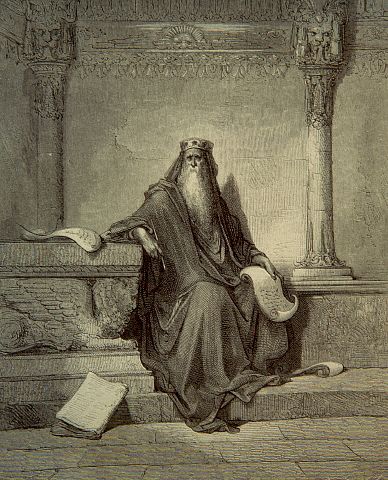
I skipped over the first Hebrew word of the book ("Proverbs-of"), to focus on "Solomon son of David king of Israel." Titled The Pithy Penmen of Proverbs, my focus was the central author and overall editor, King Solomon.

As I'm sure I've remarked somewhere before, I find Solomon one of the most frightening, sobering men in all of history, in the company of men like King Saul, fallen pastors, and the head of the pack, Judas Iscariot.

In Solomon's case, was there ever a man who was more advantaged and fell further — apart from Judas? In the sermon, I traced his lineage, his beginnings, his encounters with God, his accomplishments... and his disgraceful fall.

The sermon concluded with a series of (artless) proverbs based on the instruction one should receive from the life of Solomon. In the sermon, they're offered pretty quickly, so I reproduce them here for your reflection:

A.       Three Do’s
1.        Do love God with everything you’ve got today, now.
2.        Do cling to God as if all the demons of hell are trying to pull you away.
3.        Do learn God’s word like there’s going to be a test. Because there will be.
B.       Four  Don’ts:
1.        Don’t live on yesterday’s devotion
a.         Yesterday’s spirituality and devotional is a wonderful thing – if you’re building on it today!
b.         But if not, all it is is a towering, damning monument to our declension, a sad comment on how far we’ve fallen, like the religious buildings of Europe.
2.        Don’t relax your guard until the General says the war’s over.
3.        Don’t think you’re home until you’re actually at Jesus’ feet.
4.    Don’t stop studying, learning and doing until the Master says to put your pencil down...which will probably never happen.

To coin a phrase: you (and I) think about that. Amen

Dan Phillips's signature

17 December 2010

The Perseverance of the Saints

by Phil Johnson

I am absolutely confident no true believer in Jesus Christ will ever lose his or her salvation. Authentic believers can never do anything to forfeit the eternal life that is ours in Christ. Otherwise, by definition, it could not be said that we have everlasting life and will not come into judgment, but have passed from death to life (John 5:24).


"Blessed be the God and Father of our Lord Jesus Christ! According to his great mercy, he has caused us to be born again to a living hope through the resurrection of Jesus Christ from the dead, to an inheritance that is imperishable, undefiled, and unfading, kept in heaven for you, who by God's power are being guarded through faith for a salvation ready to be revealed in the last time" (1 Peter 1:3-5).

'm not fond of the expression "eternal security" because of the way the doctrine is abused by antinomians and people who think it's possible to own Jesus as Savior without bowing to Him as Lord. I prefer to speak of the perseverance of the saints, because that expression better captures the gist of what the doctrine entails.

The idea is not that if we once "accept Christ" we are guaranteed heaven regardless of whether we continue in the faith or not, but that those who are truly regenerate will not depart from Christ. The supposed Christian who does depart demonstrates that he was never a true Christian in the first place: "They went out from us, but they were not of us; for if they had been of us, they would have continued with us. But they went out, that it might become plain that they all are not of us" (1 John 2:19).

On the other hand, I'm convinced that the saints will persevere not because I have any confidence in the saints' own strength or their own faithfulness. My own security not does not rest in my devotion to Christ, but in His devotion to me. I am "kept by the power of God." His power is what energizes my faith and keeps me in the process of salvation, ready to be revealed at the last time.

That's an echo of the truth of 2 Thessalonians 3:3: "The Lord is faithful. He will establish you and guard you against the evil one." And 2 Timothy 2:13: "If we are faithless, he remains faithful—for he cannot deny himself." Also, Jude 24: God "is able to keep you from stumbling and to present you blameless before the presence of his glory with great joy."

So on the authority of Scripture I believe absolutely in the doctrine of the perseverance of the saints. But it's not because I have any confidence in the saints themselves. It is God who secures their perseverance.

Phil's signature

12 June 2010

Some Thoughts on Persecution

Your weekly dose of Spurgeon
posted by Phil Johnson

The PyroManiacs devote some space each weekend to highlights from The Spurgeon Archive. The following excerpt is from "A Word for the Persecuted," a sermon preached Sunday Morning, 16 August 1874 at the Met Tab, London.


ever court opposition. God forbid we should do so. Some zealots seem bent on making religion objectionable. The cup we hold to a sinful world is in itself repugnant enough to fallen nature; there can be no wisdom in making it yet more objectionable by presenting it with a scowling face.

It is as well when you have medicine to give to a child to show him a piece of sugar too: so let your kindness, and cheerfulness, and gentleness sweeten that which the world is not very likely to receive anyhow, but which it will the less resent if you present it with love, showing a desire to live peaceably with all men, and to consult the comfort of others rather than your own.

And then endure whatever you have to endure with the greatest possible meekness.

There was a farmer whose wife was very irritated with him because of his attending a dissenting place of worship, and joining with Christian people. She often declared that she would not bear it much longer, but he was very patient, and made no harsh reply to her. One day she fetched him out of the harvest field, and said, "Now it is come to this; you will give up those people, or give me up"; and she brought out a web of cloth and said, "Now you take half of this and I'll take the other half; for I am going."

He said, "No, my dear, you are welcome to it all. You have always been a very good industrious wife, take it all."

Then she proposed taking a part of their household goods and settling everything for a final separation, but again he said, "Take all there is. If you will go away take everything you like, for I should not wish you to be uncomfortable; and come back again whenever you please, I shall always be glad to see you."

Seeing that he talked in that way, she said, "Do you mean me to go?"

"No," said he, "it is your own wish, not mine. I cannot give up my religion, but anything else I can do to make you stay and be happy, I will do."

This was too much for her, she resolved to cease her opposition, and in a short time went with her husband to the place of worship, and became herself a believer.

This is the surest way to victory. Yield everything but what it would be wrong to yield. Never grow angry. Keep cool, and let the railing be all on one side.

There was a poor godly woman who used to attend the ministry of Mr. Robinson, of Leicester, and her husband, a very coarse, brutal man, said to her one day in his wrath, "If you ever go to St. Mary's church again I'll cut both your legs off."

He was a dreadful man, and equal to any violence, but on the next occasion of worship his wife went as aforetime. As she came home, she commended herself to the care of God, expecting to be assailed. Her husband said to her, "Where have you been?"

"I have been to St. Mary's church," said she.

With that he felled her to the ground with a terrible blow on the face.

Rising up, she gently said, "If you strike me on the other side I shall as freely forgive you as I do now."

She had been a very passionate woman before conversion, and had been accustomed to give her husband as good as he could send, and therefore he was struck with her gentleness. "Where did you learn this patience?" said he.

Her reply was, "By God's grace I learned it at St. Mary's."

"Then you may go as often as you like." Presently he went also, and the war was over. There is nothing like meekness. It will conquer the strongest.

After bearing with meekness return good for evil. For cruel words return warmer love and increased kindness. The most renowned weapon for a Christian to fight his antagonists with is that of overcoming evil with good.

Evil to evil is beastlike, and no Christian will indulge in it; but good for evil is Christlike, and we must practice it. I think I have before told you the story of the husband who was a very loose, gay, depraved, man of the world, but he had a wife who for many years bore with his ridicule and unkindness, praying for him day and night, though no change came over him, except that he grew even more bold in sin.

One night, being at a drunken feast with a number of his boon companions, he boasted that his wife would do anything he wished, she was as submissive as a lamb. "Now," he said, "she has gone to bed hours ago; but if I take you all to my house at once she will get up and entertain you and make no complaint."

"Not she," they said, and the matter ended in a bet, and away they went.

It was in the small hours of the night, but in a few minutes she was up, and remarked that she was glad that she had two chickens ready, and if they would wait a little she would soon have a supper spread for them. They waited, and ere long, at that late hour, the table was spread, and she took her place at it as if it was quite an ordinary matter, acting the part of hostess with cheerfulness.

One of the company, touched in his better feelings, exclaimed, "Madam, we ought to apologize to you for intruding upon you in this way, and at such an hour, but I am at a loss to understand how it is you receive us so cheerfully, for being a religious person you cannot approve of our conduct."

Her reply was, "I and my husband were both formerly unconverted, but, by the grace of God, I am now a believer in the Lord Jesus. I have daily prayed for my husband, and I have done all I can to bring him to a better mind, but as I see no charge in him, I fear he will be lost for ever; and I have made up my mind to make him as happy as I can while he is here."

They went away, and her husband said, "Do you really think I shall be unhappy for ever?"

"I fear so," said she, "I would to God you would repent and seek forgiveness."

That night patience accomplished her desire. He was soon found with her on the way to heaven.

Yield on no point of principle, but in everything else be willing to bear reproach, and to be despised and mocked at for Christ's sake. In hoc signo vinces—by the cross patiently borne thou couquerest.

"This is a hard saying," says one. I know it is, but grace can make the heaviest burden light, and transform duty into delight.

Here let one also remark that to this gentle endurance there must be added by the persecuted Christian much exactness of life. We must be very particular when such lynx-eyes are upon us, because if they can find us trespassing they will pounce upon us at once. If it is only a little wrong, a thing which they would not have noticed in anybody else, they will magnify it and raise quite a clamor about it. "Ah, that is your religion," say they, as if we claimed to be absolutely perfect.

Be watchful, therefore, walk circumspectly, do not put yourself into their hands; let them have nothing to say against you save only upon the point of your religion. Nothing bothers opponents like integrity, truthfulness, and holiness: they long to speak against you, but cannot find a fair opportunity. Take care that you daily pray for grace to keep your temper, for if you fail there they will boast of having conquered you, and will assail you again in the same way. Ask for grace to be patient, and say as little as you can, except to God. Pray much for them, for prayer is still heard, and how knowest thou, O believing woman, but thou mayst save thy unbelieving husband? Only watch on and pray on, and a blessing will come.

C. H. Spurgeon


12 May 2009

Election/reprobation: discuss

by Dan Phillips

Phil's recent (terrific) interchange with an Arminian brought this to mind. I've often thought it, but not quite sharpened it up this much.

Is this not the Biblical (which is to say, Calvinist) position?
  1. If an elect person were finally and actually to leave Christ, he would be damned; and...
  2. If a reprobate (non-elect) person were vitally to exercise repentant faith in Christ, he would be saved.
  3. However, neither can do either; which is to say:
  4. If any professor finally leaves Christ, he was never elect; and...
  5. If any denier exercises repentant faith in Christ, he is not reprobate.
I think that's Biblical and clarifying, and I think it heads off a lot of uninformed dodging.

But not quite briefly enough for a "Next!"

(Actually and seriously, I guess I could have made 2-5 "Next!"s out of it.)

Discuss.

Dan Phillips's signature

04 December 2008

Pyromaniacs (and you?) contra mundum

by Dan Phillips

On the heels of trying to source a Spurgeon quotation....

One of my favorite stories from church history may never have happened — but should have! It is the tale of Athanasius during the Arian controversy.

Sitting pretty as we are, we don't feel the drama of that time, where there were powerful and influential professed Christians who were deceived by Arianism. The leading, unyielding, and stalwart defender of the truth of Christ's full Godhood was Athanasius (328-373), the Bishop of Alexandria. Throughout his ministry, Athanasius suffered great pressure, and even seventeen years spent in exile. One exile was specifically in retaliation for Athanasius' refusal to obey Emperor Constantine's order to reinstate the unrepentant heretic Arius.

The tide was not always with Athanasius.

The story is that, at one point, someone tried to persuade Athanasius to moderate his stand. "Don't you know that the whole world is against you, Athanasius?" the man pled.

"Then Athanasius is against the world," the bishop replied. I picture Athanasius either saying it with a shrug, or else nailing the other with a "Duh!" glare — but that is definitely apocryphal. (Alternate version: the Latin phrase Athanasius contra mundum was engraved on the bishop's tombstone.)

That story of unblinking, unwavering, adamant allegiance to God's truth has long moved and challenged me. Years ago — I think it was when I was seriously considering giving the then-future Josiah the middle name "Athanasius" — I tried very hard to find any historical, contemporary validation of the story in question. (I'm a stickler for sourcing stories and quotations before using them.)

Try though I did, searching and making inquiry, I was only able to push any kind of documentation back as far as the Middle Ages. So, while it surely fits what we know about the character of Athanasius (and of clerical appeasers), and while it's one of those stories that should have happened even if it didn't... it may be a fiction.

We do know that Athanasius stood, and was ready to stand against the world if need be. We just don't know whether the story ever occurred as reported.

Yet there is a much older story that has impeccable — you might say inerrant — attestation. That is the story of Noah.

Here is the divine comment on the whole episode:
By faith Noah, being warned by God concerning events as yet unseen, in reverent fear constructed an ark for the saving of his household. By this he condemned the world and became an heir of the righteousness that comes by faith (Hebrews 11:7)
Think of it. Even more so than Athanasius, Noah was literally the only man in the world who believed what he believed. His stance isolated him totally from all his contemporaries. Only Noah and his immediate family trusted God's word. All of the smartest, most powerful, most influential people in the world thought he was barking mad.

It was, in the most literal sense, Noƫ contra mundum.

And how did that work out for Noah? For his peers? Rather well, and rather disastrously, respectively. By his stance of faith in God's Word, Noah "condemned the world."

And we, today? Sometimes we feel (and are made to feel) that we're odd, that we stick out, that we're not trendy. Well: we are, we do, and we aren't. What's odd is that it is professing Christians who make those accusations — as if they're bad things, rather than par for the course (Matthew 10:11, 25; Luke 6:22; John 7:7; 15:18-20; 17:14; 1 Timothy 3:12; 1 John 3:1, 11-12). What ought to worry us, is if we find ourselves to be in the majority (Luke 6:26; James 4:4). Because it won't go well with the majority (Matthew 7:13-14).

Just remember: however small our number, more stand with us than stood with Athanasius — and far more than stood with Noah.

All that matters is whether the Lord stands with us (2 Timothy 4:17), and we with Him (Hebrews 13:11-14).

Dan Phillips's signature

06 December 2007

Scariest man ever

by Dan Phillips

Who would you name?

Saul of Kish would be a good candidate. Such a promising beginning. Humble, modest, unambitious (1 Samuel 9:21; 10:20-22). Chosen by God, moved upon by the Spirit of God (1 Samuel 10:1, 10). Yet such a wretched, sad end to his life.

But no, Saul is not my candidate. You'll have long since guessed my proposal: Judas Iscariot. Most terrifying man who ever lived.

Such promise, such privilege; unlimited access to Truth Incarnate such as we can scarce even imagine.

And yet this is what he comes to:
"Then Satan entered into Judas called Iscariot, who was of the number of the twelve" (Luke 22:3)
And now, whatever Judas' childhood, his youth, his other accomplishments; whatever it took to bring Judas to this point or make him the man he was, everything is erased and overshadowed by this one event: Satan found in him a willing host. All his yesterdays do not matter. Whatever his family, his friends; his accomplishments, his hopes, his dreams. All are blotted out. All that remains is this: Satan himself made Judas his base of operations from which he could launch a killing strike on the Son of God.

And now, when we think of Judas, we think of this, we think of what came of this. Not of the preaching, the following, the miracle-ministry. No, Judas' name is the eponym of a traitor. We remember his treachery, and we remember his foul kiss.

But what was Judas? Was he an alien being, a creature from another race? No, he was a man, a human being, a child of Adam as you are, and as I am. In fact, but for the grace of God, he was just precisely like us.

If our theology enables us to read Judas' tale without a shudder and an earnest prayer, I daresay something vital is missing.

We may draw this observation: a man can be known for what comes of his devotion to God — or for what comes of his being a willing tool for Satan.

Judas Iscariot. Scariest man who ever lived.

Yet pause just one moment longer. I see in the shadows there a man who could be Judas' twin in some ways. He too was a big talker. He too was privileged, even more so than Judas.

He too caved, buckled, gave way before the trial. He too denied his Lord, and not once, nor twice, but thrice.

We remember his name, as well: Peter. "The Rock." We chuckled when we say it, and shake our heads, because of how "The Rock" crumbled.

But here's the difference. Judas' betrayal was his final act in relation to Christ. Peter's was not. Christ had prayed for Peter (Luke 22:32), and Peter repented, was restored. The book of Acts shows in Peter the fruits of repentance, of a genuine change of heart and mind.

If Judas is the scariest man who ever lived (and he is), then what is Peter? The most humbling man who ever lived, as we see our big mouths and lofty promises — and our feet of clay — in him?

Or possibly the most encouraging man who ever lived, because his repentance found forgiveness and restoration in the Lord's grand heart?

Both men rebuke the smug. Both men rebuke the overconfident. Both both men point us to Christ, to our need to walk with the Lord now, rather than rest on memories of having walked with Him yesterday.

A vivid view of these two men gives the appropriate edge to the words of Hebrews:
For we have come to share in Christ, if indeed we hold our original confidence firm to the end (3:14)

Since then we have a great high priest who has passed through the heavens, Jesus, the Son of God, let us hold fast our confession (
4:14)

…by two unchangeable things, in which it is impossible for God to lie, we who have fled for refuge might have strong encouragement to hold fast to the hope set before us (
6:18)

Let us hold fast the confession of our hope without wavering, for he who promised is faithful (
10:23)

Therefore, since we are surrounded by so great a cloud of witnesses, let us also lay aside every weight, and sin which clings so closely, and let us run with endurance the race that is set before us, 2 looking to Jesus, the founder and perfecter of our faith, who for the joy that was set before him endured the cross, despising the shame, and is seated at the right hand of the throne of God (
12:1-2)
Dan Phillips's signature