Showing posts with label preaching Proverbs. Show all posts

19 August 2014

The sting of sending a sluggard: Preaching a single verse from a chiasm in Proverbs

by Dan Phillips

I'm coming to the end of preaching the first ten chapters of Proverbs verse by verse, hoping to help my folks be able to win any ¿Quien es mas macho? competition among pastors. Well, that, and other things.

So as I shared, Duane Garrett helped me see that the last section of the chapter (10:19-32) breaks down into a chiasm. That helped me a lot in figuring out how to preach it. First, I preached on the first four verses, focusing on speech; then on the next four verses, dealing with security. So much for Section A and Section B.

But what to do with the single, lone verse making up Section C? What of verse 26, dealing with Sloth?

Obviously, there were three main honest choices (skipping it is not an honest choice):
  1. Group it with the preceding section, on security.
  2. Group it with the following section on, once again, security.
  3. Preach it all by its lonesome.
At first glance it made the best sense to pick 1 or 2... except when I thought about it. It would either be, "This about security, and this about security, and this about security, and this about security... oh, and a thought about the sluggard." Or it would be "A thought about the sluggard. Now, to four verses about security."

Against the law? Immoral? Heretical? No; but awkward. And not really doing justice to the genius and intents of Solomon, nor to those of the inspiring Spirit.

But could this single verse bear the weight of a whole sermon? I'd already preached very emphatically on the sluggard from chapter 6; what to add? It is a moral crime to make the Bible boring. How to avoid that?

I also was pressed by the fact that Solomon had emphasized this verse. He was the one who did a cluster on speech, a cluster on security; then a mirror-cluster on security and a mirror-cluster on speech — and put that one long verse on sending a sluggard in the middle. Wasn't he emphasizing it?

So, out of respect for Solomon (and the Spirit who inspired him), I looked more closely, prayed, thought, listened closely to my smarter friends. And it came to me.

At first read, it seems painfully simple, to the point of banality. No one likes smoke in his eyes or acidic drink on sore gums, and it's like that to send a sluggard. Sending sluggard = bad. Got it. Thanks.

But as I've said beforeevery time Solomon seems banal it's a signal to look closer.

So: why did Solomon pick vinegar and smoke, and why a sluggard? Why not vinegar and smoke, and a fool, for instance? What's special about a sluggard?

Then I started realizing: as a rule, nobody wants smoke, and nobody wants sour wine (which is what "vinegar" usually means in the Bible). In the first case, what one really wanted was fire; and in the second, a nice drink of sweet, refreshing wine. Ah, but ouch and yuck, instead he got smoke stinging his eyes, and acidic sour wine stinging his gums. What a disappointment. What a failed promise. What a letdown...


And there it was. The sluggard specializes in being a disappointment, a letdown. He majors in staring opportunity in the face, and taking a nap, or manufacturing excuses, and otherwise letting it go to ruin.

And that's bad enough when it's only himself he effects (which, strictly, is never); it's worse when it's my message, or my job that he's letting go to ruin.

That seen, it all opened to me. The first application of this proverb, and a host of other applications: to Solomon, to Israel, to Christ, and to each and every one of us.

And there I had scorcher of a sermon.

The key was respecting the text and its signals, and seeing the mind of God revealed in its formation.

Dan Phillips's signature

05 August 2014

Grin and Garrett

by Dan Phillips

In the past and more than once I've shared that the NAC volume on Proverbs (plus Solomon's other books) by Duane Garrett is...er... not my favorite. In fact, what I've said is that mostly it disappoints. Four out of five times when I've gone for help on a verse, Garrett may not even talk about the verse, or doesn't offer much.

All that to say this: Garrett has helped me a lot in approaching the last section of Proverbs 10. As you know, I'm coming to the end of preaching Proverbs 1—10. Despite (or because of) decades of studying Proverbs, the prospect of preaching through this section verse by verse was daunting, brimming with challenges and terrors. As I have drawn near each section, I've wondered how in the world I was going to preach it — but then, when I got under the hood, it's all falling together.

Or it had until I'd done verses 15-17, a triplet of verses on wealth, wisdom and life, tied together by concept and by tag-word. After that I found myself looking down the barrel of verses 18-32. What was facing me now? Fifteen separate sermons? Clusters? Any structure? Anything at all?

Bueller?

Various commenters said this, that, or nothing. But it was actually Duane Garrett whose approach fit the text best to me. He saw it as a chiasm:
A:  On the tongue (vv. 19–21)
B:   On personal security (vv. 22–25)
C:   On laziness (v. 26)
B´: On personal security (vv. 27–30)
A´: On the tongue (vv. 31–32)

You'll note Garrett starts with v. 19, because he emends the text of v. 18 and groups it otherwise. I'm not persuaded by the emendation and, that being the case, see it as obviously fitting just fine with the first cluster of verses on the tongue.

I was really grateful for Garrett's vision on these verses. It just remained for me to make it my own, and to adapt it for preaching. So I added verse 18 to the first cluster, and came up with this:

A:    Speech (vv. 18–21)
B:    Security (vv. 22–25)
C:    Sloth (v. 26)
B´:  Security (vv. 27–30)
A´:  Speech (vv. 31–32)

 The chiasm looks like this:

I preached the first section (vv. 18-21) last Sunday. Gazing at it, reflecting, praying after all my studying, I saw that the whole was connected not only by the topic of speech, but by the fact that each verse posed a paradox. So I preached it under the title Communication: Perilous Paradoxes.


That done, I now need to decide whether what remains breaks down into four sermons, three... or something else. But I d have a structure to work within!

For which I'm happy to credit Duane Garrett.

Dan Phillips's signature

25 July 2014

Academics: pastor as tour-guide

by Dan Phillips

Preaching through Proverbs has been such an adventure to me. The book of Proverbs been a love and special focus of mine for almost four decades. I've had the opportunity to do the occasional conferencelots of articles, and this book (which, by the way, is still available at a startling 40% off at the WTS bookstore). You might think I'd think I had a handle on Solomon's opus.

But no, I'll confess right up-front that Proverbs is a book where you never feel like you've "touched bottom." Preaching through chapters 1—9, and now into chapter 10, has forced me to go deep like I never had before: word-studies, syntax, poetics, semantics, the whole nine. It's made me bring out every tool I have, such as they are, and use each copiously.

That's what I'd like to muse about with you. Many think that a pastor might get some academics in seminary, and then will do best to leave them as far behind as possible the moment he gets his terminal degree. By now you know that I totally disagree. Every moment, every second I've spent in Hebrew or Greek or what-have-you over the last four decades, I did with the mind that I was going to use all that to serve Christ and His church in some way. What I would bring in the pulpit would be enhanced by the best academics I was capable of.

Ah, but how? How to wed the one to the other, how to bring the two seemingly-unpairable worlds together? To many, that's just an unmixable mix. "You can't stand up there and lecture," they'd say. "Preaching is truth on fire, it's no place for the scholar's dusty droning."

The concern is valid. A pastor who wants to lift up Christ and feed saints will never aim at putting folks to sleep, or sending people off swooning over his sesquipedalian vocab. But is there any benefit in a lazy approach to the text, one content with skimming three P's and a poem off the surface of any given text? Surely there are more options than the two extremes.

Here's what I settled on long ago: I would give exert my very best effort to dig as deeply as I could into the text, and then prayerfully translate the results into a sermon accessible by anyone yearning for God's truth. The sermon is not a showcase for all the tools I've picked up; but it is a showcase for the results gleaned by the prayerful use of those tools. I dig deep, not to drag everyone down the mine-shaft with me, but to show them the pretty gems I found in the process — and to encourage them to do their own digging.

The analogy that helps me identify my goal is that of the really good tour-guide.

You and I, artistic bumpkins that we probably are, could stroll through a museum and think, "Hunh, nice painting. Hunh, nice painting. Hunh, I don't like that one much. Hunh, nice painting..." And it'd have been a worthwhile experience. Cul-chah, don't you know.


Ah, but then bring in a really great tour-guide, and he'll say "Compare these two paintings to each other. The one of the left was done in 1889. Note all the bright blues and yellows and reds, the long brush-strokes, and how many of those strokes have an upward slant from left to right. Don't you just want to smile, as you look at it? Now compare this one. See all the greys and dark blues and blacks? See all the short, choppy strokes, the distressing feel to the whole? Makes you want to shiver, doesn't it? The painting on the left was done right after the birth of the artist's first child. The one on the right, shortly after the death of the artist's wife."

Now, you'd just looked at those very same paintings, and you hadn't seen any of that. But now, you can't unsee it. It makes perfect sense. What's changed? Not the paintings. Most of the evidence was right there; but then again, the tour-guide had the benefit of some study and education you haven't had. Sure, you appreciate him; but mostly, now you appreciate the painting and the artist in a way you never had, previously. You're looking at both with new, wondering, admiring eyes.

That's what I try to do. Listen to this sermon on Proverbs 10:1, if you want to, and look at the outline. It's a sample of what's happened with me over and over in this series. I'd read Proverbs 10:1... how many times? A hundred? Ten thousand? But in studying it for this sermon, I saw depths and relationships that had never come out to me. Some of them came to me thanks to reading it in Hebrew for the whatever-th time, some thanks to the research for the book, some just from this study.

But what I distilled and brought into the pulpit with me was an amazement at Solomon's art, and the grandeur of the God who inspired it. Yahweh gave that man such wisdom, the book bristles with it on every level. It's a marvel. And the Spirit of God, in lifting Solomon to the ability to write this book, produced such a masterpiece, such a work of art.

So I see part of what I'm doing as standing there with my dear folks looking at this marvelous painting, and excitedly saying "Look at those brushstrokes! They tell a story. This is the sort of style the artist uses to communicate..." — and off I go, waxing rhapsodic at the wonders of our sufficient Scripture.

I'll say frankly that countless others vastly dwarf me academically (Gordon Hugenberger would be an example among preachers), that's not my point. My point is that everything I have, everything I've culled together over some forty years, I use.

So: if you're in the process of preparing to be a pastor, give it everything you've got. Get a grip on that tools that you can keep up, until the Lord says you're done. If you're currently a pastor, keep them current; maybe find a way refresh them.

And if you're looking for a church: find one where the pastor's tools are many and well-used. You want him to dive in and bring back the best for you. And "the best" doesn't just fall off trees into lax, flabby, sluggardly hands (Pro. 10:4).

Dan Phillips's signature

20 June 2014

Literal translation can make a big difference: example from Proverbs 8

by Dan Phillips

Have you been following along in, and been using the outlines for, my sermons through the book of Proverbs?  If so, you'll have noticed, to your amusement or amazement or indifference, that I always provide my own very literal ad hoc translation. Here's an example of why.

As I have explained more than once to my dear ones here, I don't do it to supplant any standard translation. Our church used a now-out-of-print edition of the NASB, and has since switched to ESV. Probably like anyone who's studied Greek and Hebrew closely, it drives me nuts. Every translation does. There is no fresh, consistently and readably literal translation.

Now, my point isn't to discuss translation philosophy or debate individual translations, but to make one point. I don't know whether it's the effect of committees or what, but one of the specifics that drive me nuts is the interpretive clues that translations withhold from readers.


For instance, here's one all translations do: there are a number of different Hebrew words for "fool" and "folly" in Proverbs. English versions all tend to render them all simply by "fool" and "folly." If Solomon is doing something with his word-choice, no English reader can tell; he'll sometimes look unnecessarily repetitive — as in 17:21, where ESV has "fool" twice to render two unrelated Hebrew terms.

Now, some of this is pretty much unavoidable. Anyone who reads my translation will say it's well-nigh unreadable, and I will agree. It's extremely literal. It isn't meant to replace a standard translation. My point is to try to make transparent nuances of structure and word-choice that a smoother, more readable translation would obscure.

Sometimes there's no good reason for what English versions do, and the less-literal hides delightful features of Solomon's art.

An example is found in Proverbs 8:32-36. Here's the ESV:
32 "And now, O sons, listen to me: blessed are those who keep my ways.
33 Hear instruction and be wise, and do not neglect it.
34 Blessed is the one who listens to me, watching daily at my gates, waiting beside my doors.
35 For whoever finds me finds life and obtains favor from the LORD,
36 but he who fails to find me injures himself; all who hate me love death."
It looks like Wisdom asks them to listen and promises a blessing, says to hear (similar word, but different), then gives blessing and warning. And that's not wrong. Nobody is harmed by that translation.

But what Solomon's doing is a bit more artful than what's apparent. Here's my very-literal translation:
8:32  “So now, sons, listen to me!
And oh! the blessings of those who keep my ways.
8:33  “Listen to discipline, and be wise,
And do not ignore it.
8:34  “Oh! the blessings of the man who listens to me,
Watching at my doors day after day,
Keeping vigil at the doorposts of my opening.
8:35  “For he who finds me finds life,
And he obtains favor from Yahweh.
8:36  “But he who misses me does violence to his own soul;
All who hate me love death.”
Oh, look, that's a little different. "Listen" is in v. 32a, and v. 33a; then "oh! the blessings of" begins both v. 32b and v. 34a. Could that mean something?

Indeed it does. It means that verse 32 is the key to the entire section. Line A's call to listen is expanded in the terse imperatives (three imperatives in five words) on v. 33, and Line B's exclamation "oh! the blessings" is expanded in vv. 34-36.

In other words, Solomon has Wisdom saying "So now, sons, listen to me!" in Prov. 8:32a. Keying on "listen," verse 33 then expands this to three commands of which two are positive and one negative. It is a terse five-word verse, of which three words are imperative. Positively: listen, be wise. Negatively: do not ignore.

Then in Prov. 8:32, Wisdom exclaims "Oh! the blessings of those who keep my ways." What does all that involve? She tells us in vv. 34-36. Keeping her ways involves listening (again!), eagerly watching at her doors daily, keeping vigil at her every opening (v. 34). The one who does this gains real life, which is to say favor from Yahweh (v. 35). This bounty is heightened by a glance at the anti-blessing, the consequences of not seeking and finding her: doing violence to one's own soul, and loving death. (As I expound it, Lines A and B ov v. 36 are cause/effect, then effect/cause, respectively.)

What ESV does with vv. 32 and 33 is what it does when it's at its worst: simply echoing RSV without needed revision (pun noted, not intended). Both versions translate the exact same Hebrew word (שִׁמְעוּ, shim`û) by two different English words (listen, hear) in two sequential verses. (CSB and [it pains me to admit] NIV do not obscure this connection.)

As I said: does it harm anyone? No. Would a false doctrine be born of it? No. Could a reader read and be blessed and built up? Absolutely.

But as I say and have often said, a pastor is like a professor of ancient Hebrew and Greek literature. It'd be pretty rough for him to teach that course without knowing the languages. And one of the things that knowing the languages does for anyone is show greater color. If you've got a good B&W TV, can you watch Star Wars or Sound of Music and "get it"? Absolutely. But might you miss the color, and in some cases, the beauty is in the chromatic variations? Sure.

Proverbs 8:32-36 is a perfect example where a pastor's possession of a color TV can serve to bless his congregation with a deeper appreciation for and reverence of what God did in inspiring Solomon to craft this masterpiece.

POSTSCRIPT: having said all that, it is also true that the woodenly-literal can sometimes mislead an English reader, as I illustrate in today's post over at my personal blog.

Dan Phillips's signature


30 May 2014

Preaching Proverbs 6 — sex, sex, sex? (#5)

by Dan Phillips

Having figured out what to do with Proverbs 6:1-19, we now turn to the final section, verses 20-35. Looks simple. Is it?

Sex, then sex, then, oh yes, sex? I noticed among a number of commentators the tendency to say Solomon warns against sex in chapters 5, 6 and 7. This is not inaccurate, as far as it goes. Nor can one really assemble much of an objection, right? If he's preparing a young man to enter life on his own, one of the greatest looming traps for men or women, spiritually and morally, is the specter of sexual sin. Many parents regret not spending more time in warning their children; Solomon certainly isn't guilty of that omission. So we can forgive the repetitiveness... if that's what it is.

Is it?

Let me just say this, as a longtime student of Proverbs: many go wrong at just this point. They think something is repetitive or doesn't make sense, so they amend the text or make a curt little critical remark, and then move on. However, I have found it invariably to be the case that if we pay a bit more respect to the wisest man to predate Christ, it pays off. Apparent repetitions are clues, but we have to stop and think rather than snark and hurry on.

Not like the others. And so for instance, even on a lightly thoughtful reading of these sections, they aren't all the same. In chapter 5, Solomon counsels his son to take his teaching to heart as protection from a sexual temptress. The woman envisioned here is not specifically said to be married, and the son is urged to protect himself by (A) taking the teaching/God's Word to heart, and (B) taking joy sexually in a wife of his own. The stress here is preservation by the word and a healthy active marriage.

Then in chapter 6, no spouse is mentioned for the son, but one is for the temptress. Further, protection comes not from marriage, but from the robust and comprehensive excellence of the teaching/God's Word is (vv. 20-23). The ruin envisioned is not quite that of chapter five; it is a jealous husband, as well as the wheels of justice. The stress here is taking the Word to heart, as well as the fear of fierce judgement.

After that, all of chapter 7 is devoted to a long interpretive narrative of one clueless young sap who falls prey (pretty much literally) to a shady lady and her sweet talk. Many previous themes coalesce in this chapter. For instance, we've been warned before of this woman's smooth talking (2:16; 5:3); here in this chapter, we have an actual sample (7:14ff.).

The boy here is not said to be married, and the jealous husband doesn't seem to be a factor (vv. 19-20). What is stressed is the whole process of temptation, and the doom that follows. On reflection, this whole chapter bears many parallels to Genesis 3. Sexual temptation here seems to me to be emblematic for any temptation. The chapter, then, isn't just about sex. It's about temptation. Sex is just the specific.

So our focus now is chapter 6:20-35. This section does stand apart from from vv. 1-19, which we puzzled through before and saw as featuring three progressively-foolish character portraits. Is this trio completely separate from the chapter's end?

What's missing? In thinking it through, I noticed something rather striking. For one thing — well, let me put it as an unfunny riddle. What word is missing from this section that is central to the book's theme and has occurred 15x before this, in every chapter (except 4), including the immediately-preceding section? If you guessed "Yahweh," you'd be right. The Name occurs nearly 90 times in the book, but not once in this section. In fact, some commenters do note that fact, and come to (I believe) the exactly-wrong conclusion: that Yahweh doesn't loom very large to Solomon right here, as opposed to the fear of husbandly jealousy.

Not that Gap Theory, but still... We all know that what is present in the text is important. Sometimes, what is absent from the text is just as important. The phenomenon known as gapping usually applies to single missing words, but the idea can go larger. Perhaps one of the biggest is the ending question of the book of Jonah, and how it is never answered. Read the final words  (4:10-11), to refresh your memory.

Why is Yahweh's question not answered? This gapping of the expected is a device to involve the reader. If you've seen "Frozen" you've seen the sort of setup I'm thinking of at about 1:23 in the song "In Summer." The snowman singer pauses at one word, and every last person in the audience supplies the word "puddle."

I would suggest that Solomon's doing something like that here, and that he's still on the same progression that began the chapter.

First, Solomon spoke of the folly of surety (vv. 1-5). Then in effect, he asked "But do you know what's even dumber than surety? I'll tell you what: being a sluggard (vv. 6-11)!" Having lampooned the hapless layabout, Solomon then said "Ah, but there is something even worse than going surety or being a sluggard. It's making Yahweh your enemy by treating people hatefully (vv. 12-19)!"

So how does adultery follow, if it does? It's interesting. If we grant that it's part of the same progression, it does seem like it could be an anticlimax. Except...

Remember the hinge between the two sections of the third portrait? Verse 15 mentioned judgment but did not name the Judge, verse 16 named the Judge but did not mention judgment? Well then after that we have this section on adultery which ends with judgment but does not once name Yahweh. That's more than strange in a book whose very premise and theme is the centrality of the fear of Yahweh in everything, a book that names Yahweh 87 times in 31 chapters.

So here's what I'm suggesting. Given the progression thus far, I'm wondering whether Solomon did not intend the reader to ask himself one more time, "But is there something even worse than a man committing adultery with a woman? And say... where's Yahweh in this?" He's brought the reader to this point at least twice, if not three times, already. What is worse than surety? Sloth. What is worse than sloth? Antagonizing Yahweh by treating people hatefully. And maybe: what is worse than antagonizing Yahweh by treating people hatefully?

The answer Solomon spells out is adultery with a married woman, but I think something even worse is hinted at, by a species of gapping: adultery against Yahweh.

Precedent? This isn't so far-fetched as it might seem at first blush. Yahweh's relationship with Israel is described as a marriage covenant (Ezekiel 16:8, among others). In this covenant, as Solomon well knew, Yahweh was said to be a jealous God who would allow Israel to have no other gods besides Him (Exodus 20:3, 5). But Israel was not faithful to Yahweh; indeed, in the quaint KJV language they "went a-whoring" after other gods (cf. Exodus 34:14-16; Hosea 1:2). So spiritual apostasy after idols was specifically put in terms of adulterous unfaithfulness to Yahweh.

Ah, that fits. And so, in a book whose premise and theme is that the fear of Yahweh is the beginning of knowledge and wisdom (1:7; 9:10), it makes perfect sense for Solomon to build to a climactic case that what the son needs to avoid above all is being unfaithful to Yahweh his God. And in this, we're right at home with NT teaching as well (2 Cor. 11:1-4, 14b).

So: there are many dumb choices we can make, or wise choices we can foolishly refuse to make.

But the worst of all is to turn from Yahweh, the fear of whom is the beginning of knowledge and wisdom... and pretty much everything else.

How I preached it: First, I introduced the whole section, and singled out 6:20-23 in a sermon titled How To Hear God Speak to You. I dwelt on the sufficiency of Scripture, and its role in our lives. In so doing I tackled what terms like law and commandments mean in Proverbs. Then I treated 6:24-35 in Adultery De-Glamorized.

Previously:
First post: Introduction and Overview:
Second post: Getting Started
Third post: Commentaries
Fourth post: Getting in shape, preaching 6:1-19

Dan Phillips's signature


27 May 2014

Preaching Proverbs 6 — getting in shape to preach (#4)

by Dan Phillips

Structure. Scary. Though I've read and loved Proverbs since before many of you were born, the shape of chapters 1—9 remained a thing of mystery and terror to me. That may be an exaggeration, but it isn't much of a one.

Obviously, I could tell (and wrote about the fact!) that those chapters stood off from the rest of the book. They were longer, they were discourses of multiple verses, whereas "Proverbs of Solomon" at 10:1a signals the beginning of largely one-verse proverbs of two lines each. That much was plain.

Ah, but how many discourses? Where did they actually start and stop? Could you tell? Was there any progression from one to the other, or was it just a series of random sections? I mean, just look at 1:8ff. That's pretty clearly its own section... and then v. 20 signals a change. And then most of the chapters have discourses of at least some length to them.

But then you get to chapter 6. Just look at it.


Proverbs 6: Rollicking randomness? Starts off talking to "My son" (v. 1), so that's promising. And it's about going surety, whatever that is. It goes along and then... whoops! Now we're suddenly talking to the sluggard (v. 6). No transition, just five short verses then bam! And along we go ragging on the sluggard, and then whoops! again, we're musing aloud about a worthless person (v. 12), which we do for awhile until whoops! now we're listing off six seven things Yahweh really hates. And then another more standard discourse begins in v. 20 and seems to sweep on to the chapter's end.

So what's that all about? Is it just five unconnected sections? Fewer, more? See, you have to decide this before you teach or preach it, or you just can't, you don't know how — because you haven't seen what Solomon was doing. If you don't see what Solomon was doing, you don't see what God was doing, and you're not ready to preach or teach it.

As an aside, I'd wager this is a reason why more don't preach Proverbs. These aren't easy questions to answer with confidence, and the literature is only sometimes helpful. That is, the academics don't write for preachers, and the preachers (tend to) lack the necessary chops to answer these questions competently.

Getting under the hood. So I dove in hammer and tongs, making my own observations and ransacking others'. As I've taken to doing, I created files just on this issue — the shape of Proverbs 6. My file on that is 19 single-spaced pages in Word, and contains a number of tables and illustrations. It wasn't a cakewalk.

For starters, it was pretty clear that vv. 20-35 hung together as a self-contained, complete discourse. Whew. But what of vv. 1-19? Here were my first impressions.
Chapter 6, at least initially, looks like five little pericopes:
1.      Verses 1-5 — Surety [addressed to "my son," vv. 1, 3]
2.      Verses 6-11 — Sloth [addressed to the sluggard, vv. 6, 9]
3.      Verses 12-15 — Scamming [addressed to no one]
4.      Verses 16-19 — Seven abominations [addressed to no one]
5.      Verses 20-35 — Shun adultery [addressed to "my son," v. 20]

OK, I liked that I'd come up with five "S" summaries. That was... well... sweet. Any preacher would love that. But were they really completely separate? The commentators — those who even wrestle with shape — were all over the map. How to decide?

Is it getting hotter in here? Well, when you start looking at it more closely, you do start to notice a progression and cohesion in the first 19 verses. How? Well, as I note above, the first section is addressed to "My son," which is close, it is intimate. The second section is also addressed, but this time it is to the "sluggard." That's not so intimate! It isn't as bad as a fool or a scoffer, for whom there is little or no hope respectively. But it's still an address.

And then the third section is addressed to no one. It is a deeper level of condemnation, of contempt. In the first two, Solomon is speaking-to; in this, he is speaking-about. There's a progressive distancing. Now, this is classically Proverbial. Very often Line B is an escalation of Line A. So it doesn't surprise to see an escalation as the sections progress.
Indeed, on further reflection you see the sense in this. In the first section (vv. 1-5), the son has made a bad decision in one area of his life which will come back to bite him. It may have been good-hearted, meant to help someone else, but still it is risky and foolish. So Solomon urges him to do what he needs to do to get out of it honorably, right away. If it goes wrong, it means financial ruin. Then in the second section (vv. 6-11), it is the sluggard, and he's making bad decisions in many areas of his life. He is thinking of no one else; he's not even thinking of his own future. He's dumber than a bug! One day, he'll find his ability to choose all-gone, as the armed man puts a sword to his chin and takes away all his freedom.

So the first is bad, and the second is worse. Will this continue to the third (vv. 12-15)? Indeed it does. Solomon signals this by not even deigning to speak to this man; he speaks only of him. And what a wreck he is: he's wicked and he's worthless. He sins against God in six different ways, involving his mouth, his eyes, his feet, his finger, his heart. Whereas the son who's gone surety may face financial ruin, and the sluggard utter destitution, this man will be irreparably broken and ruined.

So now you're seeing that indeed the sections are related, they do hang together, and in a classically Solomonic way. The first paints a bad portrait, the second worse, and the third is worst of all.

Four? or three? Or is it? Must we confine it to vv. 12-15? Then what of vv. 16-19? That would be awkward: the first fifteen verses hang together, the last sixteen verses hang together, but between them are just four random verses?

So we look closer, and ponder further. We notice that the first section (vv. 1-5) is five verses long, and the second (vv. 6-11) is six verses long. This is a progression. But then, if it stands alone, the third steps back and is only four verses long (vv. 12-15). Moses doesn't have a law against it, but it does seem anticlimactic. So what if we join vv, 16-19 to vv. 12-15? Then the third section becomes eight verses long, which is a fitting climax to the progression.

Yet at first blush, the two sections don't seem to cohere. There's a musing-aloud about the worthless man (vv. 12-15), and then there's a list of six seven things Yahweh hates? Sure looks like two lists.

But look again. How many horrid crimes are charged to the worthless man? From my translation:
  1. Walks with a twisted mouth,
  2. Winks with his eyes
  3. Signals with his foot
  4. Points with his fingers
  5. With perversities in his heart/Devises evil at all times
  6. He spreads conflicts.
Why, that's six things. And in the next section, how many things does Yahweh hate?

Seven.

Okay then, that is progression. And there's more. There's a conceptual hinge, right in the middle. The last verse of the first section (v. 15) promises judgment on this man, but does not explicitly say that it is Yahweh who will bring that judgment. Then in a mirror image, the first verse of the next section (v. 16) reveals that Yahweh condemns certain traits — but does not explicitly say that He will bring judgment on these people. That hinge connects the two sections, pairs them.

One other thing. In the first section the "son" is addressed twice. In the second, the "sluggard" is addressed twice. Doesn't it make sense for Solomon to take two passes at describing what Yahweh really finds unbearably noxious, in the climactic section?

Catchy. There are also indicators in Hebrew that show the sections as relating, the use of catchwords (forms of the same word, or synonyms). Steinmann lists them out, as does Waltke. Hoping it's of some use to you, here's a color-coding I did based on my translation, trying to illustrate the catch-words which, you'll notice, run throughout the sections:

6:1  My son, if you guaranteed debt for your neighbor,
If you struck your 
palm for a stranger,
6:2  You have been snared by the sayings of your mouth,
You have been trapped by the sayings of your 
mouth.
6:3  So do this, my son, and deliver yourself —
For you have 
come into the palm of your neighbor:Go, grovel, and pester your neighbors!
6:4  Do not give sleep to your eyes,
Or 
slumber to your eyelids;
6:5  Deliver yourself as a gazelle from the hand,
As a bird from the 
hand of the fowler.
6:6  Go to the ant, sluggard;
See her ways, and become wise.
6:7  Who, though she is without leader,
Administrator, or ruler,
6:8  Readies, in the summer, her bread,
Gathers, in the harvest, her food.
6:9  Until when, sluggard, will you lie there?
When will you rise from your 
sleep?
6:10  “A little sleep, a little slumber,
A little folding of the 
hands to lie down….”
6:11  Then comes, like a vagabond, your poverty,
And your lack like an armed man!
6:12  A worthless person, an abusive man,
Is he who 
walks with a twisted mouth,
6:13  Winks with his eyes, signals with his foot,
Points with his fingers,
6:14  With perversities in his heart
Devises evil at all times.
He 
spreads conflicts.
6:15  Therefore suddenly comes his calamity,
Instantly he is broken,
      And with no healing.
6:16  Six things they are, Yahweh hates —
 in fact, seven are abominations to His soul.
6:17  Haughty eyes,
deceptive tongue,
And 
hands shedding innocent blood;
6:18  A heart devising abusive plans,Feet hastening to run to evil,
6:19  A deceptive witness who breathes out lies,
And one 
spreading conflicts between brothers. [DJP]

Now let's preach! So I ended up seeing that I should preach this as a progressive series of portraits of folly, each worse than the other. I titled the sermons thus:

Dumb: Financial Folly
Dumber: Squandered Treasures (My dear wife really liked this one. Just sayin')
Dumbest: Antagonizing God

So, what of the final section (vv. 20-35)? Does it relate? Should we do as Ortlund does, lump it with chapter 7 as being about immorality?

Next time, DV.

This way to the fifth and final post

Previously:
First post: Introduction and Overview:
Second post: Getting Started
Third post: Commentaries


Dan Phillips's signature


23 May 2014

Preaching Proverbs 6 — commentaries (#3)

by Dan Phillips

As I am working through preaching Proverbs, here are some of my friends, with their level of trust and value:

BFF
(Best Friends Forever — Lifesavers)
Derek Kidner. For what it is, this is a remarkably valuable volume. Kidner is a wonderful writer, very insightful. Fight your first impression, which would be to dismiss the book as too brief to be of any use. Kidner has Solomon's own knack for saying a great deal in a very few words. He supplements the verse-by-verse comments with his very fine subject-studies ("God and man," "Wisdom," "The Fool," etc.), and often refers to the latter from the former.

Even Kidner's titles for the sections and verses, apart from any commentary, can help head a reader in the right direction. He titles chapter 7 "Simpleton and seductress," breaking it down to prologue (vv. 1-5), drama (vv. 6-23), and epilogue (vv. 24-27). "The obedient and the opinionated" is 10:8; "Nothing to hide, nothing to fear" is 10:9; "Mischief sooner made than mended" is 10:10 — and on it goes. My biggest gripe: I wish the volume were five times as long, allowing Kidner to go into greater depth.

Bruce Waltke. Need I explain? This 2-volume NICOT set (vol 1vol 2) from the dean of evangelical OT theologians is a monument to decades of fruitful writing and thought on this subject. When I wrote my Master's thesis on Proverbs in 1983, Waltke's Bibliotheca Sacra articles were cutting-edge for believing scholarly thought, in putting Proverbs back into its canonical setting where it belongs. Now Waltke has developed the mature fruit of his thought and research into this massive 2-volume work.

This is not to say I agree with every word or conclusion. Anyone who knows Waltke much knows that he's a puzzle, a conundrum. Very conservative this minute, what-the-heck-were-you-thinking?! the next. For instance, Waltke acknowledges that no version or manuscript omits Proverbs 8:11 — yet he rejects it because it doesn't fit his view of the structure. So confident is Waltke of his view, in the face of all textual evidence, that he does not even bother to translate it!

Perhaps this explains why I write of Waltke with both the deepest of respect and even affection, and the deepest of bafflement.

Despite that and other peculiarities (Waltke's rationalization for using "LORD" instead of Yahweh will make your brain itch), the overall value of the work is immense. Waltke is particularly helpful in analyzing the borders and shape of a section — the very issues I broached in the previous post. Waltke is very attentive to catchwords and phrases, inclusios, and other devices by which Solomon reveals his mental topography. He'll comment on word-meaning, syntax, variant readings, and even Hebrew accents, as well as relating it to the revelation of the Bible as a whole. He's an in-depth preacher's best friend, and he'll be in use for years and years.

Andrew SteinmannI bet even the better-read of you are saying "Who?" It's a pity, but Steinmann is not as well-known in our circles as he deserves. I "met" Steinmann while researching and writing my book, as the Bibliography reflects, for his thoroughly-scholarly and thoroughly-believing work on the authorship of Proverbs.

This is a terrific book, written from a thoroughly Bible-affirming perspective. Steinmann provides his own translation, with detailed notes on etymology, syntax, and textual issues. After that comes his commentary, which is actually illustrated with interpretive graphics in the margin. Steinmann puts the whole book under the law/grace template, which sometimes gives the impressions that they are the Proverbs of Paul, not of Solomon. He defends at length the reading of Proverbs 8 as being about Jesus Christ, period, end of story. On the theological spectrum of Bible-reading, from over-segmentation to over-flattening, Steinmann definitely is in the latter field.

That said, I highly recommend his commentary, and refer to it without fail, constantly and closely.

BFWF
(Best Friends With a Flag)
Michael V. Fox. This two-volume Anchor Bible set is another absolute must-have for in-depth preachers, though clearly his view of Scripture is not ours. That said, Fox is a respectful, exhaustive, close and invaluable reader of the details of the text. He has a great sensitivity to the shape of Proverbs, as well as the terms and grammar. His mature and deep knowledge of Biblical Hebrew helps a lot both in translation and in interpretation. Invaluable. So glad Logos finally got the rights to it, after I'd used my hard-copy for for some time.

Richard J. Clifford. This book surprised me, given the publisher and series. Apart from difference in theological perspective, I would compare this favorably with Kidner. Clifford jams an immense amount of helpful material into a relatively very small volume. He does provides his own translation, with notes on issues of translation or text. Clifford often detects and helps with the shape and flow of the text. I make constant use of him. As a Jesuit, Clifford doesn't affirm inerrancy, and that does sometimes affect his handling of the text...but not nearly as much as one would anticipate.

Raymond VanLeeuwen. It's a drag to have to buy a whole volume of which I'll probably only ever use this part — but I got it used (still relatively pricey), and it's worth it. Also not from the view of Scripture I hold, but of the newer school that is more respectful of and attentive to the text as it stands, and its theology. Many useful insights.

Franz Delitzsch. What a brilliant scholar, Delitzsch was: faithful, deep, very attentive to the text in all its details. Usefulness is only decreased due to its age, but still worth consulting.

GF
(Good Friends)
John KitchenSee my review here. My complaint about the editor's disinterest in larger outlines particularly affects my use of the commentary on chapters 1—9, in which I don't find the help I look for in planning or shaping my preaching. Having said that, what Clifford and Fox lack in terms of reverence for the text as God's inerrant Word, Kitchen has in abundance. Kitchen clearly loves the text as the word of God, and gives attention to each word as inspired. Kitchen's a preacher, and I wish the editors would contract a second edition incorporating these suggestions.

Peter A. Steveson. Here's another useful resource that I would wager that few of you have heard of. This is from Bob Jones University Press, and it's quite good. Though Steveson's own baseline is the KJV, he constantly and competently deals with the Hebrew text. Where others reach quickly for textual emendations (even Waltke!), Steveson rarely does, which is helpful. Solid material, quite useful. Steveson's strength as a rule is his commentary on individual verses, rather than in discerning shapes and outlines; there, Waltke, Fox, Clifford and others shine. In fact, Steveson seldom does outlines. However, when I prepared to preach Proverbs 8, Steveson's outline seemed to flow with the text better than the those of the more scholarly volumes I consult, and I ended up adapting it to use as my own.


Raymond C. Ortlund, Jr. I have only used this in the first seven chapters thus far, and have been helped a number of times. As the series-title suggests ("Preaching the Word"), Ortlund's focus is on proclaiming the text. He's very readable, there's the sense of attentive reading of the Hebrew text underneath what he writes, but he processes it into a very positive, Gospel-oriented form for preaching. Ortlund has often pointed out perspectives I hadn't thought of, and that's always valuable. For instance, his passage on usury (Prov. 6:1-5) was among the most helpful I read.

However (as I'll develop in this series of posts), like all of us Ortlund can miss the ten-ring. For instance, I think he does so when he lumps together Proverbs 6:20—7:27 as if it were simply about sexuality. Then, once he finishes his thoughts on chapter 9, Ortlund falls to seven chapters of subject study, rather than any attempt at consecutive preaching or exposition. Thus, the written for men preaching through all of Proverbs has yet to be written. Also, chapter 17 is titled Family and keyed to 22:6, but there is no real exposition of that verse. Readers of my book will know that this skates over some fairly serious issues.

I do recommend Ortlund heartily for preachers and teachers going through chapters 1 through 9, it is immensely helpful. Regrettably, Crossway insults and disserves the reader by removing all of Ortlund's footnotes to endnotes.

Charles BridgesYou'll get no help here with Hebrew or any scholarly developments within the last couple of centuries. However, you will get a Puritanical (— used as a compliment) blossom of some fragrance. Bridges cares nothing for Hebrew or inclusios or chiasms or parallelism, but he is constantly mining Scripture itself for examples and illustrations of what Solomon is commending or warning against. Personally edifying, and helpful for preaching.

Otto Zöckler. From Lange's. Dated, but useful, with preaching tips.

CA
(Cordial Acquaintances)
Duane Garrett. When he's useful, Garrett can be very useful...but that's the case far less often than one would wish. I just have to say candidly (particularly after chapter 9) that I am far more often disappointed when I go to Garrett for help, than not. He has a good conservative introduction to the book, and believes it to be God's Word; but his comments are far too brief and notional as a rule, and he's a bit fonder of emendations than I'm comfortable with.

Paul Koptak. The NIV Application commentary format makes for a bit more wordiness than is most useful to me, but Koptak does occasionally offer helpful comments on translation and shape — though not enough yet (in my use) to put him in the reach-for-first list.

Tremper Longmann III. Reviewed here.

TAE
(These Also Exist)
Roland MurphyMost Disappointing Commentary Ever? Ronald Youngblood (who actually believes in the Bible) had been contracted to write this volume in the Word series, and was going to incorporate my thesis... but for some reason that fell through, and the assignment went to Roman Catholic priest and OT writer Murphy. I've wondered ever since: Why? Murphy has some Hebrew chops, but shows very little interest in Proverbs. His work seems dutiful and shallow, phoned-in, showing a tin-ear to Solomon's theology and thought. I look at it to broaden my scope, but it's very seldom of any real use to me.

Crawford H. Toy. Old ICC volume. I love the series layout and thoroughness, and really wish they'd assigned Proverbs to some scholar who actually believed the self-witness of Scripture in general, and of Proverbs in particular. Toy is liberal, ridiculously so sometimes, and disrespectful of the text. Can give helpful syntactical and even sometimes etymological help, and on very rare occasion even interpretive help. But if you're simply a preacher or on a short budget, this is not a must-have.


Allen P. Ross. Very disappointing. This is in the Expositor's Bible series, and simply does not get into the text with any depth or insight. I look at it frequently, yet virtually never am helped by it.


This way to the next (fourth) post.

Previously:
First post
Second post

Dan Phillips's signature


20 May 2014

Preaching Proverbs 6 — getting started (#2)

by Dan Phillips

As I continue walking you through a lab in preaching Proverbs, using chapter 6 as an example, I'm assuming you've worked through the basics as to the specific challenge and resource that is the book of Proverbs. Otherwise, to take you through all that, I'd have to write a whole book. Oh, hang on just a minute...

So we've got in place who wrote Proverbs, what difference it makes, how the book is shaped, what the book is about, and how to approach proverbs.  All that is absolutely essential, for starters.

The next step is translating Proverbs. If you're a pastor and you don't read Hebrew, I'd urge you to get started in learning it. For this, I'll assume that you've learned it and, since your job is to teach the Bible and 2/3 of it is in Hebrew, you use it all the time.

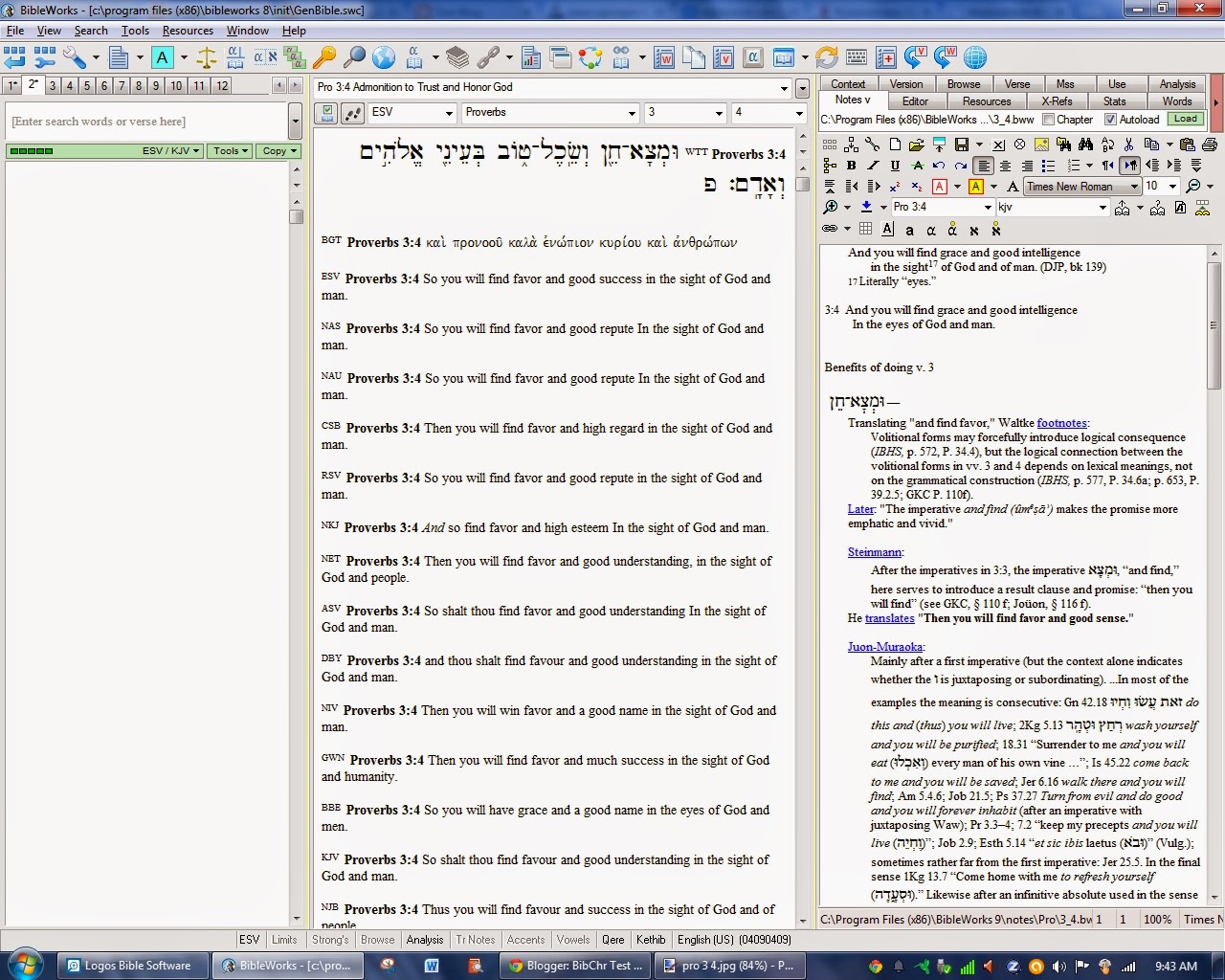
So here BibleWorks is (as always) my best friend. As I've shown you in the past, its Notes editor is simply a Godsend to me, and it's in constant use as I prepare sermons.  I can't imagine doing what I do, without BibleWorks.

So what I literally do in Proverbs is transfer every word to Notes, and break it up so I can make notes on the words. I begin with each word getting its own slot, though that will occasionally be supplemented by phrases deserving a note. Here's a screen shot from Proverbs 7:7, which was then in the planning-stages for a coming sermon:


You'll notice that my working translation is at the top, then some initial observations, then the lexical entries start. I do a search on each word's use in Proverbs; if it's already been worked on, I refer to those places. I'll also keep an eye for Solomon's abundant artistic flourishes, like the sound-play noted in red ink (aBINah BABBANIm). Of course, such observations often don't end up in the sermon, but they feed me, and if I ever write a commentary or lecture at seminary, they'll likely show up there.

Again, here's a "finished" one from Proverbs 3:4, showing what it ends up looking like:


At the top is the verse as rendered in my Proverbs book; the next is the version I ended up using in preaching, with a minor change. Then I note the opening phrase and-find-grace, with material from commenters Waltke and Steinmann, and grammar. The hyperlinks are to the resources in Logos.

So I do lexical searches within Proverbs, and usually in the larger Canon as well. Then I refer to the lexical authorities such as BDBHALOTTLOTTWOT, and NIDOTTE, as well as any of a dozen or so grammars, including Waltke-O'ConnorJoüonGKCDavidson (latter two = old, but still useful) and others, and copy info with links lavishly. My design is to end up with a little study-center in the Notes of BibleWorks.

All through this process, I'm noting words that are repeated within the section or chapter. Often, these are excellent clues as to how the chapter lays out or what it's about. This is just one of those places where Hebrew is essential, since English versions sometimes obscure connections (and, regularly, chiasms) by using different words and billowy syntax. The ESV is really frustrating about that; it's a main reason why I always provide my own more literal translation in my sermon outlines for the church.

Next step is usually to decide (A) what are the borders of the section, and (B) what is the shape within the section. This was really rough, in preaching chapter 3. Good arguments could be (and are) made for it being three sections, two sections, or one large section. This is the point at which I usually begin engaging the commentaries, focusing at this point with how they see the section laid out. Often I'll use the Editor tab in BibleWorks and do a study on this issue alone — as indeed I did with chapters 3, 6, and others.

I mention commentaries. Which are being most helpful, and which are pretty much worthless?

That will be a worthy focus in the next post.

Programming note: as of this week, I begin posting Tuesdays and Fridays (DV), instead of Tuesdays and Thursdays. Thursday is now the Greatest Hits day.

This way to the next (third) post.

Previously:
First post

Dan Phillips's signature


13 May 2014

Preaching Proverbs 6 — introduction and overview (#1)

by Dan Phillips

Though I've loved Proverbs for decades, the thought of actually preaching Proverbs — moving through it consecutively — was daunting to me. I'd preached from Proverbs here and there, and even included suggestions and an appendix on preaching the whole in my book on Proverbs — but I'd not yet actually done it.

Once I determined to preach through at least chapters 1—9, one looming issue I knew I'd have to confront is dealing with the size and shape of the discourses. I knew that there were extended sections, some of which were pretty easy to trace as to start and stop (i.e. 1:8-19, then 20-33). But I also knew that others were not so obvious at all — such as chapters 2, 3, 4... All these were matters of debate among Top Men, and if preached, I'd have to make my own decisions.

So let's see: I'd have to...
  1. Translate Hebrew poetry (always a challenge);
  2. Discern where the discourse started and stopped (no agreement among Top Men);
  3. Find the shape within and point(s) of each discourse;
  4. Interpret each discourse; and...
  5. Process how to preach each section — meaning: In how many sermons? In what way, specifically for the glory of Christ in a Christian church? How to take in-depth exegesis, light it on fire, and translate it into passionate Christ-exalting preaching?
Piece of cake!

Of course, it hasn't been a piece of cake. It has, however, been "the breakfast of champions," somewhat like a literary Bowflex. Given the amount and depth of research and thought I invest every week, it's been literally (and I only use "literally" literally) like writing a term-paper every week. Now, believe me, I'm not complaining in any way; I've loved it. But it's a real workout.

Now I'm sharing with you a series of posts just on Proverbs 6 as an example. It's fresh in my mind, and it makes for a good test-case.

So here's what you do: read through Proverbs 6, and see how you think it lays out. Is it one discourse? Two? Four, or five? What of themes — how many themes does the chapter feature?  Five? One? And further, how would you preach it? Would you preach one sermon? Or two? How would you divide your sermons? Would you do like Ray Ortlund does in his book on preaching Proverbs, and lump together 6:20—7:27 into one treatment, as if it were all the same?

If you'll tussle with that chapter a bit and "prime the pump," you'll get more out of our subsequent studies.

Or you could go through the sermons I preached on chapter six.

But that'd be cheating.

NEXT: where even to start?

Dan Phillips's signature