Showing posts with label prophecy. Show all posts

17 March 2015

The power of the word of God: oft-overlooked ramifications

by Dan Phillips

All Christians attribute power and authority to God's word, for the simple fact that it is God's word. In his Sufficient Fire talk, Phil Johnson mentioned that Brian Maclaren attempted to make mileage over the fact that 2 Timothy 3:16 said that Scripture was useful, not that it was authoritative. In my later talk I chuckled a bit over that, wondering how much more authoritative you could get than "God-breathed"!

I find John Frame's phrasing of Scripture's authority very helpful and memorable:
[Scripture] imposes on them an obligation to respond in an appropriate way. That is the proper definition of authority: an authoritative word is one that imposes obligations on those who hear. And the word of God imposes an absolute obligation.
[John M. Frame, Systematic Theology: An Introduction to Christian Belief (Phillipsburg, NJ: P&R Publishing, 2013), 529.]
There are obvious implications to this. It's easiest to see in the commandments. For instance, when God says not to commit adultery (Exodus 20:14; Ephesians 5:3), I'm to obey by not committing adultery. When God commands that we love Him (Deuteronomy 6:5; Matthew 22:37), we know we are to love God.

But do the narratives obligate me, as well? The Bible begins with a narrative: God creates the universe in six days, and rests on the seventh. Does that narrative obligate me? Or does the narrative of the call of Abram, or the Exodus, or the Passover, or Balaam's loquacious donkey, or Jonah and the big big fish? Or the narratives of Jesus' casting out demons, of His resurrection, and of dead rising in conjunction with that resurrection?

Do these stories obligate me in some way? Is there something I must do, reading them?

One's first thought might be that no moral obligation arises from a story. If so, one's first thought would be mistaken. These aren't newspaper items or oddments in old books. These present themselves to me as God's Word. As such, I am obligated — morally obligated — to believe them. If I disbelieve them, I not only err, I sin.

How so? God tells me they are true, on His honor. Reject the stories, I reject His honor. If that doesn't plunge me into blasphemy, doesn't it bring me right up to the door and knock?

But wait, there's more.

What of the passages that tell me I should fear God (Proverbs 1:7; 1 Peter 2:17), that I should rejoice in the Lord (Philippians 3:3-4), that I should hope (1 Peter 1:13)? Do those obligate me as well? Surely they do.

But wait, there's still more!

This all brings us to the Charismatic issue.

The great achievement of modern Charismaticism is to dupe so many otherwise-fine people into letting Charismatics carve a niche for themselves where they can both promote themselves and avoid all meaningful accountability. Or, put another way, both to canonize and sanctify their personal experiences and claims and to avoid testing of any sort.

One of these ways is that they will ostensibly quote God, some "word from the Lord" — but then, when challenged, hurry to say "That's just for me!"

But is that option open? They have dared to claim to quote God. They have had the breath-taking, astonishing hubris to position themselves as mediators of revelation — claiming that God said words directly to them and them alone, words they now convey to you and to me.

Can that be a private affair? If so, too late now: they've spoken. They've claimed to speak God's words!

So now I am indeed obligated. Their word obligates me. I cannot escape. (Nor can they, though they try.)

You see, if what they speak is a word of God, I am morally obligated to believe it. It doesn't matter what the content is: a word from God has God's authority, and "an authoritative word is one that imposes obligations on those who hear." Well, I hear. What is my obligation?

If it is God's word, I am obligated to believe it. And if it is not, I am obligated to rebuke and expose them as false prophets.

I want to be sure you get this. Even if what they say is "God told me personally, 'Hey, buck up, my precious darling cuddly lambie-dear, I just want to cuddle you close in sweet saccharine waves of My unconditional love and approval, and have great plans for you'" — now that they've told me, I'm obliged.

If that's God speaking and I do not believe it, I am sinning.

But if it isn't, and I do? Same result — or, at the very least, I am complicit in enabling another's sin (cf. Ezekiel 3:18).

And so, an open-but-clueless sort is obligated to search out every claim to revelation, and decide whether to embrace and submit to it, or reject and expose it. That means that such poor souls are morally obligated to be constantly directing their attention from inspired, inerrant, sufficient Scripture, to vet and test and decide on every modern claim to quote God. Because if those are words of God, I am obligated to receive and believe them, myself.

Those are our choices. Either reject the movement as a whole and stand on the sufficient Word of God, or devote yourself to constant, daily distraction.

My, that sounds like a clever way to keep Christians off-focus, doesn't it? Devilishly clever!

Claiming to speak for God is a big, big deal, as I argued at length. They want us to forget it, so they can keep the charade going.

But we mustn't forget it. And we mustn't lose focus on God's real, abiding Word.

Dan Phillips's signature


30 December 2014

Pop-offecy versus preaching as from a full Canon

by Dan Phillips

It's so much fun to be a Charismatic these days. You can say anything you want, and not only will no one in your movement call you on it, they'll give you buckets of money and the opportunity to do it over and over and over again!

Take Pat Robertson, famous for The 700 Club and much besides. Every year, Pat literally goes up in the mountains to get a word from God. Now, in case you are not familiar with Charismaticism, this isn't a Bible study. This isn't a word like the word every last child of God has been given by Him for millennia. This is a special word, a private word, just from God to just Pat.

Then Pat tells us.

Of course, like all of the distinctive doctrines and practices of modern Charismaticism, this bears no resemblance to the Biblical phenomena. (That's why some solicitous enablers have fabricated the whole "analogy" camouflage.) Unlike Biblical revelatory phenomena, these are largely unverifiable, unfalsifiable, and unremarkable.

"Largely," I say, but not always. In Pat's case, he has made some specific predictions in God's name. In those instances, how's Pat's record as a prophet? In short, not so great. For instance, in 1996 "God" murmured to Pat that Clinton would lose in his bid for the White House. Yeah, if only. Also, a nuke was going to hit the US. Then in 2005, "God" hinted that Bush would pass Social Security reform and tax reform, and would load the Supreme Court with conservatives. Again, if only. Then in 2006, the US would be hit with tsunamis, and in 2007 a mass killing would possibly leave millions dead in the US.

So you see? If Pat were held to the standards of Biblical prophecy (Deuteronomy 18:20-22), he'd be thirty years dead.

More recently, then, how did Pat do for 2014? Well, the walking, talking unpaid Charismatic bill said he thinks maybe God kinda told him that the world is going to be in chaos; some kind of credit crisis. (Wow, now, that's going out on a limb, isn't it?) Also, Iranians will have a nuclear device by end of year. President Obama will be severely hampered and will take a lot of vacations, surfing and stuff — again, hardly Isaiah 40.

But Pat also said “There’s going to be a great move of God.” Like what? Oh, the usual Charismatic stuff — so, nothing. But also this:
“There will be a move of God, and it will be the greatest year in the history of the church. It’ll be unbelievable all around the world. And I think Islam is going to be on the retreat; instead of advancing, it’s going to be retreating, uh, and, you know, onward Christian soldiers”
Apparently God didn't tell Pat what impact it has on Islamists to hear a Christian saying "onward Christian soldiers."

At this writing, that promised revival of Christianity (which, ironically, would mean the end of Charismaticism), as well as the retreat of Islam, hasn't happened either.

So as I say, if this were Israel, Pat would be thirty years dead. As it is, he can't even get himself excommunicated, or disowned, or even effectively shushed.

For our church and as a sort of foretaste for the Sufficient Fire conference, I preached a sermon titled 2015 – Predictions and Prescriptions, from the perspective of hearty affirmation of a full Canon and a sufficient Scripture.

Compare and contrast, at your leisure.

Dan Phillips's signature


21 October 2014

The real problem with Pat Robertson

by Dan Phillips

I'll just admit it up front: from their articles, I have a hard time understanding what the RAANetwork is about. They have a statement of purpose, but, as I say, I'm focusing on the articles. Where are we going, I wonder, when I see pieces like this, and this, and this? Does that all bring us together in an Ephesians 2 and 4 way, lifting up what unites us in Christ through His work on the Cross?

But I follow them in Twitter, in part because I dearly want to see Biblical truths spread all over, including those areas where historically it has not been well-presented and well-known. For that reason, Monday my eye was caught by their tweets about Pat Robertson.
Well, yeah, yes he has. Absolutely. Welcome aboard. And:
Really? Now, that's not what I would have said. I don't think it really gets to the heart of it. But I went to read the article by Cornell Ngare, to see how he developed his thought. The more Christians who put the Bible to Robertson, the better. So I read.

For one thing, I — are you sitting down? — was a bit taken aback at how bare-knuckled it was. Deserved, appropriate... but just a bit surprising to me.

"Pat Robertson has been making ridiculous statements on global television for decades." OK, well yes; again, amen. Ngare points at Robertson's "record and reputation for being flippant, bigoted, and all other words that describe a serious lack of wisdom or discretion," and asks whether we really should "be wasting our breath and time reacting to his latest episode of verbal diarrhea?"

"Latest episode of verbal diarrhea"? Ouch; absolutely true, and needs to be said. You go, bro!

Then Ngare (again truly) observes that one would hope a 84-year old would be mellowing and maturing — more "nuanced"! — and yet Robertson "only seems to be getting worse." Indeed.

Then Ngare goes on about Robertson's regular practice of popping off answers and rants and musings on an array of topics without even an attempt at deriving them from Scripture.

So: true, true, true... but what does Pat Robertson's follies in this regard have to do with Reformed folks, or the RAANetwork's statement of purpose? Robertson isn't Reformed, makes no claim to being Reformed. I'm still puzzling that out.

However, that said, I must quickly add once again that I'm always glad to see a Christian brother warning about Robertson. I myself have a long, long record of doing just that, and far less gently than Cornell Ngare (to his credit, no doubt). Just see this, and this, and this, and this, for starters.

In the first of those, I get at what I am suggesting Ngare is missing, and where I think he's just a bit wide of the mark.

I think Pat Robertson would categorically reject Ngare's accusation. Robertson would say that he seeks God's wisdom constantly—and he gets it, directly, by God's personal revelations to him.

You see, Pat Robertson is a Charismatic. He is a man who has written generously that "Probably 95 per cent of all the guidance we need as Christians is found in the clearly understood principles of the Holy Bible." The other 5 per cent? Well, that's where you need Pat and the other Charismatic leaders who have a hot line to God.

Paul's question in Romans 4:3a seldom seems to be Robertson's first question, 2 Timothy 3:15-17 doesn't inform him much, and Deuteronomy 18:20 doesn't seem to sober him up to any measurable degree. The hard fact of a completed Canon is just a "and-then-that-happened" thing in the landscape of his thinking.

So why is Robertson's ranting reported? Why does he have an audience? Why is he a problem?

It's this progression which is as unpopular as it is irrefutable: without (A) Pentecostalism, (B) Charismaticism (however you shade those two), and most crucially (C) the Open-But-Clueless crowd of Reformed-and-other enablers, Robertson would be without a platform. He'd have no one to listen to him. Once he started popping off and saying things that can't be warranted by Scripture, Christians would turn away en masse, and he'd be talking to the mirror.

This is the consequence of not truly affirming and embracing and heralding a robust doctrine of the sufficiency of Scripture. This is the consequence of winking at the Charismatic movement. This is the consequence of Reformed folks like Wayne Grudem and Vern Poythress and the others coming up with rationales to save face for Charismaticism's 100 years of straying and of failure-to-deliver.

Just take one example, only one: Robertson's internationally-famous record for false prophecies. Just take this one: here we see Pat Robertson and Michael Brown's BFF Benny Hinn, where Robertson says in so many words that God told him that Mitt Romney would win the Presidency.


Don't rush past that. There's no way to soften this. Sniggering, giggling Pat claims a word from God. Michael Brown's good buddy Hinn says "I trust God's voice." So both equate Pat's private revelation with the august voice of God, that voice which brought the universe into existence out of nothing.

Yet note again, Hinn says "I trust God's voice," and Robertson chuckles "Well, we'll see."

Words fail me. Almost.

Now, this clearly was a false prophecy. Can't we agree on that?  That, or (I speak as a fool) God was wrong. So, remind me: what are the consequences for delivering a false prophecy?
  1. In Israel, it would be death (Deuteronomy 18:20).
  2. In the church, surely it would be excommunication.
  3. In this day of Grudem and Poythress and other enablers of modern pop-offecy... nothing. No consequences.
I totally agree with Cornell Ngare that Robertson's a huge problem. But I don't think his wording of his analysis hits the ten-ring. Robertson's problem is the reason why he even has a platform: failure to give God's Word the place God gives it.

What Christ's church really needs is a revival-level, massive embrace, and living and systematic proclamation of the sufficiency of Scripture.

Dan Phillips's signature

22 July 2014

Charismatics degrading revelation? Must be a day ending in a "y"

by Dan Phillips

The speaker here is Jennifer LeClaire. She's not some obscure figure off on the fringe; she is news editor at Charisma magazine — which I guess is the leaky-Canoneers' organ of record? At any rate, she's written books, she's got an internet presence, and on and on and on.

Plus, she's a preacher. Plus, she receives direct, verbal, extra-Scriptural revelation from God. And we're not talking feelings, impressions, hunches. We're talking about words from God that she can quote for us. And we need her to, right? Because they're not in our Bibles.

They're just Jennifer.

Well, not anymore, because she's thoughtfully passed on to us what God bypassed His Bible and His body of believers to speak to her only. And here it is. These are, according to Jennifer LeClaire, the words of God:
There is a great awakening coming to this nation. For I have heard your cries and I long to heal your land. I am a covenant God and I will not forget the covenant I made with your Founding Forefathers. Yes, there will be a shaking, but the foundations will not crack and they will not crumble. Only those things which can be shaken will be shaken that the sin in the land may be laid bare.
Well, it's all there, isn't it? It is a direct quotation of God. "I have heard your cries." Read the article: there is no "I might have gotten this exactly right," or "You have to understand, I'm about to impersonate God, but I don't mean you to think that I'm, you know, impersonating God," or "Remember how Grudem made it okay for me to redefine prophecy? There's my get-out-of-responsibility card!"

But wait, there's more.

This isn't the mere rehashing of Biblical generalities that many Charismatic pop-offecies feature. It actually imparts newly-revealed information, information that changes everything. "God" here tells us that "He" made a covenant with America's Founding Forefathers. Those Deists and Romanists and all-over-the-mappers were "His" covenant partners. Covenant with Abram, with Isaac, with Jacob... and with America's founders. The texts are Genesis 12, Exodus 2:24... and Jennifer.

And where is this covenant? What was the ceremony? When did it happen? What is the exact wording? Is it unilateral, bilateral, or what? Are there promises? What are they? Sanctions?

This is heavy, immense stuff. It changes history and our view of it. It changes the way we see America, and the way we need to demand that everyone sees America — you know, demandin "God's" name, right? Because this is the Word of God. Like the Bible is.

And surely all the rest of us should put this in our preaching rotation, right? Because it's important. So: Proverbs, Ephesians, Gospel of John, prophecy of Isaiah, prophecy of Daniel, prophecy of Jennifer.

Plus, shouldn't living theologians schedule revisions of their texts? Especially Grudem? They weren't working with the full dataset.

There's a lot more in this prophecy. Interestingly, "God" calls the nation to repent — but "He" doesn't call this female preacher to repent of the obvious.

Are the high-traffic leaky-Canon-friendly reformed blogs all over this, either tearing it to shreds or preaching it up?

All right now, some of you are chuckling, some are groaning, some are gritting your teeth. Why am I doing this? (And this is nothing; we could go on, and on, and on.)

Because all of this is a perfect exhibition as to why the Strange Fire conference was necessary, and why conferences like Sufficient Fire are absolutely essential. The church has become inoculated and numbed to the outrageous audacity and distraction that is Charismaticism, and it has allowed its wonder and marvel and reverence over the Word of God to be adulterated down to the vaguest shadow of what it should be.

It's not a little thing. It's just treated like a little thing.

However, it is as if Christians who have a robust doctrine of the sufficiency of Scripture have an unspoken agreement about our Charismatic siblings. When they start claiming direct revelation, or semi-hemi-demi revelation, we just smile with fond indulgence and wait until they're done. It's like Crazy Uncle Rufus. We all love him, so when he starts up about how President Bush ordered the bombing of the World Trade Center, or alien bovine probing, we just smile and wink at each other. It's just Crazy Uncle Rufus being Crazy Uncle Rufus. We love him. No harm done, right?

Not right.

Not right, and not to God's glory. Nor does it adorn our witness to the lost. Nor is it to the good of Christ's church...nor of Jennifer LeClaire, for that matter.

That someone should speak up is a given. That all who affirm Scripture's self-revelation should speak up, sound the alarm — also a given.

That so few do... that's the mystery, and that's the shame.

But one just has to do what one can.

ADDENDUM: this poor lady only blames a 360-word rant on God. Francis Chan now tells us God "asked" him to write a whole book. This isn't Chan's first irresponsible statement of the kind. What if these thoughts from 2010 had been echoed and made more of a focus among those with a robust doctrine of the sufficiency of Scripture four years ago?

Dan Phillips's signature


30 October 2013

Strange Fire Conference #4: Steve Lawson on Calvin and the Charismatics

by Dan Phillips

First post
Second post
My overall summary report to CBC
Third post

Steve Lawson's session focused on what John Calvin would say to modern Charismatics. Lawson is a lot of things: senior pastor of Christ Fellowship Baptist Church in Mobile, Alabama, teaching fellow with Ligonier Ministries, visiting professor at the Ligonier Academy, The Master’s Seminary, and Samara Theological Seminary in Russia — and a constant fixture at conferences. (Seriously: how do you get that gig?)

It was really a terrific session. Lawson showed a surprising facility for spontaneous humor, particularly on display when a remark drew one person's applause ("Thank you to the one person who clapped" — and then, when everyone applauded, "I can tell when you don't mean it").

Having read Lawson's recent book on Luther (the review of which I plan to post after this series), I appreciate all the more the extent of research that goes into his talks. This was laced liberally with direct quotations from Calvin.

Lawson observed that Calvin faced foes who also believed they had inner light and direct revelations from God — the Anabaptists and the Libertines. He quotes Calvin as saying that they were 100 times worse than Roman Catholicism. Some of the libertines wore torn robes and seemed to want a "grunge" look. (When the audience laughed, Lawson remarked, "I feel like I just stepped on something," to more laughter.)

Lawson largely found Calvin's thoughts revealed in his commentaries on related passages. I looked them up to add to my notes and to BibleWorks as needed. Here are just some of the highlights:

On Acts 2:38, Calvin said:

Therefore this doth not properly appertain unto us. For because Christ meant to set forth the beginning of his kingdom with those miracles, they lasted but for a time; yet because the visible graces which the Lord did distribute to his did show, as it were in a glass, that Christ was the giver of the Spirit, therefore, that which Peter saith doth in some respect appertain unto all the whole Church: ye shall receive the gift of the Spirit. For although we do not receive it, that we may speak with tongues, that we may be prophets, that we may cure the sick, that we may work miracles; yet is it given us for a better use, that we may believe with the heart unto righteousness, that our tongues may be framed unto true confession, (Rom. 10:10,) that we may pass from death to life, (John 5:24,) that we, which are poor and empty, may be made rich, that we may withstand Satan and the world stoutly.

Calvin's note in the Institutes is particularly telling as to his Biblically-derived view of the attesting/revelatory gifts' purpose:
In demanding miracles from us, they act dishonestly; for we have not coined some new gospel, but retain the very one the truth of which is confirmed by all the miracles which Christ and the apostles ever wrought.
In other words, Calvin saw the purpose of the gifts as being to confirm the new message of the gospel and its messengers. When his contemporary critics demanded that he and the other reformers perform miracles, his response in effect was "Why should we? We are not bringing any new message, but the old message which has already been revealed and attested by God's supernatural power."

As I've often argued: define the gifts' purpose Biblically, and you define their intended shelf-life. Describe the gifts Biblically, and you refute modern substitutes.

Calvin again notes tongues' long-past cessation in his comment on Acts 10:44 —

The gift of the tongues, and other such like things, are ceased long ago in the Church; but the spirit of understanding and of regeneration is of force, and shall always be of force, which the Lord coupleth with the external preaching of the gospel, that he may keep us in reverence of his word, and may prevent the deadly dotings, wherein brain-sick fellows enwrap themselves, whilst that, forsaking the word, they invent an erroneous and wandering spirit. 

It was particularly interesting to hear that Calvin, in his remarks on Acts 21:9 some 500 years ago, made the same point about errorists in his day that I've made again and again about Charismatics (bolding added):
Prophecies had now almost ceased many years among the Jews, to the end they might be more attentive and desirous to hear the new voice of the gospel. Therefore, seeing that prophesying, which was in a manner quite ceased, doth now after long time return again, it was a token of a more perfect state. Notwithstanding, it seemeth that the same was the reason why it ceased shortly after; for God did support the old people with divers foretellings, until Christ should make an end of all prophecies. Therefore, it was meet that the new kingdom of Christ should be thus furnished and beautified with this furniture, that all men might know that that promised visitation of the Lord was present; and it was also expedient that it should last but for a short time, lest the faithful should always wait for some farther thing, or lest that curious wits might have occasion given to seek or invent some new thing ever now and then. For we know that when that ability and skill was taken away, there were, notwithstanding, many brain-sick fellows, who did boast that they were prophets; and also it may be that the frowardness of men did deprive the Church of this gift. But that one cause ought to be sufficient, in that God, by taking away prophecies, did testify that the end and perfection was present in Christ; and it is uncertain how these maids did execute the office of prophesying, saving that the Spirit of God did so guide and govern them, that he did not overthrow the order which he himself set down. And forasmuch as he doth not suffer women to bear any public office in the Church, it is to be thought that they did prophesy at home, or in some private place, without the common assembly.
Lawson also noted that, when challenged as to why he invested so much time in responding to errorists, Calvin replied, "Even a dog barks when he sees someone assault his master." This clearly resonated deeply with us who heard. This foolish error opens the door to Satan, leads the simple away from the truth, and provokes God. For Calvin, a charismatic Calvinist would be an oxymoron.

Lawson closed his stirring talk with three principles:
  1. The exclusivity of Biblical authority. Either there is one stream of revelation, or there are two. Either Sola Scriptura or something else. Calvin faced the "two streams" model in Roman Catholicism, and then in another form with the Anabaptists and libertines. It is the notion of the word of God and ______ that Calvin opposed, insisting that the Word of God formed the one and only stream.
  2. Priority of Biblical preaching. Look to two streams and pulpit is diminished. Bible mandates Biblical preaching. Two streams dilutes that. 
  3. The unity of Spirit and Word. The Holy Spirit is not opposed to the Word of God, but is its divine Author, and uses it as His means.
Dan Phillips's signature

13 September 2012

Gullibility versus Biblical faith: three vignettes

by Dan Phillips

I used to drive a dear lady, an older sister in the Lord, to a chiropractor. It was a long drive, and my opinions about chiropractics were irrelevant and secondary to the opportunity for fellowship.

But she became a bit concerned because she wasn't seeing any progress, after many months of visits. So she went in to the chiropractor to question him. She shared her concerns, he looked at the X-rays.

And this was the upshot: though she felt no difference, and though the X-rays showed no difference, she was making progress.

Because he said so.

Just "progress" that could not be seen, felt, nor detected by instruments.

Fast-forward a couple of decades later, to Just The Other Day.

As I drove my wife to the airport the other day, we passed a Palm Reader, so advertised by signs which blared out many claims of wonderful mysteries awaiting within.

You just have to marvel. I thought (partly aloud, to my family), "How does that person stay in business? Obviously he or she makes enough income to rent a house, have signs, keep a location on a busy street... but how? Do people really think that someone has those kinds of powers, yet all they can do is run a little shop in a little town in a little corner of the world, in total anonymity. That makes sense to people? To a lot of people?"

(I also noted that one of the claims on the advertising was "Returned loved ones." I wondered if that required a receipt. But I digress.)

And then, having delivered Valerie to her point of departure, as we journeyed home, the boys and I spotted another... well, place of business.

This time, the sign said "APOSTOLIC SIGNS AND WONDERS."

And again, I marveled.

I exploded to the boys, "Really? People who own Bibles go to a place like that? 'Signs and wonders' — so that means they're raising the dead, healing the congenitally blind and the congenitally paralyzed, parting water, making the sun stand still, stopping and starting rain at a word... all the time! Because that's the main thing they say on the sign: not that they preach the Gospel, not that they preach the Word, but that they do apostolic — not just garden-variety, mind you, but apostolic — signs and wonders. And with all that going on, they're just a never-heard-of group in a tiny building 'way off the side of the road."

So... what's the difference?

Here's the irony, the truth I keep hacking away at from every angle I can find.

Many so-called "continuationists" (Reformed!) would shake their heads and cluck their tongues right along with every one of us — even while they enable this sort of thing. Because obviously, the only reason such follies can survive is that people have given the charlatans a bye on the whole Biblical issue of falsifiability.

How so?

All the Biblical tests of genuinely revelatory/attesting events are explained away by modern hucksters or their enablers. They either die the death of a thousand qualifications, or are radically Clintoned down. "You see these tongues are... are... they're a different kind of tongues than Pentecost! Yeah, that's the ticket. So you can't test them or identify them. You just have to believe! And the prophecy, it's... it's... it's not like the entire Bible explicitly defines prophecy. No no, it's a special kind of non-inerrant non-binding low-octane objectively unverifiable prophecy for the glorious New Covenant! Yeah, that's it. That's the ticket! And these porn pictures I get in my head, they're actually..."

You see?

And what does all that leave us with?

Pious gullibility masquerading as faith. With the charlatans in charge.

Dan Phillips's signature


30 August 2012

How can Christians hear a word from God? I mean, really?

by Dan Phillips

Some guy named "Phillip R. Johnson" (whatever; I think he writes about creation, or something) posted this video from James MacDonald, in which MacDonald explains ways to receive a word from God. Turns out there are five. To wit:


Wellnow, let's us chat about this.

First, to do that thing that drives drivebys crazy, let's anticipate the first response defenders will have: this is a very small excerpt from must have been a much longer talk, and it is out of context.

Fair enough. Absolutely true. It is possible that, just before this video, MacDonald said,
"For the next two minutes and fifty-six seconds, I am going to present some traditionalistic notions that are very popular among many Christians. I'm going to do it with warmth and enthusiasm, and even add a personal anecdote, just to be sure I'm doing a fair job of representing their position. Then, starting with the fifty-seventh second of the third minute, I'll show you why this is such dangerous nonsense."
If so, that would absolutely change everything, and taking this video as representing MacDonald's thoughts would be very unfair.

So let's just focus on what is actually in the clip, rather than on MacDonald himself.

This is a test. Let's see what you've learned from our dozens of posts on this general area. How would you respond to what he said?

But even beyond that, let me broach something I'm not sure I've said before in this way.

Before giving it, I note that the vid above proceeds on the premise that of course we should accept all five ways as ways "God speaks," as ways to "hear from God," to have "the Holy Spirit speak a word," or to get, as he says explicitly and more than once, "a word from God." It's the results that we are to test by Scripture — not the ways themselves.

Note too that we need these ways, according to MacDonald. We need them. We, Christians, all Christians. He makes that very clear.

But what if we asked a more fundamental question? What if we tested the ways, and not just their results?

Suppose, in response, we just asked this multifaceted question?
What would be the premise for, and ramifications of, promoting only the way(s) in which Scripture directly and in so many words urges and directs all Christians without exception to seek and find what it itself directly calls, in so many words, a "word from God"?


Bam.

Should be both fun and profitable.

POSTSCRIPT: I untangle and answer that question HERE.

Dan Phillips's signature


07 May 2012

"What Is Written"

by Phil Johnson


o I was in Minneapolis Saturday for Todd Friel's Wretched Psalm 119 Conference, and David Wheaton broadcast his weekly radio program, "The Christian Worldview," live from the conference venue. David graciously featured an interview with me in one of the segments, and at one point he asked me to give a thumbnail sketch of what I would be speaking on later in the day. The theme of this year's Psalm 119 Conferences is the Holy Spirit, and one of my messages dealt with the question of how the Holy Spirit communicates truth to believers. Should we expect Him to reveal fresh prophecies through intuitive impulses, voices in our heads, and other means of private revelation?

I said no, nothing in Scripture instructs us to seek that kind of guidance. Instead, we are commanded to order our lives by the Scriptures (Deuteronomy 5:32; Joshua 1:7-8; Psalm 1:2-3; 1 John 2:5-6; etc.). The Holy Spirit's ministry is to enlighten our understanding of the Word (1 John 2:20, 27; Ephesians 1:17-18; 1 Corinthians 2:12-14; Psalm 119:18) and motivate our obedience (Ezekiel 36:27), so that the Word of God (not some mystical extrabiblical revelation) is "a lamp to my feet and a light to my path" (Psalm 119:105).

That's more or less what I said in answer to David Wheaton's question about how the Holy Spirit guides us.

Less than 15 minutes later, my phone dinged, letting me know I had received a fresh e-mail. Here's what the message said:

I was just listening to an interview with you on local Christian radio. It seems you have elevated that which is written above the mystery of Christ hidden in us. Perhaps I have misunderstood. I hope so. There was nothing "written" for the common man until when? The 16th century? Maybe sooner...Even so, literacy was widespread. But, here we are, the seed has not been obliterated.

I submit that you could consider the inner work of the Spirit...that is a mystery, indeed. Just as surely as the union of sperm and egg produces life, so the Spirit produces new life, and that eternal. And we have no dispute there.

Lean not into your own understanding...let the Spirit have His work...by Faith. After all, God is a Spirit and they that worship Him must do so in spirit and in truth.


Yikes.

My reply:

God himself elevates "that which is written" to the position of highest authority, and He has expressly instructed us "not to go beyond what is written" (1 Corinthians 4:6). Scripture is the only truth we have that is God-breathed (2 Timothy 3:16). And the truth of Scripture is sufficient for all our spiritual needs (v. 17).

So if someone heard my abbreviated answer to David Wheaton and thought I was saying the Scriptures are more authoritative and more reliable than any mysterious "inner work of the Spirit" that involves extra-biblical "truth" or inspired intuition, then emphatically: Yes, you heard me correctly.

Like many charismatics, my interlocutor seems to imagine that the principle of sola Scriptura is hostile to a robust understanding of the Holy Spirit's work in the daily lives of Christians today.

That idea is perhaps the single most deadly error in the vast menagerie of problems associated with the charismatic movement.

Phil's signature


09 February 2012

About any claim of a word from God: application

by Dan Phillips

Let's make a step forward from the basic considerations we laid down about any word from God, a couple of posts ago. I'll take this as established:
  • There is no such thing as a word from God that is erroneous. If a word affirms error, it is not God who is speaking (Num. 23:19; Jn. 17:17; Tit. 1:2; Heb. 6: 18).
  • There is no such thing as a word from God that is not absolutely morally-binding (Deut. 18:19; Jn. 15:22). This absolute obligation is all-encompassing: if God tells us to act or refrain from acting, we must comply; if God tells us to think or believe, we must agree. I sin equally if I fail to love my wife (Eph. 5:25), and if I fail to refrain from committing adultery (Rom. 13:9) — but I also sin if I do not believe that Christ is God (Jn. 1:1) and that He became flesh (v. 14).
Sad but true, I wish I could say that all professed Christians (myself included) "get that" in terms of accepting and embracing and practicing it with complete consistency regarding the Bible. Sanctification is a process.

But I'd like to stir your pure minds to thought in another direction. Take a hypothetical — oh boy, I wish it were hypothetical. But let's put it as one.

HYPOTHETICAL: Brother X says that God "told" or "has called" him to do Y, which is not in any way directly stated or contained in Scripture.

Now here are my questions, and I really would urge you to think hard about this. Picture me looking you straight in the eye, requiring that you lock gazes with me as I say very intently: it is failure to think through the implications of such claims that accounts for a great deal of sloppiness and error in the professing church today.


My questions, then:
  1. What absolute and immediate obligation does that put on every person who hears that assertion?
  2. What must the consequences be for church discipline?
Have at it.

Dan Phillips's signature

31 January 2012

About any Word from God: basic considerations

by Dan Phillips

[You might expect something on ER2 and, eventually, I may write more about it. Meanwhile, I'd just ask you to re-read Thabiti's eloquent and moving post from October 1 of 2011, and this and this, and ask yourself where we would be today if the thoughts in posts such as those and other similar warnings, written months in advance of ER2, had been so broadly and publicly taken up that it would be impossible for MacDonald and Driscoll to ignore such concerns. Meanwhile, this.]

It is a central tenet of Christian faith that there is such a thing as a word from God (Gen. 1:1; 15:1; Jn. 1:1, 14, 18; 3:34, etc.). Without that assertion, made and affirmed, there simply and literally is no Christian faith (Rom. 10:17).

So, HSAT, let's think through some questions about words from God:
  1. Does it change anything, if there is a word from God?
  2. Does it change everything, if there is a word from God?
  3. Does the Bible ever depict the arrival of a fresh word from God as intended to be welcomed as a casual, business-as-usual affair?
  4. Is there such a thing as a word from God that is not inherently fully true, and thus inerrant?
  5. Is there such a thing as a word from God that is not instantly, inherently and absolutely morally-binding?
  6. Even in the cases of words from God that do not direct me to do something (i.e. Jer. 18:1; Jn. 1:14), are they not still inherently and instantly and universally morally-binding in that believers must affirm that they are God's words, and must believe them?
  7. Does not the very existence of tests of prophecy (i.e. Deut. 13:1ff.; 18:15ff.) underscore the fact that, if it is a word from God, all people are obliged to embrace it appropriately?
  8. If the elder(s) of a local church knew of anyone in the congregation that was in rebellion against a word from God, either by refusing to do what the word said to do, or refusing to believe that the word was God's word, would they not be obliged to confront and discipline that person, and ultimately to expel him or her as an unbeliever, absent repentance?
  9. Can a body of believers be in the regular practice of disobeying, ignoring, or being ambivalent about words from God, without disastrous spiritual consequences?
There. Now I'll ask and answer two more questions:
  1. Say... isn't that an awfully basic list of awfully easy questions? (Answer: in "evangelicalism" today? It should be, yes. Would to God that it were. But no, evidently it is not.)
  2. Are you going somewhere with this, fella? (I mean to, yes; probably Thursday.)
Dan Phillips's signature

27 September 2011

Ashford Bible Conference 2011: Christ in the Old Testament

by Dan Phillips

As you know, I had the great joy of bringing two of the four sessions in the 2011 Ashford Bible Conference, of which the topic was Christ in the Old Testament. Brother/pastors Anthony Forsyth (about whom more, later) and Tom Drion (who serves God in His Word in London) brought the Word in the other two sessions.

Pastor Anthony Forsyth invited me and, what's more, hosted my dear wife, two youngest sons and myself. We all absolutely loved the Forsyth family (wife Jenny and children Joseph, Lydia, Phoebe, Timothy and Chloë), and loved our time with them in their stately mansion. Had a terrific time with them, trading accent-teases, as well as meeting first another American house-guest (Jeremy, music-guy), and then an Irish brother (Jonathan, media-guy).

Anthony even graciously encouraged my efforts to speak, you know, English. Nonetheless, I felt it wiser to teach and preach in American, with Anthony standing by to translate as necessary.

I'd been very anxious in my preparations over the many months since Anthony invited me to speak, poring over reams of volumes and articles on Messianic prophecy, as well as reviewing the Scriptures themselves. How to approach it? How even to touch such a massive, vital topic, over which my betters have labored for millennia with such varying results and degrees of success?

Through it all, my fundamental driving conviction came from passages such as John 5:39-40, 45-46 —
You search the Scriptures because you think that in them you have eternal life; and it is they that bear witness about me, 40 yet you refuse to come to me that you may have life. ...45 Do not think that I will accuse you to the Father. There is one who accuses you: Moses, on whom you have set your hope. 46 For if you believed Moses, you would believe me; for he wrote of me. 47 But if you do not believe his writings, how will you believe my words?”
You could say this is a subsection of my overall conviction, based on passages such as Hebrews 1:1-2, that the Bible is not a secret codebook. It is a communication, from God, to His people, commencing (always) with the original authors and hearers.

These and other passages give me the very strong impression that our Lord believed that the OT, in and of itself, bore witness to Him so directly and overwhelmingly that to reject that witness is to damn oneself. Never does He say anything even approaching, "You know, boys, I can't really blame you for not recognizing Me. Nobody could! The OT is a book of impenetrable mystery. In fact, nobody could fairly be expected to see Me in it. But just you wait: after Pentecost, the Spirit will help My guys read Me into it. Then we'll have a whole different ballgame."

Rather, in saying that Moses himself would condemn His rejectors, He is clearly asserting that Moses knowingly wrote of Him. Not wrote-of-something-else-that-later-was-deflected-to-Him, but of Him, Jesus.

So my challenge was multifold:
  1. How to read the Scripture as it should be read; which is the same as saying...
  2. How to read the Scripture as Jesus read it.
  3. How to show that the Scripture in its entirety pointed to Him.
  4. How to set this forth intelligibly in two sessions of finite length.
  5. How to do all this freshly, persuasively, accessibly, helpfully, and memorably.
Whether or not I succeeded, God is judge, and you can judge for yourself. But trying was a joy and an education.

In the first talk, I introduce the entire subject of Messiah and of Messianic prophecy, and endeavor to show (in one talk!) how the whole OT points to Jesus Christ. My dear wife says I talked too fast, and I'm sure she's right. My excuse is that I had a truckload to say, and leaned on the fact that folks could (if they wished) listen to the recording or watch the video. That's my story, and I'm sticking to it.

In keeping with my conviction, I approached the session not by expounding NT passages with talked about Messianic prophecy, but by going straight to the OT text itself, literally beginning at the beginning.

Here 'tis:

The second talk was really a continuation of the first, and a specific demonstration of ways in which one particular book (Genesis) points to Christ.


My third message in Ashford was a Sunday morning sermon focusing on Colossians 3:16 and speaking of the church's vital center. Then in the evening service, I returned to Christ in the OT, particularly speaking (surprise!) of Christ and Proverbs — because Pastor Forsyth had asked me to.

An aside: when Anthony and I met at his house, he asked "Have you ever seen this?" — and held up my Proverbs book. I hadn't! It was quite a surprise. Last I heard, the book would not be out in time for the conference. But Anthony had been persistent, publisher Eric Kress had done some magic, and the book had preceded me.

That book does contain material and an appendix that relates to Christ in Proverbs, and how to teach and preach Proverbs. However, this sermon takes a somewhat independent approach from the focus of the book.

Anthony also had ordered a large quantity of The World-Tilting Gospel, which he handed out to each family in attendance. Say, what a great conference idea. He also sees the book as a ministry-tool, extending Gospel preaching and grounding to all of the families under his care, and I believe he'd commend it to others for the same purposes.

Staying with that subject: Anthony is involved in two ministries now, an ongoing ministry Sunday afternoons in Medway, and a new church-plant in Ashford. You can see some more about it here, with more planned in approaching weeks. He would appreciate all of your prayers, and I would commend him to you. England is a land of thrilling history and a dark spiritual present. Any emphatically Gospel-preaching, Bible-teaching ministry will face trials and Satanic opposition, and Anthony's is no exception. Pray for his own walk and ministry, and for his family; and pray for the unity, growth, and evangelistic outreach of his church.

There. That should keep you busy and out of trouble for awhile.

Dan Phillips's signature

23 August 2011

"Reformed" "continuationists" and Gutless Gracers

by Dan Phillips

As I was mulling various things over, I hit upon a connection between two seldom-associated doctrinal groups. Perhaps in time this connection I'm making, existing at present only in my head, will prove prescient. I hope not.

On the one hand, we have "Gutless Gracers." This is a term I've used here, denoting a mindset I Biblically deal with at some length in Chapter Ten of... you know, that book. Advocates would call themselves "grace" believers; critics call them "non-Lordship" teachers, I call them "gutless gracers."

As presented by themselves, the position is that we are saved by grace alone through faith alone. So far, so great. However, it is when they go on to define saving faith in such a way as to exclude repentance and submission to Christ's Lordship that these folks run into grave error. To them, such elements involve "works-salvation," and are to be strictly rejected.

The practical result — to put it in terms they would themselves seldom own — is that a man can continue to live like Hell and still go to Heaven. As long as he voices the opinion that Jesus is the Son of God, or assents to the proposition that Jesus died to save him from sin('s penalty), he's okay with God.

A critic (such as I) would say that the real heart of the position is not that one is saved by faith alone (a precious truth), but rather one is saved by claiming-to-have-faith alone (a pernicious error). This "salvation" is sheerly forensic and eschatological, one might almost say theoretical. It doesn't actually save anyone from sin's dominion or power. It does not necessarily result in owning or obeying Christ as Lord. These are optional, albeit desirable, effects.

I have actually known of advocates of this school who say that one can be a Christian Hindu, a Christian homosexual, even a Christian atheist. Now, however it may sound, the case is not that they are actual theoretical relativists or liberals; far from it. As a rule, they are fundamentalistic in their affirmation of Scripture's theoretical inerrancy. Nor would they say that it is a good thing to occupy any of these positions.

It is simply that gutless-gracers are rigorously consistent in the outworking of their fatally-flawed premise: sanctification in any measurable degree is not a necessary result of by-grace-alone-through-faith-alone salvation. If Johnny says he "prayed the prayer" when he was 5, 10, 15 or 20, then no matter what Johnny goes on to do or not do, Johnny is saved, saved, wonderfully saved.

At this point, the reader's patience may be waning. "And what," he may ask, "does this possibly have to do with Reformed continuationism?"

So far, not much. As a rule, formal gutless-gracers tend to be warped dispensationalists, and "Reformed" "continuationists" tend to be non-dispensationalists. Real dispensationalism should be fatal to the gutless-grace position, as real reformed thinking should be to "continuationism"; but that is beside the point at the moment. The point is that both schools of thought are seldom wed, to the point where ignorant "continuationists" often deride all cessationists as being dispensationalists. Which annoys anti-dispensational reformed cessationists no end, and tickles me some. But I digress.

So now I'll show you the connection.

First, have this firm in your mind: the gutless-gracer insists that real, live, saving faith can exist in the heart of someone who never, ever gives the least bit of real-world evidence in his life and priorities and choices that actual conversion has taken place.  In some invisible, inaccessible realm that no eye can see, there has been this massive shift — but observable history is absolutely innocent as to its occurrence. We just have to believe it's there. It's happened, because the professor says so, and the position dictates that it is so.

And so when we look at the Bible and see that Jesus defines saving faith as necessitating submission to His authority (Lk. 6:46; Jn. 14:15; 15;14), that Jesus defines genuine discipleship as involving continuance in His word (Jn. 8:31-32), that Paul insists that it is both impossible and impermissible for a converted person to continue to live in practical denial of Christ's Lordship (Romans 6), that John in his first epistle repeatedly emphasizes that genuine faith will necessarily involve doctrinal soundness and practical holiness, and that James laughs to scorn the notion that saving faith can produce no works — when we see all that, and look at the lives of these professed believers and see nothing like any of those evidences of genuine faith — we are required simply to "dumb down" the definition, in order to accommodate reality and save the theory.

And so the entrance to the Kingdom looks less like a needle's eye, and more like the bar on a Limbo dance — pretty low, and you can dance under it.

I've read leading advocates doing just precisely that. They scramble for shadows, illusions and chimera, call them "fruit," and cling to the theory, though to anyone else it is glaringly obvious that what we are seeing is nothing like what the Bible describes as genuine Christian reality.

Sharp cookies that you are, I wager that virtually every one of you sees the point now — though some of you will generously (if unwittingly) prove my point decisively by arguing against it, simply because you don't like it and change can be unwelcome, even if needed.

Because you see the "reformed" "continuationist" does the exact same thing, in order to prop up his theory.

Every honest objective observer admits that nothing of the caliber of dominical/apostolic revelatory and attesting activity is taking place today. Nothing of that caliber has taken place since the first century. This is a simple, incontrovertible fact. The Bible is not getting bigger, genuine apostles are not ranging about among the churches, dead are not being raised on command. There simply is no post-apostolic continuation of  revelatory/attesting activity, and never has been.

Faced with the evidence, yet formally professing the inerrancy and sufficiency of Scripture, the would-be Reformed continuationist is faced with two choices:
  1. Abandon his insupportable "continuationism"; or
  2. Mess with the evidence/standard-of-proof nexus.
And, to a man or woman, unable to produce new Scripture or apostolic-level revelatorily-gifted individuals, unwilling to repent of their error, desperate to validate their experience at all costs, they opt for #2.

In this, then, they are mirror images of those very gutless-gracers against whose antinomianism they otherwise rail. They reject the gutless-grace position, with its theoretical affirmation and practical denial of real-life implications of Christ's Lordship... yet, at the same time, they insist on a theoretical affirmation of continuing apostolic/dominical-grade signs and wonders and revelation, while being equally incapable of pointing to any actual examples. So, like their gutless-grace brothers, they are forced to lower the bar so astronomically as to accommodate virtually anything as proof.

So, in both cases, it goes like this:

  1. The theory is all-important and must be preserved.
  2. The theory suggests there should be evidence, and must be a standard of proof.
  3. There is no evidence.
  4. But see #1, above.
  5. Solution: redefine "evidence," lower "standard of proof."
  6. Result: see #1, above.

As a result, then, both echo the famous line from The Treasure of the Sierra Madre:

"Fruits? We ain't got no fruits. We don't need no fruits. I don't have to show you any stinking fruits!"

Ah, if only more Christians as a whole responded with the wisdom of Humphrey Bogart's character "Dobbs," and said, "Better not come any closer!"

Dan Phillips's signature

22 August 2011

Subjective Impressions, ESP, and Reverse Deja Vu

by Phil Johnson

Intuition and Superstition: An Admonition

Impressions on the mind are like Rorschach tests: Make of them whatever you will, but if you treat them as "prophecy," that's just crazy.

Today we continue the discussion of cessationism vs. continuationism; true prophecy vs. fallible prognostication; and
sola Scriptura vs. modern charrismatic prophets.

(First posted 31 March 2007)

veryone has unexplained thoughts that seem to leap from nowhere into the mind. (Note: When I say "everyone," I mean believers and unbelievers alike; I don't necessarily mean "every single individual." I've met a few less-than-completely sentient people who seem incapable of any original thought whatsoever. They prolly never get spontaneous notions of anything. Let's leave those folks out of this discussion.)


Most people likewise have a sense of intuition, where at times you just feel like you know a thing is true and you can't give an account for how you arrived at that knowledge rationally. It may even seem like you have ESP, or ESPN2, or whatever. It's a lot like deja vu, only backwards. I happen to think that sense of intuition is probably more rational than we can explain. In any case, I'm quite sure it's not really a supernatural spiritual gift from God, because it has such a poor track record. Besides, I had the same intuitive abilities before I was converted as I have now.

My sense of intuition is sort of like a stopped clock that was designed to measure time in months instead of hours. Once or twice a year (on average) it's right. And when it's right, it can seem quite impressive. I've had some moments of intuition that I could have parlayed into a fortune, if I were the type of charlatan who is willing to claim he has a prophetic gift even when he knows he really doesn't. I certainly have no such gift. For the most part, my intuition is grossly fallible and ordinarily wrong. I don't trust it at all, even though my experience is probably a lot like yours: there are times when I feel compelled to follow my intuition.

To be clear: I usually "feel compelled to follow" my intuition only when I don't have a better rational or sensible idea of what to do. Maturity has taught me to hold off on trusting intuition and try to understand facts and reasons and the potential results of my actions before I act. In fact, I'd say that's what maturity is all about, to a very large degree.

But, how do we understand that inner sense, especially when God seems to use it to prompt us to pray, or witness, or duck and run at precisely the right moment? Because let's be honest, here: that kind of thing does happen to most of us from time to time.

As I said in a comment-thread [once upon a time] (see below), we need to regard those occasions as remarkable Providences, not inspired prophecy. God might use a spontaneous thought in my head providentially. In fact, as a Calvinist, I don't hesitate to say that He ultimately controls and uses everything providentially. But that's as true of my sins as it is of the thoughts in my head. God can use them all for His own purposes. The fact that He uses an idea in my mind to achieve some good purpose doesn't make the idea itself inspired.

That's the point we are trying to make in all these various threads about prophecy and cessationism. It's an important point. We're not trying to step on the charismatic air-hose just because it's fun.

So please give these things some serious thought before you react this time.

Four lessons:

  1. If intuition is fallible (and everyone except the out-and-out-charlatan seems to agree that it is), it cannot be considered "revelation," even when it happens to be uncannily right in an instance or two.

  2. Since intuition is so fallible—and most would agree that it is actually far more often wrong than right—we shouldn't make much of it.

  3. Those who think those moments of intuition are God speaking with a private message invariably become extremely superstitious; they foolishly order their lives by their feelings; they commit the sin of trusting too much in their own hearts; and they diminish the more sure Word of prophecy. No one who knows church history, and no one who truly understands the concept of spiritual maturity can deny that Christians who follow the voice in their heads fall into those errors all the time, and it can be (and often is) spiritually disastrous.

  4. Since our intuitive sense is so grossly fallible, and since every sane, biblical Christian would acknowledge that it's dangerous to pay much attention to it, we should not try to elevate it to the level of a supernatural "spiritual gift." It most certainly does not resemble any of the spiritual gifts—much less the gift of "prophecy"—as we see those gifts functioning in the New Testament.
Phil's signature
Here's that comment I made in the meta [once upon a time]:

I'm tied up with meetings today and unable to participate in the blog-discussion, but a couple of people have e-mailed me privately with the same question about this thread. One begged me for an answer; the other accused me of dodging the question.

So here's the question and my short answer:

Q: If God doesn't speak to you directly, how does he "lead" you to do anything? How, for example, did you know Darlene was the right person to marry?; how did you know you were called to ministry?; and how do you explain it when a thought pops into your head and prompts you to pray for someone?

Short answer: I trust the providence of God. I can't necessarily interpret the providence of God infallibly, though.

So if (for example) I suddenly think to pray for the safety or holiness of one of my children, I don't need to interpret that as a prophetic message from God that Pecadillo or one of his brothers is in immediate danger. But I pray for them nonetheless, though I can't possibly understand why that thought popped into my head or even discern correctly whether it originated in my own imagination or was immediately infused into my brain by the Holy Spirit.

If it turns out later that I prayed at exactly the right moment when some specific danger befell one of my kids, I praise God for a remarkable providence.

I DON'T, however, twist it into some kind of quasi-revelation and use it as an excuse to trust my own heart. Scripture says those who do that are fools (Proverbs 28:26).

Here's the thing: I trust Providence enough to believe that God ordained that I should pray, and He will answer my prayer for His glory and my good, even if the thought that prompted the prayer was out of my own imagination.

But it would be a sin for me to claim God "told" me to pray about that particular thing at that particular time when He did no such thing.

Providence, people. Go and learn what that means, and we can avoid having this debate every 6 weeks or so.

Here's a book, written by a good friend of mine, that deals with this issue well.

Phil's signature

11:45 AM, March 29, 2007

18 August 2011

Let's Not Dance Around the Real Issues

by Phil Johnson

If I had [a dream like Paul's Macedonian vision] today, I wouldn't know. I would have to think and pray about it. I would be no more bound to go than I would be bound to go if the Macedonian call had been a phone call (or an email) asking me to come.—good stuff from Doug Wilson

"My musings on this remind me of the guy who decided to make peace at Gettysburg by walking between the armies wearing a blue coat and gray trousers. And that worked so well . . ."
—more from Doug


ead THIS, then come back.


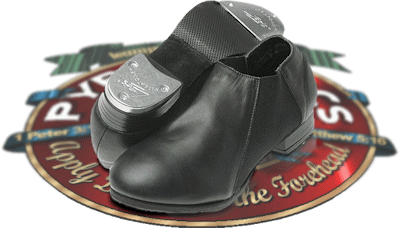
Let me say to begin with that it's neither the tailored Confederate pants nor the ill-fitting Yankee shirt that makes me want to shoot Doug Wilson. It's those ridiculous tap-dancing shoes.


It takes a very talented two-step artist to hopscotch around the many overturned cans of writhing worms Mark Driscoll's prophetic claims and recent jeremiad against cessationism have left strewn around the dance-floor. Doug attempts some impressively fast footwork, but without the necessary finesse. He comes off looking suspiciously like he's just doing the Curly Shuffle.

OK, Doug did have several good things to say, including the quote I've put at the top of this post. When he's right, he's capable of breathtaking clarity and remarkable gems of pithy wisdom. When he wants to obfuscate, he does that with supreme skill, too.

The latter is what I think he was doing throughout most of the post I've quoted above.

Remember: Mark Driscoll claims God has put a TV in his head which regularly plays explicit videos of sexual crimes and acts of fornication. Those claims (and Driscoll's other recent attacks on cessationists) have caused (or widened) a rift between Mark and certain stodgy, outspoken cessationists.

Doug Wilson acknowledges that Driscoll's assertions and allegations are, well, bizarre. But from Doug's perspective, it seems, the disagreement itself is an even more troubling and more pressing problem. Doug says there's wrong—serious wrong (perhaps even equal wrong?)—on both sides.

But Doug believes the whole conflict might be cleared up with a parley: "I would like to see us work out the protocols for how to talk about such things," he writes. "[And I] think it would be good if Phil and Mark could get together to work it through."

Doug recommends (and evidently concurs with) a post by Toby Sumpter, who likewise acknowledges that Driscoll's claims are "weird and goofy." But, says Toby, "I don't believe [Driscoll's misdeeds] rise nearly to the level of sin or scandal that [Phil] Johnson suggests."

Really? If it's not grossly sinful, certainly scandalous, and probably blasphemous to recount to one's congregation the play-by-play details of an adulterous couple's secret tryst (up to and including the coital position) and then claim one knows those details because God Himself revealed them through a prophetic peep show—then I wonder what kind of claim one would have to make to rise to the requisite level of opprobrium.

Even among the more skeevy televangelists, the only one I know of who has claimed to receive a "revelation" as obscene as what Driscoll described is Kenneth Hagin. Anyone who thinks Driscoll's claims are a misdemeanor indiscretion isn't thinking clearly. No one in Reformed circles would think it a minor matter if, say, Dave Hunt or Hank Hanegraaff claimed that kind of kinky supernatural insight into other people's private sins.

And setting aside that issue (plus the inappropriateness and tastelessness of how Driscoll publicly recounted his visions), let's not forget that Driscoll rather emphatically encouraged people in his church who have similarly suggestive imaginations to experiment with this kind of mystical "revelation" when they counsel and disciple others. That, as I said Monday, puts his people directly in harm's way spiritually. And it's not just the stub-your-toe-and-it-hurts kind of danger; this actually encourages weak and undiscerning people to flirt with eternal peril.

It also sets up a manipulative form of counseling that fosters spiritual abuse.

And so on.

Again, it's pretty hard for me to imagine what kind of pastoral malfeasance would rise to a high level of scandal and wickedness if stuff like that does not.


Anyway, what annoyed me even more about Doug Wilson's argument was the suggestion that cessationists must share the blame for teaching such as Driscoll's because we haven't "debated this one deeply enough." We haven't yet hammered out suitable "protocols" for explaining and dealing with "remarkable guidances, provisions, answers to prayer, striking bits of random knowledge, etc."

See, I think Doug knows better than that. He can probably cite from memory more Puritan and Reformed works than most pastors have read in their whole lives. I'm certain he knows about the doctrine of divine providence. And if so, he surely knows full well that the historic Reformed understanding of that doctrine is robust enough to account for any and every authentic incident of divine guidance, provision, answer to prayer, striking bit of random knowledge, and extraordinary providence that has ever occurred.

I've blogged on that issue many times before, so I won't rehash it today. I'll just say I'm disappointed in Doug for implying that cessationists aren't able to account for (or are unwilling to acknowledge) extraordinary providences, and that this has been some kind of long-standing deficiency or overlooked area in Reformed theology. That simply is not true.

Moreover, it doesn't take a Calvinistic Doctor of Divinity to understand that it is quite possible within the standard categories of historic Reformed cessationist teaching to avoid deism and do full justice to the immanence of God without claiming that God is still giving fresh revelation daily. It is most certainly not "worldly" to deny that the apostolic signs are still fully operative today (especially given the scaled-back, terribly fallible way these "gifts" supposedly operate in the modern charismatic movement). In other words, Driscoll's "Cessationism is Worldly" speech cannot be easily or blithely dismissed as excusable misunderstanding—and surely Doug Wilson recognizes that.

What precipitated Doug's post yesterday is that in a few weeks Driscoll will be one of the speakers at a conference sponsored by Wilson's church. Toby Sumpter writes, "Hopefully through this conference in particular a few bridges can be built between Seattle and Moscow, between Driscoll and Wilson, between us Presbyterians and the more groovy parts of the body of Christ. Hopefully we can learn from Driscoll, and hopefully, like good friends, we might have something to offer him."

Hopefully, that's diplomatic language suggesting that Wilson and other CREC leaders plan to raise these issues in face-to-face talks with Driscoll and (hopefully) they will try more earnestly to change his mind on the cessationism question—or at the very least persuade him to repent of these luridly sensational, highly doubtful, and spiritually dangerous claims.

(Perhaps while they're at it they can get him to lay off impugning cessationists as deists and crypto-atheists.)

But I think Doug Wilson and his fellow CREC leaders also have an even more important duty. And I want to close by encouraging them to fulfill that duty:

Doug, please give some kind of clear, unequivocal denunciation, warning, and disclaimer about this nonsense, for the sake of your own flock and the wider body of your disciples—especially the young lambs among them. Some of them will very likely think Driscoll's presence at The Grace Agenda Conference signifies the CREC's and Doug Wilson's imprimatur on the corpus of Driscoll's teaching—including not only the "weird and goofy" stuff, but also the ungodly, dangerous, and patently unbiblical notion that sometimes "eyes full of adultery" (2 Peter 2:14) might actually be a kind of special spiritual gift.

The thought sends a shudder through my soul.

Phil's signature