by Frank Turk
But when the goodness and loving kindness of God our Savior appeared, he saved us, not because of works done by us in righteousness, but according to his own mercy, by the washing of regeneration and renewal of the Holy Spirit, whom he poured out on us richly through Jesus Christ our Savior, so that being justified by his grace we might become heirs according to the hope of eternal life.
Last week as we were at the advent of a new generation of Johnsons, we were talking about the fact that the goodness and lovingkindness of God was that he didn't do anything to us which we earned, or that we deserved, but that God showed extraordinary mercy toward us, which should make us grateful.
Today I want to engage at the other end of that astonishing historical fact: that God saved us. Turns out that God didn't need us to do anything for him -- he wasn't in any danger. God wasn't waiting like a withered old regent for the apostle Paul to save him from the Old Testament and the ungrateful and hard-hearted Israel. God saved us with the Gospel, and now that we have it, maybe we should remember that it is the power to save rather than acting like it requires us to save it from all manner of enemies.
This is going to be one of those "drunken master" posts, and I am sure many of you are going to be put off by it, so before I get going here full-steam let me say this: I honor the work of thoughtful, erudite apologists who spend their lives effectually dismantling the ideologies which oppose the Gospel, and the church benefits from the work of those men. It does: it must. It is one of the duties of the elder, as I see it, to be able to rebuke those who are, frankly, wrong.
It's the rest of you I am worried about. Let's face it: everyone is not an apologist, and not everyone ought to be an apologist. It takes an interesting and spiritually-mature mix of mental acuity and personal charisma to be an effective and winning apologist. It is not just an exercise in dogmatics or legal or philosophical wrangling.
 For the rest of us, the job is to proclaim the Gospel and live like it is true, not to protect the Gospel as if it was in danger of extinction. You know: God saved us -- and for most of us, we should see that God saved us not because of works done by us in righteousness. We got saved when our plight was hopeless -- by the Gospel. By this God according to his own mercy, by the washing of regeneration and renewal of the Holy Spirit, whom he poured out on us richly through Jesus Christ our Savior, we were saved.
He doesn't need saving; he's not in trouble. We're the ones in trouble -- us, and all men like us. And that would be "all men ever born" for those of you who aren't clear about that.
He saved us, and he doesn't need us to return the favor. What he requires is that we behave like people who know what we have, and how we got it, and to treat it like it's the solution to the problem and not like it has problems that we need to provide solutions for.
We are the ones who get saved. We are not the ones who ought to be coming to the rescue of the Gospel. If we get this right, the rest of the book of Titus makes sense, and we know what to do with it.
I have two book reviews coming here, and I think I'll have a link to a podcast from an interesting fellow, so we're going to take a break from Titus for a bit. However, dear pastor reader, I am certain that you have plenty to do with what we have covered so far anyway. Consider this a working vacation.




 've mentioned before
 As noted in the closing paragraphs below, I'm not entirely happy with the way classic Reformed theology bifurcates the obedience of Christ into two parts. But I'm convinced it is a far more egregious error to adopt any doctrine that suggests our justification simply overthrows or eliminates the relevance of God's law rather than fulfilling it. I also think it is absolute folly to deny that Christ's lifelong obedience to the law has anything to do with the righteousness imputed to those who are united with Him by faith.

 hristians, be troublesome to the world! O house of Israel, be like a burdensome stone to the world! You are not sent here to be recognized as honorable citizens of this world, to be petted and well-treated.
 ou probably saw




 The full measure of what it means to be “justified by his grace” and “heirs according to the hope of eternal life” comes up in the next section of this letter, and I know I sort of get boring talking about this, but what Paul is saying here is that somehow we need to be GRATEFUL PEOPLE. Not only did God save us, and not only did God save us not because of our works (meaning: he didn’t save us since our works were so spiffy), and not only was this saving done because God has mercy toward us, but we are now, in his accounting, justified in receiving eternal life.


 his afternoon, I was reading a sermon by a certain divine, whose subject of discourse was, why the working-classes do not go to a place of worship, and the preacher seems to have made up his mind that, whatever is preached in this Tabernacle, is especially obnoxious to laboring men and women. The reason he gives why the working-classes do not attend places of worship is that we preach such dreadful doctrines.
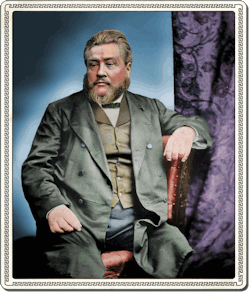 It is very remarkable that places where these truths are preached are crowded, while places where the opposite things are proclaimed are often empty! It is curious, if the doctrine of the gospel is such a very horrible thing that it drives people away, that at the places where it is preached there are more people than can get in, whereas where some of the modern doctrines are declared, you may see more spiders than people! It is a singular circumstance, certainly, yet one for which we can easily account.
 eo-evangelicalism
 In the earliest days of neo-evangelical enthusiasm, the movement included prominent leaders like Harold Lindsell, Carl Henry, and Donald Grey Barnhouse, who were qualified and willing to engage in theological dialogue. But by the end of the century, the mainstream of the evangelical movement could hardly care less about theological dialogue. Evangelical megachurches were best known for their pursuit of shallow entertainments and superficial fads. And somewhere along the line, Christianity Today's editorial board apparently came to the conclusion that engagement in theological dialogue meant giving a platform to practically every theological anomaly that came along except the old evangelical orthodoxies.
 Now, some of you tuned out of this when Prof. Horton said, "Is the Gospel rightly preached?" about 1/3rd of the way in. But the last 2/3rds is the part you need to confider more fully -- especially the parts about the flaws in your local pastor.


 by Frank Turk