posted by Phil Johnson
The PyroManiacs devote space at the beginning of each week to highlights from The Spurgeon Archive.
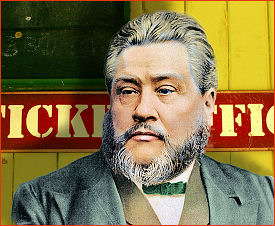 I was doing some reading this week in connection with my ongoing series of posts on 2 Corinthians 5:21, and I decided to read C. H. Spurgeon's sermons on that text. (He preached five of them, and one was titled "The Heart of the Gospel"—same as Tuesday's post, but I didn't realize that when I titled the post).
Anyway, one of the sermons, "Christ—Our Substitute," begins with this anecdote that makes some vital points about justification, penal substitution, and how the love of God relates to His justice.
This sermon was preached in London at the Metropolitan Tabernacle on July 18th, 1886. But I am amazed at how well Spurgeon's message syncs with what we have been posting this week on the blog.
Here's something I've pointed out many times, but it's worth noticing again: The "modernism" Spurgeon opposed in Victorian times is in many respects indistinguishable from the post-modernized ideology of the "emerging church movement" today. Many of the issues are the same; the arguments are the same; there is indeed nothing new under the sun.
Specifically, modernists, just like their postmodernist offspring, could not endure the truth that God demands a blood-atonement to satisfy His justice and propitiate His own wrath against sin. The concept of "penal substitution," or propitiation, entailed a view of God that modernists quite simply hated. They believed "love" is inconsistent with any demand for punishment or retribution. In their view, God's "love" ought to nullify all His demands for justice. They argued (just like Steve Chalke, Brian McLaren, and lots of other postmodern pseudo-evangelicals do today) that the penal-substitution view of the atonement makes God seem too "harsh."
Here Spurgeon gives a simple response to those claims and shows clearly why that kind of thinking is folly.
On Punishment, Justice, and Atonement
SOMETIME AGO an excellent lady sought an interview with me, with the object as she said, of enlisting my sympathy upon the question of "Anti-Capital Punishment." I heard the excellent reasons she urged against hanging men who had committed murder, and though they did not convince me, I did not seek to answer them.
She proposed that when a man committed murder, he should be confined for life.
My remark was, that a great many men who had been confined half their lives were not a bit the better for it, and as for her belief that they would necessarily be brought to repentance, I was afraid it was but a dream.
"Ah," she said, good soul as she was, "that is because we have been all wrong about punishments. We punish people because we think they deserve to be punished. Now, we ought to show them," said she, "that we love them; that we only punish them to make them better."
"Indeed, madam," I said, "I have heard that theory a great many times, and I have seen much fine writing upon the matter, but I am no believer in it. The design of punishment should be amendment, but the ground of punishment lies in the positive guilt of the offender. I believe that when a man does wrong, he ought to be punished for it, and that there is a guilt in sin which justly merits punishment."
"Oh no; she could not see that. Sin was a very wrong thing, but punishment was not a proper idea. She thought that people were treated too cruelly in prison, and that they ought to be taught that we love them. If they were treated kindly in prison, and tenderly dealt with, they would grow so much better, she was sure."
With a view of interpreting her own theory, I said, "I suppose, then, you would give criminals all sorts of indulgences in prison. Some great vagabond who has committed burglary dozens of times—I suppose you would let him sit in an easy chair in the evening before a nice fire, and mix him a glass of spirits and water, and give him his pipe, and make him happy, to show him how much we love him."
"Well, no, she would not give him the spirits, but, still, all the rest would do him good.
I thought that was a delightful picture certainly. It seemed to me to be the most prolific method of cultivating rogues which ingenuity could invent. I imagine that you could grow any number of thieves in that way; for it would be a special means of propagating all manner of roguery and wickedness.
These very delightful theories to such a simple mind as mine, were the source of much amusement, the idea of fondling villains, and treating their crimes as if they were the tumbles and falls of children, made me laugh heartily. I fancied I saw the government resigning its functions to these excellent persons, and the grand results of their marvellously kind experiments. The sword of the magistrate transformed into a gruel-spoon, and the jail become a sweet retreat for injured reputations.
Little however, did I think I should live to see this kind of stuff taught in pulpits; I had no idea that there would come out a divinity, which would bring down God's moral government from the solemn aspect in which Scripture reveals it, to a namby-pamby sentimentalism, which adores a Deity destitute of every masculine virtue.
But we never know to-day what may occur to-morrow. We have lived to see a certain sort of men—thank God they are not Baptists—though I am sorry to say there are a great many Baptists who are beginning to follow in their trail—who seek to teach now-a-days, that God is a universal Father, and that our ideas of his dealing with the impenitent as a Judge, and not as a Father, are remnants of antiquated error.
Sin, according to these men, is a disorder rather than an offence, an error rather than a crime. Love is the only attribute they can discern, and the full-orbed Deity they have not known. Some of these men push their way very far into the bogs and mire of falsehood, until they inform us that eternal punishment is ridiculed as a dream.
In fact, books now appear, which teach us that there is no such thing as the Vicarious Sacrifice of our Lord Jesus Christ. They use the word Atonement it is true, but in regard to its meaning, they have removed the ancient landmark. They acknowledge that the Father has shown his great love to poor sinful man by sending his Son, but not that God was inflexibly just in the exhibition of his mercy, not that he punished Christ on the behalf of his people, nor that indeed God ever will punish anybody in his wrath, or that there is such a thing as justice apart from discipline.
Even sin and hell are but old words employed henceforth in a new and altered sense. Those are old-fashioned notions, and we poor souls who go on talking about election and imputed righteousness, are behind our time.

Re-reading that sermon today, parts of it looked familiar. Then I remembered that I quoted a different part of this same sermon in a post last October. That post, and the comment-thread that followed it, are still worth reading.



 Let that sink in for a minute. In the mind of the WMT book buyer(s), LDS and Joyce Meyer and Rick Warren are all the same kind of thing. The big fat irony, of course, is that they are actually the same kind of thing—but as Inego Montoya is famous for saying, “I don’ thin’ thad means wha’ you thin’ thad means.”
 Isn’t that ironic? Because WMT can cherry-pick the things from CBA and then get the publishers to cheap-down the bindings, and then create franchises around personalities, CBA sees that as a threat to sales.




 Historic Protestantism was born out of Luther's realization that the doctrine of justification by faith is the heart of the gospel. That conviction of Luther's has always been part of the fabric of Protestant belief. That's a stubborn fact of history that tends to rankle some folks today who insist that the central principles of historic Reformed theology—starting with sola fide—are outdated and too narrow and therefore need to yield to "a more generous, catholic spirit."

 John is different from the Synoptics! (Crowd: "Aiieeeee!")
 spreadable. It hurts in so many ways. Reporters who have probably never in their lives spent an hour in a Bible-teaching church, who probably literally could not name a single practicing Biblical Christian whom they count as friend, lecturing the Christian church on what a terrible job we're all doing. It hurts.
 This excerpt is from

 This subject has been batted around the blogosphere for as long as I can remember. Ever since I began blogging, I have been planning to comment on it eventually.
 The whole gospel message is contained in embryo in those words. That short statement is crucial to our understanding of the nature of the atonement, the doctrine of justification by faith alone, and the twin principles of imputation and substitution. It teaches great truths about the character of God, the sinlessness of Christ, and the simplicity of salvation. It summarizes the core truth of biblical soteriology. It has important implications for Christology. And it even says something about theology proper, because it plainly assumes the sovereignty of God, the love of God, the justice of God, and the grace of God.
 Listen: this is still
 Protests worldwide have resulted in innumerable costs in human lives and property damage -- because nobody has been killed and nothing has been burned or looted.

 Before I go on, this has some pretty significant implications on the link-trolling British blogger's discussion of the T4G affirmations and denials. In my view, when we spend time discussing things in an apologetical context, or in a "bunch of guys who are Christians chewing the fat" context, like Dr. Mohler's choice of words to describe the authority of Scripture rather than why we should desire God when he has spilled the righteous blood of Christ for us, that's like spending a $100 bill on sawdust. Pheh.
 Well, if I thought all Lutherans and Presbyterians were going to hell based on the kind of baptism they are taking or giving, you might be right. The problem is that I don't think that at all: what I think is that baptism is for the believer, and it is an outward sign of an inward reality -- a symbol of identification with Christ done in obedience. So those who baptize infants might, in my view, put the cart before the horse, but they're not going to hell for it. They are allowed their mistake in that belief. The difference between me and the straightway advocate is that I allow for the fact that the method of baptism is secondary, and that there is no violation of the Gospel if one is sprinkled or dipped or comes up straight-way.
 One last pass at this for clarity's sake. The Bible certainly does not teach which operating system to use on your computer, or whether Linux, Mac or Windows is Christ's choice for computing output. However, I prefer Mac OS, and most people prefer Windows. Now which choice is "biblical"? None of them are. However, that does not mean that any of the are unbiblical -- unless someone demands that Mac OS is God's OS and all other PC users are heretics based on a very thin interpretation of Deu 32:10, Ps 17:8 and Prov 7:2.


 Okay, Edwards probably never said that, but I do. Of course I know what Spurgeon meant, and what he meant was true. But what he said was simply, in my view, a mistake. But it is old! It's very old! Old, yet mistaken. It happens.

 According to KidzWorld, death as a "lifestyle" is really cool. "If you identify more with Marilyn Manson than Britney Spears, or if you'd rather date your mom than be caught wearing anything floral or J. Lo inspired, you should check out the ins and outs of gothic style," the page tells little girls. The graphic to the left, replete with skull and crossbones on the bottle, is from the KidzWorld site.
 At least one 15-year-old critic with obvious expertise in things Gothic (nickname: Acidalayde) thinks KidzWorld's advice is a tad lame. She offers this helpful addendum for the younger girls: "[They] forgot to mention Tape. Duct-Tape, and electrician's tape, can be your best friend. And GAH. Remember kiddies, being the mime is bad, go past the chin-line and to the neck. And neon colours work too. If you want help with style look up Switchblade Symphony, Rasputina, Sisters of Mercy, Cradle of Filth on search engines such as Google"
 You may wonder why a website for kids which bills itself as