Showing posts with label TeamPyro brain trust. Show all posts

05 May 2015

Brain trust: how to prepare local churches for the coming Gaystapo

by Dan Phillips

The "Gaystapo" is on the march. We're where we are thanks to years of rampant relativism, the gospel of "follow your heart," postmodernism, and Christianoid defection and/or timidity. Any day we may find it knocking at the door of our church, no matter where we are. That this is just one tentacle on an octopus of rebellion against God is beside our point, which (as is my wont here) is very focused.

I mean to pose to you the question I find surprisingly absent from the blogs I'd expect to take lead on it:
what language do we need to put 
in our church Constitutions 
to proof us (to any degree) against lawsuits?


I don't ask in the interest of evading all persecution. I think that's coming, and Christians shouldn't be surprised. But I would sure like to spare churches the waste of thousands of dollars and hundreds of hours each frivolous lawsuit, even the "successful" ones, always mean.

So here's what I want from you:
  1. Not just "I think" and "we probably oughta" and "gee I don't know."
  2. But either (A) link us to an online Constitution that actually has included such language, or (B) refer us to an online article giving useful and specific direction, or (C) transcribe for us what your church's constitution has included.
We're being told we'd better prepare, we'd better put in in our Constitutions. Probably so. Using what words?

This topic is vital to faithful churches across the land. So let's see what we can do, to serve local churches of Christ.

Contribute if you have it to give, or get out the word.

UPDATE: m'man Denny Burk, who has been doing some first-rate, very helpful writing in these areas, has responded with pointers to very helpful resources. If Denny's blog isn't a regular stop for you, I commend you make it so.

Dan Phillips's signature


25 February 2014

Worship-service style: "Ch-ch-ch-changes," or "I shall not be moved"?

by Dan Phillips

I am particularly interested in hearing from pastors, though any church-member's welcome to chime in. Have you (A) presided over, (B) spearheaded, or (C) adamantly resisted any significant change in the Sunday morning service of the church you serve?

This could touch on number or style of songs, composition of musical accompaniment, length of service, items in the service — anything.

Please tell the how, the what, the why, and the outcome. Full is good.

Dan Phillips's signature

24 September 2013

Pyro Brain Trust question: missionary recommendations?

by Dan Phillips

Foreign missions, per se, is a topic we haven't treated with any frequency here. My purpose in bringing it up now is brief and specific. It's to ask this:

What missions do you personally know (A) that specifically target unreached people or Muslims, and (B) that do so with pure Gospel preaching (preferably Calvinistic, cessationistic, baptistic), and (C) that do so with any effectiveness?


In your answer, please identify who, how (and how deeply) you know them, anything you can about them (including contact info), and why you think they merit support.

Bonus question: anyone know anything good/bad, from our perspective, about Franklin Graham's Samaritan's Purse? Including their Operation Christmas Child?

Dan Phillips's signature

26 December 2012

Pyro brain-trust: On conferences in 2013

by Dan Phillips

Not the Point: so far, I'm working on the 2013 calendar, and am open for conference invitations for 2013, if anyone's interested: filops, then @, then yahoo.com.

Yes the Point: I'm also working on scheduling and budget for 2013. This is your opportunity to try to "sell" me (and, through me, other readers) on why I should go to your conference.

So: why should I, or anyone, go to your conference? Give info, dates, speakers, details, links.

Dan Phillips's signature


29 November 2012

Forum on female commentators, theologians, writers

by Dan Phillips

Scripture is clear: there is no such thing as a female pastor under Christ's Lordship. Any woman who aspires to leadership over men in the church is eo ipso disqualified, if only on the grounds that she does not bow the knee to Christ as Lord in terms of her sexuality, and this itself is a disqualifying vice.

So what about female seminary professors? Female commentators? Female theologians, academics, writers?

A well-regarded commentary on Peter is by Karen Jobes. Jobes has also written on Esther, among other things. Tyndale OTC volumes on Daniel and 1-2 Samuel  were by Joyce Baldwin. One of the good books on male/female issues was written by Susan Foh.

I'm currently working through a book of devotions on the Greek New Testament, for which I am writing a review. Some of the contributors are female, one of them a hyphenated Notre Dame grad who's a prof in what at least once was an evangelical seminary.

Now, I'll be up-front with you. If I was out of town and visited a church that had a promising name, and a woman stood up to preach posing as a pastor, I'd likely quietly walk out. I wouldn't find it worshipful to sit and watch her shake her fist in Christ's face, and I wouldn't want to harm her by fostering her illusion.

But these are books, and complementarians read and use them. And these are seminary classes in professedly Evangelical institutions. So what's the difference? Is reading a commentary, or sitting under pastoral preparatory classes taught by a woman different from listening to a sermon by a woman? How? Is it because they aren't in church?

Should we care about the agendas of the women who write these books, teach these courses? Should we make it a point to inquire what they are attempting to accomplish in their careers? Should we care whether they are working towards erasing resistance to female pastors? Are we aiding those efforts by using those resources? Are we safe in assuming that all these and other female Christian writers are happy, Godly mothers, who are subordinate to their husbands as to Christ, and wouldn't dream of preaching or teaching a class with men in it?

These aren't meant as "trick" or loaded questions. I don't have an airtight, all-encompassing answer. Worse, I can't think of any substantial discussion I've ever seen on the topic, though at-least-nominally evangelical female writers and professors seem to be proliferating.

When I was at seminary, it was controversial. Our seminary had fairly recently begun admitting women to the MDiv program. An MDiv is generally perceived as a professional degree for pastors. The argument was that these women were pastors' wives and teachers of women; and why shouldn't they have the benefit of the best education?

One of my fellow-profs' off-the-record response was, "That's like handing someone a loaded pistol, and telling him never, ever to shoot it."

I'm wondering what the brain trust thinks about it, or what resources you've found that I haven't yet seen.

Dan Phillips's signature


20 September 2012

Pyro brain trust forum: evangelistic tracts

by Dan Phillips

Howdy hi there, friends and neighbors. The topic of our little confab today is: evangelistic tracts.

Many tracts are overly simplistic; and yet, on the other hand, it defeats the purpose of a tract to hand someone the Collected Works of John Owen.


Apart from being overly simplistic, most rub me the wrong way as a Bibley person, which is to say, a Calvinist. I know that good Calvinists folks disagree with me on this, but as I've explained a number of times, I don't find it apostolically precedented or necessary to tell unbelievers "Jesus died for your sins." The apostles evidently didn't feel they had to say it, and neither do I. To me, as I've explained, assuring an unrepentant unbeliever that Jesus died for his sins is tantamount to saying "You're saved and have nothing to worry about from God: He accepts and forgives you just as you are."

So, having said that: What tracts have you found useful?
  1. Please explain how and why.
  2. Evaluation from a Biblical (and therefore) Calvinistic perspective would be terrific.
  3. Anecdotes would be terrific.
  4. Links to where they can be bought would also be terrific.
Have at it!

Dan Phillips's signature


19 July 2012

Pyro brain trust forum: evangelism

by Dan Phillips

I'm sorry. I do have a number of posts marinating, but none is "done" yet. This Sunday's sermon is on spiritual gifts — yep, everything that can be brought from the Bible on that entire topic in one sermon. Sermon outline handout is two pages. So that's fun, and challenging.

Also, I'm prepping a Hither and Thither (a popular feature) for tomorrow on my own little blog.

So that leaves us with just enough time for another visit to the Brain Trust.

All Biblically-faithful churches are concerned with evangelism. I'd say if they aren't, they don't fit the description.

That said, how to do it? Hand out tracts in parking lots? Go door to door? Study groups?

So let me ask you two questions:
  1. What is the best book you've ever read on personal evangelism, and what makes it so excellent?
  2. What is the best book you've ever read — or approach you know — on corporate/church evangelism, and what makes it so excellent? (Include here what approaches your church has found fruitful.)
Thanks, should be profitable.

Dan Phillips's signature

17 July 2012

Pyro brain trust forum: what Bible version, and why?

by Dan Phillips

I am still in need of a low-maintenance meta, and so...

At CBC, the pew Bibles are the 1978 version of the New American Standard Bible, which actually is no longer in print. I was happy enough to learn that this was the version in use, though, prior to coming. I had a long affectionate history with the NAS.

For English Bible reading, when I was saved I read the KJV for years, straight-up wide-margin or New Scofield-ized. I was also given a Living Bible, and soon got an NAS. Though I read through many translations (including the Modern Language Bible, the version by Charles Williams, the NIV, then later the CSB), the NAS was my staple for a good long time.


Specifically, I liked the Ryrie Study Bible version for a number of reasons. The margins were wide enough for notes; I often wrote the Hebrew and Greek in the margins. Also, the historical books' outlines were very helpful, often including date plus parallel versions (i.e. between Kings and Chronicles). Finally, the footnotes usually were less Ryrie's interpretation and more often helpful information such as "25 miles NW of Jerusalem," or archaeological finds, or the like, giving helpful facts fast and straight-up.

Then when the 1995 revision came out, I quickly got it, glad that the translators had finally dropped the Thee's and Thou's which, while useful, were no part of (hel-lo?) standard American idiom, New or otherwise.

However, I soon became disaffected with the NAS95. For instance, I noticed that the NAS95 adopted the NIV's affectation of dropping conjunctions for the sake of smoothness — even when (as in Mt. 17:1) the conjunction is arguably exegetically important. Plus it did an odd thing with which the translators of the CSB were later to go a little nuts — of usually translating (or transliterating) Christos as "Christ," but a few times inexplicably using "Messiah" as well (Mt. 1:1, 16; 2:4... and never again).

As I said, I read through the CSB but never really adopted it. I did also use the New King James for some time. I appreciated that it was often even more literal than the NAS; however, the indefensible and irrational textual practices in the NT just drove me bonkers.

When the ESV came out, I switched to it and basically stuck with it, until now. I like it in most regards. But as I have read through, almost every time I see a translation issue, they've just echoed the RSV without freshly revisiting it. Plus, some passages are actually inexplicable steps backward in fidelity to the original (e.g. Mk. 1:40-41).

To match our pew Bible, I'm back to doing my personal English text reading (and preaching) in the pre-1995 NAS.

All that to ask this: what does your church use, and why?

I'm open to hearing from anyone, but I particularly want to hear from pastors. To be even more specific, I particularly want to hear from pastors who've kept up their Hebrew and Greek (which should be a tautology but, alas, is not). I'd like to hear

  • What was your rationale?
  • What process did you go through?
  • Why do you use what you use?
  • Were there helpful books, studies, articles online or in journals? 
Share.

For my part, I like the NAS just fine, though the ESV has a readability edge. Kevin DeYoung makes a decent case for the ESV. I have reservations about any English translations... including my own! Nothing will persuade me to use the NIV or (great googly-moogly) the execrable TNIV, except for reference in study.

Dan Phillips's signature

29 November 2011

Two new World-Tilting Gospel projects, and a thank-you

by Dan Phillips

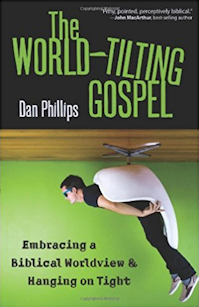
Howdy, gang. You'll recall we had fun picking the cover for the (then-future) book; now, I'm soliciting your input and help (respectively) for two more projects related to The World-Tilting Gospel. First...

Study Guide
(or: Help Me Help You)

A number of you have commented and emailed and Tweeted, asking for a Study Guide for The World-Tilting Gospel. You asked, so you shall receive, DV: I plan to get to work on one.

Since I want to meet your needs the best I can, I'm soliciting your input. So tell me, you who want a Study Guide for TWTG, any and all of the following:
  1. What features are you most looking for?
  2. What are examples of the best study guides you've used? What makes them great?
  3. What are examples of the worst study guides you've used? (No need to name them, I'm not wanting to rip on anyone.) What causeth them to stinketh?
  4. How do you plan to use it?
  5. Do you prefer a book with blank lines, blank spaces, or neither (i.e. just write in a separate book)?
  6. The World-Tilting Gospel is being read with profit by folks literally from eight to eighty-eight, from all levels of education. That being the case, it is conceivable (but not guaranteed) that I might prepare different study guides for different groups. Would you make any particular use of any particular focus?
Web page

Now here, I just need a straight-out volunteer. I'm looking to produce a page to continue to expand visibility. The more you bring to this, the more better. If you've done book pages, can host, are ready to go — hey, if I don't ask, you won't know that I'm looking for it.

I expect it will feature links to reviews, endorsements, excerpts, and contact information for conferences or guest preaching.

You probably don't want to broadcast your willingness, so please just email me: filops, then @, then yahoo.com. Tell me what you propose, and maybe link to some of your previous work.

And finally, at no extra cost:

Thank you!

Every bit of feedback I've received from folks who don't already have issues with the Gospel has been positive, humbling, encouraging. You see in this book an accessible celebration of the glorious Gospel of Christ in its components, its sweep, and its implications. You've said that it's understandable, without any dumbing-down. You want to see pastors and churches use it, you want to see your friends and family read it.

Your encouragement means more to me than I can express. Thank you.

Many of you wish you had larger platforms so that you could tell others about the book, and you wonder why those who do have such platforms — and who love the Gospel and want to see it better-grasped, better-understood, better-lived and better-preached — haven't done so yet. But you are doing what you can do, and that means everything to me. Keep it up.

You've used your blogs, your Twitter account; you've bought copies for friends, pastors, teachers, relatives. A pastor bought a box of a hundred copies to give to every family in his church, present and future. Others are using it for studies, or planning to do so. A father was reading through it with his teenage son; another reader's eighty-eight year old mother is reading it, and re-reading it.

All this, and the book's only been out for about four months!

You who've written and encouraged me live in America, Canada, England, Honduras, Scotland, Australia, South Africa... and I apologize if I've forgotten anyone! The book has endorsements from PhD's like Lig Duncan, Jim Hamilton, Rob Plummer... and it's been reviewed by an eight-year-old! Those reading and reviewing and recommending include sisters here, sisters there, sisters somewhere, brothers who are pastors, brothers who aren't, Jay Adams — all sorts.

It's amazing and humbling to me and again, from the bottom of my heart, I thank you.

God grant that others see what you see, or that they listen to you when you tell them; may God use this book to His glory, to lift up Christ's name, to edify His church, and to make His Gospel clear and compelling to those He whose world He has yet to tilt.
Thanks! Fun times!


Dan Phillips's signature

03 March 2011

Christ in the Old Testament: a bibliographical colloquium

by Dan Phillips


Some of the most fun I've had over at my place is when I tap into what I call the BibChr brain trust. Now I've an issue to offer up to the TeamPyro brain trust.


I've been invited to speak at a conference in England this summer, on the topic of Christ in the Old Testament. What a delight, and a blessing.

So I ask: What (A) are your favorite books or articles or online lecture/sermon series on that topic, and (B) why?

Should be fun, eh?

Obviously, you all know one of mine. It's a favorite because Rydelnik argues that the texts really do point to Christ by the confluence of authorial and divine intent. Messianic meanings were not illegitimately rammed back into the innocent, helpless texts by later writers. He argues this from a number of angles, with constant resort to the original Hebrew texts.

Another set of works that has a special place in my heart are those by David L. Cooper, a writer from the mid-20th century, who wrote a series themed on the God of Israel revealing Himself. Much (all?) of his work is online now.

Cooper was a deep student of the original languages, and ransacked the OT for Messianic prophecies and foreshadowings. He made an extensive case for seeing the truth of the Trinity at least framed in the OT, and expounded Messianic passages at great length, including chronological considerations and going on into future prophecy. I can't follow him exegetically at all points, but reading him was a terrific workout and left me with some helpful material. The "Golden Rule" of interpretation that I give and use is an adaptation of his own (see bottom of page).

[The "special place in my heart" is because I lived near the Biblical Research Society building, got some of its material, and ended up doing my first teaching and preaching as a Christian in a church meeting that was held there for a time.]

So, there are a couple of mine.

Now, your turn!

Dan Phillips's signature