12 April 2008

Where True Mars-Hill-Style Ministry Will Get You

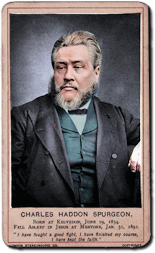
Your weekly dose of Spurgeon
posted by Phil Johnson

The PyroManiacs devote some space each weekend to highlights from The Spurgeon Archive. The following excerpt is from "Three Crosses," a sermon preached at some undetermined time in the Met Tab, and first published in 1878.


nce Saul was a great rabbi, a man profoundly versed in Hebrew lore, a Pharisee of the Pharisees, and much admired. He was also a classic scholar and a philosophic thinker, a man of great mental powers, and fit to take the lead in learned circles.

But when Paul began to preach Christ crucified—"Bah," they said, "he is an utter fool! Heed him not!" Or else they said, "Down with him! He is an apostate!" They cursed him. His name brought wrath into the face of all Jews that mentioned it, and all intelligent Greeks likewise. "Paul? He is nobody!" He was everybody when he thought their way: he is nobody now that he thinks in God's way.

And then they put him to open shame by suspecting all his motives, and by misrepresenting all his actions. It did not matter what Paul did, they were quite certain that he was self-seeking; that he was endeavoring to make a fine thing of it for himself. When he acted so that they were forced to own that he was right, they put it in such a light that they made it out to be wrong.

There were some who denied his apostleship, and said that he was never sent of God; and others questioned his ability to preach the gospel. So they crucified poor Paul one way and another to the full. They went further still. They despised, they shunned him. His old friends forsook him. Some got out of the way, others pointed at him the finger of scorn in the streets. His persecutors showed their rancour against him, now stoning him with lynch-law, and anon with a semblance of legality dragging him before the magistrates. Paul was crucified to them.

As for his teaching, they decried him as a babbler—a setter-forth of strange gods. I dare say they often sneered at the cross of Christ which he preached as a nine days' wonder, an almost exploded doctrine, and said, "If you do but shut the mouths of such men as Paul, it will soon be forgotten." I have heard them say in modern times to lesser men, "Your old-fashioned Puritanism is nearly dead, ere long it will be utterly extinct!" But we preach Christ crucified; the same old doctrine as the apostles preached, and for this by the contempt of the worldly wise we are crucified.

Now, dear Christian friends, if you keep to the cross of Christ you must expect to have this for your portion. The world will be crucified to you, and you will be crucified to the world. You will get the cold shoulder. Old friends will become open foes. They will begin to hate you more than they loved you before. At home your foes will be the men of your own household. You will hardly be able to do anything right. When you joined in their revels you were a fine fellow; when you could drink, and sing a lascivious song, you were a jolly good fellow; but now they rate you as a fool; they scout you as a hypocrite; and slanderously blacken your character. Let their dislike be a badge of your discipleship, and say, "Now also the world is crucified to me, and I unto the world. Whatever the world says against me for Christ's sake is the maundering of a doomed malefactor, and what do I care for that? And, on the other hand, if I be rejected and despised, I am only taking what I always expected—my crucifixion—in my poor, humble way, after the manner of Christ himself, who was despised and rejected of men."

The moral and the lesson of it all is this: Whatever comes of it, still glory in Christ. Go in for this, dear friends, that whether ye be in honor or in dishonor, in good report or in evil report, whether God multiply your substance and make you rich, or diminish it and make you poor, you will still glory in the cross of Christ. If you have health, and strength and vigor to work for him, or if you have to lie upon a bed of languishing and bear in patience all your heavenly Father's will, resolve that you will still glory in the cross. Let this be the point of your glorying throughout your lives. Go down the steeps of Jordan, and go through Jordan itself, still glorying in the cross, for in the heaven of glory you will find that the blood-bought hosts celebrate the cross as the trophy of their redemption.
C. H. Spurgeon


11 April 2008

Bonus Material for Your iPod

by Phil Johnson

ere are four items for weekend listening:


  1. A couple of months ago, I spent a whole day with the esteemed Dr. James White. One of the things we did that day was an hour-long studio interview where James answered questions about his ministry and his current work in the field of Islamic studies. You want to hear what kind of stuff James White and I talk about when we get together? That interview is available in four segments as a free download at the Grace to You website. It's a fascinating hour. Incidentally, for those of you here in Southern California, see this for information about Dr. White's debate with Jalal Abualrub in Fullerton this weekend.
  2. One of my seminars at this year's Shepherds' Conference was titled "Politically Incorrect? How to shepherd your congregation in an election year." It's a $2.00 download from the Shepherds' Fellowship website. However, because of the timeliness of this message during the election year, they gave us permission to post the entire message as a free download on the GraceLife Pulpit resource page. (As of this posting, that message is about the fourth one down on the list.) All the downloads there are free. Knock yourself out.
  3. Our friend (and honorary PyroManiac) Todd Friel interviewed John MacArthur on Way of the Master Radio earlier this week. My favorite moment was the sound bite from Ed McMahon which introduced John MacArthur, backed by one of the worst recordings of "MacArthur Park" ever. The conversation was mainly about John MacArthur's new book A Tale of Two Sons, but at the end, Todd, ever the provocateur, asked John MacArthur several hard questions about Emerging strategies and personalities. MacArthur pulled no punches in his reply.
  4. "Living Grace," a weekly radio broadcast featuring Dr. Martyn Lloyd-Jones, is now streaming at Oneplace.com. You can also download the individual broadcasts for your iPod or sign up for the podcast. You want something meaty and edifying? Start listening to the Doctor. Let me encourage you to donate to the MLJ ministry, too. (ht: Doug McMasters)
On another matter: It's true. I'll be on the Band of Bloggers panel at T4G in Louisville next week. Timmy Brister has done a great job organizing the BoB event. For the second time ever, the whole PyroManiacs blogteam will be together in one place during that conference. Come and say hi to us. But be nice. We're going to be on our best behavior, because our wives will be there, too. See you there. Phil's signature

10 April 2008

Why I haven't much of substance to say

by Dan Phillips

(Less-kind readers will observe that this isn't a first time.)

Right now I'm finishing up on a Sunday School lesson and two sermons I'm looking forward to preaching from Proverbs. This coming Sunday and the next I'm to have the pleasure of bringing the Word to the fellowship at Calvary Community Church of Blount County. Their pastor, Ted Steen, graciously extended an invitation some time back, I gladly accepted, and away we go.

Compounding the joy, my dear wife Valerie will be accompanying me.

Additionally, we are to take in Together for the Gospel in the week between those two Sundays. The guy Phil works for and some other fellows will be there.

But wait, there's more!

We'll get to see the Johnsons and the Turks (all of whom Valerie has never met), and participate in the "Band of Bloggers" meeting. (Phil's on the panel.) Then we're to spend a few days in a rented cabin, before I preach the second Sunday at Calvary.

I've been looking forward to it, and am finishing up my messages and details here. And Tennessee and... er... I keep wanting to say "Kansas"... Kentucky — those are, like, east and south of here? I'm not much of a traveler. But unless I'm forgetting something, it will be the furthest from California I've ever preached.

So that's both Where I Am Right Now, and where I plan to be in the immediate future.

Hope to see some of you there!

IN OTHER NEWS Karsten Piper pointed to some poets and poems he enjoyed. I looked at one, threw up my hands, admitted I didn't get it nor the genre it (to me) typifies, and I had some fun with it at my blog. Amid the lively discussion that ensued in the meta, none other than the celebrated professor himself dropped by, showed a great sense of humor and that he can give as well as he gets, and, what's more, treated us to a pithy lesson on poetry appreciation. And it was a treat; drop by and enjoy.

Dan Phillips's signature


09 April 2008

Paul and Contextualization

Yet another in a drawn-out series on Acts 17
by Phil Johnson

QUESTION: Where are the hordes of postmodernists, Emergent/emerging aficionados, and evangelical contextualizers who said they wanted to have a conversation about Acts 17? Not so long ago, people were crawling out of the woodwork to assert the necessity of seeking "common ground" with hostile worldviews. They insisted we must adapt our message to fit (rather than confront) unbelieving cultures. They were touting a brand of "missional" strategy where building bridges to other worldviews is supposed to be more important than demolishing them (contra 2 Cor. 10:4-5). So I've been making a long series of fairly non-trivial posts taking a serious look at the main passage most of those people cited as the singular biblical argument on which those opinions were based.
    So to those of you who insisted that this kind of contextualzation is patently and absolutely essential, that Paul is the model of it, and that anyone who doesn't see the point in Acts 17 is naive, ignorant, backward-thinking, and blind: Most of you said you were just itching to discuss the whole question of contextualization in light of Acts 17. Where'd y'all go?


gain: there is an obvious and legitimate need to speak a language people understand if you want to reach them. Paul didn't go into Athens and speak Hebrew to the Areopagites. He spoke Greek. There's nothing the least bit remarkable about that. What Paul did not do was adapt his message to suit the basic values and belief systems of that culture.

Observe what he did do. Every dyed-in-the-wool contextualizer will tell you that he quoted the philosophers' favorite poets right back at them. "For in Him we live and move and have our being, as also some of your own poets have said, 'For we are also His offspring'" (v. 28). He quoted two well-known Greek poets in quick succession. Epimenides, a poet from the island of Crete in the sixth century BC, wrote the line, "In Him we live and move and have our being." And Aratus, a Macedonian poet from the third century BC, wrote "we are also His offspring." Two lines from poets who were already ancient in Paul's lifetime.

Epimenides and Aratus weren't exactly the Lennon and McCartney of 1st-century Athens. Paul was not embracing aspects of the first-century Greek worldview or culture just to relate with the Athenians; he was not affirming something just because he wanted to seem hip and this poetry was fashionable in the Greek academy of his own day. Quite the opposite. He was quoting from their ancient literature to express his own worldview. His point was that these were truths about God that their own ancient ancestors once recognized also. Common grace had made these truths obvious (Romans 1:19), but the Athenian intellectuals had suppressed them. In other words, those quotations from the literature of their forefathers actually confronted the more contemporary and popular worldview of that generation.

As a matter of fact, Paul was doing his utmost to demolish their worldview, so he went systemically through a list of ideas they held in error, and he confronted them with true ideas instead.

There he stood in Athens, amid countless temples and idols. Talking to the culture's most enlightened minds, all of whom held worldviews that were for all practical purposes atheistic, materialistic, and superstitious all at once. Half of them (the Stoics) believed in an afterlife, but it was a disembodied, spiritual notion of the afterlife. The other half (the Epicureans) were such hardened materialists that they believed when the body died and the molecules went back to dust, that was it. By their way of thinking, there was no such thing as a human soul and thus no conscious existence after death.

It was very much like our secularized, atheistic culture today. So Paul is surrounded by these massive stone temples that were relics of a mostly-discarded belief system when he says what he is about to say:

God, who made the world and everything in it, since He is Lord of heaven and earth, does not dwell in temples made with hands. Nor is He worshiped with men's hands, as though He needed anything, since He gives to all life, breath, and all things. And He has made from one blood every nation of men to dwell on all the face of the earth, and has determined their preappointed times and the boundaries of their dwellings, so that they should seek the Lord, in the hope that they might grope for Him and find Him, though He is not far from each one of us; for in Him we live and move and have our being, as also some of your own poets have said, 'For we are also His offspring.' Therefore, since we are the offspring of God, we ought not to think that the Divine Nature is like gold or silver or stone, something shaped by art and man's devising. Truly, these times of ignorance God overlooked, but now commands all men everywhere to repent, because He has appointed a day on which He will judge the world in righteousness by the Man whom He has ordained. He has given assurance of this to all by raising Him from the dead (vv. 24-31).

He could hardly have said anything more counter-cultural, more in conflict with the prevailing worldview, and less contextualized for Athenian philosophers.

Without trying to exegete every word of Paul's speech, let's notice a handful of his major points—at least six points in the span of six verses—that would have been deeply offensive to the Athenian philosophers. And Paul knew enough about their beliefs to know that he was challenging their most precious presuppositions—the building blocks of their whole worldview.

For one thing, in verse 24-25, when he says, "The God who made the world and everything in it, being Lord of heaven and earth, does not live in temples made by man, nor is he served by human hands, as though he needed anything, since he himself gives to all mankind life and breath and everything"—Paul was summarily dismissing all the fundamentals of Greek-style religion. Paul certainly knew what Greek mythology taught. And the Athenian Philosophers weren't naive about world religions either. It wasn't as if they were clueless about Judaism or the God of Abraham, Isaac, and Jacob. Paul wasn't introducing them to a God they had never heard of. He was telling them as plainly as possible that their beliefs were wrong.

He was declaring the truth about God—not in the philosophical style they were accustomed to, as if to make himself seem enlightened and wise, but he was preaching authoritative truth from God Himself. Furthermore, He stressed that the God of Scripture is not just another character who belonged in the Greek Pantheon. Notice: Paul insists that God is "Lord of heaven and earth"; He "does not live in temples made by man, nor is he served by human hands," but is fully self-sufficient and sovereign over all. It was tantamount to a bold and wholesale dismissal of every aspect of Greek religion. And you can bet those Athenians got the point.

Furthermore, when he said in verse 26 that God "has made from one blood every nation of men to dwell on all the face of the earth" he was attacking one of the common assumptions of the Athenian elite, because they were convinced the Greek race was superior to every other strain of humanity. When he said God "has determined their preappointed times and the boundaries of their dwellings," he was emphatically affirming the sovereignty of the one true God to this bunch of materialistic determinists who believed in the sovereignty of blind, mechanistic chance.

In verse 27, where Paul says, "God is not far from each one of us" (and then emphasizes that truth again in verse 28) he was declaring the immanence of God, an idea that was considered utterly ludicrous by Athenian intellectuals. And when (in verse 29) he ridiculed the idea "that the Divine Nature is like gold or silver or stone, something shaped by art and man's devising"—and then in verse 30 described that idea as the defining mark of "these times of ignorance"—we have to remember that he was talking to the one crowd in the entire world who were least likely to admit that anything they believed could properly be labeled "ignorant."

It begins to look like Paul was deliberately trying to provoke them. And in a true sense he was. He caps the sermon in verse 30 with a demand for repentance. And believe me: that was no less offensive on the Areopagus in the first century than it would be in the UN general council today. Paul could have hardly packed more hard truth and counter-cultural commentary into those few words. Every sentence Paul said had something in it that would be offensive to those philosophers.

Now, it should be obvious that in the sense postmodern evangelicals use the term, Paul was not contextualizing the gospel in order to reach these philosophers with a message that would sound friendly, comfortable, and easy for them to embrace.

Next time, we'll wrap this up with a word about "charitableness."

Phil's signature

08 April 2008

Well, lookie there: my Proverbs thesis

by Dan Phillips

Ted Hildebrandt is Professor of Biblical and Theological Studies at Gordon College in Wenham, Massachusetts, and author of numerous books and articles (the links are only a sampling). He's producing a genuinely impressive list of Biblical e-sources.

Being, as you may have noticed, a lover of Proverbs, I was really very impressed with Dr. Hildebrandt's list of Proverbs resources. His invitation to contribute emboldened me to drop the good doctor a line, mentioning my 1983 Master's thesis on Proverbs. Ted responded very graciously, which led to my discovery that I owned the rights to my own thesis (I'd feared I didn't) — and, ultimately, to the scanning of it into e-form.

And now, voila! The Sovereignty of Yahweh in the Book of Proverbs: an Exercise in Theological Exegesis is now online.

Consequently, anyone who wants to can read the thesis as an html web page, as an Adobe pdf document, or as a Word document.

I actually had a lot of fun researching and writing that thesis. My typist complained with a smile that half of it was in the footnotes.

Boy, just saying "typist" is a retro-clue, isn't it? Children, a "typist" was a person who used to use something called a "typewriter" to "type" things out. There were professionals who could type better and faster, and they did this for money. My late mother typed for detectives, repossessors, students; she could type over 100 words a minute on her IBM Selectric. This was in the days before many people had computers, back when I thought it was a fad. Some of the faculty at Talbot were experimentally using a thing called a Kaypro II, which was a portable computer. It was green screen, no graphics; and printers at the time were clunky dot-matrix, or fixed-type printers. Then there was this big, grossly-overpriced high-tech Etch-a-Sketch called a "Mac"....

But I digress.

So she complained with a chuckle that I'd loaded most of it in the footnotes. You see, children, "footnotes" used to be difficult to do. Typists and type-setters had to do all sorts of calculations to accommodate for them. But they did, because, of course, it was best for both writer and reader. Now both writers and publishers can do footnotes with a click of a button, and the software does the rest. Which is why "endnotes" are such a repellent abomination.

Oops, another digression. So, as I was saying:

At the time, my argument was a bit bold, though it may not seem so to y'all. I argued that the best course towards any solid understanding of Proverbs lay directly through dealing respectfully with the text itself, rather than letting a hostile philosophy dictate the concoction of an independent historical/ideological template, which was then imposed upon the text. I sought to demonstrate that, if one takes the text seriously and treats it with respect, it not only produces a coherent portrait, but gives solid ground for meaningful exegesis and exposition.

I presented my thesis' argument at a meeting of OT professors at Talbot Theological Seminary. Faculty elsewhere heard of it, and one well-known scholar contacted me, asking for a copy. He was working on a very substantial commentary on Proverbs for a well-known series that was in process.

I was delighted to say "Yes!" There simply wasn't any commentary on Proverbs that was in-depth, scholarly, substantial, recent, and written from a Bible-believing perspective. This fellow was a conservative OT scholar, and he said he wanted to interact with the thesis in his commentary. Of course, I was thrilled — (A) that a Bible-believer was going to do a substantial commentary on Proverbs, and (B) that he thought my thesis worth mention.

After that, year after year, I watched for that commentary to come out. The due date came and went. Nothing. Years continued to come and go, still no commentary. Every time any book on Proverbs or the OT came out, even though it was probably silly, I checked the bibliography, hoping against hope that maybe the writer had come across my little thesis and thought it worth a mention.

Nope. Never.

I finally wrote the professor who was working on the Proverbs commentary, and expressed interest in a progress report. To my chagrin, I learned that he'd dropped out of the project. Worse, Proverbs had been assigned to someone else, to a scholar who — to say the least — affirms neither the inerrancy nor the sufficiency of the text. He ultimately produced what is at very best a mediocre commentary.

And, given his doctrinal positions, it is no surprise that he doesn't refer to my thesis. Folks of his ilk generally don't even indicate awareness that there is another position.

So now my baby's up online, and anyone with a connection to the internet can see what I was so jazzed about, 25 years ago. If you've got a background in OT academics, maybe you'll chuckle; or maybe you'll see that some of the ideas that I argued as revolutionary at the time are more broadly accepted and better argued today. But in the twists and turns of Providence, I didn't get to be much of a direct participant in those developments.

At any rate, and for what it's worth, it's not buried in a university library anymore.

And for that, I'm very grateful.

Now... you know that.

(PS — my 2007 seminar on Proverbs is also on that same page, plus a truckload of great resources. Be sure to check it out.)

Dan Phillips's signature

07 April 2008

Paul and Conversation

Another in our series on Acts 17
by Phil Johnson

aul declared the truth in the Areopagus without apology, without undue respect for their academic stature, and without artificial deference to their points of view. He preached the gospel; he did not sponsor a colloquium about it. In the synagogue and marketplace of Athens, Paul had engaged in discussions and debates about the gospel (Acts 17:17), but these were no doubt the typical sort of give-and-take every open-air evangelist would have with hecklers, inquisitive people, people under conviction, and people who are simply curious. Paul would have answered any questions or objections that came to him. It is inconceivable that he might have been holding round-table discussions with the goal of finding "common ground" and winning Athenians with persuasive words of human wisdom.

Especially now that he had his foot in the door and an audience with the Areopagus, he wasn't going to say, "Let's talk about this. I'm interested in learning more about your approach to the spiritual disciplines and your ideas about ethics. And tell me what you guys think about the God of Abraham, and maybe we can learn from one another."

Instead, he homes in on the very heart of what he wants them to know. He is preaching here, not inviting a conversation. Here's the start of his sermon: "God, who made the world and everything in it, since He is Lord of heaven and earth, does not dwell in temples made with hands. Nor is He worshiped with men's hands, as though He needed anything, since He gives to all life, breath, and all things. And He has made from one blood every nation of men to dwell on all the face of the earth, and has determined their preappointed times and the boundaries of their dwellings, so that they should seek the Lord, in the hope that they might grope for Him and find Him, though He is not far from each one of us" (vv. 24-27).

Notice: this is a simple declaration of truth, not an offer to exchange ideas. He starts with the basic principles of theology proper. He declares that God is creator ("God . . . made the world and everything in it"). That's the essential starting place of all biblical truth. He affirms the authority of God ("He is Lord of heaven and earth.") He affirms the spirituality of God to these materialistic philosophers ("[He] does not dwell in temples made with hands"). And he affirms the sufficiency of God, His sovereignty, His transcendence, His imminence, and His power as the giver and sustainer of all life. It's a remarkable course in theology proper in a very brief economy of words. And all of it was flatly contradictory to what these philosophers believed.

But there's no give-and-take exchange of opinions. Paul does not act deferential in the presence of these great minds. He does not assume a false humility and pretend he's just a truth seeker on his own spiritual journey looking for companions along the way. He declares the truth of God to them with authority and conviction. He does not use the conversational style and subdued demeanor most people today think we need to use so that we're not thought arrogant.

Paul wasn't arrogant, because he was declaring infallible truth God had revealed. He was not merely floating an opinion of his own for the philosophers to kick around. And he used an appropriate method: a sermon, not a conversation.

Phil's signature

05 April 2008

Some Counsel for People Confused by Postmodernism

Your weekly dose of Spurgeon
posted by Phil Johnson

The PyroManiacs devote some space each weekend to highlights from The Spurgeon Archive. The following excerpt is from "The Anchor," a sermon first delivered in the morning service on 21 May 1876 at the Met Tab.


f it could be proved to be, as certain cultivated teachers would have us believe, that there is nothing very sure, that although black is black it is not very black, and though white is white it is not very white, and from certain standpoints no doubt black is white and white is black, if it could be proved, I say, that there are no eternal verities, no divine certainties, no infallible truths, then might we willingly surrender what we know or think we know, and wander about on the ocean of speculation, the waifs and strays of mere opinion.

But while we have the truth, taught to our very souls by the Holy Ghost, we cannot drift from it, nor will we though men count us fools for our stedfastness.

Brethren, aspire not to the "charity" which grows out of uncertainty; there are saving truths and there are "damnable heresies"; Jesus Christ is not yea and nay; his gospel is not a cunning mixture of the gall of hell and the honey of heaven, flavoured to the taste of bad and good. There are fixed principles and revealed facts. Those who know anything experientially about divine things have cast their anchor down, and as they heard the chain running out, they joyfully said, "This I know, and have believed. In this truth I stand fast and immovable. Blow winds and crack your cheeks, you will never move me from this anchorage: whatsoever I have attained by the teaching of the Spirit, I will hold fast as long as I live."

C. H. Spurgeon


04 April 2008

Proverbs 18:1 — the isolationist (another multi-layer proverb)

by Dan Phillips
Whoever isolates himself seeks his own desire;
he breaks out against all sound judgment (Proverbs 18:1)
One of the points I try to make when I introduce Proverbs is that studying this book both requires and produces wisdom. Solomon's mode of writing can give a first impression of stating the obvious. This impression has led shallow readers to accuse the book of banality — a more descriptive of them than of it.

Some proverbs are like many-faceted diamonds. Though one unit, they are so designed as to apply validly on many levels. This verse is such a proverb.

[UPDATE — Grr, I looked and looked for this reference before publication, but couldn't find it. Here's where that image came from: “Thus the proverb, like a polished gem, may be turned now in one direction and now in another; it is to be regarded as a many-sided fact” (Delitzsch on Proverbs 20:12, 6:299.)]

The proverb is asyndetic, meaning no conjunction (such as "and" or "but") binds line B to line A. The form of this proverb has line B completing the thought of line A, as opposed to common instances where the two lines are synonymous (Proverbs 17:28), antithetical (10:4), or form a comparison (25:14).

But what was the matrix of the proverb? What sparked this thought in the wise man's mind?

Did Solomon observe some young would-be noble, hanging about the edge of his court, too full of himself to mix with his "inferiors"?

Or did he see people who came to worship, but shuffled in and shuffled out, never making contact with anyone else, caring about anyone else, making themselves vulnerable to anyone else?

Or was it a whole family that isolated itself from the whole of society, aloof loners, too lofty to lower themselves to the level of the common rabble? (Or too terrified to risk exposure?)

Or was it an individual of obsessive interests, too bizarre and solipsistic to survive exposure to the light of society?

Or was it a highly meticulous soul, who shaved each hair and split each atom with such microscopic precision that he eventually defined himself into a solitary corner, where even "us four, no more" would have been a crowd?

Or was it a sect that formed odd and idiomatic views, formed a single mind and single community, withdrawn from any of the refining give and take of community (Proverbs 27:17)?

Did it apply even within an individual family, to the family member with the guarded heart, always among others, yet always alone?

Regardless of the context, Solomon cautions that isolationism is not the way of wisdom; it is at violent odds with God's intelligent guidance.

Now, on the one pole, there are limits to this counsel. It is possible to be spread so socially thin, and so unwisely so, that socializing leads to disaster (Proverbs 18:24).

People who need people are not necessarily the luckiest people in the world. But people who shun people may be among the most foolish. So says the older covenant, and so says the newer (Hebrews 10:24-25).

Think about that this Lord's day, and beyond.

Dan Phillips's signature

03 April 2008

Coffee Klatsch

by Phil Johnson


ostmodernists aren't sure about much, but they work harder than Mormon apologists to maintain the few cardinal dogmas of their system. Of course, the first article of faith in the postmodernists' short canon is their belief that an impregnable fortress of ambiguity surrounds the very slippery notion of "truth." They can't seem to muster any settled conviction even when God Himself has spoken. But here's one thing they are dead certain about: Meaning is always elusive.

Meaning is at its most evanescent whenever someone disagrees with them. The more you labor to make your meaning plain, the harder the postmodern mind will labor to find a way to deconstruct your clarifications. And if you are stubborn enough to continue explaining yourself in the face of their determination to misread what you are saying, a devoted pomo will simply pretend not to be able to hear. If you persist anyway, prepare to be labeled either stupid or uncharitable.

The comment thread at Andrew Jones's blog today furnishes several fine illustrations of the kind of thing I mean.

Recapping the Conversation So Far . . .

First, let's review the issues ostensibly under discussion. I'll mostly cite verbatim from things I've recently posted here. (The previously posted material appears in bold blue typeface):

I've been raising some significant concerns about the way the term contextualization is being used these days to justify taking liberties with the Christian message. I've cited numerous real-life examples of contextualization gone awry—from relatively minor issues like "the changing of sheep to sea lions in Bible translations, to the revisionist treatment of Scripture practiced by Eugene Peterson. . . , to the unsanctified slogans and imagery used by the XXX Church, to Mark Driscoll's blasphemous description of Jesus as someone who 'needs Paxil,' to the argument set forth in [this] document."

I've also repeatedly said this: "I recognize, of course, that there's a valid necessity for the translation and illustration of truth across cultural boundaries. The problem with the average Fuller-trained missiologist's notion of contextualization, however, is that more often than not, this entails not merely translation and illustration of the truth but a wholesale deconstruction/reconstruction process where the point is lost in translation."

Moreover: "My objection to the popular notion of contextualization has nothing whatsoever to do with any phobia about context—either the word or the concept—properly considered. . . . What I object to is the utterly fallacious idea that something other than the biblical context should be the starting point for our understanding or application of spiritual truth."

And: "if contextualization entailed nothing more than translation and illustration, the word would be superfluous. It practically always means something more—and that 'something more' is what I object to, not the translation and illustration of biblical truths."

I summed up my position once more in an extended comment in reply to a couple of commenters who had utterly misconstrued what I was saying. I wrote:
Every sensible evangelist or missionary translates and illustrates the gospel using the native language and familiar imagery of whatever culture he is trying to reach. Nothing wrong with that. Its necessary.

But the term contextualization carries with it a lot of additional baggage beyond that—chiefly the idea of adapting the truth-content of the message with the aim of making it more acceptable or comfortable to the target society. Everything is wrong with that. It's the worst kind of perfidy for someone who is supposed to be an ambassador.

To illustrate: there's a huge difference between (on the one hand) illustrating what sheep are like by comparing their behavior to the mannerisms of sea lions, and (on the other hand) replacing the word lamb with walrus when you are teaching someone from the Bible. I applaud the former approach; execrate the latter.

The problem is that those who invented contextualization defined the word in a way that expressly affirms the latter methodology. Evangelicals who like the word generally try to pretend it involves only the former methodology. The two ideas must not be confused, and yet they are both often labeled contextualization nowadays.

I'm convinced there are people who deliberately foster confusion between those two ideas. They gloss over the important distinction between simple translation/illustration and full-bore contextualization, because no one really has a problem with good communication, and if we can make contextualization sound like nothing more than a simple, creative method for reaching various subcultures, certain preachers who like to use filthy language and others who want to deny essential Christian doctrines can both justify what they are doing by calling it contextualization.

Here's a simple matter of fact: if missional contextualization means what those who coined the term say it means, then it isn't simply the translation and illustration of biblical ideas.

So pointing out that this or that person has translated or illustrated some biblical truth with a particular culture's language is no proof that "everyone contextualizes."

Furthermore, I think it's sheer folly for evangelicals to try to embrace and whitewash a concept that has wreaked so much havoc. And to dismiss my point (especially after I've been so careful with definitions), with the "Everyone contextualizes (How naive can Phil Johnson be?)" argument hardly suggests that good communication is really the goal of those who find themselves on that side of the conversation.

I could go on quoting, of course, but the point here is that these are things I have said repeatedly.

Andrew Weighs In

So anyway, Andrew Jones, whom I like—but quite often disagree with—clearly isn't happy with my suggestion that post-evangelicals tend to employ high-sounding jargon like missional, incarnational, and contextual to justify outreach strategies that make unwarranted accommodations to worldly culture, alter the content of the Christian message, tone down the hard parts of the Bible, or foster man-centered religion. Andrew seems even less happy with my assertion that the Apostle Paul's ministry in Athens was fundamentally counter-cultural, and what Paul did in that chapter had nothing whatsoever to do with the kind of cultural accommodation the champions of missional-incarnational contextualization like to suggest the church must now employ lest the gates of hell suddenly prevail against her.

Andrew wrote a post last night in which he argues that I've misunderstood Acts 17. The post is titled "Context. Does it matter?" (My answer, once more: Of course it does. Whoever suggested otherwise? Remember, the question I have raised is about which context matters most—someone's cultural context, or the biblical context.) In that post:
  • Andrew indulges in some historical revisionism. (He says, "When some missionaries went to North America with complete disdain for contextualization, they took away their native dances and forced the converts to learn English so that they could worship God properly, in the correct language, and without their nuances of culture").
  • He insists that in Lystra, rather than being confrontive or countercultural, Paul was "being contextually relevant to the pagan animistic Lystrians" (which raises a fair question about why they stoned him and left him for dead).
  • He ignores the obvious connotation of Luke's observation in Acts 17:16 that Paul's "spirit was provoked within him as he saw that the city was full of idols," insisting that Paul simply gleaned from the myths of ancient Greece "redemptive analogies," and that the apostle embraced and adapted those myths. Our Tall Skinny friend furthermore claims "Christ is often pre-figured" in the imagery of those myths.
Andrew's whole post barely interacted with any actual point I have made in my five-or-so posts on this subject. He simply passed over all the emphatic clarifications I have quoted above. In fact, at the key points he so completely misrepresented my position that I wondered if he had read my posts at all. "Could it be that Paul knew nothing about Epimenides and the plague of Athens and just FLUKED it by either sheer luck or a prophetic burst of Spirit guided wisdom?" he asks with feigned astonishment—as if I were not merely opposed to blending Christianity with other cultures' worldviews; as if I were actually promoting deliberate head-in-the-sand ignorance about those worldviews.

Andrew's Commenters Weigh In

Still, what fascinated me more than Andrew's post was the freewheeling discussion he hosted in the comment-thread that followed. Here are a few typical samples, with brief replies from me:

Is there any such thing as a non-contextualized gospel anymore?

It depends on whether you define contextualization carefully and specifically, as I have tried to do, or whether you prefer a broad, hazy catch-all definition. See above for my reply to the simplistic assertion that "everyone contextualizes." Ignoring what I have said and merely repeating the same shopworn assertion once more is no answer to my point. Identify some aspect of contextualization that you think is legitimate other than translation and illustration. Then show biblically how and why you think this as-yet-unnamed aspect of "contextualization" is necessary. When you've done that, you'll have made an actual point against something I have said.

I agree. The sad thing is that both John [MacArthur] and Phil probably hunted Easter eggs a few weeks ago and thought that it was a purely "Christian" thing to do. It seems hypocritical to say that only their culture is Christian and somehow by incorporating other cultural practices into the worship of Jesus it is being diluted rather than strengthened

Was this supposed to be a serious comment? Do some of the TSK's readers actually think the point under discussion has anything remotely to do with easter-egg hunts? (I haven't participated in one since the '60s, BTW.) Does someone truly imagine my argument boils down to a jingoistic belief that one worldly culture is superior to another? Does anyone who has actually read anything I wrote seriously imagine I'm suggesting that the pleasure-mad culture in which I usually live and minister is any more "Christian" than cultures on the opposite side of planet earth (where I have also lived and ministered at various times)? How, precisely, is this fellow's comment germane to anything I have ever said?

I was first introduced to the concept of contextualization in grad school as I studied mission - at a very conservative evangelical school. . . . At the time I questioned why it was perfectly okay to contextualize to indigenous peoples, but not to our own culture. The somewhat racist response was that we are either above culture or have achieved the best culture, so contextualization isn't necessary for us. Are such assumptions still at play?

OK, again: Is this supposed to be taken seriously? Would this woman care to document her assertion that someone "at a very conservative evangelical school" told students that "we . . . have achieved the best culture"? In fact, can anyone cite any published statement even remotely resembling that claim from a single credible "conservative evangelical" source? That sounds for all the world like a bad caricature dreamed up out of thin air to justify this person's facile dismissal of the point under discussion.

As a matter of fact, in my experience, the more conservative an evangelical school is, the more uncomfortable they are likely to be with whatever culture they find themselves in.

Of course context matters. For starters, it is essential to speak the same language. Basic, but true. Try sharing the English version of The Four Spiritual Laws (or King James Version or whatever) to people who do not understand English!

But, see: I already said that. I started by acknowledging that. Does someone seriously imagine a comment like that somehow advances the discussion?

For all the talk about wanting to engage and interact with differing views, there really hasn't been any effort to do that. So far not one single commenter in Andrew's comment-thread has shown any willingness whatsoever to hear and reply to anything I actually said.

In fact, a couple of later commenters even suggested that because we use graphics to illustrate our posts, it's hypocritical for me to complain about contextualization.

. . . and so goes the Conversation. I hope the coffee isn't decaf. I think we're going to be here awhile.

Phil's signature


02 April 2008

Paul and Culture

Another in our slowly unfolding series on Acts 17
by Phil Johnson



ead (and believe) enough of the trendy books and blogs that talk about missional living, and you'll get the distinct impression that fitting into this world's cultures is vastly more important—and a much more effective evangelistic strategy—than knowing the gospel message and communicating it with boldness, precision, and clarity.

What might Paul have thought of the missional fads of post-evangelicalism? Lots of people will argue that Paul is the very model of a postmodern ministry strategist, and that Acts 17 is the classic narrative passage where we see his genius for cultural assimilation in all its perfect splendor.

Really? Let's see how that chapter actually unfolds. At the start of it (Acts 17:1-9), Paul's ministry in Thessalonica so offends the Jewish populace that their leaders deliberately stir up civil unrest. As a result, the apostle can no longer minister publicly in Thessalonica without the threat of a riot. So he goes to Berea under cover of night (v. 10).

Berea is about forty miles inland from Thessalonica and not on a major trade route, so the plan might have been to go to the closest place where Paul might preach the gospel without quite so much deliberate opposition from Jewish leaders in the region. But when he arrived in Berea, he didn't lay low and hide out or try to minister silently through lifestyle evangelism. He started proclaiming the gospel in the synagogue and the public square there, too.

However, Luke says, "when the Jews from Thessalonica learned that the Word of God was preached by Paul at Berea, they came there also and stirred up the crowds. Then immediately the brethren sent Paul away, to go to the sea; but both Silas and Timothy remained there" (v. 13). So Paul's missionary team spirited him away into hiding yet again. He was clearly not winning general admiration and grass-roots popularity in the cultures where he was taking the gospel. People kept trying to kill him.

Paul couldn't go back to Thessalonica or Berea now, because his enemies in those cities were determined to disrupt any ministry he did. So "those who conducted Paul brought him to Athens; and receiving a command for Silas and Timothy to come to him with all speed, they departed" (v. 15). Commentators generally assume he went by ship, because that seems the easiest, safest, and most reasonable way to travel from the coast near Berea to Athens.

Now, here's the scenario: Paul is cut off from his missionary team and sent to Athens for his own safety. From Berea and Thessalonica to Athens is about four days' travel by land and two or three days by sea (depending on the wind and the tides). So when Paul sends word back to Timothy and Silas to join him in Athens, he probably has about a two-week wait before they can join him there, and he spends that time alone in Athens, investigating the city and its culture. But he simultaneously launches his public ministry in Athens both at the synagogue there, and in the public square.
Now while Paul waited for them at Athens, his spirit was provoked within him when he saw that the city was given over to idols. Therefore he reasoned in the synagogue with the Jews and with the Gentile worshipers, and in the marketplace daily with those who happened to be there. Then certain Epicurean and Stoic philosophers encountered him. And some said, "What does this babbler want to say?" Others said, "He seems to be a proclaimer of foreign gods," because he preached to them Jesus and the resurrection (vv. 16-18).

What's crucial to notice here, first of all, is Paul's relationship to the culture. He doesn't try to assimilate. He doesn't embrace the culture and look for ways to shape the gospel to suit it. He is repulsed by it.

Look at verse 16 again: "his spirit was provoked within him when he saw that the city was given over to idols." The Greek word for "provoked" is paroxuno, which is a very intense word meaning "exasperated" or "agitated." It conveys the idea of outrage and indignation.

Paul, of course, was well educated, and he was fully aware of the history and the details of Greek mythology and the religion of Athens. (He even had memorized passages from Greek poets and writers, as we are about to see.) But this was his first time to be in Athens and see all the temples and the omnipresent idolatry with his own eyes. Wherever he looked, he saw the signs of it—sophisticated, intellectual, completely unspiritual religion that was utterly without any reference to the true God. That was the defining mark of that culture, and it grieved Paul deeply.

So he immediately began confronting the idolatry by proclaiming Christ. Notice: when Luke says in verse 17 that "he reasoned" with people in these public places, he's not suggesting that Paul had cream tea and quiet conversation with them. It means he stood somewhere where people couldn't possibly miss him and began to preach and proclaim like a herald, and then he interacted with hecklers and critics and honest inquirers alike. Luke uses the Greek word dialegomai, from which our word dialogue is derived, but the Greek expression is a strong one, conveying the idea of a debate or a verbal disputation. It can also speak of a sermon or a philosophical and polemical argument. Paul did all of that, because he took on all comers.

In fact, in the King James Version, it says he "disputed . . . in the synagogue with the Jews, and with the devout persons, and in the market daily with [whoever] met with him." That's not to say that he was belligerent or pugnacious, but he proclaimed the truth about Christ without low-keying the tough parts or shaving all the hard edges off the counter-cultural truths. And then he responded to whatever questions or arguments or objections people raised.

In other words, he confronted their false beliefs; he did not try to accommodate them. Paul was deliberately and intentionally counter-cultural. He didn't say, Oh, these people think the idea of bodily resurrection is foolish; I'd better soft-sell that part of the message. He did exactly the opposite. He studied the culture with an eye to confronting people with the very truths they were most prone to reject.

The Philosophers

He wasn't winning any admiration from the intellectual elite for his cultural sensitivity, either. Notice verse 18: "Certain Epicurean and Stoic philosophers encountered him." They were not impressed. They called him a seed-picker and more or less made sport of him.

Who were these guys?

The Stoics were secular determinists who believed the height of human enlightenment was achieved by complete indifference to pleasure or pain. They believed everything is predestined unchangeably by random chance, and therefore nothing really matters in the ultimate sense. They were fatalistic. Think of them as secular hyper-Calvinists with a dose of Greek Mythology defining the theistic elements of their religion. Their goal was self-mastery through the overcoming of the emotions—and they lived austere, simple lives enjoying as few pleasures as possible. The Stoic sect was founded by Zeno around 300 BC, so the system was three and a half centuries old and a mainstay of Greek philosophy when Paul encountered these guys.

The Epicureans were at the opposite end of the philosophical spectrum. They believed the chief end of man was to enjoy pleasure and avoid pain. They indulged in all the finest things and richest pleasures this life had to offer. Epicureanism was likewise 350 years old, and one of its central ideas was that God is not to be feared. They did not believe in life after death, so their one goal was earthly happiness—practically the opposite of Stoicism.

The Stoics and the Epicureans were poles apart on the philosophical spectrum and obviously adversarial in many of their beliefs. There's no doubt that some of the most interesting debates between competing Greek philosophies pitted Stoics against Epicureans and vice versa. But they also shared some of their most fundamental beliefs in common, and those common beliefs were the defining elements of Greek thought and culture. Both philosophies were materialistic and man-centered and therefore they were united in their resistance to all biblical truth.
There was a third major strain of Greek philosophy not named here by Luke—the Cynics. Even though Cynicism isn't specifically named by Luke, it's almost certain that some Cynics were in the audience. The Cynics believed virtue is defined by nature—and true happiness is achieved by freeing oneself from unnatural vales like wealth, fame, and power and living in harmony with nature. They were first-century hippies, known for their neglect of things like personal hygiene, accountability, family responsibilities, and whatever. Cynicism was the oldest of the three major strains of Athenian philosophy, dating back to about 400 years before Christ, so Cynicism was also an ancient system—450 years old by the time Paul stood in the Areopagus. It was still a robust influence in the culture of Athens, and the Cynics had a peculiar knack for irritating the other philosophers.

Remember, Paul was grieved by Athenian culture. It would be foolish to suggest that he embraced any of the defining spiritual elements of such a culture. His message was counter-culture and disturbing to the ears of Stoics, Epicureans, and Cynics alike.

But some of these high-powered philosophers heard him disputing in the marketplace and thought, Hey, this guy would be interesting in a discussion with the elite minds of Athens. They could surely tell Paul was an educated man, not just a random crackpot. And yet his ideas seemed so bizarre to their way of thinking that they could not find a way to categorize him neatly in their systems. He was clearly neither Stoic nor Epicurean nor Cynic. He stood in opposition to all of them, and that was obvious, because of what he preached: "Jesus and the resurrection."

And their attitude toward him is obvious: "Some said, 'What does this babbler want to say?'" They used a word that meant "seed-picker"—comparing him to a chicken picking up a seed here and there—as if to say, "He has a cogent thought now and then, but it's so mixed with these strange notions about resurrection that we wonder where he picked up the knowledge he does have. He's rather like a seed-picking bird, pecking and swallowing here and there, but not really very sophisticated."

Paul was clearly out of step with every major system of human wisdom known at the time. Counter-cultural. That's exactly what they meant by "a proclaimer of foreign gods"—a prophet of some new and unconventional religion that fit nowhere comfortably into the existing culture.

Paul was nevertheless articulate enough and bold enough to catch these philosophers' attention, and that made him something of a novelty. That, according to verse 21, was something they loved: "For all the Athenians and the foreigners who were there spent their time in nothing else but either to tell or to hear some new thing." Very much like our own culture. Athens was the place to surf the ancient Web and see what's new. Paul was the equivalent of a bizarre but intriguing viral YouTube video.

Mars Hill

So "they took him and brought him to the Areopagus, saying, 'May we know what this new doctrine is of which you speak? For you are bringing some strange things to our ears. Therefore we want to know what these things mean'" (v. 19).

Now that finally gets us into the actual passage we want to survey: Paul's sermon. He is brought to the Areopagus ("Mars Hill" in the King James Version)—named for the place where these philosophers had started meeting centuries before. Here was Paul, surrounded by the most high-powered minds of the most intellectual city in the world, and he has an opportunity to speak to them.
Then Paul stood in the midst of the Areopagus and said, "Men of Athens, I perceive that in all things you are very religious; for as I was passing through and considering the objects of your worship, I even found an altar with this inscription: TO THE UNKNOWN GOD. Therefore, the One whom you worship without knowing, Him I proclaim to you (vv. 22-23).

That is where many people today would say Paul adapted to and embraced their culture rather than being confrontive or antagonistic to the culture, because he begins with a reference to their beliefs (and especially the religious culture) of the city, and he makes that the point of contact.

But now remember, we have to read this in light of its own context, and verse 16 says this was the very aspect of Athenian culture that most grieved Paul. In other words, he homed in on the one point of culture that most disturbed him and began there, because that is what he most wanted to challenge. The false gods of Athens embodied the main lie he wanted to answer with the truth, and he made a beeline for it: "You are very religious," he says. "I can see it everywhere."

But the truth is, they weren't religious at all. They had all the trappings of religion, with temples and idols everywhere. But their ancient religions were nothing but superstition run amok, but all of that had long ago morphed into a simple love of human wisdom. That's what they worshiped: "The Greeks seek after wisdom" (1 Corinthians 1:22). Philosophy was the only god they really served.

The Epicureans didn't even believe in an afterlife, and the Stoics were materialists whose God was an amorphous and utterly impersonal notion of blind (but sovereign) chance. The Cynics deified nature. In other words, all the major strains of Greek philosophy were fundamentally materialistic. They had fashioned a kind of quasi-spirituality that in fact was not spiritual at all. None of them believed in a personal God. None of them had any higher value than human wisdom. Their ethics were naturalistic and materialistic. They were practical atheists—in many ways a mirror of our own society today.

They weren't truly religious at all. Paul was using sanctified sarcasm when he started out by observing how religious they were.

Now, their culture, like ours, had all the trappings of religion, and they were omnipresent: temples on every corner, idols, priests and priestesses, and lots of superstitions and deeply-ingrained traditions. But these were almost entirely devoid of any kind of true faith. That stuff just saturated all society. It had the very same significance as all the cathedrals in Europe today, or all the church buildings you'll see if you drive through New England.

The Unknown God

But in the tradition of their polytheistic mythology, the Greeks deified everything. There was a god of war (Ares); the sun god (Apollo); Hades, the Lord of the underworld; Hermes, the messenger-god; Poseidon, God of the sea; and Zeus, king of the gods. And those were just the Olympian gods. There were also primordial gods, including Aether, the god of the atmosphere; Chronos, the god of time; Eros, the god of love; Erebus, the god of shadow, and many more. Then there were the Titans, and the nymphs, and the giants, the river god, and hundreds of lesser gods. And of course no educated person in Athens really believed any of those gods were real, but they were part of the culture's mythology.

And when they ran out of things to deify, someone decided to erect a monument to whatever god there might be who was overlooked by the Greek system, just so that no deity was inadvertently slighted. They had this altar "To the Unknown God." Sort of like the tomb of the unknown soldier, but motivated by sheer superstition. Just in case they overlooked giving honor to a hidden deity somewhere, they had an altar that covered the bases.

Paul had seen that altar, and he seized on it for the opening of his message. This was by no means an affirmation of their culture. Just the opposite. It was Paul's way of homing in on what was spiritually most odious about the culture. In this quasi-religious, deeply superstitious, man-centered intellectual culture—here was an altar to something unknown. The irony was rich, because what they really worshiped was human wisdom and knowledge, but here was an altar to something they were admittedly ignorant about. And Paul more or less rubs salt in that wound. He places the accent on their utter ignorance of the one thing that matters most: This God whom you are utterly ignorant about; that's the God whose name I want to declare to you.

Don't miss what Paul was doing here. He wasn't shoe-horning God into an open niche in Greek mythology. He wasn't affirming their beliefs or embracing this aspect of their culture at all. He was seizing on this one supremely important point where they admitted their own ignorance, and he was using that as a foot in the door so that he could proclaim to them the gospel. As far as the religious aspect of their culture was concerned, he stood against it, and this opening statement made that fact absolutely clear to them. Far from using "culture" as a kind of pragmatic or ecumenical bridge in order to get himself into their inner circle and become a part of their group in order to win them, he stands in their midst as an alien to their culture and (in his own words) proclaimed the truth about God to them.

It was as if someone got in the midst of a bunch of academic postmodernists today and declared that the Bible is true. Just imagine an auditorium full of 21st-century university professors wringing their hands about epistemological humility and the dangers of overconfidence and the uncertainty of human knowledge and the subjectivity of all our opinions—and the whole dose of postmodern angst about being sure about anything. And suppose you stood up in front of that group with a Bible and declared, "Here's something you can be rock-solid certain about, because God Himself revealed it as absolute truth."

That's what this was like. It's hard to imagine any way he could have been more counter-cultural.

Phil's signature

PS: Hang on. There's lots more to come.


01 April 2008

April 1: Happy (?) Atheists' Day — Plus....

by Dan Phillips
To the choirmaster. Of David.
The fool says in his heart, "There is no God."
They are corrupt,

they do abominable deeds,
there is none who does good
(Psalm 14:1)
It takes a particular kind of belligerent fool to look at creation and refuse to acknowledge his Creator. Confronted with an avalanche of evidence from without and within himself, he suppresses it all (Romans 1:18ff.). In his heart, he knows there is a God; so he shouts the louder, and bellows the more emphatically his assurance of unfaith — and is made a moron (ἐμωράνθησαν, emōranthēsan; Romans 1:22).

But he shouldn't have the day all to himself, should he?

What of the man who may or may not be "religious," but has simply settled down into his "comfort zone"? He hears warnings and rebukes, he knows that he doesn't actually exactly know 99.9% of the Bible, so he doesn't actually exactly know what's in it... but he just doesn't care? One day his span of grace will run out, disaster will overtake him utterly and without remedy (Proverbs 1:24-32), for "the complacency of fools destroys them" (v. 32). What of him?

Or what of the man so busy talking that he never listens, and never hears — not even the word of God (Proverbs 10:8)?

Or what of the man with the giant chip on his shoulder, to whom no slight is slight (Proverbs 12:16)?

Or what of the woman who uses her God-given verbal abilities to tear down her husband (Proverbs 14:1), rather than encourage and help him (12:4)?

Or what of that young man who (at thirteen, fifteen, eighteen, twenty) feels that he has amassed such deep and seasoned sagacity that the wisdom of the Fifth Commandment has little to say to him (Proverbs 15:5, 20)?

Or what of the man so in love with his straying from God that nothing can part him from it (Proverbs 17:12; 27:22), no matter how repugnant his defection truly is (26:11)?

Or what of the man so sure of himself that he doesn't even have to hear another's full sentence before answering him (Proverbs 18:13)?

Or what of the man who goes his own way and follows his own passions, and then blames God for the disaster that follows (Proverbs 19:3)?

Or what of the man to whom no voice is more persuasive, commanding, nor compelling than that of his own heart (Proverbs 28:26)?

Or what of the man whose greatest social guiding light is the imperative to "let it all hang out," fully venting every passion and temper and emotional storm that blows (Proverbs 29:11)?

What of the man who takes to the pulpit, but sees fit to use to communicate anything and everything but the Word of God, because he imagines that isn't his "calling" (Jeremiah 8:7-9; 23:29-32)?

Or what of the man who never gives thought nor effort to being ready for the coming of Christ at any moment (Matthew 25:1-13)?

Or what of the man whose car bears the bumper sticker "He who dies with the most toys wins" — and he believes it (Luke 12:16-20)?

Or what of the man who can look at the Cross of Christ, and still think that anyone can contribute anything to his salvation — except the sin from which Christ came to save him (Galatians 3:1)?

Or what of the man who can't begin to point to any specific Biblical wisdom nor direction for his daily life (Ephesians 5:17)?

Or what of the man who imagines that fruitless faith can be saving faith (James 2:20)?

Or what of the man or woman who hears the words of Christ, but does nothing about them (Matthew 7:24-27)?

Or what of the man or woman, religious or irreligious, who does not see radical submission to the person and Word of God as foundational to all of thought and life (Proverbs 1:7; 9:10)?

Ah, April 1st. Many are your celebrities!

God help them.

Dan Phillips's signature

31 March 2008

Too Busy to Say Much...

by Phil Johnson

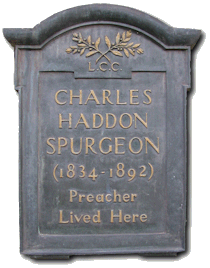
'm just back from the Dallas area and too busy to blog properly today. But I wanted to point you to a friend's blog. Doug McMasters is pastor of Trinity Road Chapel, Upper Tooting. That's a London-area church within short walking distance of the home where Spurgeon lived for several years. Spurgeon helped inaugurate Trinity Road Chapel.

Anyway, Doug has been posting some selections from the 1894 isue of The Sword and the Trowel. These articles were initially published two years after Spurgeon's death, and they include some letters, rare sermon excerpts, and other items of interest not published during Spurgeon's lifetime. Enjoy, and I'll pick up the Acts 17 series later this week, Lord willing.

Phil's signature

PS:

My friend and favorite radio talk-show personality Todd Friel started a new daily television program today: "Wretched."

That's the name of the program, not my assessment of it. It's on FamilyNet, which means as far as I can discover, it's not on DirectTV, so I can't watch. But check it out if you get FamilyNet.