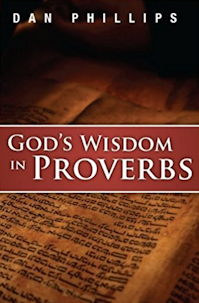
by Dan PhillipsTed Hildebrandt is Professor of Biblical and Theological Studies at
Gordon College in Wenham, Massachusetts, and author of numerous
books and
articles (the links are only a sampling). He's producing a
 genuinely impressive list of Biblical e-sources
.
Being, as
you may have noticed, a lover of Proverbs, I was really very impressed with Dr. Hildebrandt's
list of Proverbs resources. His
invitation to contribute emboldened me to drop the good doctor a line, mentioning my 1983 Master's thesis on Proverbs. Ted responded very graciously, which led to my discovery that I owned the rights to my own thesis (I'd feared I didn't) — and, ultimately, to the scanning of it into e-form.
And now, voila!
The Sovereignty of Yahweh in the Book of Proverbs: an Exercise in Theological Exegesis is now online.
Consequently, anyone who wants to can read the thesis as an
html web page, as an
Adobe pdf document, or as a
Word document.
I actually had a lot of fun researching and writing that thesis. My typist complained with a smile that half of it was in the footnotes.
Boy, just saying "
typist" is a retro-clue, isn't it? Children, a "typist" was a person who used to use something called a "typewriter" to "type" things out. There were professionals who could type better and faster, and they did this for money. My late mother typed for detectives, repossessors, students; she could type over 100 words a minute on her
IBM Selectric. This was

in the days before many people had computers, back when I thought it was a fad. Some of the faculty at Talbot were experimentally using a thing called a
Kaypro II, which was a portable computer. It was green screen, no graphics; and printers at the time were clunky dot-matrix, or fixed-type printers. Then there was this big, grossly-overpriced high-tech Etch-a-Sketch called a "Mac"....
But I digress.
So she complained with a chuckle that I'd loaded most of it in the footnotes. You see, children, "footnotes" used to be difficult to do. Typists and type-setters had to do all sorts of calculations to accommodate for them. But they did, because, of course, it was best for both writer and reader. Now both writers and publishers can do footnotes with a click of a button, and the software does the rest. Which is why "endnotes" are such a
repellent abomination.
Oops, another digression. So, as I was saying:
At the time, my argument was a bit bold, though it may not seem so to y'all. I argued that the best course towards any solid understanding of Proverbs lay directly through dealing respectfully with the text itself, rather than letting a hostile philosophy dictate the concoction of an independent historical/ideological template, which was then imposed upon the text. I sought to demonstrate that, if one takes the text seriously and treats it with respect, it not only produces a coherent portrait, but gives solid ground for meaningful exegesis and exposition.
I presented my thesis' argument at a meeting of OT professors at Talbot Theological Seminary. Faculty elsewhere heard of it, and one well-known scholar contacted me, asking for a copy. He was working on a very substantial commentary on Proverbs for a well-known series that was in process.
I was delighted to say "Yes!" There simply wasn't any commentary on Proverbs that was in-depth, scholarly, substantial, recent, and written from a Bible-believing perspective. This

fellow was a conservative OT scholar, and he said he wanted to interact with the thesis in his commentary. Of course, I was thrilled — (A) that a Bible-believer was going to do a substantial commentary on Proverbs, and (B) that he thought my thesis worth mention.
After that, year after year, I watched for that commentary to come out. The due date came and went. Nothing. Years continued to come and go, still no commentary. Every time any book on Proverbs or the OT came out, even though it was probably silly, I checked the bibliography, hoping against hope that maybe the writer had come across my little thesis and thought it worth a mention.
Nope. Never.
I finally wrote the professor who was working on the Proverbs commentary, and expressed interest in a progress report. To my chagrin, I learned that he'd dropped out of the project. Worse, Proverbs had been assigned to someone else, to a scholar who — to say the least — affirms neither the inerrancy nor the sufficiency of the text. He ultimately produced what is
at very best a mediocre commentary.
And, given his doctrinal positions, it is no surprise that he doesn't refer to my thesis. Folks of his ilk generally don't even indicate awareness that there
is another position.

So now my baby's up online, and anyone with a connection to the internet can see what I was so jazzed about, 25 years ago. If you've got a background in OT academics, maybe you'll chuckle; or maybe you'll see that some of the ideas that I argued as revolutionary at the time are more broadly accepted and better argued today. But in the twists and turns of Providence, I didn't get to be much of a direct participant in those developments.
At any rate, and for what it's worth, it's not buried in a university library anymore.
And for that, I'm very grateful.
Now... you know
that.
(PS — my 2007 seminar on Proverbs is also on that same page, plus a truckload of great resources. Be sure to check it out.)


 eet
eet  Allyson Felix, a neighbor of mine. Her dad, Paul, teaches at The Master's Seminary. She won silver and gold medals in the Beijing Olympics this week.


 But that said, you can obviously read this blog -- the one you are reading right now -- in your iPhone/iPod without many problems, but it takes like 500 years to load, and then you have to zoom in and scroll, and blablahblah. Yes: it looks very nice, but suddenly we're back in 1999 when bandwidth was a major consideration in web design and the old rules about content start rearing their ugly heads.
 'm just back from the Dallas area and too busy to blog properly today. But I wanted to point you to
 My friend and favorite radio talk-show personality Todd Friel started
 ll week the blogposts here have been lighter-than usual fare. And I'm OK with that. Especially this week. I did not need a high-maintenance brouhaha in the comment-threads this week. I had several loose ends at the office to tie up, including getting the final revisions for

 arely do I put sound files on the blog, so when I do, you know it's a good one. You've got to hear this.
 The sound clip linked below was recorded last Saturday (thanks to