13 May 2012

A Beeline to the Cross

A bonus dose of Spurgeon
posted by Phil Johnson

Spurgeon


The PyroManiacs devote some space each weekend to highlights from The Spurgeon Archive. The following excerpt is from "Christ Precious to Believers," a sermon preached Sunday morning, 13 March 1859, at the Music Hall, Royal Surrey Gardens, London.


the best sermon is that which is fullest of Christ. We never like to hear a sermon unless there is something of Christ in it.

A Welsh minister who was preaching last Sabbath at the chapel of my dear brother, Jonathan George, was saying, that Christ was the sum and substance of the gospel, and he broke out into this story:—

A young man had been preaching in the presence of a venerable divine, and after he had done he went to the old minister, and said, "What do you think of my sermon?"

"A very poor sermon indeed," said he.

"A poor sermon?" said the young man, "it took me a long time to study it."

"Ay, no doubt of it." "Why, did you not think my explanation of the text a very good one?"

"Oh, yes," said the old preacher, "very good indeed."

"Well, then, why do you say it is a poor sermon? Didn't you think the metaphors were appropriate and the arguments conclusive?"

"Yes, they were very good as far as that goes, but still it was a very poor sermon."

"Will you tell me why you think it a poor sermon?"

"Because," said he, "there was no Christ in it."

"Well," said the young man, "Christ was not in the text; we are not to be preaching Christ always, we must preach what is in the text."

So the old man said, "Don't you know young man that from every town, and every village, and every little hamlet in England, wherever it may be, there is a road to London?"

"Yes," said the young man.

"Ah!" said the old divine "and so form every text in Scripture, there is a road to the metropolis of the Scriptures, that is Christ. And my dear brother, your business in when you get to a text, to say, 'Now what is the road to Christ?' and then preach a sermon, running along the road towards the great metropolis—Christ. And," said he, "I have never yet found a text that had not got a road to Christ in it, and if I ever do find one that has not a road to Christ in it, I will make one; I will go over hedge and ditch but I would get at my Master, for the sermon cannot do any good unless there is a savour of Christ in it."

C. H. Spurgeon

12 May 2012

You know what? All right already.

by Frank Turk

OK: enough is enough.  I'm opening this post and the comments below for one reason only: SGM "Survivors".

Here's what I think: I think that SGM has had some problems, and they have called in a third party to assess those problems, and they are working on solutions based on that report.  And I think that there is a vocal and emotional faction of people inside and outside of SGM who are not satisfied with anything but the yet-to-be-determined volume of blood and mass of flesh to be extracted.


And there are a very small number of people who think they have the rational explanation for the whole thing and are also not entirely satisfied with where it is right now.

Me personally?  I think this is what you're going to get with Charismatic theology: when conflict raises its ugly head, people lead with emotions and self-image and forget they have an objective Christ who overcomes my sin and your sin so that the two men can become one under Christ.  That's not fantastically kind, but I think that's what this boils down to.

Anyway, here it is: the TeamPyro SGM thread.

Here are the ground rules:
  1. I will delete any comments which are slanderous toward any people.  "Slander" is defined by the dictionary as "a malicious, false, and defamatory statement or report."  I'm qualifying as "false" anything which is not supported by evidence, and I'm qualifying as "evidence" things done publicly or reported by an objective third party.  It's a narrow gate.  See to it.
  2. I will delete any comments which are rehashing things already covered by the AoR Report, or calling the AoR report false or otherwise tainted.  The world is not in a conspiracy against the battalion of people who claim SGM is run by the minions of Satan, in spite of some opinions to the contrary.
  3. I will welcome thoughtful reflections on the events, but not accusations or tantrums.  "What's the difference," you ask?  Then you better not comment.  Seriously.
  4. I reserve the right to be capricious and utterly unfair in my editorial prerogatives.
  5. The other rules for posting here apply.
Have a nice weekend.


11 May 2012

Transubstantiation?

Your weekly dose of Spurgeon
posted (a bit early) by Phil Johnson


The PyroManiacs devote some space each weekend to highlights from The Spurgeon Archive. The following excerpt is from "The Real Presence, the Great Want of the Church," a sermon preached Sunday morning, 11 February 1872 at the Met Tab in London.


S IT NECESSARY to say that the Lord Jesus Christ is no longer corporeally present in his church? It ought not to be needful to assert so evident a truth; and yet it is important to do so, since there are some who teach that in what they are pleased to call "the Holy Sacrament," Christ is actually present in his flesh and blood.

Such persons unwittingly deny the real humanity of our Lord Jesus Christ, for if he has indeed assumed our humanity, and is in all points made like unto his brethren, his flesh and blood cannot be in two places at one time. Our bodily humanity could not be present in more places than one at one time, and if Christ's humanity be like ours it cannot be in an unlimited number of places at once; in fact, it can only be in one place. Where that place is we know from Scripture, for he sitteth at the right hand of God, expecting till his enemies be made his footstool.

Unless you are to suppose that the humanity of Christ is something altogether different from ours, it cannot be here and there and everywhere; but to suppose that it is a different humanity from ours is to deny that he is Incarnate in our nature. Our Lord Jesus told his disciples that he would go away, and he has gone away. He ascended into heaven, bearing humanity up to the throne of God.

"He is not here, for he is risen."

C. H. Spurgeon

10 May 2012

Tag-ons to Frank's BoB2012 post

by Dan Phillips

Don't have anything ready to serve at the moment, nor the time to finish cooking what's on the drawing board (how many mixed metaphors is that?). So I'll point back to Frank's, and add a couple of tight-lipped thoughts.

I could not have said all that I think about BoB2012 (nor the, in equal parts, response and non-response to David Kjos' post) as politely as Frank did, so at the moment I'll mostly say "amen," and join you all in waiting to see if an appropriately substantial response is forthcoming, adding only these:
  1. Luke 12:48b is surely germane in this connection, is it not?
  2. I would also point out what Thabiti Anyabwile said about celebrity pastors at T4G12, if I understood him correctly: Actress X would not be a star if truckloads of people didn't buy tickets to her movies. Transferring the metaphor, readers must take responsibility that Blogger X would not have the prominence he enjoys without truckloads of clicks, retweets, follows and links. Just sayin'.
  3. Even granting that serious, weighty, dire, intense and personal discussions were being carried on behind closed doors, is there anything in this post or this post that relied on "facts not in evidence"?
  4. What would have happened differently if, instead of taking a posture of unawareness of (or sullen resentment towards) all such posts on various blogs, TGC blogs and leadership and other leading voices had taken such concerns seriously before (to quote Frank) "all the wrong that could be done was actually accomplished"?
  5. And finally, this can't be pointed to enough, if only for a needed sad chuckle:

Dan Phillips's signature

09 May 2012

BoB2012 - How the Other Half Lives

by Frank Turk

UPDATED:

OK - you came here for the fireworks, but there are a couple of things I need you to do before you start playing John Phillips Sousa for the Grand Old Flag.

1. A young friend of our family, who is named "Daniel," is going into surgery on Thursday, 9 May 2012, at about 5 AM, to have a pacemaker put in; his surgery is postponed one week.  When I say "young," I mean he's not old enough to drive.  Please pray for Daniel and his family, his doctor and the support staff, and that God will be merciful.

2. My beloved friend Mark Lamprecht, known to many of you as "Here I Blog," has a friend who is in dire need of medical treatments he cannot afford.  I haven't been given the liberty to share all the details, but I can say that Mark and I are trying to find a way to create a donation campaign for this fellow who is a father and a husband in order that he gets the minimum urgent care he needs, which will be about $12,000 to start.  Until I can find a way to make the donations payable to this fellow's church so that we know the funds will be property administered, I'm not linking to a donation site.  But for now, if you would be in very serious prayer for this man and his family, it would serve them well.

Well, I find myself with a LOT left to say after cutting some slack on section 2 of the outline last week, but I'm going to rein it in (a little) and stick to one last bit of what's left of the BoB2012 panel discussion, which we find thus:
[30:19]
JT:I think the one with [Jefferson Bethke], who is here someplace, I think that one was in some ways an easier thing because Jefferson does not represent a movement per se.  He's an individual person doing a video and received some, you know, hurtful comments, and also some iron sharpening iron push back.  I think that's in a little bit different category that, say, some of the controversy  with Sovereign Grace, or with Elephant Room.  Um, so much to say, about both those that could be said.  I take a little bit of a contrarian perspective on both of those in that there is so much dialog going on behind the scenes that not everyone is privy to.  Take Elephant Room as an example: There was just a lot of conversation going on behind closed doors, private communication, and some of the people in the blogosphere were saying, y'know, "why isn't TGC saying more?  Why isn't Carson or Keller saying more?"  I think if you're not privy to those conversations, it can seem like stone-walling or sweeping something under the carpet, and y'know, why aren't we being communicated to.  Some of that is that we're conditioned to, when there's information, it should be made public.
 
OWEN: Immediately.  Now. 
JT: And I think in the Sovereign Grace one, which I think is its own animal, very complicated, but there you have an example with uh, the wiki-leaks sort of mentality and strategy among some people who had left the movement, some who were still in it, just saying, "That's not good enough, we're gonna take this into our own hands.  We're gonna go public, make documents public, nothing's off limits."  There's literally no ethics involved.
[32:20]
The reason for it, to be as clear as possible, is that I think there's something to be said in defense of David Kjos' sparse review of the panel in which he said:
The debacle of the Elephant Room, according to the representatives of The Gospel Coalition on the Band of Bloggers panel, was the objections of numerous bloggers, and the criticism of The Gospel Coalition, of which MacDonald was a founding member, for its silence on the matter. We were scolded for expressing opinions without being privy to the inside discussions of The Gospel Coalition, as if that was at all necessary, as if T. D. Jakes was an unknown quantity instead of a public figure whose heresy is well known through multiple publications. Bottom line: if you’re not on the inside, you’re not qualified to speak.
Justin Taylor specifically said that this is a bad distortion of what he personally said, and I want to consider that as well as a further issue regarding the problem of transparency and disclosure overall.

Let's start where Justin starts: the Jeff Bethke incident which, as he rightly assesses, is an "easier thing".  But Justin's assessment is that it was easier because Young Jefferson is just a guy with a YouTube channel.


That is: a YouTube Channel that has received 20 million pageviews.  Just for comparison sake, "David after Dentist" has 110 million views in 3 years; Jeff has 20% of that in 4 months.  At this rate Jeff's video will have 100 million views by next summer and will be parodied by Chad Vader before the Fall.

My point being: Justin classes Jeff and his video as "just a guy," when in fact Jeff has captured more viewers than any one time Mark Driscoll has been on national TV.  Justin's view is an understatement at best -- and it minimizes what followed.

Jeff, who is not a pastor, or the leader of a movement, but who has gotten more views for his video than Jon Stewart gets for the Daily Show in any given 10 days combined, received some criticism for his video -- some of it constructive, some less than helpful.  But Jeff did something which, it seems to me, is instructive: he listened and admitted his mistake(s).  Of particular use for this teachable moment was the pastoral poking of Kevin DeYoungJeff's response to Kevin was, it seems to me, not just edifying but exemplary.  Jeff made some clear mistakes, Kevin lined them out clearly and fairly, and Jeff accepted them at face value.

Some things Jeff didn't do:
  • Jeff didn't pipe up on twitter toward nameless people who were vexing him
  • Jeff didn't delete posts he was thereafter ashamed of, or the original video because it took some hits
  • Jeff didn't ignore the comments, and didn't ignore Kevin in particular who was trying to point out his errors
  • Jeff didn't go into seclusion or go into radio silence while urgent and necessary private conversations were conducted for the sake of his soul and the real people who might somehow be damaged.
See: Jeff Bethke, when he put his foot in it publicly, took public criticism, and made public amends for it.  He even accepted that people criticizing him meant it for his good -- even if some of them were somewhat not good at goodness or at speaking the truth in love.  Let me say this clearly: if that's what we receive from a young fella with a YouTube channel, why would we expect less from the heroes of the reformed blogosphere?


Let's face it: saying nothing at all is actually less than what Jeff did.  Ignoring the public spin of those doing the wrong thing, which were tantamount to lies and obfuscations, is less than what Jeff did.  Failing to speak up until all the wrong that could be done was actually accomplished is far less than what Jeff Bethke did.  And doing less than Jeff when your position in a movement or in a coalition or in a band of men joined together for some para-church sake is less than what ought to be expected.

Yet here's where those I am talking about, and their advocates and surrogates, will start sniffing at the criticism.  JT has already hinted at the tactic in his statement, above: not everything has to be public.  In fact, as JT said, public statements would hurt the private conversations.

Therefore, let's think about the perfect example of that -- the mud fight surrounding SGM -- as it is also instructive.  JT, as the insightful and helpful blogger that he is, actually nails it in his statement: what happened to those with the (in my view: unreasonable) hunger and thirst for justice is that they gave up on any kind of ethics in order to make public every jot and tittle of perceived wrong-doing and to demand a pound of flesh because they said they were offended -- and not because there was any substantive offense.

From the AoR report:
One of the greatest factors that inflamed the conflicts and increased people’s wrath and clamor was the extensive use of sinful communication in talking, emails, blogs and meetings. 
While every Christian would agree that gossip and slander are sinful, many in SGM failed to recognize when they initiated, participated, or listened to and read sinful communications. 
When we met with people, they often justified their own judgmental and damning words with dangerous thinking such as:
• “It’s just the truth!”
• “I am loving this person by revealing this person’s sins to that person or to the community or even the world (e.g., through the Internet).”
• “Since I’m being ignored, I am justified in saying these terrible things about others.”
• “I need to protect the church or the world against these evil people.”
• “Because I was hurt, I am justified in how I hurt others by whatever kind of words I use!”
 
As mentioned above, AoR has often seen sins of the tongue in conflicted groups. But in working in this situation, we experienced first-hand an unusual severity of this grievous sin. It was simply shocking. 
For a people who take pride in humility, who claim to have been totally indoctrinated in biblical peacemaking, and who brag about the way they share Christ and his love, we were saddened that so many of these same people minimized sinful talk, justified gossip and slander, and refused to see how such activity itself exaggerated their troubles.
My point being: if this really is the only other choice as what "some bloggers" were demanding, then I agree with Justin: maybe we'd be better off just minding our own business.

But, in fact, that's not the only other choice -- and in a very specific sense, it's not what "some bloggers" were suggesting, and exhorting, and pointing out was missing.

One blogger (since we are not naming names) started an open letter to Carson and Keller when the ER2 hoopla was just getting ginned up by saying this:
As I begin to write this, I do so with a personal sense of indebtedness to both of you.  I am not merely grateful for your books and lectures and sermons which have taught me so much: I am grateful for the spirit with which you have done it all.  That is to say: while I am well-known through a reputation of being quite a pill for the sake of the Gospel, you both are known as fatherly men who have a graciousness I am certain I lack, and it is that spirit from which I learn much all the time.
And then this:
Recently, you have both penned a detailed statement about the nature of the Gospel Coalition, and about its duties or relationship to its readers and also its council members.  I found this essay instructive, and useful, and clarifying in the context it was coming from, but in my view, it misses the point of the concerns of almost all the critics of the dust-up over the Elephant Room.  I wanted to offer to you an outsider's perspective on what just happened and why it is not enough merely to say what you have said so far.
And then this admonition:
Now, here's what's not necessary: we don't need the reality TV version of whatever it is that has happened, is happening, and will happen between the various parties at TGC, including any trumped-up drama.  But when someone publicly makes an error of this size, the broad stokes of the public resolution are, frankly, necessary for the sake of those you started your internet site up for in the first place.
...
Saying what you might do is an interesting approach -- and it is the approach of the essay you have already written.  But showing the rest of us how to actually do it would be invaluable.  It would actually put into play something the Evangelical church lacks -- an education on how to exercise spiritual responsibility, and turn a brother away from wrong-doing and toward the right path, the right orbit in our center-bounded life which is around Christ.
So I ask you as a fan, and as your far-removed student, and as a Christian who is indebted to you: help us understand how to resolve this matter.  Please do not let the weak single tweet from James MacDonald that the parties #AgreeToDisagree stand as the milestone to this event.  That activity would be helpful to so many people for so many reasons that they cannot all be listed, but the one most important must be said: it will glorify Christ.
That's not badgering.  That's not unethical intrusion into private conversations.  But that's also not one of the choices JT is willing to proffer. See: what is said by JT (and to be fair: I think it is at least partially unintentional, partly a function of unprepared remarks) is that we can expect one thing from a young fellow with a YouTube channel, and we should expect that same thing from people with complaints about their churches, but we can't expect it from men like the guys who sit on the council for the Gospel Coalition.  These are important men, and they represent more than themselves, and we can't just expect them to take public rebukes for public misdemeanors and mistakes as if they might actually be wrong.

This is why David Kjos was offended by the table talk at BoB2012.  In fact, this is why I am offended by this little kaffeeklatsch of fellows under 40 who know things they wish they didn't know: there's no question they have a different standard for a James MacDonald or a D.A. Carson or a Mark Driscoll or a John Piper or a Mark Dever than they do for a Jeff Bethke -- and it's not a higher standard.

It really doesn't get better as you listen to this discussion: it gets worse.  Collin Hansen, God bless him, pulls back the curtain for us and makes it transparent what this means, ending around 34:50.  Again, to be utterly fair, I think he didn't intend to say it this way, but he said what he said.  In his view, in the same way that Christianity Today would never publish anything but nice about Billy Graham and his kin, the same barrier exists at TGC for the council and its members.  When you link this to Collin's foundering around about what's so bad about comments (negative comments being, on the one hand, welcome for the sake of "openness", but on the other hand, being from "parasites" who don't have any other platform or readers), it's sort of ghastly.  It's like finding that darned cat which has been missing for a few weeks behind the appliances -- it's not what one wanted to find, or meant to find, but you have (for good and ill) found it.  It answers a lot of questions.

But the choices are not to either do nothing or to produce a reality show that runs after Keeping Up with the Kardashians: a real third way could be to be like Jeff Bethke even though one might be James MacDonald or Mark Driscoll.  Or better still: specifically because one might be the leader of a movement, somehow one takes Jesus' admonition to be unlike the world but to instead save the world (or your demographical piece of it) by dying for it rather than jockeying for position.  The real third way is to be like Kevin DeYoung or Thabiti - to say what is right regarding what is wrong, in a clear and cogent and compassionate and public way so that what is actually wrong with a brother is made clear to those one intended to attract in the first place, and so that what is right about public discourse can be modeled for the plethora of hit-piece writers and undiscerning discernment bloggers.

There are more lessons to be learned here than the really-superficial and rudimentary issue that somehow Keller and Carson are aware that Jakes is a Modalist - and those lessons are actually lessons in applying the Gospel.  When a James MacDonald publicly embraces, from bad to worse, panderers, demogogues, and then a modalist, the least one can do is say, "I think my friend has made a mistake which, I hope, he will repent of."  And the least he can then do in return is to say, "I have received a general critique of what's happening here, and I hope I can resolve it with my friends."  And then let all the private enclaves and secret meetings which have jaded and disillusioned these poor young fellows with thoughts that cannot be mentioned ensue.  But that cannot be demonstrated because these men are, it seems, too great to be burdened with running the parachurch ministry they sought to build to this high a profile.  It's no wonder both James MacDonald and Mark Driscoll got a fond farewell from TGC rather than a sorrowful public final plea to repent of their terrible mistakes: there is a different standard for men like them, and men like Carson and Keller, than there is for men like me.

The proper standard, however, will be upheld in the comments, which are open. Play nice.


08 May 2012

The sufficiency challenge

by Dan Phillips

I think the truth of the sufficiency of Scripture may be the central Biblical doctrine under attack in our day.  Of course cults, heresies and false religions attack it, as they must. What is saddest to see is all the "friendly" fire that well-meaning obsessives have leveled with a boldness that seems to be on the increase.

I've come at this topic "at sundry times and in divers manners," including here, here, and here, among many others.

Sunday was part three of our Thinking Biblically series at CBC, and the sufficiency of Scripture was one of the foci of the sermon titled What Should We Do with the Bible? (That and, well, once again too many other things.) I'll lift out a part of the sermon, part that actually wasn't in the notes.

I grant that my efforts may not have convinced everyone, though I will keep trying. But virtually all remotely-sound Christians will at least give a nod to the proviso that yes, yes, yes, the Bible is God's Word, and yes, it's some kind of sufficient, and no, no hemi-demi-semi-kindasorta revelation can displace it — well, not formally, anyway.

So agree with me on this. If you really believe what you say you really believe, this should be no problem. Here we go:

Agree heartily to believe in and use Scripture as befits what it claims about itself. Treat it like it is what you say you believe it is: God's actual, real-live, inerrant, personal, living and powerful Word. Approach it as you would actually approach such a treasure as you profess to affirm to have found in Scripture.

That is, pledge yourself exclusively to seek God and His will according to Scripture. Pray only for light to understand Scripture (cf. Psa. 119:18; 2 Tim. 4:7). Commit yourself only to regard what comes from Scripture as God's binding will for you. Set aside all the yeah-buts and evasions and distractions and special-pleadings and fourteenth-hand stories and traditions, for a time.


Set yourself to seeking and being in a church that emphatically teaches the Bible as if it were what it says it is, that devotes itself to the exposition and proclamation and practice of Scripture as God's inerrant word, without the endless distractions of entertainment and fads and dancing bears.

Devote yourself exclusively to studying Scripture, all sixty-six books. Set yourself to master every book, every chapter, every verse, every word. Seek perfect understanding of all of Scripture, and Scripture only, as containing what God really wants you to know. Memorize all of it.

Finally (and at the same time) commit yourself to practicing Scripture perfectly. All of it. Master it, and be mastered by it — exclusively. If it is not Bible or a valid straight-line application of the Bible, do not claim it as any level of special revelation from God.

Then and only then — when you have plumbed the full dimensions of Scripture in every direction; when you have conformed your thoughts, attitudes, affections and behavior to it; when you've ransacked every corner and crevasse and entirely emptied the cupboards and completely cleared the shelves — if you find that Scripture is truly insufficient to lead you to know and serve God in this life (contrary to its own self-testimony)...

...then look me up.

Deal?

Dan Phillips's signature

07 May 2012

Then There's This:

A Bridge too Far
by Phil Johnson


his year's Standpoint Conference is an online video event only, and my contribution was posted today at the Sharper Iron blog.

I don't like talking into a video camera rather than speaking to an actual congregation. The timing and inflection seems stilted; my eye-contact is slightly askew (I keep looking at the computer screen in front of me rather than the actual camera lens); on playback, it feels like I'm yelling at the camera; and I miss the choruses of "amen" and "preach it, brother," that I usually get when preaching. (Just kidding about the amens. In fact, one of the good things about preaching to a video camera is that there's no one to walk out on the sermon.)

Anyway, here it is. I'm talking about bridge-building, boundary-guarding, brotherhood, belief, and the problem of how to cultivate all of those things without compromise. In the process, I'll touch on The Gospel Coalition, The Elephant Room, and some other topics that will be familiar to our regular readers:


I'm closing comments, because I don't want to detract from the discussion at Sharper Iron. If you want to comment, head over there. You'll have to sign up, and I think you have to meet a minimal standard of evangelical orthodoxy in order to comment there, but I'm pretty sure most of our regular commenters will qualify. If you have never perused Sharper Iron, look around. There's lots there to profit from.

Phil's signature

"What Is Written"

by Phil Johnson


o I was in Minneapolis Saturday for Todd Friel's Wretched Psalm 119 Conference, and David Wheaton broadcast his weekly radio program, "The Christian Worldview," live from the conference venue. David graciously featured an interview with me in one of the segments, and at one point he asked me to give a thumbnail sketch of what I would be speaking on later in the day. The theme of this year's Psalm 119 Conferences is the Holy Spirit, and one of my messages dealt with the question of how the Holy Spirit communicates truth to believers. Should we expect Him to reveal fresh prophecies through intuitive impulses, voices in our heads, and other means of private revelation?

I said no, nothing in Scripture instructs us to seek that kind of guidance. Instead, we are commanded to order our lives by the Scriptures (Deuteronomy 5:32; Joshua 1:7-8; Psalm 1:2-3; 1 John 2:5-6; etc.). The Holy Spirit's ministry is to enlighten our understanding of the Word (1 John 2:20, 27; Ephesians 1:17-18; 1 Corinthians 2:12-14; Psalm 119:18) and motivate our obedience (Ezekiel 36:27), so that the Word of God (not some mystical extrabiblical revelation) is "a lamp to my feet and a light to my path" (Psalm 119:105).

That's more or less what I said in answer to David Wheaton's question about how the Holy Spirit guides us.

Less than 15 minutes later, my phone dinged, letting me know I had received a fresh e-mail. Here's what the message said:

I was just listening to an interview with you on local Christian radio. It seems you have elevated that which is written above the mystery of Christ hidden in us. Perhaps I have misunderstood. I hope so. There was nothing "written" for the common man until when? The 16th century? Maybe sooner...Even so, literacy was widespread. But, here we are, the seed has not been obliterated.

I submit that you could consider the inner work of the Spirit...that is a mystery, indeed. Just as surely as the union of sperm and egg produces life, so the Spirit produces new life, and that eternal. And we have no dispute there.

Lean not into your own understanding...let the Spirit have His work...by Faith. After all, God is a Spirit and they that worship Him must do so in spirit and in truth.


Yikes.

My reply:

God himself elevates "that which is written" to the position of highest authority, and He has expressly instructed us "not to go beyond what is written" (1 Corinthians 4:6). Scripture is the only truth we have that is God-breathed (2 Timothy 3:16). And the truth of Scripture is sufficient for all our spiritual needs (v. 17).

So if someone heard my abbreviated answer to David Wheaton and thought I was saying the Scriptures are more authoritative and more reliable than any mysterious "inner work of the Spirit" that involves extra-biblical "truth" or inspired intuition, then emphatically: Yes, you heard me correctly.

Like many charismatics, my interlocutor seems to imagine that the principle of sola Scriptura is hostile to a robust understanding of the Holy Spirit's work in the daily lives of Christians today.

That idea is perhaps the single most deadly error in the vast menagerie of problems associated with the charismatic movement.

Phil's signature


06 May 2012

A Word of Encouragement for Tender Souls Who Wonder If They Have Repented Enough

Your weekly dose of Spurgeon
posted by Phil Johnson


The PyroManiacs devote some space each weekend to highlights from The Spurgeon Archive. The following excerpt is from "Repentance unto Life," one of Spurgeon's earliest sermons, preached on Sunday morning, 23 September 1855, at New Park Street Chapel, Southwark.


nother mistake many poor people make when they are thinking about salvation . . . is that they cannot repent enough; they imagine that were they to repent up to a certain degree, they would be saved.


"Oh, sir!" some of you will say, "I have not penitence enough."

Beloved, let me tell you that there is not any eminent degree of "repentance" which is necessary to salvation. You know there are degrees of faith, and yet the least faith saves; so there are degrees of repentance, and the least repentance will save the soul if it is sincere.

The Bible says, "He that believeth shall be saved," and when it says that, it includes the very smallest degree of faith. So when it says, "Repent and be saved," it includes the man who has the lowest degree of real repentance.

Repentance, moreover, is never perfect in any man in this mortal state. We never get perfect faith so as to be entirely free from doubting; and we never get repentance which is free from some hardness of heart. The most sincere penitent that you know will feel himself to be partially impenitent.

Repentance is also a continual life-long act. It will grow continually. I believe a Christian on his death-bed will more bitterly repent than ever he did before. It is a thing to be done all your life long. Sinning and repenting—sinning and repenting, make up a Christian's life. Repenting and believing in Jesus—repenting and believing in Jesus, make up the consummation of his happiness. You must not expect that you will be perfect in "repentance" before you are saved. No Christian can be perfect.

"Repentance" is a grace. Some people preach it as a condition of salvation. Condition of nonsense! There are no conditions of salvation. God gives the salvation himself; and he only gives it to those to whom he will. He says, "I will have mercy on whom I will have mercy." If, then, God has given you the least repentance, if it be sincere repentance, praise him for it, and expect that repentance will grow deeper and deeper as you go further on.

Then this remark I think, ought to be applied to all Christians. Christian men and women, you feel that you have not deep enough repentance. You feel that you have not faith large enough. What are you to do? Ask for an increase of faith, and it will grow. So with repentance.

C. H. Spurgeon

04 May 2012

Friday Filler

by Phil Johnson


his may be risky, because I haven't had an opportunity to listen for myself yet, but yesterday Chris Rosebrough reviewed one of my sermons. You can hear his review in the second half of this broadcast:


Chris's sermon reviews are sometimes painful to listen to but always insightful. He plays the sermon from start to end, stopping the tape where he needs to make a point. If you want to learn how to listen to preaching with a discerning ear—paying attention to content, context, and doctrine, rather than style-of-delivery alone—Chris shows how it's done.

Chris reviews the good, the bad, and the ugly almost daily. There's a lot more bad and ugly than good, sadly. I'm guessing he (mostly) appreciated my sermon on Barabbas because it featured the kind of gospel focus he usually appreciates. But if you want some scary entertainment (better than any horror movie out there), you ought to listen to Chris's review of a bad sermon someday.

Phil's signature

03 May 2012

"But otherwise": skewed priorities (classic re-post)

by Dan Phillips

Various bits of pastoralia have me too full-plated to finish half-done posts. So here's a timely post from October of 2006. Enjoy.

Consider this description of a guy. We'll call him... Guy. Guy G. Guy.
Guy's really a good person. He's as honest as the day is long. He's hard-working, a straight-shooter. He gives to charity -- and not just to formal charities: I've never seen Guy turn down a panhandler on the street. He's devoted to his wife and children, he's a regular church-attender. He drives within the speed limit, always seems neatly dressed and clean. I hardly ever see him sitting around. He's often out working on his yard, or even helping elderly neighbors work on theirs.
Good guy, right? Oh wait. Left out a trait.
Guy does have this one pastime. When the mood strikes, Guy molests small children.
But otherwise, a good guy, right?

Well, no. I'm pretty sure I lost you with that last, stomach-jolting little attribute. It's what we call a deal-killer. However nice the other descriptives might be, that last one counter-balances and stains them all. It's a vice so repellant, so intuitively appalling, that extended argumentation isn't necessary. Our image of this imaginary fellow does an abrupt volte-face, with one simple, specific bit of information.

So why do we, Christian and non-Christian, so regularly commit even a worse error in moral evaluation?

I just finished laboring through Four Views on Salvation in a Pluralistic World for a class. My, that was a chore. Four sets of authors batted around the question of "the fate of the heathen." They ranged from (IMHO) the clueless (John Hick, Clark "Evangelical! Really! I Swear!" Pinnock), to the sorta cluey (Alister E. McGrath), to the considerably more clued (R. Douglas Geivett, W. Gary Phillips [no relation]).

Hick and Clark "I Am an Evangelical! Really! I Am, I Am, I Am!" Pinnock wrung their hands about the horrible injustice of God sending good, moral, decent, religious people to Hell just because they didn't believe in Jesus. McGrath stood a bit to their Biblical right, though in a muzzy way; Geivett and Phillips considerably more so.

Unless I missed it, however, no one challenged what I think is the fundamental issue. Clark "Did I Mention That I'm an Evangelical?" Pinnock stood pretty much with John "At Least I Don't Claim to Be an Evangelical" Hick in accepting the proposition that "there are pagan saints in other religions" (p. 119) So Pinnock shrinks back from the thought that God could condemn everyone except believers. Even in their responses, the other three writers did not focus on what I think is a central issue.

Which "central issue" would that be?

Well, back up with me for one second. Can a person be rightly considered moral if he does all the wonderful things I mentioned, but just has this one little recurrent indulgence that he embraces and practices, involving little kids? If you can't give me a hearty "No" on that one, further conversation probably would not be fruitful.
Why can't we say that he's basically good, though? He does more good things than bad, doesn't he? But none of that matters, because we intuitively recognize a certain hierarchy in morality. Replace the sin of pederasty with a failure to signal his right turns, and we'd relax a bit. He might be a decent fellow after all. On any hierarchy, failure to signal one's turns ranks well below the abomination of child molestation. A child is infinitely more precious and valuable than a traffic regulation.

Let's stay with the same man, then, with an alteration. Remove the pederasty, leave him with all the other virtues (and if you like throw in a score of others). Just add this one specific: he does not hold Jesus as his Lord and Savior.

What do you think now? Is he a moral man?

Your answer to that question will tell me everything about your moral hierarchy.

Someone asked Jesus once what amounted to this: What is the chief imperative of the universe (Matthew 22:36)? What is at the pinnacle of the moral hierarchy?

As you may know, the Lord Jesus answered the man's question. Plus, at no extra charge, He laid out the second imperative of the universe.
And he said to him, "You shall love the Lord your God with all your heart and with all your soul and with all your mind. This is the great and first commandment. And a second is like it: You shall love your neighbor as yourself. On these two commandments depend all the Law and the Prophets." (Matthew 22:37-40, emphases added)
Jesus laid down two categories: first the vertical, then the horizontal. First, the theological. Second, the social. First, love the Lord your God with everything you've got. Second, love your neighbor as you already love yourself.

When we rank a person's morality, we usually primarily judge as to whether he is kind, honest, generous, decent, giving, merciful, loving -- to people. What outrages us is pederasty, rape, murder, theft, violence -- against people. Horizontal crimes. These are, indeed, important areas. In fact, they comprise the second-most important area of morality in the universe.

Second. Not first.

The chief indicator of a person's character is his relationship to God. In other words, his theology, his doctrine, his faith.

Nor should we anachronistically imagine that by "your God" Jesus means "whoever you conceive God to be." No honest Jesus-scholar would suggest that He means any other than the living God of Israel, who reveals Himself in the Law and the Prophets. It is that God -- and, by extension, the God who reveals Himself through Jesus Christ (Matthew 11:27; 17:5; John 1:18; 17:3, etc.) -- who must be loved above all else.

Can a person be a moral person, and violate what Jesus calls "the great and first commandment," the commandment that comes before and above all others?

An affirmative answer reveals a genuinely worldly viewpoint. It indicates that we're seeing the moral universe through man-centered glasses.

But if you believe Jesus, you must answer "Of course not. It's a deal-killer."

Yet we have the odd spectacle of folks who may well confidently say of a rapist, pederast, murderer, or terrorist, "He'll burn in Hell" -- but balk at saying the same of someone who violates the ultimate moral imperative in all of creation. A good guy who rejects Jesus is, by our skewed priorities, still a good guy. But if he harms women or children -- well. That's different.

When you make yourself think it through, it's odd.

But the spectacle of folks who claim to be "really, really" evangelical, balking at the justice of laying the most severe judgment on the most heinous crime in all creation? "Odd"?

Worse than odd.

Dan Phillips's signature


02 May 2012

BoB2012: The Gooey Center

by Frank Turk


For those curious, the audio of the event is still stored at the Southern Seminary archive (click to listen; right-click to download)

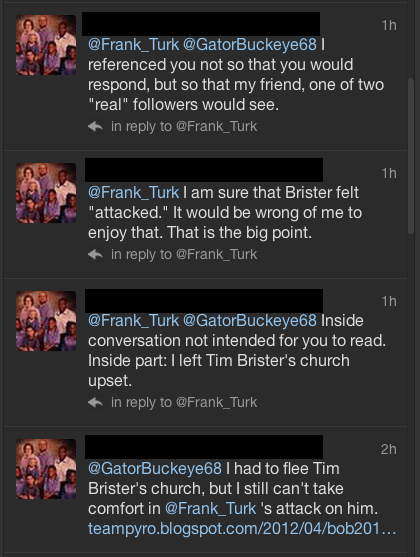
The  most interesting thing that happened last week after starting this 3-part series on Band of Bloggers 2012 was not the passive-aggressive tweets which, when called out, got deleted.  It was this tweet stream I received literally yesterday:

OK: STOP a second.  I have been advised that, for the sake of good order, it ought to be noted that the tweets below are utterly false -- that the people mentioned here are not and have never been members of Tim Brister's church.  


That is actually my point in saying these tweets are a "parable" of how comments work on the internet.  If that was not clear, please let it be clear now: in no way were these tweets clipped and posted here to reproach Grace Baptist Church, its members, or its elders for any behavior in their local church.  These comments, as they say in the KJV, stinketh, and ought to be a lesson to the rest of us as to how not to behave on the internet.


As evidence of such a thing, note that these comments are now evaporated -- as is the habit of people who can't engage the "edify" filter before hitting "post".


You know who you are.


Timmy, whom I could not identify in the first two minutes of the audio, was attacked -- according to this person who fled his church.  Mull that over as a monument to how the internet works.

Anyway, I was going to undertake an extended consideration of the reflections on how blog comments work and ought to work according to the young men of Band of Bloggers, but this example and the tweets which got deleted last week will have to be a parable of the whole thing.  I'll lay off for a week and just post my rough outline of BoB for you as a PDF you can download, right here.

Next week, in our final installment, I'll undertake to discuss, in a helpful way, section 3 of that outline.  It's the part you're dying to read anyway, so consider today a breather.


01 May 2012

Are the commands to kill Canaanites and eschew shrimp binding on Christians? Yes — in a sense

by Dan Phillips

As I preach through a series titled Thinking Biblically, last Sunday brought us to consider What Is the Bible? It was the first of a projected pair of sermons treating the nature and use of Scripture. Last Sunday's installation was probably really about 1⅓ of a sermon, as I attempted to pack an awful lot into one message (epistemology, plenary verbal inspiration, inerrancy/infallibility, Canon, autographa, textual criticism... for starters). Praise God for those gracious folks, though; their response was very kind and encouraging.

In the course of our working through the issues we laid down the assertion that all of Scripture is morally binding. My text was James 4:17 — "So whoever knows the right thing to do and fails to do it, for him it is sin."


We all know that James speaks here of sins of omission. Sins of commission are when we do what God forbids (i.e. commit adultery, lie, steal). It is no less a sin to refuse to do what God commands. These are sins of omission. Once we know what God calls us to do, we are liable to respond in believing obedience.

In that category, it isn't difficult to think of examples. A Christian who refuses personally to commit himself to involvement in a local church is committing a sin of omission (Hebrews 10:25; 13:7, 17). A Christian who refuses to study the words of Christ regularly is committing a sin of omission (Jn. 8:31-32). A Christian who refuses to pray is committing a sin of omission (1 Thess. 5:17), and so on.

But we who know what Christ makes of apparently external OT laws (Matt. 5:21ff.) should know better than to confine such sins to activities alone.

For instance, Scripture tells us that Christ is God (Jn. 1:1, etc. ad inf.). Suppose we decline to affirm this teaching. Is it not a sin to refuse to embrace that truth in faith? Scripture tells us that there is one God (Deut. 6:4), and distinguishes the persons within that one God (e.g. Jn. 1:1, again). Is it not a sin to refuse to embrace either truth? Or the truths that Christ alone is the path to God (Jn. 14:6), or that His name alone brings salvation (Acts. 4:12)? Are these not morally binding on the conscience of the Christian?

But don't stop there. When pagans unreflectingly throw Yahweh's command to kill the Canaanites or the dietary laws of the Jews at us, don't some Christians cringe? Don't we sometimes beat a hasty retreat into the claim that we are not under the law of Moses, so that we can be done with the subject?

("Where are you going with this, Phillips? I thought you were a dispensationalist, not a reconstructionist.")

While it is fair enough, and true enough, to point out the progressive nature of Scriptural revelation (Heb. 1:1-2) and the unfolding nature of God's requirements of His children, the Christian is no less morally obliged to acknowledge that those commands/prohibitions are part of God's Word and that they are wise, true, and right commandments in their context. That is, we may not "write off" such commands as an embarrassing backwards part of Israel's religious evolution, since Scripture presents them no less emphatically as God's Word than it does John 3:16. In fact if anything, the claims that these OT injunctions are direct words from God is more emphatic and transparent than NT claims.

If that isn't plain enough, let me rephrase: whether or not I am commanded and thus morally obliged to do something commanded in the Bible (i.e. Exod. 29:10; Mt. 21:2) is a matter of sane interpretation (That is to be part of the topic of the next sermon. Pray for me!) But each affirmation of Scripture also places an obligation on me — an obligation to believe, to be molded in my thinking by it. I am morally obliged to believe what Scripture affirms, whether it is the facts of creation (Gen. 1) or the foundation of knowledge (Prov. 1:7) or the dietary value of hoopoes for Israelites (Lev. 11:19) or subordination within marriage (Eph. 5:22ff.).

All Scripture is God-breathed, profitable... and (on one level or another) morally binding.


(BTW, this is a corollary of this post, and this post.)

Dan Phillips's signature

30 April 2012

"The pulpit is intended to be a pedestal for the cross"

by Phil Johnson


hew on this:


The pulpit is intended to be a pedestal for the cross, though, alas! even the cross itself, it is to be feared, is sometimes used as a mere pedestal for the preacher's fame.

We may roll the thunders of eloquence, we may dart the coruscations of genius, we may scatter the flowers of poetry, we may diffuse the light of science, we may enforce the precepts of morality, from the pulpit; but if we do not make Christ the great subject of our preaching, we have forgotten our errand, and shall do no good.

Satan trembles at nothing but the cross: at this he does tremble; and if we would destroy his power, and extend that holy and benevolent kingdom, which is righteousness, peace, and joy in the Holy Ghost, it must be by means of the cross.

—John Angell James, quoted in Spurgeon's Feathers for Arrows

Phil's signature


29 April 2012

Something to Keep in Mind In These Times of Apostasy

Your weekly dose of Spurgeon
posted by Phil Johnson


The PyroManiacs devote some space each weekend to highlights from The Spurgeon Archive. The following excerpt is from "Our King, Our Joy," a sermon delivered on Sunday morning, 27 November 1870 at London's Metropolitan Tabernacle.


ook around us at this time at the numerous defalcations from the doctrines of the gospel among our ministers and leading men. First one and then another—those who seemed to be pillars are shaken like reeds in the storm.

A pestilence has gone forth from which few of our churches are free. Human intellect is adored as an idol, and in its pride it changes the teaching of the word, and sets up new dogmas which the word of God utterly rejects. If these things depress our spirits, nevertheless let us be of good courage; for if we cannot be joyful in our ministers, we will be joyful in our King.

If the pulpit fail us, the throne is ever filled by him who is the Truth; and if we have to suspect the orthodoxy of one, and to know the heterodoxy of another, to see Judas here and Ahithophel there, nevertheless Judah still ruleth with God and is faithful with the saints. Our King abideth, and his truth endureth to all generations.

C. H. Spurgeon

27 April 2012

This is where I am today

by Phil Johnson


ook the redeye from LAX to Boston last night. (I'm sure you'll be able to tell that when this video is complete. I'll be the character asleep in the corner.) The video promises to be intriguing: a free-ranging conversation among three very intelligent men and one jet-lagged blogger. I proposed calling it "Band of Curmudgeons" or "The Emergency Room." Abendroth didn't go for my suggestions.


Phil's signature

26 April 2012

Warfield on textual evidence for inspiration as an avalanche

by Dan Phillips

I'm reading through John Frame's Doctrine of the Word of God, and his Appendix F pointed me to a useful (and uncharacteristically humorous) illustration given by the great B. B. Warfield in his own great work, The Inspiration and Authority of the Bible, from which I'll break up a portion of a massive paragraph.

After examining a number of passages that attest to Scripture's inspiration and authority, Warfield says:
But no grosser misconception could be conceived than that the Scriptures bear witness to their own plenary inspiration in these outstanding texts alone. These are but the culminating passages of a pervasive testimony to the divine character of Scripture, which fills the whole New Testament; and which includes not only such direct assertions of divinity and infallibility for Scripture as these, but, along with them, an endless variety of expressions of confidence in, and phenomena of use of, Scripture which are irresistible in their teaching when it is once fairly apprehended.

The induction must be broad enough to embrace, and give their full weight to, a great variety of such facts as these: the lofty titles which are given to Scripture, and by which it is cited, such as “Scripture,” “the Scriptures,” even that almost awful title, “the Oracles of God”; the significant formulæ by which it is quoted, “It is written,” “It is spoken,” “It says,” “God says”; such modes of adducing it as betray that to the writer “Scripture says” is equivalent to “God says,” and even its narrative parts are conceived as direct utterances of God; the attribution to Scripture, as such, of divine qualities and acts, as in such phrases as “the Scriptures foresaw”; the ascription of the Scriptures, in whole or in their several parts as occasionally adduced, to the Holy Spirit as their author, while the human writers are treated as merely his media of expression; the reverence and trust shown, and the significance and authority ascribed, to the very words of Scripture; and the general attitude of entire subjection to every declaration of Scripture of whatever kind, which characterizes every line of the New Testament.

The effort to explain away the Bible’s witness to its plenary inspiration reminds one of a man standing safely in his laboratory and elaborately expounding—possibly by the aid of diagrams and mathematical formulæ—how every stone in an avalanche has a defined pathway and may easily be dodged by one of some presence of mind. We may fancy such an elaborate trifler’s triumph as he would analyze the avalanche into its constituent stones, and demonstrate of stone after stone that its pathway is definite, limited, and may easily be avoided. But avalanches, unfortunately, do not come upon us, stone by stone, one at a time, courteously leaving us opportunity to withdraw from the pathway of each in turn: but all at once, in a roaring mass of destruction. Just so we may explain away a text or two which teach plenary inspiration, to our own closet satisfaction, dealing with them each without reference to its relation to the others: but these texts of ours, again, unfortunately do not come upon us in this artificial isolation; neither are they few in number. There are scores, hundreds, of them: and they come bursting upon us in one solid mass. Explain them away? We should have to explain away the whole New Testament. What a pity it is that we cannot see and feel the avalanche of texts beneath which we may lie hopelessly buried, as clearly as we may see and feel an avalanche of stones!

Warfield, B. B. (2008). The Works of Benjamin B. Warfield, Volume 1: Revelation and Inspiration (65–66). Bellingham, WA: Logos Research Systems, Inc.
Dan Phillips's signature