23 July 2006

Grace fully sufficient

A double dose of Spurgeon
posted by Phil Johnson

The PyroManiacs devote space at the beginning of each week to highlights from The Spurgeon Archive.

Sunday morning, a good friend reminded me of this excerpt from "Strengthening Words from the Savior's Lips," a sermon on 2 Corinthians 12:9, preached April 2, 1876, at the Metropolitan Tabernacle in London. It occurred to me that a double dose of Spurgeon would be a good way to begin this week:


"My grace is sufficient for thee: for my strength is made perfect in weakness."

   have often read in Scripture of the holy laughter of Abraham, when he fell upon his face and laughed; but I do not know that I ever experienced that laughter till a few evenings ago, When this text came home to me with such sacred power as literally to cause me to laugh.

I had been looking it through, looking at its original meaning, and trying to fathom it, till at last I got hold of it this way: "My grace," says Jesus, "is sufficient for thee, "and it looked almost as if it were meant to ridicule my unbelief: for surely the grace of such a one as my Lord Jesus is indeed sufficient for so insignificant a being as I am.

It seemed to me as if some tiny fish, being very thirsty, was troubled with fear of drinking the river dry, and Father Thames said to him, "Poor little fish, my stream is sufficient for thee." I should think it is, and inconceivably more.

My Lord seems to say to me, "Poor little creature that thou art, remember what grace there is in me, and believe that it is all thine. Surely it is sufficient for thee."

I replied, "Ah, my Lord, it is indeed."

Put one mouse down in all the granaries of Egypt when they were fullest after seven years of plenty, and imagine that one mouse complaining that it might die of famine. "Cheer up," says Pharaoh, "poor mouse, my granaries are sufficient for thee."

Imagine a man standing on a mountain, and saying, "I breathe so many cubic feet of air in a year; I am afraid that I shall ultimately inhale all the oxygen which surrounds the globe." Surely the earth on which the man would stand might reply, "My atmosphere is sufficient for thee." I should think it; let him fill his lungs as full as ever he can, he will never breathe all the oxygen, nor will the fish drink up all the river, nor the mouse eat up all the stores in the granaries of Egypt.

Does it not make unbelief seem altogether ridiculous, so that you laugh it out of the house, and say, "Never come this way any more, for with a mediatorial fullness to go to, with such a Redeemer to rest in, how dare I for a moment think that my wants cannot be supplied."

Our great Lord feeds all the fish of the sea, and the birds of the air, and the cattle on the hills, and guides the stars, and upholds all things by the power of his hand, how then can we be straitened for supplies, or be destitute of help? If our needs were a thousand times larger than they are they would not approach the vastness of his power to provide.

The Father hath committed all things into his hand. Doubt him no more. Listen, and let him speak to thee: "My grace is sufficient for thee. What if thou hast little grace, yet I have much: it is my grace thou hast to look to, not thine own, and my grace will surely be sufficient for thee."

John Bunyan has the following passage, which exactly expresses what I myself have experienced. He says that he was full of sadness and terror, but suddenly these words broke in upon him with great power, and three times together the words sounded in his ears, "My grace is sufficient for thee; my grace is sufficient for thee; my grace is sufficient for thee." And "Oh! Bethought," says he, "that every word was a mighty word unto me; as 'My,' and 'grace,' and 'sufficient,' and 'for thee'; they were then, and sometimes are still, far bigger than others be." He who knows, like the bee, how to suck honey from flowers, may well linger over each one of these words and drink in unutterable content.

C. H. Spurgeon


22 July 2006

On the virtue of simplicity

Your weekly dose of Spurgeon
posted by Phil Johnson

The PyroManiacs devote space at the beginning of each week to highlights from The Spurgeon Archive. This excerpt is from The Soul Winner, chapter 2: "Qualifications for Soul-Winning—Godward"


ou know some men who are too wise to be just simple believers; they know such a lot that they do not believe anything that is plain and simple. Their souls have been fed so daintily that they cannot live on anything but Chinese birds'-nest, and such luxuries. There is no milk that ever came fresh from a cow that is good enough for them, they are far too superfine to drink such a beverage as that. Everything they have must be incomparable.

Now God does not bless these exquisite celestial dandies, these spiritual aristocrats. No, no; as soon as you see them, you feel ready to say, "They may do well enough as Lord So-and-so's servants, but they are not the men to do God's work. He is not likely to employ such grand gentlemen as they are." When they select a text, they never explain its true meaning; but they go round about to find out something that the Holy Ghost never intended to convey by it, and when they get hold of one of their precious "new thoughts "—oh, dear! what a fuss they make over it! Here is a man who has found a stale herring! What a treat! It is so odoriferous! Now we shall hear of this stale herring for the next six months, when somebody else will find another one.

What a shout they set up! "Glory! Glory! Glory! Here is a new thought!" A new book comes out about it, and all these great men go sniffing round it to prove what deep thinkers and what wonderful men they are. God does not bless that kind of wisdom.

By simplicity of heart, I mean, that a man evidently goes into the ministry for the glory of God and the winning of souls, and nothing else.

There are some men who would like to win souls and glorify God if it could be done with due regard to their own interests. They would be delighted, oh, yes! certainly, very pleased indeed, to extend the kingdom of Christ, if the kingdom of Christ would give full play to their amazing powers. They would go in for soul-winning if it would induce people to take the horses out of their carriage, and drag them in triumph through the street; they must be somebody, they must be known, they must be talked about, they must hear people say, "What a splendid man that is!"

Of course, they give God the glory after they have sucked the juice out of it, but they must have the orange themselves first. Well, you know, there is that sort of spirit even among ministers; and God cannot endure it. He is not going to have a man's leavings; He will have all the glory, or none at all. If a man seeks to serve himself, to get honour to himself, instead of seeking to serve God and honour Him alone, the Lord Jehovah will not use that man. A man who is to be used by God must just believe that what he is going to do is for the glory of God, and he must work from no other motive.

When outsiders go to hear some preachers, all that they remember is that they were capital actors; but here is a very different kind of man. After they have heard him preach, they do not think about how he looked, or how he spoke, but about the solemn truths he uttered. Another man keeps rolling out what he has to tell in such a fashion that those who listen to him say to one another, "Do you not see that he lives by his preaching? He preaches for his living." I would rather hear it said, "That man said something in his sermon that made many of the people think less of him, he uttered most distasteful sentiments, he did nothing but drive at us with the Word of the Lord all the while that he was preaching, his one aim was to bring us to repentance and faith in Christ."

That is the kind of man whom the Lord delights to bless.

C. H. Spurgeon


PS from Phil: Yesterday in Santa Clarita the high temp was 112º Farenheit (44º Celsius). Today, they say, it's supposed to be hotter. I'm posting this early so I can mow the lawn before the mercury rises above 100.

Phil's signature

21 July 2006

We Win a Warnie (part deux)

by Phil Johnson

ast year, just three days after the launch of my original blog, PyroManiac, Brit-blogger Adrian Warnock catapulted me to worldwide fame by bestowing on me the most coveted award in the entire Christian blogosphere: the Warnie!

The following month, I met Dr. Warnock for the first time. Within an hour, all London was in utter chaos. Dr. Warnock has been cautious about sending any awards this way ever since. Also, he was not a huge fan of the gang-blog format we introduced in January.

But Adrian has finally come to grips with the harsh realities of Frank Turk and our new blogformat. Plus, he likes Dan Phillips's posts. So he is adding PyroManiacs to his world-famous award-list and blog-aggregator.

In return, we're adding the world-famous Warnie! stamp of approval to our right sidebar. We're also promising to use our link-troll graphic a little more judiciously in the future.

But I can't resist posting it one last time:


Phil's signature

meme!

by Frank Turk

For the sake of bumping Dan's last post, Because Carlos asked and deserves an answer, I'm going to post the last 5 or 6 videos/movies I have watched with my kids which turned out not to be damaging to the hours of Gospel inculturalization my wife and I have poured into them, and if it turns out to be a list of 4 or 10 videos/movies, don't be such a content-accountant.

In no particular order:
  • Nanny McPhee
  • Cars
  • Curious George
  • The various new episodes of Scooby Doo
  • Most of the episodes in the last half of the first season of Lois & Clark: the New Adventures of Superman
  • Atomic Betty
  • The various Barbie animated videos, but especially Swan Lake (note: if you're the kind of person who gets all worked up over magic in kids' programming, rather than stir up a Santa-like controversy here I suggest you avoid the Barbie videos because -- shockingly! -- they have fair tale magic in them)
  • Harold and the Purple Crayon (the one from Scholastic which includes the classic "the Mysterious Tadpole" -- not the trashy HBO version)
Now that this post is up here, you can add other titles you think would be a good addition to the list. Think of it as a public service of Team Pyro -- and you don't even have to type long sentences!


20 July 2006

Only "only"

by Dan Phillips

Small words can make such a big difference.

My family loves the cartoon "The Emperor's New Groove." There's a hysterical interchange between a young girl named Chaca and the evil Yzma (voiced by Eartha Kitt), who at the moment is locked in Chaca's closet along with her dim henchman Kronk.
Yzma: Tell us where the talking llama is, and we'll burn your house to the ground.
Kronk: Uh, don't you mean "or"?
Yzma: [sighs] Tell us where the talking llama is, *or* we'll burn your house to the ground.
Chaca: Well, which one is it? That seems like a pretty crucial conjunction.
Some older versions of the Bible were known for typesetting errors. The "Adulterous Bible" of 1632 omitted the word "not" in Exodus 20:14. The "Wicked Bible" of 1653 left out the second "not" in 1 Corinthians 6:9 ("Know ye not that the unrighteous shall not inherit the kingdom of God?")

Huge, chasmic differences can be created by the presence or absence of one small word. Take these phrases:
  • Jesus was human
  • The Bible was written by men
  • Man is a physical being
  • This life matters
  • The family is important
None of us would argue with these statements. But add the small, two-syllable word only to them, and everything changes:
  • Jesus was only human
  • The Bible was only written by men
  • Man is only a physical being
  • Only this life matters
  • Only the family is important
The same reality works in reverse. Consider these statements:
  • We are saved only in Christ (John 14:6; Acts 4:12)
  • We are saved only by grace (Ephesians 2:1-9)
  • We are saved only through faith (Romans 1:17; 3:28; 5:1)
  • Only the Scripture gives us God's rule for faith and practice (Psalm 119:99; Isaiah 8:20; Mar 7:6-10; 2 Timothy 3:15-17)
  • The glory for our salvation belongs only to God (Ephesians 1:6, 12, 14; 2:7)
Subtract the word only from any of those statements, and we have ruinous teaching at best, damning heresy at worst.

Dan Phillips's signature

18 July 2006

A note about the stuff in the sidebar

by Phil Johnson

everal days ago, (as if writing a blog weren't already narcissistic enough) I added a box in the right sidebar that lists what I'm reading, what I'm listening to, and what I've seen here and there that I like. In honor of our own Frank Turk, I titled it "Where I Am Right Now.®"

But it has room for no more than six items at a time, and I keep updating the links, so in order to preserve a record, I decided to make a permanent list titled "Where I Was Last Week . . . and all the weeks before that."

(I realize that title is a gross exaggeration at the moment, since it has only about one week's data. But presumably it will grow into its name.)

Best of all, the permanent list allows me to color code entries, so that I can identify things I strongly recommend as well as things I strongly disavow. Beyond that, I'm not going to comment. I'll just keep the running list as up to date as possible.

Try the musical offerings in the "On my iPod" list; you won't be disappointed. My musical tastes may seem eclectic, but it's good stuff.

To get to the backlist, click on the match in the box in the sidebar.


Phil's signature

My boys (unintentionally) give me a righteous slap-down

by Dan Phillips

y Josiah (age 10) just returned from what was a glorious week-long Boy Scout camp up northwards. Among tales of archery, swimming, and eating, he told me about a conversation he had at bedtime under the stars one night.

Another Scout said he didn't believe in God anymore. Some bad things had happened, and his faith was gone. Josiah told him the story of Joseph, and pointed out that God can have a good purpose behind bad circumstances. Josiah quoted other Scriptures to his friend. Josiah said after he talked, his fellow Scouts and troop leader expressed their support.

Another time, Josiah tried to talk to him, but the boy told him he didn't want to hear it. "What did you do?" I asked.

"Oh, I just stopped for then, and prayed for him," 'Siah said.

Then that same week, Josiah's younger brother Jonathan (age 6) and I were in WalMart, and Jonathan starts talking about God, Heaven, angels. It was absolutely delightful. "It's going to be fun, playing with the angels in Heaven," he said. He talked about the angels watching us, and about what they do now.

Though Jonathan was telling me, not asking questions (my kids virtually never ask questions), I volunteered, "One of the things some angels do is sing 'Holy, holy, holy' to God, all day and all night. You know, that's like your favorite hymn, 'Holy, Holy, Holy.'"

"I bet the angels are proud of me for liking that hymn," he said. Counselors will never make a dime off of Jonathan.

Then Jonathan just kept on yacking happily about God, heaven, Jesus, salvation. It was sheer pleasure. And as Jonathan chatters on, this other guy walks up, starts looking at shoes by us.

And -- God help me -- I feel this urge to shush Jonathan, to speak in hushed tones.

That urge immediately produces shame, and I don't act on it... but I continue to feel it. I actually have to fight the urge to drop my voice.

And it starts me thinking again. Jonathan and Josiah, like their older brother Matthew, don't know that they're supposed to feel embarrassed about discussing "spiritual things" in public. They've got no compunctions, no inhibitions whatever. They haven't been shamed into hiding their lights under a bushel. They don't know what a dire threat they pose to America, and how like the Shiite ayatollahs they are. They haven't experienced (as their sister had, years ago) how unwelcome their Bibles would be in public school -- though God knows everything else is welcome in school and in public discourse.

Where in the world does this come from? The degree of respect I have for folks like Kevin Phillips, Randolph Balmer, and other cultured despisers? Not as far as I know; zero isn't much of a motivator. Is it fear that these total strangers won't like me, won't be my friends? Mercy, I hope not. Ignorance of Romans 1:16? Can't plead that one.

I will admit that I have a bad case of idiomanumoragorophobia. That's the fear of being publicly made a fool by my own hands. It isn't the fear that I'll be asked a question that has no good answer; it's that I won't have the answer, the perfect answer, and will simply do a passable imitation of a wet trout on a dry, flat, hot rock.

It isn't even that it's happened that often. This isn't to my credit, certainly. I remember one of my very first apologetic encounters. I was a brand-new Christian, and was walking with one of my neighbors back in Glendale. I was all of seventeen, and he was an older man. I was a highschool senior, and far from academically remarkable; he was a well-educated doctor, an assistant to the (famous) county coroner. I was a Christian. He was an ex-Christian.

So I tremulously got us on to the subject of the Gospel, and of his apostasy. Why was he no longer a Christian? I was braced for some devastating, withering revelation from him that would leave me staggering and benumbed. I mean, such an intellectual man had to have simply cataclysmic reasons for not being a Christian. Right? So I braced myself. Here it came. It was... it was....

"Those miracles in the Bible are just not believable."

I think I blinked.

And without much thought, I responded, "Which ones?"

The flopping, beached trout in this conversation was -- to my astonishment -- not me. It was the good doctor. He had no clue, no example. Not one.

And that was it.

This has played itself out again and again. I remember tremblingly looking into Bertrand Russell's Why I Am Not a Christian, fearing the worst from the famed philosopher. His big reason for infidelity? Jesus wasn't the greatest man who ever lived. Oh? Why not? Because Jesus believed in Hell, and good men don't believe in Hell.

Yep, that was about it. Big philosopher Bertrand Russell. Just as deep as that.

So what is it that I'm afraid of? My boys sure aren't afraid. By the time the oldest was born, I'd already studied Hebrew and Greek, and was a pastor, for crying out loud. Isn't that supposed to make me at least some kind of smart? I had a Master's degree! I'd taught in grad school! Shouldn't I be able to handle a simple, on-the-street conversation?

So, you tell me. What's more impressive: all my supposed learning? Or my boys' unashamed, generous, unblinking openness with what they know?

Your answer is the same as mine.

And so I see myself mired in the same trap I see (and criticize) so freely in others. While I'm silently and abashedly waiting for the perfect moment, and the perfect opportunity, with the perfect emotional and mental state, the perfect circumstances, the perfect array of arguments and evidence, and the perfect wording -- they just do it. Right out there in public. In front of God and everybody.

My boys are still growing and learning, all three of them. I hope they learn a lot.

But I hope to God that they never learn to be ashamed of, or timid about, the Gospel.

And I hope I re-learn what they already know.

Afterword: I had basically completed this essay by last Friday. Then Sunday, my pastor preached a very fine, convicting sermon along the same lines, which you can listen to HERE. I don't read tea-leaves, signs and portents... but it's hard not to feel that a message is being underlined to me.

And now... tag! You, too!

Dan Phillips's signature

17 July 2006

The Great Exchange (Part 2)

by Phil Johnson

"For our sake he made him to be sin who knew no sin, so that in him we might become the righteousness of God" (2 Corinthians 5:21).

his, in Paul's own words, is what it means to "preach Christ." The verse is set in a context where the apostle Paul is describing his own role as an evangelist and ambassador for Christ. This is his one-verse summary of the evangelistic message. It is accompanied by an evangelistic appeal, verse 20: "Now then we are ambassadors for Christ, as though God did beseech you by us: we pray you in Christ's stead [as His ambassadors, speaking for Him, making the same appeal He would make if He were here speaking Himself], be ye reconciled to God."

That is the plea of the gospel message. That's the simple truth that ought to be the heart and the focus of everything we teach.

But verse 21 is the key that explains how this reconciliation is possible. In that sense, the principle taught in this passage is the very heart of the gospel. The ramifications of this passage are far-reaching and uniquely rich. It explains for us Christ's relationship to sin, to sinners, and to God the Father. It sheds important light on the meaning and the nature and the extent of Christ's work—and the means by which atonement for sin was accomplished.

As is obvious from the comments-thread under yesterday's post, 2 Corinthians 5:21 is a vitally important text for understanding the doctrine of justification by faith and the imputation of righteousness to sinners. In fact, the principles of justification, expiation, imputation, substitution, and reconciliation are all illuminated in some important aspect or another by this text. You could practically do a comprehensive survey of every aspect of soteriology (the doctrine of salvation) beginning with this one verse alone.

(Of course, as yesterday's comment-thread illustrates, you have to see the connections between this text and other contexts where Paul is teaching about justification in order to get the proper sense of the doctrine.)

But Christ Himself is the proper focus of the text. At least three vital perspectives of Christ are given to us in this text, and beginning tomorrow, we'll take some time to look at each of them individually.

Phil's signature

16 July 2006

The Great Exchange (Part 1)

by Phil Johnson

"He made Him who knew no sin to be sin for us, that we might become the righteousness of God in Him" (2 Corinthians 5:21).


ere is the apostle Paul's most succinct statement about the meaning of the cross. This could be the shortest, simplest verse among many in the Pauline epistles that make the meaning of justification inescapable: "He hath made him to be sin for us, who knew no sin; that we might be made the righteousness of God in him."

That text is all about the atoning work of Christ. Its meaning can be summed up in a single principle: substitution. It describes an exchange that took place through the atonement that Christ offered—our sin for Christ's righteousness. He took the place of sinners so that they might stand in His place as a perfectly righteous man.

Notice the graphic language: He was made sin (that's the very epitome of all that is despicable and odious), so that we might be made righteousness (that's everything that is good and pure and acceptable in God's estimation). This was the exchange: our sin for His righteousness. Our sin charged to His account; His righteousness credited to our account. It is a profound concept, and several amazing things stand out on the face of this text.

God did this

First of all: The atonement was God's own sovereign plan and purpose. "He [God] hath made him [Christ] to be sin for us." It was God who appointed His own Son to stand in the place of sinners.

In the words of Acts 2:23, Christ was "delivered by the determinate counsel and foreknowledge of God." His death on the cross was not merely something inflicted on Him by the wicked hands of sinful men. This was not merely an atrocity instigated and carried out in the strength of human free will. God ordained it.

As Isaiah 53:10 says, "it pleased the LORD to bruise him; he hath put him to grief . . . [He made] his soul an offering for sin." Acts 4:28 also says that what happened at the cross was precisely what the hand and the counsel of God predetermined to be done.

So God Himself was the One who offered this amazing sacrifice on behalf of sinners. It was all done, according to John 19:28, so "that the scripture might be fulfilled." In other words, the cross was not an accident of history or an afterthought. But long before the beginning of time this was the predetermined plan of a sovereign God to redeem sinners. That's why Revelation 13:8 refers to Christ as "the Lamb slain from the foundation of the world." The truth of God's sovereignty permeates this text. God did this.

He did it for us

Second, this is pure grace: "He hath made him to be sin for us." Christ, who did not deserve the wages of sin, suffered the full weight of divine wrath on behalf of people who did not deserve anything but judgment. He did not deserve to die; we did not deserve to live; but He changed places with us.

First Peter 3:18, "[Christ] suffered for sins, the just for the unjust, that he might bring us to God." Think of how amazing this is. Romans 5:7-8: "For one will hardly die for a righteous man; though perhaps for the good man someone would dare even to die. But God demonstrates His own love toward us, in that while we were yet sinners, Christ died for us."

So this was an extraordinary expression of amazing, unimaginable, incomprehensible love for people who were utterly undeserving of any favor whatsoever. Yet God did this for us. Sinners though we were; enemies though we were; our sin having set us against God as stubborn adversaries—He sacrificed His own beloved son for us.

He did it through Christ

Third, notice that what God planned and purposed was accomplished through the agency of the incarnate Christ—the eternal Son of God in human flesh, who did all this willingly, on our behalf. He "who knew no sin" became "sin for us."

Both His life and His death are in view here. The fact that He "knew no sin" speaks of His sinless life. The reality that "He [became] sin for us" speaks of His dying on the cross—when He stood in the place of sinners and bore the wages of their sin as if He Himself had been guilty of all of it.

And yet he wasn't. "[He] knew no sin." Again, that speaks of His perfect life. Born under the law, He fulfilled every jot and tittle of God's commandments perfectly, in every degree. Hebrews 7:26: "[He was] holy, harmless, undefiled, separate from sinners." "[He] did no sin, neither was guile found in his mouth" (1 Peter 2:22). According to 1 John 3:5, "He was manifested to take away our sins; [but] in him [there was] no sin." He was the spotless, sinless lamb of God—innocent, pure, without sin—as far from sin as anyone could ever be. But He was manifested to take away the sin of the world by bearing it and paying the awful price of it.

That message is what the true gospel is all about. No text of Scripture presents it more plainly or more concisely than this verse. In a few upcoming posts, we'll look at 2 Corinthians 5:21 from three perspectives that help unpack the text's implications for the doctrine of justification.

Phil's signature

14 July 2006

About that series of posts I keep promising . . .

by Phil Johnson


This is part of an ongoing (albeit sporadic) series related to 2 Corinthians 5:21. For previous posts in the series, see "The Key to the Gospel (With an Unexpected Addendum about My Criticism of NT Wright)"; "The Heart of the Gospel?"; and "Back Again."

n a previous post ("The Heart of the Gospel?") we discussed the historic and biblical importance of justification by faith and the principle of sola fide. It is to the shame and the detriment of the evangelical movement that we have not given this doctrine sufficient stress or suitable attention for the past century or more.

You'll discover an interesting irony if you study the history of the fundamentalist movement at the start of the 20th century: That movement almost from its inception failed to place sufficient stress on this most important of all fundamental doctrines.

The name fundamentalism is derived from a series of articles titled "The Fundamentals"—written in defense of several vital doctrines under attack from the modernists. It was a terrific set of tracts. They were not academic papers; they were apologetic arguments accessible to lay people. The complete set was ultimately published in book form (republished in four volumes in the 1990s). Most of the articles stand up quite well almost a century later.

But study the table of contents and you will notice a glaring omission: There is only one brief article in defense of the doctrine of justification by faith. It's a short and succinct article by H. C. G. Moule, then Bishop of Durham. It's fine, as far as it goes, but it stops short of being a thorough and definitive explanation of how Christ's righteousness is imputed to the sinner. It's buried in the middle of the third volume, not at all given the kind of prominence this doctrine deserves (and received from the Reformers and Puritans).

Perhaps our fundamentalist ancestors simply took the principle of sola fide for granted. It's true that the doctrine of justification was not the focus of the modernist attack. (The main 19th-century battle for justification by faith had come much earlier in response to the Oxford Movement.) So the doctrine of justification simply wasn't large on the radar screen in any of the battles the early fundamentalists were fighting.

Unfortunately, the same pattern of neglect continued for almost 100 years.

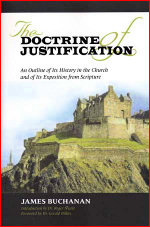
In 1961, the Banner of Truth Trust published a reprint of a book that was then 97 years old. The Doctrine of Justification, by James Buchanan, was originally published in 1867. The first Banner reprint in 1961 carried a Foreword by J. I. Packer in which Packer wrote this:

It is a fact of ominous significance that Buchanan's classic volume, now a century old, is the most recent full-scale study of justification by faith that English-speaking Protestantism . . . has produced. If we may judge by the size of its literary output, there has never been an age of such feverish theological activity as the past hundred years; yet amid all its multifarious theological concerns it did not produce a single book of any size on the doctrine of justification. If all we knew of the church during the past century was that it had neglected the subject of justification in this way, we should already be in a position to conclude that this has been a century of religious apostasy and decline.
It's been some 44 years since Packer wrote those words. And now the doctrine of justification by faith is under attack on several fronts within the evangelical movement. After multiple generations of near total silence on the subject, evangelicals are not well-equipped to defend sola fide.

The ecumenical movement represented by the "Evangelicals and Catholics Together" (ECT) document has made serious inroads into evangelical churches for precisely this reason: the inaccurate and watered-down notion most modern evangelicals have regarding justification by faith really isn't all that different from Medieval Roman Catholicism. The typical evangelical these days doesn't understand the doctrine of justification well enough to see how profound and important the difference is between what the Reformers taught and what the Roman Catholic Council of Trent declared. Try this if you don't believe me: Read the council of Trent on justification to the typical evangelical; don't tell him what it is; and in all likelihood, he will think it is perfectly sound.

In fact, that is pretty much what ECT implied, and what some evangelical leaders are now expressly saying: Luther and the Reformers got it wrong. Some actually claim that everyone since the time of Augustine has badly misunderstood what the apostle Paul meant when he spoke of justification by faith. Various New Perspectives on Paul and the doctrine of justification by faith have had a surprising and dismaying influence in Reformed circles, where you would expect men to understand and fight for the central, defining doctrine of the Protestant Reformation.

It seems to me that Paul's teaching on justification by faith is neither as obscure nor as difficult to follow as the new breed of New Testament scholarship wants to pretend. Romans 3-4, Romans 5, Romans 8, Philippians 3, and many other key texts on justification are as clear and definitive as anything in Scripture. Taken together, they give us an understanding of justification by faith that is the ideal anchor and the perfect centerpiece of a comprehensive biblical theology. It is my contention that proper exegesis of all the biblical texts will definitively prove the principles of sola fide, the imputation of Christ's righteousness, the forensic nature of justification, and every other key point that was under dispute in the Protestant Reformation.

But perhaps the best, most pointed, most explicit single text that sums up Paul's view of the evangelistic message most clearly is 2 Corinthians 5:21: "He hath made him to be sin for us, who knew no sin; that we might be made the righteousness of God in him."

Starting next week (in a series of posts I have been planning and promising and hoping to get to for the past few months) we'll delve into that text and examine how Paul himself boiled evangelical truth down to its bare essence.

Phil's signature

Addendum:

So as not to bury this post over the weekend, here, earlier than ever, is—

Your weekly dose of Spurgeon

The PyroManiacs devote space at the beginning of each week to highlights from The Spurgeon Archive. The excerpt that follows is from "The Heart of The Gospel," one of five sermons Spurgeon preached on 2 Corinthians 5:21. This message was delivered 18 July 1886 (a Sunday norning) at the Metropolitan Tabernacle:


The Most Fundamental of All the Fundamentals

The great doctrine, the greatest of all, is this, that God, seeing men to be lost by reason of their sin, hath taken that sin of theirs and laid it upon his only begotten Son, making him to be sin for us, even him who knew no sin; and that in consequence of this transference of sin he that believeth in Christ Jesus is made just and righteous, yea, is made to be the righteousness of God in Christ. Christ was made sin that sinners might be made righteousness. That is the doctrine of the substitution of our Lord Jesus Christ on the behalf of guilty men.
C. H. Spurgeon


13 July 2006

When an apostle "gets hot"

by Dan Phillips

Beginning my read-through of 1 Corinthians, I was struck by the apostle's tone.

Paul is writing to a problem-church. They are messed up, from Dan to Beersheba. They're schismatic, they're elitist; they've got some people who are confused about the resurrection, they've got others who get drunk at Communion (-- must be that curiously strong first-century grape juice). They've even got a guy having an illicit relationship with his dad's wife, and the goofs at New Life Abundant Dynamic Impacted Living Worship Center of Corinth wear it as a badge of courage. They're a mess.

And yet the apostle starts the letter off in gracious, patient tones. Hear him from that perspective:

Paul, called by the will of God to be an apostle of Christ Jesus, and our brother Sosthenes, 2 To the church of God that is in Corinth, to those sanctified in Christ Jesus, called to be saints together with all those who in every place call upon the name of our Lord Jesus Christ, both their Lord and ours: 3 Grace to you and peace from God our Father and the Lord Jesus Christ. 4 I give thanks to my God always for you because of the grace of God that was given you in Christ Jesus, 5 that in every way you were enriched in him in all speech and all knowledge— 6 even as the testimony about Christ was confirmed among you— 7 so that you are not lacking in any spiritual gift, as you wait for the revealing of our Lord Jesus Christ, 8 who will sustain you to the end, guiltless in the day of our Lord Jesus Christ. 9 God is faithful, by whom you were called into the fellowship of his Son, Jesus Christ our Lord.
He asserts his apostleship right off the bat, as he commonly does (v. 1). He is going to take them to the woodshed, and that in no uncertain terms. When they get there, Paul wants them to be crystal-clear on who it is who's hauled them out.

But Paul can also afffirm them as called to be holy, as kept and gifted; he can even thank God for them, and wish them grace and peace (vv. 2-9). That is a gentle beginning. He's holding the rod behind his back, to be sure. The admonition and sarcasm and pleading are coming. But he sets the stage in a gentle, conciliatory way. It's brothers and sisters Paul will confront.

This opening is basically like all of the apostle's letters' beginnings. All except one.

That "one" would be Galatians.

I have often said that anyone who reads Galatians 1:1ff aloud in sonorous, sepulchrally ecclesiastical tones, thereby does the letter, the apostle, and the hearers a great disservice. The apostle did not write calmly. He was perfectly rational, perfectly in control -- but he was hot. His letter starts off like a slap in the face. Notice what is there, and (almost more importantly) what is missing, in his opening words in Galatians:
Paul, an apostle—not from men nor through man, but through Jesus Christ and God the Father, who raised him from the dead— 2 and all the brothers who are with me, To the churches of Galatia: 3 Grace to you and peace from God our Father and the Lord Jesus Christ, 4 who gave himself for our sins to deliver us from the present evil age, according to the will of our God and Father, 5 to whom be the glory forever and ever. Amen. 6 I am astonished that you are so quickly deserting him who called you in the grace of Christ and are turning to a different gospel— 7 not that there is another one, but there are some who trouble you and want to distort the gospel of Christ. 8 But even if we or an angel from heaven should preach to you a gospel contrary to the one we preached to you, let him be accursed. 9 As we have said before, so now I say again: If anyone is preaching to you a gospel contrary to the one you received, let him be accursed.
Like the other letters, Paul identifies himself and his recipients, and he does wish them grace and peace -- but there the similarity ends.

In other epistles, the apostle (as it were) knocks politely at the door, identifies himself, comes in with a smile, says nice things about the kids, the cats, and the furniture, accepts a cup of coffee, and sits down to have an earnest talk.

Here in Galatians, Paul bellows out his creds, kicks the door in, charges in through the dust-cloud, and starts throwing furniture around. Less Martha Stewart, more Jack Bauer.

No coffee, thanks.

What's the difference? Why the shift in tone?

It isn't that the "issues" in Corinth aren't crucial. It isn't that Paul doesn't feel strongly about them. Read 1 Corinthians, you'll have no doubt of that. In Corinth, they may be a goofy plate of spaghetti, but the apostle evidently has reason to believe that the majority still holds fast to the essentials of the Gospel (cf. 1 Corinthians 15:1ff.).

He is not so sure of the Galatians. He's hopeful (cf. 5:10), but the apostle is clearly very worried for them (cf. 4:11, 20; 5:7). They were foolish, bewitched (3:1) Their trouble isn't elitism, immorality, disorder -- bad as those are. The Galatians' problem is that they are defecting from the Gospel itself (1:6). They are giving attentive ears to a perversion of the very core and essence of what it is to be a believer. If they embrace this perversion, it will send both them and its preachers straight to Hell (cf. Galatians 1:6-9).

This is -- or should be -- instructive to us.

We in public Christendom have our extremes. To the one extreme, of course, are the gleeful fighters. They are represented by the separated brethren of the First Baptist It-Never-Rains-In-August Church folks, who "worship" just around the corner from the First Baptist It-Does-So-Rain-In-August Church. These sorts of folks think WWF is for pansies. They jump into a brawl at the drop of a hat (or the refusal to wear one). There's no lining up such a spirit with imperatives such as those we find in Ephesians 4:1ff., Philippians 2:1ff., and elsewhere.

But at the other end we have the "peace in our time" folks, phlegmatics who think that all this quibbling about doctrinal details is just so much bosh and foolishness. They are far, far above the rabble. They are passionate about their lack of passion, and disdain those who disdain mortal heresy aloud and in public. They consider it bad form, impolite, un-conciliatory.

So this fellow preaches Christ alone as Savior, by grace alone, through faith alone, and the seamless imputed righteousness of Christ as our sole hope of standing before God; but then that other good brother preaches faith too, grace too, Christ too, salvation too -- all sealed and held and maintained by our faithfulness and righteous living. What of it? Both are preaching Christ, are they not? Why get ourselves upset over jots and tittles? Is God such a harsh theological schoolmaster? There are few enough of us as it is. We should be grateful to have such educated, articulate, winsome, influential -- and popular! -- men and women on our side at all. We should not quarrel about trivia. We agree about so much! Let us not exalt the adiaphora.

Count me in as heartily opposed to quarrelling about adiaphora. But the Gospel is not in that category. Eternal life and death is not trivial. If you don't think that way, the apostle Paul clearly did.

Paul sounds angry, does he not, like Jesus in the Temple? But it is the anger of concern, and we see both emotions mixed in his words to the Galatians. Why is it so?

No parent would have trouble understanding what close companions fear and anger can be. We all know of the scene of a mom or dad snatching his careless, wandering child out of the busy traffic on the street, hugging him tight -- and then paddling him, and telling him never, never to do it again.

So some pneumatic phlegmatics can be passive, calm, indifferent and unengaged in the controversies over the nature of the Gospel today. Some of them speak and write as if the Reformation were much ado about nothing. They seem to think it was an unfortunate mistake. They are unwilling to contend for this, the sola Gospel, the heart of the Christian faith. Worse, they instead gladly contend with those who are willing to contend for the Gospel.

I have to conclude that their problem is the opposite of their own estimation. It isn't that they are just so abounding in love that they won't fight. It is that they are bereft of love. For if they truly loved their fellow humans, they'd be unable to rest easy as men and women are sold the poison of a false, damning "gospel" -- no gospel at all, no Good News, but a dyspel, bad news. And if they loved God's Word, they'd never accept seeing its core message perverted and subverted.

And if they loved the Savior, they'd never make peace with His perfect and final sacrifice, His love, and His accomplishment on the Cross cast to the ground, there to be mixed with the dung and muck of human merit.

The apostle was no such pallid, flabby, loveless soul. When the Gospel was perverted and souls endangered, he saw red. Now, that was a man. That was a man of God.

God grant His church more of Paul's mindset today.

Dan Phillips's signature

12 July 2006

An update on where I am right now

by Phil Johnson


Not to complain, but . . .

My life is alternatively either very hectic or completely focused on one extremely stressful project to the exclusion of everything else. Deadlines determine which phase I am in at any given time.

For most of my adult life I have been a book editor. It's been my joy for the past 25 years to edit most of John MacArthur's major books, starting with The Ultimate Priority, which I began in 1981 and took about a year to assemble and edit.

People often ask about the process. I start with sermon transcripts—verbatim records of what John said in a sermon (or a series of sermons, or a collection of various sermons that are topically cross-linked). I translate that material from spoken English to written English. This involves a rather exhaustive process of rewriting—mainly to shorten sentences, simplify and clarify sermonic expressions, make the logic and readability as smooth as possible, and remove the kind of redundancies that are fine (and even crucial for proper stress) in a sermon but bad form in writing. Sometimes I rearrange material or borrow bits and pieces from multiple sermons—which necessitates lots of new transitions. I also remove extraneous material, such as recapitulations of material from last week's sermon; unusual rabbit trails; digressions into related but different topics; comments and exhortations that apply to the local congregation but aren't necessarily appropriate for a reading audience, and things like that. I check the accuracy of all quotations and find precise documentation for them. I substantiate and document all facts. And I get statistics and other specifics to eliminate generalizations.

Oh, and I also try to make sure grammar and spelling are spotless, conforming everything as much as possible to the guidelines in the Chicago Manual of Style (the authoritative style guide used by most American book publishers).

John MacArthur takes the manuscript I produce from his sermons, and he edits it exhaustively. Sometimes, he'll supply new illustrations. Sometimes, he'll totally reorganize material. He might rewrite a few transitions, tone down an expression here and there, turn up the volume on a salient point, delete anything that strikes him as redundant, or whatever. (He does all this by hand with a classy fountain pen in a nearly-illegible kind of printing. I have never known him to use a computer.) His marked-up copy comes back to me and I insert his changes into the electronic manuscript and do a final polish and edit. We normally exchange several chapters at a time this way, so I'm constantly working on two or three sections of the book all at once.

It's a long and exacting process, much more labor-intensive than simply writing a book from scratch would be. But if I wrote my own book, it would be nowhere as good. MacArthur's material is thorough, rich, and always fresh. He has an impeccable instinct for knowing what to say and how much stress to give this or that point. The biggest problem I usually face is deciding what to eliminate from the original sermons. Because the publisher usually wants a 250-page book, and I'll typically start with something close to 1600 pages of sermon transcripts.

So you get an idea of the magnitude of the task.

After the first three or four books I helped assemble like that in the 1980s, I became pretty efficient with the process, and for several years running, I was usually able to get a major book from sermon transcripts to final manuscript in about 3 months' time. But that was back when I had the mental acuity to work 18-hour days with no problem. Nowadays, in addition to keeping an eye on my duties at Grace to You, I'm co-pastoring a group of 500 people at Grace Church and occasionally speaking at conferences and whatnot. I wasn't doing those things in the 1990s.

Longtime readers might remember that the original PyroManiac blog was launched last year just days after I finished editing Twelve Extraordinary Women. Then I took a blogbreak in October to edit The Quest for Character. The cycle never ends.

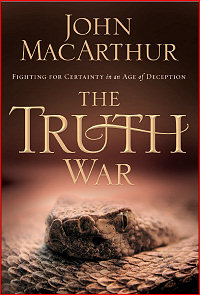
When I made the shift to a group blog back in January, it was largely in anticipation of a coming deadline for John MacArthur's next major book, The Truth War. At the time, I assumed I'd be finished with the book by April 15 at the very outside.

It turned out to be a much more difficult project than I anticipated, and I just sent the final manuscript off to the publisher last night. So that's a major source of stress off my shoulders. I have several urgent things to do now. (Lots of stuff backed up while I was focused on the book. It'll take at least a week to do them all.) But after that, I'll be back in a more normal routine and blogging like old times, I hope.

About the book . . .

The Truth War is going to be a powerful, and very controversial, book.

Actually that may be a huge understatement. It is without question the most provocative book John MacArthur has written since The Gospel According to Jesus. It deals in no-holds-barred fashion with "postmodern evangelicalism," the Emerging Church, the deliberate dumbing-down of theology, and the trivialization of everything sacred.

The book's starting point is Jude's famous mandate to contend earnestly for the faith because false teachers have crept into the church unnoticed. MacArthur traces the history of the long war against the truth and shows why the threat is so serious at this particular juncture. He says some things that might shock readers accustomed to the milder and more genteel tone of this blog. 'Nuff said.

The book is scheduled for release from Thomas Nelson next spring. When we get closer to the release date, I'm going to start posting short excerpts at the PulpitLive blog. Brace yourself.

Meanwhile...

As I said, I have let a few things back up that now require my urgent attention. I hope to be back on schedule within a week or two, and back to blogging in earnest shortly thereafter.

In the meantime, I've added to the sidebar clutter by putting a box that I can update every few days or so to keep my friends perpetually updated on the vital question of Where I Am Right Now®. I'll usually make updates without comment, but I wanted to make an all-purpose disclaimer that covers everything you'll ever see in that box: The fact that I read a book, listen to something on my iPod, or otherwise link to any source in that space is not to be construed as an unconditional endorsement of anyone or anything. The sidebar box just tells you what I'm reading, listening to, watching, or being bemused by.

For example, Ann Coulter. The girl clearly has serious issues, and one of them has to do with the credibility of her "profession of faith." I'm not sure she is the best qualified person to take the American left to task about their spiritual shortcomings. I find her trademark trenchant style alternatively amusing and annoying. But she does make some valid observations in an always-interesting way, so I am reading the book. What I read and what I endorse are not always equipollent.

So just in case the next book I read is Richard Foster's latest, something by Lesslie Newbigin, the sequel to Blue Like Jazz, Mein Kampf, or whatever, I'm not going to add another more emphatic disclaimer every time. If you see I'm reading a book or listening to something you think I ought to disagree with, chances are I do disagree with it. I read lots of stuff I disagree with. If I disagree strongly enough, and if circumstances seem to warrant it, I may blog about why I disagree. But if I don't, please assume that this all-purpose disclaimer covers it.

Maybe one of these days I'll devise a color scheme to signify which books I hate, but until I have actually read them, I can't really say if or how much I hate them anyway, can I?

Phil's signature

11 July 2006

Poorly-equipped, but well-placed (plus an aside on Christian reading and preaching of the OT)

by Dan Phillips

On my recent trip to the Eastern Sierra Nevada, I took reams of photos (you can see just a few here). On my last evening, I was strolling by a creekside looking for some fauna to add to my shots of flora, and saw this little fellow:

As you can see, he was having a fairly leisure look at me. And why shouldn't he? I'm sure I was an interesting study to him, and he could safely gaze on.

Why "safely"? He has no natural defenses against me, of any consequence. He's not large, he hasn't the bear's massive, devastating paws, nor the rattler's agonizing venom, nor the lion's crushing jaws. (Well, he does have my well-grounded fear that he might have some pestilential disease -- but he doesn't know that.)

Nor was he the only student I encountered. Here's one of his fellow-observers, gathering a few notes for his term-paper:



They and the others like them had one thing in common. When I advanced a bit closer, to get a better picture -- and how many good pictures have I lost, trying to get a better picture? -- they'd vanish. They'd disappear somewhere into their little rock fortress.

And that, of course, was their security, it was their deliverance, their defense. Nothing in themselves. Just the fact that they'd picked an impregnable place to make their abode.

As I reflected, my mind turned to the verse in Proverbs 30:26, quaintly rendered thus in the KJV: "The conies are but a feeble folk, yet make they their houses in the rocks." Here are the comments of the great man himself, Charles Spurgeon, from his evening devotional for November 20:

Conscious of their own natural defencelessness, the conies resort to burrows in the rocks, and are secure from their enemies. My heart, be willing to gather a lesson from these feeble folk. Thou art as weak and as exposed to peril as the timid cony, be as wise to seek a shelter. My best security is within the munitions of an immutable Jehovah, where his unalterable promises stand like giant walls of rock. It will be well with thee, my heart, if thou canst always hide thyself in the bulwarks of his glorious attributes, all of which are guarantees of safety for those who put their trust in him. Blessed be the name of the Lord, I have so done, and have found myself like David in Adullam, safe from the cruelty of my enemy; I have not now to find out the blessedness of the man who puts his trust in the Lord, for long ago, when Satan and my sins pursued me, I fled to the cleft of the rock Christ Jesus, and in his riven side I found a delightful resting-place. My heart, run to him anew to-night, whatever thy present grief may be; Jesus feels for thee; Jesus consoles thee; Jesus will help thee. No monarch in his impregnable fortress is more secure than the cony in his rocky burrow. The master of ten thousand chariots is not one whit better protected than the little dweller in the mountain’s cleft. In Jesus the weak are strong, and the defenceless safe; they could not be more strong if they were giants, or more safe if they were in heaven. Faith gives to men on earth the protection of the God of heaven. More they cannot need, and need not wish. The conies cannot build a castle, but they avail themselves of what is there already: I cannot make myself a refuge, but Jesus has provided it, his Father has given it, his Spirit has revealed it, and lo, again to-night I enter it, and am safe from every foe.
Those are some blessed, wonderful truths, are they not? And every word is true.

But Spurgeon's meditation also poses an example, both instructive and cautionary, of how to handle the Old Testament.

As an example of a kind of trope, it's a beauty. I am using trope here to indicate where one observes a thing, and turns from it to a tangential yet somehow-related truth. It treats something literal as a point of departure on the way to something larger. One is no longer commenting on the thing itself, the literal object or occurrence, but on the truth suggested by the thing. The result is neither a study nor interpretation of the thing-in-itself, but of that to which it is taken to point.

So here, Agur is treating of "Four things on earth" that "are small, but they are exceedingly wise" (Proverbs 30:24; cf. vv. 24-28). In verse 26, he mentions the "coney," or hyrax or rock badger. Koehler-Baumgartner identifies it as the Heterohyrax syriacus, a little creature ideally designed to make its living among the rocky outcroppings found in abundance from the Dead Sea valley to Mount Hermon (cf. Waltke's commentary on Proverbs).

Now, here's the interpretive issue: is Agur really writing about hyraxes, about rock badgers? Or is he really writing about Jesus, and the Christian church? Is it legitimate to do as Spurgeon does? If we were to preach on this passage, should we dress like Steve Irwin and give a bonzer nature talk, or should we wear our black robes and speak only of "spiritual" matters, because details of creation are un-spiritual and beneath the Christian's notice?

The latter approach would characterize perhaps the worst of that school of interpretation which advocates the "take any text, and make a bee-line for Christ" school. Though nobody bee-lines more profitably than he, I believe I've read Spurgeon say as much. The sorts of Scriptures cited to validate this approach include Luke 24:44-49 and the like.

As I don't mean this to be a fourteen-volume essay, let's cut right to what I see as a most problematic with this way of handling Scripture: it runs the risk of being more Platonic, or even borderline Gnostic, than Christian. The unspoken assumption is that speaking of something literal, something of this creation, is low and unspiritual and unworthy. It is "more Christian" to turn from the literal to Christ.

But what is wrong with creation qua creation? To my reading, literal rocks-and-branches/nails-and-fur creation itself does speak of Christ itself. It proclaims the reality and glory of God (Psalm 19:1-6; Romans 1:20). All things -- including hyraxes -- are from Him, through Him, and unto Him (Romans 11:36). Every last atom and molecule of literal creation itself without exception was fashioned through the agency of Christ (John 1:3), all was created by Christ and for His sake (Colossians 1:16), all things now cohere in Him (v. 17), and He is carrying all things towards their designed end (Hebrews 1:3).

So, while the lilies, the birds and the grass may and do of themselves point to spiritual lessons (Matthew 6:26, 28, 30), they do not thereby cease being lilies, grass, and birds -- as if items of creation are evil or anti-spiritual in themselves. When we're warned not to love the world (1 John 2:15), it isn't God's good creation that is the danger, but our sinful corruptions of it (v. 16). Christ's resurrection body was a spiritual body (1 Corinthians 15:44), but it was a spiritual body, as literal and physical as the words naturally indicate (Luke 24:37-43).

So in our reading, our interpretation, and our preaching, we dishonor God if we "go nuts" in either direction. If I preach on passages like Proverbs 30:26 in such a way as to give an impression that Agur himself was thinking and writing of Jesus Christ and New Covenant Christians, and not in any way of rock badgers, then I am heading off in the direction of trying to be more spiritual than God. The human author is destroyed, and we no longer have a man being carried by the Holy Spirit and speaking confluently from God (2 Peter 1:21). He is replaced by a disembodied echo, a pen floating in midair, writing ethereally "in code." I cripple my audience, because I convey to them (however unintentionally) that they cannot really read the Bible itself without my special help, without a decoder-ring. Nothing is as it seems, and the rules of grammar and context no longer apply.

Of course if I err in the other direction, I may give the impression that the Bible is little more than a field-book for naturalists or antiquarians, and a quaint and dated one at that. We would then read it as we would gaze at an item in the museum. It would saying something of itself, but nothing to us.

Down to brass tacks, then. Is Agur writing consciously of the safety of the Christian in Jesus Christ, crucified, buried, and risen? No. But is he writing merely of the safety of a rock badger in its craggy home? Again, no. He is writing of rock badgers, of ants, of lizards -- but they are specimens taken from the wise man's laboratory, which is God's creation. And that creation itself is instructive. It legitimately points away from itself to its Creator and, viewed rightly, it teaches of Him.

And so the little hyrax teaches us that even a brute animal is smart enough to know its own weakness, and rather than standing in that weakness, it finds a safe place to live, feed, and hide. Does this speak to us? Indeed it does, for we are weak, we are defenseless, we are vulnerable. It is our wisdom to flee from ourselves to the Rock that is higher than we (Psalm 61:2), to the name of Yahweh, which is a high tower to His people (Proverbs 18:10).

And from our perspective, with the advantage of the completed, inerrant, and sufficient written revelation of God, we know that rock to be Christ (cf. 1 Corinthians 10:4), in whom by God's sovereign grace we have all that we lack in ourselves, and all we most deeply need (1 Corinthians 1:30).

So Agur is speaking indeed of rock badgers; and rock badgers speak of Christ. For our thinking and preaching to honor our Creator God, we must reflect on, and reflect, both aspects.

Dan Phillips's signature

10 July 2006

Cran Berry Sauce

by Frank Turk

And when the night is cloudy,
There is a light that shines on me,
Shine until tomorrow, let it be.


That's as close to Catholic as you're going to get from me. Sorry.


09 July 2006

God's glorious goodness

Your weekly dose of Spurgeon
posted by Phil Johnson

The PyroManiacs devote space at the beginning of each week to highlights from The Spurgeon Archive.


The following excerpt is from the sermon "A View of God's Glory," a sermon Spurgeon preached very early in his ministry (probably around 1856-57), but it was not published as part of the Metropolitan Pulpit until 1908.

What attribute is God about to show to Moses? His petition is, "Show me thy glory." Will he show him his justice? Will he show him his holiness? Will he show his wrath? Will he show him his power? Will he break yon cedar and show him he is almighty? Will he rend yonder mountain and show him that he can be angry? Will he bring his sins to remembrance, and show that he is omniscient? No; hear the still small voice—"I will make all my goodness pass before thee." Ah! the goodness of God is God's glory. God's greatest glory is that he is good. The brightest gem in the crown of God is his goodness. "I will make all my goodness pass before thee." There is a panorama such as time would not be long enough for you to see.
C. H. Spurgeon