by Dan Phillips
The recent discussion over N. T. Wright, and some of the frankly off-base comments in that thread, jogged some memories and stirred some thoughts.
After the Lord saved me in 1973, the first real Biblical scholar I remember reading was F. F. Bruce. Most of you will know the name. If you're  old enough, you'll know that particularly in the '70s and '80s, it was "cool" to be able to name Bruce as "one of us." He was reputed to be both an evangelical and a first-rank scholar.
In my little experience of him, he was also a very nice fellow. I had been absolutely bowled over by the man's body of work. It seemed has if he'd written on everything, had scholarly "chops" both in Old and New Testament, and all his work was meticulously footnoted and detailed and sourced and painfully precise. In Answers to Questions (Zondervan: 1972), the sort of book I devoured as a new believer, he answered all sorts the widest variety of questions. (Much later, I realized that many of the answers were very... wriggly.)
So I wrote Professor Bruce over there in England, myself being around 18 years old and just getting my Biblical feet under me. I told the professor that I couldn't believe that he was just one man. No, he had to be a committee of scholars writing under a pseudonym. Otherwise, how could he do it?
To my delighted startlement, Professor Bruce actually took the time to answer me. He assured me he was an individual. "My name is not Legion, for we are not many," he added wryly. Then he gave me a priceless bit of advice. "How do I do it?" he mused, to my question. Then he said he'd never stopped to think about it. He supposed it was a matter of "filling up odd moments." That very practical little nugget has helped me ever since.
But as I grew in my studies, I began to wonder about Bruce's own convictions. I was learning about Biblical criticism, and liberalism, and some of his writings left me a bit unsettled. He characteristically couched everything he said, hedged, cited this or that scholar, or the "early Christian community's" beliefs. He often seemed evasive. What did he believe?
I naively asked him if he believed the Biblical books were "authentic." He replied that, if I meant were they "authentic witnesses to Christ," then yes he did. I realized I'd left some weasel room... and he'd leapt for it. (I was learning about talking to "academics.")
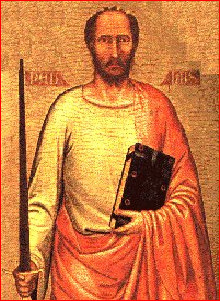 So I wrote and asked him point-blank who wrote the Pastoral Epistles, and the like. I came to learn that he did not accept the Bible's attribution of the Pastorals (among others) to Paul, nor various other straightforward canonical evidence. He had a fairly standard liberal line, but he seldom came out with it in his writings, which evangelicals like me bought prodigiously.
At the time, I was disappointed. But years later, my disappointment turned to real sadness as I read Bruce's Paul: Apostle of the Heart Set Free, from 1977. Published when Bruce was in his late 60's, this should have been the seasoned product of decades of immersion in the text of Scripture. Surely years of deep Pauline studies had touched the heart of this evangelical scholar.
Yet what I found was constant, once-removed, third-person academicisms. Still, one could read between the lines; and what one read was not heartening. Bruce saw Paul and Luke as disagreeing with each other, he batted about what the early Church believed about Scripture rather than what it says; in fact, Bruce did not seem to think that the meaning they took from OT texts was legitimate.
Since Bruce wrote the book, of course it had a wealth of good academic information. What it didn't have was heart, contrary to the title. No proclamation, and a troubling concern about and from the wrong side of issues from Paul -- usually between the lines. Since Bruce rejected Pauline authorship of some of the apostle's last and most passionately personal letters, a fair bit was left out of the portrait of the great apostle.
Now, back more broadly to the issue of academics. Going just by the interview, I continue to grow in my sense of the mass of frustrating confusion that evidently is N. T. Wright. Consider:
What Wright says about anastasis is just wonderful, right-on. His defense of the eyewitness character of the Gospels, and his broadsides at Bultmann and his ilk -- simply delightful. But then it comes down to some "touchy" issues, and he waffles, is diffident, double-spoken, tepid.
Wright's defenders say, "Oh, sticklebats. That's just how academics talk." So... academics get a "pass" from being Christians 24/7? And besides, what's that word that comes before "Wright"? Isn't it "Bishop"? What's that mean? What are the office-hours for a "Bishop," anyway? Did he do the interview in his "off" hours?
I've done academics, I've got some dusty "creds," I guess; taught beginning and advanced Hebrew in seminary, Old Testament Theology elective, and this and that here and there. But I never got the idea that my discipleship ended when I opened a book, or stood behind a lectern. No one ever explained that doing academics gave me a "pass" from being passionately gripped by a Biblical worldview.
Here's the Christian vision: "The earth is the LORD's and the fullness thereof, the world and those who dwell therein" (Psalm 24:1). God is not confined to a ghetto. It's all His property -- everything, material, spiritual, conceptual. There is no atom in all the universe that is not His possession, not His by right, does not own Him as its master. Or else the Bible is nonsense, and you shouldn't bother with it.
Historiography? God's. Lexicography? God's. Theology? God's. Higher criticism, lower criticism, middlin' criticism? God's. See the pattern?
Consider the attitude that speaks thus: "Well, that's all very nice, but to be an academic, to speak and walk in that world, one must put aside one's religious convictions, and concern oneself objectively with facts, not faith."
That's an urbane way of saying, "You know all that Bible stuff? Nonsense. Sheer bosh and fairy-tales."
Am I making a naive or obscurantist statement? I don't think so. While the Bible bears the marks of its human authors (it is "letters" and "Scripture"; 2 Timothy 3:15, 16), it is unlike any other book in that it is theopneustos, God-breathed (2 Timothy 3:16). It claims to present God's words from the first verses to the last.
Now, with all due apologies to pomo's (i.e. none), this is a categorical statement. It is true, or it is false. And in approaching the Bible, we approach it as necessarily what it claims to be, or not necessarily. For all intents and purposes, "not necessarily" = "not."
What about being all things to all men? That's potentially the subject of a much longer post, and probably by a better man than I (Phil?). But I do note that in Athens (Acts 17), Paul was able to  hold his own with the philosophers, and quote some of their own writers from memory. Yet they knew he preached Iesous and Anastasis (Jesus and the resurrection), and they had no doubt that he was making an authoritative proclamation to them.
Now, I can hear objectors sputtering, "So you are saying that a man should warp and twist the evidence to fit his religious convictions?!" That is in fact exactly what I am not saying. Think: that charge rests on the premise that the Bible is not what it claims to be.
Think further. If I have to twist and hide facts to treat the Bible as the Word of God, then it isn't the Word of God. I'm deceiving... someone. Myself, my readers; someone.
But equally, if the Bible is what it claims to be, and I speak of it as if it is not, it is then that I am twisting facts and being deceitful.
I don't really see any way around it. Read Matthew 22:34-40 carefully. Find me an exemption-clause for academics. In what settings should one love God will less than his whole heart and mind and soul and strength? In what interview-settings should one not be lovingly concerned for the souls of his interviewer and listeners? How could not being ready to answer the question, "What must I do to be saved?" possibly be seen as a positive Christian quality?
If you and I are not striving to be genuine Christians fulltime and everywhere, will we be genuine Christians anytime, or anywhere?




 Jeff is a reader of


 Someone recently asked me how long I can go on posting Spurgeon's comments about modernism. "Do you really believe the trends Spurgeon fought against were the same kind of thing as today's postmodern, post-evangelical, 'emerging' approaches to Christianity?" my friend asked.
 The school of modern thought laughs at the ridiculous positiveness of Reformers and Puritans; it is advancing in glorious liberality, and before long will publish a grand alliance between heaven and hell, or, rather, an amalgamation of the two establishments upon terms of mutual concession, allowing falsehood and truth to lie side by side, like the lion with the lamb.
 Cast your vote for:

 When can it be said of us, that we corrupt the Word of God in the present day? What are the rocks and shoals which we ought to shun, if we would not be of the "many" who deal deceitfully with God’s truth? A few suggestions on this head may not be without use.

 The following post is borrowed from
  In the early part of the 20th century liberalism took mainline Protestant churches by storm.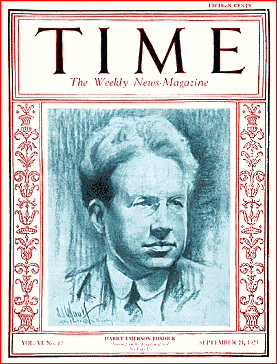
 Before I go on, let’s be clear that when we first become disciples of Christ and not just members of the local religious club we are all wannabes. As I remember my conversion experience, it was a pretty heady thing. And I wanted to try everything – try being in the choir (be glad you missed it), try being a teacher (which, if your church is right-minded, it does not let new believers do), try being a greeter (as if I was that nice in person), etc. Again, if you have decent elders and discipleship going on in your church (and that’s what I think I had when I first came to the church as a disciple), there’s nothing wrong with this if it is contextualized or moderated with the end of true discipleship in mind. It’s fine to see all the places at the dinner table, but in the end you should sit in one seat and not handle everyone’s silverware for them.
 In that context, I want to consider an example as generically as possible. Let’s imagine that there’s a work going on in Central America which is seeking out, sheltering, educating and discipling abandoned children. It’s heart-rending when you see these kids on the videos – absolutely devastating. You can see them sleeping huddled together in trash heaps at night to keep warm – any night of the week, but particularly in the video you are watching. And in the video, you see a lot of American youngsters who flew down there to spend a week doing part of that work – fishing these kids literally out of the trash and placing them in a new home and with a new lease on life.
 Now, what you spend to get down there is more like $2000 after you get your shots and buy your tickets – and if this is your first trip out of the country, you also buy luggage, so maybe you spend $2500. And about 4-6 times a year (on average), a plane load of about 30 people make this trip down. So for the cost of about $75,000, they provide this mission with about $15,000 in services which the mission could probably have purchased for about $7500.
 Here is what would make more sense: the first plane load of folks down – they stay for the whole year. Net cost: $75,000, plus room and board at EL Salvador standard. Then the next 4 plane-loads of folk should simply send their $75,000 per plane load for a net $225,000 in cash for the mission – which is a lot of money in El Salvador. But what that would mean is that 3/4th of the people who were going to vacation in El Salvador would simply have to do something for the sake of the Gospel rather than the sake of their experiences and make a personal sacrifice. And the ones who go down for the year? Dude: they are spending a year off from work in a country that’s like a discarded suburb of Miami (which I don’t think is a nice thing to say) in terms of climate and habitat, making a personal sacrifice for the Gospel work. And like Paul in Corinth, they have the chance to live for the sake of the Gospel.
 Is it not very possible for a man to talk without knowing what he is saying?


 What has kept me the busiest this week has been the soon-to-be-launched
  There's a great answer to that, so follow along with me. The first reason is this: who really clicks through the blogroll? Y'know, for example, on the days when I post at TeamPyro, I get a bump of 300-500 clicks from here, but on the off-days, I get between 100 and 250 clicks. And I have a fan base due to my endless hobby of self-promotion. How many of you have recently (or ever) clicked on Scott McClare's blog, or Reid Ferguson's blog, or Loki Odinsson's blog? These are all great blogs that people ought to be reading because they are inside the fence and they are talking about things that matter to the Christian life.
 And hear me clearly: these blog ought not all to be Th.D. dissertations or abstracts. They should be accessible to the readers of blogs and relate to the things blog readers are thinking about and living in. That's not a wild concession to culture or a call to be relevant: it's a fact that discourse about the subtle lexical nuances of the Greek in John 6 has only the most remote meaning to those people surfing the blogosphere – but that the content of John 6 has application to the guy at work who reading this blog and wondering if there is any hope for this world.
 My closest and most enduring friend (for some 35 years now) is Steve Kreloff, who for nearly 25 years has been the senior pastor of Lakeside Community Chapel, Clearwater, FL. They've been experimenting with radio for the past year or so, and I've encouraged them to expand the outreach of that ministry by podcasting. Podcasts aren't available yet, but you can listen online at


 Man, that was cold. All-good? No? Hunh. Let's see....
 Surely that has me sorted out for you. No?