Our church has an annual Sunrise Service, 6:30a.m. the morning of Resurrection Day. We meet out front under a massive oak tree. We always have a decent turnout, though I'm a bit bewildered each year to see a lot of people who don't usually attend our church turn up for the Sunrise Service, then not return for the full morning service.
At any rate, it features a briefer message, shouted to be heard over the traffic, not recorded. This is a post-ized version of this year's Sunrise Service.
Let's suppose a person who hasn't read the Bible, and doesn't much know what’s in it. That isn't so hard to imagine, these days, is it? (Some of you are saying "Yeah, in fact I know a pastor like that." Behave.)
So let's say this Biblically-untaught person was told that God would send His Son to solve the dilemma of our planet — what kind of scenario might he come up with? What script might he write? It isn't too hard to imagine, I think.
Our Script
The Elements In Our Script. It's easy to envision three scenarios:
Scenario One: In this version, God the Son assumes a Christophany, a temporary appearance in human form. He rides down to earth in a chariot of fire, conquers all the sinners, and sets up His kingdom. And there we have our happy ending!
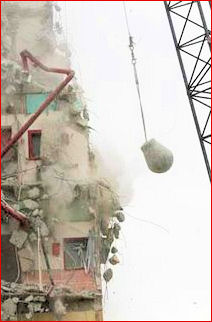
Scenario Two: Perhaps our tale-weaver is aware of Christmas, so in the second version, God the Son indeed takes on human flesh, and is born...into the family of a wealthy, influential nobleman. It's one of the leading families in Israel, so He grows, winning partisans from the nation, amassing a huge following made up of Jews and Gentiles alike.
Then, when He reaches manhood, He declares Himself King, smashes Rome, conquers all the sinners and sets up His kingdom. And there we have our happy ending!
Scenario Three: In this telling, God the Son doesn’t go anywhere. Why should He? He’s God the Son! He doesn’t have to leave His throne to get this done!
So, from His throne in Heaven, the Son of God simply exercises His power, conquers all the sinners and sets up His kingdom. And there, once again, we have our happy ending!
The Results Of Our Script. Now that you've read those all over, can you pick out the one recurring phrase in all three scenarios that poses just one itty-bitty problem for us, for you and for me?
It’s where I said, each time, “…conquers all the sinners and sets up His kingdom”
So here's the problem: How many of us are sinners? Correct: 100%.
We know that sin is a big deal to our holy, righteous God. So if we're going to avoid being conquered, we have to do something about our sin. What can we do? Repent? Lovely thought, but it won't do anything about past sin. If I owe you $500000, then say I'm sorry, I still owe you $500000.
So how about if I become perfectly righteous and never sin again? That won't work, since that is what I was supposed to be all along.
Shall I offer a lamb or an ox? Can the blood of bulls and goats take away sin? No.
What this means, then, is this:
- Who would He have had to “conquer,” to set up His kingdom? Everyone. You. Me. All of us.
- Who would be left to populate His kingdom? No one. Not me. Not you. None of us.

God’s Script (Philippians 2:5-11)
This script unfolds in two grand movements.Christ Humbled Himself (vv. 5-8). So far from riding in as conquering King, Christ lowered Himself to a virtually unimaginable degree, and that in two ways:
By incarnation (vv. 5-7).
Have this mind among yourselves, which is yours in Christ Jesus, 6 who, though he was in the form of God, did not count equality with God a thing to be grasped, 7 but emptied himself, by taking the form of a servant, being born in the likeness of men.
 Incarnation was not a promotion for the Logos. It was a step down of infinite degree. But that isn't the full extent of it.
By crucifixion (v. 8).
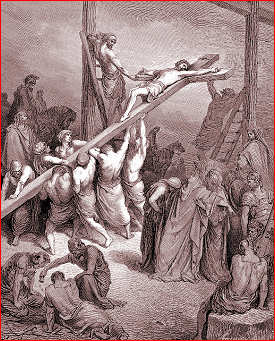
And being found in human form, he humbled himself by becoming obedient to the point of death, even death on a cross.
He died a death of such obscenity that Roman citizens wouldn't mention it in polite company, a death experienced only by the lowest, most contemptible dregs. A Roman would no more wear a cross around his neck than we would wear an aborted fetus or some other obscenity around ours.
Yet this is what He did, because this was the only way to deal with the sin problem. [I developed this theme much more fully in the morning service, a sermon titled Easter Certainties.]
God Exalted Christ (vv. 9-11).
Therefore God has highly exalted him and bestowed on him the name that is above every name, 10 so that at the name of Jesus every knee should bow, in heaven and on earth and under the earth, 11 and every tongue confess that Jesus Christ is Lord, to the glory of God the Father.
As a consequence of His death on the Cross, Jesus Christ won the right to give repentance and saving faith to His people, to give forgiveness of sins, and to grant eternal life. And because of the suffering of death, He will indeed will rule and reign.
 And the only reason the God-man can do that is because of the DISASTER of the Cross! It is as Herbert Schlossberg said: “The Bible can be interpreted as a string of God’s triumphs disguised as disasters” (Herbert Schlossberg, Idols for Destruction, p. 304, quoted by Doug Wilson).
The greatest disaster in all of history was the crucifixion of Jesus. And yet, that greatest disaster is the key and foundation to the ultimate victory! That is God's scenario.
So what happened on Good Friday was God’s plan, what happened on holy Saturday was God’s plan, and what happened on Resurrection Sunday was God’s plan. We serve a crucified, buried, and risen Savior. And because He is all that, we are citizens of His coming kingdom.
All because of Jesus' triumph in disguise.



 an is not delivered from the bondage of his sins without a price. No one goes free by the naked mercy of God. Every captive exposed to God's vengeance must be redeemed before he is delivered, otherwise he must continue a captive.
 Who Killed Jesus?
 The murder of Jesus was a vast conspiracy involving Rome, Herod, the Gentiles, the Jewish Sanhedrin, and the people of Israel—diverse groups who were seldom fully in accord with one another. In fact, it is significant that the crucifixion of Christ is the only historical event where all those factions worked together to achieve a common goal. All were culpable. All bear the guilt together. The Jews as a race were no more or less blameworthy than the Gentiles.
 The designs of those who killed Christ were entirely murderous. They are by no means exonerated from their evil, just because God's purposes are good. It was still the act of "lawless hands" (Acts 2:23). It was, as far as the human perpetrators were concerned, an act of pure evil. The wickedness of the crucifixion is in no sense mitigated by the fact that God sovereignly ordained it for good. The truth that it was His sovereign plan makes the deed itself no less a diabolical act of murder.
 The cross is therefore the ultimate proof of the utter sovereignty of God. His purposes are always fulfilled in spite of the evil intentions of sinners. God even works His righteousness through the evil acts of unrighteous agents. Far from making Him culpable for their evil, this demonstrates how all He does is good, and how He is able to work all things together for good (Romans 8:28)—even the most wicked deed the powers of evil have ever conspired to carry out.
 I press on to make the resurrection my own, because Christ Jesus has made me his own. I don’t consider that I can take it by my own power. But one thing I do: forgetting what lies behind and straining forward to what lies ahead, I press on toward the goal for the prize of the upward call of God in Christ Jesus. For me, His resurrection is hope for what I cannot do for myself, but which will bring me the greatest joy in spite of both my failings and my successes. That will be a great day.
 When Jesus and his disciples were near the town of Caesarea Philippi, he asked them, "What do people say about the Son of Man?"