by Dan PhillipsJustin Taylor links to a
shocking video. It depicts Jews preparing, then slitting the throat of a sacrificial animal, and gathering its blood.

You watch it, hearing their ritual in rapid Hebrew, not understanding. But you have this feeling of dread, a horror for what you know is coming. Odds are that you had never quite seen the like, as I hadn't. But you feel it coming, you watch perhaps with a hand to your mouth, wanting to look away, but stopping yourself. The struggling victim, no clue what is coming; bound, prepared, shaved, given some liquid (
sh'teh! sh'teh! — "Drink! Drink!" a speaker urges in Hebrew).
Then the blade slashes, the blood spurts and is gathered, and surprisingly quickly, the victim's struggles subside.

This was
God's ancient pedagogy. From the very start, He taught us all that
sin called for shed blood. He showed this to Adam and Eve in the Garden (Genesis 3:21). Somehow Abel knew it (Genesis 4:4). Shed blood meant death (Genesis 9:6), and shed blood was
the means that Yahweh instituted, for covering and paying for sin (Leviticus 17:11, 14).
This was
God's pedagogy for the nation of Israel. The sight that so shocks us in the video is a sight every Israelite was exposed to from childhood, by divine design. Had they
heard Yahweh, had they
listened and
learned, they would have
known:
sin-blood-life.
Sin can only be atoned for by innocent
life,
life is in the
blood,
blood brings
life and
forgiveness. Violent death of an innocent victim, a substitute on whose head the offerer presses his hand, transferring, marking it as his substitute.
Yet all those animals never really
finish the job. God forgives the believing worshipers... but then they have to bring
another victim. And
another. And
another (Hebrews 10:1-4, 11).
Then God tells Israel that these animals would one day be summed up, fulfilled, in one grand Substitute, a Man who would die for His people and bring
final and lasting peace and atonement (Isaiah 52:13—53:12).
That Man comes. Many reject Him, many do not. He dies. God removes the Temple. No more sacrifices
according to the prescription of the Law are even
possible. As if embarrassed (but not humbled), the nation fabricates substituted traditions, works, programs, rituals. The reality has come, but they keep trying to pencil in shadows.
It is like a child that ignored its entire childhood instruction.
Blood is necessary for atonement; it
would be offered, it
has been offered. But the lesson was not heard.
Don't feel smug, Gentile reader, Christian reader. From our own numbers, from professed "evangelicals," there are plenty who
just as badly — more badly — miss the point.

Imagine that, instead of watching a video of an animal's death, you somehow saw this day, nearly 2000 years ago. Imagine that, instead of that animal, you were watching
Jesus Christ at last night's supper, at prayer in the garden, arrested, subjected to mock-justice, condemned. Imagine you were watching him being beaten and whipped, and led away.
Imagine the sick, nauseated, worsening clench in your gut as you saw Him stagger off, carrying the cross. You want to tear your eyes away. You want to make it
stop. You want to scream "Stop! STOP! This is
wrong!"
Yet He goes. He hangs. He bleeds. He dies. He is buried.
Why such an ugly, horrid death? Why, if penal, substitutionary,
blood atonement were not
indispensable for our salvation? Do we dare shake our heads at Jews who don't "get" the millennia of instruction?
Best not to mock, while such folly is tolerated in our numbers.
Alas! and did my Savior bleed
And did my Sovereign die?
Would He devote that sacred head
For such a worm as I?
Refrain
At the cross, at the cross where I first saw the light,
And the burden of my heart rolled away,
It was there by faith I received my sight,
And now I am happy all the day!
Thy body slain, sweet Jesus, Thine—
And bathed in its own blood—
While the firm mark of wrath divine,
His Soul in anguish stood.
Was it for crimes that I had done
He groaned upon the tree?
Amazing pity! grace unknown!
And love beyond degree!
Well might the sun in darkness hide
And shut his glories in,
When Christ, the mighty Maker died,
For man the creature’s sin.
Thus might I hide my blushing face
While His dear cross appears,
Dissolve my heart in thankfulness,
And melt my eyes to tears.
But drops of grief can ne’er repay
The debt of love I owe:
Here, Lord, I give my self away
’Tis all that I can do.
Isaac Watts, 1707
(There is a companion-piece up at my blog)


 Can you imagine instead the tale of a king who wins his kingdom, not buoyed by his supporters' surging numbers, but abandoned by them all? Whose erstwhile subjects do not greet him, but rather scorn, reject, and betray him? Who wins his throne and his kingdom at the cost of death and bloodshed, indeed — but his own death, his own blood, not that of his foes?




 Who Killed Jesus?
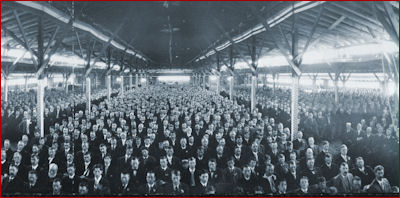
 The murder of Jesus was a vast conspiracy involving Rome, Herod, the Gentiles, the Jewish Sanhedrin, and the people of Israel—diverse groups who were seldom fully in accord with one another. In fact, it is significant that the crucifixion of Christ is the only historical event where all those factions worked together to achieve a common goal. All were culpable. All bear the guilt together. The Jews as a race were no more or less blameworthy than the Gentiles.
 The designs of those who killed Christ were entirely murderous. They are by no means exonerated from their evil, just because God's purposes are good. It was still the act of "lawless hands" (Acts 2:23). It was, as far as the human perpetrators were concerned, an act of pure evil. The wickedness of the crucifixion is in no sense mitigated by the fact that God sovereignly ordained it for good. The truth that it was His sovereign plan makes the deed itself no less a diabolical act of murder.
 The cross is therefore the ultimate proof of the utter sovereignty of God. His purposes are always fulfilled in spite of the evil intentions of sinners. God even works His righteousness through the evil acts of unrighteous agents. Far from making Him culpable for their evil, this demonstrates how all He does is good, and how He is able to work all things together for good (Romans 8:28)—even the most wicked deed the powers of evil have ever conspired to carry out.


 he wrath of God and the judgment of the day of the Lord cannot be a trifling matter. How emphatically are we told in Scripture, that it is "a fearful thing to fall into the hands of the living God." Upon such a subject we cannot afford to trifle.